Melissa Tooley
Director, Educator Quality
A holistic approach to bolstering the teacher and school leader workforce helps reach our shared goals of successful students and communities

We all want the best for our students. In fact, we all need the best for students, as their success is critical for the future of our communities, our workforce, and our shared prosperity.
But, right now—despite research showing that students’ success in school largely hinges on their teachers and school leaders—we can’t guarantee that a skilled teacher is leading instruction for every student, or that an effective principal is at the helm of every school. In fact, nationally, one in eight teaching positions goes unfilled or filled by someone not adequately prepared for their role. This shortage of high-quality educators is most acute in science, math, and special education, and in schools that predominantly serve economically-disadvantaged students and/or students of color.
Key factors deterring talented educators from entering and remaining in the profession include:
Business, education, and civic leaders increasingly recognize that a stable, high-quality educator workforce with strong ties to our communities is one of the most strategic investments that state and local leaders can make for our future well-being. For example, the National Governors Association found that at least 26 governors mentioned strengthening the teacher workforce as a priority in their 2025 State of the State addresses.
However, many recent state and local efforts to bolster the workforce have focused on short-term, piecemeal solutions, such as one-time bonus pay or allowing untrained individuals to obtain emergency certificates to fill vacant teacher positions. Quick-fix strategies like these can sometimes produce small or temporary improvements, but they don’t create true, lasting changes that benefit students. And sometimes they can even cause harm. For example, a recent study found lower test scores, more absences, and more disciplinary actions for students in emergency-certified teachers’ classrooms compared to those in other classrooms in the same schools.
To develop a more effective, coherent approach to addressing our nation’s educator workforce issues, New America pooled the expertise of 23 national education policy organizations (see list below) through virtual and in-person convenings in the winter and spring of 2025. The resulting Six-Strand Strategy for Educator Excellence is informed by decades of research on what works, as well as promising state and local efforts currently underway.
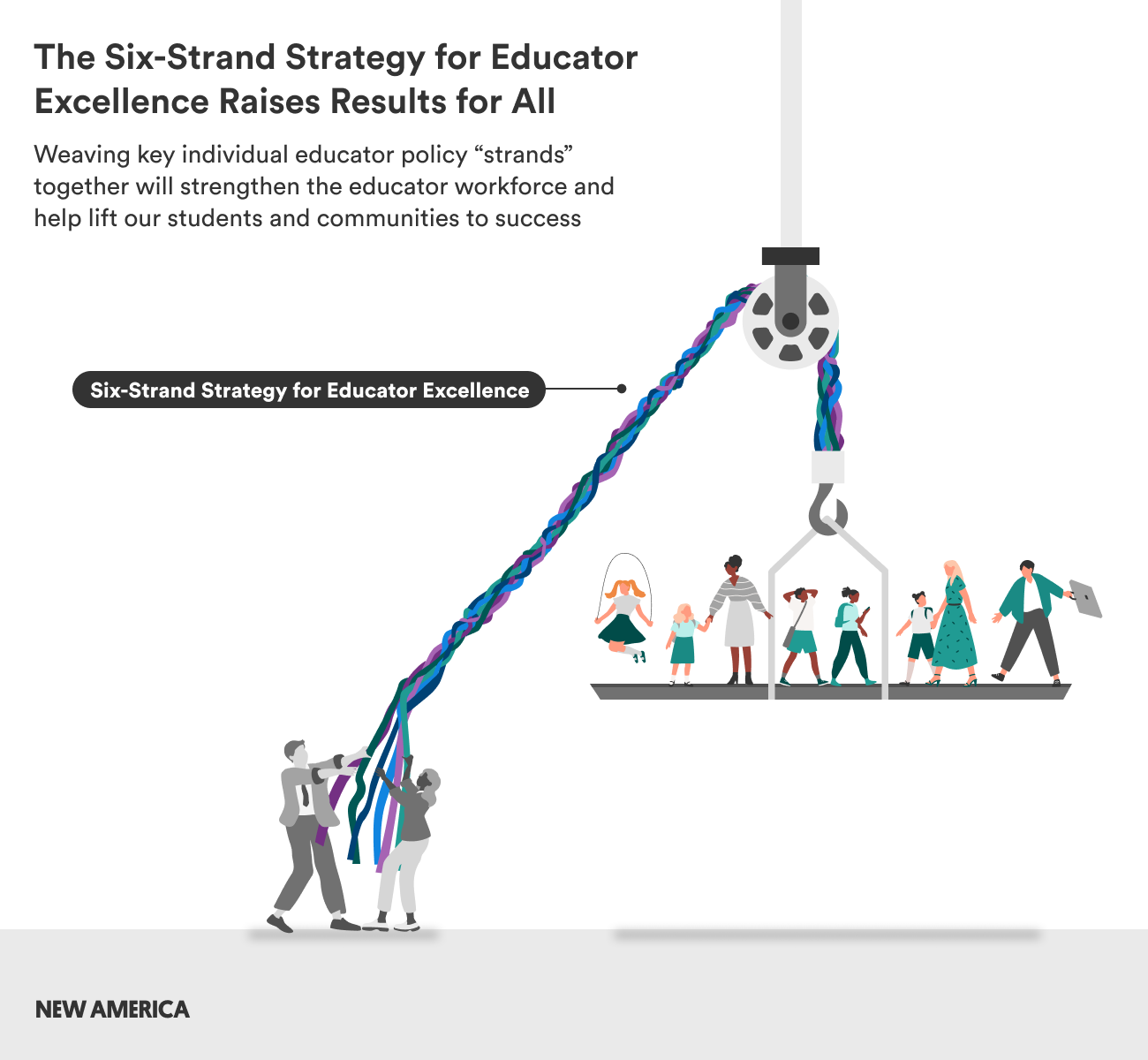
The key to this approach’s success is the coordinated integration of the following six evidence-based policy principles, or “strands”:
By purposefully intertwining these six educator policy strands, state and local leaders can mutually reinforce and strengthen every aspect of the educator profession simultaneously—from recruitment to preparation, and ongoing professional development to meaningful career pathways. In this way, building a strong educator workforce system is like making a sturdy rope: while individual strands have limited strength on their own, weaving them together ensures they’re all pulling in the same direction and intensifies their power.
Investing in the Six-Strand Strategy not only benefits students, but it ultimately pays for itself.
Investing in the Six-Strand Strategy not only benefits students, but it ultimately pays for itself. For example, reducing turnover of talented educators saves money on recruiting and hiring replacements—money which can be strategically reinvested in high-impact approaches to developing and retaining excellent educators. This creates a virtuous cycle, where more successful educators produce more successful students, and more successful students lead to flourishing communities and a more prosperous economy.
(in alphabetical order)
FullScale (formerly the Aurora Institute)
Beyond100K
Brown Center on Education Policy, Brookings Institution
Center for American Progress
Deans for Impact
Data Quality Campaign
Education First
Educators for Excellence
Education Reform Now
Education Trust
Center on Great Teachers and Leaders at American Institutes for Research
KnowledgeWorks
Learning Forward
Learning Policy Institute
National Center for Learning Disabilities
National Council on Teacher Quality
National Institute for Excellence in Teaching
National Urban League
New Leaders
Prepared to Teach
Teach Plus
TNTP
UnidosUS
Over the coming year, New America will publish a blog series, drawing on interviews with staff at some of the national education policy organizations we consulted to develop the Six-Strand Strategy for Educator Excellence. The series will further explore the benefits and challenges of implementing this comprehensive, coordinated approach to educator workforce policy. It will also offer details on each of the six policy strands and provide specific recommendations for how to effectively weave them together to produce substantive and enduring results for educators, students, and our communities.
Director, Educator Quality