Senate Stimulus Shake-Up

Since the House passed its version of the Stimulus bill late last month, the Senate has been crafting its own version. The Senate is wrapping up debate on the initial bill reported from the Senate Appropriations Committee on January 27th. News reports suggest that several Senators took issue with the total cost of the bill, jeopardizing the 60 votes needed to pass it. To avert a stalemate, Senators Collins (R-ME) and Nelson (D-NE) forged a compromise late last week that appears likely to garner sufficient support to pass.
Ed Money Watch has analyzed the proposed compromise below. Our calculations suggest that if amended, the Senate version would provide $60 billion less in education stimulus funding than the version reported out of committee. This difference is primarily due to the elimination of stimulus dollars for K-12 and higher education renovation and modernization (previously $19.5 billion total) and the $40 billion reduction in the State Fiscal Stabilization Fund (previously $79 billion total).
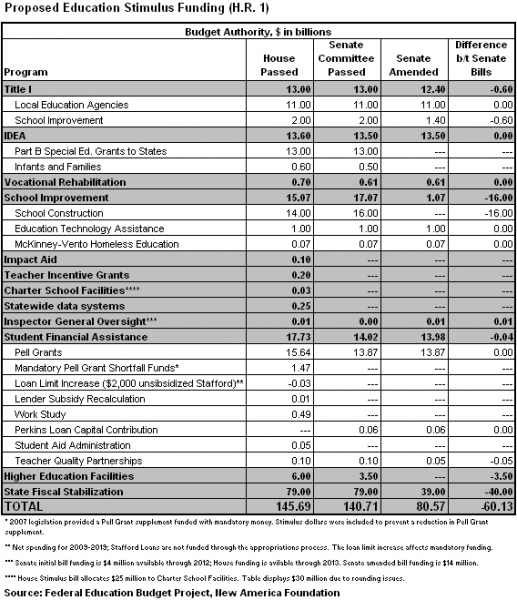
The Senate bill reported out of committee provided $16 billion for K-12 school renovation and remodeling and $3.5 billion for higher education construction. The K-12 funds were to be distributed based on FY 2008 share of Title I dollars, while the higher ed funds were to be distributed based on the share of higher education students in each state. The original Senate bill also made special considerations for community colleges, guaranteeing them funding based on their share of public higher education students, as opposed to total higher education students. The amended Senate language eliminates all school construction funding.
As currently written, the State Fiscal Stabilization Fund consists of three parts. The first is a $14.35 billion State Incentive Grant program which the Secretary can award to states that equitably distribute teachers, improve their collection and use of data, implement quality assessments, and ensure that failing schools undergo corrective action or restructuring. The amended Senate bill would fund the program at $6.85 billion. In both versions states must distribute 50 percent of the Incentive Grant funds they receive to local education agencies (LEAs).
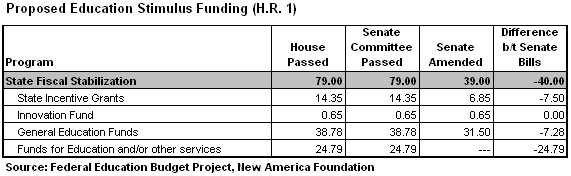
The second section of the current Stabilization Fund is the Innovation Fund. Under the Committee version, the Secretary can award Innovation Funds to LEAs, partnerships between LEAs and non-profit organizations, groups of LEAs, or consortia of schools that have made strides in closing the achievement gap. These funds can be used to expand current work, partner with more organizations, or identify and develop best practices. Funding for the Innovation Fund remains at $650 million in the amended version.
The main section of the State Fiscal Stabilization Fund is a general fund intended to help states maintain 2008 levels of funding for education. The proposed amendment to the Senate bill provides $31.5 billion, down from the $64 billion in the Committee reported bill. Additionally, the original reported language allowed 61 percent of these funds to be used for K-16 education and the remaining 39 percent to be used for other activities like public safety. The amended bill, however, requires that all $31.5 billion be used toward pre-K-16 programs authorized under No Child Left Behind, IDEA, and the Perkins Career and Technical Education Act.
The proposed amendment to the Senate bill provides $1.4 billion for Title I School Improvement funds, $600 million less than the committee reported version, and $50 million for Teacher Quality Partnership grants, half as much as the committee version. The amendment funds IDEA at the same $13.5 billion, but the bill language no longer specifies that $500 million must be used for Infants and Families (IDEA Part C). The amendment also leaves Pell Grant funding unchanged at $13.87 billion.
The proposed compromise language would also provide a maximum of $10 billion over two years for Qualified School Construction Bonds and $1.4 billion for Qualified Zone Academy Bonds (QZABs). QZABs can be used to help charter schools pay for facilities. The proposed amendment to the Senate stimulus bill also provides $100 million for School Nutrition Program equipment assistance including $20 million which can be used to make nutrition computer systems web-compatible. The committee version provided $198 million for School Nutrition equipment.
The Senate is expected to vote on the amended version of the stimulus bill tomorrow. Once the bill is passed in the Senate, it will go to conference committee to work out the many differences with the House bill. We look forward to seeing how the amended bill fairs in the conference committee with the House.
More About the Authors
Issues
Related

Why Accreditation Exists: A Q&A with Antoinette Flores

How the Right Twists Accreditation

Accreditation 101