Senate Panel Approves New Early Education Funding for 2014

For more details on the Senate Appropriations Committee Labor-HHS-Education bill, check out this post from our sister blog, Ed Money Watch.
The Senate Appropriations Committee voted last week to approve a fiscal year 2014 spending bill for the Departments of Labor, Health and Human Services (HHS) and Education. The plan, which would still have to be approved by the full Senate as well as the House before it becomes law, includes some big money for early education programs.
Earlier this year, President Obama announced a White House push to implement a series of early childhood grant programs and partnerships with states. It was designed as a multi-faceted approach to early education, including: Preschool for All, a pre-K program for 4-year-olds below 200 percent of the federal poverty level; Preschool Development Grants to help states develop their early learning systems; Early Head Start-Child Care partnerships; and expansion of a home-visiting program for at-risk mothers and children.
The president’s plan proposes that the home-visiting and Preschool for All programs be funded by an increase in the tobacco tax under the White House plan. That means they would have mandatory funding, not subject to this appropriations process. (Sen. Patty Murray [D-WA] has said she plans to introduce this portion of the early childhood plan separately.) But the Senate committee did include $750 million for the Preschool Development Grants and a $1.6 billion increase to Head Start to help fund the Early Head Start-Child Care partnerships. These are important wins for the White House, which faced many questions about the costs of its proposal when it released the details in April.
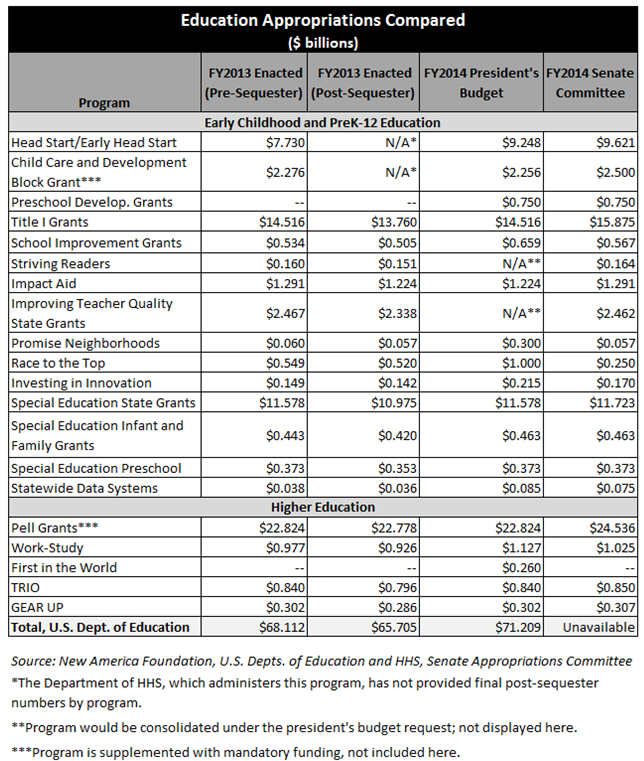
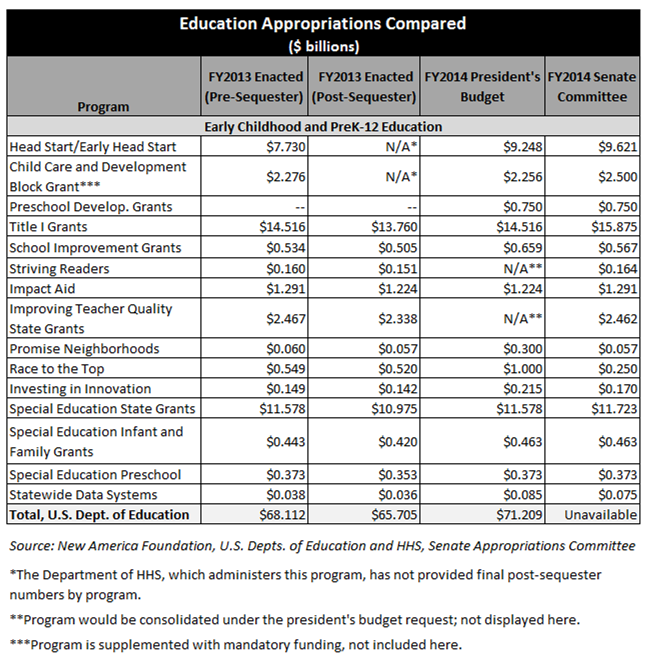
Other early learning programs would fare similarly well. The bill reverses the cuts made by sequestration for most HHS and Department of Education programs, and even increases spending for many of those programs. For more details, see the table at the bottom of this post.
The bill would grant small increases in funding to the two largest PreK-12 programs funded by the federal government, Title I grants to school districts and special education grants to states. It would also grant increases to the Striving Readers program, the Investing in Innovation (i3) grant competition and special education grants for infants and families.
Other signature Obama initiatives – including grant programs like School Improvement Grants (SIG), Promise Neighborhoods and Race to the Top (RTT) – were not all so lucky. SIG funding rose from $532 million pre-sequester in 2013 to $567 million. The committee cut Race to the Top funding, though, from $548 million pre-sequester in 2013 to $250 million, after a $150 million chunk was taken out of the original Senate proposal and diverted to the Low-Income Heating Assistance Program. The bill also specifies that the RTT funds would be used for a new college affordability and completion initiative – a break from the early learning and K-12 programs the Department of Education has already run with RTT funds. And funding for the Promise Neighborhoods program, which provides comprehensive services to low-income communities on a Harlem Children’s Zone model, fell from $60 million last year before sequestration to $57 million.
Under the Senate committee’s bill, teacher programs, including Teacher Quality State Grants and the Teacher Incentive Fund, would receive small increases. The bill also increases funding for a program designed to help build educational data systems, from $38 million to $75 million. Most other programs saw few changes.
Now the question is what will happen to the Senate appropriations bill. Funding for the 2014 fiscal year, which begins on October 1, 2013, is set to decline even further from the final 2013 levels after the sequester made across-the-board spending cuts.
And though the House hasn’t yet passed a bill, the two are worlds apart in their overall spending limits. Earlier this year, the Senate passed a budget resolution that exceeds the top-level amount the House plans to provide (and the amount set out in law back in 2011) by about $92 billion. That means the funding provided for the Departments of Health and Human Services and Education is also well over the amount the House is likely to approve. And that means it looks like another long road to approving funding for fiscal year 2014.
Issues
Programs/Projects/Initiatives
Related
Federal Early Education Update: March 2026
A Bureaucratic Shakeup Threatens Future Child Care Research