Senate Appropriations Committee Passes Labor-HHS-Education Appropriations Bill

Last week, the Senate Appropriations Committee approved a fiscal year 2012 Labor-HHS-Education Appropriations bill. Though this action is a little late, given that Congress is already considering a Continuing Resolution to temporarily extend 2012 appropriations at 2011 levels, it does give us a sense of what Department of Education appropriations could look like in 2012, at least according to Senate Democrats. The bill provides the Department of Education with $68.4 billion in funding, $81 million more than in 2011. Given that the Budget Control Act of 2011 requires an overall cut in discretionary spending, this increase suggests that the Senate Appropriations Committee has chosen to protect education spending in 2012.
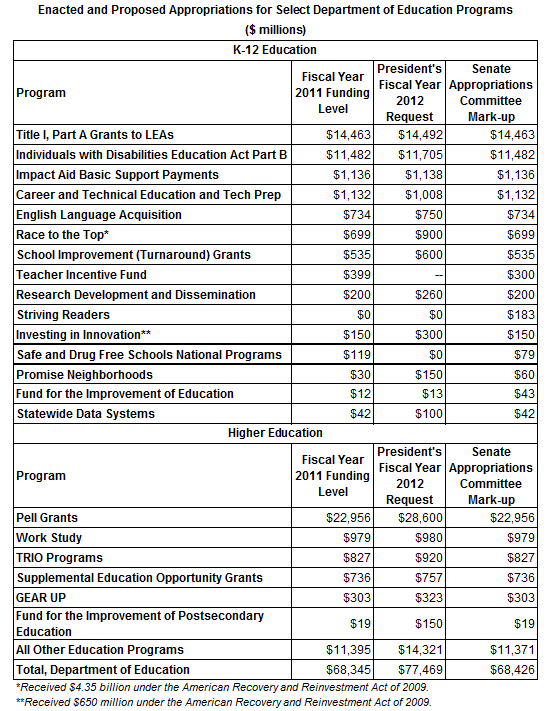
There are very few surprises in the Senate Committee’s bill. In fact, most large K-12 education programs would be funded at 2011 levels in the bill including Title I, Part A ($14.463 billion), Individuals with Disabilities Education Act ($11.482 billion) and Impact Aid Basic Support Payments ($1.136 billion). The bill even includes funding for Race to the Top ($699 million) and Investing in Innovation ($150 million) at 2011 levels. The same is true of the large higher education programs like Work-Study ($979 million), TRIO ($827 million), and Supplemental Educational Opportunity Grants ($736 million). A table of appropriations for selected programs can be found at the end of this post.
Interestingly, the bill ignores many of the president’s requests for increased funding for individual programs. For example, the president requested $150 million, up from $30 million in 2011, in funding for Promise Neighborhoods, a program that supports the planning and implementation of community-based schools similar to the Harlem Children’s Zone. However, the Senate Appropriations Committee bill provides the program with $60 million instead. The Senate Committee also ignored the president’s request to increase funding for Race to the Top from $699 million to $900 million, and Investing in Innovation from $150 million to $300 million.
The Committee did choose to increase funding for some programs without the president’s prompting. For example, the bill increases funding for the Fund for the Improvement of Education Programs of National Significance from $12 million in 2011 to $43 million in 2012. This increase includes $30 million for a competitive grant program for national non-profits and libraries that focus on child literacy.
The bill does cut some funding for a couple of programs from 2011 levels. For example, the Teacher Incentive Fund, which provides grants to districts and states to implement innovative teacher compensation, hiring, and retention plans, would receive $300 million in 2012, down from $399 million in 2011. The bill also broadens the scope of the program to include other interventions besides performance-based compensation systems because “rigorous research released over the past year” shows that these systems “had no effect on increasing student achievement.” The Safe and Drug Free Schools National Programs would also be cut, receiving $79 million, down from $119 million in 2011.
And the Senate Appropriations Committee bill restores $183 million in funding for Striving Readers, a comprehensive literacy program that was defunded in fiscal year 2011 during the extended appropriations process.
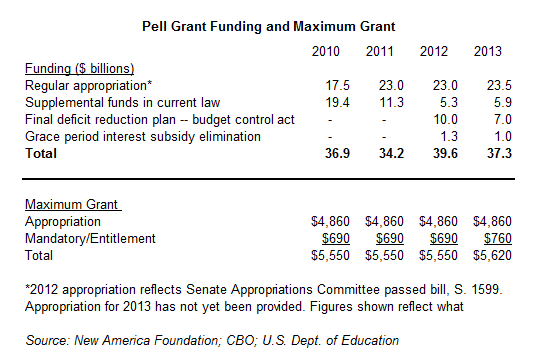
The most complicated aspect of the 2012 appropriations process is Pell Grant funding. The Senate Committee’s bill provides $23 billion in discretionary funding for Pell Grants, the same as in 2011, but also provides a supplement of $1.3 billion to the regular appropriation to maintain a maximum grant of $5,550 in fiscal year 2012 (and an additional $1.0 billion in 2013). As we’ve discussed previously, the cost of the Pell Grant program is growing and Congress has been struggling each year to maintain the funding that it first provided on in the American Recovery and Reinvestment act of 2009. The Senate Appropriations Committee bill provides the third supplemental funding boost for the program this year, and the second for fiscal year 2012. Earlier this year, Congress provided $10 billion for the program in fiscal year 2012 under the Budget Control Act (the debt ceiling agreement), but only by cutting interest rate subsidies on federal student loans. To provide the latest $1.3 billion in supplemental funding, the Senate Appropriations Committee would eliminate the interest grace period (students would not have to make payments during this six-month period but interest would accrue) on subsidized Stafford Loans for undergraduate students. All together, these many sources of support for Pell Grants make up just enough funding to maintain the maximum grant.
The Senate Appropriations Committee bill maintains the vast majority of funding for Department of Education programs in 2012. But this only represents what the Democratic-controlled Senate leadership supports. It is highly unlikely that the Republican-controlled House will provide as generous a budget for the Department of Education. Because the final appropriations bill must be passed by both houses, it will probably differ greatly from the current Senate Appropriations Committee bill. The fiscal year 2012 appropriations process is still far from over.
More About the Authors
Issues
Related

Representation Matters for Women of Color in Youth Apprenticeships

Meet the Commissioners

New America & ACCT Invite Community Colleges to Apply for Work-Based Learning Capacity-Building Cohort