Keara Cormier-Hill
Design Researcher
Safety is three-dimensional, and not just based on the absence of crime. Families evaluate safety through three interdependent domains: safe people, safe places, and safe services.
When one area of safety fails, the others can partially compensate, but families feel most secure when care is visibly present across all three (people, places, and services).
Access to resources determines who can act on safety concerns. While fears about safety are widely shared across income levels, families with resources can leave unsafe neighborhoods, install cameras, or change child care; families without resources are left to rely on constant vigilance and personal sacrifice, absorbing risk that better-resourced families can simply avoid.
The very services meant to protect families often threaten them instead. Institutions like law enforcement, child protective services, and immigration enforcement frequently register as sources of danger rather than safety, particularly for immigrant, low-income, and marginalized families.
In policymaking and government budgets, public safety is typically characterized by the absence of visible street crime and the presence of emergency preparedness.1 Safety in communities is frequently measured by static data points like crime rates, arrest statistics, police patrols, or response times. While this framing addresses acute threats, it fails to reflect the full scope of socially vulnerable families’ concerns and daily realities.
A growing body of community-based research points to the need for a more expansive understanding that incorporates social, economic, and political indicators of safety.2 What we learned from families aligns with this more expansive definition. Families are not only evaluating whether there is a visible lack of danger to determine safety. They are also seeking a visible presence of care.
“A safe place is when people feel safe; when they are respected, valued, and have access to a full range of health, social, natural, and educational resources.”
—Grace
Safety emerged as a theme organically in our initial conversations with families as they described the support they wanted in their communities and whether they felt a sense of belonging there. Recognizing the weight families gave the topic, we deepened the inquiry and asked directly: What does it take to create a feeling of safety in your home and community? Their responses revealed a much more layered, dynamic, and personal evaluation process than the conventional framing captures.
As they shared what it is like to guide young children through a world of risks—whether hypothetical, observed, or directly experienced—families made clear that safety is not confined to any single space. Their concerns touched on the home, health, their communities (both the built environment and social fabric), child care settings, schools (particularly bullying and gun violence), and the digital world (including data protection and children’s online safety).
Some families believed that crime is inevitable, seeing risks and threats as an expected part of life. As such, their definition of “safety” wasn’t about absolute risk elimination, but instead, it was about caring and helpful protection in the different areas of their lives where they felt that danger was possible or likely.
Across all concerns, we heard families weighing safety not only by how crises or acute moments were responded to across three domains:
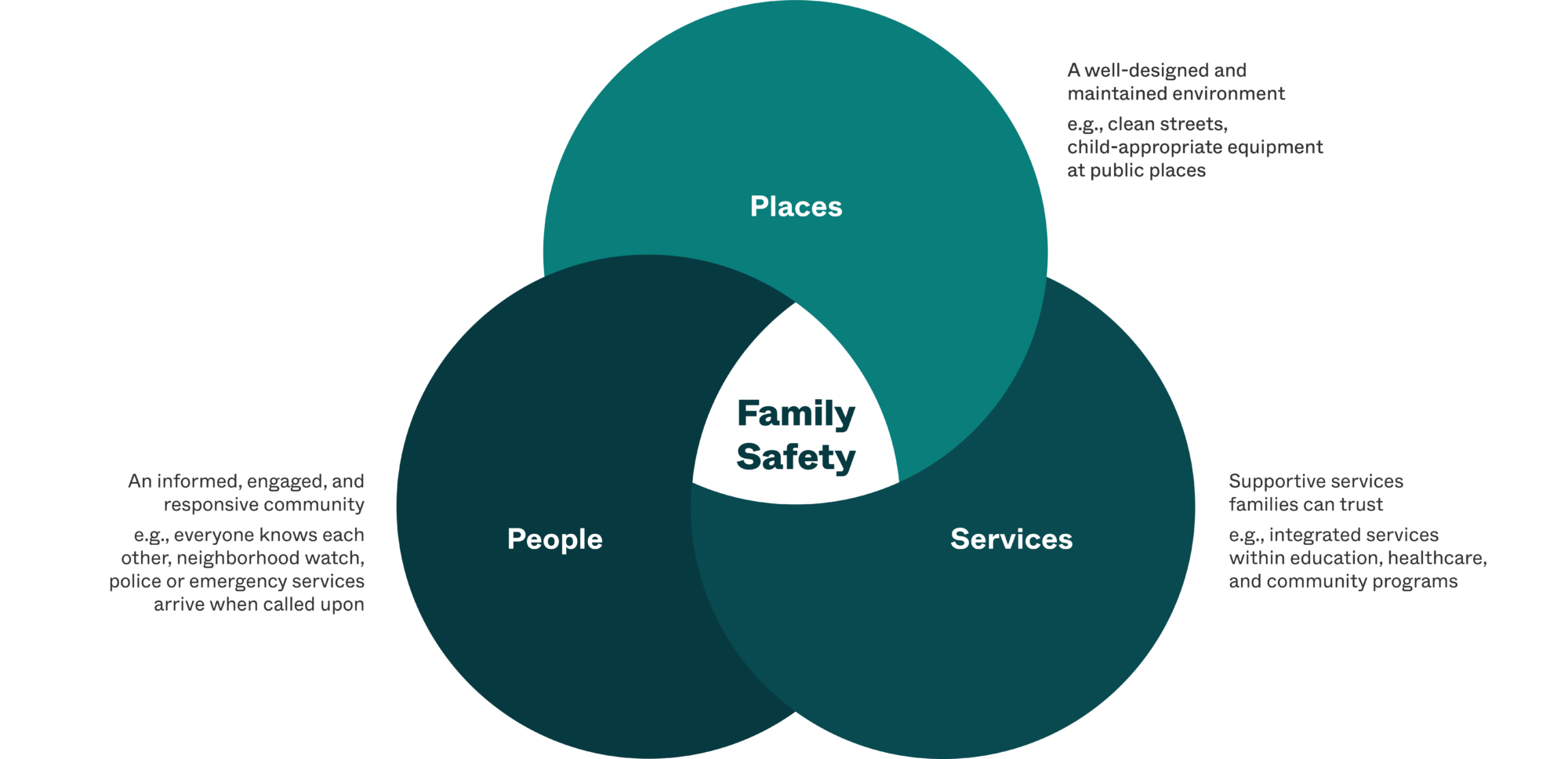
The presence of care in any of the three areas contributed to a greater sense of safety for themselves and their children. In contrast, families shared how they experienced increased stress and obstacles where care in one or more of the domains was missing. Below, we explore each domain through families’ descriptions of factors that create and undermine safety.
“We’re the nosy ones…the cautious ones [in our neighborhood]. We’ll be looking out the windows when we hear noises and stuff. Or our cameras go off, so we call one another and be like, ‘Hey, somebody’s at your door.’ ‘Oh, that’s just the Uber, girl.’ ‘Oh OK, just checking on you, girl’…One of my neighbors…he’ll take in my garbage cans if I forget to or take them out if I forget to…We’re in group messages. It’s pretty cool. I like having that little support too, to know if I leave, [go] out of town, my house is safe.”
—Cassidy
Families described feeling safest in neighborhoods where “everyone knows everyone,” where neighbors have each other’s numbers, and where people offer everyday help like texting when something looks out of place.
But watchfulness in preventative support alone isn’t enough. To feel at peace, families also need to trust that there are people to rely on when a crisis actually strikes. This looked like:
They described feeling that they were in a safe environment when watchfulness came from a place of genuine care and mutual support—the kind where neighbors pay attention because they’re invested in each other’s well-being, not because they’re suspicious of each other.
The flip side, however, was that when that human presence was absent, community spaces, even if they were well maintained, became unsafe. Parents described infrastructure improvements that meant nothing without people around them watching out:
“[People in the park] do a lot of drinking. There’s a lot of glass in there and they fixed it up really nice. Now they made it a garden. They fixed it up nicely with flowers. A basketball area. But when the police move from there, forget it…For a while, the police stopped in the middle of the park where there is a fountain. They stood there, but the police left and everyone went back to the park. So how are you going to take a baby there?”
—Graciela
Public transit emerged as another space where the absence of watchful people transformed a shared resource into a daily risk. In a group conversation during a workshop, three New Mexico parents described the bus system as essential but unsafe:
Cassidy: “The bus is horrible.”
Sam: “It’s terrible.”
Courtney: “It’s all we have.”
Sam: “The last six times I’ve taken the bus, there has been some mentally handicapped person on there masturbating like it’s normal. And nobody says anything.”
Families without other transportation options can’t opt out of unsafe public spaces; they navigate them with their children because there’s no alternative. And without a consistent, watchful presence, whether from transit staff, security, or other riders willing to intervene, safety falls back on parents to manage alone.
“One place in our community where my family and I feel safest is our local park. The park is always well maintained, with clean walking paths and plenty of open spaces for children to play. The presence of regular patrols by local security and the friendly, familiar faces of neighbors we often see there contribute to our sense of safety. It’s a welcoming environment where everyone looks out for each other, making it a place we always enjoy visiting.”
—Matthew
Families consistently evaluate safety through signals of investment and a sense of family-oriented care in the built environment. When families discussed safety for young children, safe and accessible parks and places to play emerged as a priority. Safety in this context included the presence of developmentally appropriate infrastructure and fencing, both in parks and in their own backyards, to prevent young children from running into the road. This is especially important when parents are caring for more than one child at once. Families described a sense of relief in finding places where their toddlers could have their own age-appropriate space to play, separate from spaces with older children, where accidents are more likely to happen.
In contrast, when basic play infrastructure is absent or unsafe, families described spaces as feeling unusable.
“These parks aren’t fenced in, are close to roads, and are hard to take our ADHD son to when we have our other children with [us] also. We wish we could take them all to the park together, but when [he] runs off and [the other children] are there, it’s almost impossible to even consider a park because they aren’t enclosed for the safety of children.”
—Ava
Families wished for infrastructure that would protect their children, both around their homes and in their neighborhoods. Especially in the community, when amenities lack child-centric design, recreation becomes a place for likely harm rather than amusement. One parent said of their local water park:
“Younger children should have their own space where they can play and not drown, because sometimes they go with the older ones and there are accidents. But that wouldn’t happen if the children were in their own space so that they could have fun, and have another area for moms and siblings by age so that there aren’t accidents.”
—Sofia
Beyond seeking developmentally appropriate design, families described scanning play spaces for signs of danger before feeling comfortable letting children play. As one parent shared, “I always have to check for needles and other drug-related items before letting my kids play.”
Families were divided on who these spaces are for: Some believed play spaces should belong to the whole community, with adults free to use them as freely as children, while others preferred that adult activities take place elsewhere. One mom shared that encountering realities like open substance abuse is an unfortunate part of life, and she didn’t want to raise children who were “ignorant” of what’s happening around them. Nevertheless, families agreed that things like broken glass or needles automatically made an area off-limits, even if it was the only nearby park.
Families also discussed how people and places interplay to create a sense of safety, weighing how visible or populated a space felt to determine whether it was safe. Isolated areas, like parks on the outskirts of the city near new developments and woods, raised concerns for a Minnesota family about potential wildlife encounters, and the lack of activity gave them a general sense of unease. This discomfort was echoed by a parent in Philadelphia, who avoided parks that simply didn’t draw enough people.
Safety within the home environment was another primary concern for families.
Families spoke candidly about how the built environment in their own homes presented risks, including mold, hazardous structures, and environments that could cause health problems for their children.
“It would be our rental house. It’s very old and has a lot of problems. Where do I start? Floors have nails coming up, have to be careful hanging things on the wall, very old pipes, not well insulated. The list goes on.”
—Julie
Neighborhood conditions shaped how families used their homes as well. For some, a lack of safety meant children’s belongings couldn’t be left outside; one parent wished for a neighborhood where her kids could “leave all the toys out there and…just have a good time till they get tired,” with the parent “[knowing] they’re going to be safe.” In contrast, another mother described a sense of ease as she shared why she felt comfortable in her neighborhood:
“I don’t know how many times I left the house. I didn’t lock my door, but when I came back…nobody was waiting. Nobody stole anything. And sometimes when we travel—like we go for vacation one week, two weeks. The way we leave our house, that’s how we come and find it.”
—Hope
Beyond parks and homes, care in the built environment also looks like clean streets and clear, usable sidewalks. Two infrastructure elements in particular, lighting and security cameras, came up frequently from both families who felt safe in their neighborhoods and those who didn’t. Lights and security cameras were described as the difference between feeling protected and feeling vulnerable, and access to them was shaped by what families could afford and what was provided or allowed to be installed in rented homes.
One New Mexico grandmother described being afraid to open the door when someone knocked because the yard outside was so dark, despite repeated requests to her landlord for brighter lights. Even a Minnesota father, who described feeling safe in his neighborhood, named lighting as a community need:
“Better lighting would not only deter potential criminal activity but also make it safer for us to walk or drive at night. Improved visibility would contribute to a greater sense of security for everyone in the community.”
—Matthew
Security cameras carried a similar weight. For some families who already felt comfortable in their neighborhoods, cameras represented a preventive deterrent even though they had not experienced criminal activity nearby. For example, one mother in Minnesota explained:
“It’s just having more security cameras everywhere, so that people kind of like, ‘Oh, you know, there’s cameras. I can’t do this, I can’t do this’…That will kind of put a lot of fear in people.”
—Evelyn
For a Philadelphia mother, the absence of cameras presented itself as a need after direct experience:
“We were victims of burglars in our house because we didn’t have a security camera or even an alarm. I think that if we could put them in our house, we could be a little more relaxed.”
—Selma
Across these experiences, whether harm had already occurred or families were working to prevent it, inadequate infrastructure narrows the choices families have about where children can play, how freely they can move through their neighborhoods, and whether they can rest in their own homes. In the absence of adequate infrastructure, the responsibility for safety falls entirely on parents, leaving less room for presence, rest, or play.
Among immigrant families, people described a constant fear of deportation making them afraid to move freely through their communities.
“I’ve always been afraid of places like where there are police, the DMV, and courthouses.”
—Isabel
Interactions with law enforcement added another layer of worry about safety. Sam, a queer parent of color who has struggled with being unhoused in the past, described the relief of now having permanent housing. For them, becoming housed reduced encounters with police who had threatened their safety when they were homeless:
“Before, when I was carrying around, like, two or three backpacks, stuff like that. I would always get side eye or they’d go slow as they went by me, or something like that. And being a person of color, and not only a person [of color], but a queer person of color, I already feared for my life every time I step outside, because every interaction with the cop could be my last. And [our police department] is known for more police fatalities than almost any other state.”
—Sam
These experiences reflect what the Othering & Belonging Institute describes as “othering,” a set of dynamics, processes, and structures that engender marginality and persistent inequality based on group identities.3
In the context of place, othering shows up when certain groups receive the message, through how they are treated and policed, that shared spaces and resources aren’t really meant for them, narrowing who can move freely through a community and feel they belong in it. People also described feeling othered or not when applying for benefits, entering some government buildings, and interacting with their children’s schools.
Families described feeling safe when their communities provided quality education programming, affordable housing, reliable transportation, affordable health care, opportunities for physical activity, and emergency response services.
These resources aren’t distributed equally across communities. Tools like the Child Opportunity Index map these conditions down to the census tract and reveal stark differences between neighborhoods, with wealthier communities consistently offering children greater access to the conditions that support healthy development.4
Additionally, as we found in our earlier analysis, support services aren’t helpful just by existing. Instead, they must also be flexible, accessible, and compassionate.5 Families described a fundamental component of safe services as having safe people in safe spaces. This looked like churches, libraries, Head Start programs, gyms, and after-school programs, where people welcome them with friendly faces, warm atmospheres, and activities for the whole family, with caring adults looking out for their children.
Unsafe services, by contrast, are often experienced as threatening, particularly when families perceive service providers as authority figures with power over them. In one example, a mother who called for help during her son’s father’s medical crisis was met with SWAT and police instead of medical assistance, escalating rather than de-escalating a moment of vulnerability.
Additionally, families with limited English proficiency described service workers showing obvious aversion to helping them, with one attendant confronting a parent directly: “Why are you even in this country if you don’t speak English?”
Even services designed explicitly to protect families could feel more threatening than protective. Another participant, Graciela, expressed doubt in the ability of the police to stop and track crime when families, especially immigrants, are afraid to report for fear that they will be the ones detained instead of the perpetrators.
Several participants described child protective services as an organization that punished poverty rather than prevented harm, removing children from homes where parents were doing their best with limited resources, while failing to intervene in situations of genuine danger.
This is an excerpt from a workshop conversation between families:
Leidy: “From what I understand, CYFD [Children, Youth, and Families Department of New Mexico] is supposed to help you be a better parent, not take your kids away.”
Sam: “And that’s the first thing they go to every time. Taking your kids.”
Cassidy: “They don’t want to help the ones that need help. Because I’ve had to help…get a child out of the home because she actually asked me to help her get out. When they reported, [child protection] fell for her dad’s lying. But the dad was actually doing trafficking. They want to take kids that are taken care of out of the home, all because we don’t have a bed, or we don’t have food in the fridge.”
The result is an impossible bind: Families need responsive services to feel safe, but the very institutions designed to provide that safety (law enforcement, social services, immigration offices) frequently represent threats themselves, creating what the Othering & Belonging Institute calls “structural exclusion.”
For some families, threats in these domains overlap in ways that compound one another. One mother described:
“A year ago I was living in a third-floor apartment that didn’t have air conditioning and was in a smoking building. My daughter always had a runny nose and ear infections. I also lived in the same town as her dad and that was not fun. We were harassed daily and the police did nothing.”
—Candace
In families’ vision of community, safety needs to be visibly present in places, experienced in services, and felt with people in order to create comprehensive protection. Addressing safety through crisis response and crime reduction after something terrible happens doesn’t meet this standard. When even one domain is compromised, families described feeling vulnerable to risk. As more foundations fail, parents seek ways to minimize danger and create care using whatever means and resources are available to them.
For Maria, the problem wasn’t with a single factor; rather, there was the sense that places, systems, and people were all working against her family at once. She described what it felt like in the parks and playgrounds where she took her children:
“As a mother with small children, we like going to the parks and playgrounds a lot. But one downside…People drink, smoke, use drugs, and carry guns openly in those places. I honestly never experienced anything like this…It’s supposed to be a safe space for families, so why do people walk around with armed weapons, especially with children involved?”
—Maria
For other families, when one area is strong, it can soften the impact of others that are weaker, such as when consistent gestures from neighbors mitigate the impact of real risk in the broader environment:
“I don’t like [the city] because there are many people taking drugs and all the grime that’s in the streets and in the community. Every week there is a shooting death. And where I live there are no Hispanics; all my neighbors on the block speak nothing but English. I don’t know anyone, but whenever they have an activity, they leave me a note. For example, they do a cleanup every two weeks—they always ask me to participate. I feel happy and calm here.”
—Lena
Lena’s account complicates a simple equation between unsafe conditions and unsafe feelings. Even acknowledging the shootings, the drugs, and the language barrier with her neighbors, the small, consistent invitations from her block signal that she is seen and welcomed. People, in this case, do work that places and systems aren’t doing.
Even in neighborhoods where families feel relatively safe, the broader environment delivers its own steady reminders that danger is present. Families shared how the constant stream of Silver Alerts and Amber Alerts, sirens passing through the neighborhood, the sound of gunshots, and missing children posters on Facebook and Walmart walls heightened their concerns.
In the absence of community-provided safety, families responded strategically with their own resources to the dangers they feared, observed, or experienced. Across participants, the strategies themselves were similar: gathering information before making decisions, teaching children about stranger danger and emergency protocols, maintaining awareness of their children’s whereabouts and activities, and in some cases, restricting where children could go or what they could do.
Information gathering looked like vetting a neighborhood by its crime rate before considering a move, or turning to a Head Start teacher to make sense of conflicting public messaging about formula recalls.
Teaching started early and scaled with age. Families described teaching young children about household hazards (sharp objects, stoves, medications), then layering in lessons about strangers, traffic, and emergency protocols as children grew. Several parents extended these lessons explicitly to digital threats. As one mother put it:
“I tell them that there are many crazy people and they can hide pretending to be children and they are not. They should tell me if they do not like something. Do not upload pictures of them.”
—Graciela
Watchfulness was the most consistent throughline: keeping eyes on children directly, tracking their location through technology, and ensuring trusted adults were always present.
When teaching and watching weren’t enough, families restricted which public places they used, who had access to their children, and what their children could see online. They even avoided sharing photos of their kids.
What differs dramatically between families is whether they can act on these strategies effectively, and at what cost. While fears about safety are widely shared, exposure to risk and the ability to address it are not. A neighborhood that feels risky or an unreliable support system isn’t an inconvenience that families living in these environments can simply work around, and change requires resources they may not have. Vulnerability becomes a reality that they navigate regularly.
Families with resources to act on safety concerns:
Families without resources to act on safety concerns:
Some families could leave neighborhoods where they didn’t feel safe, install security cameras, or change work arrangements when child care feels unsafe. Others had the same concerns and desires, but remained in situations they identified as dangerous and tried to make adjustments to at least minimize risk. This created trade-offs between employment and their children’s well-being, and ongoing stress from dangers they couldn’t adequately address.
These trade-offs played out in everyday logistics, not just major decisions. One mother described:
“My first month at [a transitional shelter], I spent all my money on Ubers. We need to be [places] on time, but they set us back. So there goes our interview, and there goes our appointment, you know?…I didn’t want to take the baby on the bus, because of the fentanyl, you know?”
—Courtney
For many families, the strategies were temporary measures while working toward something better. Protection, however, comes with its own costs. Parents described making thoughtful choices about where children can play, which transit to use, and who can provide care.
“I would have lost one of my kids because there was a shooting [in my community]. But I never let my kids play outside, and it was funny because I felt like I denied them the freedom…It’s summertime—they should be out there enjoying [it].”
—Maria
In attempting to protect their children, they absorbed financial and social costs, including the loss of something harder to quantify: children’s freedom to play freely and grow in their community. And notably, these protective strategies won’t bring families closer to the vision of a connected, caring community where they can truly thrive.
Though we heard families using their resources to address risks to the best of their ability, some threats felt entirely outside families’ capacity to address. Regardless of what protective strategy they employ or how well resourced their communities are, families felt there were some areas where they had no solution. These mirror issues of concern to families and local, state, and national policymakers across the country:
The families quoted above aren’t outliers; they represent patterns visible across all 43 participating families. All were experiencing economic vulnerability. However, what we heard countered the narrative that being a low-income household means inherently living without a sense of safety, and that escape is the only resolution.
When neighbors watch out for each other, services are responsive, and infrastructure and physical places are designed and maintained with families in mind, families described feeling safe.
Ultimately, we are left to consider two lines of questions:
Well-resourced communities already prioritize prevention through sustained investment. They haven’t eliminated all danger, but they’ve created conditions where families navigate from stability rather than constant crisis. This same choice is available to all communities through policy, funding, and resource decisions rather than through enforcement or policing alone.
Prevention means investing across the three domains of people, places, and services to support rather than undermine family well-being.
The watchfulness and mutual support families described as most critical to safety cannot be mandated, but communities can create conditions that support it. This can look like funding community-based leadership and grassroots organizing that builds neighbor-to-neighbor connections, particularly efforts led by community members themselves who understand local dynamics. It can also mean creating opportunities for families to build relationships through funded family activities, neighborhood gatherings, and programming that brings people together across differences.6 Research on public space supports what families told us.
As Jane Jacobs argued in The Death and Life of Great American Cities, genuine safety emerges from density and diversity—mixed ages, mixed uses, continuous activity creating informal social control rather than police-dependent safety. Examples like the Friendship Bench, where grandmothers provide community mental health support in public spaces, or Genesis, where seniors live alongside young mothers who grew up in foster care, demonstrate how investing in people and social infrastructure creates safety through connection rather than surveillance.
Separately, trust must be built between community members and people who provide services in the community, including police officers, civil servants, and community leaders.
Preventing safety crises begins with designing and maintaining places with families and young children specifically in mind. International research on making cities child-friendly demonstrates what’s possible when municipalities prioritize play-based infrastructure.7 In North Vancouver, Canada, there was increased outdoor commuting by children, including children traveling independently, after investing in child-centered design. The nearby city of New Westminster experienced enrollment growth (contrasting the downward provincial trends) through strategic public space investments and supportive housing policies.
Beyond equipment, prevention requires infrastructure that supports community watchfulness, like well-lit streets, sight lines that allow natural supervision, and increased foot traffic, which becomes its own protective factor. Programs like Safe Routes to School and Vision Zero for Youth translate these principles into U.S. policy practice, funding street design improvements, traffic calming, and pedestrian infrastructure in places where children walk and bike.
It also requires what researchers call social infrastructure: the physical places that enable social connection and community life. An international report describing the impact of social infrastructure identifies three types: havens (spaces to gather around shared identity), hubs (spaces to connect across different backgrounds), and hangouts (spaces to just be), emphasizing that social infrastructure matters because of what it enables people to do together, not just because it exists.8
In the United States, William Whyte’s foundational 1980s research in The Social Life of Small Urban Spaces found that well-used, activated spaces actually self-regulate: A lively, populated plaza reduces problematic behavior simply because that behavior is outweighed by ordinary social activity. His work showed that attempting to designate “undesirable” people and grinding away at communal sense of belonging often created dead, underused spaces that became less safe. More recent guidance from Healthy Places by Design translates these principles into actionable design strategies for parks, public spaces, and third places, emphasizing that violence prevention is inseparable from the creation of welcoming places for everyday gathering and connection.9This means investing in parks, libraries, community centers, and gathering spaces where care becomes visible through how spaces are designed, who uses them, and what they make possible.
Current federal budget proposals run in the opposite direction. The FY 2026 budget request proposed eliminating 21st Century Community Learning Centers and slashing funding for the Institute of Museum and Library Services from $313 million to $6 million.10 While Congress has so far rejected these eliminations, the proposals reveal what’s at stake: Prevention is not a matter of resources alone but of choices about what we fund and what we treat as expendable.
Meeting families’ basic economic needs reduces violence, including intimate partner violence, child maltreatment, and community violence.11 This makes a crucial part of prevention creating systems that work to keep people housed, fed, clothed, and healthy. Too often, support isn’t available until the spiral starts: A family is in poverty or close to homelessness, gaps in health care or mental health services have created a crisis, and a family’s best options for help, “family services” agencies, can result in family separations and incarceration. It’s worth repeating that part of creating services that feel safe in this era will also be continuing to intentionally build trust that’s broken through discriminatory enforcement, immigration raids, and policies like broken-windows policing that criminalize poverty.
Prevention also means recognizing when well-documented, widespread threats to children require accountability and systems-level solutions, rather than leaving individual families to navigate those risks on their own. For instance, when parents described being unable to control what online content reaches their children despite vigilant monitoring, they were describing a problem that cannot be solved by individual families alone. A Los Angeles jury found Meta and YouTube liable for intentionally building addictive platforms that harmed children’s mental health, Australia has imposed restrictions, and the United Kingdom is piloting a ban on major social media platforms for children under the age of 16. These changes signal a shift: Rather than expecting individual parents to manage consequences of corporate design choices, platforms themselves will be required to prevent harm through age-appropriate design and meaningful child protection standards.
Some have considered solutions that move families to communities with supportive systems already in place. While economic mobility initiatives like Moving to Opportunity produced positive outcomes—notably higher earnings in adulthood for children who moved to lower-poverty neighborhoods before they turned 13—they also came with documented costs. Disrupted social networks made it harder for families to find work and arrange child care, and most families failed to build new social ties in their new neighborhoods.12 Less disruptive prevention invests in improving environments where families already live rather than forcing them to leave communities where they have relationships and support. Initiatives designed to honor existing residents’ desire to stay, like New Orleans’ coalition-led rebuilding of its early childhood education system after Hurricane Katrina and The Kresge Foundation’s neighborhood investment in Detroit’s Livernois-McNichols corridor, illustrate what this commitment looks like in practice.
When messaging focuses solely on declining crime statistics, it misses families’ lived reality. Families’ sense of safety shapes their daily decisions, and polling shows they want politicians addressing root causes, not just offering enforcement rhetoric.13 Further, while crime statistics can help identify communities in need of greater investment and attention from public officials, they can also narrow our understanding of safety by making some harms more visible than others.
Street-level crime is routinely counted and used to shape public safety priorities, directing resources toward policing, enforcement, and incarceration while other threats to families’ safety and well-being often receive far less investment. At the same time, funding is being reduced for both the data needed to understand other safety threats and the support families themselves associate with safety, including SNAP and public libraries, even as investment increases in systems they described as contributing to harm. Data on hazards such as drownings, traffic injuries and deaths, and household accidents is also threatened by budget cuts.14 We cannot solve problems if we do not know they are happening, nor can we create safety while dismantling the supports that help produce it.
Throughout this publication, families showed us that safety requires three interdependent realms: people, places, and services. This reveals something critical for policymakers: Safety policy and family policy cannot be siloed. Accessible child care, affordable housing, preventive health care, and reliable transit, traditionally framed as family supports, directly determine whether families feel safe. Conversely, safety concerns shape every family decision about where to live, which child care to use, and whether children can play outside.
We have also seen how a sense of security is achievable even within economic limitations when communities are able to develop solutions that stop making individual families bear the burden of creating safety where collective foundations are missing. Effective leaders must recognize each of these factors, and the bigger fears that families viscerally feel on a daily basis, in all family-supporting policy work—enabling families to let their kids be kids.
Updated at 11:40 a.m. on September 23, 2026: The New Practice Lab engaged 43 families with young children (at least one child under age six) living in Minnesota, Pennsylvania, and New Mexico through a qualitative study, with an in-person workshop followed by an 18-month diary study. Between April 2023 and June 2026, these families shared their experiences and thoughts on topics from their daily lives to their hopes for the future. This piece complements the series of publications the New Practice Lab has shared from the study; in this publication, the findings focus only on safety. Please note that most responses were collected before intensified ICE raids, state violence, and protests began in Minnesota.
Design Researcher