
Table of Contents
- Executive Summary
- I. Introduction
- II. The Past, Present, and Future of School System Redistricting
- III. Overview of Data and Methods
- IV. Gains from Three Approaches to School System Redistricting
- V. Achieving District Boundary Change: Lessons from a School System Leader
- VI. State Spotlights
- VII. A Time for Better Borders
- VIII. Interactive Map and Data Explorer
II. The Past, Present, and Future of School System Redistricting
A Century of School District Boundary Change
Pennsylvania’s school district consolidation conversations, and those happening today in other states, are actually a return to something that used to be quite common. The National Center for Education Statistics records that in the 1939–40 school year, there were 117,108 regular public-school districts.1 By the 2022–23 school year—the most recent reported—there were 13,318 districts, a decline of 88.6 percent. Most of these school districts were eliminated in the middle third of the twentieth century. Over 33,000 districts were dissolved in the 1940s, and the number was reduced by half in each of the following two decades, leaving just 17,995 by the 1970–71 school year. Since then, declines have been more modest but steady, with a healthy handful of districts disappearing from the count each year.
In his book The Fight for Local Control, education historian Campbell F. Scribner describes how this massive change occurred.2 In large part, it was a story of consolidation. One-room schoolhouses in rural areas, originally governed by small groups of local residents and funded almost entirely with community property taxes, began to join together into larger school systems. At first, these consolidations happened on local initiative. They were driven by a desire for separate high schools with more course options and professionalized teaching, and by a need for greater economies of scale during economic downturns. Later mergers were driven by top-down policies, including state financial incentives (both increased aid for consolidators and financial penalties for resisters) and new rules requiring larger schools and specific curricula that were far easier to implement in bigger districts. Ultimately, many states mandated the dissolution not only of one-room schoolhouse districts, but small-town high school districts as well. Despite significant pushback from rural voters, by the 1970s, nearly all one-room schoolhouses had been eliminated in favor of larger, consolidated school districts.
Today, school district consolidation is back in state policy conversations. The state most seriously pursuing this strategy is Vermont, where a School District Redistricting Task Force3 is charged with proposing a map of “new, larger school district boundaries” that will “increase the efficiency of delivery of educational services through scale,” according to its authorizing legislation.4 Vermont Governor Phil Scott has suggested reducing the state’s count to just five school districts.5 A bill that would have created a similar task force in Mississippi passed in the state House in 2025, though it didn’t progress in the Senate.6 New Jersey has a fairly new grant program that provides funding to districts that wish to study regionalization and consolidation,7 and several school districts have begun the process, motivated by falling numbers of students and funding challenges.8 And a Pennsylvania state representative is proposing to study the idea, citing inefficiencies, increasing costs, and rising property taxes.9 Much of this activity is due to the fact that declining public school enrollment leaves many districts serving smaller student populations than the ones for which they were built.10
Consolidation is not the only form of school district boundary change. In addition to mergers,11 most states allow the partial transfer of territory between two extant school districts.12 States also tend to permit the splitting of one school district into two or more, including via the secession of part of an existing district.13 This process is less common than consolidation, however, and mergers continue to reduce America’s overall count of districts. States prescribe different processes for these boundary changes and impose a range of requirements and limitations.
Consolidation is often driven by efficiency concerns, either to capture new economies of scale or to address inefficiencies that have come about through declining enrollment. Territory transfer can occur for a range of reasons, some more benign than others—to sell empty land for development or to facilitate school construction,14 for instance, but also to reassign a small and specific set of homes to a different school district. A transfer can have the effect of changing local property values by affecting which schools families can access; moving high-value property into a different district’s tax base; or increasing segregation by shifting students to a district that is already overwhelmingly of their same race.15 School district secession also tends to result in increased segregation and inequality. A 2022 report by the U.S. Government Accountability Office found that the breakaway districts in a secession were generally wealthier than the districts they left behind, and enrolled much higher proportions of White and Asian students but far fewer Black and Hispanic students.16 In these instances, school district boundary change has much in common with the gerrymandering of congressional and legislative districts to diminish the voting power of specific racial groups.17
In all of these forms, boundary change is used as a tool—by those seeking fiscal efficiency; by school districts (or real estate developers) looking to buy and sell land for economic or school construction reasons; and by residents of the most affluent neighborhoods in school districts, looking to cement their children’s advantages over others or to avoid specific schools, frequently those enrolling more students of color. But redistricting is almost never used as a policy tool by those seeking to improve the equity of education funding systems or increase school system integration.18
Why District Boundaries Matter for Funding Fairness and Integration
District property taxes play a significant role in school finance, albeit not on the scale that they did in the era of the old, locally funded one-room schoolhouse. In 2023, the average school district received over a quarter of its funding specifically from local property taxes, and 43.5 percent of its revenue from local sources generally.19 Local tax capacity continues to determine how well school districts can fund their schools, and big disparities in funding can often be traced to differences in property wealth. Just as legislative gerrymandering can shift the balance of political power in a state without changing anything about the voters who live there, the choice of where to draw school district boundaries can give the same kids, living in the same communities, access to less or more local school funding.
Just as legislative gerrymandering can shift the balance of political power in a state without changing anything about the voters who live there, the choice of where to draw school district boundaries can give the same kids, living in the same communities, access to less or more local school funding.
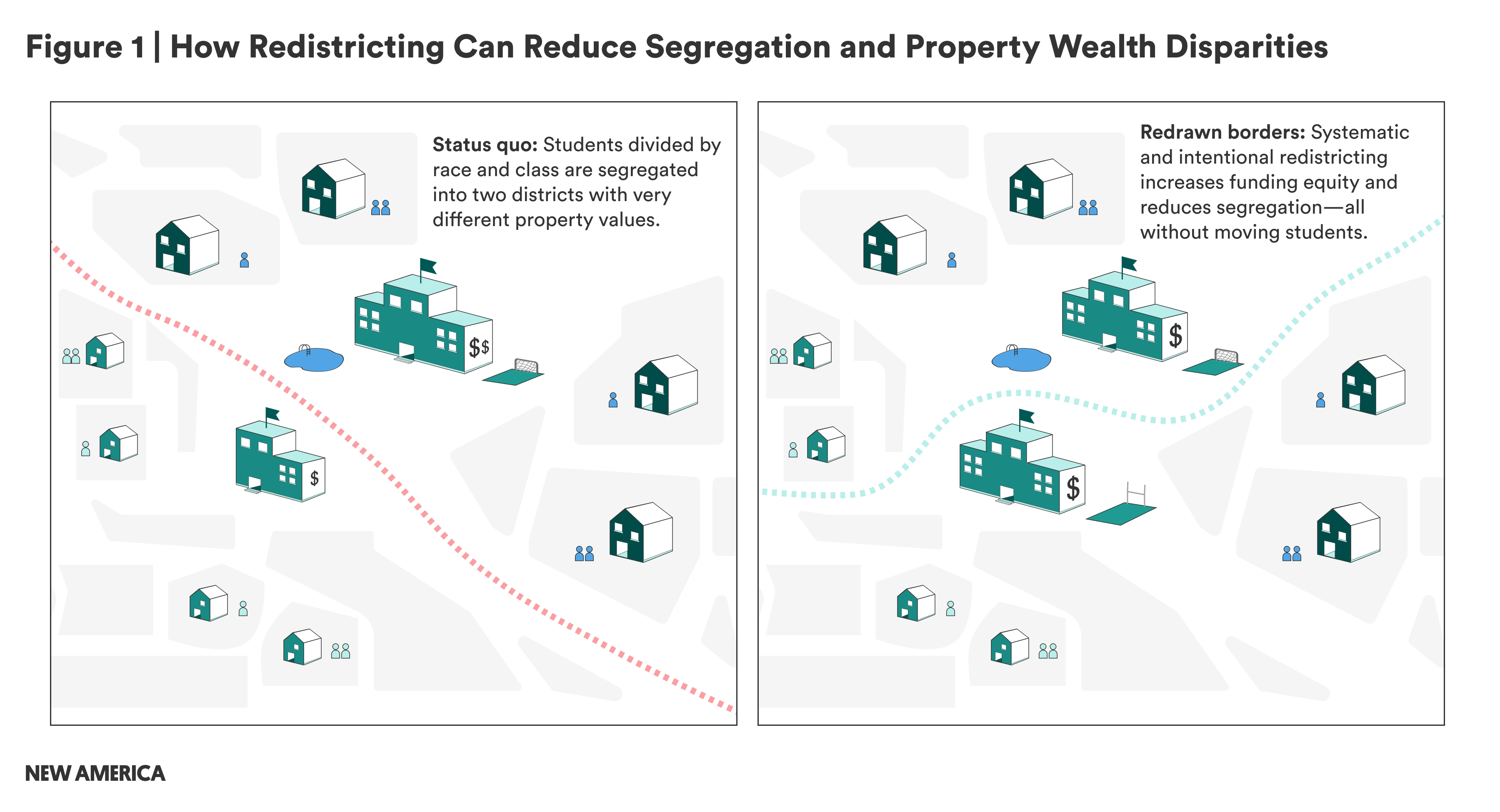
How much funding can be raised from local sources is heavily determined by the meaning of local. The school district boundary not only delimits the area in which a set of children can go to a certain group of schools governed by a school board, it also outlines the taxing jurisdiction that supports those schools—defining local for the purposes of local school revenue. This means that the placement of the district border is one of the most powerful ways that policymakers decide which children will have access to what school resources (Figure 1).
School district boundaries would matter less for fairness if there weren’t such significant economic and racial disparities between communities. But as we discussed in our 2024 report Crossing the Line, there are vast differences even between neighboring school systems. These divides are no accident. They are the result of years of housing policies that have segregated America and prevented people of color from building housing wealth. These included explicitly racist policies in the middle of the twentieth century, like public funding for Whites-only housing developments,20 redlining practices that made mortgages unattainable in neighborhoods with many people of color,21 and court enforcement of racially restrictive covenants (contracts that prevented the sale of property to nonwhite buyers).22 Other, ostensibly race-neutral housing policies have also had, and continue to have, segregative effects. For instance, twentieth-century urban renewal policies saw city governments, with federal backing, use their eminent domain powers to remove “blight,” which often amounted to destroying Black neighborhoods.23 Even now, exclusionary zoning laws limit construction in ways that make housing less plentiful and more expensive.24 These policies not only put specific neighborhoods out of reach for low-income families, but they also cause racial segregation, since they often prohibit multifamily homes, which are disproportionately home to people of color.25
Taken together, these policies have produced an America in which neighborhoods that are quite segregated, and Black households hold only half the housing wealth that they should by population size, even after some recent growth.26 School district borders are drawn onto this divided and unequal landscape, often positioned at the point of existing racial and economic divides. As a result, there is substantial segregation between school districts. In 2021, for example, there was a 14-percentage-point divide in the proportion of students of color enrolled in the average pair of side-by-side school districts.27 Less affluent communities, often those with more residents of color, tend to have lower property values, and therefore less access to local school funding.
Much of current school finance policy is oriented towards compensating for these ground-level inequities. State education funding formulas, which set target funding amounts for districts, nearly always allocate more dollars for students from low-income backgrounds. (They generally also apportion more funding for students whose educational needs are more resource-intensive, including English learners and students with disabilities.) And the vast majority of states have “equalization” policies, in which districts that have higher-value property tax bases are responsible for covering more of their formula amounts out of local revenues.
However, there is a limit to how much a state can rebalance funding when the system is built on such unlevel ground. Ultimately, different districts have access to widely disparate tax bases. Wealthier school systems may be asked to self-fund more of their formula targets, but in nearly every state, they are also permitted to raise extra funding—more than the district’s formula target—from local sources. This allows them to vastly outspend low-wealth school systems, whose students lose out. Those students get less experienced teachers, narrower course offerings, fewer support services, and school buildings in disrepair. Better education funding formulas have made state allocations more progressive. But when such wide wealth gaps remain between school districts at the local level, those equity gains can fall through the cracks.
Better education funding formulas have made state allocations more progressive. But when such wide wealth gaps remain between school districts at the local level, those equity gains can fall through the cracks.
If school funding is truly going to flow based on student need rather than community wealth, we cannot have students divided by race and class into districts with such different property tax bases. Education policy may seem ill suited to the tasks of shifting residential patterns and rebalancing housing values. But states do have a powerful tool for giving students in all communities more equal access to local school revenues: school district boundaries. States can redraw these lines with an eye towards increasing funding equity and reducing segregation, giving more diverse groups of students access to fairer school funding.
Mapping the Way to Fairer School Systems
School system redistricting, especially consolidation, is often done with the narrow goal of improving budget efficiency, or to actively evade and undermine school system diversity. Communities may prioritize merging similar districts; transfer territory to keep students with other, demographically similar peers; or pursue secessions and other boundary changes to help communities avoid schools with more economic or racial diversity. But school district boundary change can, and should, be used in pursuit of greater educational equity. Given racial and economic inequality in community property wealth, improving school funding fairness goes hand in hand with decreasing segregation between school districts.
For this report, we simulated district maps that would achieve just that. Using methods adapted from those sometimes employed in legislative redistricting, we proposed brand-new school system borders, constructed from scratch out of census tracts to provide districts in each state with the greatest equality of property valuation per pupil while also reducing interdistrict racial and economic segregation. For comparison, we considered another set of school district maps, calculating the tax-base-equality impacts and demographic changes that would result if all states used only county lines as their school system boundaries. Finally, we simulated state maps that use current school district boundaries as a starting point, merging existing school systems with the same goals of apportioning per-pupil property wealth more equally across more diverse districts.
Note that the redistricting options presented here are aimed at increasing funding fairness and reducing segregation across entire states. With limited exceptions—Vermont’s current redistricting effort, for instance, and a statewide reorganization that was legislated in Maine in 200728—school district boundary change in the twenty-first century has been a piecemeal affair, usually affecting just two school districts at a time as they merge, split, or trade territory. But it is states, not local school districts, that bear constitutional responsibility for education.29 States should make use of every available tool to ensure that all their students have fair and equal access to a well-resourced, high-quality education. School district boundary change is a powerful means of furthering this goal, and states should act accordingly. This means being systematic and intentional about the placement of district boundaries throughout the state, not just redrawing individual lines in response to specific problems or local demands. This report presents redistricting options that would aid states in improving funding equity and diversity statewide.
Citations
- Institute of Education Sciences, National Center for Education Statistics, “Table 214.10: Number of Public School Districts and Public and Private Elementary and Secondary Schools: Selected School Years, 1869–70 through 2022–23” in Digest of Education Statistics, revised January 2024, source.
- Campbell F. Scribner, The Fight for Local Control: Schools, Suburbs, and American Democracy (Cornell University Press, 2016), 32–56, eBook Collection (Cornell Scholarship Online).
- State of Vermont, Agency of Administration, “School Redistricting Task Force: About,” source.
- Act 73, An Act Relating to Transforming Vermont’s Education Governance, Quality, and Finance Systems, Regular Session 2025–2026, Vermont, 2025, source.
- Bridget Higdon, “Gov. Phil Scott Rolls Out School District Consolidation Plan; Local Officials Weigh-In,” St. Albans Messenger, January 23, 2025, source.
- The Education Efficiency Act, House Bill 1431, Regular Session 2025, Mississippi, source.
- Official Site of the State of New Jersey, Department of Community Affairs, “School Regionalization Efficiency Program (SREP),” source.
- Hannah Gross, “More NJ School Districts Think Hard About Consolidating,” NJ Spotlight News, August 20, 2024, source.
- Scott, “School District Reorganization Study,” source.
- For more on student enrollment declines, see Tara Moon, “K–12 Public School Enrollment Declines, Explained,” FutureEd, August 5, 2025, source; and Abigail Francis and Joshua Goodman, “School Enrollment Shifts Five Years After the Pandemic,” EdWorkingPaper 25-1233 (June 2025), source.
- EdBuild, Frontier: Merger (EdBuild, June 2020), source.
- EdBuild, Frontier: Territory Transfer (EdBuild, June 2020), source.
- EdBuild, Frontier: Secession (EdBuild, June 2020), source.
- See, for example, ABC News 4 Staff, “Dorchester School District Two Urges Land Transfer for New School Construction,” ABC 4 News, March 31, 2025, source; and Christopher Saul, “Val-p Leader: ‘If We Don’t So Something, We Are Going To Tax Ourselves Out of Existence,’” Mid Bay News, October 28, 2024, source.
- See, for example, Marielle Argueza, “What Two North County School Districts Stand to Gain and Lose in New Territory Proposal,” Monterey County Now, September 12, 2019, source; Julianna Morano, “Will Clovis Unified Expand Into the Fresno County Foothills? Not if One Rural School District Can Help It,” Fresnoland, September 5, 2024, source; and Will Garbe, “Local District Cites Race as Reason Some Want to Leave Schools,” Dayton Daily News, June 12, 2018, source.
- Jacqueline M. Nowicki, K–12 Education: Student Population Has Significantly Diversified, but Many Schools Remain Divided Along Racial, Ethnic, and Economic Lines (U.S. Government Accountability Office, June 2022), source.
- Democracy Docket, “Racial Gerrymandering vs. Racial Vote Dilution, Explained,” Democracy Docket, August 17, 2022, source.
- The exception to this rule is the very occasional role that required redistricting played in court-ordered desegregation plans in the second half of the twentieth century, including in the metropolitan areas of Wilmington, Delaware and Louisville, Kentucky. See Gary Orfield, foreword to The Courts, the Legislature, and Delaware’s Resegregation (The Civil Rights Project at UCLA, December 2014), 6, source.
- United States Census Bureau, “2023 Public Elementary-Secondary Education Finance Data,” source.
- Betsey Martens, Elizabeth Glenn, and Tiffany Mangum, “Race, Equity and Housing: The Early Years,” Journal of Housing & Community Development 77, no. 5 (September/October 2020), source; and National Low Income Housing Coalition, “Public Housing History,” October 17, 2019, source.
- Robert K. Nelson, “Mapping Inequality: Redlining in New Deal America” in the American Panorama: An Atlas of United States History online map project, Digital Scholarship Lab at University of Richmond, https:// dsl.richmond.edu/panorama/redlining/.
- University of Minnesota, Libraries, “What is a Covenant?” Mapping Prejudice Project, accessed September 2, 2025, source.
- Brent Cebul, “Tearing Down Black America,” Boston Review, July 22, 2020, source.
- Cecilia Rouse, Jared Bernstein, Helen Knudsen, and Jeffery Zhang, “Exclusionary Zoning: Its Effect on Racial Discrimination in the Housing Market,” The White House, June 17, 2021, source.
- Jonathan Rothwell and Douglas S. Massey, “The Effect of Density Zoning on Racial Segregation in U.S. Urban Areas,” Urban Affairs Review 44, no. 6 (April 9, 2009): 779–806, source.
- John Walsh and Jung Hyun Choi, “Black Housing Wealth Varies Across Local Markets, Despite Recent Improvement in the Black Homeownership Rate Nationally,” Urban Wire (blog), Urban Institute, February 18, 2025, source.
- Stadler and Abbott, Crossing the Line, 18, source.
- Glenn Adams, “Baldacci Secures Consolidation Plan,” Portsmouth Herald, June 8, 2007, Seacoastonline (website), source.
- Molly A. Hunter, State Constitution Education Clause Language, Education Law Center, n.d., source.