
Redrawing the Lines: How Purposeful School System Redistricting Can Increase Funding Fairness and Decrease Segregation
Table of Contents
- Executive Summary
- I. Introduction
- II. The Past, Present, and Future of School System Redistricting
- III. Overview of Data and Methods
- IV. Gains from Three Approaches to School System Redistricting
- V. Achieving District Boundary Change: Lessons from a School System Leader
- VI. State Spotlights
- VII. A Time for Better Borders
- VIII. Interactive Map and Data Explorer
Abstract
Students often attend school in segregated districts that are funded with very different amounts of property tax revenue. These conditions are the result of the fact that states place their school district borders along lines that entrench and worsen America’s racial and economic divides.
States can, and should, redraw school district boundaries to encompass more equal property tax capacities and more diverse student populations. Just as legislative gerrymandering can shift the balance of political power in a state without changing anything about the voters who live there, purposeful school-system redistricting can ensure that all kids get a fairer share of the state’s property tax base, regardless of race, class, or neighborhood—all without changing anything about property values or where families live.
In this new research report, New America’s Education Funding Equity initiative draws on the machine-learning methods often used for legislative redistricting to simulate new school system boundaries. We present three potential redistricting approaches—a blank-slate model that draws entirely new school districts, one consisting of only county-based districts, and one that strategically merges existing districts—and measure their impact on tax-base fairness and segregation. The average state analyzed shows enormous potential gains: up to a 66.6 percent increase in the equality of per-pupil tax capacity between districts, a 47.6 percent reduction in racial segregation, and a 65.0 percent decrease in economic segregation. An accompanying interactive map and data tool allow users to compare the three models against states’ existing school district boundaries and see how redrawing the boundary lines could give more diverse student populations fairer access to local school funding.
Acknowledgments
This report was created with the support of the American Institutes for Research Opportunity Fund. It was produced as part of the Education Funding Equity Initiative at New America, which is supported by the Skyline Foundation and the Gates Foundation. New America thanks these supporters. The findings and conclusions contained within this report are those of the authors and do not necessarily reflect the positions or policies of AIR or the foundations. The authors would like to thank Scott Menzel, superintendent of Scottsdale Unified School District, for contributing his expertise and perspective. Additional thanks to Tyler Simko and Nabeel Gillani for their expert guidance on the methodology for this analysis, and to Justin Madron and John Salman of the Center for Geospatial Solutions at the Lincoln Institute of Land Policy for their development of the interactive map and data tool that accompanies this report.
This analysis would not have been possible without several federal data sources, including the American Community Survey, the Small Area Income and Poverty Estimates Program, and geographic data from the U.S. Census Bureau. We are grateful to the federal statisticians, geographers, and other data scientists who collected these data, ensured their integrity, and shared them with the public. Their work is indispensable for any effort to understand, describe, and improve America’s education systems.
Executive Summary
School district boundary change has an extensive history in the United States. Lines were redrawn to eliminate over 100,000 school districts in the twentieth century,1 consolidating one-room-schoolhouse districts into comprehensive systems offering modern education and professionalized teaching.2 Since then, states and communities have continued to change school district boundaries, albeit in a less consistent way. Consolidation—erasing the line between two school systems—has often been a way of seeking greater efficiencies or attempting to address fiscal distress or declining enrollment.3 By contrast, secession—pulling away from a school district by drawing a new dividing line—has often been a means for affluent, usually predominantly White communities to keep their property tax dollars within their own small enclaves.4 But redistricting has almost never been used as a tool for advancing education equity, even though it holds great potential to create fairer school districts.
School district boundaries serve two main purposes. First, they define the area in which resident children can go to a certain group of schools. Second, they outline the local taxing jurisdiction that will provide much of those schools’ funding. This means that the placement of the district border is one of the most powerful ways that policymakers decide which children have access to what school resources. Too often, school district boundaries are drawn along existing neighborhood fault lines, outlining unequal tax bases and replicating residential segregation by race and class in our public schools.5 But the right boundaries, drawn to encompass more integrated student populations and more equal tax bases, could transform our public-school systems.
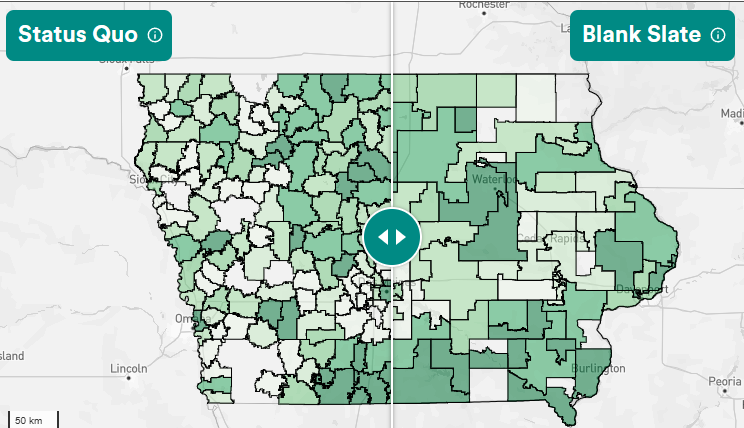
Zahava Stadler and Jordan Abbott, Redrawing the Lines: How Purposeful School System Redistricting Can Increase Funding Fairness and Decrease Segregation (interactive map), (New America, 2025), newamerica.org/redrawingthelinesmap.
For this report, we seek to do just that. We draw on the machine-learning methods often used for legislative redistricting to simulate new school system boundaries and measure their impact on segregation and tax-base equity. This report and its accompanying interactive map and data tool show how specific redistricting choices can create fairer school systems for our children.
Gains from Different Approaches to School System Redistricting
This report presents three redistricting models and assesses: (1) how well they equalize per-pupil property tax capacity across districts; (2) how much more representative the proposed districts are of statewide student racial demographics; and (3) how much more similar the proposed districts’ poverty rates are to the statewide school-aged poverty rate.
The first model, which we call blank-slate redistricting, entirely replaces each state’s school district map with one optimized for gains in tax-base equality and integration between school districts. In the average state analyzed, this model would produce:
- 66.6 percent fairer access to local property tax revenue
- 47.6 percent greater racial integration
- 65.0 percent greater economic integration
The second model, county-based redistricting, measures the gains in tax-base equality and integration that would result if all school districts had the same borders as counties. This model is not algorithmically optimized but uses existing jurisdictional boundaries to provide a point of comparison with the other models. In the average state analyzed, this approach would produce:
- 39.0 percent fairer access to local property tax revenue
- 40.7 percent greater racial integration
- 57.2 percent greater economic integration
The third model, redistricting by merger, strategically merges existing school districts to create an optimized map of larger districts that offer fairer access to property wealth and increase integration between school districts. In the average state analyzed, this approach would produce:
- 63.0 percent fairer access to local property tax revenue
- 48.2 percent greater racial integration
- 54.6 percent greater economic integration
All of these gains can be achieved without changing anything about property values or where families live—just by redrawing the imaginary lines that separate students from resources, and from each other.
A Time for Better Borders
State policy discussions about education funding usually focus on allocations: the formula that states use to determine how much money districts need for their schools and students. But state policy also governs many aspects of local funding. One underused way for states to make local school funding fairer is to redraw school district boundaries to encompass more equal tax capacities and more diverse student populations. With whole-state redistricting using any of the three approaches discussed in this report, states can better align district property tax bases to the number of students they support and ensure that all kids get a fairer share of the state’s property tax base, regardless of race, class, or neighborhood.
This is an opportune moment for states to take up this challenge. State budgets are newly threatened by severe cuts to federal safety net programs. Big reductions in health care funding and food assistance will leave states squeezed, and they will likely consider cuts to education funding. Property-poor districts depend more heavily on state aid, and across-the-board cuts are likely to affect their students the most, unless they can make up the difference by severely increasing local property taxes.6 Rather than subject these districts to the double whammy of state aid cuts and higher property taxes, states should try redistricting to eliminate big property-wealth disparities. The proposals in this report offer a new way to rightsize districts’ tax bases so they correspond with their student populations. By bringing all districts’ per-pupil tax capacity closer to the statewide property valuation per pupil, states can reduce any one district’s reliance on state aid, softening the blow of state budget cuts. At the same time, districts will have more of a local cushion—a tax base that can better support schools without onerous rate increases.
It has become commonplace to observe that disparities between our nation’s school systems prevent public education from being the “great equalizer” envisioned by schooling pioneer Horace Mann in 1848.7 Students of different backgrounds are not prepared to go on to participate in the economy, or in American democracy, on equal terms. But this problem arises in large part from ground-level divides that simply do not have to exist. Students of different races and economic backgrounds do not need to be segregated into different districts. Property tax capacity does not have to be so much higher in some school systems than others. These conditions are the result of the fact that states place their school district borders along lines that entrench and worsen America’s racial and economic divides.8
Just as legislative gerrymandering can shift the balance of political power in a state without changing anything about the voters who live there, the choice of where to draw school district boundaries can give the same kids, living in the same communities, access to better- or worse-funded public schools. By adopting a redistricting approach like one of the models presented here, states can choose a different present for their students and set them up for a better future.
Citations
- Institute of Education Sciences, National Center for Education Statistics, “Table 214.10: Number of Public School Districts and Public and Private Elementary and Secondary Schools: Selected School Years, 1869–70 through 2022–23” in Digest of Education Statistics, revised January 2024, source.
- Campbell F. Scribner, The Fight for Local Control: Schools, Suburbs, and American Democracy (Cornell University Press, 2016), 32–56, eBook Collection (Cornell Scholarship Online).
- See, for example, Bridget Higdon, “Gov. Phil Scott Rolls Out School District Consolidation Plan; Local Officials Weigh In,” Saint Albans Messenger, January 23, 2025, source; Hannah Gross, “More NJ School Districts Think Hard About Consolidating,” NJ Spotlight News, August 20, 2024, source.
- Jacqueline M. Nowicki, K–12 Education: Student Population Has Significantly Diversified, but Many Schools Remain Divided Along Racial, Ethnic, and Economic Lines (U.S. Government Accountability Office, June 2022), source.
- Zahava Stadler and Jordan Abbott, Crossing the Line: Segregation and Resource Inequality Between America’s School Districts (New America, February 2024), source.
- Krista Kaput and Bonnie O’Keefe, Fortifying Funding: How States Can Strengthen Education Finance Systems for the Future (Bellwether, February 2023), 12, source.
- See, for example, David Rhode, Kristina Cooke, and Himanshu-Ojha, “The Decline of the ‘Great Equalizer,’” The Atlantic, December 19, 2012, source; Thomas B. Edsall, “Is Education No Longer the ‘Great Equalizer’?” New York Times, June 23, 2021, source; and Arne Duncan, “Education: The ‘Great Equalizer,’” Britannica, 2018, source.
- Zahava Stadler and Jordan Abbott, Crossing the Line: Segregation and Resource Inequality Between America’s School Districts (New America, February 2024), source.
I. Introduction
State conversations about school system redistricting have become more common in the United States, especially in Pennsylvania, where lawmakers have been discussing the idea for nearly two decades. The state’s 1.5 million public school students are spread among 500 different school districts. These range in size from over 118,000 students in Philadelphia to fewer than 150 in the rural Austin Area School District. There are 112 districts that enroll under 1,000 students.9 Most of the boundaries between districts were drawn many decades ago, often in ways that separate students by race and income. The profusion of small districts creates extra administrative expenses, and the state’s heavy reliance on local taxes to fund public education leaves many schools cash-poor.
In 2007, the state legislature’s Budget and Finance Committee ordered a study of district consolidation that found the potential for cost savings.10 In 2009, Governor Ed Rendell took up the cause and proposed cutting the state’s 500-some school districts down to 100, putting it on par with states like North Carolina.11 A legislator proposed a bill in 2010 that would have replaced existing school systems with county-based school districts.12 A House Republican sought to create a $100 million School District Consolidation Incentive Fund in 2015,13 and a Senate Democrat tried to legislate both financial aid and state planning support for mergers in 2023.14 Today, a state representative is again proposing that Pennsylvania reduce the district count through consolidation.15 But time after time, these efforts have failed.
Changing political boundaries is never easy, but Pennsylvania has fallen short in part because lawmakers have defined their case too narrowly, focusing only on efficiencies from school district consolidation and greater economies of scale. They have ignored two other potential benefits from school district boundary change: greater fiscal equity between school districts, and reduced racial and economic segregation. These are stubborn problems in American public schools—not just in Pennsylvania, but across the country.16 And they are closely connected. Both have to do with where Americans of different races and incomes live, and why.
Decades of American housing policy have resulted in deep residential segregation and prevented people of color, in particular, from building wealth in their homes.17 In the twentieth century, this included openly race-based policies that made it effectively impossible for homebuyers of certain ethnicities to secure mortgages in many areas and reserved certain housing for White families. Today, it manifests in subtler forms of discrimination, like zoning rules that effectively close towns or communities to the construction of affordable housing. These policies, past and present, have produced a residential landscape that is highly segregated by race and class. Because nearly all public-school students attend school in the district in which they live, and school district boundaries are frequently drawn along existing racial and residential fault lines, segregation between neighborhoods also means segregation between school systems.
Unfair housing policy shows up in schools in another way: unequal district budgets. Much of the disparity in school funding between school districts comes from differences in local property tax bases. The average school district in the United States received 43.5 percent of its revenue from local sources in 2023, and the majority of that—27.1 percent of the total—came from local property taxes.18 School district funding amounts are therefore directly tied to local property wealth levels. Higher property values mean a district will be able to raise ample revenue for schools easily, at lower tax rates. As a result, big funding gaps are often related to significant disparities in the property tax base. Because property-poor districts struggle to collect enough local revenue for schools, they are at a disadvantage in everything from attracting the best teachers to building and maintaining modern school buildings. And since property values are shaped by many years of racialized housing policy, it is not only high-poverty districts that often deal with low tax capacity; it is also districts that serve many students of color.
This ground-level school finance inequality, with its troubling racial dimension, is an injustice to students. To state lawmakers, it is also a budget problem. States have constitutional obligations to provide students with a fairly and adequately funded public education.19 Local property taxes just aren’t sufficient to support that education in most school districts. So, states spend billions of dollars on K–12 education each year, compensating for local funding inequality by providing greater amounts of state aid to districts with less property wealth. This is the reason that only slightly less than half of school funding comes from local sources in the average school district. A similar proportion comes from state aid, though this share is generally lower in property-wealthy districts and higher in property-poor districts.20 In nearly every state, however, school finance policy allows plenty of room for high-wealth districts to counteract this progressive aid with additional local tax revenue for their own schools, overwhelming state efforts. This makes it an ever-increasing task for states to achieve resource equity just through compensatory aid.
The job will only get harder over the next few years. Districts, still not fully recovered from the COVID-19 pandemic and its massive academic disruptions, are currently dealing with the expiration of their final federal pandemic relief funds.21 State budgets are newly threatened by severe cuts to federal safety net programs; slashed federal funding for health care and food assistance will leave states squeezed, as they will need to meet new costs with less revenue.22 Since public education spending looms so large in state budgets, it is unlikely that K–12 schools will be spared in the financial crunch. And state education aid cuts are likely to hit low-wealth districts hardest. Because state funding policies are set up so that property-poor districts receive more of their funding from the state, across-the-board state cuts affect their budgets the most. (Multiple studies of Great Recession education cuts show exactly that.23) This puts the burden on school systems with smaller tax bases and asks them to jack up property taxes to make up the loss. But the last few years have already seen substantial property tax increases for the average American homeowner.24 Something has to give.
School redistricting is a solution for all of these problems. If states draw district boundaries with the goals of encompassing more diverse student populations and more equal amounts of property wealth per pupil, then the system will be fairer at the ground level. States will be better able to provide an equally resourced education to all their students, without making individual districts disproportionately dependent on state aid.
With this report, we show how. Drawing on machine-learning methods often used for legislative redistricting, we simulated three options for new school system boundaries and measured their impact on segregation and tax-base equity. We offer a first-of-its-kind interactive map and data tool displaying states’ current school district maps and better alternatives, showing how specific redistricting choices can create a fairer school system for our children.
The gains from these changes would be enormous. The average state analyzed showed a potential 66.6 percent increase in the equality of per-pupil tax base between districts, as well as a 47.6 percent reduction in racial segregation and a 65.0 percent decrease in economic segregation between districts. All of this can be achieved without changing anything about property values or where families live—just by redrawing the imaginary lines that separate students from resources, and from each other.
Citations
- Institute of Education Sciences, National Center for Education Statistics, “Table 214.10: Number of Public School Districts and Public and Private Elementary and Secondary Schools: Selected School Years, 1869–70 through 2022–23” in Digest of Education Statistics, revised January 2024, source">source.
- Campbell F. Scribner, The Fight for Local Control: Schools, Suburbs, and American Democracy (Cornell University Press, 2016), 32–56, eBook Collection (Cornell Scholarship Online).
- See, for example, Bridget Higdon, “Gov. Phil Scott Rolls Out School District Consolidation Plan; Local Officials Weigh In,” Saint Albans Messenger, January 23, 2025, source">source; Hannah Gross, “More NJ School Districts Think Hard About Consolidating,” NJ Spotlight News, August 20, 2024, source">source.
- Jacqueline M. Nowicki, K–12 Education: Student Population Has Significantly Diversified, but Many Schools Remain Divided Along Racial, Ethnic, and Economic Lines (U.S. Government Accountability Office, June 2022), source">source.
- Zahava Stadler and Jordan Abbott, Crossing the Line: Segregation and Resource Inequality Between America’s School Districts (New America, February 2024), source">source.
- Krista Kaput and Bonnie O’Keefe, Fortifying Funding: How States Can Strengthen Education Finance Systems for the Future (Bellwether, February 2023), 12, source">source.
- See, for example, David Rhode, Kristina Cooke, and Himanshu-Ojha, “The Decline of the ‘Great Equalizer,’” The Atlantic, December 19, 2012, source">source; Thomas B. Edsall, “Is Education No Longer the ‘Great Equalizer’?” New York Times, June 23, 2021, source">source; and Arne Duncan, “Education: The ‘Great Equalizer,’” Britannica, 2018, source">source.
- Zahava Stadler and Jordan Abbott, Crossing the Line: Segregation and Resource Inequality Between America’s School Districts (New America, February 2024), source">source.
- Pennsylvania Department of Education, “Types of Schools,” September 1, 2025, source; and United States Census Bureau, “2023 Public Elementary-Secondary Education Finance Data,” source.
- Metropolitan Philadelphia Indicators Project, Policy Brief: Consolidating School Districts (MPIP, May 2011), source.
- Metropolitan Philadelphia Indicators Project, Policy Brief, source.
- Senate Bill 131, Regular Session of 2010, Pennsylvania, source.
- Pennsylvania House Republican Caucus, “Parker Amendments to Fix School Funding—State Representative Calls for Faster Transition to Equity,” press release, August 21, 2015, source.
- Pennsylvania Senate Democrats, “Schwank Announces Plans to Introduce Bills to Aid School Mergers,” press release, October 31, 2023, source.
- Representative Greg Scott, “School District Reorganization Study,” Pennsylvania House of Representatives (website), May 25, 2025, source.
- Zahava Stadler and Jordan Abbott, Crossing the Line: Segregation and Resource Inequality Between America’s School Districts (New America, February 2024), source.
- Krista Kaput and Bonnie O’Keefe, Fortifying Funding: How States Can Strengthen Education Finance Systems for the Future (Bellwether, February 2023), 12, source.
- United States Census Bureau, “2023 Public Elementary-Secondary Education Finance Data,” source.
- Center for Educational Equity, “School Funding Court Decisions by State,” source.
- United States Census Bureau, “2023 Public Elementary-Secondary Education Finance Data,” source.
- Zahava Stadler, K–12 Federal COVID Relief: What Can We Learn from Doing School Funding Differently? (New America, October 2023), 18, source.
- Melissa Yelenik, “Experts: Medicaid, SNAP Cuts Could Hurt Economy, Strain State Budgets,” U.S. News & World Report, August 11, 2025, source; and Sarah D. Wire, “'Catastrophe': States Scramble after Trump's Cuts to Medicaid, SNAP,” USA Today, July 16, 2025, source.
- William N. Evans, Robert M. Schwab, and Kathryn L. Wagner, “The Great Recession and Public Education,” Education Finance and Policy 14, no. 2 (March 2019): 298–326, source; and David S. Knight, “Are High-Poverty School Districts Disproportionately Impacted by State Funding Cuts? School Finance Equity Following the Great Recession,” Journal of Education Finance 43, no. 2 (September 2017): 169–94, source.
- Michael Kolomatsky, “How Much Higher Are Your Post-Pandemic Property Taxes?” New York Times, March 28, 2024, source; and Niko Spyridonos, “The Impact of Rising Property Taxes on Communities,” Smart Cities Dive, July 22, 2024, source.
II. The Past, Present, and Future of School System Redistricting
A Century of School District Boundary Change
Pennsylvania’s school district consolidation conversations, and those happening today in other states, are actually a return to something that used to be quite common. The National Center for Education Statistics records that in the 1939–40 school year, there were 117,108 regular public-school districts.25 By the 2022–23 school year—the most recent reported—there were 13,318 districts, a decline of 88.6 percent. Most of these school districts were eliminated in the middle third of the twentieth century. Over 33,000 districts were dissolved in the 1940s, and the number was reduced by half in each of the following two decades, leaving just 17,995 by the 1970–71 school year. Since then, declines have been more modest but steady, with a healthy handful of districts disappearing from the count each year.
In his book The Fight for Local Control, education historian Campbell F. Scribner describes how this massive change occurred.26 In large part, it was a story of consolidation. One-room schoolhouses in rural areas, originally governed by small groups of local residents and funded almost entirely with community property taxes, began to join together into larger school systems. At first, these consolidations happened on local initiative. They were driven by a desire for separate high schools with more course options and professionalized teaching, and by a need for greater economies of scale during economic downturns. Later mergers were driven by top-down policies, including state financial incentives (both increased aid for consolidators and financial penalties for resisters) and new rules requiring larger schools and specific curricula that were far easier to implement in bigger districts. Ultimately, many states mandated the dissolution not only of one-room schoolhouse districts, but small-town high school districts as well. Despite significant pushback from rural voters, by the 1970s, nearly all one-room schoolhouses had been eliminated in favor of larger, consolidated school districts.
Today, school district consolidation is back in state policy conversations. The state most seriously pursuing this strategy is Vermont, where a School District Redistricting Task Force27 is charged with proposing a map of “new, larger school district boundaries” that will “increase the efficiency of delivery of educational services through scale,” according to its authorizing legislation.28 Vermont Governor Phil Scott has suggested reducing the state’s count to just five school districts.29 A bill that would have created a similar task force in Mississippi passed in the state House in 2025, though it didn’t progress in the Senate.30 New Jersey has a fairly new grant program that provides funding to districts that wish to study regionalization and consolidation,31 and several school districts have begun the process, motivated by falling numbers of students and funding challenges.32 And a Pennsylvania state representative is proposing to study the idea, citing inefficiencies, increasing costs, and rising property taxes.33 Much of this activity is due to the fact that declining public school enrollment leaves many districts serving smaller student populations than the ones for which they were built.34
Consolidation is not the only form of school district boundary change. In addition to mergers,35 most states allow the partial transfer of territory between two extant school districts.36 States also tend to permit the splitting of one school district into two or more, including via the secession of part of an existing district.37 This process is less common than consolidation, however, and mergers continue to reduce America’s overall count of districts. States prescribe different processes for these boundary changes and impose a range of requirements and limitations.
Consolidation is often driven by efficiency concerns, either to capture new economies of scale or to address inefficiencies that have come about through declining enrollment. Territory transfer can occur for a range of reasons, some more benign than others—to sell empty land for development or to facilitate school construction,38 for instance, but also to reassign a small and specific set of homes to a different school district. A transfer can have the effect of changing local property values by affecting which schools families can access; moving high-value property into a different district’s tax base; or increasing segregation by shifting students to a district that is already overwhelmingly of their same race.39 School district secession also tends to result in increased segregation and inequality. A 2022 report by the U.S. Government Accountability Office found that the breakaway districts in a secession were generally wealthier than the districts they left behind, and enrolled much higher proportions of White and Asian students but far fewer Black and Hispanic students.40 In these instances, school district boundary change has much in common with the gerrymandering of congressional and legislative districts to diminish the voting power of specific racial groups.41
In all of these forms, boundary change is used as a tool—by those seeking fiscal efficiency; by school districts (or real estate developers) looking to buy and sell land for economic or school construction reasons; and by residents of the most affluent neighborhoods in school districts, looking to cement their children’s advantages over others or to avoid specific schools, frequently those enrolling more students of color. But redistricting is almost never used as a policy tool by those seeking to improve the equity of education funding systems or increase school system integration.42
Why District Boundaries Matter for Funding Fairness and Integration
District property taxes play a significant role in school finance, albeit not on the scale that they did in the era of the old, locally funded one-room schoolhouse. In 2023, the average school district received over a quarter of its funding specifically from local property taxes, and 43.5 percent of its revenue from local sources generally.43 Local tax capacity continues to determine how well school districts can fund their schools, and big disparities in funding can often be traced to differences in property wealth. Just as legislative gerrymandering can shift the balance of political power in a state without changing anything about the voters who live there, the choice of where to draw school district boundaries can give the same kids, living in the same communities, access to less or more local school funding.
Just as legislative gerrymandering can shift the balance of political power in a state without changing anything about the voters who live there, the choice of where to draw school district boundaries can give the same kids, living in the same communities, access to less or more local school funding.
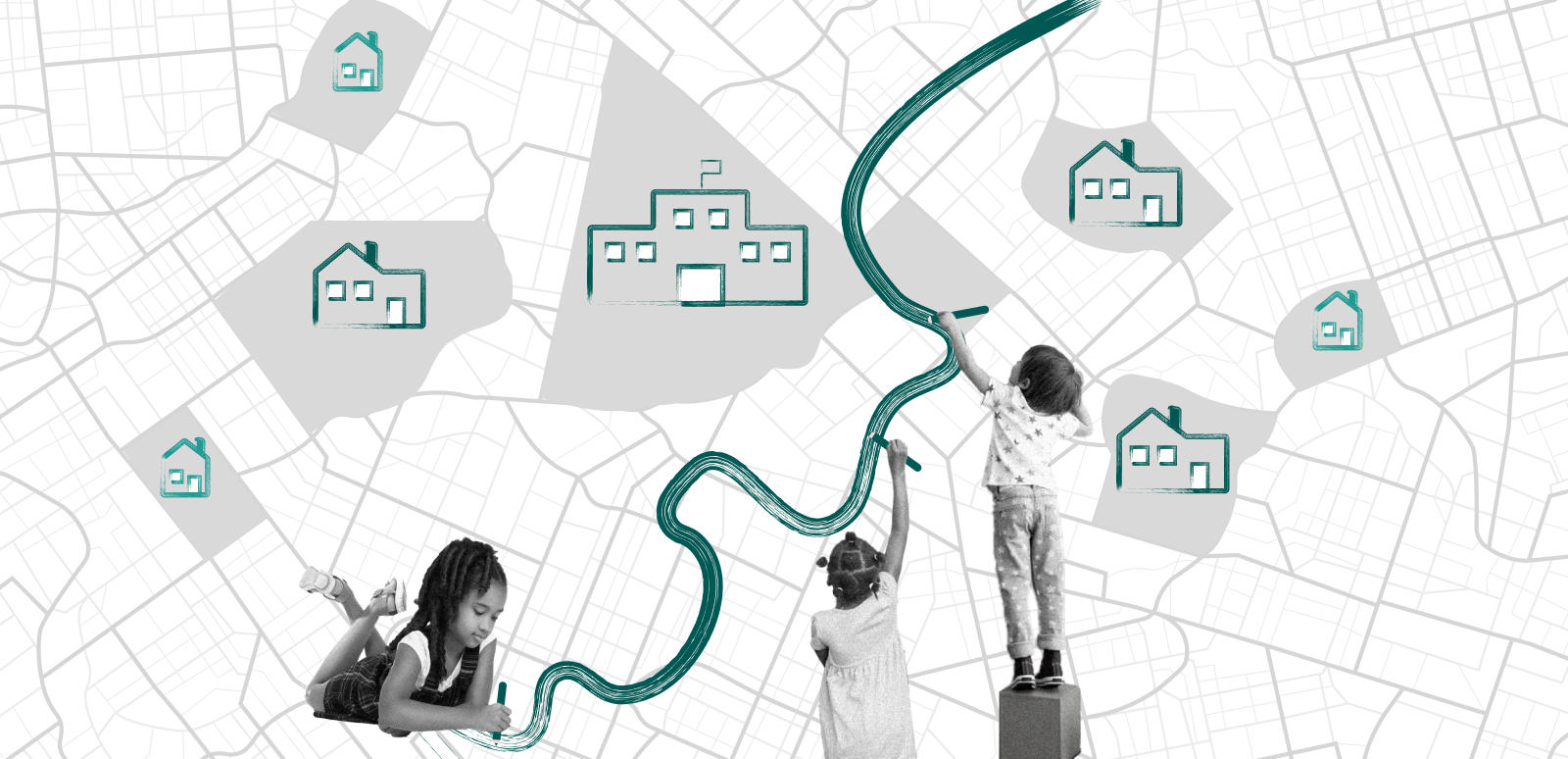
How much funding can be raised from local sources is heavily determined by the meaning of local. The school district boundary not only delimits the area in which a set of children can go to a certain group of schools governed by a school board, it also outlines the taxing jurisdiction that supports those schools—defining local for the purposes of local school revenue. This means that the placement of the district border is one of the most powerful ways that policymakers decide which children will have access to what school resources (Figure 1).
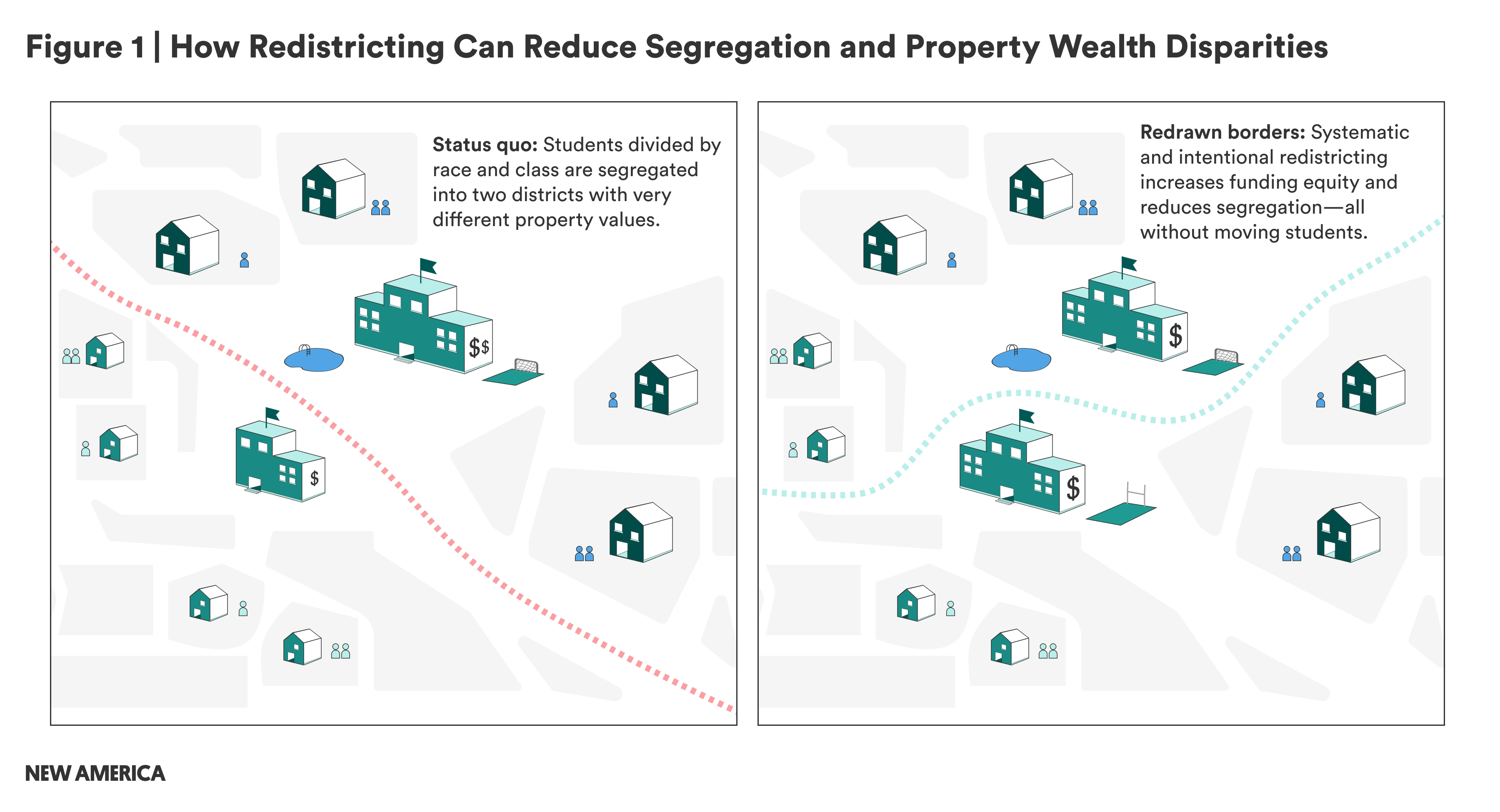
School district boundaries would matter less for fairness if there weren’t such significant economic and racial disparities between communities. But as we discussed in our 2024 report Crossing the Line, there are vast differences even between neighboring school systems. These divides are no accident. They are the result of years of housing policies that have segregated America and prevented people of color from building housing wealth. These included explicitly racist policies in the middle of the twentieth century, like public funding for Whites-only housing developments,44 redlining practices that made mortgages unattainable in neighborhoods with many people of color,45 and court enforcement of racially restrictive covenants (contracts that prevented the sale of property to nonwhite buyers).46 Other, ostensibly race-neutral housing policies have also had, and continue to have, segregative effects. For instance, twentieth-century urban renewal policies saw city governments, with federal backing, use their eminent domain powers to remove “blight,” which often amounted to destroying Black neighborhoods.47 Even now, exclusionary zoning laws limit construction in ways that make housing less plentiful and more expensive.48 These policies not only put specific neighborhoods out of reach for low-income families, but they also cause racial segregation, since they often prohibit multifamily homes, which are disproportionately home to people of color.49
Taken together, these policies have produced an America in which neighborhoods that are quite segregated, and Black households hold only half the housing wealth that they should by population size, even after some recent growth.50 School district borders are drawn onto this divided and unequal landscape, often positioned at the point of existing racial and economic divides. As a result, there is substantial segregation between school districts. In 2021, for example, there was a 14-percentage-point divide in the proportion of students of color enrolled in the average pair of side-by-side school districts.51 Less affluent communities, often those with more residents of color, tend to have lower property values, and therefore less access to local school funding.
Much of current school finance policy is oriented towards compensating for these ground-level inequities. State education funding formulas, which set target funding amounts for districts, nearly always allocate more dollars for students from low-income backgrounds. (They generally also apportion more funding for students whose educational needs are more resource-intensive, including English learners and students with disabilities.) And the vast majority of states have “equalization” policies, in which districts that have higher-value property tax bases are responsible for covering more of their formula amounts out of local revenues.
However, there is a limit to how much a state can rebalance funding when the system is built on such unlevel ground. Ultimately, different districts have access to widely disparate tax bases. Wealthier school systems may be asked to self-fund more of their formula targets, but in nearly every state, they are also permitted to raise extra funding—more than the district’s formula target—from local sources. This allows them to vastly outspend low-wealth school systems, whose students lose out. Those students get less experienced teachers, narrower course offerings, fewer support services, and school buildings in disrepair. Better education funding formulas have made state allocations more progressive. But when such wide wealth gaps remain between school districts at the local level, those equity gains can fall through the cracks.
Better education funding formulas have made state allocations more progressive. But when such wide wealth gaps remain between school districts at the local level, those equity gains can fall through the cracks.
If school funding is truly going to flow based on student need rather than community wealth, we cannot have students divided by race and class into districts with such different property tax bases. Education policy may seem ill suited to the tasks of shifting residential patterns and rebalancing housing values. But states do have a powerful tool for giving students in all communities more equal access to local school revenues: school district boundaries. States can redraw these lines with an eye towards increasing funding equity and reducing segregation, giving more diverse groups of students access to fairer school funding.
Mapping the Way to Fairer School Systems
School system redistricting, especially consolidation, is often done with the narrow goal of improving budget efficiency, or to actively evade and undermine school system diversity. Communities may prioritize merging similar districts; transfer territory to keep students with other, demographically similar peers; or pursue secessions and other boundary changes to help communities avoid schools with more economic or racial diversity. But school district boundary change can, and should, be used in pursuit of greater educational equity. Given racial and economic inequality in community property wealth, improving school funding fairness goes hand in hand with decreasing segregation between school districts.
For this report, we simulated district maps that would achieve just that. Using methods adapted from those sometimes employed in legislative redistricting, we proposed brand-new school system borders, constructed from scratch out of census tracts to provide districts in each state with the greatest equality of property valuation per pupil while also reducing interdistrict racial and economic segregation. For comparison, we considered another set of school district maps, calculating the tax-base-equality impacts and demographic changes that would result if all states used only county lines as their school system boundaries. Finally, we simulated state maps that use current school district boundaries as a starting point, merging existing school systems with the same goals of apportioning per-pupil property wealth more equally across more diverse districts.
Note that the redistricting options presented here are aimed at increasing funding fairness and reducing segregation across entire states. With limited exceptions—Vermont’s current redistricting effort, for instance, and a statewide reorganization that was legislated in Maine in 200752—school district boundary change in the twenty-first century has been a piecemeal affair, usually affecting just two school districts at a time as they merge, split, or trade territory. But it is states, not local school districts, that bear constitutional responsibility for education.53 States should make use of every available tool to ensure that all their students have fair and equal access to a well-resourced, high-quality education. School district boundary change is a powerful means of furthering this goal, and states should act accordingly. This means being systematic and intentional about the placement of district boundaries throughout the state, not just redrawing individual lines in response to specific problems or local demands. This report presents redistricting options that would aid states in improving funding equity and diversity statewide.
Citations
- Institute of Education Sciences, National Center for Education Statistics, “Table 214.10: Number of Public School Districts and Public and Private Elementary and Secondary Schools: Selected School Years, 1869–70 through 2022–23” in Digest of Education Statistics, revised January 2024, <a href="source">source">source.
- Campbell F. Scribner, The Fight for Local Control: Schools, Suburbs, and American Democracy (Cornell University Press, 2016), 32–56, eBook Collection (Cornell Scholarship Online).
- See, for example, Bridget Higdon, “Gov. Phil Scott Rolls Out School District Consolidation Plan; Local Officials Weigh In,” Saint Albans Messenger, January 23, 2025, <a href="source">source">source; Hannah Gross, “More NJ School Districts Think Hard About Consolidating,” NJ Spotlight News, August 20, 2024, <a href="source">source">source.
- Jacqueline M. Nowicki, K–12 Education: Student Population Has Significantly Diversified, but Many Schools Remain Divided Along Racial, Ethnic, and Economic Lines (U.S. Government Accountability Office, June 2022), <a href="source">source">source.
- Zahava Stadler and Jordan Abbott, Crossing the Line: Segregation and Resource Inequality Between America’s School Districts (New America, February 2024), <a href="source">source">source.
- Krista Kaput and Bonnie O’Keefe, Fortifying Funding: How States Can Strengthen Education Finance Systems for the Future (Bellwether, February 2023), 12, <a href="source">source">source.
- See, for example, David Rhode, Kristina Cooke, and Himanshu-Ojha, “The Decline of the ‘Great Equalizer,’” The Atlantic, December 19, 2012, <a href="source">source">source; Thomas B. Edsall, “Is Education No Longer the ‘Great Equalizer’?” New York Times, June 23, 2021, <a href="source">source">source; and Arne Duncan, “Education: The ‘Great Equalizer,’” Britannica, 2018, <a href="source">source">source.
- Zahava Stadler and Jordan Abbott, Crossing the Line: Segregation and Resource Inequality Between America’s School Districts (New America, February 2024), <a href="source">source">source.
- Pennsylvania Department of Education, “Types of Schools,” September 1, 2025, source">source; and United States Census Bureau, “2023 Public Elementary-Secondary Education Finance Data,” source">source.
- Metropolitan Philadelphia Indicators Project, Policy Brief: Consolidating School Districts (MPIP, May 2011), source">source.
- Metropolitan Philadelphia Indicators Project, Policy Brief, source">source.
- Senate Bill 131, Regular Session of 2010, Pennsylvania, source">source.
- Pennsylvania House Republican Caucus, “Parker Amendments to Fix School Funding—State Representative Calls for Faster Transition to Equity,” press release, August 21, 2015, source">source.
- Pennsylvania Senate Democrats, “Schwank Announces Plans to Introduce Bills to Aid School Mergers,” press release, October 31, 2023, source">source.
- Representative Greg Scott, “School District Reorganization Study,” Pennsylvania House of Representatives (website), May 25, 2025, source">source.
- Zahava Stadler and Jordan Abbott, Crossing the Line: Segregation and Resource Inequality Between America’s School Districts (New America, February 2024), source">source.
- Krista Kaput and Bonnie O’Keefe, Fortifying Funding: How States Can Strengthen Education Finance Systems for the Future (Bellwether, February 2023), 12, source">source.
- United States Census Bureau, “2023 Public Elementary-Secondary Education Finance Data,” source">source.
- Center for Educational Equity, “School Funding Court Decisions by State,” source">source.
- United States Census Bureau, “2023 Public Elementary-Secondary Education Finance Data,” source">source.
- Zahava Stadler, K–12 Federal COVID Relief: What Can We Learn from Doing School Funding Differently? (New America, October 2023), 18, source">source.
- Melissa Yelenik, “Experts: Medicaid, SNAP Cuts Could Hurt Economy, Strain State Budgets,” U.S. News & World Report, August 11, 2025, source">source; and Sarah D. Wire, “'Catastrophe': States Scramble after Trump's Cuts to Medicaid, SNAP,” USA Today, July 16, 2025, source">source.
- William N. Evans, Robert M. Schwab, and Kathryn L. Wagner, “The Great Recession and Public Education,” Education Finance and Policy 14, no. 2 (March 2019): 298–326, source">source; and David S. Knight, “Are High-Poverty School Districts Disproportionately Impacted by State Funding Cuts? School Finance Equity Following the Great Recession,” Journal of Education Finance 43, no. 2 (September 2017): 169–94, source">source.
- Michael Kolomatsky, “How Much Higher Are Your Post-Pandemic Property Taxes?” New York Times, March 28, 2024, source">source; and Niko Spyridonos, “The Impact of Rising Property Taxes on Communities,” Smart Cities Dive, July 22, 2024, source">source.
- Institute of Education Sciences, National Center for Education Statistics, “Table 214.10: Number of Public School Districts and Public and Private Elementary and Secondary Schools: Selected School Years, 1869–70 through 2022–23” in Digest of Education Statistics, revised January 2024, source.
- Campbell F. Scribner, The Fight for Local Control: Schools, Suburbs, and American Democracy (Cornell University Press, 2016), 32–56, eBook Collection (Cornell Scholarship Online).
- State of Vermont, Agency of Administration, “School Redistricting Task Force: About,” source.
- Act 73, An Act Relating to Transforming Vermont’s Education Governance, Quality, and Finance Systems, Regular Session 2025–2026, Vermont, 2025, source.
- Bridget Higdon, “Gov. Phil Scott Rolls Out School District Consolidation Plan; Local Officials Weigh-In,” St. Albans Messenger, January 23, 2025, source.
- The Education Efficiency Act, House Bill 1431, Regular Session 2025, Mississippi, source.
- Official Site of the State of New Jersey, Department of Community Affairs, “School Regionalization Efficiency Program (SREP),” source.
- Hannah Gross, “More NJ School Districts Think Hard About Consolidating,” NJ Spotlight News, August 20, 2024, source.
- Scott, “School District Reorganization Study,” source.
- For more on student enrollment declines, see Tara Moon, “K–12 Public School Enrollment Declines, Explained,” FutureEd, August 5, 2025, source; and Abigail Francis and Joshua Goodman, “School Enrollment Shifts Five Years After the Pandemic,” EdWorkingPaper 25-1233 (June 2025), source.
- EdBuild, Frontier: Merger (EdBuild, June 2020), source.
- EdBuild, Frontier: Territory Transfer (EdBuild, June 2020), source.
- EdBuild, Frontier: Secession (EdBuild, June 2020), source.
- See, for example, ABC News 4 Staff, “Dorchester School District Two Urges Land Transfer for New School Construction,” ABC 4 News, March 31, 2025, source; and Christopher Saul, “Val-p Leader: ‘If We Don’t So Something, We Are Going To Tax Ourselves Out of Existence,’” Mid Bay News, October 28, 2024, source.
- See, for example, Marielle Argueza, “What Two North County School Districts Stand to Gain and Lose in New Territory Proposal,” Monterey County Now, September 12, 2019, source; Julianna Morano, “Will Clovis Unified Expand Into the Fresno County Foothills? Not if One Rural School District Can Help It,” Fresnoland, September 5, 2024, source; and Will Garbe, “Local District Cites Race as Reason Some Want to Leave Schools,” Dayton Daily News, June 12, 2018, source.
- Jacqueline M. Nowicki, K–12 Education: Student Population Has Significantly Diversified, but Many Schools Remain Divided Along Racial, Ethnic, and Economic Lines (U.S. Government Accountability Office, June 2022), source.
- Democracy Docket, “Racial Gerrymandering vs. Racial Vote Dilution, Explained,” Democracy Docket, August 17, 2022, source.
- The exception to this rule is the very occasional role that required redistricting played in court-ordered desegregation plans in the second half of the twentieth century, including in the metropolitan areas of Wilmington, Delaware and Louisville, Kentucky. See Gary Orfield, foreword to The Courts, the Legislature, and Delaware’s Resegregation (The Civil Rights Project at UCLA, December 2014), 6, source.
- United States Census Bureau, “2023 Public Elementary-Secondary Education Finance Data,” source.
- Betsey Martens, Elizabeth Glenn, and Tiffany Mangum, “Race, Equity and Housing: The Early Years,” Journal of Housing & Community Development 77, no. 5 (September/October 2020), source; and National Low Income Housing Coalition, “Public Housing History,” October 17, 2019, source.
- Robert K. Nelson, “Mapping Inequality: Redlining in New Deal America” in the American Panorama: An Atlas of United States History online map project, Digital Scholarship Lab at University of Richmond, https:// dsl.richmond.edu/panorama/redlining/.
- University of Minnesota, Libraries, “What is a Covenant?” Mapping Prejudice Project, accessed September 2, 2025, source.
- Brent Cebul, “Tearing Down Black America,” Boston Review, July 22, 2020, source.
- Cecilia Rouse, Jared Bernstein, Helen Knudsen, and Jeffery Zhang, “Exclusionary Zoning: Its Effect on Racial Discrimination in the Housing Market,” The White House, June 17, 2021, source.
- Jonathan Rothwell and Douglas S. Massey, “The Effect of Density Zoning on Racial Segregation in U.S. Urban Areas,” Urban Affairs Review 44, no. 6 (April 9, 2009): 779–806, source.
- John Walsh and Jung Hyun Choi, “Black Housing Wealth Varies Across Local Markets, Despite Recent Improvement in the Black Homeownership Rate Nationally,” Urban Wire (blog), Urban Institute, February 18, 2025, source.
- Stadler and Abbott, Crossing the Line, 18, source.
- Glenn Adams, “Baldacci Secures Consolidation Plan,” Portsmouth Herald, June 8, 2007, Seacoastonline (website), source.
- Molly A. Hunter, State Constitution Education Clause Language, Education Law Center, n.d., source.
III. Overview of Data and Methods
Our analysis simulates three approaches to school system redistricting for 42 states. Due to limitations in available property valuation data, we were not able to simulate new districts for Alaska, Kansas, Kentucky, Maine, Minnesota, New Mexico, or South Carolina. Hawaii and the District of Columbia were also excluded from this analysis because they have only one school district apiece.
In each of the three models, we measured the impact of the redistricting in three priority areas: disparities in per-pupil property tax capacity, racial segregation, and economic segregation based on student poverty status.
Data Sources
The geographic data used for this project included 2020 census tract boundaries and 2022 school district boundaries from the U.S. Census Bureau.
Property value data were provided by the Center for Geospatial Solutions at the Lincoln Institute of Land Policy. These data included total property values based on each jurisdiction’s most recent assessment, aggregated to allow for analysis by census tract, school district, or county. Approximately 8 percent of census tracts lacked property assessment data. We leveraged demographic, economic, and spatial data from the American Community Survey to impute additional property values where it was possible to do so with high confidence. After imputation, states with less than 70 percent coverage in assessment data by geographic area, or less than 75 percent coverage by state population, were excluded from our analysis. These states were Alaska, Kansas, Kentucky, Maine, Minnesota, New Mexico, and South Carolina.
Racial and ethnic composition data came from the American Community Survey 5-year estimates (2018–2022) for the population ages 5–17. Child poverty rates were obtained from the Census Bureau's Small Area Income and Poverty Estimates program. This data source captured all school-age children residing in a geographic area regardless of whether they were enrolled in public schools.
Redistricting Approaches
Model 1, blank-slate redistricting, entirely replaces the state’s school district map with an optimized school district map. Simulated school districts are constructed out of census tracts (the smallest units for which the relevant data are available). The new districts in this blank-slate approach are drawn without regard for existing school system boundaries, to maximize potential gains in tax-base equality and integration.
Model 2, county-based redistricting, simulates school districts that align with existing county borders and shows the impact of adopting that model in all states.
Model 3, redistricting by merger, creates optimized school district maps by strategically merging each state’s existing school districts. It shows what levels of tax-base equality and integration can be attained without cutting across any existing school districts.
Optimization Priorities and Constraints
Model 1 (blank-slate redistricting) and Model 3 (redistricting by merger) produce different forms of optimized school district maps. In both cases, the optimization process was designed to maximize improvement in all three priority areas. The process aimed to minimize per-pupil property value disparities by bringing all districts as close as possible to the statewide amount of assessed property valuation per pupil. It also attempted to draw school districts whose resident school-aged populations mirror, as nearly as possible, the racial composition and poverty rate of the state’s overall population of school-aged children, reducing inter-district racial and economic segregation.
We added constraints to ensure that optimized district maps meet certain criteria. These included:
- Geographic contiguity: Each proposed school district must form a single, connected territory.
- Minimum enrollment: No proposed school district may have a potential enrollment below 50 percent of the state’s current lowest-enrollment school district.
- District count: No state can have a proposed map with fewer than 25 percent of its current number of school districts.
- School infrastructure capacity: The number of children residing in each proposed district may not exceed 125 percent of the sum of the number of children enrolled in the existing schools geographically located within the proposed district. The actual enrollment used for reference was that of the highest-enrollment year over the past 10 years.
Model 2 (county-based redistricting) does not produce an optimized map and is not subject to the above constraints, but the same three outcomes were measured for this model.
More detailed information about the data and methods used for this report, including the specific two-stage algorithmic pipeline used to create the optimized models, the mathematical formulation of the optimization framework, and the method for measuring improvement on the three priority outcomes, can be found in our technical appendix document.
Citations
- Institute of Education Sciences, National Center for Education Statistics, “Table 214.10: Number of Public School Districts and Public and Private Elementary and Secondary Schools: Selected School Years, 1869–70 through 2022–23” in Digest of Education Statistics, revised January 2024, <a href="<a href="source">source">source">source.
- Campbell F. Scribner, The Fight for Local Control: Schools, Suburbs, and American Democracy (Cornell University Press, 2016), 32–56, eBook Collection (Cornell Scholarship Online).
- See, for example, Bridget Higdon, “Gov. Phil Scott Rolls Out School District Consolidation Plan; Local Officials Weigh In,” Saint Albans Messenger, January 23, 2025, <a href="<a href="source">source">source">source; Hannah Gross, “More NJ School Districts Think Hard About Consolidating,” NJ Spotlight News, August 20, 2024, <a href="<a href="source">source">source">source.
- Jacqueline M. Nowicki, K–12 Education: Student Population Has Significantly Diversified, but Many Schools Remain Divided Along Racial, Ethnic, and Economic Lines (U.S. Government Accountability Office, June 2022), <a href="<a href="source">source">source">source.
- Zahava Stadler and Jordan Abbott, Crossing the Line: Segregation and Resource Inequality Between America’s School Districts (New America, February 2024), <a href="<a href="source">source">source">source.
- Krista Kaput and Bonnie O’Keefe, Fortifying Funding: How States Can Strengthen Education Finance Systems for the Future (Bellwether, February 2023), 12, <a href="<a href="source">source">source">source.
- See, for example, David Rhode, Kristina Cooke, and Himanshu-Ojha, “The Decline of the ‘Great Equalizer,’” The Atlantic, December 19, 2012, <a href="<a href="source">source">source">source; Thomas B. Edsall, “Is Education No Longer the ‘Great Equalizer’?” New York Times, June 23, 2021, <a href="<a href="source">source">source">source; and Arne Duncan, “Education: The ‘Great Equalizer,’” Britannica, 2018, <a href="<a href="source">source">source">source.
- Zahava Stadler and Jordan Abbott, Crossing the Line: Segregation and Resource Inequality Between America’s School Districts (New America, February 2024), <a href="<a href="source">source">source">source.
- Pennsylvania Department of Education, “Types of Schools,” September 1, 2025, <a href="source">source">source; and United States Census Bureau, “2023 Public Elementary-Secondary Education Finance Data,” <a href="source">source">source.
- Metropolitan Philadelphia Indicators Project, Policy Brief: Consolidating School Districts (MPIP, May 2011), <a href="source">source">source.
- Metropolitan Philadelphia Indicators Project, Policy Brief, <a href="source">source">source.
- Senate Bill 131, Regular Session of 2010, Pennsylvania, <a href="source">source">source.
- Pennsylvania House Republican Caucus, “Parker Amendments to Fix School Funding—State Representative Calls for Faster Transition to Equity,” press release, August 21, 2015, <a href="source">source">source.
- Pennsylvania Senate Democrats, “Schwank Announces Plans to Introduce Bills to Aid School Mergers,” press release, October 31, 2023, <a href="source">source">source.
- Representative Greg Scott, “School District Reorganization Study,” Pennsylvania House of Representatives (website), May 25, 2025, <a href="source">source">source.
- Zahava Stadler and Jordan Abbott, Crossing the Line: Segregation and Resource Inequality Between America’s School Districts (New America, February 2024), <a href="source">source">source.
- Krista Kaput and Bonnie O’Keefe, Fortifying Funding: How States Can Strengthen Education Finance Systems for the Future (Bellwether, February 2023), 12, <a href="source">source">source.
- United States Census Bureau, “2023 Public Elementary-Secondary Education Finance Data,” <a href="source">source">source.
- Center for Educational Equity, “School Funding Court Decisions by State,” <a href="source">source">source.
- United States Census Bureau, “2023 Public Elementary-Secondary Education Finance Data,” <a href="source">source">source.
- Zahava Stadler, K–12 Federal COVID Relief: What Can We Learn from Doing School Funding Differently? (New America, October 2023), 18, <a href="source">source">source.
- Melissa Yelenik, “Experts: Medicaid, SNAP Cuts Could Hurt Economy, Strain State Budgets,” U.S. News & World Report, August 11, 2025, <a href="source">source">source; and Sarah D. Wire, “'Catastrophe': States Scramble after Trump's Cuts to Medicaid, SNAP,” USA Today, July 16, 2025, <a href="source">source">source.
- William N. Evans, Robert M. Schwab, and Kathryn L. Wagner, “The Great Recession and Public Education,” Education Finance and Policy 14, no. 2 (March 2019): 298–326, <a href="source">source">source; and David S. Knight, “Are High-Poverty School Districts Disproportionately Impacted by State Funding Cuts? School Finance Equity Following the Great Recession,” Journal of Education Finance 43, no. 2 (September 2017): 169–94, <a href="source">source">source.
- Michael Kolomatsky, “How Much Higher Are Your Post-Pandemic Property Taxes?” New York Times, March 28, 2024, <a href="source">source">source; and Niko Spyridonos, “The Impact of Rising Property Taxes on Communities,” Smart Cities Dive, July 22, 2024, <a href="source">source">source.
- Institute of Education Sciences, National Center for Education Statistics, “Table 214.10: Number of Public School Districts and Public and Private Elementary and Secondary Schools: Selected School Years, 1869–70 through 2022–23” in Digest of Education Statistics, revised January 2024, source">source.
- Campbell F. Scribner, The Fight for Local Control: Schools, Suburbs, and American Democracy (Cornell University Press, 2016), 32–56, eBook Collection (Cornell Scholarship Online).
- State of Vermont, Agency of Administration, “School Redistricting Task Force: About,” source">source.
- Act 73, An Act Relating to Transforming Vermont’s Education Governance, Quality, and Finance Systems, Regular Session 2025–2026, Vermont, 2025, source">source.
- Bridget Higdon, “Gov. Phil Scott Rolls Out School District Consolidation Plan; Local Officials Weigh-In,” St. Albans Messenger, January 23, 2025, source">source.
- The Education Efficiency Act, House Bill 1431, Regular Session 2025, Mississippi, source">source.
- Official Site of the State of New Jersey, Department of Community Affairs, “School Regionalization Efficiency Program (SREP),” source">source.
- Hannah Gross, “More NJ School Districts Think Hard About Consolidating,” NJ Spotlight News, August 20, 2024, source">source.
- Scott, “School District Reorganization Study,” source">source.
- For more on student enrollment declines, see Tara Moon, “K–12 Public School Enrollment Declines, Explained,” FutureEd, August 5, 2025, source">source; and Abigail Francis and Joshua Goodman, “School Enrollment Shifts Five Years After the Pandemic,” EdWorkingPaper 25-1233 (June 2025), source">source.
- EdBuild, Frontier: Merger (EdBuild, June 2020), source">source.
- EdBuild, Frontier: Territory Transfer (EdBuild, June 2020), source">source.
- EdBuild, Frontier: Secession (EdBuild, June 2020), source">source.
- See, for example, ABC News 4 Staff, “Dorchester School District Two Urges Land Transfer for New School Construction,” ABC 4 News, March 31, 2025, source">source; and Christopher Saul, “Val-p Leader: ‘If We Don’t So Something, We Are Going To Tax Ourselves Out of Existence,’” Mid Bay News, October 28, 2024, source">source.
- See, for example, Marielle Argueza, “What Two North County School Districts Stand to Gain and Lose in New Territory Proposal,” Monterey County Now, September 12, 2019, source">source; Julianna Morano, “Will Clovis Unified Expand Into the Fresno County Foothills? Not if One Rural School District Can Help It,” Fresnoland, September 5, 2024, source">source; and Will Garbe, “Local District Cites Race as Reason Some Want to Leave Schools,” Dayton Daily News, June 12, 2018, source">source.
- Jacqueline M. Nowicki, K–12 Education: Student Population Has Significantly Diversified, but Many Schools Remain Divided Along Racial, Ethnic, and Economic Lines (U.S. Government Accountability Office, June 2022), source">source.
- Democracy Docket, “Racial Gerrymandering vs. Racial Vote Dilution, Explained,” Democracy Docket, August 17, 2022, source">source.
- The exception to this rule is the very occasional role that required redistricting played in court-ordered desegregation plans in the second half of the twentieth century, including in the metropolitan areas of Wilmington, Delaware and Louisville, Kentucky. See Gary Orfield, foreword to The Courts, the Legislature, and Delaware’s Resegregation (The Civil Rights Project at UCLA, December 2014), 6, source">source.
- United States Census Bureau, “2023 Public Elementary-Secondary Education Finance Data,” source">source.
- Betsey Martens, Elizabeth Glenn, and Tiffany Mangum, “Race, Equity and Housing: The Early Years,” Journal of Housing & Community Development 77, no. 5 (September/October 2020), source">source; and National Low Income Housing Coalition, “Public Housing History,” October 17, 2019, source">source.
- Robert K. Nelson, “Mapping Inequality: Redlining in New Deal America” in the American Panorama: An Atlas of United States History online map project, Digital Scholarship Lab at University of Richmond, https:// dsl.richmond.edu/panorama/redlining/.
- University of Minnesota, Libraries, “What is a Covenant?” Mapping Prejudice Project, accessed September 2, 2025, source">source.
- Brent Cebul, “Tearing Down Black America,” Boston Review, July 22, 2020, source">source.
- Cecilia Rouse, Jared Bernstein, Helen Knudsen, and Jeffery Zhang, “Exclusionary Zoning: Its Effect on Racial Discrimination in the Housing Market,” The White House, June 17, 2021, source">source.
- Jonathan Rothwell and Douglas S. Massey, “The Effect of Density Zoning on Racial Segregation in U.S. Urban Areas,” Urban Affairs Review 44, no. 6 (April 9, 2009): 779–806, source">source.
- John Walsh and Jung Hyun Choi, “Black Housing Wealth Varies Across Local Markets, Despite Recent Improvement in the Black Homeownership Rate Nationally,” Urban Wire (blog), Urban Institute, February 18, 2025, source">source.
- Stadler and Abbott, Crossing the Line, 18, source">source.
- Glenn Adams, “Baldacci Secures Consolidation Plan,” Portsmouth Herald, June 8, 2007, Seacoastonline (website), source">source.
- Molly A. Hunter, State Constitution Education Clause Language, Education Law Center, n.d., source">source.
IV. Gains from Three Approaches to School System Redistricting
Model 1: Blank-Slate Redistricting
This model disregards existing school district boundaries in an effort to draw the optimal school district map for each state—a set of entirely new school districts that have much more equal property tax capacity per pupil and less segregation between school districts.
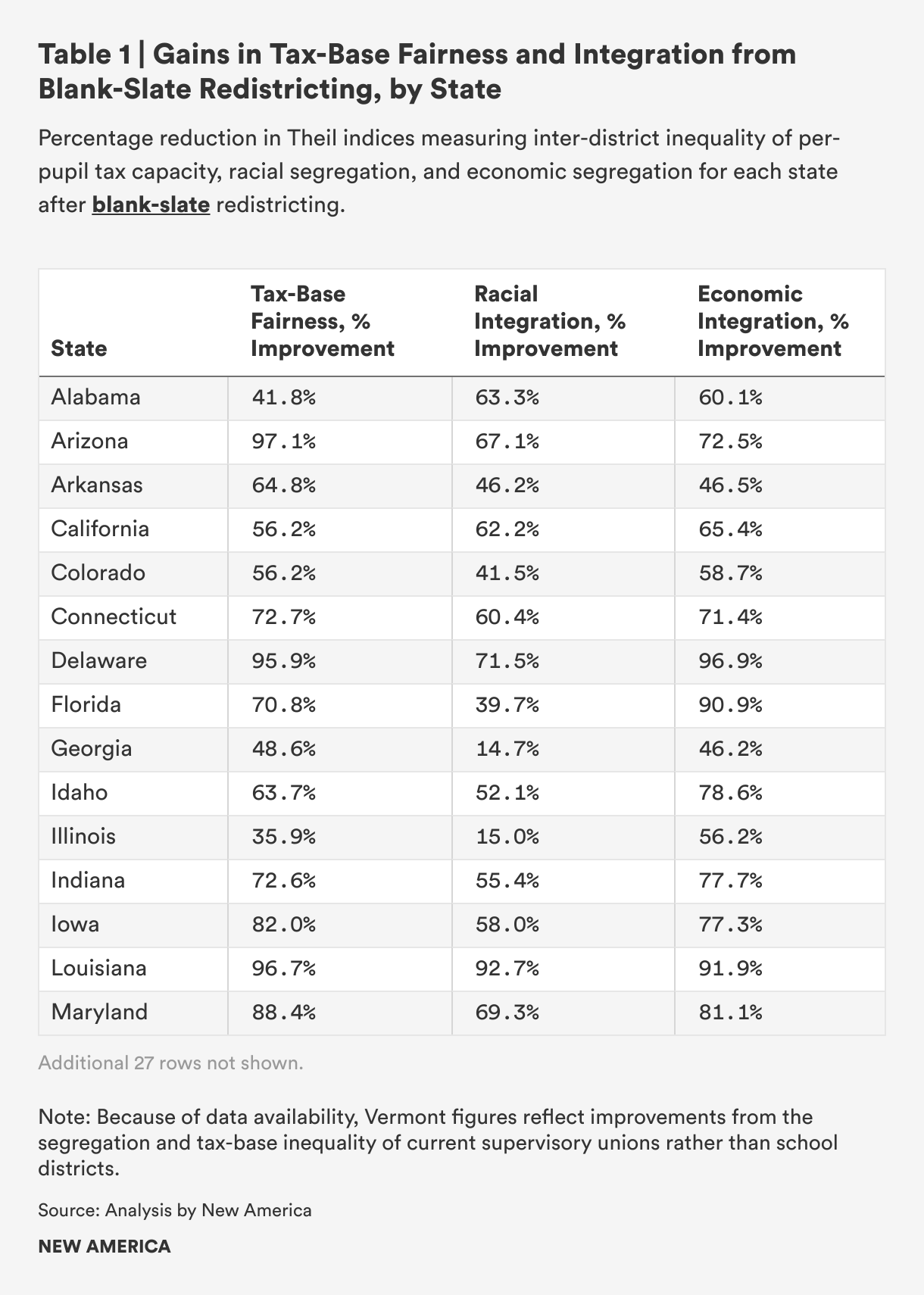
Our analysis revealed widespread gains from drawing new school district borders with funding equity and district diversity in mind. We measured improvements in our three outcomes of interest: equality across districts of per-pupil property valuation, district representativeness of the state’s racial composition, and similarity of district poverty rates to the statewide child poverty rate. These results are summarized in Table 1 and discussed in more detail below. To see each state’s proposed blank-slate redistricting map, see the interactive tool that accompanies this report.
Impact on Per-Pupil Property Tax Capacity
All 42 states analyzed saw reduced inequality of per-pupil tax capacity across districts after this simulated redistricting. In the average state, this inequality was reduced by 66.6 percent. Arizona saw the most significant gains, cutting inequality of property tax capacity by 97.1 percent. This was achieved by redrawing boundaries to encompass properties whose collective valuation per pupil is much closer to the statewide per-pupil valuation, making sure students across each state have fair access to local revenue and no district is at either extreme when it comes to property wealth.
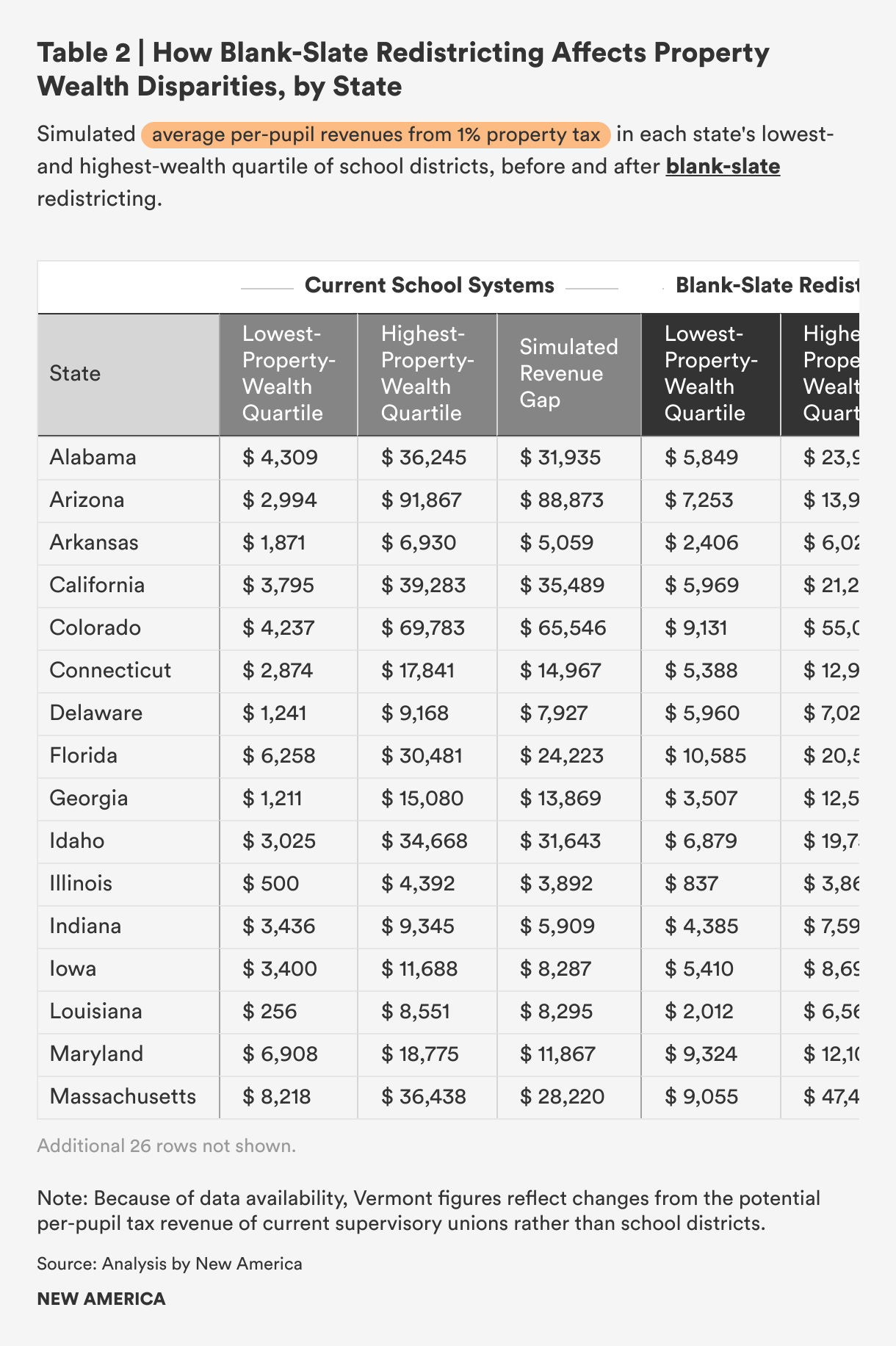
Currently, if every school district collected a 1 percent property tax and school districts in every state were divided into quartiles by property wealth per pupil, districts in the highest-wealth quartiles would raise $28,900 per student per year, on average. Districts in the lowest-wealth quartile would raise about $3,300 per student. The worst of these divides is in Oregon, where a district in the property-richest quartile would collect an astounding $119,000 more per pupil than a district in the property-poorest quartile. After blank-slate redistricting, districts in the highest-wealth quartile in the average state would still raise more from that 1 percent tax: about $16,100 per student per year, compared with $5,600 per student on average in the lowest-wealth quartile of districts. But that disparity would be less than half as large as it is today. In fact, the tax-capacity gap between property-wealthy and property-poor districts would narrow in 40 of 42 states. It would shrink considerably, by an average of 49 percent (and by 90 percent in Oregon).
Table 2 shows the average amount that would be raised per pupil by a 1 percent property tax in the lowest- and highest-wealth quartile of districts as they currently exist in each state, and the parallel amounts if our proposed new districts replaced existing districts.
Impact on Racial Segregation
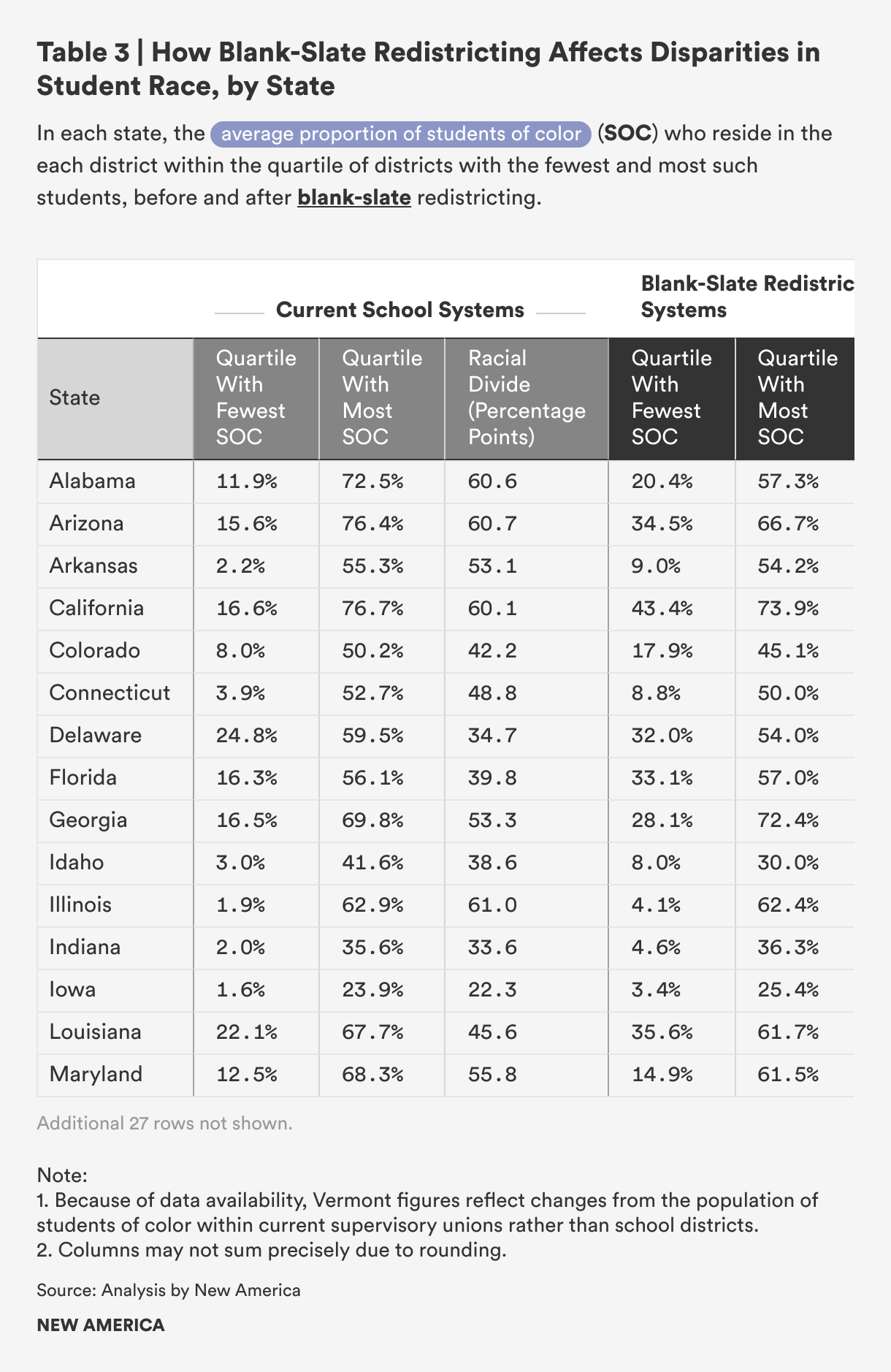
The new proposed school district boundaries would reduce inter-district racial segregation in all 42 states. The average state would see district racial demographics become 47.6 percent more aligned with statewide racial proportions for the school-aged population, across five racial groups (Asian, Black, Latino, Native, and White students). The state that would see the greatest such gains would be Louisiana, which would cut inter-district segregation by 92.7 percent if the proposed boundaries were enacted.
When districts in each state are divided into quartiles based on the percentage of students of color they include, we can see how the racial gap changes between the quartiles of districts with the most and fewest students of color. This comparison is a cruder measure of segregation than the overall improvement percentages reported above, primarily because that measure considers how well each district’s student population represents the statewide percentages of five specific races, while the quartile analysis only reflects differences in the percentage of students of color as a single group. Nevertheless, it can be helpful to see these quartile averages to get a more concrete sense of how White students and students of color are currently assigned to districts, and how they would be spread across districts after redistricting.
Currently, the average state’s bottom-quartile district has 7.5 percent students of color, while its top-quartile district has a population that is half students of color (49.3 percent), a racial gap of 41.8 percentage points. After blank-slate redistricting, the racial gap between the average state’s top- and bottom-quartile districts narrowed to 33.3 percentage points. This was the result of a shrinking divide in 35 of 42 states examined, and a modestly widening divide in seven states. However, when all five racial groups were accounted for separately, districts became more representative of statewide racial demographics in all 42 states.
Table 3 shows each state’s average percentage of students of color in the quartiles of districts, including the fewest and most such students, before and after blank-slate redistricting.
Impact on Economic Segregation
All 42 states in our analysis saw less economic segregation between districts under the proposed new district map. The average state saw district poverty rates become 65.0 percent more reflective of the statewide school-aged poverty rate after blank-slate redistricting.
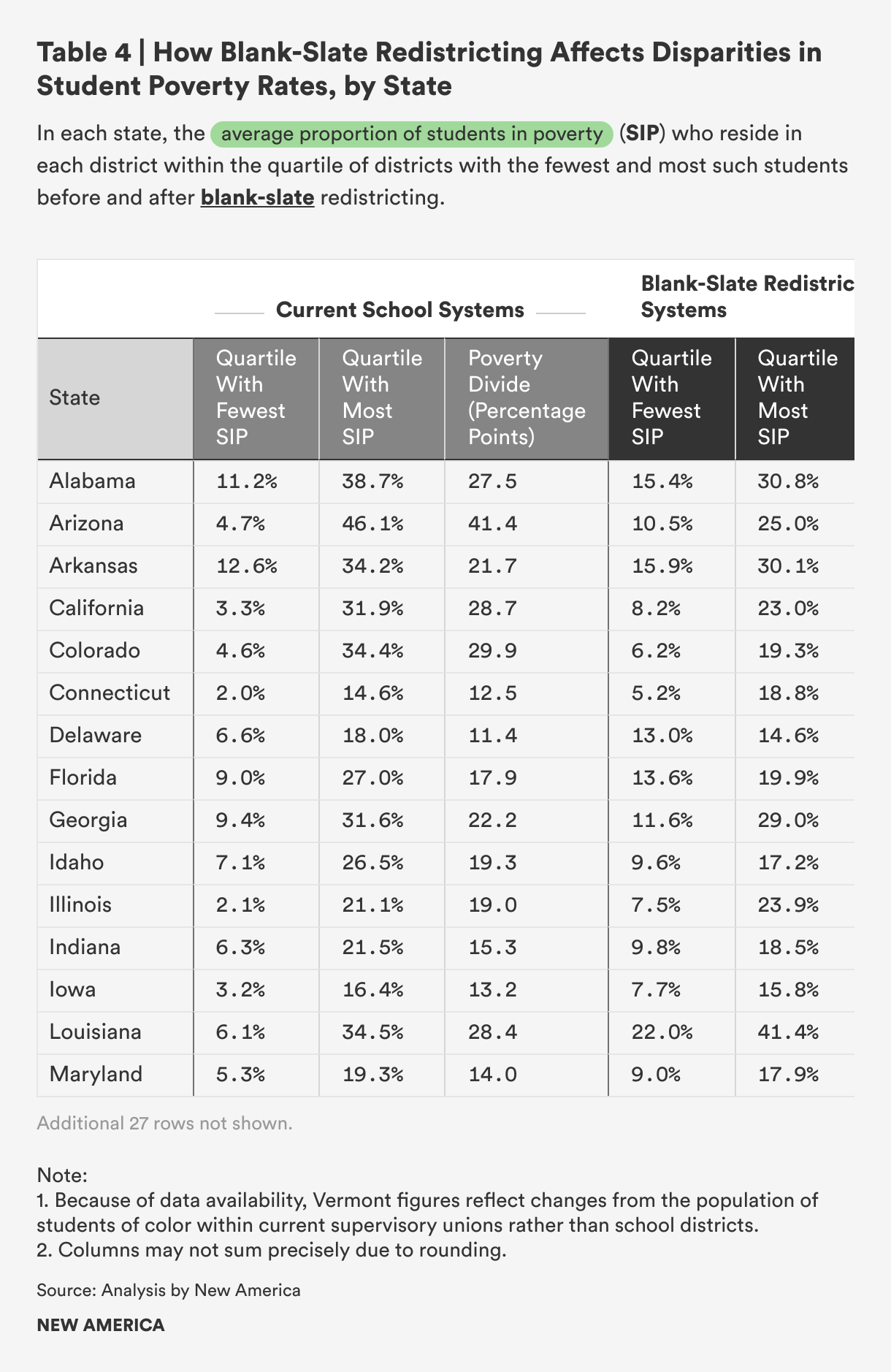
When districts in each state are divided into quartiles by student poverty rate, before redistricting, the average state’s poorest districts have a mean poverty rate of 26.2 percent, while its least-poor districts have a mean rate of 5.7 percent children in poverty, a gap of 20.5 percentage points. If school system borders were made fairer through blank-slate redistricting, that gap would narrow to 12.2 points, with highest-poverty districts averaging a child poverty rate of 22.0 percent, compared with 9.8 percent in the least-poor districts. Comparing these numbers for every state, 41 out of the 42 states analyzed would see their range of poverty rates narrow, reducing economic segregation. The sole exception, Connecticut, saw its poverty gap worsen by just 1.2 percentage points.
Table 4 shows the average district poverty rate in the lowest- and highest-poverty quartiles of districts based on current school system borders, and the parallel figures for districts after blank-slate redistricting.
Model 2: County-Based Redistricting
Rather than using an algorithmic method to redraw school districts, this model makes use of existing jurisdictional boundaries that are generally larger than current school districts: county lines. While there are states that use counties as the basis for some school district boundaries, few have exclusively county-level school districts.
In Florida and West Virginia, all school districts align with counties without exception.54 In Maryland, Nevada, and Virginia, there are only county-level school districts, with the sole exception of city-level school districts for cities that are not legally part of a county.55 These are the five states we consider to already have fully county-based school district maps.
Alabama, Georgia, Indiana, Kentucky, Louisiana, Mississippi, North Carolina, South Carolina, Tennessee, and Utah currently each have a substantial number of county-level districts alongside some other, non-county districts.56 Additionally, many of the counties with “county” school districts in these states actually contain both a county district and a separate city district, so the county district does not truly encompass the entire county. Montana has county-level high school districts.57 In other states, school systems either do not align with county boundaries or do so only occasionally, in individual cases.
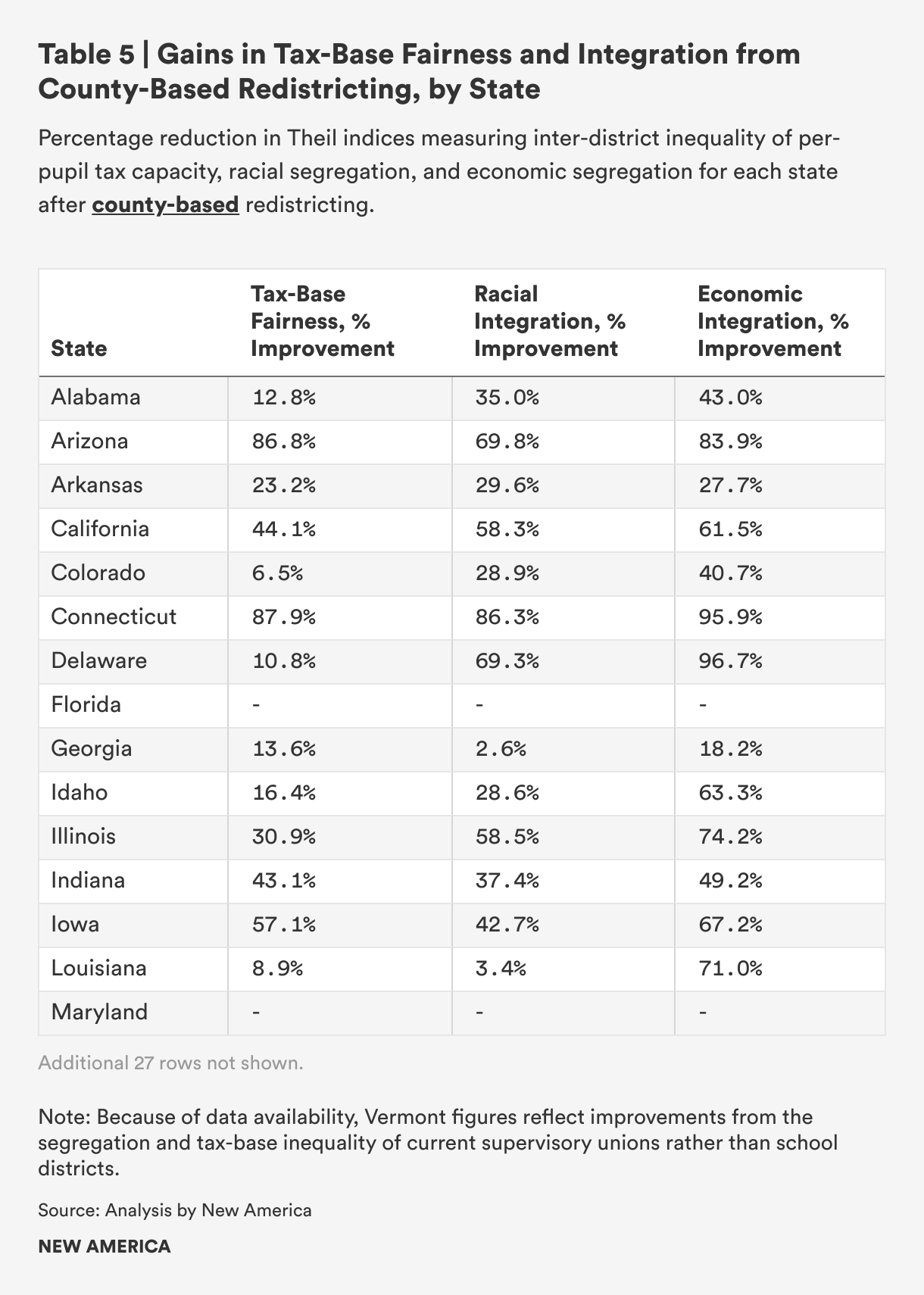
Because there is ample precedent for county-level school districts but states with exclusively county-level school district boundaries are rare, it is instructive to see how this familiar model, universally applied, could transform the equity of state school district maps. For this simulation, we analyzed the effects of replacing current school district lines with county borders in all states.58 We measured improvements in the same three priority outcomes as in Model 1: equality across districts of property valuation per pupil, district mirroring of statewide racial demographics, and district mirroring of statewide child poverty percentages. These results are summarized in Table 5 and discussed in more detail below. To see each state’s county-based school district map, see the interactive tool that accompanies this report.
Impact on Per-Pupil Property Tax Capacity
Out of the 42 states analyzed, 37 do not already have exclusively county-based school systems. All of these saw improvements in equality of access to per-pupil property wealth, though they were not as large as in Model 1.
Across the 37 states analyzed whose borders would change under a county-based redistricting model, the average state saw a 39.0 percent improvement in equality of access to per-pupil property wealth. Generally, school districts in Northeastern states (where existing districts are usually drawn at the town or city level) would see some of the greatest tax fairness gains from a switch to county-based school systems. Connecticut, for instance, would see a gain of 87.9 percent in equality of per-pupil tax capacity between districts. Rhode Island would improve by 81.2 percent on this measure, and New Hampshire by 66.4 percent. These gains underscore how a systematic move to wider, more inclusive borders can do much to level the property-tax playing field for school districts.
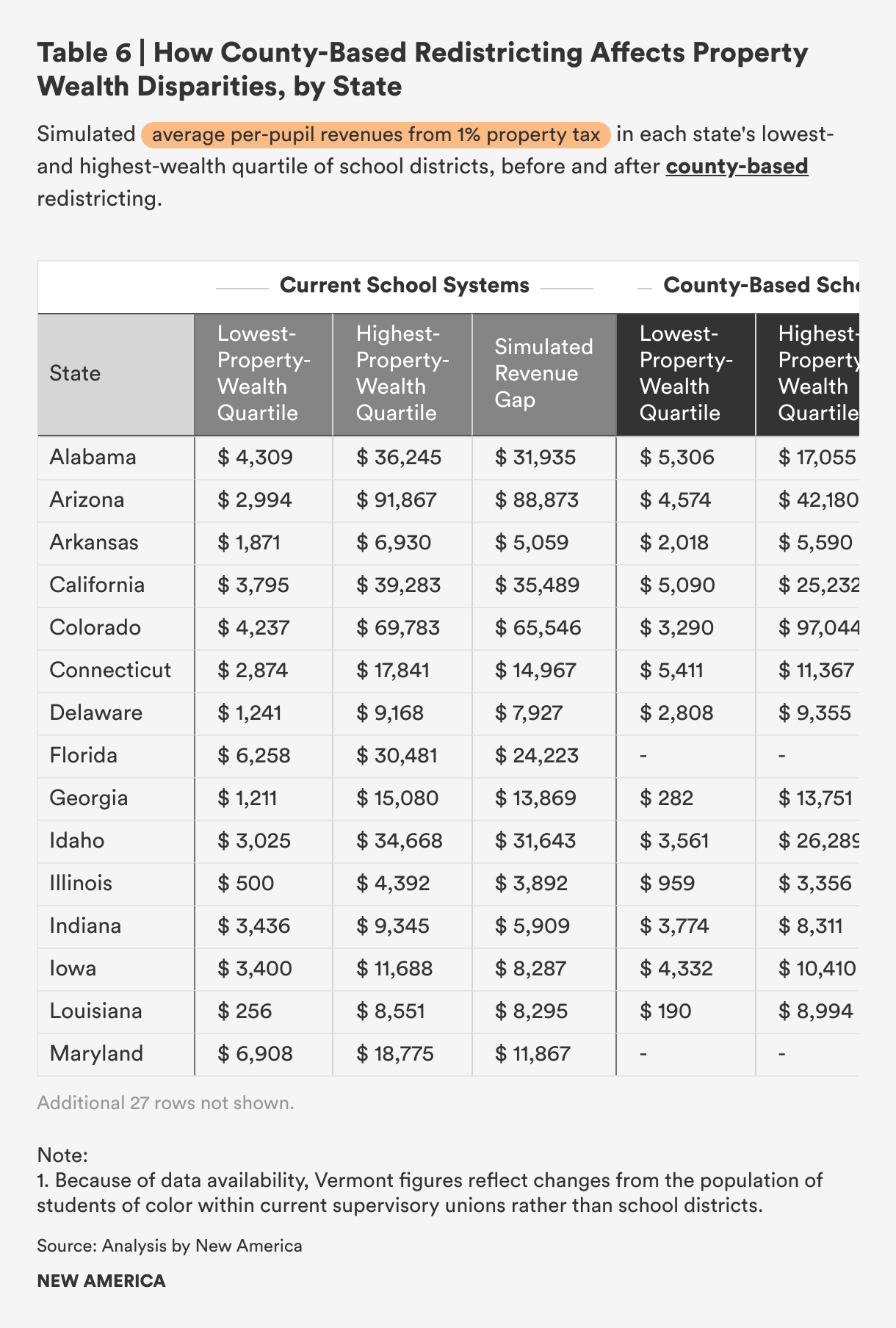
If every existing school district in these 37 states were collecting a 1 percent property tax, and if school districts in every state were divided into quartiles by property wealth per pupil, districts in the highest-wealth quartiles would raise about $26,700 more per student per year, on average, than districts in the lowest-wealth quartiles. County-based redistricting would reduce this tax-capacity gap between the highest- and lowest-wealth districts in only 26 of the 37 states. This indicates that the county-based model—which yields generally larger school districts, but not through any optimized process—may improve tax-base fairness across the whole group of districts in all states, but it does not reliably break the monopoly of the wealthiest districts on their states’ highest-value properties.
On average, county districts in their states’ highest-wealth quartiles would collect about $22,800 per student per year, while those in the lowest-wealth quartiles would raise almost $4,300. While this tax capacity gap would still be substantial and larger than the one that would result from blank-slate redistricting, it would reduce by more than a quarter the disparity that exists in states today, increasing fairness in students’ access to local school revenue.
Table 6 shows the average amount that would be raised per pupil with a 1 percent property tax in the lowest- and highest-wealth quartile of districts as they currently exist in each state, and the parallel amounts if the state had a universal, county-based school district map.
Impact on Racial Segregation
All 37 states saw a reduction in inter-district racial segregation in this model. That is, after the simulated county-based redistricting, the racial makeup of school districts in all these states more closely matched the proportions of five racial groups of school-aged children statewide (Asian, Black, Latino, Native, and White students). Racial segregation decreased by 40.7 percent on average.
When the districts of each of these states are divided into quartiles based on the percentage of students of color they include, the racial gap between the average state’s bottom-quartile and top-quartile district is 42.6 percentage points. Once states were redistricted along county lines, that gap shrank to 33.4 percentage points, an improvement almost identical to that in blank-slate redistricting. With county-based redistricting, this racial gap narrowed in 33 of 37 states analyzed.
This quartile comparison is less nuanced than the overall percentage improvement figure reported first in this section, since that measure considers the representativeness of districts’ populations across five different races while the quartile comparison places all students of color together in one category. When all five racial groups were accounted for separately, county-based redistricting made districts more representative of statewide racial demographics in all 37 states. Still, the quartile averages are helpful for understanding the degree to which White students and students of color would live and learn in the same districts.
Table 7 shows each state’s average percentage of students of color in the quartiles of districts including the fewest and most such students, before and after county-based redistricting.
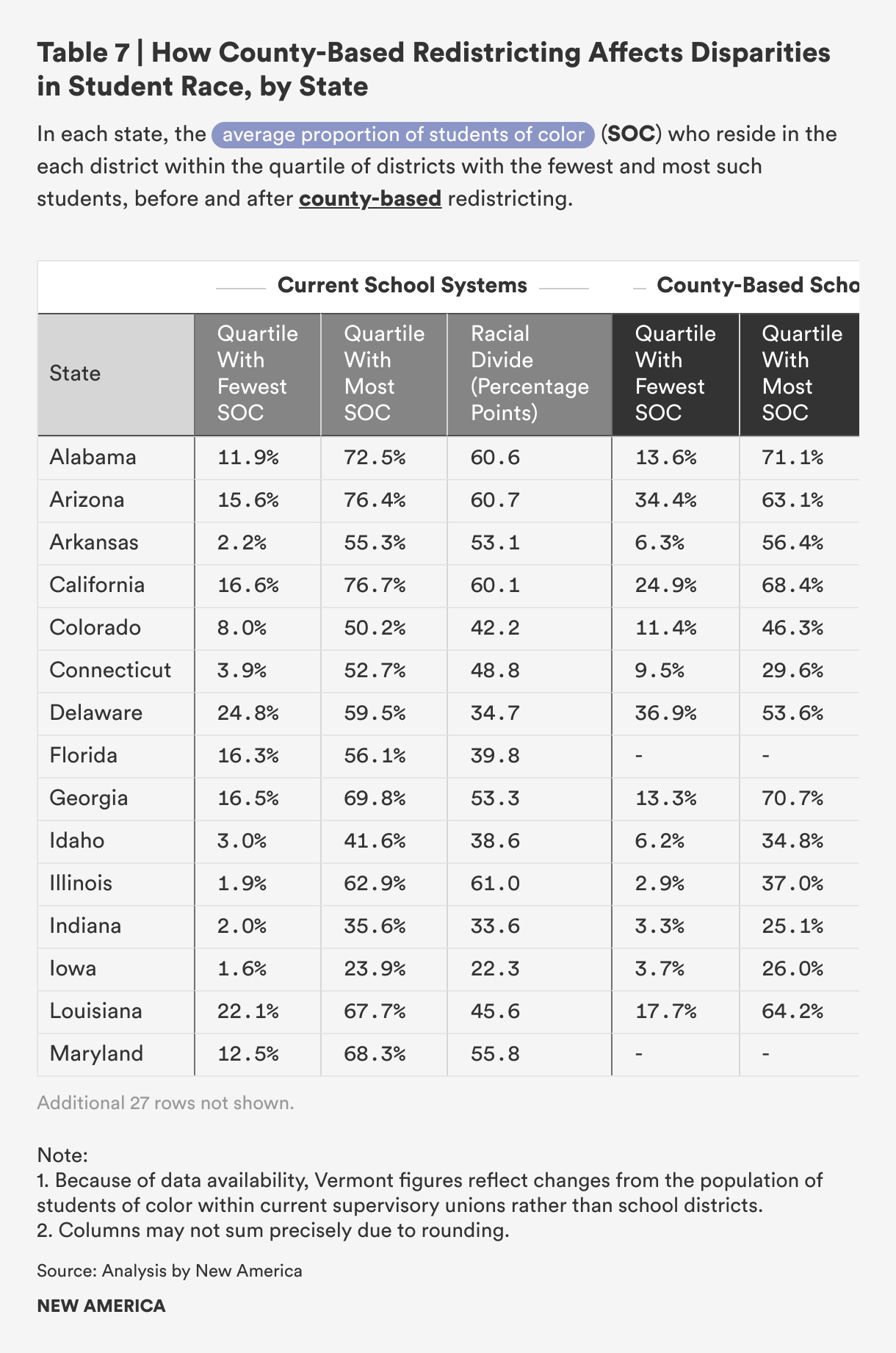
Impact on Economic Segregation
All of the 37 states saw a decrease in inter-district economic segregation, meaning that after the simulated replacement of current school district boundaries with county lines, school districts in all these states saw their poverty rates become more similar to the statewide poverty rate among school-aged children. On this measure, the average state improved by 57.2 percent.
When each of these districts is assigned to quartiles by poverty rate, the average state’s highest-poverty districts currently have a mean proportion of 26.6 percent children in poverty, while its lowest-poverty districts have a mean poverty rate of 5.3 percent—a 21.3-point gap. After school districts were redrawn along county lines, that gap narrowed by over a third, with average poverty rates of 10.1 percent in the lowest-poverty districts and 23.2 percent in the highest-poverty districts. All 37 states saw this poverty gap shrink. The most impressive improvement was in Montana, where the poverty-rate gap was reduced from 47.9 points to just 13.1 points through county-based redistricting.
Table 8 shows the average district poverty rate in the lowest- and highest-poverty quartiles of districts based on current school system borders, and the comparison figures for districts after county-based redistricting.
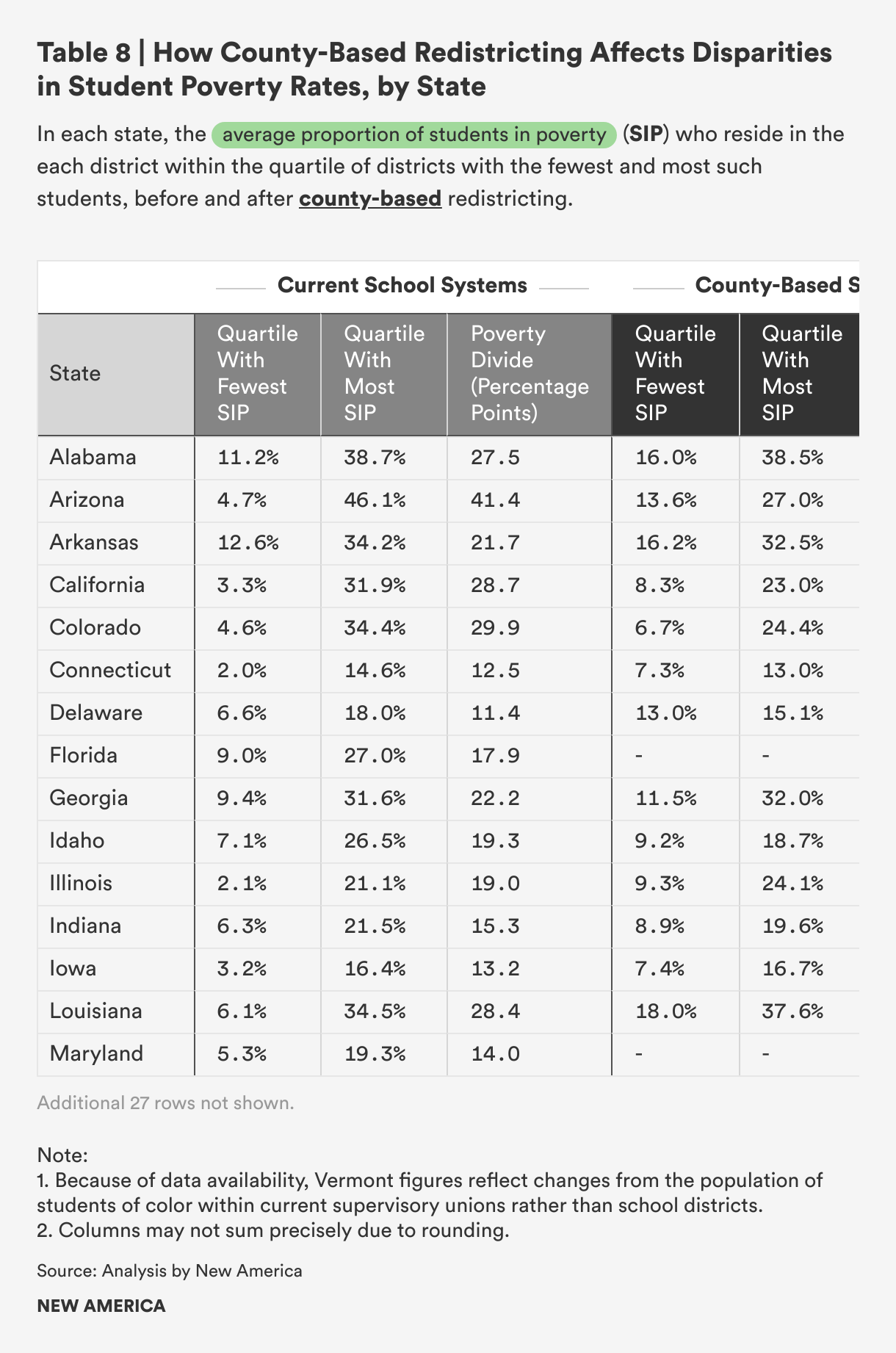
Model 3: Redistricting by Merger
For this simulation, we measured the effects of strategically merging existing school districts to create larger districts that offer fairer access to property wealth and increase integration. School district consolidation is the most common form of district boundary change. This approach makes use of that familiar mechanism, but where most merger efforts occur at the local level, this model proposes optimal statewide merger plans. As before, we measured improvements in three areas: equality across districts of assessed property valuation per pupil, similarity of district racial demographics to statewide racial demographics, and similarity of district poverty rates to statewide child poverty rates.
Though the gains we measure from the merger model were not quite as great as those from the blank-slate model, redistricting via consolidation offers some practical benefits. The primary advantage of merger-based redistricting is that each school’s entire attendance zone (the geographic area from which the school draws its students) will be included in the new district. This is not guaranteed with the other two models, whose proposed boundaries may cut across existing districts. As a result, there is no automatic need to change school attendance zones when districts merge, reducing the potential growing pains for students and families when joining a new district. Additionally, while the blank-slate and county-based redistricting options can only be pursued wholesale, by states redrawing their entire school district maps, consolidations can happen individually, on local initiative. Our methods optimize for statewide improvement, seeking to simulate the merged-district map that would produce the most equal assessed property valuation per pupil across the state’s school systems while reducing racial and economic segregation between those school systems. This is ideally meant to provide guidance for whole-state school system redistricting. But statewide improvements are composed of district-by-district gains. So, in states that do not take up wholesale redrawing of school district boundaries, communities can still refer to this analysis to see the local mergers that would be most beneficial.
State results are summarized in Table 9 and discussed in more detail below. For maps showing the specific consolidated districts in each state’s merger model, see the interactive mapping tool that accompanies this report.
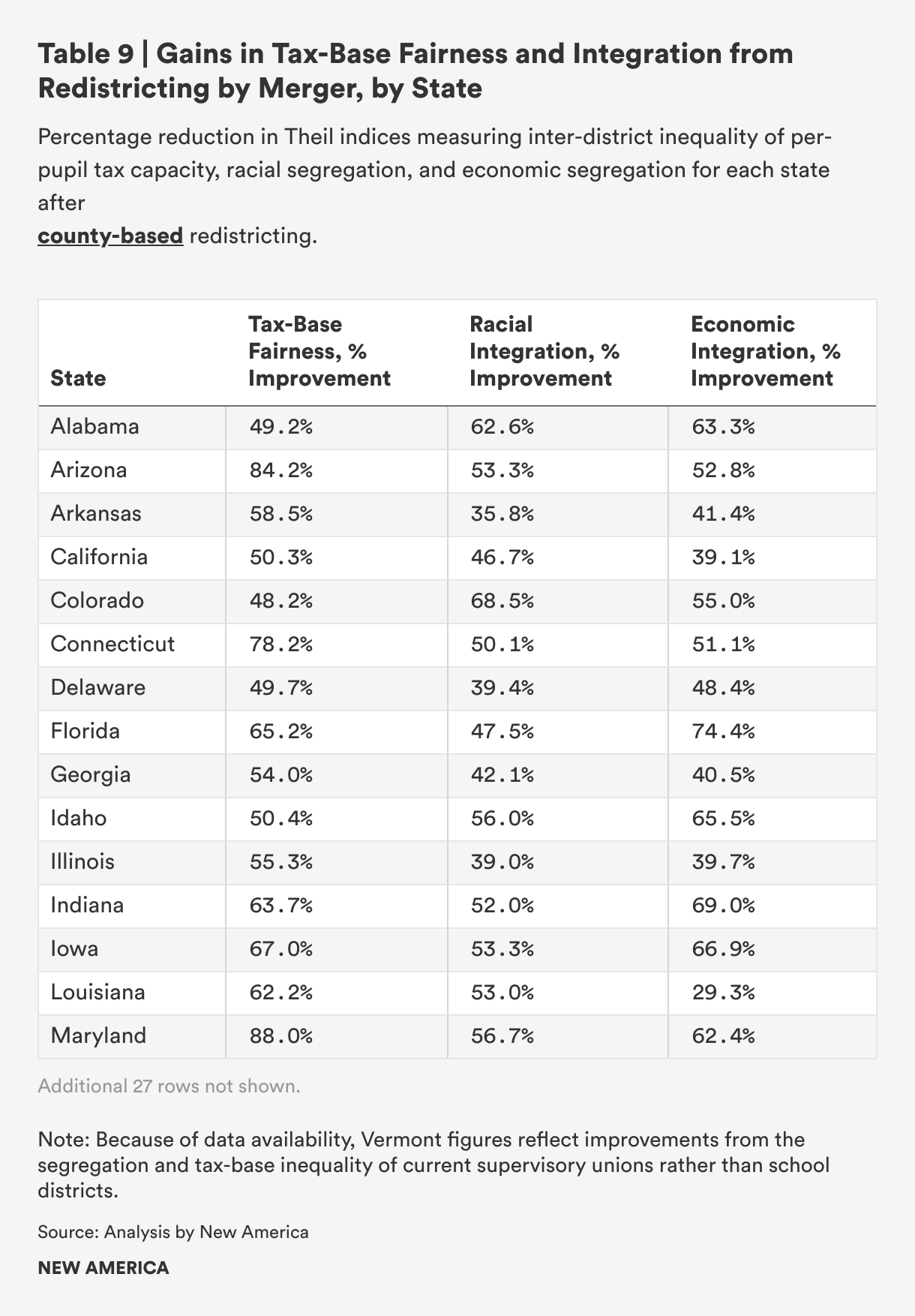
Impact on Per-Pupil Property Tax Capacity
All of the 42 states in our analysis saw improvement in equality of per-pupil property tax capacity after simulated redistricting via strategic merger. The average state saw a 63.0 percent gain on this measure, as the per-pupil value of districts’ tax bases became much more similar to the per-student share of the state’s overall tax capacity.
We have already determined that if every existing school district were to collect a 1 percent property tax, districts in the highest-wealth quartile of school districts for their state would raise about $28,900 per student per year, on average. Meanwhile, districts in the least property-wealthy quartile of school systems would raise just over $3,300 per student per year. After redistricting by strategic merger, that disparity would narrow in all 42 states analyzed. While the tax-capacity gap would shrink in more states after redistricting by merger than after blank-slate redistricting, the gains are not as great. On average across all states analyzed, top-wealth-quartile districts would raise about $20,000 per pupil from a 1 percent property tax after strategic mergers, while districts in the bottom wealth quartiles would raise $4,050, leaving a divide of more than $15,900 per student per year. This is about 40 percent smaller than the tax capacity gap under current school district boundaries, but that impressive gain still falls short of the blank-slate model.
Table 10 shows the amount that would be raised per pupil by a 1 percent property tax in the lowest- and highest-wealth quartile of districts as they currently exist in each state, and the parallel amounts if the districts were merged, as in our proposed model.
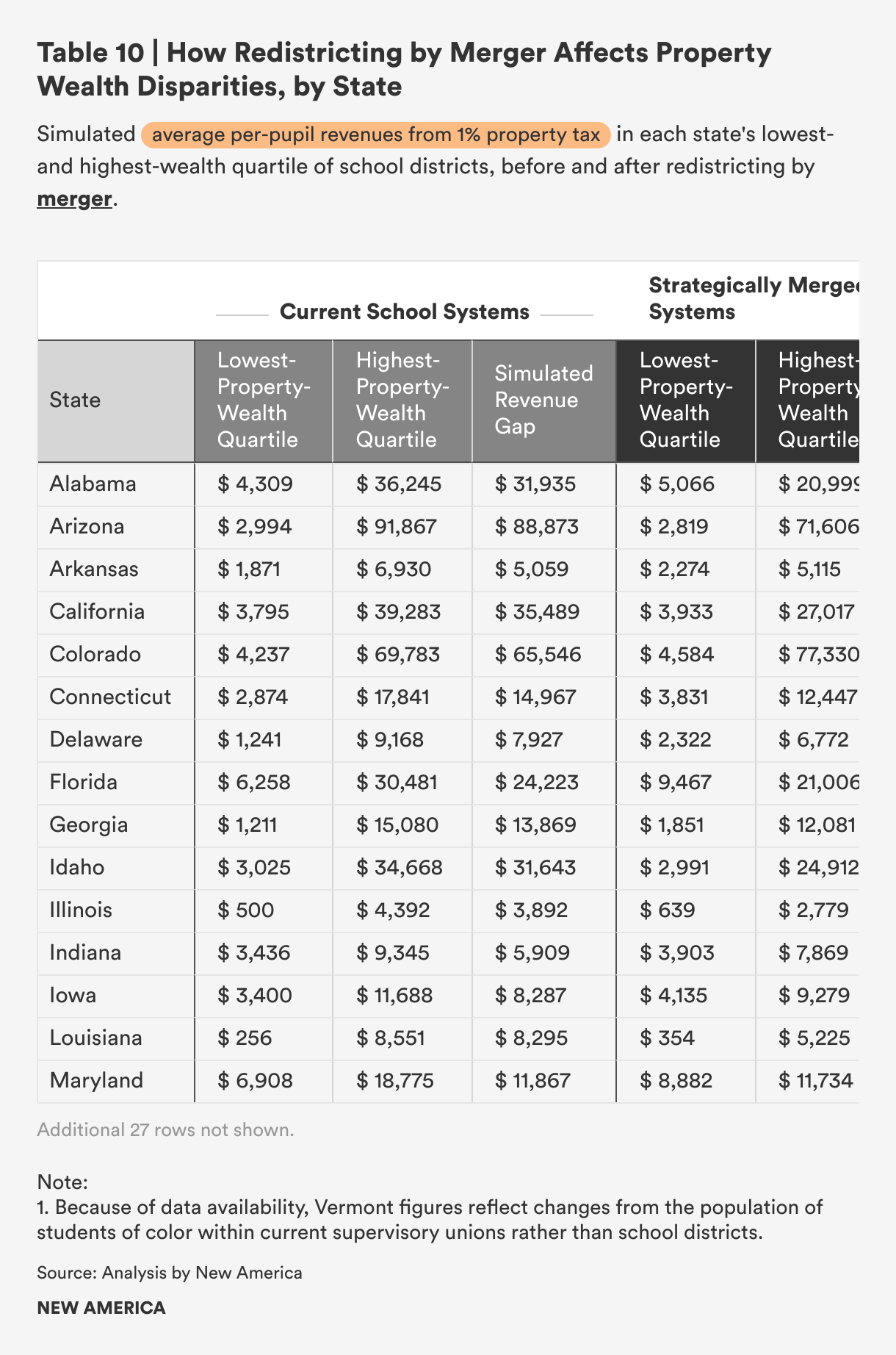
Impact on Racial Segregation
All of the 42 states saw inter-district racial segregation decrease after redistricting through optimal mergers. In the average state, districts’ racial demographics, defined as proportions of the school-aged population falling into five racial categories (Asian, Black, Latino, Native, and White), became 48.2 percent more reflective of the statewide school-aged population.
When each state’s districts are assigned to quartiles based on their percentage of students of color, the racial gap between the average state’s bottom-quartile and top-quartile district is 41.8 percentage points, between 7.5 percent students of color and 49.3 percent. After redistricting by merger, this difference would shrink to 35.4 percentage points, a slightly smaller improvement than with either blank-slate or county-based redistricting. This racial gap would narrow in 37 of 42 states analyzed.
As noted in the discussions of the other models, this comparison is somewhat simplistic relative to the overall improvement percentage above, which accounts separately for students in five different racial groups and shows gains for all 42 states. The quartile comparison has only a single category for students of color. Still, it is useful for showing concretely how White students and students of color are distributed across districts before and after redistricting by merger.
Table 11 shows each state’s average percentage of students of color in the quartiles of districts, including the fewest and most such students, before and after redistricting by merger.
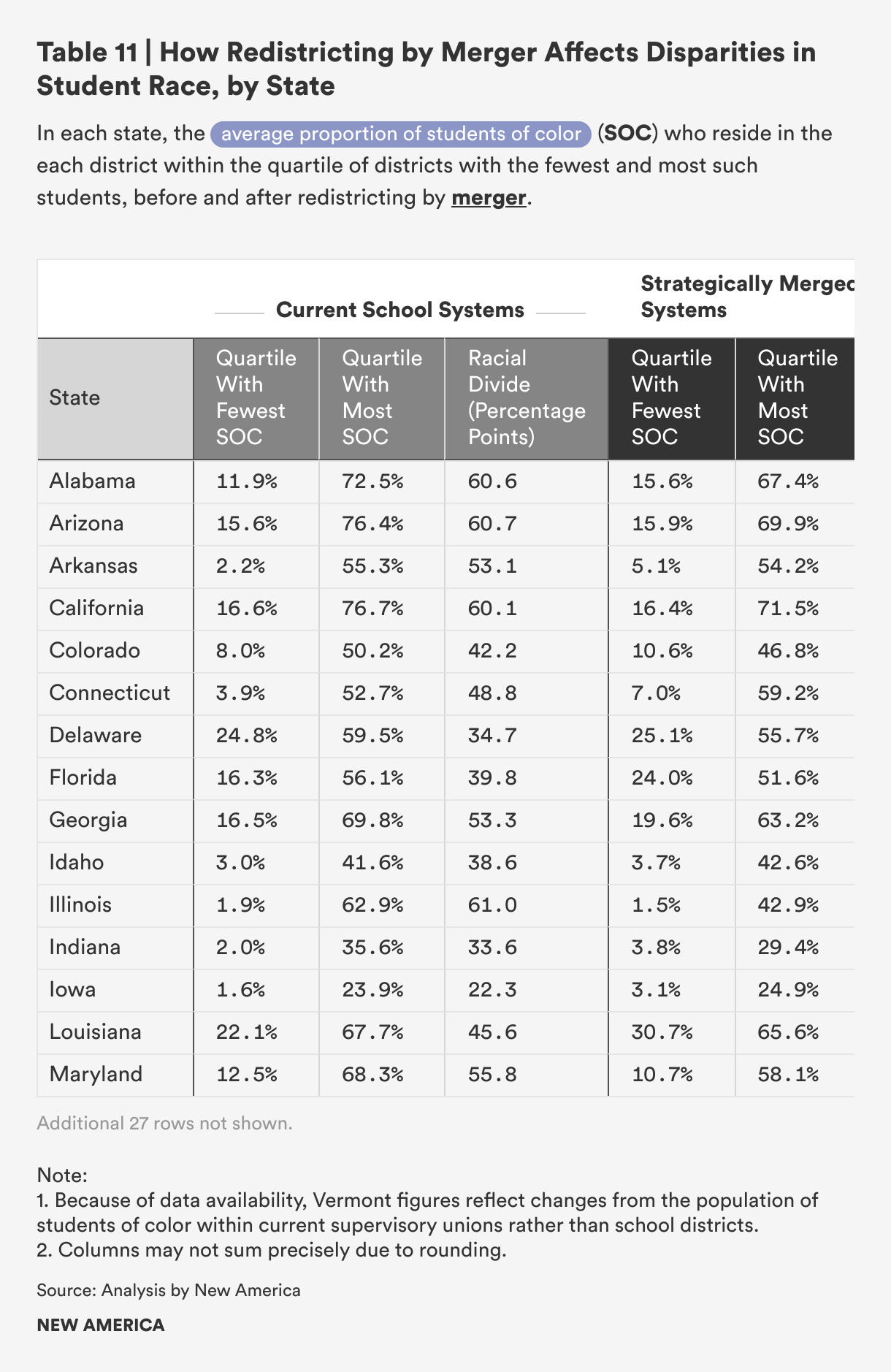
Impact on Economic Segregation
All 42 states analyzed saw a decrease in economic segregation between school districts after merger-based redistricting. The average state saw its districts’ poverty rates become 54.6 percent more similar to the statewide school-aged poverty rate.
As noted above, when the school districts in each state are divided into quartiles based on their poverty rates, the average district in its state’s highest-poverty quartile has a poverty rate of 26.3 percent, while the average district in the lowest-poverty quartile has a poverty rate of 5.7 percent. If district borders were optimally merged, that 20.5-point poverty-rate gap would narrow modestly to 16.4 points, with the school-aged population in highest-poverty districts having a rate of 23.6 percent, compared with 7.2 percent in lowest-poverty districts. This average would result from a smaller poverty gap in 38 out of 42 states.
Table 12 shows the average district poverty rate in the lowest- and highest-poverty quartiles of districts based on current school system borders, and the parallel number for districts after redistricting by merger.
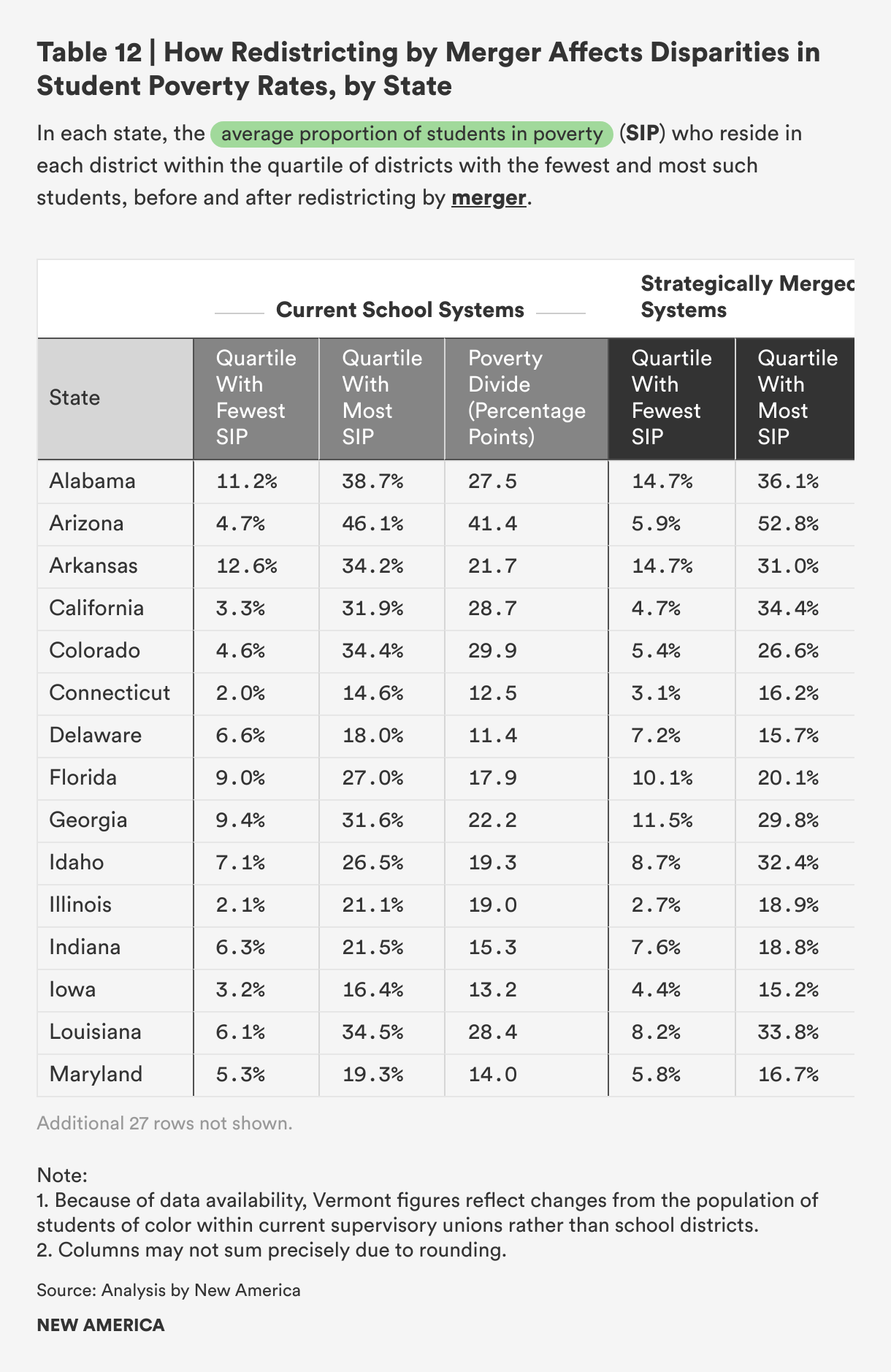
Discussion
Across all redistricting models, every state analyzed would see improvement on every one of our three priority measures. Over and over, we see that purposeful, whole-state redistricting can produce more diverse school districts with fairer access to local revenue.
Unsurprisingly, the blank-slate model, which is guided only by community-level property valuations and by where students live, would produce the largest gains for per-pupil tax-base equality and reduced inter-district segregation. But merger-based redistricting, for which there is more precedent nationally and which reduces the practical challenges associated with having to assign some students to new schools, would yield average improvements that are nearly as large. Even county-based redistricting, which uses only existing jurisdictional boundaries and is not algorithmically driven to address any of our priority areas, would still result in significantly more tax-base fairness and less inter-district segregation. For states willing to take up this issue, huge progress can be made. And all this is possible without changing anything about underlying student residential patterns or property values—just by redrawing the invisible lines that divide states and students into today’s unequal school systems.
This does not mean, however, that redistricting is a simple process for school officials and communities to navigate. The following section, authored by a school district superintendent who was directly involved in two school system consolidation efforts, discusses the practical and political challenges associated with effecting district boundary change and the policies that can help smooth the way.
Citations
- Institute of Education Sciences, National Center for Education Statistics, “Table 214.10: Number of Public School Districts and Public and Private Elementary and Secondary Schools: Selected School Years, 1869–70 through 2022–23” in Digest of Education Statistics, revised January 2024, <a href="<a href="<a href="source">source">source">source">source.
- Campbell F. Scribner, The Fight for Local Control: Schools, Suburbs, and American Democracy (Cornell University Press, 2016), 32–56, eBook Collection (Cornell Scholarship Online).
- See, for example, Bridget Higdon, “Gov. Phil Scott Rolls Out School District Consolidation Plan; Local Officials Weigh In,” Saint Albans Messenger, January 23, 2025, <a href="<a href="<a href="source">source">source">source">source; Hannah Gross, “More NJ School Districts Think Hard About Consolidating,” NJ Spotlight News, August 20, 2024, <a href="<a href="<a href="source">source">source">source">source.
- Jacqueline M. Nowicki, K–12 Education: Student Population Has Significantly Diversified, but Many Schools Remain Divided Along Racial, Ethnic, and Economic Lines (U.S. Government Accountability Office, June 2022), <a href="<a href="<a href="source">source">source">source">source.
- Zahava Stadler and Jordan Abbott, Crossing the Line: Segregation and Resource Inequality Between America’s School Districts (New America, February 2024), <a href="<a href="<a href="source">source">source">source">source.
- Krista Kaput and Bonnie O’Keefe, Fortifying Funding: How States Can Strengthen Education Finance Systems for the Future (Bellwether, February 2023), 12, <a href="<a href="<a href="source">source">source">source">source.
- See, for example, David Rhode, Kristina Cooke, and Himanshu-Ojha, “The Decline of the ‘Great Equalizer,’” The Atlantic, December 19, 2012, <a href="<a href="<a href="source">source">source">source">source; Thomas B. Edsall, “Is Education No Longer the ‘Great Equalizer’?” New York Times, June 23, 2021, <a href="<a href="<a href="source">source">source">source">source; and Arne Duncan, “Education: The ‘Great Equalizer,’” Britannica, 2018, <a href="<a href="<a href="source">source">source">source">source.
- Zahava Stadler and Jordan Abbott, Crossing the Line: Segregation and Resource Inequality Between America’s School Districts (New America, February 2024), <a href="<a href="<a href="source">source">source">source">source.
- Pennsylvania Department of Education, “Types of Schools,” September 1, 2025, <a href="<a href="source">source">source">source; and United States Census Bureau, “2023 Public Elementary-Secondary Education Finance Data,” <a href="<a href="source">source">source">source.
- Metropolitan Philadelphia Indicators Project, Policy Brief: Consolidating School Districts (MPIP, May 2011), <a href="<a href="source">source">source">source.
- Metropolitan Philadelphia Indicators Project, Policy Brief, <a href="<a href="source">source">source">source.
- Senate Bill 131, Regular Session of 2010, Pennsylvania, <a href="<a href="source">source">source">source.
- Pennsylvania House Republican Caucus, “Parker Amendments to Fix School Funding—State Representative Calls for Faster Transition to Equity,” press release, August 21, 2015, <a href="<a href="source">source">source">source.
- Pennsylvania Senate Democrats, “Schwank Announces Plans to Introduce Bills to Aid School Mergers,” press release, October 31, 2023, <a href="<a href="source">source">source">source.
- Representative Greg Scott, “School District Reorganization Study,” Pennsylvania House of Representatives (website), May 25, 2025, <a href="<a href="source">source">source">source.
- Zahava Stadler and Jordan Abbott, Crossing the Line: Segregation and Resource Inequality Between America’s School Districts (New America, February 2024), <a href="<a href="source">source">source">source.
- Krista Kaput and Bonnie O’Keefe, Fortifying Funding: How States Can Strengthen Education Finance Systems for the Future (Bellwether, February 2023), 12, <a href="<a href="source">source">source">source.
- United States Census Bureau, “2023 Public Elementary-Secondary Education Finance Data,” <a href="<a href="source">source">source">source.
- Center for Educational Equity, “School Funding Court Decisions by State,” <a href="<a href="source">source">source">source.
- United States Census Bureau, “2023 Public Elementary-Secondary Education Finance Data,” <a href="<a href="source">source">source">source.
- Zahava Stadler, K–12 Federal COVID Relief: What Can We Learn from Doing School Funding Differently? (New America, October 2023), 18, <a href="<a href="source">source">source">source.
- Melissa Yelenik, “Experts: Medicaid, SNAP Cuts Could Hurt Economy, Strain State Budgets,” U.S. News & World Report, August 11, 2025, <a href="<a href="source">source">source">source; and Sarah D. Wire, “'Catastrophe': States Scramble after Trump's Cuts to Medicaid, SNAP,” USA Today, July 16, 2025, <a href="<a href="source">source">source">source.
- William N. Evans, Robert M. Schwab, and Kathryn L. Wagner, “The Great Recession and Public Education,” Education Finance and Policy 14, no. 2 (March 2019): 298–326, <a href="<a href="source">source">source">source; and David S. Knight, “Are High-Poverty School Districts Disproportionately Impacted by State Funding Cuts? School Finance Equity Following the Great Recession,” Journal of Education Finance 43, no. 2 (September 2017): 169–94, <a href="<a href="source">source">source">source.
- Michael Kolomatsky, “How Much Higher Are Your Post-Pandemic Property Taxes?” New York Times, March 28, 2024, <a href="<a href="source">source">source">source; and Niko Spyridonos, “The Impact of Rising Property Taxes on Communities,” Smart Cities Dive, July 22, 2024, <a href="<a href="source">source">source">source.
- Institute of Education Sciences, National Center for Education Statistics, “Table 214.10: Number of Public School Districts and Public and Private Elementary and Secondary Schools: Selected School Years, 1869–70 through 2022–23” in Digest of Education Statistics, revised January 2024, <a href="source">source">source.
- Campbell F. Scribner, The Fight for Local Control: Schools, Suburbs, and American Democracy (Cornell University Press, 2016), 32–56, eBook Collection (Cornell Scholarship Online).
- State of Vermont, Agency of Administration, “School Redistricting Task Force: About,” <a href="source">source">source.
- Act 73, An Act Relating to Transforming Vermont’s Education Governance, Quality, and Finance Systems, Regular Session 2025–2026, Vermont, 2025, <a href="source">source">source.
- Bridget Higdon, “Gov. Phil Scott Rolls Out School District Consolidation Plan; Local Officials Weigh-In,” St. Albans Messenger, January 23, 2025, <a href="source">source">source.
- The Education Efficiency Act, House Bill 1431, Regular Session 2025, Mississippi, <a href="source">source">source.
- Official Site of the State of New Jersey, Department of Community Affairs, “School Regionalization Efficiency Program (SREP),” <a href="source">source">source.
- Hannah Gross, “More NJ School Districts Think Hard About Consolidating,” NJ Spotlight News, August 20, 2024, <a href="source">source">source.
- Scott, “School District Reorganization Study,” <a href="source">source">source.
- For more on student enrollment declines, see Tara Moon, “K–12 Public School Enrollment Declines, Explained,” FutureEd, August 5, 2025, <a href="source">source">source; and Abigail Francis and Joshua Goodman, “School Enrollment Shifts Five Years After the Pandemic,” EdWorkingPaper 25-1233 (June 2025), <a href="source">source">source.
- EdBuild, Frontier: Merger (EdBuild, June 2020), <a href="source">source">source.
- EdBuild, Frontier: Territory Transfer (EdBuild, June 2020), <a href="source">source">source.
- EdBuild, Frontier: Secession (EdBuild, June 2020), <a href="source">source">source.
- See, for example, ABC News 4 Staff, “Dorchester School District Two Urges Land Transfer for New School Construction,” ABC 4 News, March 31, 2025, <a href="source">source">source; and Christopher Saul, “Val-p Leader: ‘If We Don’t So Something, We Are Going To Tax Ourselves Out of Existence,’” Mid Bay News, October 28, 2024, <a href="source">source">source.
- See, for example, Marielle Argueza, “What Two North County School Districts Stand to Gain and Lose in New Territory Proposal,” Monterey County Now, September 12, 2019, <a href="source">source">source; Julianna Morano, “Will Clovis Unified Expand Into the Fresno County Foothills? Not if One Rural School District Can Help It,” Fresnoland, September 5, 2024, <a href="source">source">source; and Will Garbe, “Local District Cites Race as Reason Some Want to Leave Schools,” Dayton Daily News, June 12, 2018, <a href="source">source">source.
- Jacqueline M. Nowicki, K–12 Education: Student Population Has Significantly Diversified, but Many Schools Remain Divided Along Racial, Ethnic, and Economic Lines (U.S. Government Accountability Office, June 2022), <a href="source">source">source.
- Democracy Docket, “Racial Gerrymandering vs. Racial Vote Dilution, Explained,” Democracy Docket, August 17, 2022, <a href="source">source">source.
- The exception to this rule is the very occasional role that required redistricting played in court-ordered desegregation plans in the second half of the twentieth century, including in the metropolitan areas of Wilmington, Delaware and Louisville, Kentucky. See Gary Orfield, foreword to The Courts, the Legislature, and Delaware’s Resegregation (The Civil Rights Project at UCLA, December 2014), 6, <a href="source">source">source.
- United States Census Bureau, “2023 Public Elementary-Secondary Education Finance Data,” <a href="source">source">source.
- Betsey Martens, Elizabeth Glenn, and Tiffany Mangum, “Race, Equity and Housing: The Early Years,” Journal of Housing & Community Development 77, no. 5 (September/October 2020), <a href="source">source">source; and National Low Income Housing Coalition, “Public Housing History,” October 17, 2019, <a href="source">source">source.
- Robert K. Nelson, “Mapping Inequality: Redlining in New Deal America” in the American Panorama: An Atlas of United States History online map project, Digital Scholarship Lab at University of Richmond, https:// dsl.richmond.edu/panorama/redlining/.
- University of Minnesota, Libraries, “What is a Covenant?” Mapping Prejudice Project, accessed September 2, 2025, <a href="source">source">source.
- Brent Cebul, “Tearing Down Black America,” Boston Review, July 22, 2020, <a href="source">source">source.
- Cecilia Rouse, Jared Bernstein, Helen Knudsen, and Jeffery Zhang, “Exclusionary Zoning: Its Effect on Racial Discrimination in the Housing Market,” The White House, June 17, 2021, <a href="source">source">source.
- Jonathan Rothwell and Douglas S. Massey, “The Effect of Density Zoning on Racial Segregation in U.S. Urban Areas,” Urban Affairs Review 44, no. 6 (April 9, 2009): 779–806, <a href="source">source">source.
- John Walsh and Jung Hyun Choi, “Black Housing Wealth Varies Across Local Markets, Despite Recent Improvement in the Black Homeownership Rate Nationally,” Urban Wire (blog), Urban Institute, February 18, 2025, <a href="source">source">source.
- Stadler and Abbott, Crossing the Line, 18, <a href="source">source">source.
- Glenn Adams, “Baldacci Secures Consolidation Plan,” Portsmouth Herald, June 8, 2007, Seacoastonline (website), <a href="source">source">source.
- Molly A. Hunter, State Constitution Education Clause Language, Education Law Center, n.d., <a href="source">source">source.
- Economic Statistical Methods Division, Individual State Descriptions: 2022 (U.S. Census Bureau, April 2024), source.
- Baltimore, Maryland; Carson City, Nevada; and 38 cities in the state of Virginia.
- Economic Statistical Methods Division, Individual State Descriptions: 2022, source. Note that in Louisiana, these geographic entities are called parishes but are equivalent to counties.
- Economic Statistical Methods Division, Individual State Descriptions: 2022, source.
- Municipalities that are not legally part of counties are kept as separate school districts in this model, including Baltimore, Maryland; Carson City, Nevada; St. Louis, Missouri; and 38 cities in the state of Virginia.
V. Achieving District Boundary Change: Lessons from a School System Leader
This section is written by Scott Menzel, superintendent of Scottsdale Unified School District in Arizona and former superintendent of the Washtenaw Intermediate School District in Michigan.
Leading one successful consolidation of two Michigan school districts and working on another, failed district annexation in the same county offered me firsthand experience in the ways in which state policy, local context, and community values intersect in border-change conversations.
A Tale of Two Consolidation Efforts
Willow Run Community Schools and Ypsilanti Public Schools were neighboring districts on the east side of Washtenaw County. Both dealt with financial deficits and long-term enrollment declines. They also struggled academically and faced the threat of state takeover or dissolution. Beginning in 2011, the Washtenaw Intermediate School District (an educational service agency serving all school districts in the county) agreed to work with the two districts and their communities on a potential new beginning via consolidation. Numerous meetings over an 18-month span surfaced both hopes and fears.

Photo courtesy of Scott Menzel, used with permission.
Some wondered how it could improve anything to combine two failing districts. Others wondered why we weren’t looking to merge with Ann Arbor, which was large, high-performing, and well-funded. Still, 61 percent of the voters in both school districts ultimately approved the consolidation in November 2012.

Photo courtesy of Scott Menzel, used with permission.
A few years later, Ann Arbor Public Schools (AAPS) and the much smaller Whitmore Lake Public Schools (WLPS) considered an annexation. AAPS would take over WLPS’s area and students. While the Whitmore Lake community would lose “local control,” it would gain higher per-pupil funding and greater system capacity and would hopefully arrest its enrollment declines. AAPS would get school building space and, because of the specifics of Michigan’s funding policy, increased revenue. This effort was overwhelmingly approved by Whitmore Lake residents but failed when it was rejected by 57 percent of voters in Ann Arbor.
Local Politics and District Boundary Change
In Michigan, like in most states, district border changes usually have to be proposed and approved locally, by school boards and district voters. This makes local politics decisive in whether redistricting happens.
Over the course of multiple administrations in Michigan, specific funds were designated to support district consolidations, but most still didn’t move forward, even when they would have benefited students. State aid might be enough to seal the merger of two distressed districts, like Ypsilanti and Willow Run, but it probably won’t overcome the resistance of voters in a more prosperous district to merging with a struggling one.
It is important for local leaders pursuing consolidation to have clarity on the “why.” Often, discussions are simply about perceived economic inefficiencies. These arguments rarely motivate communities to act. But when financial challenges and academic performance are combined and the focus is on creating high-quality options for all students, conversations can move from protecting what was to creating what should be for the next generation of students.
It is also necessary to be honest about voters’ priorities: Demographics matter. In the case of Ypsilanti and Willow Run, the student populations were similar demographically. Both districts were high-poverty, with students of color making up nearly 80 percent of enrollment (quite different than demographics in the wider area). Conversely, Ann Arbor contains the vast majority of property wealth in Washtenaw County, is highly educated, and is demographically diverse. Whitmore Lake, a predominantly White, higher-poverty community, wasn’t seen as a desirable acquisition. Whitmore Lake had a compelling reason to merge; it was a shrinking district that needed help to give the best possible education to its students. Ann Arbor did not face a similar existential threat, and it ultimately rejected the annexation proposal.
State Policy to Support District Boundary Change
State elected officials are often reluctant to wade into the messy politics of district consolidation, given how community identity is linked to local schools. But states can create the conditions that encourage border-change conversation, especially the threat of state takeover for failing or insolvent districts. State policy can also provide incentive funding for consolidation.
There are four more specific ways states can mitigate the political and practical challenges of consolidation:
- Mandatory reorganization conversations can create the space for tackling the hard questions. Leveraging educational service agencies (also known as intermediate school districts, intermediate units, or other, state-specific terms) can be a way to have third-party facilitation with an understanding of the relevant local considerations and context. In 1964, Michigan Public Act 289 required each intermediate school district to convene a committee on school system reorganization.59 At the time, numerous communities did not provide education through high school completion. As a result of this effort, many smaller K–5 and K–8 districts were absorbed into K–12 districts.
- It is very challenging to navigate debt obligations from the districts where boundary changes are being considered. Taxpayers are reluctant to assume someone else’s debt, and failure to address this at the beginning can lead to stalled processes. State solutions for legacy debt obligations are needed to remove an impediment to redistricting. The state could provide aid to equalize local tax levies or take on part of the debt obligation. This did not happen at the beginning of the Willow Run-Ypsilanti merger, but 10 years later, the state provided funding to erase the legacy debt, leveling the playing field.
- Facility utilization after consolidation is important. To ensure demographically diverse districts (not segregated, which is what we’ve seen happen as a result of existing school choice policies in Michigan), it is imperative to make the options compelling not only in terms of quality teachers and curricula, but also in terms of the facilities and infrastructure and proximity to where students live. Before consolidation, Ypsilanti schools were in better shape due to more recent bond initiatives that provided funding for capital improvements. However, it was also important to keep some schools in the former Willow Run district open to honor the community’s history and to educate students in neighborhoods where they lived. States should support districts in making plans for facility usage and in upgrading buildings where needed.
- Schools of choice and open enrollment policies complicate district boundary discussions. At a time when students can choose to attend a school that is not in their neighborhood, traditional district public schools are tasked with being prepared to serve all who live within their boundaries. This can result in inadequate support for public system, dollars shift to alternative options (often without a commitment to transparency and accountability for how taxpayer resources are spent). Because these policies affect both revenue and enrollment in traditional school districts, they can become reasons that districts may be pushed to consider consolidation. States should help school systems navigate that transition.
If redrawing educational boundaries aims to ensure students have access to high-quality, well-funded public education, regardless of background or zip code, then state legislatures must engage on this issue, creating the policy framework for productive border-change discussions and providing the funding and support necessary to implement these changes.
Citations
- Institute of Education Sciences, National Center for Education Statistics, “Table 214.10: Number of Public School Districts and Public and Private Elementary and Secondary Schools: Selected School Years, 1869–70 through 2022–23” in Digest of Education Statistics, revised January 2024, <a href="<a href="<a href="<a href="source">source">source">source">source">source.
- Campbell F. Scribner, The Fight for Local Control: Schools, Suburbs, and American Democracy (Cornell University Press, 2016), 32–56, eBook Collection (Cornell Scholarship Online).
- See, for example, Bridget Higdon, “Gov. Phil Scott Rolls Out School District Consolidation Plan; Local Officials Weigh In,” Saint Albans Messenger, January 23, 2025, <a href="<a href="<a href="<a href="source">source">source">source">source">source; Hannah Gross, “More NJ School Districts Think Hard About Consolidating,” NJ Spotlight News, August 20, 2024, <a href="<a href="<a href="<a href="source">source">source">source">source">source.
- Jacqueline M. Nowicki, K–12 Education: Student Population Has Significantly Diversified, but Many Schools Remain Divided Along Racial, Ethnic, and Economic Lines (U.S. Government Accountability Office, June 2022), <a href="<a href="<a href="<a href="source">source">source">source">source">source.
- Zahava Stadler and Jordan Abbott, Crossing the Line: Segregation and Resource Inequality Between America’s School Districts (New America, February 2024), <a href="<a href="<a href="<a href="source">source">source">source">source">source.
- Krista Kaput and Bonnie O’Keefe, Fortifying Funding: How States Can Strengthen Education Finance Systems for the Future (Bellwether, February 2023), 12, <a href="<a href="<a href="<a href="source">source">source">source">source">source.
- See, for example, David Rhode, Kristina Cooke, and Himanshu-Ojha, “The Decline of the ‘Great Equalizer,’” The Atlantic, December 19, 2012, <a href="<a href="<a href="<a href="source">source">source">source">source">source; Thomas B. Edsall, “Is Education No Longer the ‘Great Equalizer’?” New York Times, June 23, 2021, <a href="<a href="<a href="<a href="source">source">source">source">source">source; and Arne Duncan, “Education: The ‘Great Equalizer,’” Britannica, 2018, <a href="<a href="<a href="<a href="source">source">source">source">source">source.
- Zahava Stadler and Jordan Abbott, Crossing the Line: Segregation and Resource Inequality Between America’s School Districts (New America, February 2024), <a href="<a href="<a href="<a href="source">source">source">source">source">source.
- Pennsylvania Department of Education, “Types of Schools,” September 1, 2025, <a href="<a href="<a href="source">source">source">source">source; and United States Census Bureau, “2023 Public Elementary-Secondary Education Finance Data,” <a href="<a href="<a href="source">source">source">source">source.
- Metropolitan Philadelphia Indicators Project, Policy Brief: Consolidating School Districts (MPIP, May 2011), <a href="<a href="<a href="source">source">source">source">source.
- Metropolitan Philadelphia Indicators Project, Policy Brief, <a href="<a href="<a href="source">source">source">source">source.
- Senate Bill 131, Regular Session of 2010, Pennsylvania, <a href="<a href="<a href="source">source">source">source">source.
- Pennsylvania House Republican Caucus, “Parker Amendments to Fix School Funding—State Representative Calls for Faster Transition to Equity,” press release, August 21, 2015, <a href="<a href="<a href="source">source">source">source">source.
- Pennsylvania Senate Democrats, “Schwank Announces Plans to Introduce Bills to Aid School Mergers,” press release, October 31, 2023, <a href="<a href="<a href="source">source">source">source">source.
- Representative Greg Scott, “School District Reorganization Study,” Pennsylvania House of Representatives (website), May 25, 2025, <a href="<a href="<a href="source">source">source">source">source.
- Zahava Stadler and Jordan Abbott, Crossing the Line: Segregation and Resource Inequality Between America’s School Districts (New America, February 2024), <a href="<a href="<a href="source">source">source">source">source.
- Krista Kaput and Bonnie O’Keefe, Fortifying Funding: How States Can Strengthen Education Finance Systems for the Future (Bellwether, February 2023), 12, <a href="<a href="<a href="source">source">source">source">source.
- United States Census Bureau, “2023 Public Elementary-Secondary Education Finance Data,” <a href="<a href="<a href="source">source">source">source">source.
- Center for Educational Equity, “School Funding Court Decisions by State,” <a href="<a href="<a href="source">source">source">source">source.
- United States Census Bureau, “2023 Public Elementary-Secondary Education Finance Data,” <a href="<a href="<a href="source">source">source">source">source.
- Zahava Stadler, K–12 Federal COVID Relief: What Can We Learn from Doing School Funding Differently? (New America, October 2023), 18, <a href="<a href="<a href="source">source">source">source">source.
- Melissa Yelenik, “Experts: Medicaid, SNAP Cuts Could Hurt Economy, Strain State Budgets,” U.S. News & World Report, August 11, 2025, <a href="<a href="<a href="source">source">source">source">source; and Sarah D. Wire, “'Catastrophe': States Scramble after Trump's Cuts to Medicaid, SNAP,” USA Today, July 16, 2025, <a href="<a href="<a href="source">source">source">source">source.
- William N. Evans, Robert M. Schwab, and Kathryn L. Wagner, “The Great Recession and Public Education,” Education Finance and Policy 14, no. 2 (March 2019): 298–326, <a href="<a href="<a href="source">source">source">source">source; and David S. Knight, “Are High-Poverty School Districts Disproportionately Impacted by State Funding Cuts? School Finance Equity Following the Great Recession,” Journal of Education Finance 43, no. 2 (September 2017): 169–94, <a href="<a href="<a href="source">source">source">source">source.
- Michael Kolomatsky, “How Much Higher Are Your Post-Pandemic Property Taxes?” New York Times, March 28, 2024, <a href="<a href="<a href="source">source">source">source">source; and Niko Spyridonos, “The Impact of Rising Property Taxes on Communities,” Smart Cities Dive, July 22, 2024, <a href="<a href="<a href="source">source">source">source">source.
- Institute of Education Sciences, National Center for Education Statistics, “Table 214.10: Number of Public School Districts and Public and Private Elementary and Secondary Schools: Selected School Years, 1869–70 through 2022–23” in Digest of Education Statistics, revised January 2024, <a href="<a href="source">source">source">source.
- Campbell F. Scribner, The Fight for Local Control: Schools, Suburbs, and American Democracy (Cornell University Press, 2016), 32–56, eBook Collection (Cornell Scholarship Online).
- State of Vermont, Agency of Administration, “School Redistricting Task Force: About,” <a href="<a href="source">source">source">source.
- Act 73, An Act Relating to Transforming Vermont’s Education Governance, Quality, and Finance Systems, Regular Session 2025–2026, Vermont, 2025, <a href="<a href="source">source">source">source.
- Bridget Higdon, “Gov. Phil Scott Rolls Out School District Consolidation Plan; Local Officials Weigh-In,” St. Albans Messenger, January 23, 2025, <a href="<a href="source">source">source">source.
- The Education Efficiency Act, House Bill 1431, Regular Session 2025, Mississippi, <a href="<a href="source">source">source">source.
- Official Site of the State of New Jersey, Department of Community Affairs, “School Regionalization Efficiency Program (SREP),” <a href="<a href="source">source">source">source.
- Hannah Gross, “More NJ School Districts Think Hard About Consolidating,” NJ Spotlight News, August 20, 2024, <a href="<a href="source">source">source">source.
- Scott, “School District Reorganization Study,” <a href="<a href="source">source">source">source.
- For more on student enrollment declines, see Tara Moon, “K–12 Public School Enrollment Declines, Explained,” FutureEd, August 5, 2025, <a href="<a href="source">source">source">source; and Abigail Francis and Joshua Goodman, “School Enrollment Shifts Five Years After the Pandemic,” EdWorkingPaper 25-1233 (June 2025), <a href="<a href="source">source">source">source.
- EdBuild, Frontier: Merger (EdBuild, June 2020), <a href="<a href="source">source">source">source.
- EdBuild, Frontier: Territory Transfer (EdBuild, June 2020), <a href="<a href="source">source">source">source.
- EdBuild, Frontier: Secession (EdBuild, June 2020), <a href="<a href="source">source">source">source.
- See, for example, ABC News 4 Staff, “Dorchester School District Two Urges Land Transfer for New School Construction,” ABC 4 News, March 31, 2025, <a href="<a href="source">source">source">source; and Christopher Saul, “Val-p Leader: ‘If We Don’t So Something, We Are Going To Tax Ourselves Out of Existence,’” Mid Bay News, October 28, 2024, <a href="<a href="source">source">source">source.
- See, for example, Marielle Argueza, “What Two North County School Districts Stand to Gain and Lose in New Territory Proposal,” Monterey County Now, September 12, 2019, <a href="<a href="source">source">source">source; Julianna Morano, “Will Clovis Unified Expand Into the Fresno County Foothills? Not if One Rural School District Can Help It,” Fresnoland, September 5, 2024, <a href="<a href="source">source">source">source; and Will Garbe, “Local District Cites Race as Reason Some Want to Leave Schools,” Dayton Daily News, June 12, 2018, <a href="<a href="source">source">source">source.
- Jacqueline M. Nowicki, K–12 Education: Student Population Has Significantly Diversified, but Many Schools Remain Divided Along Racial, Ethnic, and Economic Lines (U.S. Government Accountability Office, June 2022), <a href="<a href="source">source">source">source.
- Democracy Docket, “Racial Gerrymandering vs. Racial Vote Dilution, Explained,” Democracy Docket, August 17, 2022, <a href="<a href="source">source">source">source.
- The exception to this rule is the very occasional role that required redistricting played in court-ordered desegregation plans in the second half of the twentieth century, including in the metropolitan areas of Wilmington, Delaware and Louisville, Kentucky. See Gary Orfield, foreword to The Courts, the Legislature, and Delaware’s Resegregation (The Civil Rights Project at UCLA, December 2014), 6, <a href="<a href="source">source">source">source.
- United States Census Bureau, “2023 Public Elementary-Secondary Education Finance Data,” <a href="<a href="source">source">source">source.
- Betsey Martens, Elizabeth Glenn, and Tiffany Mangum, “Race, Equity and Housing: The Early Years,” Journal of Housing & Community Development 77, no. 5 (September/October 2020), <a href="<a href="source">source">source">source; and National Low Income Housing Coalition, “Public Housing History,” October 17, 2019, <a href="<a href="source">source">source">source.
- Robert K. Nelson, “Mapping Inequality: Redlining in New Deal America” in the American Panorama: An Atlas of United States History online map project, Digital Scholarship Lab at University of Richmond, https:// dsl.richmond.edu/panorama/redlining/.
- University of Minnesota, Libraries, “What is a Covenant?” Mapping Prejudice Project, accessed September 2, 2025, <a href="<a href="source">source">source">source.
- Brent Cebul, “Tearing Down Black America,” Boston Review, July 22, 2020, <a href="<a href="source">source">source">source.
- Cecilia Rouse, Jared Bernstein, Helen Knudsen, and Jeffery Zhang, “Exclusionary Zoning: Its Effect on Racial Discrimination in the Housing Market,” The White House, June 17, 2021, <a href="<a href="source">source">source">source.
- Jonathan Rothwell and Douglas S. Massey, “The Effect of Density Zoning on Racial Segregation in U.S. Urban Areas,” Urban Affairs Review 44, no. 6 (April 9, 2009): 779–806, <a href="<a href="source">source">source">source.
- John Walsh and Jung Hyun Choi, “Black Housing Wealth Varies Across Local Markets, Despite Recent Improvement in the Black Homeownership Rate Nationally,” Urban Wire (blog), Urban Institute, February 18, 2025, <a href="<a href="source">source">source">source.
- Stadler and Abbott, Crossing the Line, 18, <a href="<a href="source">source">source">source.
- Glenn Adams, “Baldacci Secures Consolidation Plan,” Portsmouth Herald, June 8, 2007, Seacoastonline (website), <a href="<a href="source">source">source">source.
- Molly A. Hunter, State Constitution Education Clause Language, Education Law Center, n.d., <a href="<a href="source">source">source">source.
- Economic Statistical Methods Division, Individual State Descriptions: 2022 (U.S. Census Bureau, April 2024), source">source.
- Baltimore, Maryland; Carson City, Nevada; and 38 cities in the state of Virginia.
- Economic Statistical Methods Division, Individual State Descriptions: 2022, source">source. Note that in Louisiana, these geographic entities are called parishes but are equivalent to counties.
- Economic Statistical Methods Division, Individual State Descriptions: 2022, source">source.
- Municipalities that are not legally part of counties are kept as separate school districts in this model, including Baltimore, Maryland; Carson City, Nevada; St. Louis, Missouri; and 38 cities in the state of Virginia.
- Act 289, Reorganization of School Districts, Regular Session 1964, Michigan, 1964, source.
VI. State Spotlights
Blank-State Redistricting: Spotlight on Mississippi
The policies governing school district boundaries in Mississippi are a study in contrasts.
On the one hand, its only statutory processes for redrawing borders must be instigated by local school boards or local voters,60 and while the State Board of Education must review and approve changes, the law specifies no criteria at all that the board should consider.61 This suggests that redistricting in the state is guided almost entirely by local priorities.
On the other hand, the Mississippi legislature has repeatedly passed laws to alter the borders of specific districts. Between 2012 and 2019, it forced the creation of countywide districts in Sunflower, Clay, Oktibbeha, Montgomery, Leflore, and Holmes Counties, merging multiple school systems each time.62 In 2012 and 2017, respectively, it consolidated some of the districts in each of Bolivar and Chickasaw Counties,63 and in 2019, it ordered that the Lumberton Public School District be dissolved and its territory split between two other districts.64 It is clear that, while there is no statutory process for the state to change school district boundaries, Mississippi lawmakers are not shy about passing new laws to redraw lines where they see the need.
Perhaps, then, the state legislature might consider a more comprehensive set of changes to Mississippi’s boundaries—one with the potential to bring about huge gains for its students. Mississippi has pockets of deep segregation. Our Crossing the Line report found that in 2021, the state had four of the country’s 100 worst poverty-rate divides between adjacent school districts, and five of the 100 worst racial divides.65 If the state were to adopt the map, see Figure 2, we proposed in the blank-slate model, inter-district segregation by poverty rate would be cut by 73.2 percent, and districts would become 64.7 percent more racially representative of the state as a whole. Impressively, this model would reduce per-pupil tax-base inequality by 81.6 percent. This whole-state revision of district maps would create far more integrated school districts and give their students a much more level playing field when it comes to local school funding.
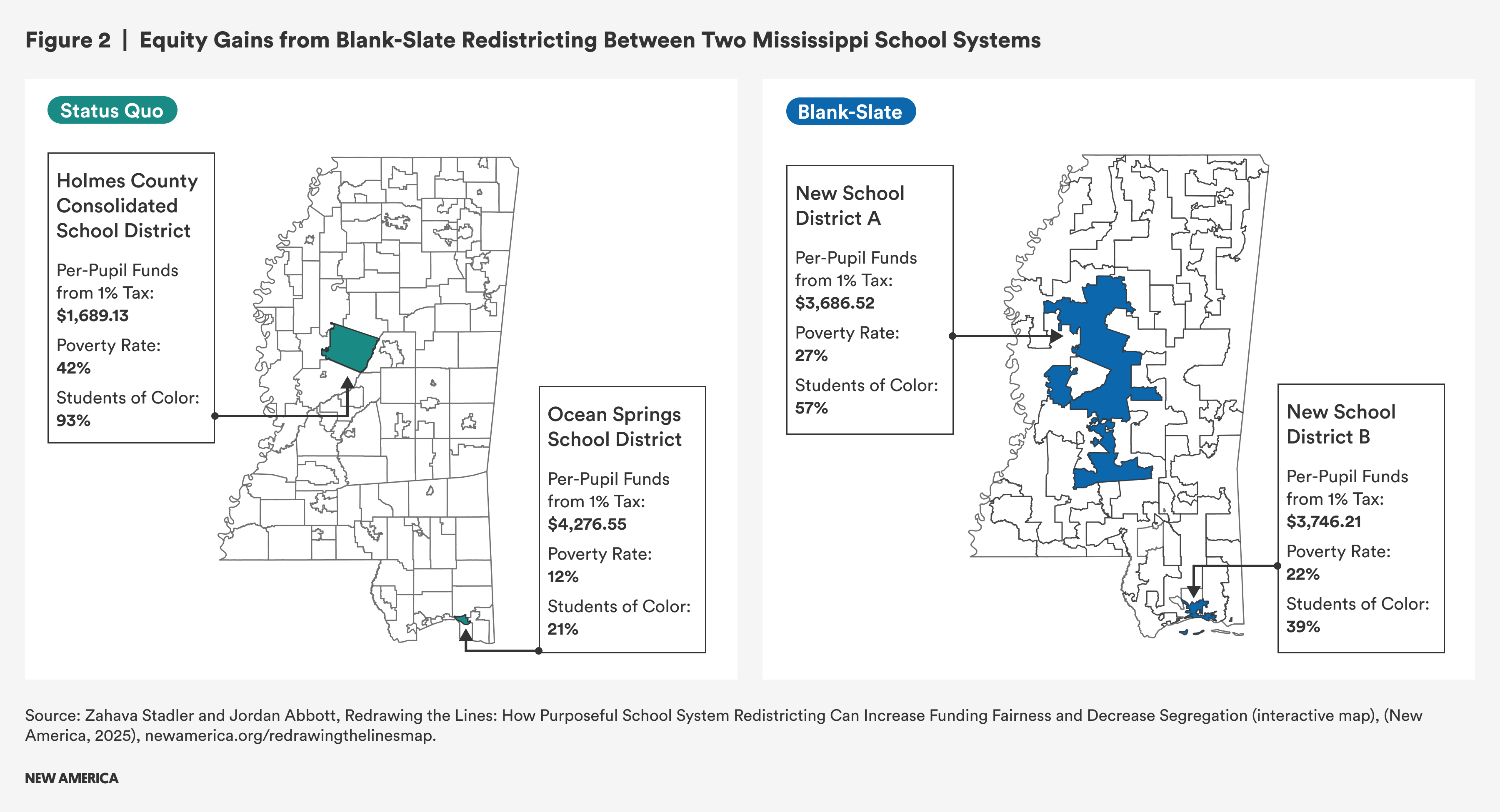
To see the new map of school systems proposed for Mississippi by our optimization algorithm and compare it to the state’s existing school district map, select Mississippi on the interactive mapping tool that accompanies this report and choose “blank slate” from the model drop-down menu.
County-Based Redistricting: Spotlight on Ohio
Ohio is currently engaged in a conversation about a different kind of redistricting—congressional redistricting—and the fear that gerrymandering could make the state’s congressional delegation less representative of Ohio voters than it is now.66 The state has an advantage, though, amid national concerns over partisan gerrymandering. In 2015, Ohioans amended the state constitution to require that new congressional districts be approved by a bipartisan supermajority of the state legislature.67 Failing that, the districts must be drawn by a bipartisan, independent redistricting commission. With this process, Ohio voters threw their support behind the idea that redistricting should be fair and not be used to advantage one party over the other.
To a limited extent, Ohio’s policy regarding school district boundary change also prioritizes fairness. The State Board of Education must approve locally initiated mergers and territory transfers,68 so boundary change is not entirely driven by hyperlocal concerns. The state board also has the power to initiate redistricting on its own rather than waiting for school districts to propose changes, though local voter approval is usually required in the end.69 When a local school board applies to the state for a change of boundaries, the state department of education must send all potentially affected school districts a list of 25 questions.70 These include a few related to property tax capacity and segregation. For instance, would a proposed territory transfer increase the concentration of students of color in the district that would be giving up land? And is the property in the area targeted for acquisition valuable enough that the request could be motivated by the prospect of increased property tax revenue? Though these questions are not asked in every instance of school district boundary change, financial and racial equity priorities are part of how Ohio approaches this policy area and could be extended to a whole-state redistricting effort.
Ohio state law already addresses the one-off merger of districts within the same county,71 as well as mergers proposed by educational service centers,72 many of which cover whole counties.73 This precedent is useful because Ohio would benefit significantly from county-based redistricting, see Figure 3 below. Ohio is currently fragmented into over 600 school districts—about double the national average. County-based redistricting would reduce that number to 88. Although the county-based model is not algorithmically optimized, the wider district borders would still increase inter-district tax-base equality in the state by 56.2 percent, while cutting racial segregation by 52.8 percent and reducing poverty-rate disparities by 74.1 percent. (These improvements are all greater than the national average for county-based redistricting, though they mostly fall short of the gains that Ohio could realize by adopting one of the optimized-model maps.) When districts in Ohio are assigned to quartiles based on the percentage of students of color they include, current bottom-quartile Ohio school systems have just 1.1 percent students of color, on average, while top-quartile school systems have 34.6 percent. County-based redistricting would cut this racial gap by a third.
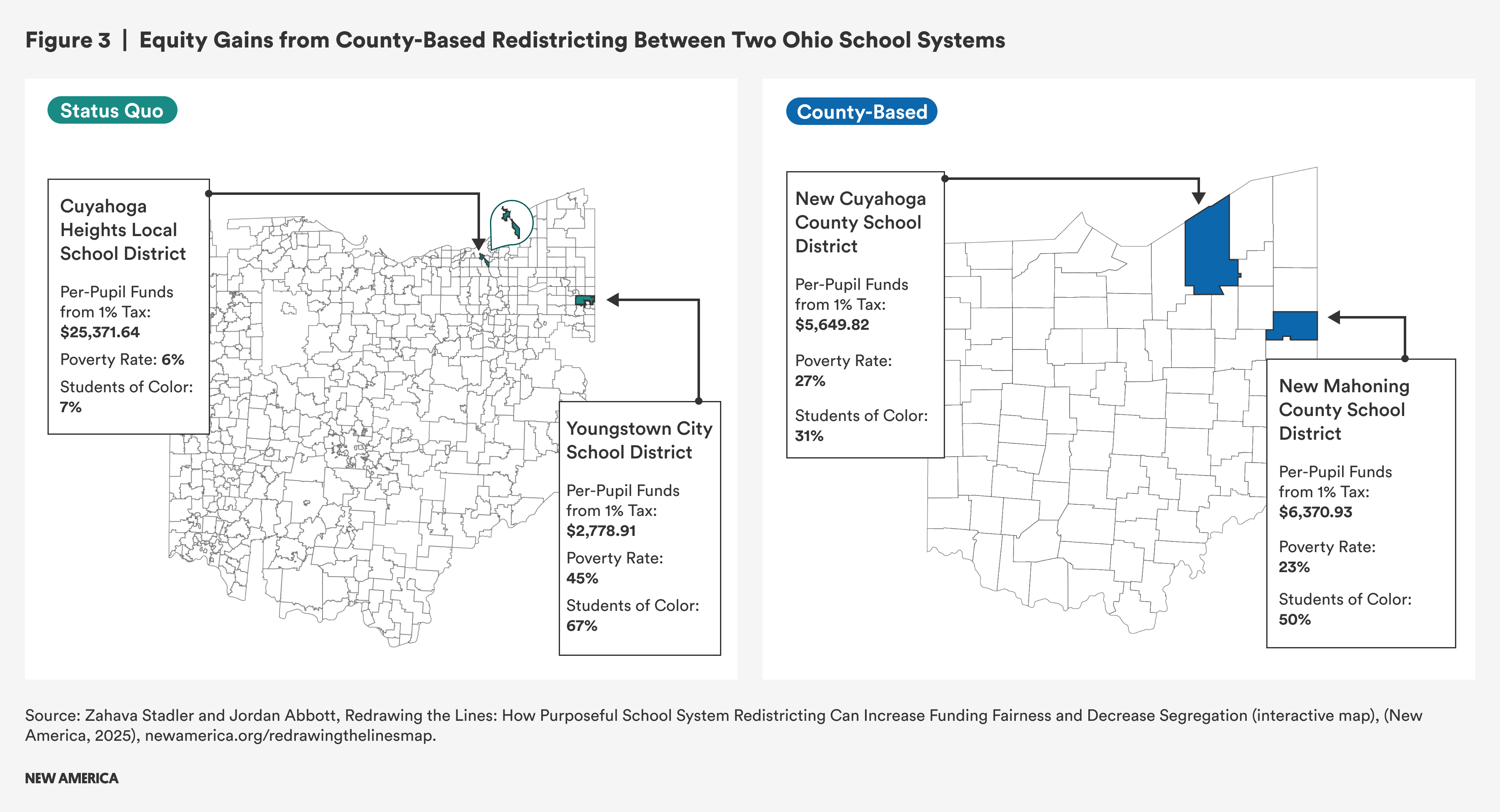
While there is no specific process prescribed in Ohio law for whole-state redistricting or universal county-based districts, the state board has a history of involvement in district boundary change and of considering the financial and diversity implications of new district lines. These would be advantages for a state taking on wholesale, equity-driven redistricting. Still, the fact that current law generally requires voters in affected districts to approve each boundary change would pose a real difficulty for statewide redistricting. Unless that policy were changed, the voters in a single school system would hold effective veto power over any new district map. Ohio would likely need to address that barrier before attempting to institute county-level school districts.
To see the impact of Ohio’s simulated, county-based school system and compare it to the state’s existing school district map, select Ohio on the interactive mapping tool that accompanies this report and choose “county” from the model drop-down menu.
Redistricting by Merger: Spotlight on Pennsylvania
As recounted in the Introduction, state leaders in Pennsylvania have been discussing statewide school district consolidation for years, but hardly any mergers have actually occurred. In fact, no school districts have consolidated in the state since the lone merger of two districts in Beaver County in 2009.74 This is a loss, because our analysis shows significant gains for Pennsylvania from redistricting by strategic merger.
Our Crossing the Line report found that in 2021, Pennsylvania had 13 of the country’s 100 widest poverty-rate divides between neighboring school districts, and four of the 100 worst racial divides between neighbor-districts.75 Of the 42 states analyzed in this report, Pennsylvania had the seventh-worst level of interdistrict racial segregation.
Our simulated redistricting by merger would reduce Pennsylvania’s number of school districts to 128—almost as few as proposed by Governor Rendell in 2009, see Figure 4 below. These strategic consolidations would give Pennsylvania school systems 64.6 percent more equal access to per-pupil property wealth. It would also make school districts 44.8 percent more racially representative of the state’s population of school-aged children, and 70.2 percent more similar to the state overall when it comes to the school-aged child poverty rate.
Why, despite the potential gains and the persistent interest, has Pennsylvania not pursued school system consolidation in earnest? One possibility is that while state law does prescribe a process for school district consolidation, it only contemplates one merger at a time, and only on local initiative. The board of each involved district must separately vote for the consolidation, and then an application must be filed with the state secretary of education.76 This is not a framework for a statewide consolidation effort.
However, when districts apply to merge, state law requires the State Board of Education to review the application and approve it only if the board considers the merger “wise, in the best interest of the Commonwealth.”77 The statute is silent on what these interests might be. But it does recognize that school district mergers can carry statewide implications. By this logic, there should be a way for the state itself—the secretary of education, the state board, or the Department of Education—to instigate a consolidation, or multiple consolidations in a coordinated effort.
A 2019 article in The Pennsylvania Capital-Star noted that when two districts merge, they must clear many practical hurdles, including reconciling teacher salary scales and labor agreements, resolving curricular differences, and making best use of existing school buildings.78 The article also described the public relations challenge of winning over “district taxpayers, parents, and alumni” who may not be enthused about the merger. (These lists echo the difficulties described by Scott Menzel above, in Section V.) Pennsylvania districts currently lack support for this process. Given that there is only provision for one-off, locally instigated mergers, each pair or group of consolidating districts must handle it alone, developing bespoke solutions to problems as they come up. As State Senator Judy Schwank told The Capital-Star at the time, “This gets back to educational equity, which is why I think the commonwealth should play some role.”79 If mergers can serve the best interest of the commonwealth and all its students, then state government should be involved in smoothing the way. In a statewide consolidation effort, the state could not only choose the mergers that would do most to further school system diversity and funding fairness, but could also guide districts by offering tools and standard processes for addressing the predictable questions that arise in nearly every consolidation.
To see the consolidated school systems proposed for Pennsylvania by our optimization algorithm and compare it to the state’s existing school district map, select Pennsylvania on the interactive mapping tool that accompanies this report and choose “merger” from the model drop-down menu.
Citations
- Institute of Education Sciences, National Center for Education Statistics, “Table 214.10: Number of Public School Districts and Public and Private Elementary and Secondary Schools: Selected School Years, 1869–70 through 2022–23” in Digest of Education Statistics, revised January 2024, <a href="<a href="<a href="<a href="<a href="source">source">source">source">source">source">source.
- Campbell F. Scribner, The Fight for Local Control: Schools, Suburbs, and American Democracy (Cornell University Press, 2016), 32–56, eBook Collection (Cornell Scholarship Online).
- See, for example, Bridget Higdon, “Gov. Phil Scott Rolls Out School District Consolidation Plan; Local Officials Weigh In,” Saint Albans Messenger, January 23, 2025, <a href="<a href="<a href="<a href="<a href="source">source">source">source">source">source">source; Hannah Gross, “More NJ School Districts Think Hard About Consolidating,” NJ Spotlight News, August 20, 2024, <a href="<a href="<a href="<a href="<a href="source">source">source">source">source">source">source.
- Jacqueline M. Nowicki, K–12 Education: Student Population Has Significantly Diversified, but Many Schools Remain Divided Along Racial, Ethnic, and Economic Lines (U.S. Government Accountability Office, June 2022), <a href="<a href="<a href="<a href="<a href="source">source">source">source">source">source">source.
- Zahava Stadler and Jordan Abbott, Crossing the Line: Segregation and Resource Inequality Between America’s School Districts (New America, February 2024), <a href="<a href="<a href="<a href="<a href="source">source">source">source">source">source">source.
- Krista Kaput and Bonnie O’Keefe, Fortifying Funding: How States Can Strengthen Education Finance Systems for the Future (Bellwether, February 2023), 12, <a href="<a href="<a href="<a href="<a href="source">source">source">source">source">source">source.
- See, for example, David Rhode, Kristina Cooke, and Himanshu-Ojha, “The Decline of the ‘Great Equalizer,’” The Atlantic, December 19, 2012, <a href="<a href="<a href="<a href="<a href="source">source">source">source">source">source">source; Thomas B. Edsall, “Is Education No Longer the ‘Great Equalizer’?” New York Times, June 23, 2021, <a href="<a href="<a href="<a href="<a href="source">source">source">source">source">source">source; and Arne Duncan, “Education: The ‘Great Equalizer,’” Britannica, 2018, <a href="<a href="<a href="<a href="<a href="source">source">source">source">source">source">source.
- Zahava Stadler and Jordan Abbott, Crossing the Line: Segregation and Resource Inequality Between America’s School Districts (New America, February 2024), <a href="<a href="<a href="<a href="<a href="source">source">source">source">source">source">source.
- Pennsylvania Department of Education, “Types of Schools,” September 1, 2025, <a href="<a href="<a href="<a href="source">source">source">source">source">source; and United States Census Bureau, “2023 Public Elementary-Secondary Education Finance Data,” <a href="<a href="<a href="<a href="source">source">source">source">source">source.
- Metropolitan Philadelphia Indicators Project, Policy Brief: Consolidating School Districts (MPIP, May 2011), <a href="<a href="<a href="<a href="source">source">source">source">source">source.
- Metropolitan Philadelphia Indicators Project, Policy Brief, <a href="<a href="<a href="<a href="source">source">source">source">source">source.
- Senate Bill 131, Regular Session of 2010, Pennsylvania, <a href="<a href="<a href="<a href="source">source">source">source">source">source.
- Pennsylvania House Republican Caucus, “Parker Amendments to Fix School Funding—State Representative Calls for Faster Transition to Equity,” press release, August 21, 2015, <a href="<a href="<a href="<a href="source">source">source">source">source">source.
- Pennsylvania Senate Democrats, “Schwank Announces Plans to Introduce Bills to Aid School Mergers,” press release, October 31, 2023, <a href="<a href="<a href="<a href="source">source">source">source">source">source.
- Representative Greg Scott, “School District Reorganization Study,” Pennsylvania House of Representatives (website), May 25, 2025, <a href="<a href="<a href="<a href="source">source">source">source">source">source.
- Zahava Stadler and Jordan Abbott, Crossing the Line: Segregation and Resource Inequality Between America’s School Districts (New America, February 2024), <a href="<a href="<a href="<a href="source">source">source">source">source">source.
- Krista Kaput and Bonnie O’Keefe, Fortifying Funding: How States Can Strengthen Education Finance Systems for the Future (Bellwether, February 2023), 12, <a href="<a href="<a href="<a href="source">source">source">source">source">source.
- United States Census Bureau, “2023 Public Elementary-Secondary Education Finance Data,” <a href="<a href="<a href="<a href="source">source">source">source">source">source.
- Center for Educational Equity, “School Funding Court Decisions by State,” <a href="<a href="<a href="<a href="source">source">source">source">source">source.
- United States Census Bureau, “2023 Public Elementary-Secondary Education Finance Data,” <a href="<a href="<a href="<a href="source">source">source">source">source">source.
- Zahava Stadler, K–12 Federal COVID Relief: What Can We Learn from Doing School Funding Differently? (New America, October 2023), 18, <a href="<a href="<a href="<a href="source">source">source">source">source">source.
- Melissa Yelenik, “Experts: Medicaid, SNAP Cuts Could Hurt Economy, Strain State Budgets,” U.S. News & World Report, August 11, 2025, <a href="<a href="<a href="<a href="source">source">source">source">source">source; and Sarah D. Wire, “'Catastrophe': States Scramble after Trump's Cuts to Medicaid, SNAP,” USA Today, July 16, 2025, <a href="<a href="<a href="<a href="source">source">source">source">source">source.
- William N. Evans, Robert M. Schwab, and Kathryn L. Wagner, “The Great Recession and Public Education,” Education Finance and Policy 14, no. 2 (March 2019): 298–326, <a href="<a href="<a href="<a href="source">source">source">source">source">source; and David S. Knight, “Are High-Poverty School Districts Disproportionately Impacted by State Funding Cuts? School Finance Equity Following the Great Recession,” Journal of Education Finance 43, no. 2 (September 2017): 169–94, <a href="<a href="<a href="<a href="source">source">source">source">source">source.
- Michael Kolomatsky, “How Much Higher Are Your Post-Pandemic Property Taxes?” New York Times, March 28, 2024, <a href="<a href="<a href="<a href="source">source">source">source">source">source; and Niko Spyridonos, “The Impact of Rising Property Taxes on Communities,” Smart Cities Dive, July 22, 2024, <a href="<a href="<a href="<a href="source">source">source">source">source">source.
- Institute of Education Sciences, National Center for Education Statistics, “Table 214.10: Number of Public School Districts and Public and Private Elementary and Secondary Schools: Selected School Years, 1869–70 through 2022–23” in Digest of Education Statistics, revised January 2024, <a href="<a href="<a href="source">source">source">source">source.
- Campbell F. Scribner, The Fight for Local Control: Schools, Suburbs, and American Democracy (Cornell University Press, 2016), 32–56, eBook Collection (Cornell Scholarship Online).
- State of Vermont, Agency of Administration, “School Redistricting Task Force: About,” <a href="<a href="<a href="source">source">source">source">source.
- Act 73, An Act Relating to Transforming Vermont’s Education Governance, Quality, and Finance Systems, Regular Session 2025–2026, Vermont, 2025, <a href="<a href="<a href="source">source">source">source">source.
- Bridget Higdon, “Gov. Phil Scott Rolls Out School District Consolidation Plan; Local Officials Weigh-In,” St. Albans Messenger, January 23, 2025, <a href="<a href="<a href="source">source">source">source">source.
- The Education Efficiency Act, House Bill 1431, Regular Session 2025, Mississippi, <a href="<a href="<a href="source">source">source">source">source.
- Official Site of the State of New Jersey, Department of Community Affairs, “School Regionalization Efficiency Program (SREP),” <a href="<a href="<a href="source">source">source">source">source.
- Hannah Gross, “More NJ School Districts Think Hard About Consolidating,” NJ Spotlight News, August 20, 2024, <a href="<a href="<a href="source">source">source">source">source.
- Scott, “School District Reorganization Study,” <a href="<a href="<a href="source">source">source">source">source.
- For more on student enrollment declines, see Tara Moon, “K–12 Public School Enrollment Declines, Explained,” FutureEd, August 5, 2025, <a href="<a href="<a href="source">source">source">source">source; and Abigail Francis and Joshua Goodman, “School Enrollment Shifts Five Years After the Pandemic,” EdWorkingPaper 25-1233 (June 2025), <a href="<a href="<a href="source">source">source">source">source.
- EdBuild, Frontier: Merger (EdBuild, June 2020), <a href="<a href="<a href="source">source">source">source">source.
- EdBuild, Frontier: Territory Transfer (EdBuild, June 2020), <a href="<a href="<a href="source">source">source">source">source.
- EdBuild, Frontier: Secession (EdBuild, June 2020), <a href="<a href="<a href="source">source">source">source">source.
- See, for example, ABC News 4 Staff, “Dorchester School District Two Urges Land Transfer for New School Construction,” ABC 4 News, March 31, 2025, <a href="<a href="<a href="source">source">source">source">source; and Christopher Saul, “Val-p Leader: ‘If We Don’t So Something, We Are Going To Tax Ourselves Out of Existence,’” Mid Bay News, October 28, 2024, <a href="<a href="<a href="source">source">source">source">source.
- See, for example, Marielle Argueza, “What Two North County School Districts Stand to Gain and Lose in New Territory Proposal,” Monterey County Now, September 12, 2019, <a href="<a href="<a href="source">source">source">source">source; Julianna Morano, “Will Clovis Unified Expand Into the Fresno County Foothills? Not if One Rural School District Can Help It,” Fresnoland, September 5, 2024, <a href="<a href="<a href="source">source">source">source">source; and Will Garbe, “Local District Cites Race as Reason Some Want to Leave Schools,” Dayton Daily News, June 12, 2018, <a href="<a href="<a href="source">source">source">source">source.
- Jacqueline M. Nowicki, K–12 Education: Student Population Has Significantly Diversified, but Many Schools Remain Divided Along Racial, Ethnic, and Economic Lines (U.S. Government Accountability Office, June 2022), <a href="<a href="<a href="source">source">source">source">source.
- Democracy Docket, “Racial Gerrymandering vs. Racial Vote Dilution, Explained,” Democracy Docket, August 17, 2022, <a href="<a href="<a href="source">source">source">source">source.
- The exception to this rule is the very occasional role that required redistricting played in court-ordered desegregation plans in the second half of the twentieth century, including in the metropolitan areas of Wilmington, Delaware and Louisville, Kentucky. See Gary Orfield, foreword to The Courts, the Legislature, and Delaware’s Resegregation (The Civil Rights Project at UCLA, December 2014), 6, <a href="<a href="<a href="source">source">source">source">source.
- United States Census Bureau, “2023 Public Elementary-Secondary Education Finance Data,” <a href="<a href="<a href="source">source">source">source">source.
- Betsey Martens, Elizabeth Glenn, and Tiffany Mangum, “Race, Equity and Housing: The Early Years,” Journal of Housing & Community Development 77, no. 5 (September/October 2020), <a href="<a href="<a href="source">source">source">source">source; and National Low Income Housing Coalition, “Public Housing History,” October 17, 2019, <a href="<a href="<a href="source">source">source">source">source.
- Robert K. Nelson, “Mapping Inequality: Redlining in New Deal America” in the American Panorama: An Atlas of United States History online map project, Digital Scholarship Lab at University of Richmond, https:// dsl.richmond.edu/panorama/redlining/.
- University of Minnesota, Libraries, “What is a Covenant?” Mapping Prejudice Project, accessed September 2, 2025, <a href="<a href="<a href="source">source">source">source">source.
- Brent Cebul, “Tearing Down Black America,” Boston Review, July 22, 2020, <a href="<a href="<a href="source">source">source">source">source.
- Cecilia Rouse, Jared Bernstein, Helen Knudsen, and Jeffery Zhang, “Exclusionary Zoning: Its Effect on Racial Discrimination in the Housing Market,” The White House, June 17, 2021, <a href="<a href="<a href="source">source">source">source">source.
- Jonathan Rothwell and Douglas S. Massey, “The Effect of Density Zoning on Racial Segregation in U.S. Urban Areas,” Urban Affairs Review 44, no. 6 (April 9, 2009): 779–806, <a href="<a href="<a href="source">source">source">source">source.
- John Walsh and Jung Hyun Choi, “Black Housing Wealth Varies Across Local Markets, Despite Recent Improvement in the Black Homeownership Rate Nationally,” Urban Wire (blog), Urban Institute, February 18, 2025, <a href="<a href="<a href="source">source">source">source">source.
- Stadler and Abbott, Crossing the Line, 18, <a href="<a href="<a href="source">source">source">source">source.
- Glenn Adams, “Baldacci Secures Consolidation Plan,” Portsmouth Herald, June 8, 2007, Seacoastonline (website), <a href="<a href="<a href="source">source">source">source">source.
- Molly A. Hunter, State Constitution Education Clause Language, Education Law Center, n.d., <a href="<a href="<a href="source">source">source">source">source.
- Economic Statistical Methods Division, Individual State Descriptions: 2022 (U.S. Census Bureau, April 2024), <a href="source">source">source.
- Baltimore, Maryland; Carson City, Nevada; and 38 cities in the state of Virginia.
- Economic Statistical Methods Division, Individual State Descriptions: 2022, <a href="source">source">source. Note that in Louisiana, these geographic entities are called parishes but are equivalent to counties.
- Economic Statistical Methods Division, Individual State Descriptions: 2022, <a href="source">source">source.
- Municipalities that are not legally part of counties are kept as separate school districts in this model, including Baltimore, Maryland; Carson City, Nevada; St. Louis, Missouri; and 38 cities in the state of Virginia.
- Act 289, Reorganization of School Districts, Regular Session 1964, Michigan, 1964, source">source.
- Miss. Code Ann. § 37-7-105, § 37-7-107, § 37-7-109 (FindLaw 2025).
- Miss. Code Ann. § 37-7-113 (FindLaw 2025).
- State Board of Education Meeting Agenda, October 18–19, 2012, Mississippi Department of Education, source; and Miss. Code Ann. § 37-7-104, § 37-7-104.2, § 37-7-104.3, Miss. Code Ann. § 37-7-104.4, Miss. Code Ann. § 37-7-104.6, and § 37-7-104.7 (FindLaw 2025).
- Miss. Code Ann. § 37-7-104.1, § 37-7-104.8 (FindLaw 2025).
- 55 Miss. Code Ann. § 37-7-104.5 (FindLaw 2025).
- Stadler and Abbott, Crossing the Line, 48–53, source.
- Morgan Trau, “Ohio Congressional Redistricting Process Begins on Heels of Texas Battle,” Ohio Capital Journal, August 12, 2025, source.
- Emily E. Wendel, “Members Brief: Redistricting in Ohio,” Ohio Legislative Service Commission, Ohio General Assembly, April 19, 2024, source.
- Ohio Rev. Code Ann. § 3311.06 (FindLaw 2025).
- Ohio Rev. Code Ann. § 3311.26 (FindLaw 2025); and Ohio Rev. Code Ann. § 3311.38 (FindLaw 2025).
- Ohio Admin. Code § 3301-89-02 (2025).
- Ohio Rev. Code Ann. § 3311.25 (FindLaw 2025).
- Ohio Rev. Code Ann. § 3311.22 (FindLaw 2025).
- OESC Association, “Ohio Educational Service Centers (ESCs),” accessed August 3, 2025, source.
- Editorial Board, “School District Consolidation Will Be Necessary for Pa.,” Pittsburgh Post-Gazette, August 13, 2025, source.
- Stadler and Abbott, Crossing the Line, 48–53, source.
- 24 Pa. Stat. Ann. §2-224 (FindLaw 2025).
- Elisabeth Hardison, “Pennsylvania Has 500 School Districts. What’s Stopping Consolidations?” Pennsylvania Capital-Star, June 18, 2019, source.
- Hardison, “Pennsylvania Has 500 School Districts,” source.
VII. A Time for Better Borders
School district boundary change is not a new idea. Lines were redrawn to merge over 100,000 school districts in the twentieth century. Since then, redistricting has been used extensively, albeit in a less systematic way. Consolidation—erasing the line between two school systems—has often been a way of seeking greater efficiencies or attempting to address fiscal distress or declining enrollment. By contrast, secession—pulling away from a school district by drawing a new dividing line—has often been a means of advancing the interests of affluent, usually predominantly White communities. Creating a new district, and a new taxing jurisdiction, allows them to keep from sharing property tax dollars beyond their own small enclaves.
But redistricting has almost never been used as a tool in the education equity toolbox, even though it holds great potential to create fairer school districts. The right boundaries, drawn to encompass more integrated student populations and more equal tax bases, could transform our school systems.
The right boundaries, drawn to encompass more integrated student populations and more equal tax bases, could transform our school systems.
Policy discussions about education funding usually focus on state allocations, especially the formula that states use to determine how much money districts need for their schools and students. But state policy also governs many aspects of local funding. State equalization policies determine the amount of formula funding that districts are responsible to raise themselves, with higher-wealth districts expected to cover more of the cost out of local dollars. State laws also set the breadth of local taxing authority—how low or high school district property tax rates can be, and whether they can impose any other kinds of taxes locally. And a third, underappreciated way that states affect local school funding is by drawing school district boundaries or by legislating the ways in which they can be drawn and by whom. This is an area that is already very much within the state’s purview.
This is the time for states to take up this challenge. As they face near-certain budget difficulties born of cuts to federal health care and nutrition assistance funding, they will likely consider cuts to education funding. But property-poor districts depend more heavily on state aid for their schools, and across-the-board cuts are likely to affect their students the most, unless they can make up the difference by severely increasing local property taxes. Rather than subject these districts to the double whammy of aid cuts and higher property taxes, states should instead try redistricting to eliminate big property-wealth disparities. The proposals in this report offer a new way to rightsize districts’ tax bases so they correspond to their student populations. By bringing all school districts’ per-pupil tax capacity closer to the statewide property valuation per pupil, states can reduce any one district’s reliance on state aid, softening the blow of any state budget cuts on schools. At the same time, districts will have more of a local cushion—tax bases that can better support their schools without onerous rate increases.
In addition to helping maintain adequate education funding in difficult budget times, the models presented in this report also show that it is possible for states to give more diverse student populations more equitable access to local revenues. With whole-state redistricting using any of the three approaches discussed, states can better align district property tax bases to the number of students they support and ensure that all kids get a fairer share of the state’s property tax base, regardless of race, class, or neighborhood.
It has become commonplace to observe that disparities between our nation’s school systems prevent public education from being the “great equalizer” envisioned by schooling pioneer Horace Mann in 1848.80 Poor and minoritized students receive fewer educational resources than they should; their districts struggle to raise the funding needed to support them to success. Students of different backgrounds are not prepared to go on to participate in the economy, or in American democracy, on equal terms. But this problem arises in large part from ground-level divides that simply do not have to exist. Students of different races need not be segregated into different districts. Poverty does not have to be concentrated into some districts and almost entirely absent from others. And no law of nature requires that property tax capacity be so much higher in some school districts. All of these conditions are the product of where states place their school district borders: along lines that entrench and worsen America’s racial and economic divides.
States can make a different policy choice because school district maps are indeed a product of state policy. By adopting a redistricting approach like one of the models presented here, states can create more diverse systems supported by more equal tax bases. Greater integration and funding fairness would go a long way toward restoring the potential of the great equalizer. States have a responsibility toward all their children, and they have the power to do better. They just need to redraw the lines.
Citations
- Institute of Education Sciences, National Center for Education Statistics, “Table 214.10: Number of Public School Districts and Public and Private Elementary and Secondary Schools: Selected School Years, 1869–70 through 2022–23” in Digest of Education Statistics, revised January 2024, <a href="<a href="<a href="<a href="<a href="<a href="source">source">source">source">source">source">source">source.
- Campbell F. Scribner, The Fight for Local Control: Schools, Suburbs, and American Democracy (Cornell University Press, 2016), 32–56, eBook Collection (Cornell Scholarship Online).
- See, for example, Bridget Higdon, “Gov. Phil Scott Rolls Out School District Consolidation Plan; Local Officials Weigh In,” Saint Albans Messenger, January 23, 2025, <a href="<a href="<a href="<a href="<a href="<a href="source">source">source">source">source">source">source">source; Hannah Gross, “More NJ School Districts Think Hard About Consolidating,” NJ Spotlight News, August 20, 2024, <a href="<a href="<a href="<a href="<a href="<a href="source">source">source">source">source">source">source">source.
- Jacqueline M. Nowicki, K–12 Education: Student Population Has Significantly Diversified, but Many Schools Remain Divided Along Racial, Ethnic, and Economic Lines (U.S. Government Accountability Office, June 2022), <a href="<a href="<a href="<a href="<a href="<a href="source">source">source">source">source">source">source">source.
- Zahava Stadler and Jordan Abbott, Crossing the Line: Segregation and Resource Inequality Between America’s School Districts (New America, February 2024), <a href="<a href="<a href="<a href="<a href="<a href="source">source">source">source">source">source">source">source.
- Krista Kaput and Bonnie O’Keefe, Fortifying Funding: How States Can Strengthen Education Finance Systems for the Future (Bellwether, February 2023), 12, <a href="<a href="<a href="<a href="<a href="<a href="source">source">source">source">source">source">source">source.
- See, for example, David Rhode, Kristina Cooke, and Himanshu-Ojha, “The Decline of the ‘Great Equalizer,’” The Atlantic, December 19, 2012, <a href="<a href="<a href="<a href="<a href="<a href="source">source">source">source">source">source">source">source; Thomas B. Edsall, “Is Education No Longer the ‘Great Equalizer’?” New York Times, June 23, 2021, <a href="<a href="<a href="<a href="<a href="<a href="source">source">source">source">source">source">source">source; and Arne Duncan, “Education: The ‘Great Equalizer,’” Britannica, 2018, <a href="<a href="<a href="<a href="<a href="<a href="source">source">source">source">source">source">source">source.
- Zahava Stadler and Jordan Abbott, Crossing the Line: Segregation and Resource Inequality Between America’s School Districts (New America, February 2024), <a href="<a href="<a href="<a href="<a href="<a href="source">source">source">source">source">source">source">source.
- Pennsylvania Department of Education, “Types of Schools,” September 1, 2025, <a href="<a href="<a href="<a href="<a href="source">source">source">source">source">source">source; and United States Census Bureau, “2023 Public Elementary-Secondary Education Finance Data,” <a href="<a href="<a href="<a href="<a href="source">source">source">source">source">source">source.
- Metropolitan Philadelphia Indicators Project, Policy Brief: Consolidating School Districts (MPIP, May 2011), <a href="<a href="<a href="<a href="<a href="source">source">source">source">source">source">source.
- Metropolitan Philadelphia Indicators Project, Policy Brief, <a href="<a href="<a href="<a href="<a href="source">source">source">source">source">source">source.
- Senate Bill 131, Regular Session of 2010, Pennsylvania, <a href="<a href="<a href="<a href="<a href="source">source">source">source">source">source">source.
- Pennsylvania House Republican Caucus, “Parker Amendments to Fix School Funding—State Representative Calls for Faster Transition to Equity,” press release, August 21, 2015, <a href="<a href="<a href="<a href="<a href="source">source">source">source">source">source">source.
- Pennsylvania Senate Democrats, “Schwank Announces Plans to Introduce Bills to Aid School Mergers,” press release, October 31, 2023, <a href="<a href="<a href="<a href="<a href="source">source">source">source">source">source">source.
- Representative Greg Scott, “School District Reorganization Study,” Pennsylvania House of Representatives (website), May 25, 2025, <a href="<a href="<a href="<a href="<a href="source">source">source">source">source">source">source.
- Zahava Stadler and Jordan Abbott, Crossing the Line: Segregation and Resource Inequality Between America’s School Districts (New America, February 2024), <a href="<a href="<a href="<a href="<a href="source">source">source">source">source">source">source.
- Krista Kaput and Bonnie O’Keefe, Fortifying Funding: How States Can Strengthen Education Finance Systems for the Future (Bellwether, February 2023), 12, <a href="<a href="<a href="<a href="<a href="source">source">source">source">source">source">source.
- United States Census Bureau, “2023 Public Elementary-Secondary Education Finance Data,” <a href="<a href="<a href="<a href="<a href="source">source">source">source">source">source">source.
- Center for Educational Equity, “School Funding Court Decisions by State,” <a href="<a href="<a href="<a href="<a href="source">source">source">source">source">source">source.
- United States Census Bureau, “2023 Public Elementary-Secondary Education Finance Data,” <a href="<a href="<a href="<a href="<a href="source">source">source">source">source">source">source.
- Zahava Stadler, K–12 Federal COVID Relief: What Can We Learn from Doing School Funding Differently? (New America, October 2023), 18, <a href="<a href="<a href="<a href="<a href="source">source">source">source">source">source">source.
- Melissa Yelenik, “Experts: Medicaid, SNAP Cuts Could Hurt Economy, Strain State Budgets,” U.S. News & World Report, August 11, 2025, <a href="<a href="<a href="<a href="<a href="source">source">source">source">source">source">source; and Sarah D. Wire, “'Catastrophe': States Scramble after Trump's Cuts to Medicaid, SNAP,” USA Today, July 16, 2025, <a href="<a href="<a href="<a href="<a href="source">source">source">source">source">source">source.
- William N. Evans, Robert M. Schwab, and Kathryn L. Wagner, “The Great Recession and Public Education,” Education Finance and Policy 14, no. 2 (March 2019): 298–326, <a href="<a href="<a href="<a href="<a href="source">source">source">source">source">source">source; and David S. Knight, “Are High-Poverty School Districts Disproportionately Impacted by State Funding Cuts? School Finance Equity Following the Great Recession,” Journal of Education Finance 43, no. 2 (September 2017): 169–94, <a href="<a href="<a href="<a href="<a href="source">source">source">source">source">source">source.
- Michael Kolomatsky, “How Much Higher Are Your Post-Pandemic Property Taxes?” New York Times, March 28, 2024, <a href="<a href="<a href="<a href="<a href="source">source">source">source">source">source">source; and Niko Spyridonos, “The Impact of Rising Property Taxes on Communities,” Smart Cities Dive, July 22, 2024, <a href="<a href="<a href="<a href="<a href="source">source">source">source">source">source">source.
- Institute of Education Sciences, National Center for Education Statistics, “Table 214.10: Number of Public School Districts and Public and Private Elementary and Secondary Schools: Selected School Years, 1869–70 through 2022–23” in Digest of Education Statistics, revised January 2024, <a href="<a href="<a href="<a href="source">source">source">source">source">source.
- Campbell F. Scribner, The Fight for Local Control: Schools, Suburbs, and American Democracy (Cornell University Press, 2016), 32–56, eBook Collection (Cornell Scholarship Online).
- State of Vermont, Agency of Administration, “School Redistricting Task Force: About,” <a href="<a href="<a href="<a href="source">source">source">source">source">source.
- Act 73, An Act Relating to Transforming Vermont’s Education Governance, Quality, and Finance Systems, Regular Session 2025–2026, Vermont, 2025, <a href="<a href="<a href="<a href="source">source">source">source">source">source.
- Bridget Higdon, “Gov. Phil Scott Rolls Out School District Consolidation Plan; Local Officials Weigh-In,” St. Albans Messenger, January 23, 2025, <a href="<a href="<a href="<a href="source">source">source">source">source">source.
- The Education Efficiency Act, House Bill 1431, Regular Session 2025, Mississippi, <a href="<a href="<a href="<a href="source">source">source">source">source">source.
- Official Site of the State of New Jersey, Department of Community Affairs, “School Regionalization Efficiency Program (SREP),” <a href="<a href="<a href="<a href="source">source">source">source">source">source.
- Hannah Gross, “More NJ School Districts Think Hard About Consolidating,” NJ Spotlight News, August 20, 2024, <a href="<a href="<a href="<a href="source">source">source">source">source">source.
- Scott, “School District Reorganization Study,” <a href="<a href="<a href="<a href="source">source">source">source">source">source.
- For more on student enrollment declines, see Tara Moon, “K–12 Public School Enrollment Declines, Explained,” FutureEd, August 5, 2025, <a href="<a href="<a href="<a href="source">source">source">source">source">source; and Abigail Francis and Joshua Goodman, “School Enrollment Shifts Five Years After the Pandemic,” EdWorkingPaper 25-1233 (June 2025), <a href="<a href="<a href="<a href="source">source">source">source">source">source.
- EdBuild, Frontier: Merger (EdBuild, June 2020), <a href="<a href="<a href="<a href="source">source">source">source">source">source.
- EdBuild, Frontier: Territory Transfer (EdBuild, June 2020), <a href="<a href="<a href="<a href="source">source">source">source">source">source.
- EdBuild, Frontier: Secession (EdBuild, June 2020), <a href="<a href="<a href="<a href="source">source">source">source">source">source.
- See, for example, ABC News 4 Staff, “Dorchester School District Two Urges Land Transfer for New School Construction,” ABC 4 News, March 31, 2025, <a href="<a href="<a href="<a href="source">source">source">source">source">source; and Christopher Saul, “Val-p Leader: ‘If We Don’t So Something, We Are Going To Tax Ourselves Out of Existence,’” Mid Bay News, October 28, 2024, <a href="<a href="<a href="<a href="source">source">source">source">source">source.
- See, for example, Marielle Argueza, “What Two North County School Districts Stand to Gain and Lose in New Territory Proposal,” Monterey County Now, September 12, 2019, <a href="<a href="<a href="<a href="source">source">source">source">source">source; Julianna Morano, “Will Clovis Unified Expand Into the Fresno County Foothills? Not if One Rural School District Can Help It,” Fresnoland, September 5, 2024, <a href="<a href="<a href="<a href="source">source">source">source">source">source; and Will Garbe, “Local District Cites Race as Reason Some Want to Leave Schools,” Dayton Daily News, June 12, 2018, <a href="<a href="<a href="<a href="source">source">source">source">source">source.
- Jacqueline M. Nowicki, K–12 Education: Student Population Has Significantly Diversified, but Many Schools Remain Divided Along Racial, Ethnic, and Economic Lines (U.S. Government Accountability Office, June 2022), <a href="<a href="<a href="<a href="source">source">source">source">source">source.
- Democracy Docket, “Racial Gerrymandering vs. Racial Vote Dilution, Explained,” Democracy Docket, August 17, 2022, <a href="<a href="<a href="<a href="source">source">source">source">source">source.
- The exception to this rule is the very occasional role that required redistricting played in court-ordered desegregation plans in the second half of the twentieth century, including in the metropolitan areas of Wilmington, Delaware and Louisville, Kentucky. See Gary Orfield, foreword to The Courts, the Legislature, and Delaware’s Resegregation (The Civil Rights Project at UCLA, December 2014), 6, <a href="<a href="<a href="<a href="source">source">source">source">source">source.
- United States Census Bureau, “2023 Public Elementary-Secondary Education Finance Data,” <a href="<a href="<a href="<a href="source">source">source">source">source">source.
- Betsey Martens, Elizabeth Glenn, and Tiffany Mangum, “Race, Equity and Housing: The Early Years,” Journal of Housing & Community Development 77, no. 5 (September/October 2020), <a href="<a href="<a href="<a href="source">source">source">source">source">source; and National Low Income Housing Coalition, “Public Housing History,” October 17, 2019, <a href="<a href="<a href="<a href="source">source">source">source">source">source.
- Robert K. Nelson, “Mapping Inequality: Redlining in New Deal America” in the American Panorama: An Atlas of United States History online map project, Digital Scholarship Lab at University of Richmond, https:// dsl.richmond.edu/panorama/redlining/.
- University of Minnesota, Libraries, “What is a Covenant?” Mapping Prejudice Project, accessed September 2, 2025, <a href="<a href="<a href="<a href="source">source">source">source">source">source.
- Brent Cebul, “Tearing Down Black America,” Boston Review, July 22, 2020, <a href="<a href="<a href="<a href="source">source">source">source">source">source.
- Cecilia Rouse, Jared Bernstein, Helen Knudsen, and Jeffery Zhang, “Exclusionary Zoning: Its Effect on Racial Discrimination in the Housing Market,” The White House, June 17, 2021, <a href="<a href="<a href="<a href="source">source">source">source">source">source.
- Jonathan Rothwell and Douglas S. Massey, “The Effect of Density Zoning on Racial Segregation in U.S. Urban Areas,” Urban Affairs Review 44, no. 6 (April 9, 2009): 779–806, <a href="<a href="<a href="<a href="source">source">source">source">source">source.
- John Walsh and Jung Hyun Choi, “Black Housing Wealth Varies Across Local Markets, Despite Recent Improvement in the Black Homeownership Rate Nationally,” Urban Wire (blog), Urban Institute, February 18, 2025, <a href="<a href="<a href="<a href="source">source">source">source">source">source.
- Stadler and Abbott, Crossing the Line, 18, <a href="<a href="<a href="<a href="source">source">source">source">source">source.
- Glenn Adams, “Baldacci Secures Consolidation Plan,” Portsmouth Herald, June 8, 2007, Seacoastonline (website), <a href="<a href="<a href="<a href="source">source">source">source">source">source.
- Molly A. Hunter, State Constitution Education Clause Language, Education Law Center, n.d., <a href="<a href="<a href="<a href="source">source">source">source">source">source.
- Economic Statistical Methods Division, Individual State Descriptions: 2022 (U.S. Census Bureau, April 2024), <a href="<a href="source">source">source">source.
- Baltimore, Maryland; Carson City, Nevada; and 38 cities in the state of Virginia.
- Economic Statistical Methods Division, Individual State Descriptions: 2022, <a href="<a href="source">source">source">source. Note that in Louisiana, these geographic entities are called parishes but are equivalent to counties.
- Economic Statistical Methods Division, Individual State Descriptions: 2022, <a href="<a href="source">source">source">source.
- Municipalities that are not legally part of counties are kept as separate school districts in this model, including Baltimore, Maryland; Carson City, Nevada; St. Louis, Missouri; and 38 cities in the state of Virginia.
- Act 289, Reorganization of School Districts, Regular Session 1964, Michigan, 1964, <a href="source">source">source.
- Miss. Code Ann. § 37-7-105, § 37-7-107, § 37-7-109 (FindLaw 2025).
- Miss. Code Ann. § 37-7-113 (FindLaw 2025).
- State Board of Education Meeting Agenda, October 18–19, 2012, Mississippi Department of Education, source">source; and Miss. Code Ann. § 37-7-104, § 37-7-104.2, § 37-7-104.3, Miss. Code Ann. § 37-7-104.4, Miss. Code Ann. § 37-7-104.6, and § 37-7-104.7 (FindLaw 2025).
- Miss. Code Ann. § 37-7-104.1, § 37-7-104.8 (FindLaw 2025).
- 55 Miss. Code Ann. § 37-7-104.5 (FindLaw 2025).
- Stadler and Abbott, Crossing the Line, 48–53, source">source.
- Morgan Trau, “Ohio Congressional Redistricting Process Begins on Heels of Texas Battle,” Ohio Capital Journal, August 12, 2025, source">source.
- Emily E. Wendel, “Members Brief: Redistricting in Ohio,” Ohio Legislative Service Commission, Ohio General Assembly, April 19, 2024, source">source.
- Ohio Rev. Code Ann. § 3311.06 (FindLaw 2025).
- Ohio Rev. Code Ann. § 3311.26 (FindLaw 2025); and Ohio Rev. Code Ann. § 3311.38 (FindLaw 2025).
- Ohio Admin. Code § 3301-89-02 (2025).
- Ohio Rev. Code Ann. § 3311.25 (FindLaw 2025).
- Ohio Rev. Code Ann. § 3311.22 (FindLaw 2025).
- OESC Association, “Ohio Educational Service Centers (ESCs),” accessed August 3, 2025, source">source.
- Editorial Board, “School District Consolidation Will Be Necessary for Pa.,” Pittsburgh Post-Gazette, August 13, 2025, source">source.
- Stadler and Abbott, Crossing the Line, 48–53, source">source.
- 24 Pa. Stat. Ann. §2-224 (FindLaw 2025).
- Elisabeth Hardison, “Pennsylvania Has 500 School Districts. What’s Stopping Consolidations?” Pennsylvania Capital-Star, June 18, 2019, source">source.
- Hardison, “Pennsylvania Has 500 School Districts,” source">source.
- See, for example, David Rhode, Kristina Cooke, and Himanshu-Ojha, “The Decline of the ‘Great Equalizer,’” The Atlantic, December 19, 2012, source; Thomas B. Edsall, “Is Education No Longer the ‘Great Equalizer’?” New York Times, June 23, 2021, source; and Arne Duncan, “Education: The ‘Great Equalizer,’” Britannica, 2018, source.
VIII. Interactive Map and Data Explorer
This interactive map and data explorer show states’ current school district boundaries alongside the new lines produced by each redistricting model. Use the map to compare each model against status-quo boundaries. Explore the data to see how redrawing school district boundaries could give more diverse student populations fairer access to local school funding in every state. See here for a short video tutorial on how to use this tool.
Error: Data visualization bundle URL missing.
Note: New districts were not simulated for Alaska, Kansas, Kentucky, Maine, Minnesota, New Mexico, or South Carolina due to limitations in available property valuation data. Hawaii and the District of Columbia were excluded from this analysis because they each have only one school district.

Citations
- Institute of Education Sciences, National Center for Education Statistics, “Table 214.10: Number of Public School Districts and Public and Private Elementary and Secondary Schools: Selected School Years, 1869–70 through 2022–23” in Digest of Education Statistics, revised January 2024, <a href="<a href="<a href="<a href="<a href="<a href="<a href="source">source">source">source">source">source">source">source">source.
- Campbell F. Scribner, The Fight for Local Control: Schools, Suburbs, and American Democracy (Cornell University Press, 2016), 32–56, eBook Collection (Cornell Scholarship Online).
- See, for example, Bridget Higdon, “Gov. Phil Scott Rolls Out School District Consolidation Plan; Local Officials Weigh In,” Saint Albans Messenger, January 23, 2025, <a href="<a href="<a href="<a href="<a href="<a href="<a href="source">source">source">source">source">source">source">source">source; Hannah Gross, “More NJ School Districts Think Hard About Consolidating,” NJ Spotlight News, August 20, 2024, <a href="<a href="<a href="<a href="<a href="<a href="<a href="source">source">source">source">source">source">source">source">source.
- Jacqueline M. Nowicki, K–12 Education: Student Population Has Significantly Diversified, but Many Schools Remain Divided Along Racial, Ethnic, and Economic Lines (U.S. Government Accountability Office, June 2022), <a href="<a href="<a href="<a href="<a href="<a href="<a href="source">source">source">source">source">source">source">source">source.
- Zahava Stadler and Jordan Abbott, Crossing the Line: Segregation and Resource Inequality Between America’s School Districts (New America, February 2024), <a href="<a href="<a href="<a href="<a href="<a href="<a href="source">source">source">source">source">source">source">source">source.
- Krista Kaput and Bonnie O’Keefe, Fortifying Funding: How States Can Strengthen Education Finance Systems for the Future (Bellwether, February 2023), 12, <a href="<a href="<a href="<a href="<a href="<a href="<a href="source">source">source">source">source">source">source">source">source.
- See, for example, David Rhode, Kristina Cooke, and Himanshu-Ojha, “The Decline of the ‘Great Equalizer,’” The Atlantic, December 19, 2012, <a href="<a href="<a href="<a href="<a href="<a href="<a href="source">source">source">source">source">source">source">source">source; Thomas B. Edsall, “Is Education No Longer the ‘Great Equalizer’?” New York Times, June 23, 2021, <a href="<a href="<a href="<a href="<a href="<a href="<a href="source">source">source">source">source">source">source">source">source; and Arne Duncan, “Education: The ‘Great Equalizer,’” Britannica, 2018, <a href="<a href="<a href="<a href="<a href="<a href="<a href="source">source">source">source">source">source">source">source">source.
- Zahava Stadler and Jordan Abbott, Crossing the Line: Segregation and Resource Inequality Between America’s School Districts (New America, February 2024), <a href="<a href="<a href="<a href="<a href="<a href="<a href="source">source">source">source">source">source">source">source">source.
- Pennsylvania Department of Education, “Types of Schools,” September 1, 2025, <a href="<a href="<a href="<a href="<a href="<a href="source">source">source">source">source">source">source">source; and United States Census Bureau, “2023 Public Elementary-Secondary Education Finance Data,” <a href="<a href="<a href="<a href="<a href="<a href="source">source">source">source">source">source">source">source.
- Metropolitan Philadelphia Indicators Project, Policy Brief: Consolidating School Districts (MPIP, May 2011), <a href="<a href="<a href="<a href="<a href="<a href="source">source">source">source">source">source">source">source.
- Metropolitan Philadelphia Indicators Project, Policy Brief, <a href="<a href="<a href="<a href="<a href="<a href="source">source">source">source">source">source">source">source.
- Senate Bill 131, Regular Session of 2010, Pennsylvania, <a href="<a href="<a href="<a href="<a href="<a href="source">source">source">source">source">source">source">source.
- Pennsylvania House Republican Caucus, “Parker Amendments to Fix School Funding—State Representative Calls for Faster Transition to Equity,” press release, August 21, 2015, <a href="<a href="<a href="<a href="<a href="<a href="source">source">source">source">source">source">source">source.
- Pennsylvania Senate Democrats, “Schwank Announces Plans to Introduce Bills to Aid School Mergers,” press release, October 31, 2023, <a href="<a href="<a href="<a href="<a href="<a href="source">source">source">source">source">source">source">source.
- Representative Greg Scott, “School District Reorganization Study,” Pennsylvania House of Representatives (website), May 25, 2025, <a href="<a href="<a href="<a href="<a href="<a href="source">source">source">source">source">source">source">source.
- Zahava Stadler and Jordan Abbott, Crossing the Line: Segregation and Resource Inequality Between America’s School Districts (New America, February 2024), <a href="<a href="<a href="<a href="<a href="<a href="source">source">source">source">source">source">source">source.
- Krista Kaput and Bonnie O’Keefe, Fortifying Funding: How States Can Strengthen Education Finance Systems for the Future (Bellwether, February 2023), 12, <a href="<a href="<a href="<a href="<a href="<a href="source">source">source">source">source">source">source">source.
- United States Census Bureau, “2023 Public Elementary-Secondary Education Finance Data,” <a href="<a href="<a href="<a href="<a href="<a href="source">source">source">source">source">source">source">source.
- Center for Educational Equity, “School Funding Court Decisions by State,” <a href="<a href="<a href="<a href="<a href="<a href="source">source">source">source">source">source">source">source.
- United States Census Bureau, “2023 Public Elementary-Secondary Education Finance Data,” <a href="<a href="<a href="<a href="<a href="<a href="source">source">source">source">source">source">source">source.
- Zahava Stadler, K–12 Federal COVID Relief: What Can We Learn from Doing School Funding Differently? (New America, October 2023), 18, <a href="<a href="<a href="<a href="<a href="<a href="source">source">source">source">source">source">source">source.
- Melissa Yelenik, “Experts: Medicaid, SNAP Cuts Could Hurt Economy, Strain State Budgets,” U.S. News & World Report, August 11, 2025, <a href="<a href="<a href="<a href="<a href="<a href="source">source">source">source">source">source">source">source; and Sarah D. Wire, “'Catastrophe': States Scramble after Trump's Cuts to Medicaid, SNAP,” USA Today, July 16, 2025, <a href="<a href="<a href="<a href="<a href="<a href="source">source">source">source">source">source">source">source.
- William N. Evans, Robert M. Schwab, and Kathryn L. Wagner, “The Great Recession and Public Education,” Education Finance and Policy 14, no. 2 (March 2019): 298–326, <a href="<a href="<a href="<a href="<a href="<a href="source">source">source">source">source">source">source">source; and David S. Knight, “Are High-Poverty School Districts Disproportionately Impacted by State Funding Cuts? School Finance Equity Following the Great Recession,” Journal of Education Finance 43, no. 2 (September 2017): 169–94, <a href="<a href="<a href="<a href="<a href="<a href="source">source">source">source">source">source">source">source.
- Michael Kolomatsky, “How Much Higher Are Your Post-Pandemic Property Taxes?” New York Times, March 28, 2024, <a href="<a href="<a href="<a href="<a href="<a href="source">source">source">source">source">source">source">source; and Niko Spyridonos, “The Impact of Rising Property Taxes on Communities,” Smart Cities Dive, July 22, 2024, <a href="<a href="<a href="<a href="<a href="<a href="source">source">source">source">source">source">source">source.
- Institute of Education Sciences, National Center for Education Statistics, “Table 214.10: Number of Public School Districts and Public and Private Elementary and Secondary Schools: Selected School Years, 1869–70 through 2022–23” in Digest of Education Statistics, revised January 2024, <a href="<a href="<a href="<a href="<a href="source">source">source">source">source">source">source.
- Campbell F. Scribner, The Fight for Local Control: Schools, Suburbs, and American Democracy (Cornell University Press, 2016), 32–56, eBook Collection (Cornell Scholarship Online).
- State of Vermont, Agency of Administration, “School Redistricting Task Force: About,” <a href="<a href="<a href="<a href="<a href="source">source">source">source">source">source">source.
- Act 73, An Act Relating to Transforming Vermont’s Education Governance, Quality, and Finance Systems, Regular Session 2025–2026, Vermont, 2025, <a href="<a href="<a href="<a href="<a href="source">source">source">source">source">source">source.
- Bridget Higdon, “Gov. Phil Scott Rolls Out School District Consolidation Plan; Local Officials Weigh-In,” St. Albans Messenger, January 23, 2025, <a href="<a href="<a href="<a href="<a href="source">source">source">source">source">source">source.
- The Education Efficiency Act, House Bill 1431, Regular Session 2025, Mississippi, <a href="<a href="<a href="<a href="<a href="source">source">source">source">source">source">source.
- Official Site of the State of New Jersey, Department of Community Affairs, “School Regionalization Efficiency Program (SREP),” <a href="<a href="<a href="<a href="<a href="source">source">source">source">source">source">source.
- Hannah Gross, “More NJ School Districts Think Hard About Consolidating,” NJ Spotlight News, August 20, 2024, <a href="<a href="<a href="<a href="<a href="source">source">source">source">source">source">source.
- Scott, “School District Reorganization Study,” <a href="<a href="<a href="<a href="<a href="source">source">source">source">source">source">source.
- For more on student enrollment declines, see Tara Moon, “K–12 Public School Enrollment Declines, Explained,” FutureEd, August 5, 2025, <a href="<a href="<a href="<a href="<a href="source">source">source">source">source">source">source; and Abigail Francis and Joshua Goodman, “School Enrollment Shifts Five Years After the Pandemic,” EdWorkingPaper 25-1233 (June 2025), <a href="<a href="<a href="<a href="<a href="source">source">source">source">source">source">source.
- EdBuild, Frontier: Merger (EdBuild, June 2020), <a href="<a href="<a href="<a href="<a href="source">source">source">source">source">source">source.
- EdBuild, Frontier: Territory Transfer (EdBuild, June 2020), <a href="<a href="<a href="<a href="<a href="source">source">source">source">source">source">source.
- EdBuild, Frontier: Secession (EdBuild, June 2020), <a href="<a href="<a href="<a href="<a href="source">source">source">source">source">source">source.
- See, for example, ABC News 4 Staff, “Dorchester School District Two Urges Land Transfer for New School Construction,” ABC 4 News, March 31, 2025, <a href="<a href="<a href="<a href="<a href="source">source">source">source">source">source">source; and Christopher Saul, “Val-p Leader: ‘If We Don’t So Something, We Are Going To Tax Ourselves Out of Existence,’” Mid Bay News, October 28, 2024, <a href="<a href="<a href="<a href="<a href="source">source">source">source">source">source">source.
- See, for example, Marielle Argueza, “What Two North County School Districts Stand to Gain and Lose in New Territory Proposal,” Monterey County Now, September 12, 2019, <a href="<a href="<a href="<a href="<a href="source">source">source">source">source">source">source; Julianna Morano, “Will Clovis Unified Expand Into the Fresno County Foothills? Not if One Rural School District Can Help It,” Fresnoland, September 5, 2024, <a href="<a href="<a href="<a href="<a href="source">source">source">source">source">source">source; and Will Garbe, “Local District Cites Race as Reason Some Want to Leave Schools,” Dayton Daily News, June 12, 2018, <a href="<a href="<a href="<a href="<a href="source">source">source">source">source">source">source.
- Jacqueline M. Nowicki, K–12 Education: Student Population Has Significantly Diversified, but Many Schools Remain Divided Along Racial, Ethnic, and Economic Lines (U.S. Government Accountability Office, June 2022), <a href="<a href="<a href="<a href="<a href="source">source">source">source">source">source">source.
- Democracy Docket, “Racial Gerrymandering vs. Racial Vote Dilution, Explained,” Democracy Docket, August 17, 2022, <a href="<a href="<a href="<a href="<a href="source">source">source">source">source">source">source.
- The exception to this rule is the very occasional role that required redistricting played in court-ordered desegregation plans in the second half of the twentieth century, including in the metropolitan areas of Wilmington, Delaware and Louisville, Kentucky. See Gary Orfield, foreword to The Courts, the Legislature, and Delaware’s Resegregation (The Civil Rights Project at UCLA, December 2014), 6, <a href="<a href="<a href="<a href="<a href="source">source">source">source">source">source">source.
- United States Census Bureau, “2023 Public Elementary-Secondary Education Finance Data,” <a href="<a href="<a href="<a href="<a href="source">source">source">source">source">source">source.
- Betsey Martens, Elizabeth Glenn, and Tiffany Mangum, “Race, Equity and Housing: The Early Years,” Journal of Housing & Community Development 77, no. 5 (September/October 2020), <a href="<a href="<a href="<a href="<a href="source">source">source">source">source">source">source; and National Low Income Housing Coalition, “Public Housing History,” October 17, 2019, <a href="<a href="<a href="<a href="<a href="source">source">source">source">source">source">source.
- Robert K. Nelson, “Mapping Inequality: Redlining in New Deal America” in the American Panorama: An Atlas of United States History online map project, Digital Scholarship Lab at University of Richmond, https:// dsl.richmond.edu/panorama/redlining/.
- University of Minnesota, Libraries, “What is a Covenant?” Mapping Prejudice Project, accessed September 2, 2025, <a href="<a href="<a href="<a href="<a href="source">source">source">source">source">source">source.
- Brent Cebul, “Tearing Down Black America,” Boston Review, July 22, 2020, <a href="<a href="<a href="<a href="<a href="source">source">source">source">source">source">source.
- Cecilia Rouse, Jared Bernstein, Helen Knudsen, and Jeffery Zhang, “Exclusionary Zoning: Its Effect on Racial Discrimination in the Housing Market,” The White House, June 17, 2021, <a href="<a href="<a href="<a href="<a href="source">source">source">source">source">source">source.
- Jonathan Rothwell and Douglas S. Massey, “The Effect of Density Zoning on Racial Segregation in U.S. Urban Areas,” Urban Affairs Review 44, no. 6 (April 9, 2009): 779–806, <a href="<a href="<a href="<a href="<a href="source">source">source">source">source">source">source.
- John Walsh and Jung Hyun Choi, “Black Housing Wealth Varies Across Local Markets, Despite Recent Improvement in the Black Homeownership Rate Nationally,” Urban Wire (blog), Urban Institute, February 18, 2025, <a href="<a href="<a href="<a href="<a href="source">source">source">source">source">source">source.
- Stadler and Abbott, Crossing the Line, 18, <a href="<a href="<a href="<a href="<a href="source">source">source">source">source">source">source.
- Glenn Adams, “Baldacci Secures Consolidation Plan,” Portsmouth Herald, June 8, 2007, Seacoastonline (website), <a href="<a href="<a href="<a href="<a href="source">source">source">source">source">source">source.
- Molly A. Hunter, State Constitution Education Clause Language, Education Law Center, n.d., <a href="<a href="<a href="<a href="<a href="source">source">source">source">source">source">source.
- Economic Statistical Methods Division, Individual State Descriptions: 2022 (U.S. Census Bureau, April 2024), <a href="<a href="<a href="source">source">source">source">source.
- Baltimore, Maryland; Carson City, Nevada; and 38 cities in the state of Virginia.
- Economic Statistical Methods Division, Individual State Descriptions: 2022, <a href="<a href="<a href="source">source">source">source">source. Note that in Louisiana, these geographic entities are called parishes but are equivalent to counties.
- Economic Statistical Methods Division, Individual State Descriptions: 2022, <a href="<a href="<a href="source">source">source">source">source.
- Municipalities that are not legally part of counties are kept as separate school districts in this model, including Baltimore, Maryland; Carson City, Nevada; St. Louis, Missouri; and 38 cities in the state of Virginia.
- Act 289, Reorganization of School Districts, Regular Session 1964, Michigan, 1964, <a href="<a href="source">source">source">source.
- Miss. Code Ann. § 37-7-105, § 37-7-107, § 37-7-109 (FindLaw 2025).
- Miss. Code Ann. § 37-7-113 (FindLaw 2025).
- State Board of Education Meeting Agenda, October 18–19, 2012, Mississippi Department of Education, <a href="source">source">source; and Miss. Code Ann. § 37-7-104, § 37-7-104.2, § 37-7-104.3, Miss. Code Ann. § 37-7-104.4, Miss. Code Ann. § 37-7-104.6, and § 37-7-104.7 (FindLaw 2025).
- Miss. Code Ann. § 37-7-104.1, § 37-7-104.8 (FindLaw 2025).
- 55 Miss. Code Ann. § 37-7-104.5 (FindLaw 2025).
- Stadler and Abbott, Crossing the Line, 48–53, <a href="source">source">source.
- Morgan Trau, “Ohio Congressional Redistricting Process Begins on Heels of Texas Battle,” Ohio Capital Journal, August 12, 2025, <a href="source">source">source.
- Emily E. Wendel, “Members Brief: Redistricting in Ohio,” Ohio Legislative Service Commission, Ohio General Assembly, April 19, 2024, <a href="source">source">source.
- Ohio Rev. Code Ann. § 3311.06 (FindLaw 2025).
- Ohio Rev. Code Ann. § 3311.26 (FindLaw 2025); and Ohio Rev. Code Ann. § 3311.38 (FindLaw 2025).
- Ohio Admin. Code § 3301-89-02 (2025).
- Ohio Rev. Code Ann. § 3311.25 (FindLaw 2025).
- Ohio Rev. Code Ann. § 3311.22 (FindLaw 2025).
- OESC Association, “Ohio Educational Service Centers (ESCs),” accessed August 3, 2025, <a href="source">source">source.
- Editorial Board, “School District Consolidation Will Be Necessary for Pa.,” Pittsburgh Post-Gazette, August 13, 2025, <a href="source">source">source.
- Stadler and Abbott, Crossing the Line, 48–53, <a href="source">source">source.
- 24 Pa. Stat. Ann. §2-224 (FindLaw 2025).
- Elisabeth Hardison, “Pennsylvania Has 500 School Districts. What’s Stopping Consolidations?” Pennsylvania Capital-Star, June 18, 2019, <a href="source">source">source.
- Hardison, “Pennsylvania Has 500 School Districts,” <a href="source">source">source.
- See, for example, David Rhode, Kristina Cooke, and Himanshu-Ojha, “The Decline of the ‘Great Equalizer,’” The Atlantic, December 19, 2012, source">source; Thomas B. Edsall, “Is Education No Longer the ‘Great Equalizer’?” New York Times, June 23, 2021, source">source; and Arne Duncan, “Education: The ‘Great Equalizer,’” Britannica, 2018, source">source.