Zahava Stadler
Project Director, Education Funding Equity Initiative

In much of the country, students live in neighborhoods separated by race and class. School district boundaries often mirror that segregation, dividing students of different races and family incomes into separate school systems.1 But that’s not all they do. America’s history of housing discrimination, from mortgage lending to property assessment and beyond, has made it more difficult for low-income people and people of color to build home equity and property wealth.2 As a result, the same boundaries that define segregated school districts also outline areas with unequal property tax bases, affecting what local revenues can be raised for districts that serve different communities.
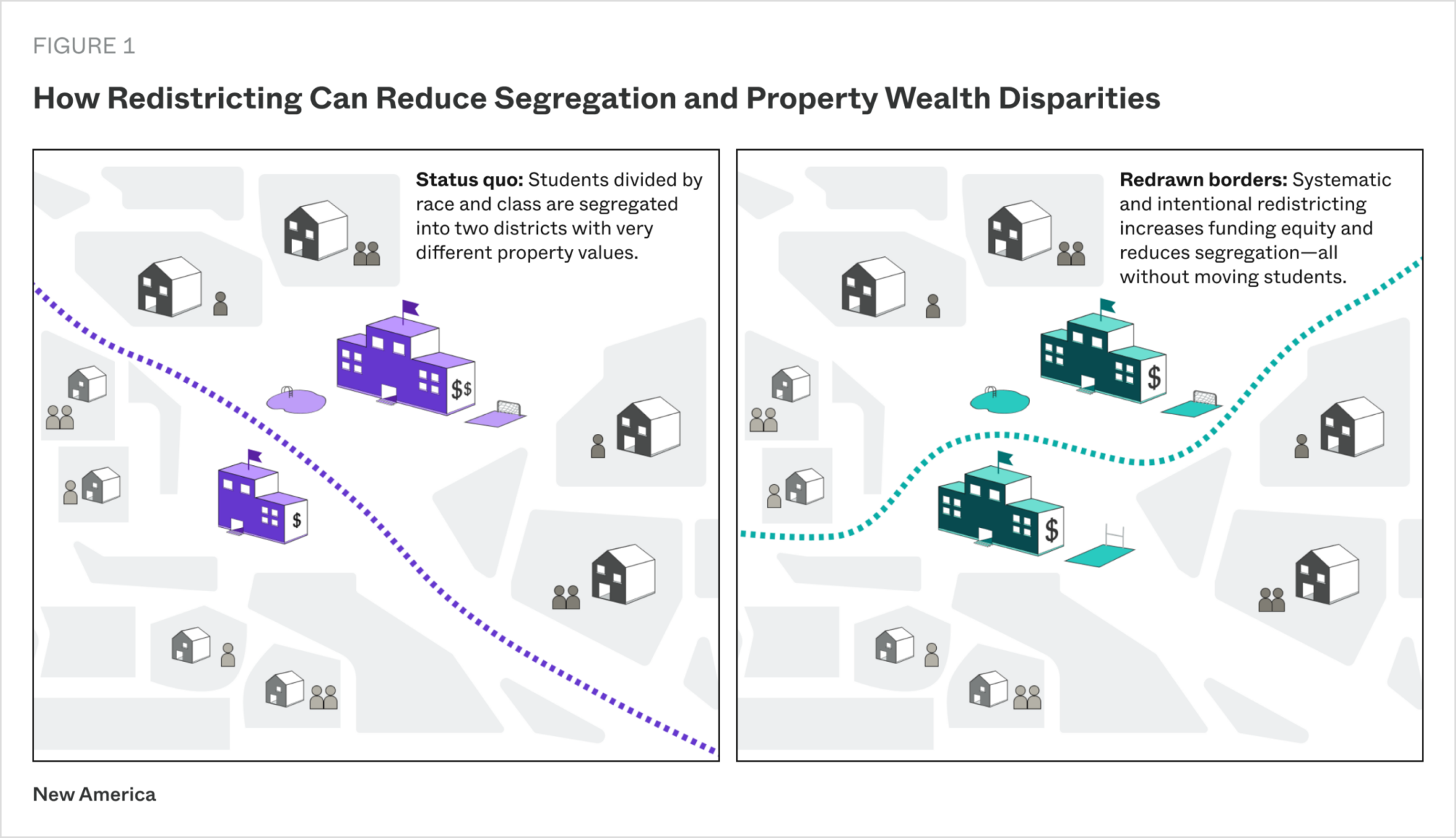
It doesn’t have to be this way. Instead of compounding the problem, school district boundaries can be drawn to counter and correct segregation and inequality. In our previous report, Redrawing the Lines: How Purposeful School System Redistricting Can Increase Funding Fairness and Decrease Segregation, we modeled three equity-driven approaches to school system redistricting across 42 states. Our results demonstrate that it is possible to draw school district maps to give more diverse groups of students fairer access to local school funding.3 We found that if states redistricted with an eye toward increasing tax-base fairness and reducing segregation between districts, they could realize huge improvements. In the average state, our most effective simulation yielded a 66.6 percent increase in the equality of per-pupil tax capacity between districts, a 47.6 percent drop in racial segregation, and a 65.0 percent decrease in economic segregation. These gains can be achieved without changing where students live or the value of their families’ homes. Better lines can be drawn around and through existing neighborhoods (Figure 1).
If states are going to build school finance systems on a foundation of local property tax dollars, as nearly all have, then they should ensure that foundation is as level as possible. But no state has yet made a systematic attempt to draw its school district boundaries in a way that does right by students. Instead, district boundary change has mostly been treated as a local matter, usually affecting just two school districts choosing to swap territory, merge, or break apart. The broad decision to leave redistricting to local decision makers has left too many kids in school districts that do not have the resources to meet their needs.
The stories that follow are drawn from interviews with educators4 from three districts that are rich in community, culture, and resilience, but not property tax capacity. The borders around these school systems do them no favors. They fence resources away from high-need students and create barriers to school integration. This common problem affects districts in varied ways, and these portraits show the impact it has had on three very different communities.
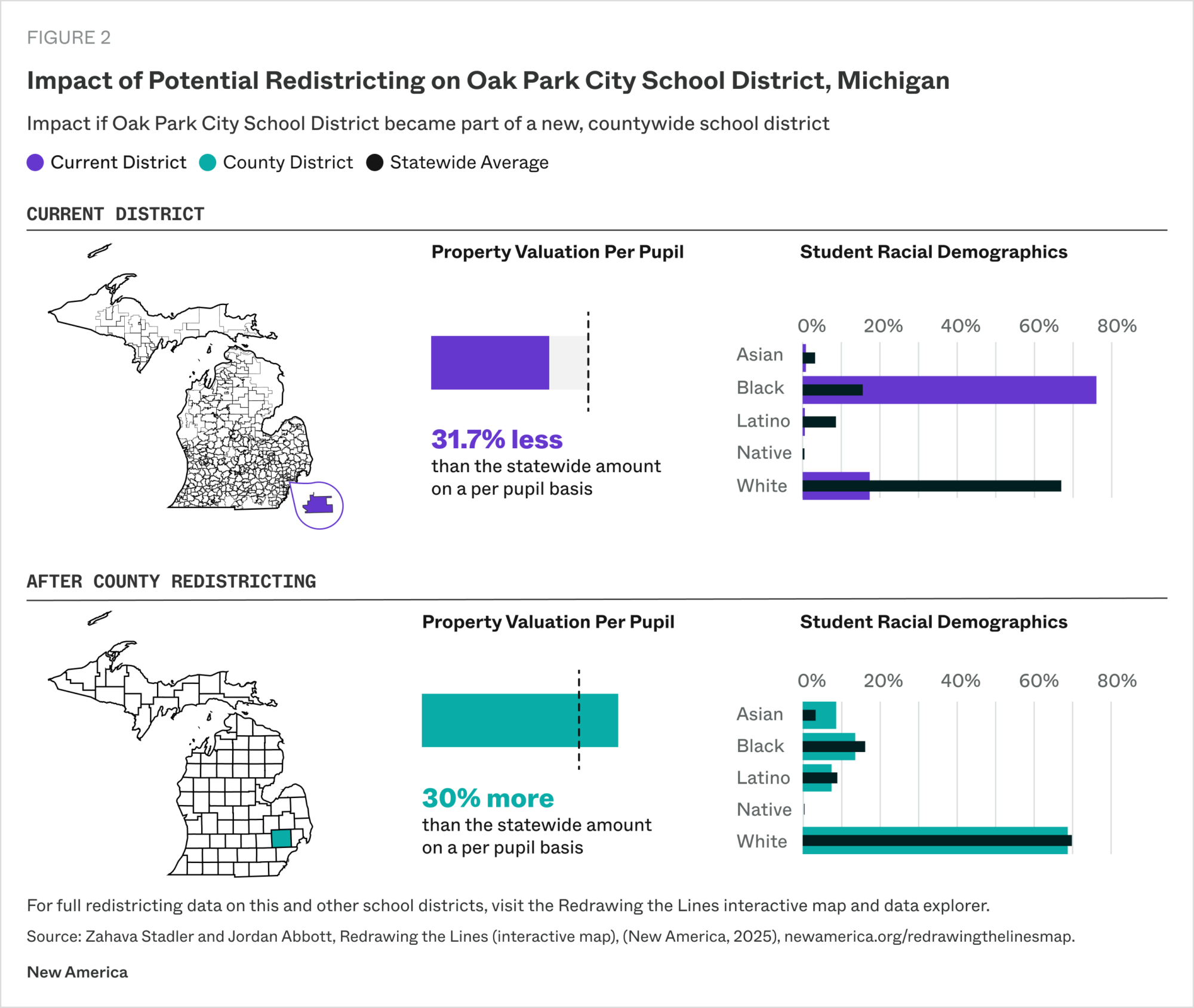
Oak Park, Michigan, is an inner-ring suburb of Detroit. For every dollar of property wealth per pupil in Michigan, Oak Park has just 68 cents, which impacts its school funding levels. The district does not actually cover the entirety of Oak Park; while a substantial portion of the city is served by Oak Park City School District, two other districts, Berkley and Ferndale, also overlap with the city. Both enroll primarily white students, while Oak Park City School District’s student body is 73 percent Black.5 Both have higher property values than Oak Park City School District, but because of the way the school district boundaries cut through the city, Oak Park cannot access those resources for its students. Michigan’s inter-district choice programs have enabled some students to opt out of their local schools,6 and enrollment has dropped in Oak Park. In the 2025–2026 school year, the student count was just under 3,000 students, down from almost 3,700 three years earlier and from over 4,400 in 2020, the year Kevin Keys III graduated from high school.7 Below, Keys shares his story.
As told to the authors of this report. Edited for length and clarity.
I am a product of the Oak Park School District. I graduated in 2020. By 2023, I was back inside of a school teaching third grade at my alma mater, Einstein Elementary, my own old classroom. Now, I teach elsewhere, but I’m still a community member in the district. I am also a commissioner for the Arts, Culture, and Diversity Commission of the city of Oak Park, and the chairman of the city’s Juneteenth Commission. I love this city.
Families deeply value education here, and many alumni stay connected to our district. For a long time, families had generational roots in Oak Park. Parents would stay in the city for 45 years and pass a house along to their children. But that’s changing. The city is seeing a boom. Bars and coffee shops are popping up, there’s a lot of nightlife happening, and younger folks are coming in.
But Oak Park is divided. There are three school districts within the city: Oak Park School District in the south, Ferndale School District to the east, and Berkley School District to the north. Property values have gone up in certain parts of the city, in the area around the new bars and restaurants, but those taxes are mostly going to Berkley School District. When we talk about southern Oak Park, which is predominantly Black and where Oak Park School District is, property values aren’t increasing. They’re not doing anything.
For me, Oak Park was an amazing district. I’m 23 years old, and I have a bachelor’s, a master’s, and a doctorate degree. It’s where I learned the value of education and hard work. But the unfortunate reality is that a lot of students that graduate from Oak Park don’t do well in college. Some people who graduated from high school with me dropped out after two years; some have been in college for the last six years. They just weren’t prepared. It took me a while to realize that we didn’t have the same experience in high school. Because I was in the Gifted and Talented Honors Program, we had different opportunities, a whole different set of teachers. Because of the lack of funding, the district only had enough resources to give that to a certain group of kids, and that was an uncomfortable realization for me.
Now, we don’t even have that. We don’t even have enough funding to try to help 30 of our kids. We have some strong pockets of programming, we have administrators that are trying to stretch limited resources, and we have dedicated teachers who are working beyond contract hours to try to do what they can. But there’s only so much they can do when they don’t have the resources. Today, Oak Park is a district that is half-doing everything. The sense is, “We don’t have enough resources to get them achieving at or beyond grade level. We need to just get them to at least a grade level below. That’s good enough for us.” So, 5 percent growth looks like a superb year, and we are accepting the bare minimum. But we can’t build on a foundation of bare minimums.
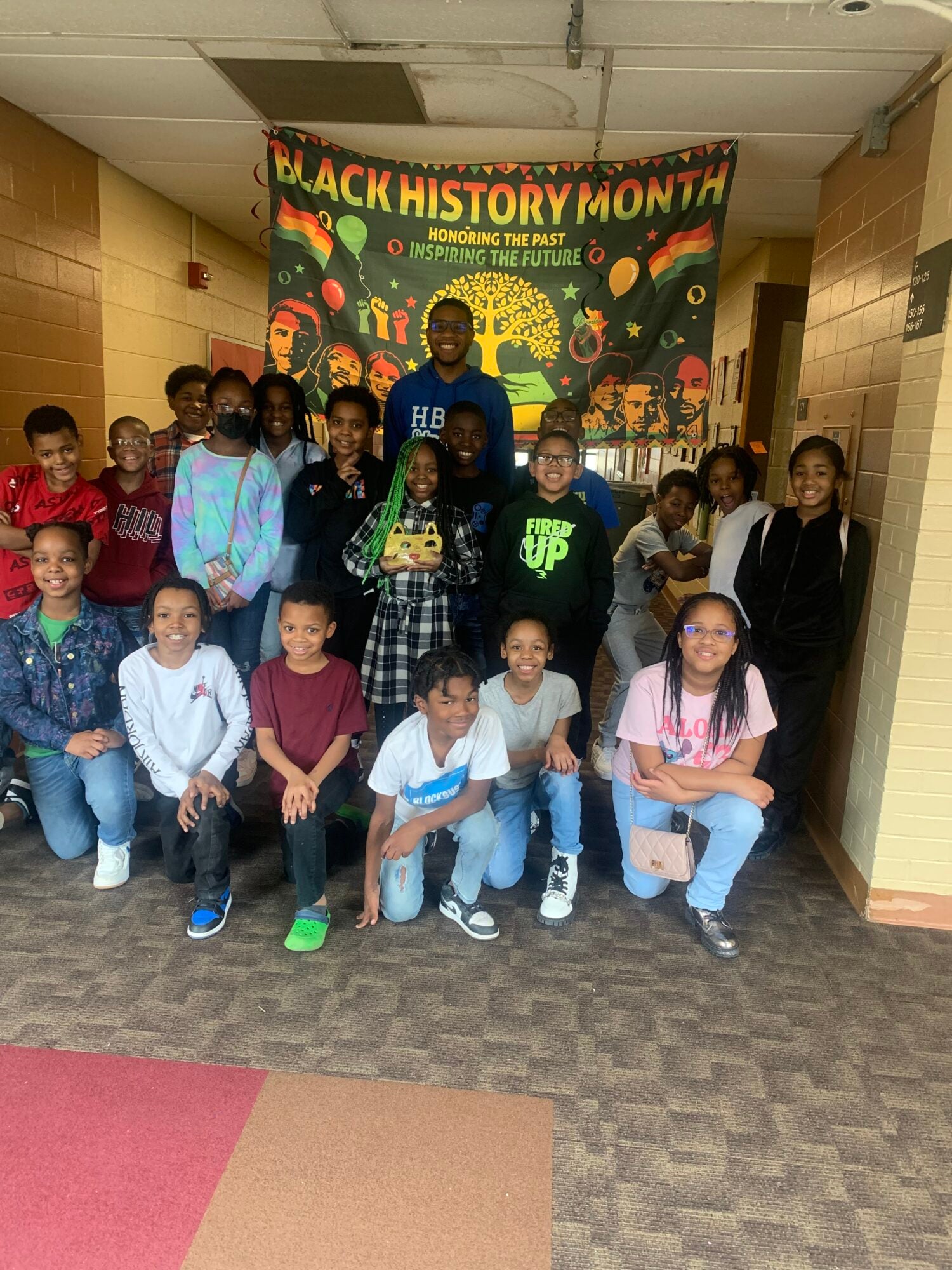
We have a high-need student population. Some of our students are three or four grade levels below where they should be, and we can’t address that with the same resources we give to a student in Berkley. They’re equipped. With those resources, they can excel. But when you have a child that is three grade levels behind, you have to invest more resources, to have more class time, to do more in order to bring that child up to where they need to be. Equity would mean giving Oak Park more resources so they can fill those gaps.
Right now, it’s the teachers filling those gaps. They’re paying for school supplies out of their own pockets. When they have too many students at different grade levels and need something to help differentiate instruction, they’re using their own money to buy materials on the Teachers Pay Teachers website. But teachers can’t do everything. In my first year teaching, I had about 10 students with IEPs (individualized education programs, detailing their special education needs) in one classroom. I was constantly advocating to make sure everyone was getting their services. Based on those IEPs, I should have been seeing the social worker in my classroom three times a day, but it just wasn’t happening. The social workers, psychologists, and occupational therapists were overwhelmed. My kids weren’t getting the full support they needed, and I was burnt out.
If we had more funding to hire auxiliary staff, that would help us, but we just didn’t have the budget. I had a child in my class who was visually impaired. She clearly required one-on-one support, because I could not sit beside her and give her everything she needed when I had 27 other students. But it was like pulling teeth to get a paraprofessional for her, because Oak Park School District could only pay paraprofessionals $12 an hour. A paraprofessional can work in Royal Oak School District, 15 minutes away, and get paid more than some teachers in Oak Park. When you can’t compete with other districts, you have a lack of support staff. It’s the same with teachers. When I left Oak Park to teach at a charter school in Detroit, my salary doubled. How can Oak Park thrive with underpaid teachers and overcrowded classrooms?
We also don’t have the elective classes and extracurricular options we did when I was in school. I did robotics in the third grade. I was part of a marching band that generated over $4.4 million in scholarship dollars. I was a theater kid, and I learned the ins and outs of audio-visual production; knowing how to edit videos even helped me with my campaign when I ran for state representative. I had all these tools that I had learned in Oak Park. We just don’t have the budget to run those programs anymore.
There are a lot of students using inter-district choice to attend schools in different districts in the Detroit metro area, and now, fewer Oak Parkers are sending their children to Oak Park School District. A lot of the enrollment we do see is kids crossing the city line from Detroit. We say that makes our schools into schools of choice, but I’ve heard people joke about it, calling our kids “Detroit rejects.” I hate to hear them label our students that way, and unfortunately, there are a lot of people in positions of power who use that type of language about Oak Park School District. The media contributes to stereotypes about our district, beliefs that Oak Park is broke, that students are always getting into fights, and that no one is learning. I’ve heard leaders in our area say that they can be proud of everything in the city except Oak Park School District. How can we expect people to invest resources in a district when that’s what they think of it?

I’ve heard leaders in our area say that they can be proud of everything in the city except Oak Park School District. How can we expect people to invest resources in a district when that’s what they think of it?
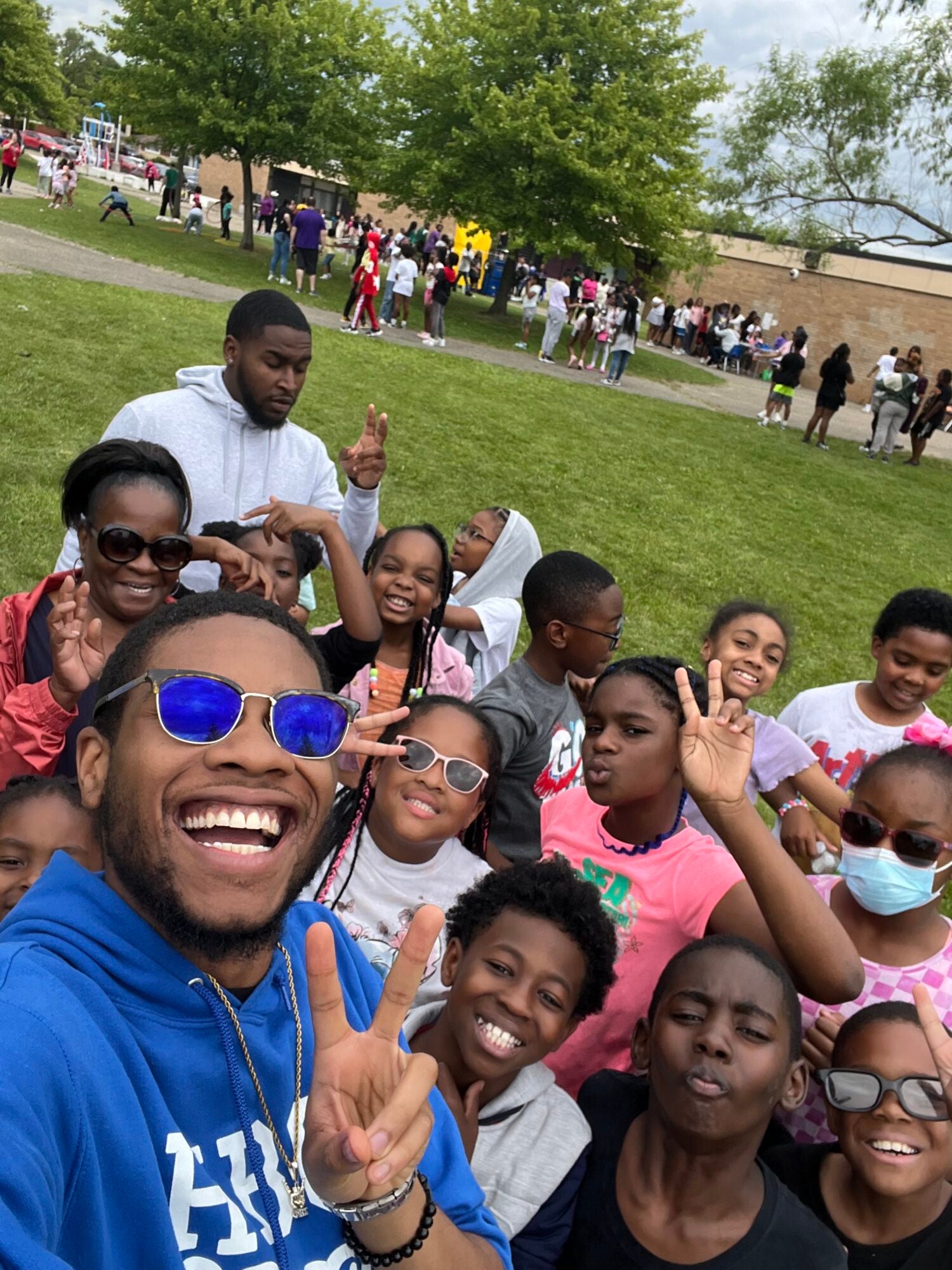
When I’m out in the community, I get offended when people assume I must have gone to Cass Tech, King, or Renaissance—the “big three” selective magnet high schools in Detroit—and are surprised to hear that I went to Oak Park High School. I teach eighth grade, and as my kids consider high schools, I ask parents, “Have you ever thought about Oak Park?” They always say they wouldn’t send their child there, that they couldn’t do that to their child. That hurts my heart, because I’m a product of Oak Park. And I say to them, “Well, hold on. You just said you love my teaching. You said you value the impact that I had on your child. I’m an Oak Park graduate, so I’m offering you the school that made me who I am.”
But we have to point out the elephant in the room. We see a poverty rate that’s significantly higher than the state average, but a tax base that is worth much less per pupil than the other districts near us. Southfield Public Schools is literally tearing down a school now to build a state-of-the-art facility, and it’s only going to take them three years, because they have the funding to push it through. It’s all competition. If I have to drive five or 10 minutes away and that gets my child access to the state-of-the-art tech center and a brand-new gym instead of a building that hasn’t been renovated since the 1950s, or a university-backed charter school instead of a district school where only 5 percent of students are proficient on state tests, it’s clear what I’m going to do. Because you have to make sure your kids are equipped to take off in the world. And in Oak Park, we just don’t have the resources. This is such a beautiful district, and I hate the condition that it’s in now, because our kids deserve more.
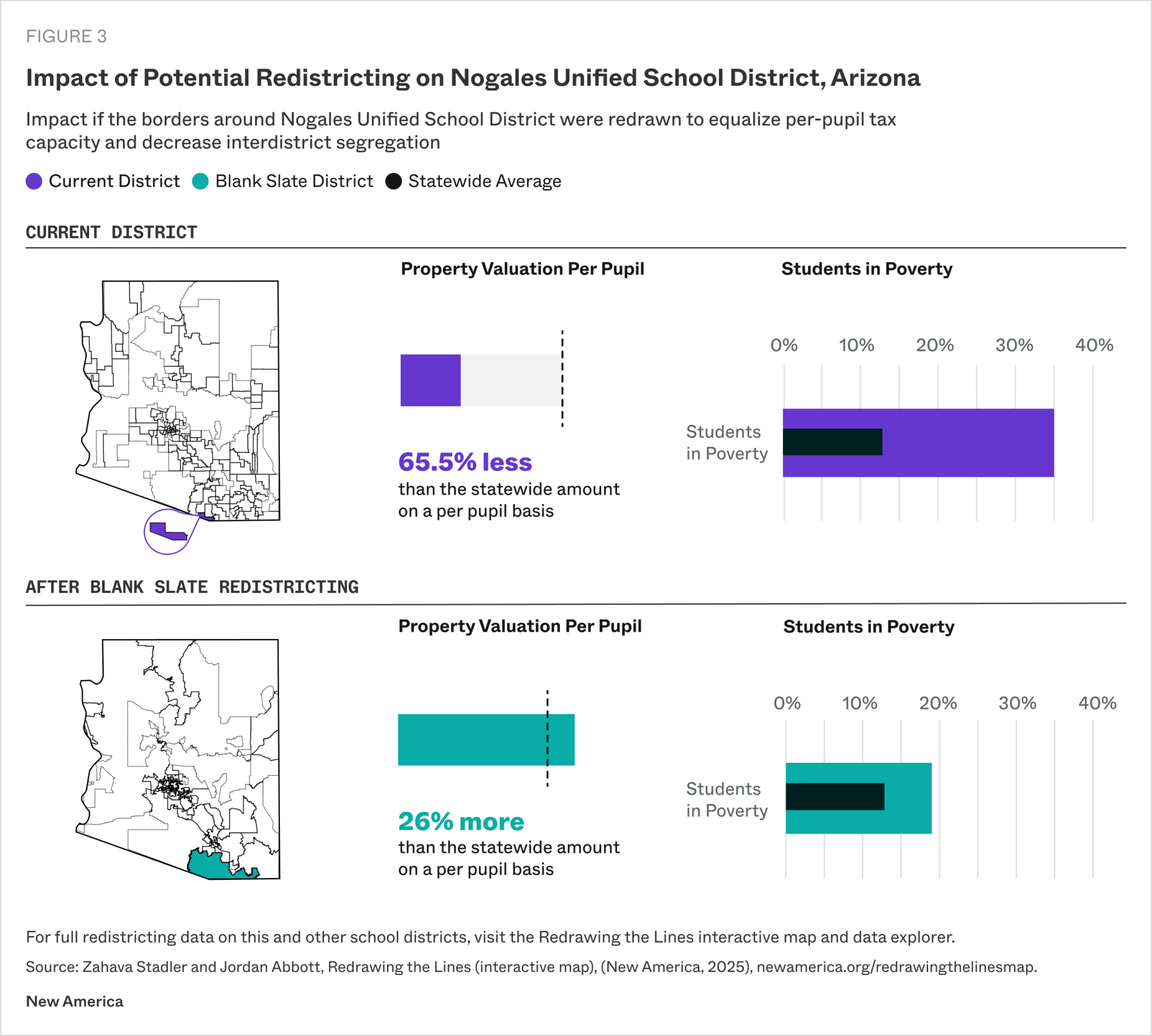
Nogales, Arizona is on the U.S. border, just opposite Nogales, Sonora, Mexico. The poverty rate among school-aged children living in Nogales Unified School District is 35 percent, more than triple the statewide rate. Despite this high level of local need, however, Nogales Unified’s funding levels are lower than average for the state. In 2023, its funding from state and local sources totaled $12,152 per pupil, while the average Arizona district had $14,400. This gap was partially driven by the district’s lower-than-average property tax revenues. Nogales Unified’s per-student share of the state’s tax base is only a third of what it would be if property wealth were spread evenly among Arizona’s school districts. Compare this with San Fernando Elementary District, just to the west of Nogales. The district is so small that it comprises only two classrooms, one for grades K–3 and one for grades 4–8,8 and it enrolled a total of nine students last year.9 It has only three houses on its tax rolls, but its property tax base is enriched by an energy pipeline that runs through the district, offering an easy and plentiful source of revenue for its very few students.10 San Fernando Elementary District’s per-pupil funding, powered overwhelmingly by local property taxes, far outstrips that of Nogales Unified. The school district boundary keeps this good fortune contained and away from neighbors like Nogales, which enrolls nearly 5,700 students11 and must rely on volunteers and community partners for key programming. Below, Nogales Unified alumna Christie Monreal shares her experience.
As told to the authors of this report. Edited for length and clarity.
I was born and raised in Nogales. I graduated from Nogales High School in 2014 and completed my associate’s degree through Cochise College in Nogales before getting my bachelor’s degree.
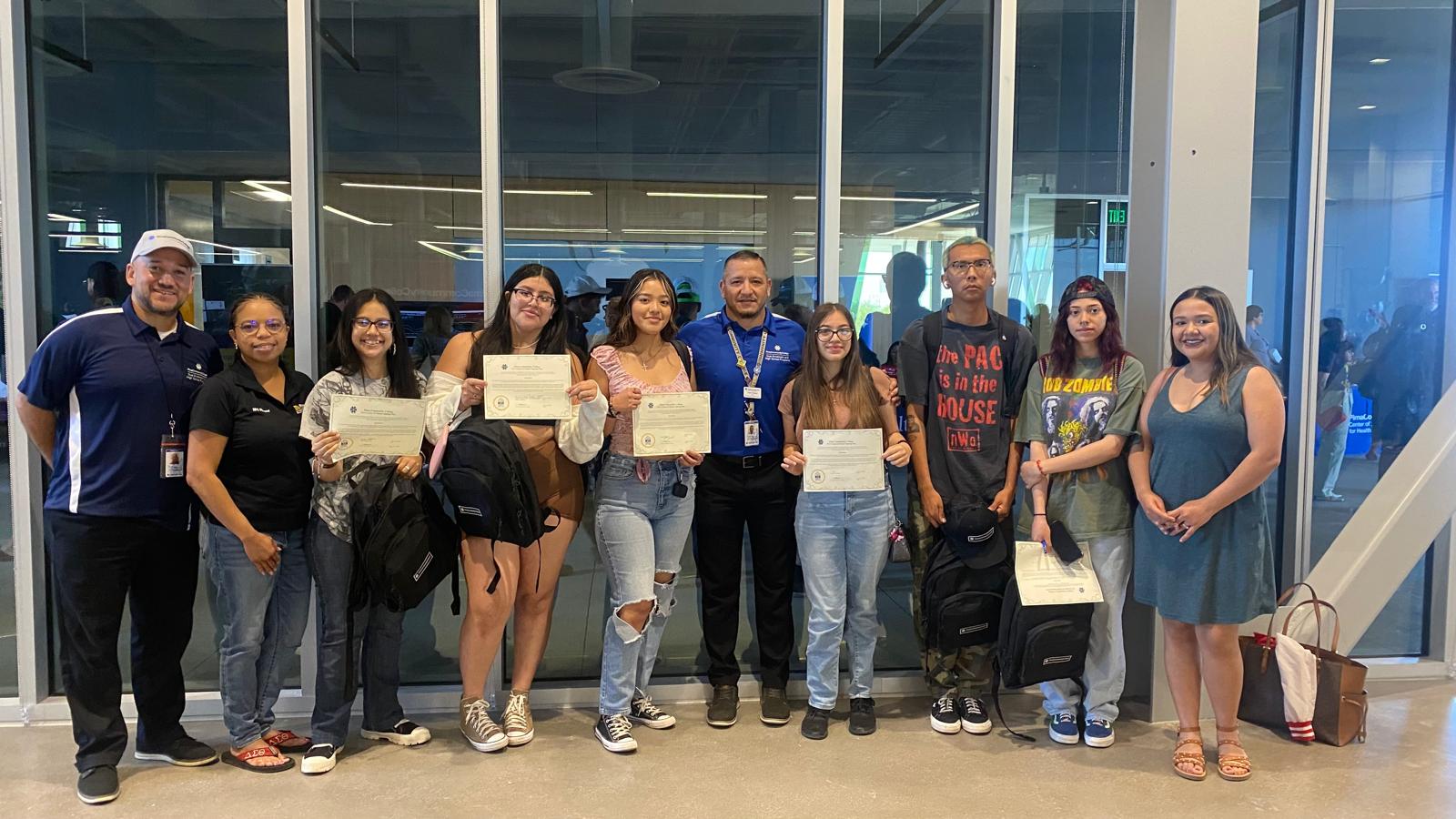
Like a lot of people from Nogales, I was a first-generation college student with no knowledge of higher education, or even what questions I should be asking. Counselors had full loads and the district didn’t have specific college and career counselors, so I struggled to receive information. But while I was at Cochise, I had a federal work-study job at a reception desk, answering questions like, “I’m interested in going to college, but where do I start?” or, “What is it that I’m supposed to be asking so I can get enrolled?” I saw how important it is to help students, so I pursued a career in higher education. At first, I was a coach with the Gear Up college and career readiness program in Santa Cruz County, which includes Nogales. Now, I’m a dual enrollment program manager for Pima Community College, serving high schools in Nogales Unified School District and other districts in the county, helping students take advantage of free classes that allow them to earn college credit in high school.
The city of Nogales is on the border with Mexico. There are a lot of people here who were born and raised in Nogales, Arizona, but we also have people who live in Nogales, Sonora, Mexico and have dual citizenship, so they want to take advantage of American educational opportunities. We have some schools so close to the border that students cross every morning and walk to school, and walk back home across the border after school. Lots of people who live here go into Nogales, Sonora just to go grocery shopping, to buy tortillas and cheese, to go to the pharmacy or get some good Mexican food. And a lot of people from Nogales, Sonora come here to go to stores like Ulta and Bath & Body Works that still don’t exist in Mexico. It’s all within a 15-minute drive. This is truly a binational community.
In Nogales, you will hear more people speaking Spanish than English, so it’s important for the district to communicate with parents in their main language and make everything understandable for our families. Because so many families come every year wanting their kids to go to an American school, there are always new kids becoming part of our community. So, the district and school administrators are very dedicated to making sure that parents understand what their kids are experiencing. And it can be challenging; parents living in Nogales, Sonora might not be able to come to an event or a meeting at their children’s school if it could take an hour to cross the border. But we also have a lot of engaged parents who communicate by email or join a meeting by video conference.
Even though nearly all our students speak both English and Spanish, not all our teachers are bilingual. Enrollment at Nogales High School is just growing and growing, but it’s been harder for them to match that by hiring enough teachers. And the teachers we do have are given a full schedule, where they hardly have time for lesson planning and grading. There are barely enough counselors, and for college and career counseling, they rely on us to fill the gaps, because dual enrollment is a free program. They’re trying their best to cover all the needs, but obviously, there are some funding issues.
Because our students are considered low-income, the district is very on top of organizing free programs, from summer programs for kids to workshops on life skills like taxes and résumé-writing. But the district doesn’t have funding to staff all of these programs, so a lot of it is done by volunteers, community members who come and share their knowledge with our students. People here are always willing to step up for the students. When I was at Gear Up, I was always asking our community to contribute, like donating shaved ice or free movie tickets—treats or prizes that would be an incentive for students to come to events and learn. Nogales is such a close community. We all know each other, and we’re always helping each other. We’re always trying to wear so many hats, because we’re not the type to let others down. We’ll find a way to make it work, and we’re always pushing each other forward. That’s just the way that we’re raised in this community.
But if I put myself in the shoes of a parent in the district, I see a lot of differences between what’s here in Santa Cruz County and next door in Pima County. One I’ve noticed is a program called Youth on Their Own, which gives students in Pima County who have insecure housing a stipend to help them pay rent, to buy groceries that can get delivered to their high school. Or TRIO, the college preparatory program, or Educational Talent Search, which helps with field trips and visits to universities—I’ve never seen any of these programs in Nogales. And I feel our kids still need that. It’s just that they have never really reached all the way to our county. If we could open our district up a bit more, maybe by redrawing some lines, we could be a little bit more exposed to all the things that could help our community. We’re open for anything that could help our kids. There are just so many things we haven’t asked for because we didn’t know about it.
There are just so many things we haven’t asked for because we didn’t know about it.
Nogales has a very special place in my heart. I just want the best for this community. We’re very hardworking people. Nogales is the first step for a lot of immigrant families. There’s not a lot of kids whose grandpa went to college or whose mom went to college. There are always new people coming in, looking to make a start. And we are always looking to help, to guide. So that’s something I really admire. We have so much potential to be a big community. Every program we bring here is successful. But we just need more exposure—to understand what resources are out there, and what’s possible.
Nogales is a small community. So when people grow up here, they tend to move away, looking for the fun and the opportunities of the big city. And they learn so much, but sometimes they never come back with it. We need that knowledge and experience to come home, too. Go, but come back. So we can learn and bring more resources to our community. I always get calls: “Can you do a presentation and share your experience? You’ve lived here, you’ve gone to school here, now you work with the schools—how can we guide our kids?” If we could multiply that by a thousand, maybe our community would be better off. And if we could open our school district up to more offerings and experiences, maybe our kids would be better off.
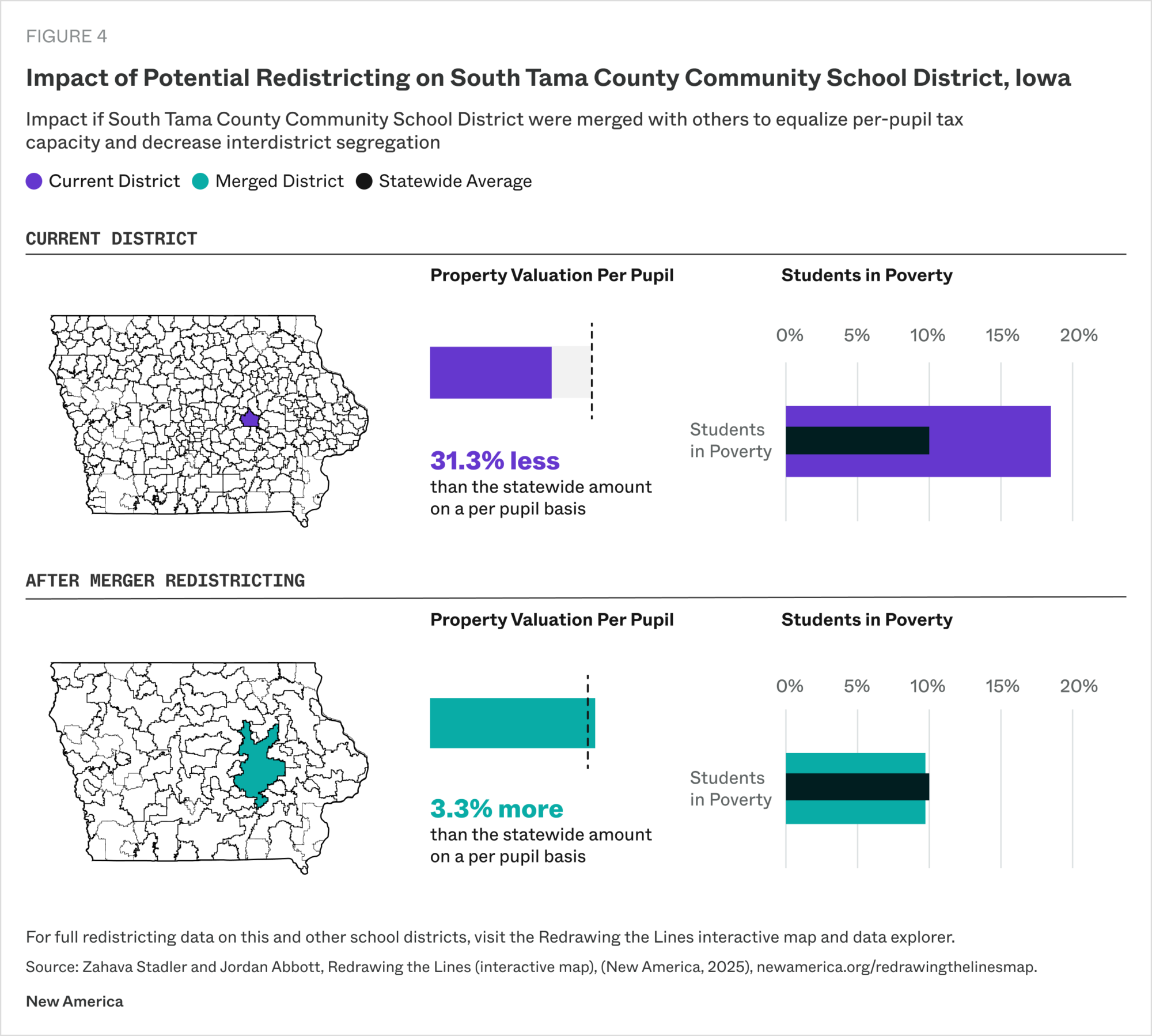
South Tama is a rural school district that is roughly halfway between Des Moines and Cedar Rapids. Families in the district are racially diverse—far more so than Iowa’s overall school-aged population—and almost 19 percent of students live below the poverty line, close to double the rate for schoolchildren statewide. South Tama has about $1,000 less to spend per pupil than the average Iowa district. Between budget challenges and a remote location, the district has trouble attracting and retaining staff for key positions. But if this district were merged with others in the region, the consolidated school system could access far more resources for its high-need student population.
As told to the authors of this report. Edited for length and clarity.
I have been teaching for nine years, and I’m blessed that all of it has been at South Tama County Community School District. I student-taught here, and I fell in love with it. My first three years were in a fourth-grade classroom, and after the COVID-19 pandemic prompted some changes, I moved to third grade and have been there ever since. It’s a great school district. I tell people I wouldn’t want to go anywhere else, and that is because of the students. They work hard, and they enjoy learning, and they are just a fantastic group. South Tama might be in the middle of nowhere, but we really have so much to offer.
It’s a rural area. When you look outside my classroom window, you see the playground, and beyond it, there’s a cornfield that is planted by our high school agriculture program students. A good number of our students come from farming families. Many others have parents that work at Iowa Premium, a huge beef corporation based in Tama, Iowa, in the meatpacking facility. And in lots of families, the adults are working multiple jobs. That’s something to be sensitive to, as a teacher. I give homework as an option, but I know it’s not always going to be done because there’s not the ability for parents to help at home. I know the majority of academic support has to come from the teacher at school.
We have huge diversity in our district, which is such a beautiful thing. Our school has a mix of Hispanic and white students, and the Meskwaki Settlement is just five minutes away from Tama, so we have a number of Native students as well, though many students from the Meskwaki Nation also go to their own Tribal school. We have students that speak so many different languages—I’ve had high-flyers before who speak Kʼicheʼ and Swahili—and one of the huge benefits of being an employee at South Tama is that you have a chance to embrace lots of different cultures.
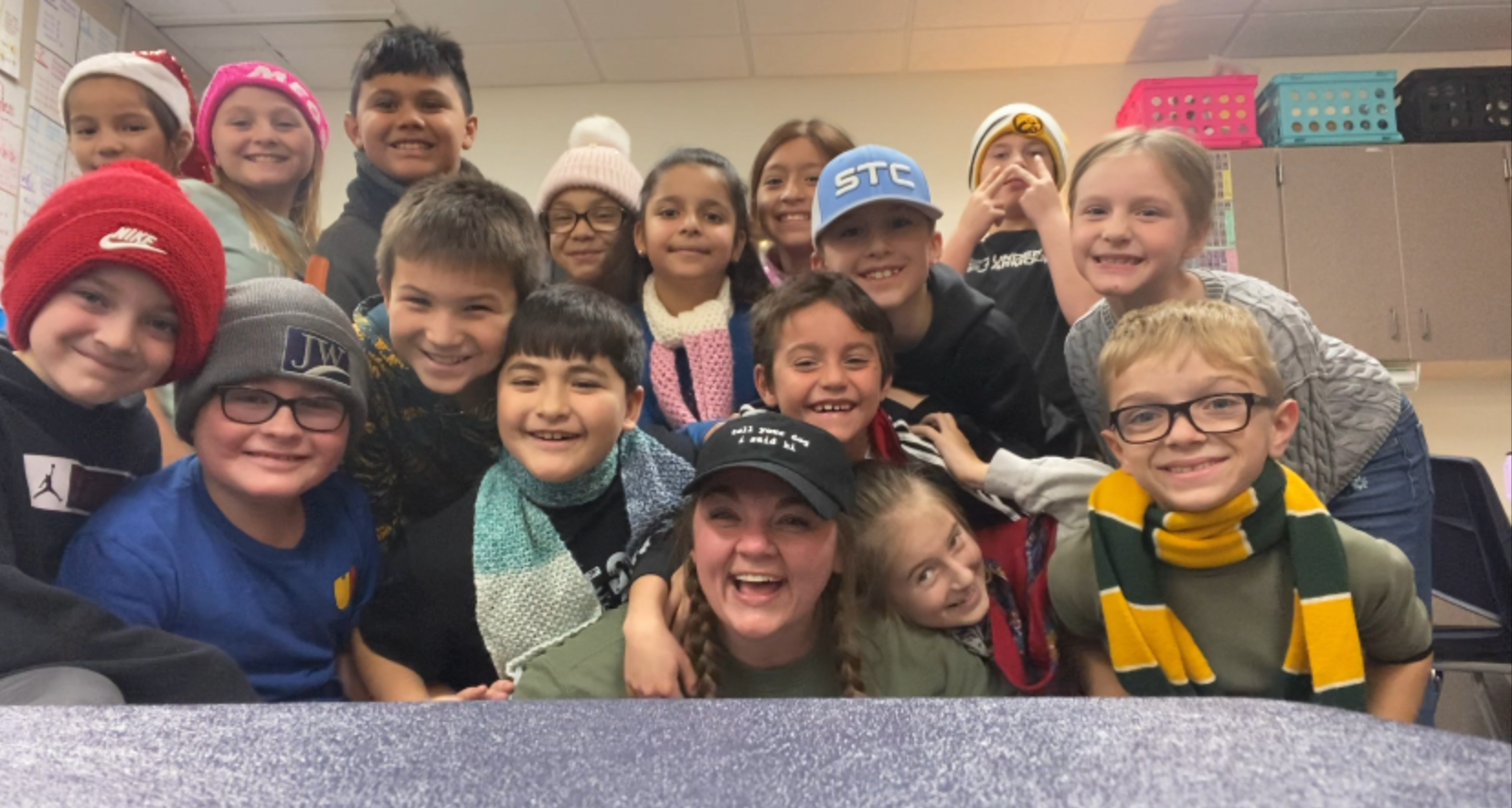
Our K–4 elementary school has three teachers for English language learners (ELLs), so we have to share them across grade levels, which can be tricky. We are blessed with what we have, but we would always love more resources. Our ELL teacher is split between the third and fourth grade, and she does a great job of trying to manage different groups. We have to be flexible, too, as classroom teachers. Within the past few years, as some of our veteran paraprofessionals have retired, we’ve been able to hire some new paraprofessionals who are bilingual in English and Spanish, which is very beneficial if you have a student who has very low English proficiency. But if there is no bilingual staff member in the classroom, or if you have a student who is a newcomer, the best support comes from our other students, who sit next to their classmates and help with translation. Our students are amazing. They work so hard, and they want to be part of helping other students grow. I just wish that people could come here and see how great the students are, because they are remarkable.
Of course, we have students with disabilities in our school, and we have multiple dual-identified students that are both English learners and receiving special education services. I would love it if we had more resources for both. Right now, we have a position open for a special education teacher for level 3 students, those with the most intensive needs, but we’re managing. We have a wonderful teacher on staff that has that certification, and she’s already doing kindergarten special education, but she’s also filling in for our level 3 students.
We have some challenges with filling teacher positions. When candidates have the choice between South Tama and even a district like Marshalltown, which is a bigger town 20 minutes closer to Des Moines—that’s where the nearest Walmart is—it can be hard to compete. What I really hope, though, is that even if we have vacancies, the integrity of our staff stays strong. If I have a co-worker, I want them to be a strong teacher who is passionate and loves what they’re doing, not just someone filling a position. I just hope that the education of South Tama County continues to be strong, or we won’t be giving students the education experience they deserve.
We have some challenges with filling teacher positions...It can be hard to compete.
The enrollment in South Tama County has been going down a bit. In our elementary school, we previously had about 100 kids per grade. Now, that number is in the high 80s. And there have been noticeable changes in the community. For example, when I first started here, I remember there being two different eye clinics, but now there are no eye clinics in Tama.
Our district does rely on our local businesses for support. We have a program called Partners in Education, where different companies sponsor supplies and help cover costs. At the beginning of each school year, we have a “Pack the Bus” event, where community members can purchase school supplies for students who need them. Local organizations like the American Legion get involved as well.
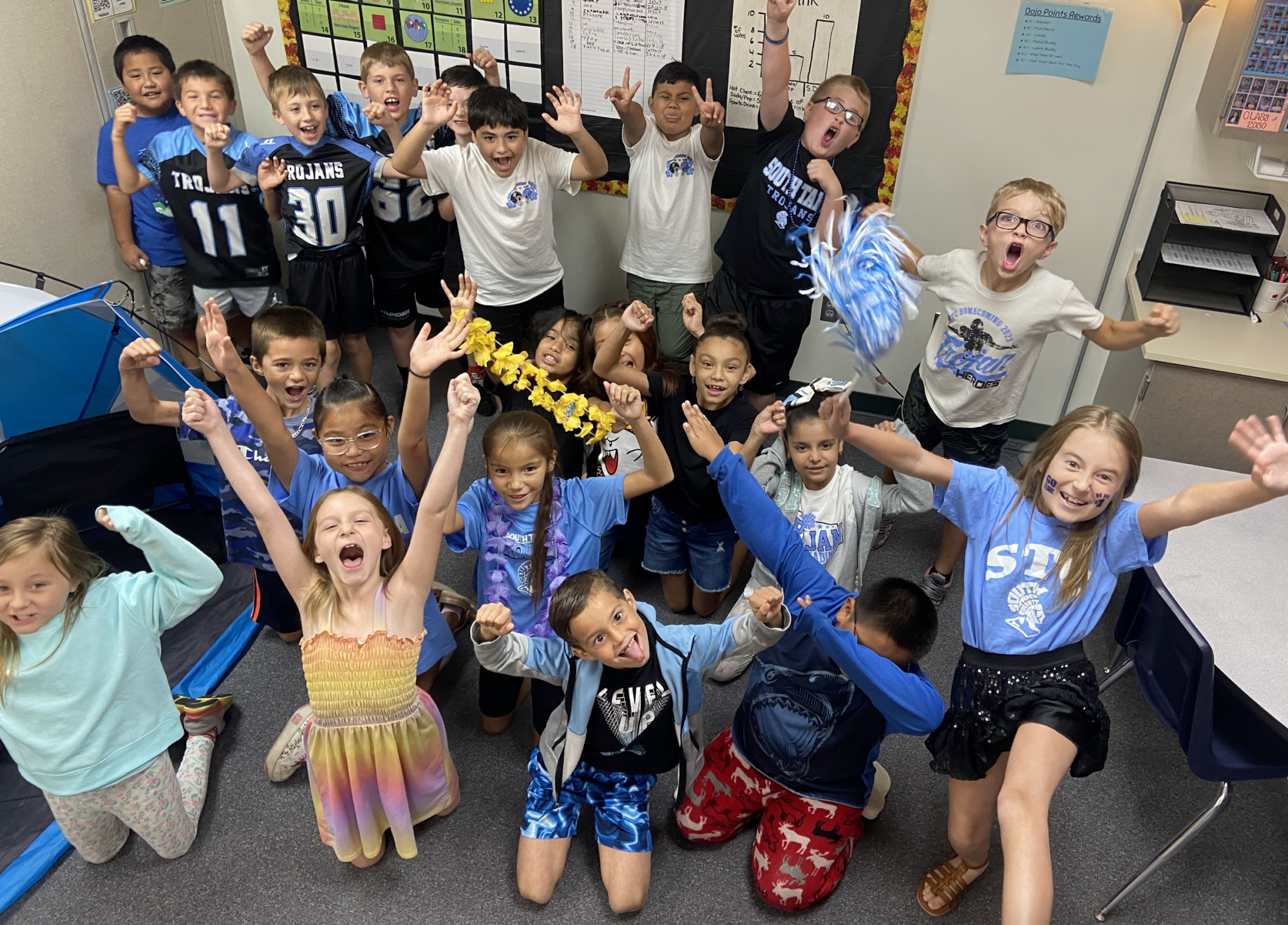
The home liaison for our elementary school goes above and beyond, reaching out to those partners for donations, and when we have students who don’t have what they need, we can go to her. She has what is known as “Jenny’s closet,” because she has not only things like pencils and backpacks, but also donated clothing for students who may have not been able to shower for a few days. She wears a lot of hats, and we are very grateful she’s there to help our families. We have a program where food is sent home with students on Fridays so that they have enough for the weekend, and washers and dryers in the school for when we see that the student hasn’t been able to do laundry at home.
If we had the budget, there are lots of things I’d love to do to benefit the students, whether that’s academically or personally. And it’s intriguing to think that there are other resources in nearby districts that we can’t currently tap into, even within our own county. We’re called the South Tama County Community School District, but the district doesn’t even cover half the county, which is crazy to think about. You can see in the data what a difference could be made if we had access to funding from the rest of the county. But I’m also thinking about the communities around us. North Tama County, a school district with higher property values just north of us, is a predominantly white district, and South Tama has so much diversity. You just never know how people will act, and when I think about joining together, it raises the question of who would have control over those resources. Because it has the potential to be amazing, but it also makes you wonder what could happen because of the pull that one local school community could have within the district. We just hope that everything is done for the benefit of the students, and that they always get the equal education that they deserve.
The students of Oak Park, Nogales, and South Tama deserve no less than students in the best-funded school system. But greater funding is just out of reach, walled behind school district borders that separate students from the resources they need. The fact that nearby districts have so much more property tax capacity makes for stark comparisons between neighbors. But therein also lies the good news: The resources are there. If the borders that outline these districts were redrawn with equity in mind, students could access a much fairer share of the state’s property tax revenue, and much more support for their schools.
In this, Oak Park, Nogales Unified, and South Tama County are not unusual. Students all over the United States—students of all races and backgrounds, in cities, suburbs, and rural communities—have had their opportunities narrowed by school district boundaries that reinforce our country’s divisions. But there are alternatives. In Redrawing the Lines, New America’s Education Funding Equity initiative shows the way, with data and interactive maps demonstrating how different redistricting approaches would give students more diverse districts and place school funding on fairer footing.
To date, no state has approached its district map as a tool for ensuring that all children have access to a high-quality, well-resourced public education. But these lines are a matter of state policy. They are governed by laws, and those laws can be changed any time state legislators choose to take up the cause. Redrawing the lines can help states give all their students the education they deserve.
This report was created with the support of the American Institutes for Research Opportunity Fund. It was produced as part of the Education Funding Equity initiative at New America, which is supported by the Skyline Foundation and the Gates Foundation. New America thanks these supporters. The findings and conclusions contained within this report are those of the authors and do not necessarily reflect the positions or policies of AIR or the foundations. The authors would like to thank Sabrina Detlef for her copyediting support and Katherine Portnoy, Natalya Brill, and Amanda Dean for their communications and data visualization support. Special thanks to contributors Kevin Keys III, Christie Monreal, and Natasha Becker, all of whom shared generously of their time, insight, and personal experience.
Project Director, Education Funding Equity Initiative