Ranked-Choice Voting is an Acquired Taste
This brief is part of a series by the Electoral Reform Research Group, a collaboration between New America, Stanford University’s Center on Democracy, Development, and the Rule of Law, the American Enterprise Institute, and the Unite America Institute. To find the full report of the study summarized below, click here.
Overview
We conducted a survey experiment in which respondents participated in a voting task using both the single vote method and ranked-choice method, and then evaluated the two methods. Some respondents were randomly assigned to receive longer descriptions that emphasized the vote transfer and majoritarian features of ranked-choice voting.
Research Questions
- In a national survey sample, how do voters rate the fairness and ease-of-use of ranked-choice voting (RCV) compared with the single vote method?
- If voters are informed about the vote transfer and majoritarian features of RCV, does their support for RCV increase?
Key Findings
- Respondents give the single vote method higher ratings on fairness and ease-of-use measures, and a strong majority prefers the single vote to the ranked vote.
- A short explanation of the vote transfer properties of RCV does not increase public support for that method.
- Younger voters, Democrats, more educated respondents, and third-party supporters tend to evaluate RCV more positively than older voters, Republicans, less educated respondents, and major party supporters.
Background and Research Design
Ranked-choice voting (RCV) is an electoral reform that is gaining support in the United States. RCV has voters rank candidates in order of preference, rather than just selecting one candidate. Several municipalities across the country now use RCV for local contests. Maine adopted RCV through ballot measure for statewide and some federal elections in 2018, and Alaska was the second state to adopt RCV through ballot measure in November 2020. While these reforms are gaining in number, there is still little research indicating how American voters evaluate RCV rules.
American voters have little knowledge of or experience with alternatives to plurality voting rules. This means that they are likely to be influenced by arguments about the positive or negative features of alternative voting rules until they have a chance to vote with those rules. On the positive end, for example, we would expect that emphasizing the RCV's vote transfer and majoritarian properties would increase its public support.
The research measuring support for RCV is limited, but it points to some prevailing factors in public support for and evaluations of RCV, particularly age, education, party affiliation, and prior experience voting with RCV rules. When asking voters to compare RCV with plurality-based voting systems, the evidence is somewhat mixed on which systems voters prefer.1
To date, most experiments testing support for voting rules have used a between-subjects research design, which treats different voting rules as alternative experimental treatments (e.g., one group does a plurality voting task and another group does a ranked voting task) and relies on random assignment to assess whether subject behavior varies by treatment.2 In this study, we use a within-subjects design, which asks each respondent to vote under each voting rule with the same set of candidates, and we randomize the order of voting tasks. A within-subjects design gives voters a more direct comparison of different voting rules with the same set of candidates. This experience may help voters better understand how voting rules differ.
Our sample is from a national survey of American adults conducted as a module on the Cooperative Congressional Election Study (CCES) in 2020 (N=1,000). The CCES survey is administered online and includes pre-election and post-election waves, so it offers two chances to query respondents. In the pre-election wave (conducted from September 29, 2020 to November 2, 2020), we included a voting task featuring five general election candidates for president: the two major party candidates (Donald Trump and Joe Biden) plus three minor party candidates (Howie Hawkins, Jo Jorgensen, and Kanye West). We asked respondents to vote using single vote (plurality) and RCV methods, with the order of voting methods randomized. We then asked respondents how much they like each voting method.
Because we were interested in testing whether informing voters about ballot-counting procedures influences their assessments, we varied the description of plurality and RCV rules before each voting task. One group received short descriptions of plurality and RCV rules (as in many previous studies), while the other group received longer and more complete descriptions of the voting rules.
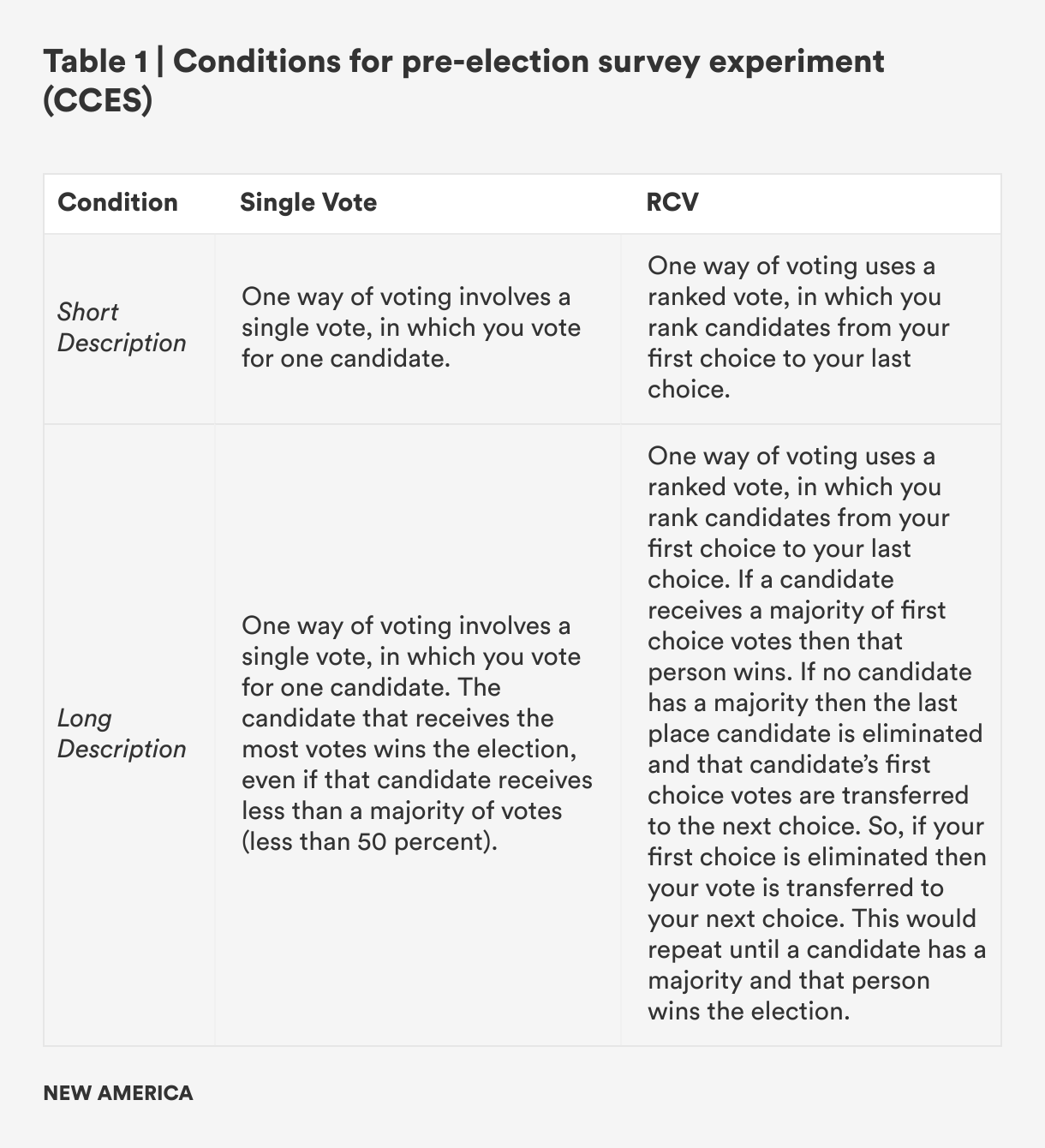
As shown in Table 1, the short description is just one sentence and only describes the task for the voter (e.g., vote for one candidate or rank candidates in order of preference). The longer version adds a couple of sentences describing how votes are counted. For the single vote, the longer description mentions that a candidate can win with less than a majority. For the ranked vote, the longer version includes two important details: (1) that if a voter’s first-choice candidate is eliminated, then the vote transfers to the voter’s next choice; and (2) the retabulation continues until a candidate has a majority of votes. We borrowed language from voter guides in the United States for the longer description of RCV.
After casting their vote with a given method, respondents were asked to use four-point scales to rate the fairness of the voting method and its ease of use. Once they had completed both voting tasks, respondents were asked which voting method they prefer and how important it is for a winning candidate to receive a majority of votes.
Findings
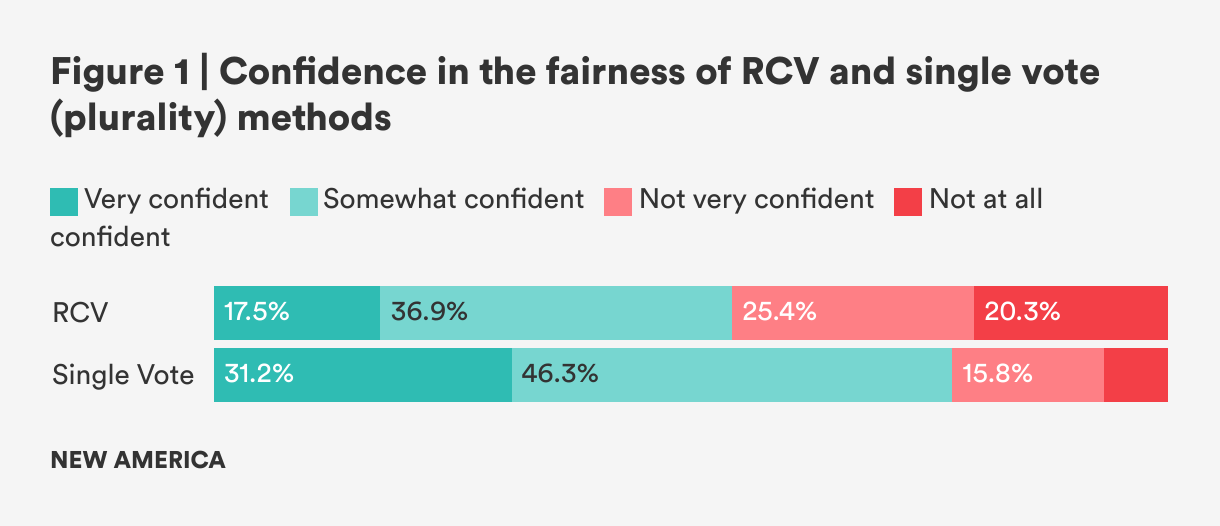
Overall, even though both voting rules tend to receive positive fairness ratings, the single vote is clearly rated more positively than RCV. Contrary to our expectations, providing a more thorough explanation of voting rules that emphasizes the vote transfer properties of RCV does not influence public evaluations of the fairness of either voting rule.
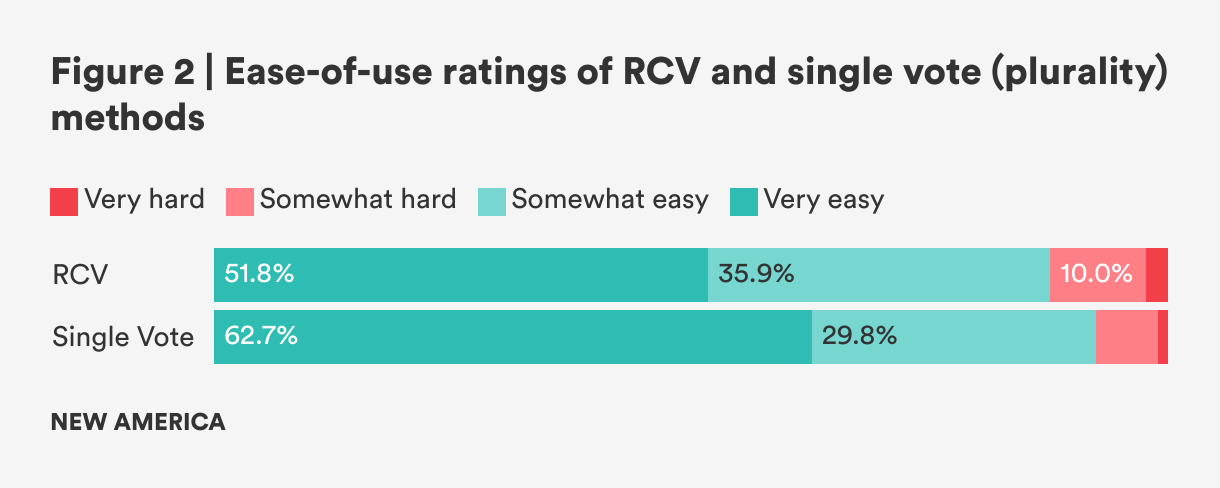
Large majorities find each method very easy or somewhat easy to follow, with the single vote rule earning somewhat higher ratings. Over 70 percent of respondents gave the same rating to both voting rules. Still, the mean rating for the single vote rule (3.54) is significantly higher than the mean rating for the ranked vote (3.37) on a 4-point scale (p<.001).
Asked which voting rule they prefer, 78 percent of respondents chose single vote, and only 22 percent chose ranked-choice voting. But when asked to rate (on a 5-point scale) how important it is for the winning candidate to receive a majority of the vote, 49 percent indicated that a majority winner is very important or extremely important, while just 21 percent reported that it is a little or not at all important.
When we examine the correlates of respondent preferences, age is the strongest predictor of evaluations of both voting rules. Older respondents tend to rate the single vote method as fairer and easier to understand than young voters. Similarly, older respondents express less confidence in the fairness of RCV than younger voters. Among respondents 65 and older, just 6.5 percent prefer RCV to the single vote. Among respondents aged 18-25, slightly more than 40 percent prefer RCV to the single vote. Despite their relative dislike of RCV, we find that older respondents are more likely than younger respondents to see the value in elections that produce a majority winner.
Partisanship is also consistently associated with evaluations of RCV. Democrats tend to rate RCV more favorably than Republicans in terms of fairness and ease-of-use. Party identification is not associated with ratings of the single vote method. Among Republicans, less than 7 percent prefer RCV to the single vote, while 28 percent of Democrats prefer RCV.
We find education to be an important predictor as well. Respondents with higher levels of education tend to give higher ratings of the fairness and ease-of-use of both voting methods. Furthermore, preference for RCV is higher among more educated respondents. Among those with at least a college degree, 31 percent prefer RCV, compared to only 17 percent among respondents with no more than a high school degree. More educated voters are also less likely to see the importance of voting rules that produce a majority winner.
Finally, respondents with a preference for a minor party presidential candidate offer lower ratings of the fairness of the single vote method than other voters, and third-party candidate supporters indicate a stronger affinity for RCV. These results are consistent with other studies that address the wasted vote dilemma confronting minor party supporters in plurality elections.
Conclusion
When given a choice between the single and ranked voting methods, a large majority of survey respondents prefer to stay with the single vote. Respondents also tend to rate the single vote method as fairer and easier to understand than ranked-choice voting. Relatively few respondents seem to understand problems associated with plurality voting rules, like the spoiler effect of third-party candidates.
Likewise, few seem to understand the benefits of RCV. A brief explanation of the vote transfer features of RCV does little to nothing to increase support for that voting rule. Older respondents simultaneously value the principle of majority rule and rate plurality above RCV, which suggests they do not consider the details when evaluating different voting rules, such as whether the rules produce a majority winner.
Jurisdictions that adopt RCV should prepare for initial resistance from voters who are accustomed to the simplicity of plurality rules. A public backlash against new voting rules is likely to come from elderly, Republican, and less educated voters in particular. Meanwhile, younger and more educated voters seem more open to alternatives, as are third-party supporters, who are more likely to see problems with the single vote method and more likely to support RCV.
In sum, these results indicate that building understanding and public support for voting reform may require sustained and targeted efforts to explain the shortcomings of current voting rules as well as the mechanics and rationale for new rules.
View and download the full report here.
Acknowledgments
We appreciate feedback on this research from Laura Arnold, Lee Drutman, and Alex Keena. We also received valuable guidance from participants at a meeting of the Electoral Reform Research Group (ERRG) in February 2020. Data collection for this project was funded by New America through their ERRG initiative, with support from Arnold Ventures.
Downloads
Citations
- Devin McCarthy and Jack Santucci, “Ranked-choice Voting as a Generational Issue in Modern American Politics,” Politics & Policy 49 (2021): 33-60; Todd Donovan, Caroline Tolbert, and Kellen Gracey, “Self‐Reported Understanding of Ranked‐Choice Voting,” Social Science Quarterly 100 (2019): 1768-1776.
- Melody, Crowder-Meyer, Shana Kushner Gadarian, and Jessica Trounstine. “A Different Kind of Disadvantage: Candidate Race, Cognitive Complexity, and Voter Choice,” Political Behavior 42(2020): 509–53; Lindsay Nielson, “Ranked-choice Voting and Attitudes toward Democracy in the United States: Results from a Survey Experiment,” Politics & Policy 45(2017): 535-70.
More About the Authors

Joseph Anthony