
Table of Contents
- Executive Summary
- Introduction: An Example for Systemic Land Reform
- The Legacy Land Administration of Punjab
- Project Preparation and Initial Implementation (2005-2012)
- Additional Financing and Project Expansion (2012-2016)
- Post-Project Developments (2017-2018)
- Prospects for the Future
- Conclusion: Balanced Development
- Appendix A
- Appendix B
- Appendix C
The Legacy Land Administration of Punjab
Punjab Province maintained an anachronistic land administration system before LRMIS project implementation. The bureaucracy was inherited from the British Raj, which governed the Indian subcontinent from the mid-19th century until independence and partition in 1947.1
Under this system, inaccurate handwritten registries were easily damaged or misplaced. Local land administrators—the Patwaris—often elicited bribes, tampered with records, and marginalized groups such as poor farmers and women.2 Wealthy landowners received preferential treatment from rent-seeking Patwaris, and poor tenure security contributed to difficulties in the transfer of land ownership and unequal access to finance.3
In the provincial south, the legacy system exacerbated weak governance, economic neglect, and perceptions of exploitation. Poor locals resentfully describe the industrialized central and north of Punjab as the Takht Lahore, or the “Throne of Lahore.” These grievances have often been manipulated for recruitment purposes by radical Islamist groups that present themselves as challengers to the traditional elite.4
Local land administrators—the Patwaris—often elicited bribes, tampered with records, and marginalized groups such as poor farmers and women.
By the early 21st century, the need for systemic change was increasingly apparent to influential stakeholders within the provincial government—most importantly Chief Minister (CM) Muhammad Shehbaz Sharif.5 Land reform via registry digitization was perceived as a powerful option to improve socioeconomic conditions and streamline government processes.6
Remnants of the British Colonial System
The greater Punjab region has long been coveted for its substantial agricultural yields and its strategic position in South Asia.7 The British annexed the territory in 1849, and successive colonial officials were very attentive to revenue collection from the lucrative farming sector.8 After the Indian Rebellion of 1857, British administrators specifically implemented policies and bureaucratic structures to preserve order and control over the region.9
Three resultant policies markedly contributed to the Patwar system. First, the British formalized the rural land system in order to efficiently collect taxes from the profitable agricultural sector and, in doing so, neglected urban centers.10 Second, because the colonial reaction to the 1857 rebellion prioritized order over socioeconomic transformation, the British Raj restricted land transfers. The British believed that the ‘hidden hand’ of the market imperiled stability by unleashing volatile forces.11 Third, colonial administrators implemented tribal law in place of both British and Sharia law—much to the detriment of female land inheritance rights. Tribal law helped to maintain an indigenous political base and allowed the British to codify and systematize existing legal patterns. This colonial strategy ultimately contributed to political underdevelopment and agricultural stagnation.
The institutional framework created to tax rural landholdings involved multiple agencies and suffered from paternalism, inflexibility, and inconsistent policy implementation.12 Adding to the convoluted nature of the system, colonial court rulings determined that land records were contestable, that revenue records were not documents of title, and that entries could be challenged to determine the title of land.13 These official decrees primarily affected the poor, as many could not afford protracted legal disputes.
Colonial administrators implemented tribal law in place of both British and Sharia law—much to the detriment of female land inheritance rights.
The consequent structure was a non-transparent and disjointed bureaucracy prone to corruption and rent- seeking. Such illegitimate activity was primarily conducted by Patwaris operating in local villages.
Patwar Culture
By the end of the 20th century, the Punjabi land administration system had evolved into three largely independent agencies: the Board of Revenue (BOR); the Excise and Taxation Department; and the Lahore Development Authority. Despite the considerable bureaucracy, no single agency maintained updated land registries, and coordinated record keeping was limited.
The BOR possessed the most significant authority to oversee Punjabi land management. Its administrative structure was loosely organized into multiple levels.14 This framework curbed sufficient oversight at the local level, granting dishonest Patwaris considerable autonomy.
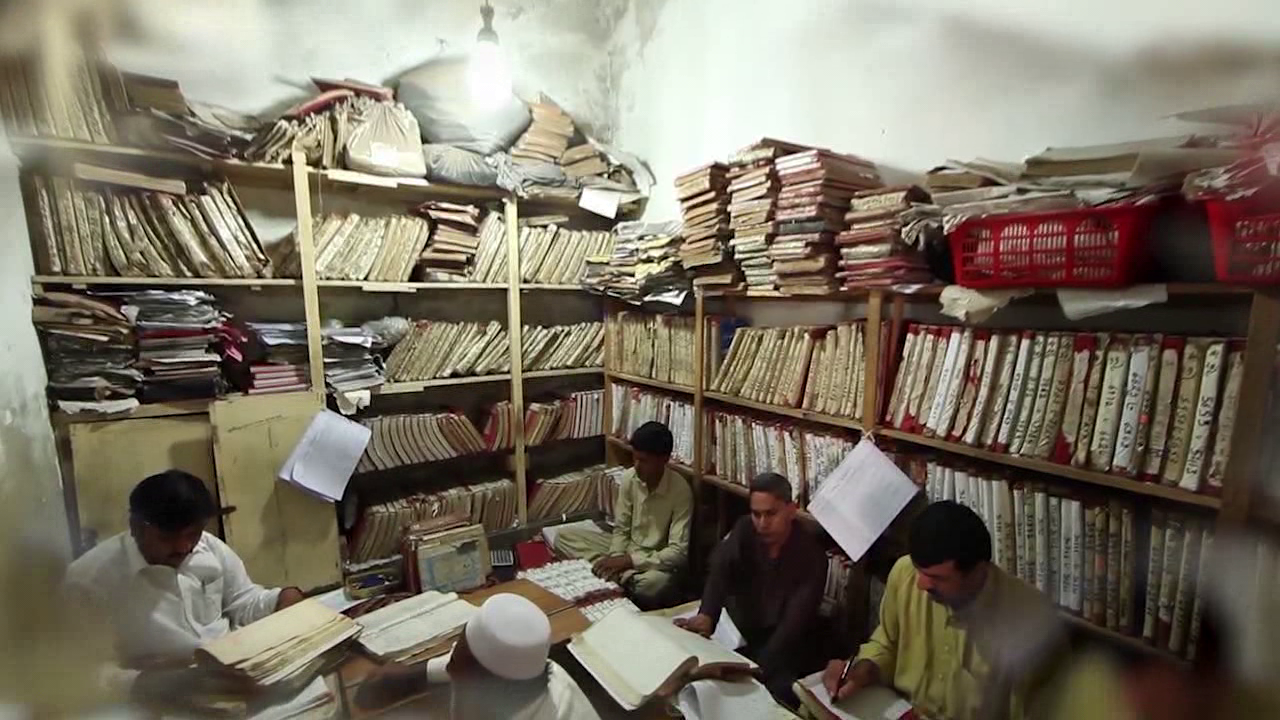
Patwaris were the sole custodians of both public and private land records within rural villages. They were the only officials who could issue copies of property records, or fards.15 All land-related documents were even carried on their person in a cloth bag, or basta.16
Patwaris were the sole custodians of land records within rural villages, but were often unresponsive and very difficult to locate physically despite their importance.
Patwaris were often unresponsive and very difficult to locate physically despite their importance.17 The project’s baseline study indicates that issuance of a fard took one to seven days.18 Additionally, the manual record keeping system resulted in easily lost data, as all information was written onto a single cloth ledger.19 Although a backup system existed, its use was not strictly enforced.20 Pertinent agricultural information was commonly unavailable to various stakeholders—such as women, small farmers, financial institutions, and even high-level provincial officials.21
Punjab Land Records Authority
Beyond these logistical challenges, the legacy system was biased toward large landholders. High transaction costs for land-related services and the prevalence of rent-seeking and corruption favored richer farmers over the poor.22 Bribery allowed the wealthy greater access to the Patwaris, and the influence of large landowners over the local administrators enabled delivery of services to their doorsteps.23
Women were typically barred from formal access to land services under the Patwar system.24 Even though women frequently inherited family land under Sharia law, they were unable to exercise their rights. Male relatives regularly bribed Patwaris in order to seize land originally and rightfully intended for widows, mothers, and sisters.25
High transaction costs for land-related services and the prevalence of rent-seeking and corruption favored richer farmers over the poor.
The legacy system contributed to difficulties in the transfer of land ownership and unequal access to services, capital, and markets. The resulting uneven land distribution and economic disparity disproportionately affected women and small farmers.26 In the agrarian south, particularly, wealth and political clout were concentrated in the hands of large landholding families. This economic deprivation and the absence of fair governance were ultimately exploited by radical Islamist groups for recruitment purposes and public support.27
The average citizen eventually perceived “Patwarism” as a symbol of corruption and oppression. Many within the provincial government, including CM Muhammad Shehbaz Sharif, concurrently aspired to discontinue the outmoded system.28 Comprehensive land administration reform contained the potential to address socioeconomic hardships, unresponsive governance, and security issues.
The Need for Systemic Reform
Twenty-first century political support for Punjabi land administration reform was strong, with a significant level of involvement from CM Muhammad Shehbaz Sharif. Elected to a second term in 2008, CM Sharif personally championed official support after experiencing firsthand the pervasive corruption and tampering in land administration.29 Following the hindrance of investment due to manipulated government records, Sharif recognized the costly and unreliable nature of the manual system. The record keeping scheme was unhelpful, and even damaging, to everyone—from the Chief Minister of Pakistan’s most populated province to the poorest tenant farmer.30
Termination of the Patwar system would potentially improve livelihoods, strengthen governance, and help counter extremism. Sharif aimed to implement a reliable and transparent system with the maximum amount of automation. Despite deficiencies in past projects to reform the provincial land administration system via technology, GoPunjab elected to partner with the World Bank in a renewed effort.31
The record keeping scheme was unhelpful, and even damaging, to everyone—from the Chief Minister of Pakistan’s most populated province to the poorest tenant farmer.
Punjabi support and insight were critical for success. A project should generally be responsive to local technological, political, and socioeconomic conditions. Through prudent measures, secure and formal land rights promote greater prosperity, provide the marginalized with easier access to capital, and are a powerful tool for gender equality.32 Development initiatives also increase the opportunity costs associated with militancy.33
These improvements are reinforced by digitization. Throughout the developing world, digitization can strengthen tenure security and indirectly raise land value by streamlining loan procurement and investment. Computerized data can inform policy planning and be leveraged to improve tax collection, resource allocation, and disaster management.34 Most importantly, digitization helps to modify administrative structures to empower women and the poor, as marginalized groups are accorded more equality in a standardized system that is resistant to both bribery and favoritism.35 A more responsive government—better able to protect and engage with its citizens—can provide nonviolent and legitimate channels to voice grievances.
Citations
- Kaul, “From Empire to Independence.”
- “Rural Punjab Goes Digital.”
- Pott, Implementation Completion and Results Report, 1-2.
- Pakistan’s Jihadist Heartland, 8-9.
- Interview with Osama Bin Saeed (April 24, 2018).
- Patrick Kelley and Michael Graglia, “Why Property Rights Matter,” FPR Blog (blog), New America, March 10, 2017, www.newamerica.org/international-security/future-property-rights/blog/why-property-rights-matter/, accessed April 30, 2018.
- John Marriott, The Other Empire: Metropolis, India and Progress in the Colonial Imagination (Manchester University Press: Manchester, 2003), 195.
- Ian A. Talbot, “The Punjab Under Colonialism: Order and Transformation in British India,” Journal of Punjab Studies, 14, no. 1 (2007), 3; first interview with Igor Popiv (March 19, 2018).
- Talbot, “The Punjab Under Colonialism,” 3-5.
- First interview with Igor Popiv (March 19, 2018).
- Talbot, “The Punjab Under Colonialism,” 5-6, 9.
- Ibid., 7-9. Relevant colonial land administration agencies included the Board of Revenue (BOR) and the Irrigation Department. However, taxes enforced by the Irrigation Department were physically collected by Patwaris employed by the BOR (comment from Osama Bin Saeed (April 29, 2018)).
- Pott, Implementation Completion and Results Report, 1.
- Please see Appendix B for information on the BOR administrative levels.
- Pott, Implementation Completion and Results Report, 1-2.
- Linus Pott, “From Cloth Bags to Land Record Service Centers – Experiences From a World Bank Funded Project in Punjab, Pakistan,” paper presented at the 2017 World Bank Conference on Land and Poverty, Washington, DC, March 22, 2017; Mary Lisbeth Gonzalez, “Land records go digital in Punjab, Pakistan,” End Poverty in South Asia (blog), World Bank Group, October 26, 2016 blogs.worldbank.org/endpovertyinsouthasia/land-records-go-digital-punjab-pakistan, accessed May 11, 2018.
- “Rural Punjab Goes Digital.”
- Pott, Implementation Completion and Results Report, 16.
- “Rural Punjab Goes Digital.”
- The legacy backup system required creation of two copies of every land record—one stored at the Patwari’s office and the other consigned to an official record room. This scheme was not reliable, however, as the manually-maintained records were produced at the discretion of the individual Patwari. If the Patwari chose not to provide backup copies of land records, the system quickly became outdated (comment from Osama Bin Saeed (April 29, 2018)).
- Interview with Osama Bin Saeed (April 24, 2018).
- Pott, Implementation Completion and Results Report, 1-2.
- Ibid., 20.
- The legacy land administration system was male-dominated. Out of the approximately 25,000 Patwari positions, and almost 8,000 supervisor positions, a woman was never able to secure a vacancy (comment from Osama Bin Saeed (April 29, 2018)).
- First interview with Mary Lisbeth Gonzalez (March 22, 2018).
- Independent Evaluation Group, PK:Land Records Mgmt and Information Syst. (P090501) Implementation Completion Report (ICR) Review (Washington, DC: World Bank Group, September 5, 2017), 4, documents.worldbank.org/curated/en/821101504632525457/pdf/ICRR-Disclosable-P090501-09-05-2017-1504632512156.pdf.
- Pakistan’s Jihadist Heartland, 9.
- Interview with Osama Bin Saeed (April 24, 2018). Muhammad Shehbaz Sharif is brother to Nawaz Sharif, the former Prime Minister of Pakistan.
- “Shahbaz Sharif,” Dawn, April 25, 2013, www.dawn.com/news/1024486, accessed May 11, 2018. Muhammad Shehbaz Sharif first served as Chief Minister of Punjab from 1997 until the 1999 Pakistani military coup.
- Interview with Osama Bin Saeed (April 24, 2018).
- Ibid.
- Kelley and Graglia, “Why Property Rights Matter.”
- Norman Loayza, “How to defeat terrorism: Intelligence, integration, and development,” Future Development (blog), The Brookings Institution, July 25, 2016, www.brookings.edu/blog/future-development/2016/07/25/how-to-defeat-terrorism-intelligence-integration-and-development/, accessed May 31, 2018.
- Pott, Implementation Completion and Results Report, 38.
- “In Pakistan and Beyond, Land Records Get a Digital Upgrade.”