
Table of Contents
- Executive Summary
- Introduction
- I. Providing Care Can Shape Men’s Attitudes and Beliefs
- II. Men Who Care
- III. Men and Work-Family Conflict: The Heavy Toll on Men who are High-Intensity Caregivers and/or Parents
- IV. An Overwhelming Majority of Men Value Care and Believe it Should be Equally Shared. But Belief Isn’t Associated with Practice.
- Conclusion
- Methodology
IV. An Overwhelming Majority of Men Value Care and Believe it Should be Equally Shared. But Belief Isn’t Associated with Practice.
We asked a series of questions to try to unearth how men valued care, and whether having the experience of giving care would be associated with men valuing it more. Or, conversely, if men valued care, whether that would be associated with them actually giving it. We didn’t find that. Instead, we found that men fairly universally said they value care—men who are High-Intensity Caregivers and/or Parents, HICP, Other Fathers, and Non-Caregiving men alike. And an overwhelming majority of men—more than 80 percent—regardless of their caregiving or parenting experience and across racial and ethnic identity believe that men and women should share care responsibilities equally at home.
And yet, we found that that belief doesn’t translate into actually giving care.
Men Overwhelmingly Value Care
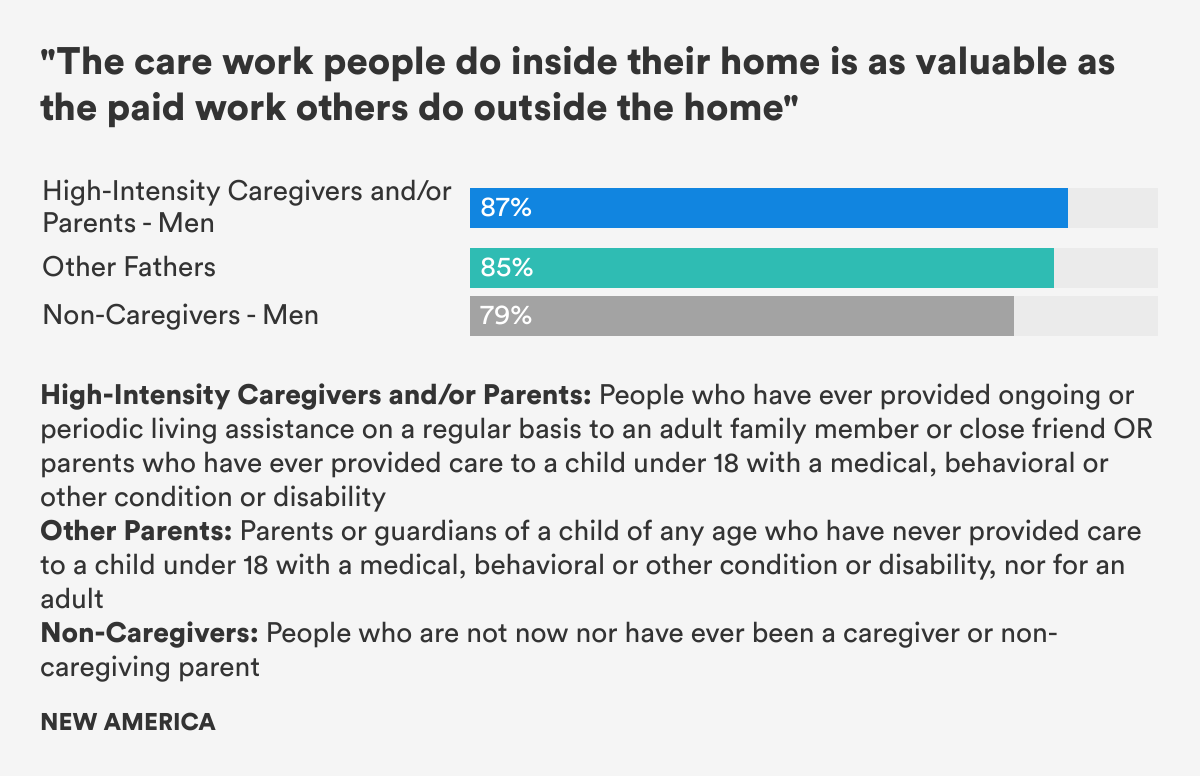
Overwhelming majorities of men—men who are High-Intensity Caregivers and/or Parents, HICP, who have ever cared for an adult or fathers who have ever cared for a child with special needs, Other Fathers who have never cared for a child with special needs and men who are Non-Caregivers—agreed that the care work people do at home is valuable to society, ranging from 84 percent of Non-Caregiving men to 91 percent of Other Fathers. Large majorities of men also said that the care work people do inside the home is as valuable as the paid work others do outside the home, ranging from 79 percent of Non-Caregiving men to 87 percent of men who are High-Intensity Caregivers and/or Parents, HICP. That so many men value care work as much as paid work is a surprising finding, given the powerful cultural norms that tie women to unpaid care work and men to paid breadwinning work in a society that has long undervalued care as a “labor of love” and equated success and power with the ability to earn income. But it could also be a reflection of men valuing care in the abstract or the care that others give without necessarily connecting the question to their own role, identity, or the expectation that they give it.
Large majorities of men also said that the care work people do inside the home is as valuable as the paid work others do outside the home.
A majority of people in all three groups espoused egalitarian views: 88 percent of women who are Non-Caregivers said care work is as valuable as paid work, compared to 79 percent of men who are Non-Caregivers. Among High-Intensity Caregivers and/or Parents, HICP, and Other Parents, there was not a significant difference between genders, with more than 80 percent of men and women sharing this view.
There was also more similarity than difference along racial and ethnic lines, with more than 80 percent of Black, Latino, and white men who are High-Intensity Caregivers and/or Parents, HICP, saying that the care work people do at home is valuable to society.
Figure 13
Additionally, those who were older or had more income were also more likely to agree that care work is as valuable as paid work and that care at home is valuable to society. Men and women over age 44, regardless of care experience, valued care at higher rates than those younger than 44, a sign perhaps that the idea of care becomes more valuable as one becomes more likely to give it, or to need it. And, again regardless of care experience, those earning more than $100,000 were more likely to say care work is valuable to society and as valuable as paid work than were those earning less than $30,000, an indicator, perhaps, that financial stability, and freedom from constantly worrying about putting food on the table or paying the rent, is a key precursor to enabling more men and women to see the value of care. Or it could be a sad indicator that, in the United States, the ability to provide care is a privilege.
We asked our focus group of men who care for adults whether they felt society respects and values the work they do caring for another adult. Four said yes. Four said no. “I don’t think society appreciates the caregiver until it’s time to be cared for,” said Justin, 39, from Atlanta, who cares for his father who has mobility issues. And six said they either didn’t care what society thought or that society doesn’t understand them.
I don’t think society appreciates the caregiver until it’s time to be cared for.
Matthew, who cares for his widowed mother told us, “Nothing makes me prouder [than] knowing she’s proud of me.”
Men Have Strong Egalitarian Beliefs. Yet Traditional Gender Norms Hold Sway
As we noted in our earlier Men and Care report on fathers, there are wide discrepancies between what men say they believe and what they do: 91 percent of men and women in our survey agreed that care work should be divided equally between men and women. Yet, just 46 percent said that is what actually happens when a family member needs care. And, as other surveys have found, men were nearly twice as likely as women to see the division of care labor as equitable—60 percent of men compared to 32 percent of women.
Still, the egalitarian ideal is strong: The vast majority of survey respondents, regardless of their care experience, say that men and women should divide care responsibilities equally at home: close to 90 percent of men in all three groups. Women in these groups agreed at about the same rates.
This egalitarian ideal is held across all racial and ethnic groups, income groups, ages, geographic areas—rural, urban, and suburban—and political party affiliation, with more than 80 percent of respondents in each category saying that men and women should divide care work equally.
Yet, in our focus group discussions, men and women alike, regardless of their experience of providing care, expressed the traditionally gendered view that women are naturally suited to care. While both men and women said that men are as capable of providing care, many believed that women possess inherent traits that men lack. Eight of the 13 men in the general population focus group thought of women as having a “maternal instinct” or that women are more “nurturing” or “compassionate” than men. And nine of the 14 men who care for adults also held this view, as did eight of the 14 women in the general population focus group of women.
Still, when we asked men who care for adults if their care experience would be different if they were women, nine said no. Nicholas, a 36-year-old man from Virginia who helps care for his father, said that taking care of others shows that a “man or woman can be very similar when it comes to giving support of their loved ones.” Mark, the FedEx driver from Atlanta who cares for several adults, including his parents, grandfather, and a nephew with mobility issues, even as he nodded to believing that women may possess innate qualities for care, said that that doesn’t matter. “Women have a maternal instinct that could factor in them being better caregivers, but I think it’s up to each individual person and the makeup of their character and willingness to sacrifice for someone else.”
I think it’s up to each individual person and the makeup of their character and willingness to sacrifice for someone else.
Of the five men who care for adults who thought their experience would be different if they were women, three specifically mentioned that it is society’s expectations, not an inherent skill, that makes the experience of providing care different by gender. “I think people are not as used to men as caregivers. People prejudge without realizing. They think women are better,” said Cody, who works in logistics and cares for his aging parents. Added Malachi, a 32-year-old from Chicago who cares for his father with advanced Alzheimers, “I believe if I was a woman, it may be accepted more in society, as women are seen as the caregivers for families.”
And in our focus group of fathers, all 14 believed that, in addition to a “maternal” instinct, there is also a “paternal” instinct. Again, some fathers pointed to societal expectations for shaping unconscious bias and the view that women are more suited to care. “I think that the unconscious prejudices in society have made the historical mothers’ role more important to be filled by a female,” said Kyle, 36, a manager at a logistics company in Massachusetts. “I think there has been progress made but there is a long way to go for it to be seen as equal.”
In a potentially important sign that the experience of providing care can shape men’s beliefs, biases, and attitudes, more men who had cared for an adult than the men in the general population focus group believed that women were not more likely than men to possess any skills important to being a good carer. Only two men in the general population group held that view, while the majority believed women are more naturally empathetic and compassionate, so better at caring.
Yet in the group of men who care for adults, opinions were more divided, with six men disagreeing, sometimes vehemently, that women have skills important to caregiving that men don’t have. “No!” said Larry, who cares for his aging wife. “None that I could think of … whatsoever,” said Oliver, who also cares for his wife. Others believed that men may have instincts that workplaces and traditionally gendered cultural expectations don’t allow them to fully develop.
Andres, who cares for two elderly men in his community, in a view that others applauded, said that men and women both have instincts to care for others. “But a man’s instinct in that realm doesn’t kick in until there is something worth caring for present in their lives. Most women I have met do not need to tap into that instinct. Men seem to have to learn that skill vs. already having it.”
Twice as Many Men as Women Say Society Doesn’t Trust Them to Give Care
Men who are High-Intensity Caregivers and/or Parents, HICP, and Other Fathers were twice as likely as HICP women and Other Mothers to report pushback to their caring because of their gender. One in five men (21 percent) who were either High-Intensity Caregivers and/or Parents, HICP, who have ever cared for an adult or fathers who have ever cared for a child with special needs or Other Fathers who have never cared for a special needs child said that people do not trust them to give care or to parent in a safe and caring manner simply because they are men, compared to only 10 percent of women with the same care responsibilities.
That feeling of mistrust came through clearly in focus groups with men who care for adults. Several reported that people can react to their care work with astonishment and even distrust. Justin said that he often feels “the stares and questions” when he takes his father to his medical appointments, saying “the majority of men that are associated with medical [care] are looked at in a feminine manner.” Roger, 32, who owns his own real estate business in Illinois and who cares for his diabetic grandfather, who lives with him, said people expect him not to be as compassionate and patient as women. “I guess it’s not a typical job for a man to do.”
Mark, who cares for his mother, said “I had an instance on Saturday where we were at the doctor’s office and the receptionist couldn’t believe that I didn’t try to get someone else to bring my mom, so I could stay home and watch football.” Yet Malachi, who cares for his elderly father, said that, at times, he’s met with compassion, but largely because of the surprise of his gender. “Typically women are expected to be in this role,” he said.
In the focus group discussions, some men who care for adults expressed often bitter disappointment in how little support, acknowledgment, or appreciation they often receive.
“I can’t think of any specific support that society currently provides caregivers, other than acknowledging nurses during Nurses Week. Caregivers need more support emotionally and financially. Being a good caregiver usually means you are invested in the wellbeing of the person you are providing care for. This can be rewarding but at the same time mentally draining and can expose you to an emotional roller coaster,” said Mark, who cares for several adults.
When we asked men in the focus groups whether society gives people who provide care, including men, the support they need, the majority said no. Only two said society is doing enough to support those who give care. Six men said people with care responsibilities need more financial support, either making long-term care more affordable, compensating family carers, or paying better wages to paid carers. And three reported wanting more emotional or social support.
“I do not think we as society give other adults the support they need. There was a time in history when it was an honor in American society to take care of the elderly, that got lost somewhere. The way that things are set up now, a lot of families have to both work just to pay bills and don’t have time to caregive. What could be done differently is a universal healthcare system like every other industrialized nation on earth. Further, caregivers that choose to select this as a career should be properly compensated and supervised, I feel that is not the case now,” said Richard, who cares for an elderly neighbor with dementia.
There was a time in history when it was an honor in American society to take care of the elderly, that got lost somewhere.
The Legacy of Cultural Stereotypes and Structural Racism
Large majorities of men (more than 80 percent) across racial and ethnic groups agreed that care work is valuable. White men were more likely than men of color to say that care work is both valuable to society and as valuable as paid work, by five to six percentage points.
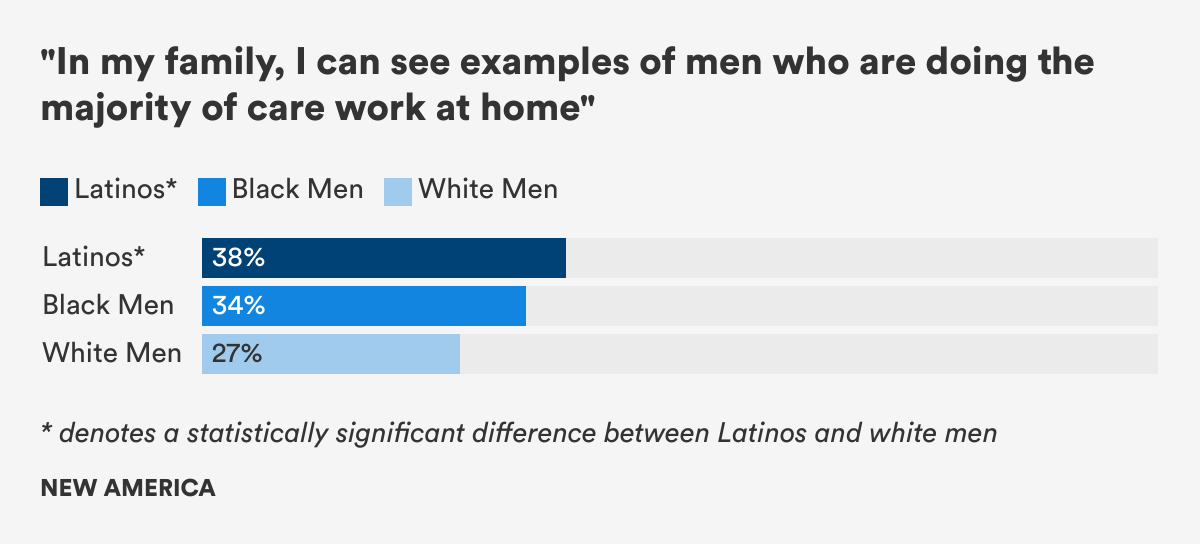
At the same time, Latinx respondents were more likely than white respondents to say they lived in families where men do the majority of care—32 percent of Latinx respondents compared to 22 percent of white respondents. (Black respondents, 26 percent, fell in between the other two ethnic groups.) (Figure 14)
What to make of these somewhat perplexing findings that some men of color say they see more men doing the majority of care at home than white men, but value that care slightly less?
Figure 14
Previous research has found that race, ethnicity, socio-economic status, and other demographic factors play a role in shaping fathers’ attitudes about the value of care and parenting styles. That research found that Black fathers may show less engagement and warmth, but “exert more control and take more responsibility” than white fathers, and that Mexican-American fathers are highly supportive, responsive, engaged, and involved with child care, in contrast to the traditional distant, disciplinarian Latino father stereotype.
Men of color, and Black men, in particular, have long been harder hit by unemployment than white men—the rate is typically about twice as high, particularly in times of economic crisis, putting more men of color in positions to give more care and rely on their partners to provide for the family. It’s too soon to tell how the COVID-19 pandemic will reshape men’s caring role—largely because women, particularly women of color, have been disproportionately impacted, forced out of the workforce by both being overrepresented in the industries most affected by shutdowns and by the closure of schools and childcare facilities. But, if history is any guide, in the years around the 2008 Great Recession, research has shown that while men across race and ethnicity were hard hit by job losses, so were women. Black and Latino fathers’ involvement in childcare increased dramatically, while white fathers’ did not. In the COVID-19 pandemic, communities of color have also been disproportionately hit by the virus itself, meaning that more are being called upon to care for family members.
In an interview, Glen Henry, a Black father of four who documents his fathering experience on his Beleaf in Fatherhood website and YouTube channel, said he was not surprised by the finding that Latino men, in particular, may have more exposure to men who care compared to white men, but that men of color value care slightly less than white men say they do. That perception, he said, may be rooted in the long history of racism in the United States, and how the structural racism built into centuries of slavery and subsequent laws, regulations, and discrimination have made it difficult-to-impossible for Black men to find good jobs with decent wages and benefits in order to be breadwinners, provide for their families and build wealth and stability.
“It’s a role that’s longed for. We’ve longed to be in a position to make money,” Henry said. “But it’s not what we have.” And, he continued, it’s not that Black men don’t value care. Instead, they may see it as a given. “For people who are not privileged, we have to take care of more family members,” he said. “We don’t see it as a burden. It’s more, ‘This is my responsibility as a man.’ I don’t expect to get a pat on my back for taking care of our kids, or helping my aunt pay the rent.”
We don’t see it as a burden. It’s more, ‘This is my responsibility as a man.’ I don’t expect to get a pat on my back for taking care of our kids, or helping my aunt pay the rent.
Ronnie Taylor, the occupational therapist whose experience caring for his infant daughter changed his attitude about care and transformed his life, also said that, for many men of color, providing care may not be a choice. Black people, for instance, are incarcerated at five times the rate of white people, and Latinx people nearly three times the rate as white people, according to the latest data from the U.S. Bureau of Justice Statistics. And the higher unemployment rates for men of color, compared to white men, means that care responsibilities may also be forced out of necessity because the longed-for breadwinning role is unattainable.
“More [Black men] are home with their kids because they can’t go to work. That has a psychological effect on how you value care,” Taylor said. “It’s not your choice. You’re caregiving because someone won’t value you enough to give you a job.”
It’s not your choice. You’re caregiving because someone won’t value you enough to give you a job.