
Table of Contents
I. How Professional Caregiving Men See Themselves
Professional Caregiving Men are Proud of the Work They Do and Find it Meaningful
In both the NORC survey and in the focus group of 13 caregiving men, the majority of men expressed pride in the care work they do. Many described the care work they do as not only exciting and challenging, but also deeply meaningful.
The 331 professional caregiving men in our non-representative NORC survey sample described their work providing care as a positive experience. The sample included 9 percent doctors, 5 percent home health workers, 69 percent other health care workers, including nurses, physician’s assistants and therapists, and 16 percent early childhood education workers. More than six in 10 said they enjoy their work (65 percent) and sought out the profession because they wanted work that was meaningful and rewarding (63 percent).
In our focus group discussion of 13 professional male caregivers who worked as nurses, nurse practitioners, academic tutors, or early care educators, all 13 said they loved their work, loved helping others, that they were proud of the care they provide, found it profoundly meaningful, and that they were excited to talk to others about it. Joshua, 47, from Nebraska, has worked as a surgical nurse for 17 years, and has a specialty in robotics. “I love my job, find it very interesting, and love to talk about it,” he said.
Luther, 67, an African American licensed vocational nurse in California said, “The best thing about my job is, ‘I love helping others.’” Terrence, 40, who works as a registered nurse at a post-surgery and rehabilitation facility in Louisiana, said he not only loved his work, but sought to share his excitement for care work to encourage other men to join the profession. “I’m always ecstatic about discussing my job,” he said, “especially with young guys who may have even a slight interest in nursing.”
One man who works as a certified registered nurse anesthetist (CRNA), Devon, 31, from Pennsylvania, said he too loved talking about his care work. “It’s the best kept secret in healthcare. Most people think that physician anesthesiologists give anesthesia, but we (CRNAs) give 75 percent of the anesthesia in the United States, and close to 100 percent in rural underserved areas.”
The professional caregiving men all said their work was often profoundly meaningful. For those in health professions, they described being on teams that provided care that could mean life or death for people, and how “joyful” it felt to get letters or be stopped by people to thank them for their care. “I feel like I’m making a difference in people’s lives,” said Joshua, the surgical nurse. And the early care educators and teachers said they viewed their work as helping the next generation get a good start in life and meet their goals and potential. Federico, 39, a child and adult tutor, shared that he’s experienced “moments of great satisfaction when learners that I tutor have achieved the goals that they have set for themselves (e.g., graduating from high school).”
I feel like I’m making a difference in people’s lives.
Nathan, 35, a nurse working in oncology in Salt Lake City, said, “Many people outside of the medical world have little understanding of what it is to be a nurse unless they have seen a loved one seriously ill. I am proud to tell people what I do, because the work I do has a positive influence on our society.”
When asked to think back on the best day they’d ever had at their job, Lucas, 49, who works as an intensive care nurse in Louisiana said, “When you save a life and they come back later to thank you.” Dominic, a 49-year-old cardiology nurse practitioner in Georgia, agreed. “There is no better feeling than this.” He then shared a story of a patient whose heart began beating abnormally fast during a stress test that he “thumped” in the chest to induce a normal rhythm. The patient then went on to get a stent. “And he told me “thank you for saving [my] life,” Dominic said.
Montell, who cares for infants at a childhood development center, talked of the awe of watching one of the children in his care taking her first steps. And he spoke with pride of being a nurturing male role model. “What we do as a whole is very valuable because we could be role models for younger males, and influence them to follow their dreams no matter what society standards are,” he said.
Martin, 44, an operating room nurse, recalled caring for a trauma case patient after the Boston Marathon bombing who ended up having a “very good outcome.”
Devon, the CRNA from Philadelphia, described a day he was called in to help place an epidural for a woman who had just learned that her 16-week-old fetus had died in her womb. “Some of the best days for me at my job are unfortunately some patient’s worst days,” he said. His own wife had had her first of two miscarriages just a few weeks earlier. The epidural helped the patient deliver the miscarried baby in comfort, he said. Then he “prayed and cried with them as they held their child who had died. I will never forget the pain I felt for them and the reminder of the pain of losing my own,” Devon said. “But I know I did the absolute best for my patient that night.”
Joshua, the surgical nurse from Nebraska, responded to Devon’s story in the focus group: “It's great when other males are comfortable with showing emotion in their caring for patients!”
Professional Caregiving Men See their Jobs as Requiring Special Skills and Training
Several men described their work in competitive terms, as challenging, requiring special skills, education, training and credentials, as well as an ability to troubleshoot, triage and manage their time in order to juggle a number of demanding tasks. Cameron, 45, an African American hematology oncology nurse practitioner in New York, described being able to provide “cutting-edge” treatment to patients. He said he is also quick to point out the difference between a nurse practitioner, an “independent provider who can bill, diagnose and prescribe with or without” a medical doctor and who can open their own practice, and a physician’s assistant, who can’t. Nathan, the nurse in oncology, said he enjoys being part of a team that provides the “complex care” that his patients with “very challenging problems” need.
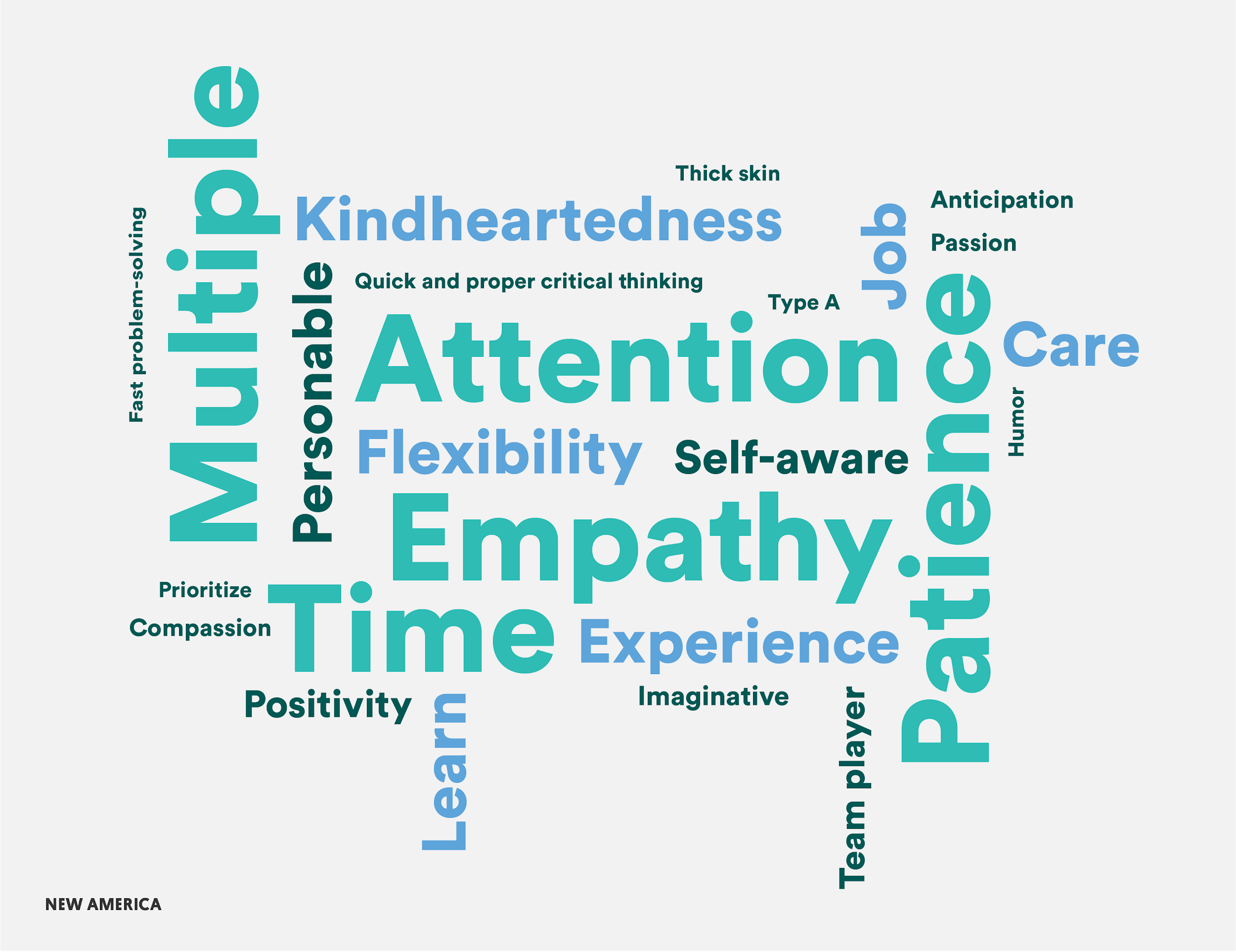
We asked professional caregiving men: “What skills, qualities or personality traits make a person good at your job?” Many emphasized the complex skills required to excel in their professions, including managing multiple tasks, attention to detail, and time management. The men in healthcare highlighted the professional and complex nature of their work; for example, Joshua, the surgical nurse, mentioned “anticipation, fast problem solving, [and] quick and proper critical thinking” as crucial skills for his job. Many men noted that certain caring traits are necessary as well, including empathy, patience, and kindheartedness. As Lucas, an intensive care unit nurse, explained, “You have to have a heart and soul to be a nurse. You need to care for people or it shows.” The childcare workers and educators, in particular, emphasized the traits of human warmth, like patience and a desire to help others, as essential to do their jobs well. Montell, the early childhood educator, listed “patience, [willingness] to learn, and positivity” as key traits to succeed in his work. Further, several men noted that schooling only goes so far; many of the necessary skills, they argued, can only be acquired on the job. “The job and experience makes you the professional.” (Terrence, registered nurse) Overall, the men characterized their careers as requiring the right mix of high-level cognitive skills and caring personality traits.
Professional Caregiving Men May Choose, or “Stumble Into” Care Work, But Most See it as a Lifetime Career
In our NORC survey, about half of the professional caregiving men (53 percent) said they took their jobs because they wanted to take care of people. Only 14 percent said they were encouraged by family and friends to take the job. Even fewer, just 6 percent, said they were inspired to go into care work because they saw other men in the field.
In our focus group of 13 professional male caregivers, eight said they sought out their jobs in care work. Five said they fell into their work. Still, 10 men in the group said they saw their work as careers that are fulfilling with room for more learning and advancement that will last a lifetime. Two didn’t answer. Just one, Nathan, the nurse in Salt Lake City, said he thinks of his current job as a step towards something else. He’s not sure what his next career goal is. His current job, he said, “Is very mentally engaging and a good placeholder until I figure out what to do next.”
Of those who actively pursued a career as a professional caregiver, Martin, the operating room nurse, said it was something he’d always wanted to do, and saw the work as challenging, and involving a lot of troubleshooting with complicated equipment. Federico, the tutor, said he’d always been interested in helping others achieve their education goals. While several of the men said they were drawn by the challenge of care work, the decision-making and critical thinking it required and carefully mapped out their educations, Nathan, the oncology nurse in Salt Lake City, said he was drawn to the “flexible lifestyle” that enables him to put in long but reliable hours and have time off to pursue his interests in outdoor sports.
Others did not set out to become professional caregivers. Five of the men in the focus group described a more circuitous route to their current care work. One was in restaurant management. Another in the entertainment industry. One had a computer job that didn’t turn out well. Another started his college career as a petroleum engineer. Lucas, the intensive care unit nurse, joined the military and became a medic. That’s how he “stumbled” into nursing. “It has given me a great career,” he said.
Most said they learned about caregiving from watching other family members, typically their mothers or grandmothers, care for others. Montell, the early educator, for instance, worked with children in his grandmother’s youth center. Elijah, a nurse in Seattle, saw how well his sister was cared for when she was sick as a child. Devon, the CRNA, helped his mother take care of his grandfather, giving him medication, breathing treatments and helping him get around. “I really enjoyed taking care of him and I believe that led me to look into nursing from the beginning,” he said.
Professional Caregiving Men Also Provide Unpaid Care at Home and Face Work-Family Conflict
As much as the professional caregivers in both the survey and focus groups said they found their work meaningful and enjoyable, they also faced a number of challenges with the conflicting demands of their professional role as caregivers at work, and their family responsibilities.
In the NORC survey, nearly six in 10 (57 percent) said they work more than 40 hours a week. Thirty-four percent reported they often feel their job is more stressful than average, and 17 percent said they feel burned out.
About half of professional caregiving men also provide informal care to an adult family member, friend, or a child with special needs. Nearly 60 percent say that that informal care has had a negative impact on their work, 48 percent say it’s been bad for their physical health, nearly 40 percent say that informal caregiving has had a negative impact on their household finances and about one-third say that it has increased their levels of stress, anxiety or overall mental health. About half (54 percent) expect that they’ll need to take time off work in the future to provide care for a family member with a serious illness or disability or who needs extra help due to old age.
About half of professional caregiving men also provide informal care to an adult family member, friend, or a child with special needs.
The men in the focus group of professional male caregivers were split in their answers. Many were fathers of young children, and several cared for or lived with aging parents, relatives or other loved ones. Eight said that their jobs provided them with enough flexibility that they had time to concentrate on work, and also have time for their families, with Lucas proudly saying how he’s able to attend his children’s events. “Days are long but rewarding,” echoed Terrence. “Life at home and life on the job complement each other through time management and work/family bonding activities.”
Yet three professional caregivers reported long work hours, exhaustion and high stress. Devon works 50 – 60 hours a week trying to pay off $130,000 in graduate school loans while trying to make time for his two small sons. Nathan was under additional strain because of understaffing due to the nursing shortage. Said Luther, “I feel caring for others can be overwhelming.” He spoke of how important it is for professional caregivers to take time off work to rest and to make time for family. “Turn off your Nursing demeanor and just be a family member,” he said, “not a care provider.”
Turn off your Nursing demeanor and just be a family member, not a care provider.
It’s important to note that these focus group interviews took place before the outbreak of COVID-19, which has ratcheted the demands on health care professionals to unprecedented and dangerous levels, just as it has threatened the livelihoods of early care educators whose schools and childcare centers have been shut down for months.
Men in Care Professions Need Time Off Work to Provide Care at Home
When it comes to balancing work and care, the professional caregiving men unanimously supported having access to paid family and medical leave through a national public program. Further, they said that any public or workplace policy should include men. “The need to tend to family, personal or medical issues is a need that cannot be taken lightly,” said Terrence. “The gender of the worker should not be of any importance.” Said Cameron, “I think men can be just as good a caretaker for babies.” The professional caregiving men said a public paid leave policy for caregiving should be normal and expected for men as well as women, and that they themselves would use such a program “in a heartbeat.” In the NORC survey, about half of the professional caregiving men surveyed said they anticipated needing to take leave in the future for the birth or adoption of a new child or to take care of a family member with a serious illness or disability, or who needed extra help due to old age.
The gender of the worker should not be of any importance.
In the focus group, the professional caregiving men said that they had seen the sometimes desperate need for paid leave observing the experiences of their patients and their patients’ families. “There is always the need to recover from surgery,” said Joshua, “and sometimes that recovery can be long.” Said Elijah, “Being an oncology nurse, taking care of very sick patients, I often ask myself how patients and families navigate work, sickness and afford a decent life without going bankrupt.”