
Professional Caregiving Men find Meaning and Pride in their Work, But Face Stigma
Abstract
This report is part of the Better Life Lab’s multi-year project to better understand the experiences, attitudes, and beliefs of men who provide paid and unpaid care—the channels that enable them to do it, and the barriers that keep them from it. This is the only report in the series to explore the experiences of professional caregiving men. For the project, we partnered with the National Opinion Research Center at the University of Chicago (NORC) to conduct a nationally representative survey of 2,996 American adults and used 20|20 Research’s QualBoard facilitation platform to host five online focus group discussions. Both the survey and focus group data were collected before the outbreak of the COVID-19 global pandemic.
Acknowledgments
This study was conducted with support from the Robert Wood Johnson Foundation and Pivotal Ventures, an investment and incubation company created by Melinda Gates. The authors wish to thank our colleagues at NORC and the men who generously gave our team guidance on shaping the focus group questions. Thanks also to Aaron Loewenberg who took time out of his schedule to share insights and expertise. Thanks, too, to Better Life Lab senior fellow Vicki Shabo, for her thoughtful review, the Better Life Lab team – Haley Swenson, Sade Bruce, Jahdziah St. Julien and Stavroula Pabst. And to former colleagues Amanda Lenhart, Alieza Durana, Elizabeth Weingarten and Leah Crowder. Thanks, too, to Samantha Webster, Maria Elkin and the New America Communications team.
Executive Summary
Men who work as paid professional caregivers are a small minority in health, education, and many caring professions. Based on qualitative interviews and non-scientific survey data, we find that men who provide care professionally are proud of their care work and find it deeply meaningful. Still, many say they face gendered stereotypes and stigma, and some feel that society doesn’t respect them or trust them to give care because of their gender. Men in nursing and other health professions, however, tend to face less stigma than men in early care and learning professions, and some are even afforded more respect and authority because of their gender.
As automation and artificial intelligence rapidly reshape the nature of work, caring professions, which require warmth, empathy and human interaction, are among the fastest growing and most future-proof jobs. Yet women predominantly occupy these professions, driven by the gendered stereotype beliefs that care work is “women’s work,” and that women are naturally “warm” and better suited for caring occupations, and that men are more “competent,” and thus more inclined to competition. Caring jobs are, as a result, undervalued, seen as less challenging or requiring less skill as jobs in sectors dominated by men, and underpaid. Understanding better what caring jobs truly entail and what could attract and retain men to these fast-growing caring professions could be critical for the future economy, worker and family health, wellbeing and stability, as well as for helping to drive the transformation of these undervalued jobs into decent, dignified and respected work for people of all genders.
Introduction
Advancements in technology, artificial intelligence, automation, and growing globalization continue to rapidly change the nature of work and who does it, with the potential of displacing an estimated 85 million jobs around the world by 2025. One trend is clear: The work of the care economy is growing in demand as societies around the globe age, and technology can’t easily replace that caring work. Home health and personal care aides are among the fastest in the United States, with a projected growth of 34 percent from 2019–2029 according to the Bureau of Labor Statistics. And jobs in child care, elder care, and education are some of the most future-proof jobs as they, too, require human touch and interaction. While some have considered using robots to take over simple goal-oriented tasks like the routine administration of medication, most care work requires empathy, warmth, human interaction and responsiveness, creativity, and compassion—all work that would be difficult if not impossible to replace with computer code. Many of these care economy jobs have been deemed essential in the global COVID-19 pandemic.
Yet these fast-growing and essential jobs are not only dominated by women, they are also low-paying and often precarious. Nine out of 10 home health aides are women, 62 percent are people of color and about one third are immigrants. They often have inconsistent work, unpredictable schedules, and make about $11.52 an hour. Of the 5.8 million people working in healthcare jobs that pay less than $30,000 a year, 83 percent are women and half are nonwhite. Early care and education teachers and child care workers—almost exclusively women and 40 percent people of color—make poverty wages, with about half qualifying for public support like food stamps or Medicaid, as do home health aides.
That there are so few men in these caring professions and that these are such poorly paid and unstable jobs is not surprising in a society that has long associated care work as “women’s work” and undervalued it as an unproductive “labor of love.” And having so few men in care professions also means that men both enjoy unique benefits and face often demoralizing challenges solely because of their gender. In a sign of how much more men and men’s work is valued in the United States, professional caregiving men tend to earn more than their female counterparts—male registered nurses, for instance, earn about $7,300 more a year than female RNs. And men in female-dominated fields like nursing and teaching benefit as clients and managers tend to assume they hold leadership positions. Men in early care and education are often pushed out of the classroom and into administration. They can get special treatment, and are treated as pursuing careers rather than holding jobs. Yet men can also face stigma and stereotyping that can push them out of these caring professions, or dampen their interest in pursuing care work in the first place. Men in these fields tend to downplay the “feminine” or caring nature of their work. Sometimes clients refuse to accept care from a nurse because they are male. In a study on Black men in nursing, sociologist Adia Harvey Wingfield found that stigma and pressure, not men’s choices, are what prevent Black men from entering the nursing field, and that the stigma stems from racist and sexist assumptions by colleagues and patients about Black men.
Still, Black and Latino men are a fast-growing demographic in care economy jobs like home health aides and nursing assistants. It is critical to better understand the experience of men in these caring and future-proof professions in order to learn how to draw more men to them and retain them, and, at the same time, work to make these fast-growing care jobs good jobs for people of all genders. This question comes at a pivotal time, as the unemployment rate due to the unprecedented global pandemic remains high, as men’s disengagement from the workforce has been described as a crisis, and as economists and others predict that automation will replace the repetitive, manual tasks common in many professions dominated by men like manufacturing and truck driving.
This report is part of the Better Life Lab’s multi-year project to better understand the experiences, attitudes, and beliefs of men who provide paid and unpaid care—the channels that enable them to do it, and the barriers that keep them from it. This is the only report in the series to explore the experiences of professional caregiving men. For the project, we partnered with the National Opinion Research Center at the University of Chicago (NORC) to conduct a nationally representative survey of 2,996 American adults and used 20|20 Research’s QualBoard facilitation platform to host five online focus group discussions. Both the survey and focus group data were collected before the outbreak of the COVID-19 global pandemic.
NORC also conducted a non-scientific sample of 331 men employed in caregiving professions, including doctors, home health workers, nurses, physician’s assistants and other health occupations, as well as early childhood education. But because the sample is not representative—the majority were white college graduates over age 45 making $100,000 a year or more—we concentrated our analysis in this report on the in-depth focus group discussion of 13 professional caregiving men who worked as nurses, home health aides or early care and learning educators, in addition to two other focus groups—a general population group of men over 18 and a general population group of women over 18. We changed the names of focus group participants to protect their anonymity. We did not change their ages, professions, geographic locations nor information about race or ethnicity.
Although the data was collected prior to the global pandemic, it can serve as both a baseline to measure change as well as a useful guide in understanding professional caregiving men’s experience, what keeps men from entering or thriving in these fast-growing professions, and the changes in workplace culture, public policy, and cultural attitudes that are needed to both attract and retain more men in caring professions and to transform these undervalued jobs into decent, dignified and respected work for people of all genders.
I. How Professional Caregiving Men See Themselves
Professional Caregiving Men are Proud of the Work They Do and Find it Meaningful
In both the NORC survey and in the focus group of 13 caregiving men, the majority of men expressed pride in the care work they do. Many described the care work they do as not only exciting and challenging, but also deeply meaningful.
The 331 professional caregiving men in our non-representative NORC survey sample described their work providing care as a positive experience. The sample included 9 percent doctors, 5 percent home health workers, 69 percent other health care workers, including nurses, physician’s assistants and therapists, and 16 percent early childhood education workers. More than six in 10 said they enjoy their work (65 percent) and sought out the profession because they wanted work that was meaningful and rewarding (63 percent).
In our focus group discussion of 13 professional male caregivers who worked as nurses, nurse practitioners, academic tutors, or early care educators, all 13 said they loved their work, loved helping others, that they were proud of the care they provide, found it profoundly meaningful, and that they were excited to talk to others about it. Joshua, 47, from Nebraska, has worked as a surgical nurse for 17 years, and has a specialty in robotics. “I love my job, find it very interesting, and love to talk about it,” he said.
Luther, 67, an African American licensed vocational nurse in California said, “The best thing about my job is, ‘I love helping others.’” Terrence, 40, who works as a registered nurse at a post-surgery and rehabilitation facility in Louisiana, said he not only loved his work, but sought to share his excitement for care work to encourage other men to join the profession. “I’m always ecstatic about discussing my job,” he said, “especially with young guys who may have even a slight interest in nursing.”
One man who works as a certified registered nurse anesthetist (CRNA), Devon, 31, from Pennsylvania, said he too loved talking about his care work. “It’s the best kept secret in healthcare. Most people think that physician anesthesiologists give anesthesia, but we (CRNAs) give 75 percent of the anesthesia in the United States, and close to 100 percent in rural underserved areas.”
The professional caregiving men all said their work was often profoundly meaningful. For those in health professions, they described being on teams that provided care that could mean life or death for people, and how “joyful” it felt to get letters or be stopped by people to thank them for their care. “I feel like I’m making a difference in people’s lives,” said Joshua, the surgical nurse. And the early care educators and teachers said they viewed their work as helping the next generation get a good start in life and meet their goals and potential. Federico, 39, a child and adult tutor, shared that he’s experienced “moments of great satisfaction when learners that I tutor have achieved the goals that they have set for themselves (e.g., graduating from high school).”
I feel like I’m making a difference in people’s lives.
Nathan, 35, a nurse working in oncology in Salt Lake City, said, “Many people outside of the medical world have little understanding of what it is to be a nurse unless they have seen a loved one seriously ill. I am proud to tell people what I do, because the work I do has a positive influence on our society.”
When asked to think back on the best day they’d ever had at their job, Lucas, 49, who works as an intensive care nurse in Louisiana said, “When you save a life and they come back later to thank you.” Dominic, a 49-year-old cardiology nurse practitioner in Georgia, agreed. “There is no better feeling than this.” He then shared a story of a patient whose heart began beating abnormally fast during a stress test that he “thumped” in the chest to induce a normal rhythm. The patient then went on to get a stent. “And he told me “thank you for saving [my] life,” Dominic said.
Montell, who cares for infants at a childhood development center, talked of the awe of watching one of the children in his care taking her first steps. And he spoke with pride of being a nurturing male role model. “What we do as a whole is very valuable because we could be role models for younger males, and influence them to follow their dreams no matter what society standards are,” he said.
Martin, 44, an operating room nurse, recalled caring for a trauma case patient after the Boston Marathon bombing who ended up having a “very good outcome.”
Devon, the CRNA from Philadelphia, described a day he was called in to help place an epidural for a woman who had just learned that her 16-week-old fetus had died in her womb. “Some of the best days for me at my job are unfortunately some patient’s worst days,” he said. His own wife had had her first of two miscarriages just a few weeks earlier. The epidural helped the patient deliver the miscarried baby in comfort, he said. Then he “prayed and cried with them as they held their child who had died. I will never forget the pain I felt for them and the reminder of the pain of losing my own,” Devon said. “But I know I did the absolute best for my patient that night.”
Joshua, the surgical nurse from Nebraska, responded to Devon’s story in the focus group: “It's great when other males are comfortable with showing emotion in their caring for patients!”
Professional Caregiving Men See their Jobs as Requiring Special Skills and Training
Several men described their work in competitive terms, as challenging, requiring special skills, education, training and credentials, as well as an ability to troubleshoot, triage and manage their time in order to juggle a number of demanding tasks. Cameron, 45, an African American hematology oncology nurse practitioner in New York, described being able to provide “cutting-edge” treatment to patients. He said he is also quick to point out the difference between a nurse practitioner, an “independent provider who can bill, diagnose and prescribe with or without” a medical doctor and who can open their own practice, and a physician’s assistant, who can’t. Nathan, the nurse in oncology, said he enjoys being part of a team that provides the “complex care” that his patients with “very challenging problems” need.
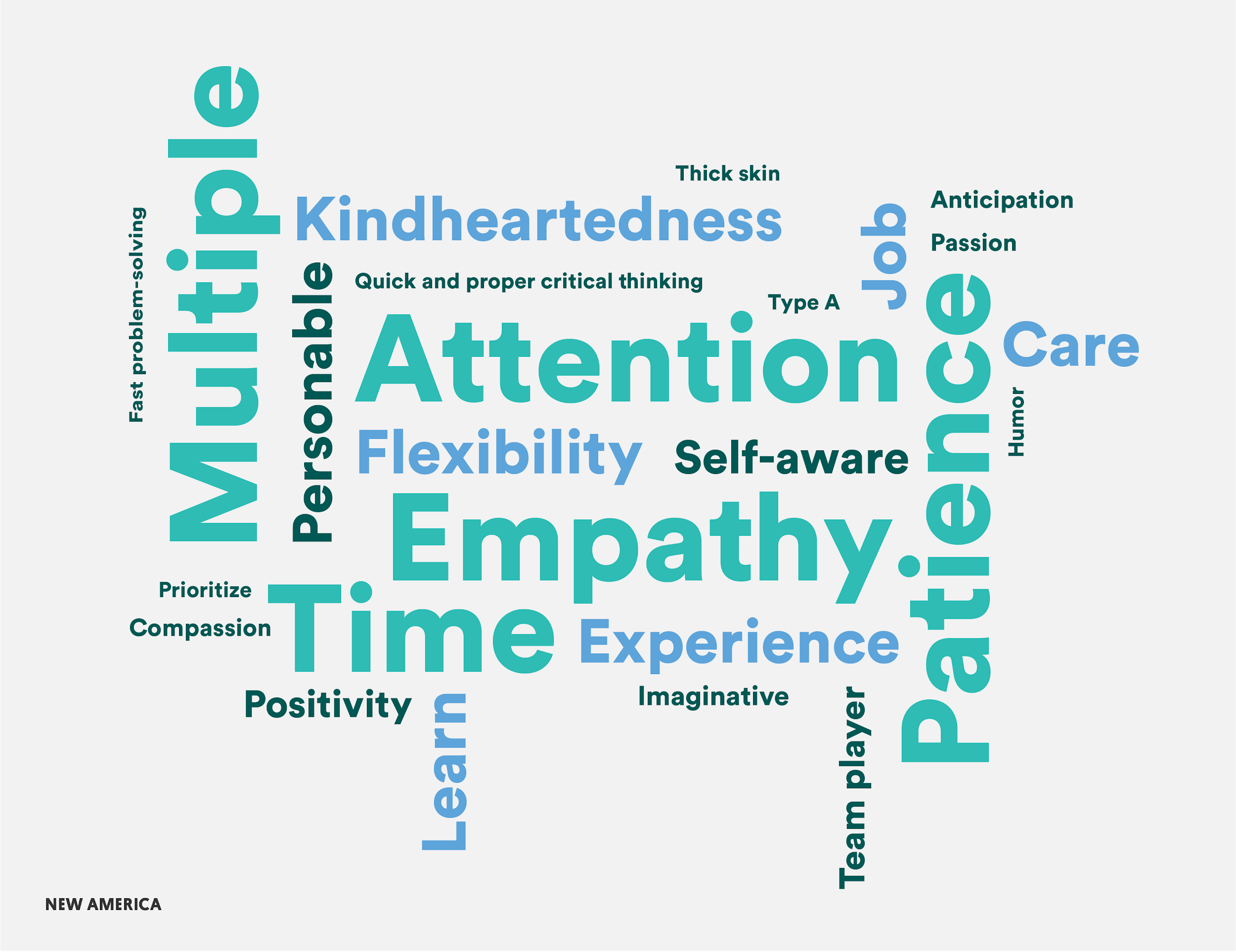
We asked professional caregiving men: “What skills, qualities or personality traits make a person good at your job?” Many emphasized the complex skills required to excel in their professions, including managing multiple tasks, attention to detail, and time management. The men in healthcare highlighted the professional and complex nature of their work; for example, Joshua, the surgical nurse, mentioned “anticipation, fast problem solving, [and] quick and proper critical thinking” as crucial skills for his job. Many men noted that certain caring traits are necessary as well, including empathy, patience, and kindheartedness. As Lucas, an intensive care unit nurse, explained, “You have to have a heart and soul to be a nurse. You need to care for people or it shows.” The childcare workers and educators, in particular, emphasized the traits of human warmth, like patience and a desire to help others, as essential to do their jobs well. Montell, the early childhood educator, listed “patience, [willingness] to learn, and positivity” as key traits to succeed in his work. Further, several men noted that schooling only goes so far; many of the necessary skills, they argued, can only be acquired on the job. “The job and experience makes you the professional.” (Terrence, registered nurse) Overall, the men characterized their careers as requiring the right mix of high-level cognitive skills and caring personality traits.
Professional Caregiving Men May Choose, or “Stumble Into” Care Work, But Most See it as a Lifetime Career
In our NORC survey, about half of the professional caregiving men (53 percent) said they took their jobs because they wanted to take care of people. Only 14 percent said they were encouraged by family and friends to take the job. Even fewer, just 6 percent, said they were inspired to go into care work because they saw other men in the field.
In our focus group of 13 professional male caregivers, eight said they sought out their jobs in care work. Five said they fell into their work. Still, 10 men in the group said they saw their work as careers that are fulfilling with room for more learning and advancement that will last a lifetime. Two didn’t answer. Just one, Nathan, the nurse in Salt Lake City, said he thinks of his current job as a step towards something else. He’s not sure what his next career goal is. His current job, he said, “Is very mentally engaging and a good placeholder until I figure out what to do next.”
Of those who actively pursued a career as a professional caregiver, Martin, the operating room nurse, said it was something he’d always wanted to do, and saw the work as challenging, and involving a lot of troubleshooting with complicated equipment. Federico, the tutor, said he’d always been interested in helping others achieve their education goals. While several of the men said they were drawn by the challenge of care work, the decision-making and critical thinking it required and carefully mapped out their educations, Nathan, the oncology nurse in Salt Lake City, said he was drawn to the “flexible lifestyle” that enables him to put in long but reliable hours and have time off to pursue his interests in outdoor sports.
Others did not set out to become professional caregivers. Five of the men in the focus group described a more circuitous route to their current care work. One was in restaurant management. Another in the entertainment industry. One had a computer job that didn’t turn out well. Another started his college career as a petroleum engineer. Lucas, the intensive care unit nurse, joined the military and became a medic. That’s how he “stumbled” into nursing. “It has given me a great career,” he said.
Most said they learned about caregiving from watching other family members, typically their mothers or grandmothers, care for others. Montell, the early educator, for instance, worked with children in his grandmother’s youth center. Elijah, a nurse in Seattle, saw how well his sister was cared for when she was sick as a child. Devon, the CRNA, helped his mother take care of his grandfather, giving him medication, breathing treatments and helping him get around. “I really enjoyed taking care of him and I believe that led me to look into nursing from the beginning,” he said.
Professional Caregiving Men Also Provide Unpaid Care at Home and Face Work-Family Conflict
As much as the professional caregivers in both the survey and focus groups said they found their work meaningful and enjoyable, they also faced a number of challenges with the conflicting demands of their professional role as caregivers at work, and their family responsibilities.
In the NORC survey, nearly six in 10 (57 percent) said they work more than 40 hours a week. Thirty-four percent reported they often feel their job is more stressful than average, and 17 percent said they feel burned out.
About half of professional caregiving men also provide informal care to an adult family member, friend, or a child with special needs. Nearly 60 percent say that that informal care has had a negative impact on their work, 48 percent say it’s been bad for their physical health, nearly 40 percent say that informal caregiving has had a negative impact on their household finances and about one-third say that it has increased their levels of stress, anxiety or overall mental health. About half (54 percent) expect that they’ll need to take time off work in the future to provide care for a family member with a serious illness or disability or who needs extra help due to old age.
About half of professional caregiving men also provide informal care to an adult family member, friend, or a child with special needs.
The men in the focus group of professional male caregivers were split in their answers. Many were fathers of young children, and several cared for or lived with aging parents, relatives or other loved ones. Eight said that their jobs provided them with enough flexibility that they had time to concentrate on work, and also have time for their families, with Lucas proudly saying how he’s able to attend his children’s events. “Days are long but rewarding,” echoed Terrence. “Life at home and life on the job complement each other through time management and work/family bonding activities.”
Yet three professional caregivers reported long work hours, exhaustion and high stress. Devon works 50 – 60 hours a week trying to pay off $130,000 in graduate school loans while trying to make time for his two small sons. Nathan was under additional strain because of understaffing due to the nursing shortage. Said Luther, “I feel caring for others can be overwhelming.” He spoke of how important it is for professional caregivers to take time off work to rest and to make time for family. “Turn off your Nursing demeanor and just be a family member,” he said, “not a care provider.”
Turn off your Nursing demeanor and just be a family member, not a care provider.
It’s important to note that these focus group interviews took place before the outbreak of COVID-19, which has ratcheted the demands on health care professionals to unprecedented and dangerous levels, just as it has threatened the livelihoods of early care educators whose schools and childcare centers have been shut down for months.
Men in Care Professions Need Time Off Work to Provide Care at Home
When it comes to balancing work and care, the professional caregiving men unanimously supported having access to paid family and medical leave through a national public program. Further, they said that any public or workplace policy should include men. “The need to tend to family, personal or medical issues is a need that cannot be taken lightly,” said Terrence. “The gender of the worker should not be of any importance.” Said Cameron, “I think men can be just as good a caretaker for babies.” The professional caregiving men said a public paid leave policy for caregiving should be normal and expected for men as well as women, and that they themselves would use such a program “in a heartbeat.” In the NORC survey, about half of the professional caregiving men surveyed said they anticipated needing to take leave in the future for the birth or adoption of a new child or to take care of a family member with a serious illness or disability, or who needed extra help due to old age.
The gender of the worker should not be of any importance.
In the focus group, the professional caregiving men said that they had seen the sometimes desperate need for paid leave observing the experiences of their patients and their patients’ families. “There is always the need to recover from surgery,” said Joshua, “and sometimes that recovery can be long.” Said Elijah, “Being an oncology nurse, taking care of very sick patients, I often ask myself how patients and families navigate work, sickness and afford a decent life without going bankrupt.”
II. How Professional Caregiving Men Think Others See Them
Men Are Not the Norm in Female-Dominated Care Industries and Have Mixed Views on Whether Society Respects Them
In the focus group discussion, the majority of professional caregiving men said they worked in female-dominated environments. Sometimes they were one of a handful of men—or in some cases, the only man—on their teams, in their departments, in their hospitals, childcare centers or schools. Cameron said that he is “always” the only African American male nurse at meetings at his workplace.
Luther said he works with primarily Filipina nurses and Latina certified nursing assistants. “Everyone worked wonderfully together,” he said. Because men in caring professions are so rare, many in the focus group said that people are surprised to find out about their work. “Being male, most people are surprised that I work in senior care. They see me as more of a construction kind of guy,” said Luther. “Once they understand what I do and why, I think they become impressed with my skills and my empathy for others.”
Once they understand what I do and why, I think they become impressed with my skills and my empathy for others.
Some of the professional caregiving men, because they were older, said that people often sought them out for mentorship or, as Dominic said, as “the person everyone comes to for answers or to get the job done.”
In describing his workplace, a nursing home facility where the majority of staff are women and the top administrators are men, Terrence was also describing a common phenomenon in female-dominated work environments: vertical segregation, where women may make up the majority of the workers, but the managers and leaders tend to be men.
Still, despite how rare they are in caring professions, and the disbelief they sometimes encounter, most of the professional caregiving men in the focus group said they felt society respected them and valued their work, but only, as Montell said, “to a certain point.” In the NORC survey, too, the majority of professional caregiving men in the sample said they felt respected for their role taking care of others within their profession (70 percent) and outside their profession (63 percent.)
Dominic said that even though friends and acquaintances are surprised that he’s a male nurse, they are “impressed” when they find out he’s a cardiology nurse practitioner. “I get phone calls from friends, family and church members wanting my opinion on their or their family members’ health problems or recommendations for a physician.”
Gordon, the early care educator, said that while people say they value education, early care and learning teachers aren’t compensated for their work. “There is evidence now that shows the effects of a high quality early education, and yet teachers still do not get the respect they deserve.”
Said Joshua, “Society values nursing as a whole. However, males in nursing are usually derided or the butt of many jokes. (Meet the Fockers),” he said, referring to the movie where the character played by Ben Stiller is continually derided for being a male nurse and questioned about why he didn’t become a doctor, implying he made a lesser choice, or couldn’t “hack” being a doctor.
Devon agreed and added: “I feel that male nurses are an easy target for people to make fun of. I hate the term ‘Murse.’”
When we asked whether they thought society viewed professional caregiving men favorably or negatively, only three thought they were seen favorably for being men in care work. “The idea that only women can be compassionate enough to be nurses has long gone,” said Terrence.
The idea that only women can be compassionate enough to be nurses has long gone.
Yet others said that, because of stereotypes and stigma, society frowned on their presence as men in caring professions. “They may believe that men who are in my role are soft or feminine and in some cases gay. But this is the furthest from the truth,” said Cameron. “I think this narrative is slowly changing. Men tend to be asked to leave rooms where women are undressing or in vulnerable positions.”
Joshua, too, said that he felt society, in general, viewed men in caring professions negatively. “While nursing is considered to be a noble profession, it is also predominantly a female profession, and males in nursing are given a hard time because of the nursing stereotype,” he said. “Also, in society, males are expected to be stoic and not show emotion. A good nurse is able to use their emotions to their patients’ benefit.”
The men in early care and education said they are often looked on with suspicion because of, as Gordon said, “the bad press and horrible crimes men have committed in my profession.” Montell said he, too, faces bias that “males are more likely to molest a child” than women are. Further, he doesn’t believe the stereotypical view that only women can teach or care for infants because they have “motherly instincts” that people don’t think men have.
Professional Caregiving Men Face Gender Stigma and Isolation
In our NORC survey, a small share of professional caregiving men reported feeling that they aren’t accepted by their colleagues (9 percent), or students, patients, or clients (5 percent), and that others are uncomfortable with them providing care (6 percent). About one in 10 say that they aren’t trusted to provide care because of their gender (5 percent) or that they are treated differently on the job because they are men (4 percent).
Similarly, in the NORC survey of men and fathers who provide unpaid care for family members, about one in five men (21 percent) said that people do not trust them to give care or to parent in a safe and caring manner simply because they are men—twice as many as women who provide unpaid care for family members.
And while some in the focus group of professional caregiving men said the “stigma” of being a man in a female-dominated caring profession is “slowly fading,” it’s still an everyday factor. Stereotypes and unconscious bias that men should be doctors and women should be nurses, or men should be principals and women should be teachers are still powerful, they said.
“When people first find out that I work with babies they laugh,” said Malique, who works with infants in an early care and learning center.
Luther, who was the only man in his nursing classes, said that nursing is still considered a “Pink Collar” position. “I’m not sure how much guys like the term,” he said. “I think some men see nursing as a ‘sissy’ field to enter.” In school, he said, “some of the students felt I should be elsewhere (as in the field of construction.) Others asked why I didn’t study to become a doctor. No one understood why I chose to work with seniors.”
Lucas, a male nurse, said some “older ladies that are old fashioned” who think nurses are only women are surprised to see him, and often will prefer a female nurse to help them with bathing and toileting. Male nurses, he said, are sometimes drawn to the ICU or Emergency Room, “because it has the most adventure that men seek.”
Cameron, another male nurse, agreed. “As I once worked in the ICU, I have noticed that more males are in ICU because ICU nurses have more autonomy and leadership, and that’s what men mostly like to be viewed as stereotypically.”
When we asked the focus group, “Would doing your job be different if you were a woman?” five said no, and six said yes.
Of those who said it would be different, it’s primarily because people are more likely to look up to or defer to them because they’re men—a bias that benefits men but contributes to men and women experiencing different treatment at work and gender-based isolation. Cameron said that he tends to get more respect and leadership roles because he’s a man, “which is great for me, but biased at the end of the day.” Similarly, Nathan said that “there are times when my opinions are taken more seriously because I am a male, and that might be a hindrance to many female nurses in that it is more difficult for them to be heard by patients and physicians.” That’s a scenario Dominic said he sees over and over. He will often give his medical opinion to doctors and be listened to, whereas female nurses are more likely to get pushback. “I have seen this firsthand,” he said.
Joshua said were he a woman, he would have more friends at work, and not feel so isolated. “Although I have friends at work, I don’t think it’s easy to have a best friend of the opposite gender, excluding your spouse. It’s usually not the best thing for a married man and a married female coworker to go out. However, females are able to do that frequently.” He added that while the caring duties would be the same, “I do think it is easier for females because of the social support.”
As a result of the focus group discussion, Joshua reached out to his 17-year-old son, who had once made a joke about his being a male nurse. “He said it was kind of funny. I asked him what was funny about it, and he said that in society everybody thinks it's funny for a guy to be a nurse. Even with that so close to home, I wouldn't change what I do, am proud of the work I've done, and for the many people I've been able to comfort.”
I wouldn't change what I do, am proud of the work I've done, and for the many people I've been able to comfort.
Professional Caregiving Men Encourage Men to Do Care Work Despite Gender Stigma
Ten of the 13 professional caregiving men in our focus groups said they would encourage men to enter caring professions that are still largely dominated by women.
Luther said he would, with one caveat: They have to love the job, and they have to be willing to break with the stoic male stereotype that they’ve been conditioned to believe is the “best” way to be a man and show their masculinity, and instead embrace their emotions. “I honestly feel females make better nurses due to empathy and other emotional factors. Sometimes men have no inner feelings. A lady may say ‘I understand, how may I help you?’ A guy might say ‘No big deal, Suck it up,’” he said. “However some men make good nurses. I would tell a guy, ‘If you really love helping others, it's worth it.’ If you’re looking for a paycheck, find something else to do.”
Montell and Gordon, the early care and learning educators, both said it’s important that they be role models, and show the way for men to become early educators. “What we do as a whole is very valuable because we could be role models for younger males, and influence them to follow their dreams no matter what society standards are,” Montell said.
Joshua said he too hopes more men will enter caring professions and help dispel gendered stereotypes and bias. “With the shortage in nursing, I think that it is critical to tap into the male side of the population. I think the portrayal of actual people in the profession, emphasizing that people, in general, are caring and nursing IS caring,” Joshua said. “Also, explaining the benefits would show them that there is a real opportunity.”
III. How Others See Professional Caregiving Men
The General Public is More Accepting of Male Nurses Than Men in Early Care and Education
To better gauge how the general public responds to professional male caregivers, we presented two photos sequentially to two general population online focus groups of adults over age 18, one exclusively men, and the other exclusively women. First, we showed a photo of a male nurse caring for a patient with the accompanying question, “If you had to guess, what do you think working in this job is like for him as a man? Do you think patients are surprised to see him there? Do you think they’d be comfortable or uncomfortable? And how would you feel being treated by him?”
We then presented a photo of a male childcare provider/early care and education teacher with the question, “If you had to guess, what do you think working in this job is like for him as a man? How do you think parents or other staff members react to him working in that environment?”
Overall, the men and women in both groups expressed views more accepting of a male nurse than a male childcare provider. They mostly took a gender neutral stance regarding nursing, but expressed gender specific attitudes regarding male childcare providers. Men’s and women’s views were quite similar, though some differences emerged with regards to how male nurses and male childcare providers are perceived by patients and parents, respectively.

(Male nurse photo similar to the photo shown to focus group participants)
In both general population focus groups, men and women expressed a gender-neutral ethic regarding nursing care. They largely shared the view that gender is irrelevant to the profession; what matters is possessing the right talents, skills, and qualifications. James, 48, echoed most men in his focus group when he stated, “I think the job is important, not the sex of the person doing it. I believe that the person should be qualified, empathetic and do a good job. I would feel fine about being treated by him.” The women from the general population expressed a very similar sentiment. Janet, 58, spoke of her positive experiences with men in nursing: “I have seen male nurses who have been very kind, patient, and caring. They have spoken with compassion and been very effective. Whatever the gender of a nurse, the importance is the job they have done.” A couple of men and women also noted that some men’s physical strength and fitness is an asset in nursing.
Both men and women were largely accepting of men in nursing and were confident that others generally felt the same. Most people today, they claimed, perceive a male nurse as normal. As Colin, 41, explained, “I know a few male nurses and they are very comfortable in their jobs. I don't get the impression that it's [unusual] for men to be nurses and I would not be concerned if a man was my nurse.” Some acknowledged that a minority of “old fashioned” people may perceive a male nurse as strange and might be hesitant to receive his care. Kari, 51, for example, reasoned that “…most people are comfortable with male nurses. There may be some from an older generation that are not comfortable. I have had many male nurses. I am comfortable with them.”
Almost universally, the women and men in the focus groups stated that they personally would feel fine being treated by a male nurse. A few women were more comfortable being treated by a female nurse, and a few men also noted this preference among some women. But even the minority of women who preferred female nurses said this only applied for certain types of care: “I would be comfortable [with a male nurse], but there are times when I would be more comfortable with a female nurse” (Margaret, 43). One interesting gender difference in the general population’s perception of men in nursing was that several women suggested that patients will likely assume he is a doctor; no men mentioned this possibility. “I do have to admit that I may at first think he is the doctor. I know that is stereotypical,” said Samantha, 52.

(Early Care and Education Teacher photo similar to the photo shown to focus group participants)
In contrast, the men and women in both general population focus groups were less comfortable with the photo portraying a man childcare provider. Their perception of male childcare workers and educators revealed some gendered assumptions and stereotypes. The majority of both men and women felt that parents would be suspicious of a man in this profession, or that they would think it strange that men were in this role. Mary Beth, 61, expressed her discomfort and imagined parents of young kids felt the same: “I think it would be strange for a man to work there. Parents would probably think that a woman would be more qualified to work there.”
Further, focus group participants noted that, even without evidence or cause for concern, people assume men are more likely to abuse children, and thus parents would be more cautious around male childcare workers than around female childcare workers. More men than women specifically mentioned child abuse, whereas women thought men in early education would be regarded as either suspicious, strange, or stereotyped as gay. Allison, 53, worried that societal stereotypes would make it difficult for a man to work in this role: “I think there would be some element of surprise at seeing a male child care worker. I believe this is more uncommon than a male nurse. Again, because of stereotypes, I believe people do not expect to see men in such nurturing roles. I can see this as being uncomfortable for a man. I think his abilities in this role would be questioned more.” Three men and two women admitted to personally harboring the suspicion that men are more likely to abuse children, and expressed a preference for female childcare workers. James, 48, lamented, “It’s sad to say that I prefer a female childcare provider over a male childcare provider because I feel (right or wrong) that child abuse is done more by males than females.”
However, four of the 13 men and four of the 15 women approved of a man in this role as long as he has the proper skills and traits. They argued that as long as he does his job well, there should be no resistance to him from parents or coworkers. “I do not think parents would have a problem with this as long as he is competent. I also think other staff members would be fine as long as he does his job well”, said Kari. Interestingly, while men and women spoke a language of gender neutrality regarding nursing, a few suggested that men could bring gender-specific assets to childcare work. For example, a man could serve as a father figure to fatherless children or “invoke his fatherly instincts in being a protector and provider to thrive in this environment” (Leonard, age 42, Project Manager). Corrine (age 60, Medical Claims) suggested that a man “would be a role model for the boys and sometimes children react differently to a man giving directions than to a female.” Thus, they felt men could bring a level of authority to this work that women may stereotypically lack.
Conclusion and Recommendations
Men who work as professional caregivers find meaning and pride in their work, and generally feel respected by others in their profession, as well as outside of the profession. They still face stigma, tied to the stereotypical gendered belief that women are more naturally suited to care work, and men to competitive work. Some talk of being met with surprise, laughed at or, particularly for men in early care and education, met with suspicion as men working in these female-dominated professions. Men, particularly those who work in early care and education, feel that the low pay associated with care work reflects society failing to value it. Still, though men in early education in particular would like to see higher wages, most of the men we spoke to in our focus group of 13 professional male caregivers said they view their care work as careers for a lifetime, with opportunities to learn and advance, and would encourage other men to pursue professional care work.
Caring professions include some of the fastest growing jobs as society ages, and among the most future-proof jobs as care work is not easily replaced by technology or automation. Because men tend to earn more than women and male-dominated fields tend to pay higher wages and offer more stability, increasing the share of men in care work could potentially also lead to higher wages and decent and dignified work, instead of the poverty wages, unstable hours, and lack of benefits. To attract and retain more men in caring professions, workplaces, public policies and cultural attitudes must shift:
Transform culture to support men in caring professions
- Change the narrative. Highlight the challenges, competencies required, and rewards of care work, that it can be complex and require special skills, and dispel stereotypes that it is drudgery, unchallenging, or “women’s work.”
- Share stories that feature professional male caregivers, continue to provide role models and normalize men as equal and fully capable caregivers in both private and public settings.
- Openly address the stigma men face in the caring professions, particularly early care and learning, as norm violators.
- Recognize that most married mothers point to their husbands as the people they trust most to care for their children other than themselves. This same trust must be extended to men in professional childcare settings.
Improve education, training, and work pathways to create a gender-equal care workforce
- Create role model opportunities for mentorship between professional caregiver men and students at the high school and college level.
- Create more pathways for men to enter professional caring professions. At the educational level, actively recruit young men to take classes, training or pursue degrees to become professional caregivers. At the organizational level, health organizations and early care and learning centers should recruit, train, and support men as professional care providers.
- Recruit family caregiving men into caregiving professions like direct care and home health.
- Improve school security practices so that parents and guardians can rest assured that their child is safe through comprehensive background checks on all individuals who work with children.
- Schools and school districts provide clear policies and guidance to students, teachers and parents on what sort of touch is allowed between early care and education teachers and children. Strict “no touch” policies may not be realistic for young children. Thus, defining unambiguous parameters about what is acceptable is crucial.
- Provide unconscious bias training to create awareness and more welcoming environments in schools, training and workplaces for men, particularly men of color, in health and early care and learning professions.
- Actively open up management and leadership positions for women in professional caring professions and work to reduce the unconscious gender bias that can mean women’s voices are not heard nor their opinions as respected as their male colleagues’.
Invest in the care economy
- Create and pass public policies that require and support decent wages, benefits, stable schedules that offer flexibility, and dignified work for professional care workers.
- Provide a public, universal paid family and medical leave program to people of all genders and normalize the expectation that men, as capable caregivers, need to take it.
Methodology
The Better Life Lab at New America conducted a multi-modal study of men and care in the United States, with support from the Robert Wood Johnson Foundation and Pivotal Ventures, an investment and incubation company created by Melinda Gates. This research included a quantitative component: a nationally representative survey of 2,966 Americans, in partnership with NORC at the University of Chicago, including oversamples of adult men and fathers of children zero to eight years old using the AmeriSpeak Panel®, the probability-based panel of NORC. Interviews were conducted online and over the phone. Additionally, a sample of 331 male professional caregivers was collected using Dynata.We also conducted five three-day long online discussions using the 20|20 Research’s facilitation platform QualBoard. 20|20 recruited and screened focus group participants for each of the online discussions. The groups were conducted over four weeks in May 2019 and included a total of 68 participants. Participants were compensated for their time. This is part of a larger series of reports on men and paid leave, engaged fathers and political affiliation and attitudes toward care. Click here for more information.
More About the Authors

Brigid Schulte
Director, Better Life Lab
Emily Hallgren
PhD Intern, Better Life Lab

Roselyn Miller Champion
Grant Analyst, City of Portland