
Preschool Access and Quality Decline in Wake of Recession

The 2011 school year brought a new first for state pre-kindergarten programs: Arizona became the first state to reverse course and entirely eliminate its pre-K program. Though that was the only state to defund pre-K altogether, state pre-K funding across the country declined from 2010 levels by $145 per child on average. Those and other metrics of state pre-K programs are detailed in the National Institute for Early Education Research’s (NIEER) update to its annual yearbook, “The State of Preschool 2011,” released today.
Enrollment in state-funded pre-K ticked upward over the past year, and over the last decade has grown by over 600,000 children. This growth over 10 years has been almost entirely among 4-year-olds, though there was a slight 1 percentage point increase in 3-year-old enrollment. But since 2010, enrollment has declined in 12 states, and another 10 continued not to provide pre-K programs for 3- or 4-year-olds.
State spending per pre-K child has declined by 10 percent, or $487, over the past 10 years among states that already served at least 4 percent of 4-year-olds in 2001. Among all states, spending has declined by more than $700. Ongoing budget crunches in many states have led penny-pinching legislatures to cut pre-K funding. The expiration of federal stimulus funds, which plugged budget gaps in many states, has exacerbated their fiscal circumstances, and some states have not replaced those funds with state monies for the current 2012 fiscal year.
The declining funds are triggering declines in pre-K program quality, according to NIEER. “If you were to interview teachers in any state in the country, they would tell you that these kinds of cuts have been hurting quality,” said NIEER director Steve Barnett on a call with reporters last week. The report, which uses a series of 10 benchmarks to measure program quality, found that only 12 states provided enough funding to meet all of the benchmarks. That translates to about 20 percent of children in state-funded pre-K programs with the funding capacity to provide good instruction and services. Only five states actually met all 10; another 14 met at least eight of the quality standards. A large proportion – 43 percent – of all children served by state pre-K programs are enrolled in programs that meet fewer than half of the benchmarks.
But the news in the early childhood realm is not all bad. Though state budget cuts may be leading states to cut enrollments or loosen standards, recent federal grant competitions, such as the Race to the Top – Early Learning Challenge, are leading many states to build rating systems and other coordinated programs to emphasize quality. U.S. Secretary of Education Arne Duncan, speaking with reporters last week, promised that the Department would continue to focus on expanding access to high-quality pre-K programs that demonstrate an ability to better prepare students for school. He also gave accolades to Secretary of Health and Human Services Kathleen Sebelius’s Head Start re-competition regulations, saying that “we owe it both to our children and our taxpayers not to keep funding things that aren’t making a difference in school readiness.” And almost half of governors mentioned early learning in their annual State of the State addresses for 2012.
These moves are welcome, and the emphasis on quality is critical, but it remains to be seen whether states and the federal government will be able to increase the number of children who have access to high-quality preschool – at least in the short term. With many state budgets remaining tight and debates raging over the appropriate level of federal funding for public services and education, Congress and state legislators will need to prioritize access to early education if we are going to see any reversal in the trends showcased in NIEER’s report.
Updated April 17, 2012: NIEER created a video to visually depict pre-K spending and access per state over time. Take a look here.
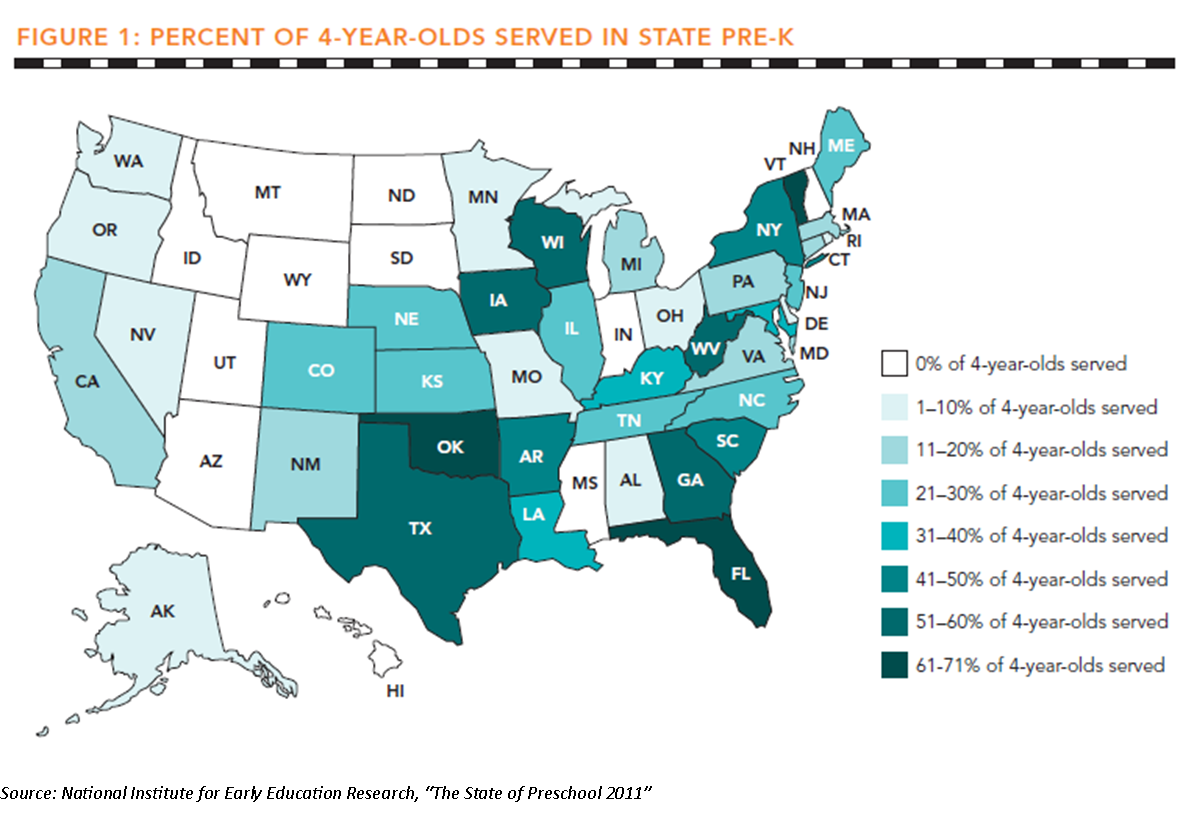
This map from NIEER shows where states stand in 4-year-old state pre-K program enrollment as of 2011:
More About the Authors
Issues
Programs/Projects/Initiatives
Related
Confronting Harmful Federal Disability Policy in Health and Human Services
Federal Early Education Update: March 2026
A Bureaucratic Shakeup Threatens Future Child Care Research