Preparing Principals for Pre-K in Illinois
Table of Contents
- The Impetus for Principal Preparation Reform
- Principals as Early Learning Leaders
- The Long Road to Reform
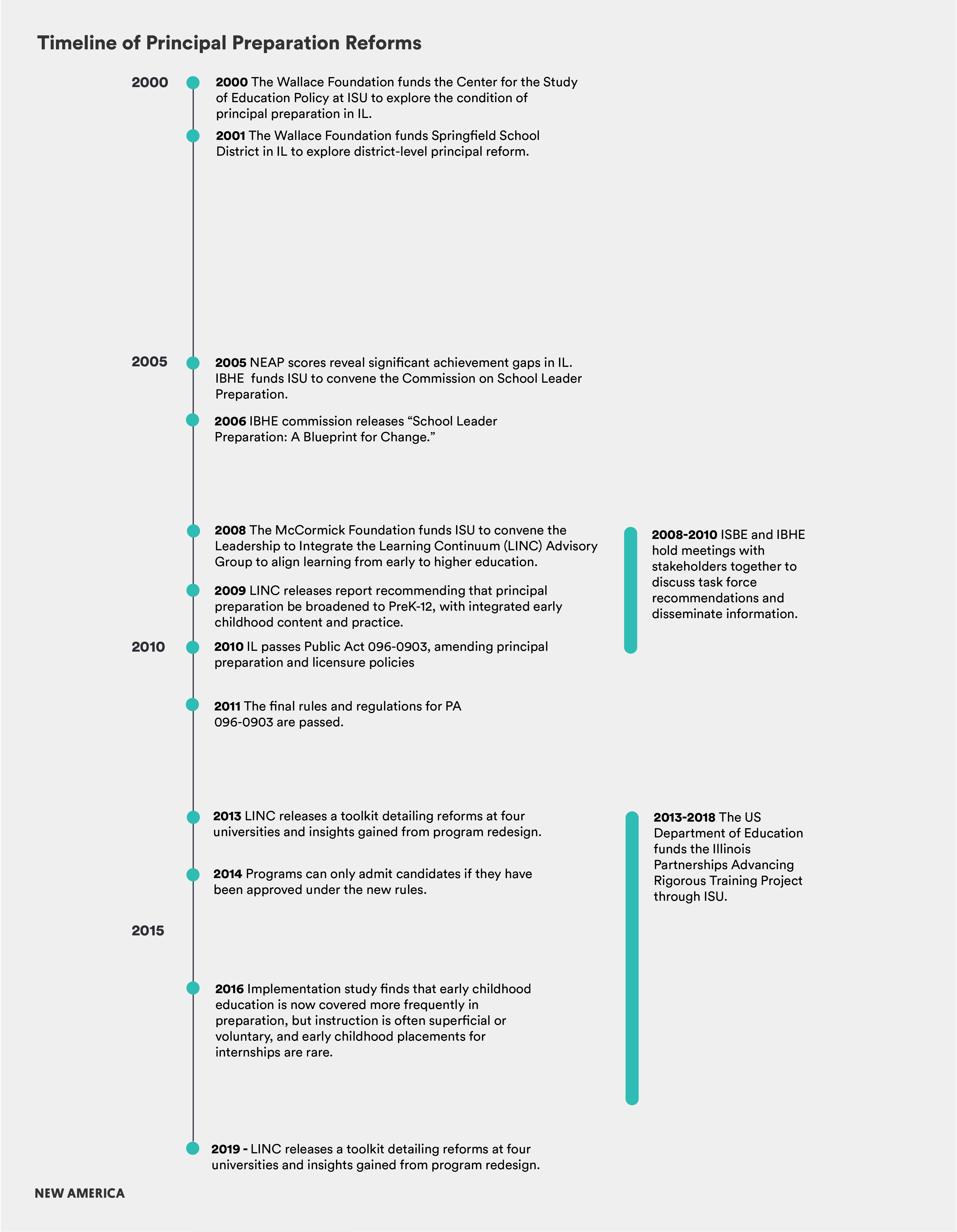
- Timeline of Principal Preparation Reforms
- The Longer Road to Implementation
- Opportunities and Challenges in Illinois
- Takeaways for States Looking to Strengthen Principals as Early Learning Leaders
- Appendix I: Useful Acronyms
- Appendix II: Interviews Conducted
Abstract
This paper explores Illinois’s shift from a general administrative license, called a “Type 75” license, to a “PK–12 Principal Endorsement.” It includes both a history of the reform efforts and a look at how implementation has fared nearly a decade after the legislation was signed into law. It also offers lessons and recommendations for other states looking to ensure principals are equipped to lead pre-K and early grade classrooms.
Acknowledgments
This paper benefited from the insights of many, including the interviewees listed in the appendix. I am especially grateful for the participation and support of Erika Hunt and Lisa Hood at the Center for the Study of Education Policy at Illinois State University. Thank you to New America colleagues Laura Bornfreund, Aaron Loewenberg, Roxanne Garza, Elise Franchino, and Sabrina Detlef for editorial insight and guidance; and to Maria Elkin and Riker Pasterkiewicz for layout and communications support. This work would not have been possible without the generous support of the Heising-Simons Foundation. The views expressed in this paper are of the author alone.
The Impetus for Principal Preparation Reform
The role of an elementary school principal is as critical as it is challenging. Principals arrive at school well before the first bell rings and spend their days doing everything from greeting children as they get off the bus, to meeting with parents, scheduling staff, and managing finances. In recent years, there has been an increased focus on the role of principals as instructional leaders, which can involve choosing curricula and assessments as well as supporting and evaluating teachers.1 With these responsibilities, principals establish the school culture and determine the quality of staff who interact directly with children. It should come as no surprise that principals have a sizeable impact on student achievement.2
In 2005, Arthur Levine, formerly of Columbia University’s Teachers College, released a damning report on the state of the nation’s principal preparation programs. His review found that they “suffered from curricular disarray, low admissions and graduation standards, weak faculty with no experience in schools, inadequate clinical instruction, inappropriate degree structures, and a lack of research-based elements.”3 In response, the Illinois Board of Higher Education (IBHE) convened a commission to review the quality of the state’s principal preparation programs. The commission released School Leader Preparation: A Blueprint for Change in 2006, affirming that Levine’s findings held true in Illinois.4 As one Illinois higher education official explained, “Historically, some principal prep programs were cash cows for universities. Many students who enrolled weren’t interested in actually becoming principals; they were interested in moving up the salary scale.”5
At the time, state policymakers were concerned with achievement disparities based on a student’s race, ethnicity, and family income. On the 2005 National Assessment of Educational Progress (NAEP), only 29 percent of Illinois fourth graders scored “proficient or above” for reading. Disaggregated scores showed that 65 percent of African American students and 56 percent of Latinx students scored “below basic.” There was a 40-point disparity between low-income students and their peers, making Illinois’s reading achievement gap one of the largest in the country.6
Stakeholders saw principal preparation as a lever for improving student outcomes. In 2010, the state passed legislation making significant changes to its preparation and licensure policies in an effort to better prepare principals “to be highly effective in leadership roles to improve teaching and learning and increase academic achievement and the development of all students.”7 Illinois’s reforms were ambitious, sunsetting all programs and requiring them to reapply for approval from the state board of education (ISBE) under new standards. Programs would now be expected to prepare principals to lead all grade levels and all students—including preschoolers.8
This paper explores Illinois’s shift from a general administrative license, called a “Type 75” license, to a “PK–12 Principal Endorsement.” It includes both a history of the reform efforts and a look at how implementation has fared nearly a decade after the legislation was signed into law. It also offers lessons and recommendations for other states looking to ensure principals are equipped to lead pre-K and early grade classrooms.
Citations
- For further reading on instructional leaders: Roxanne Garza, Guiding Principals: State Efforts to Bolster Instructional Leadership (Washington, DC: New America, 2018), source
- Robert J. Marzano, Timothy Waters, and Brian A. McNulty, School Leadership That Works: From Research to Results (Alexandria, VA: Association for Supervision and Curriculum Development, 2005).
- Erika Hunt, Lisa Hood, Alicia Haller, and Maureen Kincaid, eds., Reforming Principal Preparation at the State Level (New York: Taylor & Francis, April 2019), source
- School Leader Preparation: A Blueprint for Change (Springfield: Commission on School Leader Preparation in Illinois Colleges and Universities, 2006), source
- Paul Zavitovsky (leadership coach and assessment specialist, University of Illinois at Chicago), interview with author, June 19, 2019.
- Education Watch: Illinois Key Education Facts and Figures (Washington, DC: The Education Trust, 2006), source
- Illinois State Board of Education, Title 23: Education and Cultural Resources Code 30, Programs for the Preparation of Principals in Illinois, effective November 2017, source
- Public Act 096-0903 uses the terms “preschool” and “early childhood programs” to refer all children from birth to age five. New America uses the term “pre-kindergarten” or “pre-K” throughout this paper to refer to three- and four-year-old children.
Principals as Early Learning Leaders
Around the same time that Illinois was rethinking principal preparation, there was a coinciding movement in the United States to improve access to and quality of early childhood education, namely pre-K. From 2002 to 2018, the percentage of four-year-olds served by state-funded pre-K programs in the U.S. more than doubled.9 Many school districts and cities throughout the country also saw the potential of pre-K and started investing in programs during this time.10 The Obama administration accelerated state and local efforts to serve young children with competitive grant programs like Race to the Top–Early Learning Challenge and Preschool Development Grants.11 Support for early childhood education became largely bipartisan, with a strong majority of voters supporting investments in young children’s care and education.12
Much of this progress was in response to a growing body of research showing how crucial the earliest years of development and learning are to children’s future success.13 Research shows that it is the quality of interactions that young children have with adults and the skills those adults bring into interactions that truly matter. The 2015 National Academies of Sciences, Engineering, and Medicine report, Transforming the Workforce for Children Birth Through Age 8: A Unifying Foundation, details the knowledge and competencies that educators, both teachers and leaders, need to work in settings with young children.14
To be effective instructional leaders who can help advance teacher practice, elementary school principals, who are increasingly responsible for overseeing pre-K classrooms, must understand how young children learn.15 Teaching and learning should look different in a kindergarten classroom—where it is more developmentally appropriate for children to be engaged in dramatic play than sitting at desks completing worksheets—than it does in a fourth grade classroom. Principals need to be able to make that distinction. As leaders in their communities, principals are naturally positioned to help align early childhood programs with elementary schools to create a seamless continuum of learning and support for children and families, even when pre-K classrooms are not located in their school buildings. Yet when New America conducted a series of focus groups with elementary school principals around the country in 2015, we found that principals felt ill-equipped to promote high-quality teaching in pre-K and the early grades.16
Principals are naturally positioned to help align early childhood programs with elementary schools to create a seamless continuum of learning and support for children and families.
The exclusion of early learning and child development in principal preparation programs or licensure requirements is partially to blame. Of 45 states that responded to a 2017 New America survey of policies related to elementary principals, only six reported that they require principals to take coursework that covers early learning. It is also rare for states to require elementary school principals to have clinical experiences specifically in elementary schools.17 The Center for Enhancing Early Learning Outcomes found in a 2014 review of principal licensure standards that, “Although many states include pre-K in the scope of principal licensure (PreK–12, for example) the extent to which that involves any childhood content or experience is varied, but generally extremely limited.”18 Couple this with the fact that only three states require elementary school principals to have experience teaching in the elementary grades and there is a recipe for leaders who are not prepared to serve their youngest students.
Illinois’s 2010 reform set out to change this. State policymakers wanted to see pre-K and early learning covered in principal preparation in a meaningful way. Among the many reforms in the 2010 law, lawmakers included a requirement for all preparation programs to incorporate early learning into their curricula and provide candidates with internships across the PreK–12 continuum. Early childhood content was added to the state’s principal licensure exam as well.
Citations
- For further reading on instructional leaders: Roxanne Garza, Guiding Principals: State Efforts to Bolster Instructional Leadership (Washington, DC: New America, 2018), source">source
- Robert J. Marzano, Timothy Waters, and Brian A. McNulty, School Leadership That Works: From Research to Results (Alexandria, VA: Association for Supervision and Curriculum Development, 2005).
- Erika Hunt, Lisa Hood, Alicia Haller, and Maureen Kincaid, eds., Reforming Principal Preparation at the State Level (New York: Taylor & Francis, April 2019), source">source
- School Leader Preparation: A Blueprint for Change (Springfield: Commission on School Leader Preparation in Illinois Colleges and Universities, 2006), source">source
- Paul Zavitovsky (leadership coach and assessment specialist, University of Illinois at Chicago), interview with author, June 19, 2019.
- Education Watch: Illinois Key Education Facts and Figures (Washington, DC: The Education Trust, 2006), source">source
- Illinois State Board of Education, Title 23: Education and Cultural Resources Code 30, Programs for the Preparation of Principals in Illinois, effective November 2017, source">source
- Public Act 096-0903 uses the terms “preschool” and “early childhood programs” to refer all children from birth to age five. New America uses the term “pre-kindergarten” or “pre-K” throughout this paper to refer to three- and four-year-old children.
- Allison Friedman-Krauss, Steven Barnett, Karin Garver, Katherine Hodges, G. G. Weisenfeld, and Nicole DiCrecchio, The State of Preschool Yearbook 2018: Executive Summary (New Brunswick, NJ: The National Institute for Early Education Research, Rutgers University, 2019), source
- Pre-K in American Cities (New Brunswick, NJ: National Institute for Early Childhood Research and CityHealth, 2019), source
- U.S. Department of Health & Human Services, Office of the Administration for Children & Families (website), “Race to the Top-Early Learning Challenge,” source; and U.S. Department of Education (website), “Preschool Development Grants,” source
- Charles Joughin, “FFYF Poll: Voters Across Party Lines Bridge Political Divides In Support of Early Childhood Education,” First Five Years Fund (website), June 20, 2017, source
- The Current State of Scientific Knowledge on Pre-Kindergarten Effects (Washington, DC: Brookings Institution, 2017), source
- LaRue Allen and Bridget B. Kelly, eds., Transforming the Workforce for Children Birth Through Age 8: A Unifying Foundation (Washington, DC: National Academies of Science, Engineering, and Medicine, April 2015), 344–345, source
- Leading Pre-K–3 Learning Communities Executive Summary (Alexandria, VA: National Association of Elementary School Principals), source
- Aaron Loewenberg, Shayna Cook, Laura Bornfreund, and Abbie Lieberman, Principal’s Corner: Perspectives on Teaching and Learning in PreK–3rd Grade series (Washington, DC: New America, 2016), source
- Abbie Lieberman, A Tale of Two Pre-K Leaders: How State Policies for Center Directors and Principals Leading Pre-K Programs Differ, and Why They Shouldn’t (Washington, DC: New America, 2017), source
- Kirsty Clarke Brown, Jim Squires, Lori Connors Tadros, and Michelle Horowitz, CEELO Policy Report: What Do We Know About Principal Preparation, Licensure Requirements, and Professional Development for School Leaders? (New Brunswick, NJ: Center on Enhancing Early Learning Outcomes, 2014), source uploads/2014/07/ceelo_policy_report_ece_principal_ prep.pdf
The Long Road to Reform
Statewide efforts to improve principal preparation in Illinois can be traced back to 2000.19 At the time, Illinois’s Type 75 certificate was a general administrative license that teachers could pursue to become a school leader, such as an instructional coach, department head, or principal.
In 2000, the Center for the Study of Education Policy at Illinois State University (ISU) received a grant from the Wallace Foundation to begin a statewide initiative around principal preparation reform. This grant involved convening multiple institutions of higher education around the state that were interested in improvement efforts. The group, led by Erika Hunt, Lisa Hood, and Norm Durflinger, studied “the condition of school leadership preparation and development in Illinois” and released a report with recommendations for state agencies.20 In 2002, the Wallace Foundation funded Illinois’s Springfield School District 186 to explore what could be done to improve the principalship at the district level.21 Diane Rutledge, superintendent during this time, was interested in evaluating the role of preparation and strengthening the partnership between her district and ISU.22
In 2005, the Illinois Board of Higher Education (IBHE) funded ISU to convene the Commission on School Leader Preparation, marking the first time that a state agency convened a group around this topic.23 The commission’s resulting report, School Leader Preparation: A Blueprint for Change, affirmed that principal preparation needed significant reform and offered recommendations for institutions of higher education.24 The report held up the partnership between Springfield School District 186 and ISU, as well as two program partnerships that Chicago Public Schools had with New Leaders for New Schools and the University of Illinois at Chicago (UIC), as models of innovation in principal preparation reform.25
In 2006, the Illinois State Board of Education (ISBE), which is responsible for educator licensure, joined IBHE to call for the creation of the Illinois School Leader Task Force, “charged specifically with developing strategies for the implementation of the commission’s recommendations.”26 Both regulatory agencies making this a priority brought legitimacy to the work. The 28-member Illinois School Leader Task Force, staffed by ISU, IBHE, and ISBE, set out to determine how to prepare principals to improve student learning. Steve Tozer, founder of UIC’s program and a former kindergarten teacher, was chosen to chair the task force. Its suggestions strongly resembled evidence-based criteria for effective principal preparation, which also aligned with key elements of UIC’s program.27 As Paul Zavitovsky, a leadership coach at UIC for 14 years said, “UIC’s program didn’t change as much in response to statewide reform efforts as statewide reform efforts mirrored what was being developed at UIC.”28
The task force recommended the state pursue the following:
1) "State Policies that set high standards for school leadership certification and align principal preparation, early career development, and distinguished principal recognition with those standards.
2) Formal Partnerships between school districts, institutions of higher education, and other qualified partners to support principal preparation and development.
3) Refocused Principal Preparation Programs committed to developing and rigorously assessing in aspiring principals the capacities that are most likely to improve student learning in PreK–12 schools."29
Each recommendation came with detailed steps for implementation. These included creating a principal-specific endorsement focused on instructional leadership; revamping program approval criteria and requiring all programs to reapply; and creating a new licensure exam for principals based on updated standards. By requiring programs to partner with districts and view districts as their “clients,” they sought to ensure that programs meet the needs of local communities and schools. They also recommended that programs adopt highly selective admissions criteria and ensure that students have intensive, closely supervised residency experiences. Other than the use of the term “PreK–12 schools,” there was no mention of early learning in the task force report.
IBHE and ISBE then established multiple committees made up of a broad range of stakeholders to develop action plans for the recommendations. Materials from the various meetings that took place from 2008 to 2009 were made public and experts in different fields were asked to weigh in. From 2009 to 2010, the two agencies held numerous “dissemination meetings” around the state to share the proposed changes and gather feedback, bringing together more than 800 people.30
So Where Did Early Childhood Education Come In?
According to Tozer, “There was a window between the task force initiation in 2008 and passage of new state leadership endorsement law in 2010. This was the window in which pre-K became part of the leadership agenda.” And the Chicago-based Robert R. McCormick Foundation, whose work focuses on early learning, was the key player. As Sara Slaughter,31 a program director at McCormick at the time, recalls, “My observation was that more elementary schools were opening preschool classrooms, and existing preschool classrooms were not connecting to the K–12 system. I saw principal preparation as a tool.”
McCormick gave a grant to the Center for the Study of Education Policy at ISU to explore the role of principals in improving coordination and collaboration of early childhood education and elementary schools, based on ISU’s work convening the school leader task force.32 Slaughter also knew that Hunt and Hood were “bilingual actors in the education sphere,” meaning they spoke and understood early education and the K–12 space.33
In 2008, ISU convened the Leadership to Integrate the Learning Continuum (LINC) Advisory Group, assembling 50 key stakeholders across state agencies and programs, bridging silos between early childhood, K–12, and higher education.34 With support from McCormick, the group recommended ISBE broaden the principal endorsement to PreK–12 and incorporate early learning content and practice into preparation programs.35 Specifically, LINC recommended:
The Illinois State Board of Education and Illinois Board of Higher Education should expand criteria for principal preparation programs to include:
• "Developmentally appropriate practices and curricula from birth;
• Information about the Illinois Early Learning Standards in relation to the Illinois Learning Standards;
• Team-building and collaboration with early learning organizations;
• Internship/practicum experiences at all educational levels (early learning, elementary, secondary); and
• Early care and learning representatives as preparation program partners."36
The recommendations of this advisory group carried a lot of weight. This is not to say that discussion of early childhood would have been absent from the conversation without McCormick’s involvement. The early childhood advocacy community also played an active role. Joyce Weiner, senior policy manager for the Chicago-based Ounce of Prevention Fund, was a strong voice representing the early childhood field on the state task force. She remembers, “There were many conversations that were not early childhood or early elementary-focused at all. Having an early childhood policy voice at the table was helpful to making connections for others on the full continuum of children’s education, particularly the earliest years which build a foundation for all subsequent learning … people often overlook that first rung of the education ladder.”37 And when the IBHE- and ISBE-established committees were developing plans for implementing the task force recommendations, additional experts in early childhood education and other areas were invited to weigh in.38
The Final Rule
In May 2010, the final bill passed both the House and Senate with strong support. Sponsors of the bills in both chambers had been involved in the principal reform efforts for numerous years. The legislation was signed into law in June 2010 as Public Act 096-0903.39 Early childhood is specifically mentioned in two sections of the administrative code, highlighted below.40 First, in regard to program curricula:
Program Curricula
Illinois State Board of Education
23 ILLINOIS ADMINISTRATIVE CODE 30
30.30 SUBTITLE A SUBCHAPTER b
d) Each program shall offer curricula that address student learning and school improvement and focus on:
1) all grade levels (i.e., preschool through grade 12);
2) the role of instruction (with an emphasis on literacy and numeracy), curriculum, assessment and needs of the school or district in improving learning;
3) the Illinois Professional Teaching Standards (23 Ill. Adm. Code 24 (Standards for All Illinois Teachers));
4) all students, with specific attention on students with special needs (e.g., students with disabilities, English language learners, gifted students, students in early childhood programs); and
5) collaborative relationships with all members of the school community (e.g., parents, school board members, local school councils or other governing councils, community partners).
(Source: Amended at 37 Ill. Reg. 4258, effective March 25, 2013)
And second, in regard to the internship requirement:
Internship Requirements
Illinois State Board of Education
23 ILLINOIS ADMINISTRATIVE CODE 30
30.40 SUBTITLE A SUBCHAPTER b
Internship Requirements
a) The internship portion of the program shall be conducted at one or more public or nonpublic schools so as to enable the candidate to be exposed to and to participate in a variety of school leadership situations in settings that represent diverse economic and cultural conditions and involve interaction with various members of the school community (e.g., parents, school board members, local school councils or other governing councils, community partners).
1) The internship shall consist of the following components:
A) Engagement in instructional activities that involve teachers at all grade levels (i.e., preschool through grade 12), including teachers in general education, special education, bilingual education and gifted education settings;
B) Observation of the hiring, supervision and evaluation of teachers, other licensed staff, and nonlicensed staff, and development of a professional development plan for teachers; and
C) Participation in leadership opportunities to demonstrate that the candidate meets the required competencies described in Section 30.45.
2) The internship shall not include activities that are not directly related to the provision of instruction at the school (e.g., supervision of students during lunch or recess periods, completion of program coursework).
3) The internship shall require the candidate to work directly with the mentor observing, participating in, and taking the lead in specific tasks related to meeting the critical success factors and essential competencies referenced in Section 30.30(b)(3).
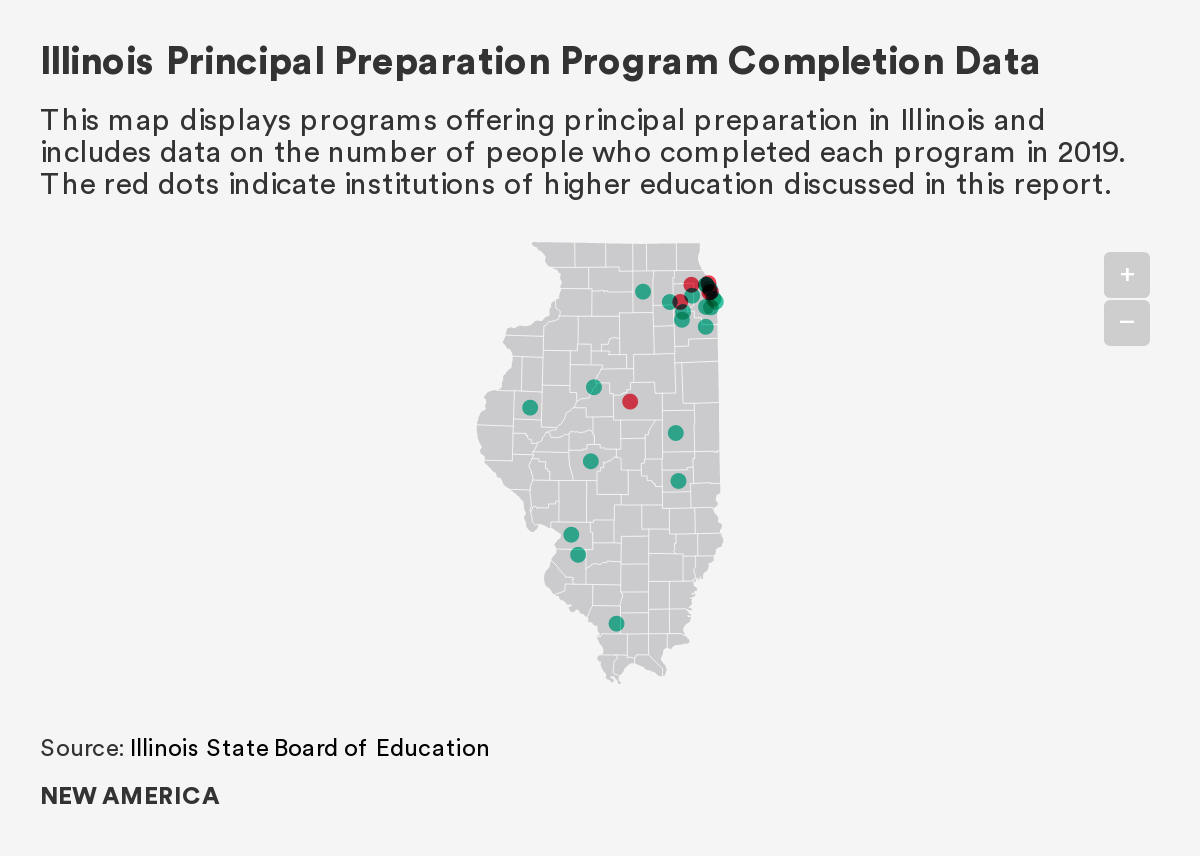
Experts and stakeholders were engaged throughout the process of creating rules and regulations to reflect the new legislation.41 The final rules were passed in June 2011. Preparation programs had until June 2014 to receive approval under the new rules or shut down.42 Eight years later, 27 programs offer educational leadership programs that lead to principal licensure, down from 34 in 2010.43
Citations
- For further reading on instructional leaders: Roxanne Garza, Guiding Principals: State Efforts to Bolster Instructional Leadership (Washington, DC: New America, 2018), <a href="source">source">source
- Robert J. Marzano, Timothy Waters, and Brian A. McNulty, School Leadership That Works: From Research to Results (Alexandria, VA: Association for Supervision and Curriculum Development, 2005).
- Erika Hunt, Lisa Hood, Alicia Haller, and Maureen Kincaid, eds., Reforming Principal Preparation at the State Level (New York: Taylor & Francis, April 2019), <a href="source">source">source
- School Leader Preparation: A Blueprint for Change (Springfield: Commission on School Leader Preparation in Illinois Colleges and Universities, 2006), <a href="source">source">source
- Paul Zavitovsky (leadership coach and assessment specialist, University of Illinois at Chicago), interview with author, June 19, 2019.
- Education Watch: Illinois Key Education Facts and Figures (Washington, DC: The Education Trust, 2006), <a href="source">source">source
- Illinois State Board of Education, Title 23: Education and Cultural Resources Code 30, Programs for the Preparation of Principals in Illinois, effective November 2017, <a href="source">source">source
- Public Act 096-0903 uses the terms “preschool” and “early childhood programs” to refer all children from birth to age five. New America uses the term “pre-kindergarten” or “pre-K” throughout this paper to refer to three- and four-year-old children.
- Allison Friedman-Krauss, Steven Barnett, Karin Garver, Katherine Hodges, G. G. Weisenfeld, and Nicole DiCrecchio, The State of Preschool Yearbook 2018: Executive Summary (New Brunswick, NJ: The National Institute for Early Education Research, Rutgers University, 2019), source">source
- Pre-K in American Cities (New Brunswick, NJ: National Institute for Early Childhood Research and CityHealth, 2019), source">source
- U.S. Department of Health & Human Services, Office of the Administration for Children & Families (website), “Race to the Top-Early Learning Challenge,” source">source; and U.S. Department of Education (website), “Preschool Development Grants,” source">source
- Charles Joughin, “FFYF Poll: Voters Across Party Lines Bridge Political Divides In Support of Early Childhood Education,” First Five Years Fund (website), June 20, 2017, source">source
- The Current State of Scientific Knowledge on Pre-Kindergarten Effects (Washington, DC: Brookings Institution, 2017), source">source
- LaRue Allen and Bridget B. Kelly, eds., Transforming the Workforce for Children Birth Through Age 8: A Unifying Foundation (Washington, DC: National Academies of Science, Engineering, and Medicine, April 2015), 344–345, source">source
- Leading Pre-K–3 Learning Communities Executive Summary (Alexandria, VA: National Association of Elementary School Principals), source">source
- Aaron Loewenberg, Shayna Cook, Laura Bornfreund, and Abbie Lieberman, Principal’s Corner: Perspectives on Teaching and Learning in PreK–3rd Grade series (Washington, DC: New America, 2016), source">source
- Abbie Lieberman, A Tale of Two Pre-K Leaders: How State Policies for Center Directors and Principals Leading Pre-K Programs Differ, and Why They Shouldn’t (Washington, DC: New America, 2017), source">source
- Kirsty Clarke Brown, Jim Squires, Lori Connors Tadros, and Michelle Horowitz, CEELO Policy Report: What Do We Know About Principal Preparation, Licensure Requirements, and Professional Development for School Leaders? (New Brunswick, NJ: Center on Enhancing Early Learning Outcomes, 2014), source">source uploads/2014/07/ceelo_policy_report_ece_principal_ prep.pdf
- For a detailed history of the reform efforts in Illinois, please reference Reforming Principal Preparation at the State Level: Perspectives on Policy Reform from Illinois by Erika Hunt, Alicia Haller, Lisa Hood, and Maureen Kincaid. Much of the summary described in this section was informed by this book.
- Erika Hunt, Lisa Hood, Alicia Haller, and Maureen Kincaid, eds., Reforming Principal Preparation at the State Level (New York: Taylor & Francis, April 2019), source
- “Wallace Launches Major State-District Initiative to Strengthen School Leadership,” Wallace Foundation, press release, January 8, 2002, source
- Diane Rutledge (partner at District Leadership Solutions, Springfield, IL), interview with author, June 21, 2019.
- Erika Hunt, Lisa Hood, Alicia Haller, and Maureen Kincaid, eds., Reforming Principal Preparation at the State Level (New York: Taylor & Francis, April 2019), source
- School Leader Preparation: A Blueprint for Change, (Springfield: Commission on School Leader Preparation in Illinois Colleges and Universities, 2006), source
- Erika Hunt, Lisa Hood, Alicia Haller, and Maureen Kincaid, eds., Reforming Principal Preparation at the State Level (New York: Taylor & Francis, April 2019), source
- Erika Hunt, Lisa Hood, Alicia Haller, and Maureen Kincaid, eds., Reforming Principal Preparation at the State Level (New York: Taylor & Francis, April 2019), 7, source
- Report to the Illinois General Assembly (Springfield: Illinois School Leader Task Force, February 2008), source; and Linda Darling-Hammond, Michelle LaPointe, Debra Meyerson, and Margaret Orr, Preparing School Leaders for a Changing World: Lessons from Exemplary Leadership Development Programs (Stanford, CA: Stanford University, April 2007), source
- Paul Zavitovsky (leadership coach and assessment specialist, University of Illinois at Chicago), interview with author, June 19, 2019.
- Report to the Illinois General Assembly (Springfield: Illinois School Leader Task Force, February 2008), source
- Erika Hunt, Lisa Hood, Alicia Haller, and Maureen Kincaid, eds., Reforming Principal Preparation at the State Level (New York: Taylor & Francis, April 2019), 9, source
- Sara Slaughter is currently the executive director of The W. Clement & Jessie V. Stone Foundation; this foundation is a funder of New America’s Early and Elementary Education Policy program.
- Erika Hunt, Lisa Hood, Alicia Haller, and Maureen Kincaid, eds., Reforming Principal Preparation at the State Level (New York: Taylor & Francis, April 2019), 9, source
- Sara Slaughter (executive director, W. Clement & Jessie V. Stone Foundation), telephone interview with author, August 7, 2019.
- Erika Hunt, Lisa Hood, Alicia Haller, and Maureen Kincaid, eds., Reforming Principal Preparation at the State Level (New York: Taylor & Francis, April 2019), 9, source
- Building a Seamless Learning Continuum: The Role of Leadership in Bridging the Gaps Between Early Childhood and K–12 Education Systems (Springfield, IL: Leadership to Integrate the Learning Continuum, 2009), 17 source
- Building a Seamless Learning Continuum: The Role of Leadership in Bridging the Gaps Between Early Childhood and K–12 Education Systems (Springfield, IL: Leadership to Integrate the Learning Continuum, 2009), source
- Joyce Weiner, telephone interview with author, July 8, 2019.
- Erika Hunt, Lisa Hood, Alicia Haller, and Maureen Kincaid, eds., Reforming Principal Preparation at the State Level (New York: Taylor & Francis, April 2019), 8, source
- Illinois State Board of Education, Title 23: Education and Cultural Resources Code 30, Programs for the Preparation of Principals in Illinois, effective November 2017, source
- Illinois Administrative Code 30, Title 23.
- Erika Hunt, Lisa Hood, Alicia Haller, and Maureen Kincaid, eds., Reforming Principal Preparation at the State Level (New York: Taylor & Francis, April 2019), source
- Erika Hunt, Lisa Hood, Alicia Haller, and Maureen Kincaid, eds., Reforming Principal Preparation at the State Level (New York: Taylor & Francis, April 2019), 13, source
- Illinois State Board of Education data on school leader preparation program completers, received from Deputy Superintendent for Teaching and Learning Jason Helfer on July 24, 2019.
Timeline of Principal Preparation Reforms
Citations
- For further reading on instructional leaders: Roxanne Garza, Guiding Principals: State Efforts to Bolster Instructional Leadership (Washington, DC: New America, 2018), <a href="<a href="source">source">source">source
- Robert J. Marzano, Timothy Waters, and Brian A. McNulty, School Leadership That Works: From Research to Results (Alexandria, VA: Association for Supervision and Curriculum Development, 2005).
- Erika Hunt, Lisa Hood, Alicia Haller, and Maureen Kincaid, eds., Reforming Principal Preparation at the State Level (New York: Taylor & Francis, April 2019), <a href="<a href="source">source">source">source
- School Leader Preparation: A Blueprint for Change (Springfield: Commission on School Leader Preparation in Illinois Colleges and Universities, 2006), <a href="<a href="source">source">source">source
- Paul Zavitovsky (leadership coach and assessment specialist, University of Illinois at Chicago), interview with author, June 19, 2019.
- Education Watch: Illinois Key Education Facts and Figures (Washington, DC: The Education Trust, 2006), <a href="<a href="source">source">source">source
- Illinois State Board of Education, Title 23: Education and Cultural Resources Code 30, Programs for the Preparation of Principals in Illinois, effective November 2017, <a href="<a href="source">source">source">source
- Public Act 096-0903 uses the terms “preschool” and “early childhood programs” to refer all children from birth to age five. New America uses the term “pre-kindergarten” or “pre-K” throughout this paper to refer to three- and four-year-old children.
- Allison Friedman-Krauss, Steven Barnett, Karin Garver, Katherine Hodges, G. G. Weisenfeld, and Nicole DiCrecchio, The State of Preschool Yearbook 2018: Executive Summary (New Brunswick, NJ: The National Institute for Early Education Research, Rutgers University, 2019), <a href="source">source">source
- Pre-K in American Cities (New Brunswick, NJ: National Institute for Early Childhood Research and CityHealth, 2019), <a href="source">source">source
- U.S. Department of Health & Human Services, Office of the Administration for Children & Families (website), “Race to the Top-Early Learning Challenge,” <a href="source">source">source; and U.S. Department of Education (website), “Preschool Development Grants,” <a href="source">source">source
- Charles Joughin, “FFYF Poll: Voters Across Party Lines Bridge Political Divides In Support of Early Childhood Education,” First Five Years Fund (website), June 20, 2017, <a href="source">source">source
- The Current State of Scientific Knowledge on Pre-Kindergarten Effects (Washington, DC: Brookings Institution, 2017), <a href="source">source">source
- LaRue Allen and Bridget B. Kelly, eds., Transforming the Workforce for Children Birth Through Age 8: A Unifying Foundation (Washington, DC: National Academies of Science, Engineering, and Medicine, April 2015), 344–345, <a href="source">source">source
- Leading Pre-K–3 Learning Communities Executive Summary (Alexandria, VA: National Association of Elementary School Principals), <a href="source">source">source
- Aaron Loewenberg, Shayna Cook, Laura Bornfreund, and Abbie Lieberman, Principal’s Corner: Perspectives on Teaching and Learning in PreK–3rd Grade series (Washington, DC: New America, 2016), <a href="source">source">source
- Abbie Lieberman, A Tale of Two Pre-K Leaders: How State Policies for Center Directors and Principals Leading Pre-K Programs Differ, and Why They Shouldn’t (Washington, DC: New America, 2017), <a href="source">source">source
- Kirsty Clarke Brown, Jim Squires, Lori Connors Tadros, and Michelle Horowitz, CEELO Policy Report: What Do We Know About Principal Preparation, Licensure Requirements, and Professional Development for School Leaders? (New Brunswick, NJ: Center on Enhancing Early Learning Outcomes, 2014), <a href="source">source">source uploads/2014/07/ceelo_policy_report_ece_principal_ prep.pdf
- For a detailed history of the reform efforts in Illinois, please reference Reforming Principal Preparation at the State Level: Perspectives on Policy Reform from Illinois by Erika Hunt, Alicia Haller, Lisa Hood, and Maureen Kincaid. Much of the summary described in this section was informed by this book.
- Erika Hunt, Lisa Hood, Alicia Haller, and Maureen Kincaid, eds., Reforming Principal Preparation at the State Level (New York: Taylor & Francis, April 2019), source">source
- “Wallace Launches Major State-District Initiative to Strengthen School Leadership,” Wallace Foundation, press release, January 8, 2002, source">source
- Diane Rutledge (partner at District Leadership Solutions, Springfield, IL), interview with author, June 21, 2019.
- Erika Hunt, Lisa Hood, Alicia Haller, and Maureen Kincaid, eds., Reforming Principal Preparation at the State Level (New York: Taylor & Francis, April 2019), source">source
- School Leader Preparation: A Blueprint for Change, (Springfield: Commission on School Leader Preparation in Illinois Colleges and Universities, 2006), source">source
- Erika Hunt, Lisa Hood, Alicia Haller, and Maureen Kincaid, eds., Reforming Principal Preparation at the State Level (New York: Taylor & Francis, April 2019), source">source
- Erika Hunt, Lisa Hood, Alicia Haller, and Maureen Kincaid, eds., Reforming Principal Preparation at the State Level (New York: Taylor & Francis, April 2019), 7, source">source
- Report to the Illinois General Assembly (Springfield: Illinois School Leader Task Force, February 2008), source">source; and Linda Darling-Hammond, Michelle LaPointe, Debra Meyerson, and Margaret Orr, Preparing School Leaders for a Changing World: Lessons from Exemplary Leadership Development Programs (Stanford, CA: Stanford University, April 2007), source">source
- Paul Zavitovsky (leadership coach and assessment specialist, University of Illinois at Chicago), interview with author, June 19, 2019.
- Report to the Illinois General Assembly (Springfield: Illinois School Leader Task Force, February 2008), source">source
- Erika Hunt, Lisa Hood, Alicia Haller, and Maureen Kincaid, eds., Reforming Principal Preparation at the State Level (New York: Taylor & Francis, April 2019), 9, source">source
- Sara Slaughter is currently the executive director of The W. Clement & Jessie V. Stone Foundation; this foundation is a funder of New America’s Early and Elementary Education Policy program.
- Erika Hunt, Lisa Hood, Alicia Haller, and Maureen Kincaid, eds., Reforming Principal Preparation at the State Level (New York: Taylor & Francis, April 2019), 9, source">source
- Sara Slaughter (executive director, W. Clement & Jessie V. Stone Foundation), telephone interview with author, August 7, 2019.
- Erika Hunt, Lisa Hood, Alicia Haller, and Maureen Kincaid, eds., Reforming Principal Preparation at the State Level (New York: Taylor & Francis, April 2019), 9, source">source
- Building a Seamless Learning Continuum: The Role of Leadership in Bridging the Gaps Between Early Childhood and K–12 Education Systems (Springfield, IL: Leadership to Integrate the Learning Continuum, 2009), 17 source">source
- Building a Seamless Learning Continuum: The Role of Leadership in Bridging the Gaps Between Early Childhood and K–12 Education Systems (Springfield, IL: Leadership to Integrate the Learning Continuum, 2009), source">source
- Joyce Weiner, telephone interview with author, July 8, 2019.
- Erika Hunt, Lisa Hood, Alicia Haller, and Maureen Kincaid, eds., Reforming Principal Preparation at the State Level (New York: Taylor & Francis, April 2019), 8, source">source
- Illinois State Board of Education, Title 23: Education and Cultural Resources Code 30, Programs for the Preparation of Principals in Illinois, effective November 2017, source">source
- Illinois Administrative Code 30, Title 23.
- Erika Hunt, Lisa Hood, Alicia Haller, and Maureen Kincaid, eds., Reforming Principal Preparation at the State Level (New York: Taylor & Francis, April 2019), source">source
- Erika Hunt, Lisa Hood, Alicia Haller, and Maureen Kincaid, eds., Reforming Principal Preparation at the State Level (New York: Taylor & Francis, April 2019), 13, source">source
- Illinois State Board of Education data on school leader preparation program completers, received from Deputy Superintendent for Teaching and Learning Jason Helfer on July 24, 2019.
The Longer Road to Implementation
There were many facets to the full implementation of the new rules and regulations, some of which are still being ironed out almost a decade later. Because this brief is concerned with the incorporation of early education into principal preparation, it focuses on how different preparation programs have addressed this issue both in terms of curricula and field experiences.
Broadly, the new law required that the coursework for prospective principals “address student learning and school improvement.”44 Throughout their preparation, principals should engage in coursework that is grounded in conceptual frameworks and prepares them to meet the practical, everyday demands of their roles as leaders. This means developing proficiency in instructional leadership and supporting teachers in serving all students well.45 Experts agree that high-quality coursework should include evidence-based practices and be aligned with professional standards.46 Successful curricula show candidates how to apply theory to actual practice through adult leadership opportunities.
Research suggests that clinical experiences, such as internships, assistant principalships, and mentorships are extremely valuable.47 In fact, the Wallace Foundation describes clinical experience as “potentially the most powerful learning opportunity for aspiring principals.”48 And 99 percent of respondents to an American Association of Colleges for Teacher Education survey said clinical practice or internships in the field are important for effective principal preparation.49 To ensure quality experiences, the Illinois legislation requires internships to align with the 13 critical success factors and 36 associated competencies outlined in The Principal Internship: How Can We Get It Right? published by the Southern Regional Education Board.50
Early Education and Program Curricula
In Illinois, most preparation programs require students to complete approximately one year of part-time coursework before beginning their internship. As part of the reform, courses are intended to focus heavily on instructional leadership. Programs have interpreted the requirement around early childhood education in different ways, however, and used a variety of approaches to integrate this content into coursework.
As mentioned, the University of Illinois at Chicago’s (UIC) principal preparation program was viewed as a model that informed the statewide reform efforts. Yet Tozer described the early education requirement as a “heavy lift” for most programs, even UIC. According to Tozer, “Early childhood was not originally part of the conception of UIC’s program; it was K–12, not PreK–12.” Part of the challenge with incorporating early childhood was that most of the program faculty had no early childhood background.51 UIC received a grant from the McCormick Foundation to begin incorporating early childhood into the program in 2009, before the reform passed in 2010. With this grant, UIC brought in early childhood experts to identify places throughout the curriculum where this content is relevant, such as literacy, math, and education law. Ultimately, UIC’s faculty agreed that every course should have early childhood content unless the instructor could demonstrate that it was not relevant. Tozer calls this “default inclusion,” but added that “it’s very easy to not follow through and to fail to implement. It requires strong progress monitoring.” This is something that UIC continues to work on, he said.
At Illinois State University (ISU), where professors had been leading the state reform work, there was a concerted effort to infuse early education into coursework. To meet the new standards, ISU added a new course, called “Leadership for Stages of Mind.” According to the course description, “Topics chosen for this course are both content-focused and leader-focused, giving insights about learning at different stages of mind, from early childhood to adulthood.”52 A major assignment for this course involves writing a “position paper on early childhood learning environments,” which requires visiting an early childhood classroom, interviewing a principal about practices that support young learners, and analyzing the impact of a PreK–3rd approach on elementary schools. Early childhood is incorporated into other courses as well, as ISU’s goal is to demonstrate “the principle of redundancy.”53
ISU was one of four universities that worked with the McCormick-funded Leadership to Integrate the Learning Continuum (LINC) project during implementation.54 In addition to providing technical assistance statewide on developing PreK–12 leadership programs, LINC provided in-depth technical assistance to a network of universities to redesign their programs: ISU, Loyola University Chicago, North Central College, and Western Illinois University. This work was led by Erika Hunt, Lisa Hood, and Alicia Haller. The goal of the two-year grant was to help programs build content around early childhood, English learners, and special education. In 2013, LINC released a toolkit detailing redesign efforts at these four institutions and offering lessons for others.55 Loyola University Chicago, for instance, sought out expertise from faculty outside its department and program to weigh in on course content. It asked early childhood faculty what principals need to know about early childhood and integrated topics like “selecting and supporting developmentally appropriate curricula” and “ensuring early childhood educators are meaningful members of the school community” into the redesigned program.56
At Concordia University Chicago, which is the largest provider of principal preparation in the state, early childhood appears to be addressed in the internship as opposed to in coursework. Victor Simon, a school superintendent and adjunct professor at Concordia, said of the various courses he teaches as part of the principal preparation program, none of them contain a section explicitly focused on early education. He described his teacher evaluation course and his course on curriculum, instruction, and assessment as grade-level agnostic.57 Concordia’s Joan DuChane said she “knows early childhood is not incorporated into the finance course. Special Education gets focus there because it’s a federal program (IDEA).”58 Simon said, “There is not a good understanding of early childhood instruction.” He attributes this to the lack of early education programs in general. Aspiring principals “need to understand what this level of instruction should look like and they just haven’t seen enough examples yet,” he said.
A 2016 study by the Illinois Education Research Council and the University of Chicago Consortium on School Research59 reviewing implementation across the state found that overall, coursework now emphasized special populations, including early education, more than before.60 However, it was relatively common for programs to have no early childhood content prior to the redesign. The study found that “the interviews and syllabi review suggest that, in many instances, ECE content is addressed only superficially or voluntarily.” A review of syllabi from 14 institutions found that of the special populations included in the new law, “ECE content had the least coverage by a substantial margin, and there was wide variation between programs… .”61 Investigators also found that early childhood was often included as a component of other classes as opposed to as a subject unto itself.
Early Education and the Internship
ISBE ultimately determined that the internship would span the course of one year and be competency-based instead of based on a set number of hours. Through the internship, candidates are supposed to have instructional leadership opportunities that closely match those of a first-year principal. The internship is also where the partnerships between preparation programs and school districts tend to come into play.
The University of Illinois at Chicago (UIC) has a strong partnership with Chicago Public Schools, which is by far the largest district in Illinois, with over 600 schools. UIC students complete a full-time, year-long residency, usually outside of the school where they previously worked. Chicago Public Schools funds the residency and pays residents approximately $100,000 in salary and benefits for the year. According to Tozer, “The district can’t afford not to invest in the principal pipeline because of what it is getting out of it. The general estimate is that principal turnover costs $75,000 per position, but it’s really much more. So this is really cost effective.”62
When asked about exposure to early childhood, Tozer said, “We often place [aspiring] elementary principals in high schools so they will develop a high school background and vice versa. We are cross-fertilizing. This is so that any UIC candidate you get has a substantial PreK–3rd background.” UIC requires everyone in each cohort to conduct structured visits to elementary schools and pre-K classrooms regardless of their residency placement. Zavitkovsky said, “Principals need to be prepared to start leading conversations on PreK–3rd alignment strategies. Coaches [who work with students during the residency] end up being the ones who are most responsible for ensuring that residents have rich opportunities to lead work in this area.”63
Illinois State University (ISU) requires students to complete 36 leadership tasks over the course of their internships that align with the competencies referenced in the legislation.64 Located in central Illinois, ISU has partnerships with a few surrounding school districts, and ISU student internship experiences can differ substantially depending on the district.65 Tracy Donath, a 2019 graduate, attended ISU while teaching elementary school in McLean County Unit District No. 5. Her district paid for a semester-long substitute so that she could be released to intern full time in an assistant principal role at a neighboring elementary school. The internship was one semester, but she had the full year to complete ISU’s 36 leadership tasks while she resumed teaching. Overall, she found the internship and associated tasks to be very challenging, but said “I really felt by the time I was done that I was ready to be a principal. Not an assistant principal, but a principal.”
One of ISU’s leadership tasks is focused on pre-K: creating an early childhood school improvement plan. To complete this task, Donath and one of her fellow cohort members met with the administration and teachers at a district pre-K school to determine current challenges they were facing, and then drafted a solution to present to the principal. Their project was to identify a new screening tool for incoming students that would identify their language ability in both English and Spanish to help ensure that Spanish-speaking students were placed in the appropriate bilingual, English learner, or monolingual classroom setting. Donath and her partner found a potential screener that fit the school’s needs, presented it to the principal, and with the principal’s enthusiastic recommendation, presented it to the superintendent for funding.
While the pre-K program benefited from Donath’s help, she realizes that advising on these types of tasks does take time out of school administrators’ days. She said, “There are not that many schools that specialize in pre-K. And because ISU is in this town, aspiring principals are consistently wanting to work with the same schools.” She also acknowledged the importance of having a semester off to complete these tasks, saying, “We had to meet with the pre-K school probably five times. I’m not sure how you do this if you are not relieved from teaching duties.”66 Many of her classmates were in districts that did not have the funding to hire a substitute for a semester and thus had to complete the tasks on top of their full-time teaching jobs.
From 2013 to 2018, ISU had funding from the U.S. Department of Education for the Illinois Partnerships Advancing Rigorous Training (IL-PART) Project to strengthen relationships between preparation programs and school districts.67 Co-directed by Alicia Haller and Erika Hunt, this grant funded full-time, semester-long internships for principal candidates where they “were engaged in authentic principal duties collaborating daily with an experienced principal mentor and receiving immediate coaching and feedback.”68 The grant provided full-time substitute teachers for $25,000 each. Unfortunately, since the grant has expired, the only way for candidates to do fully immersive internships is if their district finds the funding.
For all students at Concordia University Chicago the internship is unpaid, as there is no formal partnership with a school district. Students almost always stay in their home schools for the internship and continue working in their current roles. Victor Simon, adjunct professor for Concordia since 2011, said he has known students to “take on leadership roles such as running the school’s summer or tutoring program.”69 When it comes to incorporating early childhood, he said, “At Concordia, it’s about exposure and building some sense of familiarity with this grade level, and not necessarily expertise.”
Joan DuChane, co-director of principal internships and partnerships at Concordia, said, early childhood education falls into the diverse learner category. “We define diverse learners as special education, early childhood education, English learners, and gifted education. Each of the diverse learner groups has a specific project to provide students a basic understanding of each group,” she said.70 During the second semester of the internship there are specific projects for each diverse learner group, including an evaluation of an early childhood program. This requires visiting a public early learning program and interviewing an administrator. Candidates analyze the instructional setting, materials, staffing, and other aspects of the program. DuChane said that, “high school interns always seem reluctant” to go to early childhood classrooms, but “they come back almost in awe of the work being done with children at that age. Usually they remark that those teachers are not paid enough.” DuChane believes they benefit from this wider view.
“High school interns always seem reluctant” to go to early childhood classrooms, but “they come back almost in awe of the work being done with children at that age.”
Apryl Lowe, principal of Illinois Park Center for Early Learning in Elgin, which serves solely pre-K students, has hosted multiple aspiring principals in recent years from different preparation programs, such as National Louis University, as they aim to complete their early childhood education requirement. Most of the students are teaching full time and completing their internships part time. Lowe works with them to create projects that can be mutually beneficial. For example, she had one student analyze whether pre-K attendance or participation in the school’s family engagement activities were correlated with third grade test scores. Another student designed and ran a parent education activity, and another created an online handbook to streamline useful resources for teachers. Lowe believes these projects are important: “Early childhood is a different beast,” she said, “and many elementary school principals are still trying to wrap their heads around it.”
The 2016 study reviewing implementation across the state found that overall, it was difficult for candidates to secure an early childhood education placement during the internship.71 One reason is that some schools or districts did not have early childhood centers, making it harder for candidates to access in-district placements (in Illinois some districts are only made up of secondary schools). However, there is nothing in the legislation or rules that bars students from doing course, clinical, or internship experiences with community-based early learning centers such as Head Start or private centers. The study also found that UIC’s year-long residency-style internship is not the norm. The researchers found that in most programs “candidates typically participate in an unpaid, part-time internship that is generally two or three semesters (approximately one year) long in duration.” In interviews, candidates said they would have preferred a paid, full-time internship if given the option.
Differences Among Institutions of Higher Education
While some stakeholders have argued that the reform was too prescriptive,72 it did leave room for flexibility, allowing institutions to implement the reforms in different ways and incorporate early education to varying degrees.
For example, UIC is a doctoral program that works with aspiring principals over five years. The doctoral requirement in and of itself attracts a certain type of candidate. Former UIC coach Zavitkovsky said, “Turning principal prep into a doctoral program let the university have coaching access for five years or more. This allowed us to stick with people across important thresholds in their early development as leaders. This created a different kind of vibe that went beyond completing coursework and getting a degree.”73 The year-long residency is followed by three years of formal, on-the-job coaching. UIC is highly selective and is a small program, admitting only 10 to 20 students per year. With its strong partnership with Chicago Public Schools, UIC is committed to urban school reform. UIC also keeps close track of the impact its principals have on student outcomes.
Concordia University Chicago, on the other hand, produces by far the highest number of graduates. It is a two-year program and with no district partnership, students keep their current jobs and complete the program requirements part time. According to Simon, “The program is marketed as flexible and more affordable.”74 He feels the time commitment is more realistic for most teachers who are balancing a demanding job with their other responsibilities. Concordia does not track which of its graduates go on to become principals or how those that do impact student outcomes.
Citations
- For further reading on instructional leaders: Roxanne Garza, Guiding Principals: State Efforts to Bolster Instructional Leadership (Washington, DC: New America, 2018), <a href="<a href="<a href="source">source">source">source">source
- Robert J. Marzano, Timothy Waters, and Brian A. McNulty, School Leadership That Works: From Research to Results (Alexandria, VA: Association for Supervision and Curriculum Development, 2005).
- Erika Hunt, Lisa Hood, Alicia Haller, and Maureen Kincaid, eds., Reforming Principal Preparation at the State Level (New York: Taylor & Francis, April 2019), <a href="<a href="<a href="source">source">source">source">source
- School Leader Preparation: A Blueprint for Change (Springfield: Commission on School Leader Preparation in Illinois Colleges and Universities, 2006), <a href="<a href="<a href="source">source">source">source">source
- Paul Zavitovsky (leadership coach and assessment specialist, University of Illinois at Chicago), interview with author, June 19, 2019.
- Education Watch: Illinois Key Education Facts and Figures (Washington, DC: The Education Trust, 2006), <a href="<a href="<a href="source">source">source">source">source
- Illinois State Board of Education, Title 23: Education and Cultural Resources Code 30, Programs for the Preparation of Principals in Illinois, effective November 2017, <a href="<a href="<a href="source">source">source">source">source
- Public Act 096-0903 uses the terms “preschool” and “early childhood programs” to refer all children from birth to age five. New America uses the term “pre-kindergarten” or “pre-K” throughout this paper to refer to three- and four-year-old children.
- Allison Friedman-Krauss, Steven Barnett, Karin Garver, Katherine Hodges, G. G. Weisenfeld, and Nicole DiCrecchio, The State of Preschool Yearbook 2018: Executive Summary (New Brunswick, NJ: The National Institute for Early Education Research, Rutgers University, 2019), <a href="<a href="source">source">source">source
- Pre-K in American Cities (New Brunswick, NJ: National Institute for Early Childhood Research and CityHealth, 2019), <a href="<a href="source">source">source">source
- U.S. Department of Health & Human Services, Office of the Administration for Children & Families (website), “Race to the Top-Early Learning Challenge,” <a href="<a href="source">source">source">source; and U.S. Department of Education (website), “Preschool Development Grants,” <a href="<a href="source">source">source">source
- Charles Joughin, “FFYF Poll: Voters Across Party Lines Bridge Political Divides In Support of Early Childhood Education,” First Five Years Fund (website), June 20, 2017, <a href="<a href="source">source">source">source
- The Current State of Scientific Knowledge on Pre-Kindergarten Effects (Washington, DC: Brookings Institution, 2017), <a href="<a href="source">source">source">source
- LaRue Allen and Bridget B. Kelly, eds., Transforming the Workforce for Children Birth Through Age 8: A Unifying Foundation (Washington, DC: National Academies of Science, Engineering, and Medicine, April 2015), 344–345, <a href="<a href="source">source">source">source
- Leading Pre-K–3 Learning Communities Executive Summary (Alexandria, VA: National Association of Elementary School Principals), <a href="<a href="source">source">source">source
- Aaron Loewenberg, Shayna Cook, Laura Bornfreund, and Abbie Lieberman, Principal’s Corner: Perspectives on Teaching and Learning in PreK–3rd Grade series (Washington, DC: New America, 2016), <a href="<a href="source">source">source">source
- Abbie Lieberman, A Tale of Two Pre-K Leaders: How State Policies for Center Directors and Principals Leading Pre-K Programs Differ, and Why They Shouldn’t (Washington, DC: New America, 2017), <a href="<a href="source">source">source">source
- Kirsty Clarke Brown, Jim Squires, Lori Connors Tadros, and Michelle Horowitz, CEELO Policy Report: What Do We Know About Principal Preparation, Licensure Requirements, and Professional Development for School Leaders? (New Brunswick, NJ: Center on Enhancing Early Learning Outcomes, 2014), <a href="<a href="source">source">source">source uploads/2014/07/ceelo_policy_report_ece_principal_ prep.pdf
- For a detailed history of the reform efforts in Illinois, please reference Reforming Principal Preparation at the State Level: Perspectives on Policy Reform from Illinois by Erika Hunt, Alicia Haller, Lisa Hood, and Maureen Kincaid. Much of the summary described in this section was informed by this book.
- Erika Hunt, Lisa Hood, Alicia Haller, and Maureen Kincaid, eds., Reforming Principal Preparation at the State Level (New York: Taylor & Francis, April 2019), <a href="source">source">source
- “Wallace Launches Major State-District Initiative to Strengthen School Leadership,” Wallace Foundation, press release, January 8, 2002, <a href="source">source">source
- Diane Rutledge (partner at District Leadership Solutions, Springfield, IL), interview with author, June 21, 2019.
- Erika Hunt, Lisa Hood, Alicia Haller, and Maureen Kincaid, eds., Reforming Principal Preparation at the State Level (New York: Taylor & Francis, April 2019), <a href="source">source">source
- School Leader Preparation: A Blueprint for Change, (Springfield: Commission on School Leader Preparation in Illinois Colleges and Universities, 2006), <a href="source">source">source
- Erika Hunt, Lisa Hood, Alicia Haller, and Maureen Kincaid, eds., Reforming Principal Preparation at the State Level (New York: Taylor & Francis, April 2019), <a href="source">source">source
- Erika Hunt, Lisa Hood, Alicia Haller, and Maureen Kincaid, eds., Reforming Principal Preparation at the State Level (New York: Taylor & Francis, April 2019), 7, <a href="source">source">source
- Report to the Illinois General Assembly (Springfield: Illinois School Leader Task Force, February 2008), <a href="source">source">source; and Linda Darling-Hammond, Michelle LaPointe, Debra Meyerson, and Margaret Orr, Preparing School Leaders for a Changing World: Lessons from Exemplary Leadership Development Programs (Stanford, CA: Stanford University, April 2007), <a href="source">source">source
- Paul Zavitovsky (leadership coach and assessment specialist, University of Illinois at Chicago), interview with author, June 19, 2019.
- Report to the Illinois General Assembly (Springfield: Illinois School Leader Task Force, February 2008), <a href="source">source">source
- Erika Hunt, Lisa Hood, Alicia Haller, and Maureen Kincaid, eds., Reforming Principal Preparation at the State Level (New York: Taylor & Francis, April 2019), 9, <a href="source">source">source
- Sara Slaughter is currently the executive director of The W. Clement & Jessie V. Stone Foundation; this foundation is a funder of New America’s Early and Elementary Education Policy program.
- Erika Hunt, Lisa Hood, Alicia Haller, and Maureen Kincaid, eds., Reforming Principal Preparation at the State Level (New York: Taylor & Francis, April 2019), 9, <a href="source">source">source
- Sara Slaughter (executive director, W. Clement & Jessie V. Stone Foundation), telephone interview with author, August 7, 2019.
- Erika Hunt, Lisa Hood, Alicia Haller, and Maureen Kincaid, eds., Reforming Principal Preparation at the State Level (New York: Taylor & Francis, April 2019), 9, <a href="source">source">source
- Building a Seamless Learning Continuum: The Role of Leadership in Bridging the Gaps Between Early Childhood and K–12 Education Systems (Springfield, IL: Leadership to Integrate the Learning Continuum, 2009), 17 <a href="source">source">source
- Building a Seamless Learning Continuum: The Role of Leadership in Bridging the Gaps Between Early Childhood and K–12 Education Systems (Springfield, IL: Leadership to Integrate the Learning Continuum, 2009), <a href="source">source">source
- Joyce Weiner, telephone interview with author, July 8, 2019.
- Erika Hunt, Lisa Hood, Alicia Haller, and Maureen Kincaid, eds., Reforming Principal Preparation at the State Level (New York: Taylor & Francis, April 2019), 8, <a href="source">source">source
- Illinois State Board of Education, Title 23: Education and Cultural Resources Code 30, Programs for the Preparation of Principals in Illinois, effective November 2017, <a href="source">source">source
- Illinois Administrative Code 30, Title 23.
- Erika Hunt, Lisa Hood, Alicia Haller, and Maureen Kincaid, eds., Reforming Principal Preparation at the State Level (New York: Taylor & Francis, April 2019), <a href="source">source">source
- Erika Hunt, Lisa Hood, Alicia Haller, and Maureen Kincaid, eds., Reforming Principal Preparation at the State Level (New York: Taylor & Francis, April 2019), 13, <a href="source">source">source
- Illinois State Board of Education data on school leader preparation program completers, received from Deputy Superintendent for Teaching and Learning Jason Helfer on July 24, 2019.
- Illinois State Board of Education, Title 23: Education and Cultural Resources Code 30, Programs for the Preparation of Principals in Illinois, effective November 2017, source
- Pamela Mendels, ed., Improving University Principal Preparation Programs: Five Themes from the Field (New York: Wallace Foundation, 2016), source
- Improving Principal Preparation: A Review of Current Practices & Recommendations for State Action (New York: New Leaders, 2012), source
- Pamela Mendels, ed., Improving University Principal Preparation Programs: Five Themes from the Field (New York: Wallace Foundation, 2016), source
- Betty Fry, Gene Bottoms, and Kathy O’Neill, The Principal Internship: How Can We Get It Right? (Atlanta, GA: The Southern Regional Education Board, 2005), source
- Steve Tozer (professor and university scholar emeritus, University of Illinois at Chicago), telephone interview with author, June 6, 2019.
- Robin Young, Erika Hunt, and Lisa Hood, The Leadership to Integrate the Learning Continuum (LINC) Tool Kit: Redesigning Principal Preparation Programs across Four Illinois Institutions (Normal: Center for the Study of Education Policy, Illinois State University, 2013), source
- Robin Young, Erika Hunt, and Lisa Hood, The Leadership to Integrate the Learning Continuum (LINC) Tool Kit: Redesigning Principal Preparation Programs across Four Illinois Institutions (Normal: Center for the Study of Education Policy, Illinois State University, 2013), 7, source
- Robin Young, Erika Hunt, and Lisa Hood, The Leadership to Integrate the Learning Continuum (LINC) Tool Kit: Redesigning Principal Preparation Programs across Four Illinois Institutions (Normal: Center for the Study of Education Policy, Illinois State University, 2013), source
- Erika Hunt, Lisa Hood, Alicia Haller, and Maureen Kincaid, eds., Reforming Principal Preparation at the State Level (New York: Taylor & Francis, April 2019), 148, source
- Victor Simon (superintendent of schools, Gower School District 62, Willowbrook, IL), interview with author, June 19, 2019.
- Joan DuChane (associate professor and co-director of principal internships and partnerships, Concordia University Chicago), telephone interview with author, July 11, 2019.
- This study was funded by the Robert R. McCormick Foundation and the Wallace Foundation.
- Bradford R. White, Amber Stitziel Pareja, Holly Hart, Brenda K. Klostermann, and Michelle Hanh Huyuh, Navigating the Shift to Intensive Principal Preparation in Illinois: An In-Depth Look a Stakeholder Perspectives (Edwardsville: Illinois Education Research Council Publications, 2016), source
- CHURN: The High Cost of Principal Turnover (Hinsdale, MA: School Leaders Network, 2014), source
- Paul Zavitovsky, (leadership coach and assessment specialist, University of Illinois at Chicago), interview with author, June 19, 2019.
- Illinois State Board of Education, Title 23: Education and Cultural Resources Code 30, Programs for the Preparation of Principals in Illinois, effective November 2017, source
- For many years, Illinois State University had a partnership with Springfield Public Schools 186. According to Diane Rutledge, former superintendent, Springfield Public Schools 186 required principal candidates to move around during their internships, changing schools as frequently as every few weeks. The district paid for substitute teachers for the full school year to release teachers. To ensure all candidates were exposed to all grade levels, early education walkthroughs were common when they were in a high school residency. This is no longer practiced due to a lapse in funding.
- Tracy Donath, telephone interview with author, July 31, 2019.
- The IL-PART project was funded with a competitive grant through the U.S. Department of Education’s School Leadership Program. More information on the program can be found here: source
- Erika Hunt, Lisa Hood, Alicia Haller, and Maureen Kincaid, eds., Reforming Principal Preparation at the State Level (New York: Taylor & Francis, April 2019), 153, source
- Victor Simon (superintendent of schools, Gower School District 62, Willowbrook, IL), interview with author, June 19, 2019.
- Joan DuChane, telephone interview with author, July 11, 2019.
- Bradford R. White, Amber Stitziel Pareja, Holly Hart, Brenda K. Klostermann, and Michelle Hanh Huyuh, Navigating the Shift to Intensive Principal Preparation in Illinois: An In-Depth Look a Stakeholder Perspectives (Edwardsville: Illinois Education Research Council Publications, 2016), 38, source
- Jason Leahy (executive director, Illinois Principals Association) and Stephanie Bernoteit (deputy director, Illinois Board of Higher Education), interviews with author, June 2019.
- Paul Zavitovsky (leadership coach and assessment specialist, University of Illinois at Chicago), interview with author, June 19, 2019.
- Victor Simon (superintendent of schools, Gower School District 62, Willowbrook, IL), interview with author, June 19, 2019.
Opportunities and Challenges in Illinois
Illinois’s principal reform journey is evidence that policy change and implementation take time. Even though it has been almost 10 years since the law passed, it is still too early to tell whether the reforms have achieved the goal of improving student learning. After all, it takes a few years to redesign programs, a few years for candidates to enroll and graduate, and sometimes years for them to be hired as a principal. To make evaluation more difficult, the 2016 implementation study by the Illinois Education Research Council and the University of Chicago Consortium on School Research found that “less than a quarter of programs report collecting any data on retention in principal or AP [assistant principal] positions, performance data for principals or APs who graduated from the program, or feedback from principal or AP supervisors,” let alone data on student outcomes.75
Stakeholder Perceptions
In interviews for this report, stakeholders shared a general feeling that the reforms are on the right track. For example, Victor Simon, superintendent of schools in Gower School District 62, sees a cultural shift: “You used to be able to typecast a principal as a law and order keeper of rules with a whistle around their neck and a clipboard in hand. Now they are instructional leaders and are able to execute across a wide variety of elements linked to the school while building the capacity of their teachers.” And while Jason Leahy, executive director of the Illinois Principals Association, feels the reform was “a bit of an overcorrection,” he added, “I do think there’s more of a focus on what it takes to lead a learning organization now, versus what it takes to just manage one. It’s more than just making sure the buses run on time. There is more of a focus on continuous improvement.” The 2016 implementation study found that candidates are now “perceived as being stronger overall, more committed to careers in the principalship than those from previous programs.”76
Many stakeholders agree with the sentiment that preparation is now a “mile wide and an inch deep” and that programs have “so much ground to cover.”77 Not everyone thinks this is positive. According to Leahy, “We’re asking programs to do a lot that I think takes away from school leaders exploring more essential requirements.” Stephanie Bernoteit, deputy director for the Illinois Board of Higher Education, said, “While many see the value of the early childhood requirement, there are concerns about the content load and perceptions of prescriptiveness” of the reform.78
But Erika Hunt and Lisa Hood at ISU said programs “should reflect a realistic world. Principals don’t have to be deep experts in every area.” Sara Slaughter, who led McCormick’s involvement in this work agrees. “Not every principal needs to be an expert on every topic. But they all need basic knowledge, including child development,” she said.79 She likened it to all doctors needing to know how the cardiovascular system works even if they end up specializing in dermatology. Hunt and Hood feel that when it comes to early education, it is most important for principals to understand the complexity of early childhood funding, the alignment between grades, and the importance of early interventions.
“Not every principal needs to be an expert on every topic. But they all need basic knowledge, including child development.”
Disparities Across Preparation Programs and Districts
A challenge with implementing the new requirements has been that preparation programs and school districts are coming to this work from different starting points. For instance, faculty in many principal preparation programs do not have knowledge of early learning or child development. The McCormick Foundation’s LINC initiative has tried to address this by creating and sharing resources on how to incorporate this content into coursework.80 One solution LINC identified is to build relationships across university programs to take advantage of expertise. There may not be early education expertise among existing program faculty, but this expertise likely can be found elsewhere in the university. This aligns with the National Academies of Medicine recommendation in the 2015 Transforming the Workforce report to “build an interdisciplinary foundation in higher education for child development.”81 The report recommends that “institutions of higher education, including leadership, administrators, and faculty, should review and revise their programs, policies, and infrastructure so they support child development as a cross-departmental, cross-disciplinary foundation that feeds into specialized degree and certificate programs for multiple specific professional roles.” The report suggests that governments, grantmaking bodies, and accrediting agencies play a role in incentivizing institutions to do this work.
Another challenge with the early education requirement is that some districts do not have early education programs or they are consistently relying on the same few programs for internships and field experiences, which can be burdensome. In 2016, the Illinois School Leader Advisory Council, convened by ISBE and IBHE and funded by the McCormick and Wallace Foundations, released a five-year plan for successful implementation. One recommendation was to “determine geographic boundaries for school districts to access regional partnership ‘hubs’ to optimize and equalize resources throughout the state, including opportunities for principal candidates to access high-quality preparation programs.”82 This could enable more programs and districts to benefit from partnerships. Another option is for preparation programs to partner with community-based organizations or privately run early education classrooms.
Disparate resources across programs and school districts are aggravated by limited funding. The 2008 Illinois School Leader Task Force report said, “School districts will need varying levels of state funding to establish extended, supervised residencies for those principal aspirants who are not already in administrative roles that could serve as full-time, rigorously assessed residencies for as long as an academic year.”83 It also listed other aspects of the reform that would require more funding for institutions of higher education. Not only did districts and institutions receive no new state funding to support the redesign, but a two-year budget standoff in the state led to deep funding cuts for public universities.84 Hunt believes that part of the pushback from institutions is that many are struggling financially.
Institutions are also making less money from principal preparation programs since the reform. Enrollment in most programs has dropped substantially since 2010 because they now exclusively serve aspiring principals as opposed to leaders more broadly. “Before, some universities viewed their leadership programs more as cash cows. Now institutions really have to put in money and support to do it right. In some universities this is hard, and they are questioning the value of these programs,” said Hunt. Multiple people interviewed for this paper were concerned about an impending principal shortage as a result of the reforms.
Resource disparities can help explain why implementation has been inconsistent across programs. The 2016 implementation study concluded that “highly-engaged partnerships accrue significant benefits to both the program and the district partners, but they require substantial levels of investment in terms of funding, time, and personnel.”85 Districts are not equally equipped to make such investments. As a result, the full-time, year-long residency like that offered at UIC is not the reality for the vast majority of candidates.
Additional funding, whether it comes from the district, the state, or external grants, may be key to ensuring that principal candidates across programs have meaningful internship experiences. Title II of the federal Every Student Succeeds Act, which can be used to fund principal preparation and development, is a potential source that the state could tap.86 Tozer said, “The challenge isn’t in learning how to do this in one program, although that is challenging. The real challenge is taking what we are learning and putting it to work at scale. We know how to create a successful school for low-income kids, and we know how to produce strong school leaders; the challenge is doing both of these at scale.”87 As of now, lacking resources stand in the way of scaling up best practices, which has implications for long-term impacts of the reform.
Further Considerations for Early Education in Principal Preparation
The 2016 implementation study found that programs were more likely to cover early childhood in both coursework and internships post-reform, but raised the important question of whether this coverage is sufficient. Analyzing the benefits and drawbacks of how and when early childhood is included is an important next step. For instance, is incorporating early childhood into a few courses sufficient? What aspects of early childhood are most critical for principals to know? Is one site visit to a pre-K program enough exposure for an aspiring high school principal? Or should all candidates be immersed in a variety of settings for an extended time? These are crucial questions on which the field does not have consensus.88
Another important discussion for state policymakers is determining where to include which content. Reaching principals through preparation is important, as it ensures that they have the knowledge and skills they need from day one on the job. But principal development cannot end there; it must continue throughout the principal pipeline. In an interview, Leahy said, “We are asking prep programs to do a whole bunch and cram it into a short period of time … some topics are better suited to mentoring, induction, and professional learning, especially technical aspects.” He suggested that early childhood may be better suited for another part of the pipeline. He said the state passed a bill in 2006 requiring principals be mentored for a year, “but it is contingent on state dollars. The law is on the books, but there is still no appropriation for that.”
While the 2016 implementation study found that early learning is now more incorporated into programs, it is not clear whether the connection between early learning and K–12 has strengthened in practice. Joyce Weiner, a key early education advocate on the state task force, said one goal of incorporating early learning was to “better connect principals with the communities that their children and families live in, encourage engagement with relevant community-based organizations, and have them think about supporting effective transitioning practices before children enter their building.” Bridging the relationships between early childhood programs and K–12 more broadly, not just equipping principals to lead pre-K classrooms in their buildings, was also a clear goal for the McCormick LINC Advisory Group.89 This is an area for further exploration, whether by institutions of higher education or policymakers.
Citations
- For further reading on instructional leaders: Roxanne Garza, Guiding Principals: State Efforts to Bolster Instructional Leadership (Washington, DC: New America, 2018), <a href="<a href="<a href="<a href="source">source">source">source">source">source
- Robert J. Marzano, Timothy Waters, and Brian A. McNulty, School Leadership That Works: From Research to Results (Alexandria, VA: Association for Supervision and Curriculum Development, 2005).
- Erika Hunt, Lisa Hood, Alicia Haller, and Maureen Kincaid, eds., Reforming Principal Preparation at the State Level (New York: Taylor & Francis, April 2019), <a href="<a href="<a href="<a href="source">source">source">source">source">source
- School Leader Preparation: A Blueprint for Change (Springfield: Commission on School Leader Preparation in Illinois Colleges and Universities, 2006), <a href="<a href="<a href="<a href="source">source">source">source">source">source
- Paul Zavitovsky (leadership coach and assessment specialist, University of Illinois at Chicago), interview with author, June 19, 2019.
- Education Watch: Illinois Key Education Facts and Figures (Washington, DC: The Education Trust, 2006), <a href="<a href="<a href="<a href="source">source">source">source">source">source
- Illinois State Board of Education, Title 23: Education and Cultural Resources Code 30, Programs for the Preparation of Principals in Illinois, effective November 2017, <a href="<a href="<a href="<a href="source">source">source">source">source">source
- Public Act 096-0903 uses the terms “preschool” and “early childhood programs” to refer all children from birth to age five. New America uses the term “pre-kindergarten” or “pre-K” throughout this paper to refer to three- and four-year-old children.
- Allison Friedman-Krauss, Steven Barnett, Karin Garver, Katherine Hodges, G. G. Weisenfeld, and Nicole DiCrecchio, The State of Preschool Yearbook 2018: Executive Summary (New Brunswick, NJ: The National Institute for Early Education Research, Rutgers University, 2019), <a href="<a href="<a href="source">source">source">source">source
- Pre-K in American Cities (New Brunswick, NJ: National Institute for Early Childhood Research and CityHealth, 2019), <a href="<a href="<a href="source">source">source">source">source
- U.S. Department of Health & Human Services, Office of the Administration for Children & Families (website), “Race to the Top-Early Learning Challenge,” <a href="<a href="<a href="source">source">source">source">source; and U.S. Department of Education (website), “Preschool Development Grants,” <a href="<a href="<a href="source">source">source">source">source
- Charles Joughin, “FFYF Poll: Voters Across Party Lines Bridge Political Divides In Support of Early Childhood Education,” First Five Years Fund (website), June 20, 2017, <a href="<a href="<a href="source">source">source">source">source
- The Current State of Scientific Knowledge on Pre-Kindergarten Effects (Washington, DC: Brookings Institution, 2017), <a href="<a href="<a href="source">source">source">source">source
- LaRue Allen and Bridget B. Kelly, eds., Transforming the Workforce for Children Birth Through Age 8: A Unifying Foundation (Washington, DC: National Academies of Science, Engineering, and Medicine, April 2015), 344–345, <a href="<a href="<a href="source">source">source">source">source
- Leading Pre-K–3 Learning Communities Executive Summary (Alexandria, VA: National Association of Elementary School Principals), <a href="<a href="<a href="source">source">source">source">source
- Aaron Loewenberg, Shayna Cook, Laura Bornfreund, and Abbie Lieberman, Principal’s Corner: Perspectives on Teaching and Learning in PreK–3rd Grade series (Washington, DC: New America, 2016), <a href="<a href="<a href="source">source">source">source">source
- Abbie Lieberman, A Tale of Two Pre-K Leaders: How State Policies for Center Directors and Principals Leading Pre-K Programs Differ, and Why They Shouldn’t (Washington, DC: New America, 2017), <a href="<a href="<a href="source">source">source">source">source
- Kirsty Clarke Brown, Jim Squires, Lori Connors Tadros, and Michelle Horowitz, CEELO Policy Report: What Do We Know About Principal Preparation, Licensure Requirements, and Professional Development for School Leaders? (New Brunswick, NJ: Center on Enhancing Early Learning Outcomes, 2014), <a href="<a href="<a href="source">source">source">source">source uploads/2014/07/ceelo_policy_report_ece_principal_ prep.pdf
- For a detailed history of the reform efforts in Illinois, please reference Reforming Principal Preparation at the State Level: Perspectives on Policy Reform from Illinois by Erika Hunt, Alicia Haller, Lisa Hood, and Maureen Kincaid. Much of the summary described in this section was informed by this book.
- Erika Hunt, Lisa Hood, Alicia Haller, and Maureen Kincaid, eds., Reforming Principal Preparation at the State Level (New York: Taylor & Francis, April 2019), <a href="<a href="source">source">source">source
- “Wallace Launches Major State-District Initiative to Strengthen School Leadership,” Wallace Foundation, press release, January 8, 2002, <a href="<a href="source">source">source">source
- Diane Rutledge (partner at District Leadership Solutions, Springfield, IL), interview with author, June 21, 2019.
- Erika Hunt, Lisa Hood, Alicia Haller, and Maureen Kincaid, eds., Reforming Principal Preparation at the State Level (New York: Taylor & Francis, April 2019), <a href="<a href="source">source">source">source
- School Leader Preparation: A Blueprint for Change, (Springfield: Commission on School Leader Preparation in Illinois Colleges and Universities, 2006), <a href="<a href="source">source">source">source
- Erika Hunt, Lisa Hood, Alicia Haller, and Maureen Kincaid, eds., Reforming Principal Preparation at the State Level (New York: Taylor & Francis, April 2019), <a href="<a href="source">source">source">source
- Erika Hunt, Lisa Hood, Alicia Haller, and Maureen Kincaid, eds., Reforming Principal Preparation at the State Level (New York: Taylor & Francis, April 2019), 7, <a href="<a href="source">source">source">source
- Report to the Illinois General Assembly (Springfield: Illinois School Leader Task Force, February 2008), <a href="<a href="source">source">source">source; and Linda Darling-Hammond, Michelle LaPointe, Debra Meyerson, and Margaret Orr, Preparing School Leaders for a Changing World: Lessons from Exemplary Leadership Development Programs (Stanford, CA: Stanford University, April 2007), <a href="<a href="source">source">source">source
- Paul Zavitovsky (leadership coach and assessment specialist, University of Illinois at Chicago), interview with author, June 19, 2019.
- Report to the Illinois General Assembly (Springfield: Illinois School Leader Task Force, February 2008), <a href="<a href="source">source">source">source
- Erika Hunt, Lisa Hood, Alicia Haller, and Maureen Kincaid, eds., Reforming Principal Preparation at the State Level (New York: Taylor & Francis, April 2019), 9, <a href="<a href="source">source">source">source
- Sara Slaughter is currently the executive director of The W. Clement & Jessie V. Stone Foundation; this foundation is a funder of New America’s Early and Elementary Education Policy program.
- Erika Hunt, Lisa Hood, Alicia Haller, and Maureen Kincaid, eds., Reforming Principal Preparation at the State Level (New York: Taylor & Francis, April 2019), 9, <a href="<a href="source">source">source">source
- Sara Slaughter (executive director, W. Clement & Jessie V. Stone Foundation), telephone interview with author, August 7, 2019.
- Erika Hunt, Lisa Hood, Alicia Haller, and Maureen Kincaid, eds., Reforming Principal Preparation at the State Level (New York: Taylor & Francis, April 2019), 9, <a href="<a href="source">source">source">source
- Building a Seamless Learning Continuum: The Role of Leadership in Bridging the Gaps Between Early Childhood and K–12 Education Systems (Springfield, IL: Leadership to Integrate the Learning Continuum, 2009), 17 <a href="<a href="source">source">source">source
- Building a Seamless Learning Continuum: The Role of Leadership in Bridging the Gaps Between Early Childhood and K–12 Education Systems (Springfield, IL: Leadership to Integrate the Learning Continuum, 2009), <a href="<a href="source">source">source">source
- Joyce Weiner, telephone interview with author, July 8, 2019.
- Erika Hunt, Lisa Hood, Alicia Haller, and Maureen Kincaid, eds., Reforming Principal Preparation at the State Level (New York: Taylor & Francis, April 2019), 8, <a href="<a href="source">source">source">source
- Illinois State Board of Education, Title 23: Education and Cultural Resources Code 30, Programs for the Preparation of Principals in Illinois, effective November 2017, <a href="<a href="source">source">source">source
- Illinois Administrative Code 30, Title 23.
- Erika Hunt, Lisa Hood, Alicia Haller, and Maureen Kincaid, eds., Reforming Principal Preparation at the State Level (New York: Taylor & Francis, April 2019), <a href="<a href="source">source">source">source
- Erika Hunt, Lisa Hood, Alicia Haller, and Maureen Kincaid, eds., Reforming Principal Preparation at the State Level (New York: Taylor & Francis, April 2019), 13, <a href="<a href="source">source">source">source
- Illinois State Board of Education data on school leader preparation program completers, received from Deputy Superintendent for Teaching and Learning Jason Helfer on July 24, 2019.
- Illinois State Board of Education, Title 23: Education and Cultural Resources Code 30, Programs for the Preparation of Principals in Illinois, effective November 2017, source">source
- Pamela Mendels, ed., Improving University Principal Preparation Programs: Five Themes from the Field (New York: Wallace Foundation, 2016), source">source
- Improving Principal Preparation: A Review of Current Practices & Recommendations for State Action (New York: New Leaders, 2012), source">source
- Pamela Mendels, ed., Improving University Principal Preparation Programs: Five Themes from the Field (New York: Wallace Foundation, 2016), source">source
- Betty Fry, Gene Bottoms, and Kathy O’Neill, The Principal Internship: How Can We Get It Right? (Atlanta, GA: The Southern Regional Education Board, 2005), source">source
- Steve Tozer (professor and university scholar emeritus, University of Illinois at Chicago), telephone interview with author, June 6, 2019.
- Robin Young, Erika Hunt, and Lisa Hood, The Leadership to Integrate the Learning Continuum (LINC) Tool Kit: Redesigning Principal Preparation Programs across Four Illinois Institutions (Normal: Center for the Study of Education Policy, Illinois State University, 2013), source">source
- Robin Young, Erika Hunt, and Lisa Hood, The Leadership to Integrate the Learning Continuum (LINC) Tool Kit: Redesigning Principal Preparation Programs across Four Illinois Institutions (Normal: Center for the Study of Education Policy, Illinois State University, 2013), 7, source">source
- Robin Young, Erika Hunt, and Lisa Hood, The Leadership to Integrate the Learning Continuum (LINC) Tool Kit: Redesigning Principal Preparation Programs across Four Illinois Institutions (Normal: Center for the Study of Education Policy, Illinois State University, 2013), source">source
- Erika Hunt, Lisa Hood, Alicia Haller, and Maureen Kincaid, eds., Reforming Principal Preparation at the State Level (New York: Taylor & Francis, April 2019), 148, source">source
- Victor Simon (superintendent of schools, Gower School District 62, Willowbrook, IL), interview with author, June 19, 2019.
- Joan DuChane (associate professor and co-director of principal internships and partnerships, Concordia University Chicago), telephone interview with author, July 11, 2019.
- This study was funded by the Robert R. McCormick Foundation and the Wallace Foundation.
- Bradford R. White, Amber Stitziel Pareja, Holly Hart, Brenda K. Klostermann, and Michelle Hanh Huyuh, Navigating the Shift to Intensive Principal Preparation in Illinois: An In-Depth Look a Stakeholder Perspectives (Edwardsville: Illinois Education Research Council Publications, 2016), source">source
- CHURN: The High Cost of Principal Turnover (Hinsdale, MA: School Leaders Network, 2014), source">source
- Paul Zavitovsky, (leadership coach and assessment specialist, University of Illinois at Chicago), interview with author, June 19, 2019.
- Illinois State Board of Education, Title 23: Education and Cultural Resources Code 30, Programs for the Preparation of Principals in Illinois, effective November 2017, source">source
- For many years, Illinois State University had a partnership with Springfield Public Schools 186. According to Diane Rutledge, former superintendent, Springfield Public Schools 186 required principal candidates to move around during their internships, changing schools as frequently as every few weeks. The district paid for substitute teachers for the full school year to release teachers. To ensure all candidates were exposed to all grade levels, early education walkthroughs were common when they were in a high school residency. This is no longer practiced due to a lapse in funding.
- Tracy Donath, telephone interview with author, July 31, 2019.
- The IL-PART project was funded with a competitive grant through the U.S. Department of Education’s School Leadership Program. More information on the program can be found here: source">source
- Erika Hunt, Lisa Hood, Alicia Haller, and Maureen Kincaid, eds., Reforming Principal Preparation at the State Level (New York: Taylor & Francis, April 2019), 153, source">source
- Victor Simon (superintendent of schools, Gower School District 62, Willowbrook, IL), interview with author, June 19, 2019.
- Joan DuChane, telephone interview with author, July 11, 2019.
- Bradford R. White, Amber Stitziel Pareja, Holly Hart, Brenda K. Klostermann, and Michelle Hanh Huyuh, Navigating the Shift to Intensive Principal Preparation in Illinois: An In-Depth Look a Stakeholder Perspectives (Edwardsville: Illinois Education Research Council Publications, 2016), 38, source">source
- Jason Leahy (executive director, Illinois Principals Association) and Stephanie Bernoteit (deputy director, Illinois Board of Higher Education), interviews with author, June 2019.
- Paul Zavitovsky (leadership coach and assessment specialist, University of Illinois at Chicago), interview with author, June 19, 2019.
- Victor Simon (superintendent of schools, Gower School District 62, Willowbrook, IL), interview with author, June 19, 2019.
- Bradford R. White, Amber Stitziel Pareja, Holly Hart, Brenda K. Klostermann, and Michelle Hanh Huyuh, Navigating the Shift to Intensive Principal Preparation in Illinois: An In-Depth Look a Stakeholder Perspectives (Edwardsville: Illinois Education Research Council Publications, 2016), 61, source
- Interviews with multiple Illinois stakeholders, June 2019.
- Stephanie Bernoteit (deputy director, Illinois Board of Higher Education), interview with author, June 20, 2019.
- Sara Slaughter (executive director, W. Clement & Jessie V. Stone Foundation), telephone interview with author, August 7, 2019.
- Illinois State University, College of Education (website), “Illinois School Leader: Resources,” source
- LaRue Allen and Bridget B. Kelly, eds., Transforming the Workforce for Children Birth Through Age 8: A Unifying Foundation (Washington, DC: National Academies of Science, Engineering, and Medicine, April 2015), 522, source
- Illinois School Leadership Advisory Council: Final Report (Illinois: March 2016), source
- Report to the Illinois General Assembly (Springfield: Illinois School Leader Task Force, February 2008), source
- Rick Seltzer, “Picking up the Pieces in Illinois,” Inside Higher Ed, July 10, 2017, source
- Bradford R. White, Amber Stitziel Pareja, Holly Hart, Brenda K. Klostermann, and Michelle Hanh Huyuh, Navigating the Shift to Intensive Principal Preparation in Illinois: An In-Depth Look a Stakeholder Perspectives (Edwardsville: Illinois Education Research Council Publications, 2016), 64, source
- U.S. Department of Education (website), “Programs: TITLE II—Preparing, Training, and Recruiting High-Quality Teachers, Principals, or Other School Leaders,” source
- Steve Tozer (professor and university scholar emeritus, University of Illinois at Chicago), telephone interview with author, June 6, 2019.
- Bradford R. White, Amber Stitziel Pareja, Holly Hart, Brenda K. Klostermann, and Michelle Hanh Huyuh, Navigating the Shift to Intensive Principal Preparation in Illinois: An In-Depth Look a Stakeholder Perspectives (Edwardsville: Illinois Education Research Council Publications, 2016), source
- Building a Seamless Learning Continuum: The Role of Leadership in Bridging the Gaps Between Early Childhood and K–12 Education Systems (Springfield, IL: Leadership to Integrate the Learning Continuum, 2009), source
Takeaways for States Looking to Strengthen Principals as Early Learning Leaders
According to Erika Hunt and Lisa Hood at ISU, other states interested in reforming principal preparation have contacted them for assistance. However, they have yet to work with another state committed to incorporating early education into principal preparation, despite the fact that many states are investing time and money to improve their early learning systems. As states pursue reform in both school leadership and early education, they should look for opportunities to align these efforts. Here are a half-dozen takeaways from Illinois’s experience:
- Seat the right stakeholders at the table. Those leading this effort in Illinois included a variety of voices throughout the process. Ensuring that leaders across fields, including institutions of higher education, school districts, state government, advocates, philanthropic organizations, and practitioners were involved in multiple steps of the process helped get buy-in. Early education experts were given multiple opportunities to weigh in on the reforms. The fact that two state agencies, ISBE and IBHE, led this effort gave legitimacy and urgency to the issue. Illinois’s experience is evidence that states have the power to convene key stakeholders and the leverage to improve the quality of school leadership.
- Invest in order to scale up successful reforms. Illinois required programs and districts to make substantial reforms without additional state funding, exacerbating disparities in implementation. Districts with the ability to fund full-time internships can ensure their incoming principals have meaningful real-world leadership experience. In Illinois, grants from committed foundations were essential to guiding reform, supporting redesign efforts, and evaluating implementation in the absence of state investment. State funding should be used to incentivize best practices. The state could also choose to allocate federal funding in this direction, such as through Title II of the Every Student Succeeds Act90 or Title II of the Higher Education Act,91 both of which can be used for principal preparation.
- Monitor implementation progress. Illinois passed legislation almost a decade ago, but efforts to improve implementation are ongoing. For example, the McCormick Foundation made numerous investments to aid programs in the redesign process, including with the LINC initiative that helped institutions incorporate early education into their programs. The Wallace Foundation and McCormick Foundation also funded implementation studies to evaluate what is working and what stakeholders can do differently.92
A continuous improvement mindset at both the state and program level are essential to achieving the long-term goal of preparing principals to support student success. UIC’s Steve Tozer said, “All of us have to work together to support the state in making this effort in high-quality principal prep because we are learning how to do this as we go.” UIC is one of the few programs that has been diligent about collecting student outcome data. Programs should be regularly evaluating and making changes to improve their quality, which requires better data, specifically on graduate outcomes.93
- Facilitate and encourage program partnerships with early education programs. To expand exposure to early childhood education, the state can support those responsible for coordinating internship opportunities and site visits in partnering with high-quality community-based programs. This would lessen the burden on school-based pre-K programs in districts with few classrooms, as well as help build connections across the birth-through-third-grade continuum. While it may require interagency collaborations, states can play a role in identifying high-quality programs for aspiring principals to visit. In the same vein, states can take steps to strengthen the relationships between early education programs and elementary schools more broadly so that teaching and learning are aligned. For example, the state of Illinois has created a Kindergarten Transition Advisory Committee to explore how schools can support children’s transition to kindergarten. Its framework includes recommendations related to principals as early learning leaders.94
- Incorporate early education throughout the principalship. All incoming principals should begin their jobs prepared to lead all staff and students in their charge. However, principals continue to need support and opportunities for development throughout their careers. On-the-job training allows them to hone in on the knowledge and skills specific to the population they are serving, such as young children. ISU has worked to integrate early education into the Illinois Principal Administrator Academies, a professional development opportunity offered throughout the state.
- Acknowledge that individual policies do not stand alone. In interviews for this report, numerous stakeholders mentioned how shifts at the national and state levels to prioritize the early years impacts leaders’ understanding of early education. Joyce Weiner from The Ounce explained that implementation of the Kindergarten Individual Development Survey (KIDS), a uniform statewide kindergarten entry assessment, helped focus administrators’ attention on pre-K and kindergarten. Superintendent Victor Simon said that when he became an elementary principal, the state accountability system for pre-K programs helped him to learn about best practice. He said, “ISBE audits pre-K programs and sends the school leader a report that details what it is looking for. I found that to be really helpful from a leadership perspective in terms of being able to compare to what was in place and what was expected.” Principal Apryl Lowe said her district added early childhood education as a “pillar of focus,” sending the message to educators, principals included, that the early years deserve their attention. Principals’ knowledge and priorities are impacted by countless policies beyond preparation requirements, and as a result there are numerous ways to expose principals to the importance of early childhood education.
While Illinois’s commitment to incorporating early education into principal preparation is unique, other initiatives exist throughout the country to ensure that elementary school principals are better equipped to support teachers of young children. To show how other policymakers are thinking about these challenges, New America released a blog series in June, “Building Early Education Leaders: A Closer Look at How States and Districts are Equipping Principals to Support Young Learners.” This series explores how two states and one district are investing in on-the-job professional learning around early education.95
Citations
- For further reading on instructional leaders: Roxanne Garza, Guiding Principals: State Efforts to Bolster Instructional Leadership (Washington, DC: New America, 2018), <a href="<a href="<a href="<a href="<a href="source">source">source">source">source">source">source
- Robert J. Marzano, Timothy Waters, and Brian A. McNulty, School Leadership That Works: From Research to Results (Alexandria, VA: Association for Supervision and Curriculum Development, 2005).
- Erika Hunt, Lisa Hood, Alicia Haller, and Maureen Kincaid, eds., Reforming Principal Preparation at the State Level (New York: Taylor & Francis, April 2019), <a href="<a href="<a href="<a href="<a href="source">source">source">source">source">source">source
- School Leader Preparation: A Blueprint for Change (Springfield: Commission on School Leader Preparation in Illinois Colleges and Universities, 2006), <a href="<a href="<a href="<a href="<a href="source">source">source">source">source">source">source
- Paul Zavitovsky (leadership coach and assessment specialist, University of Illinois at Chicago), interview with author, June 19, 2019.
- Education Watch: Illinois Key Education Facts and Figures (Washington, DC: The Education Trust, 2006), <a href="<a href="<a href="<a href="<a href="source">source">source">source">source">source">source
- Illinois State Board of Education, Title 23: Education and Cultural Resources Code 30, Programs for the Preparation of Principals in Illinois, effective November 2017, <a href="<a href="<a href="<a href="<a href="source">source">source">source">source">source">source
- Public Act 096-0903 uses the terms “preschool” and “early childhood programs” to refer all children from birth to age five. New America uses the term “pre-kindergarten” or “pre-K” throughout this paper to refer to three- and four-year-old children.
- Allison Friedman-Krauss, Steven Barnett, Karin Garver, Katherine Hodges, G. G. Weisenfeld, and Nicole DiCrecchio, The State of Preschool Yearbook 2018: Executive Summary (New Brunswick, NJ: The National Institute for Early Education Research, Rutgers University, 2019), <a href="<a href="<a href="<a href="source">source">source">source">source">source
- Pre-K in American Cities (New Brunswick, NJ: National Institute for Early Childhood Research and CityHealth, 2019), <a href="<a href="<a href="<a href="source">source">source">source">source">source
- U.S. Department of Health & Human Services, Office of the Administration for Children & Families (website), “Race to the Top-Early Learning Challenge,” <a href="<a href="<a href="<a href="source">source">source">source">source">source; and U.S. Department of Education (website), “Preschool Development Grants,” <a href="<a href="<a href="<a href="source">source">source">source">source">source
- Charles Joughin, “FFYF Poll: Voters Across Party Lines Bridge Political Divides In Support of Early Childhood Education,” First Five Years Fund (website), June 20, 2017, <a href="<a href="<a href="<a href="source">source">source">source">source">source
- The Current State of Scientific Knowledge on Pre-Kindergarten Effects (Washington, DC: Brookings Institution, 2017), <a href="<a href="<a href="<a href="source">source">source">source">source">source
- LaRue Allen and Bridget B. Kelly, eds., Transforming the Workforce for Children Birth Through Age 8: A Unifying Foundation (Washington, DC: National Academies of Science, Engineering, and Medicine, April 2015), 344–345, <a href="<a href="<a href="<a href="source">source">source">source">source">source
- Leading Pre-K–3 Learning Communities Executive Summary (Alexandria, VA: National Association of Elementary School Principals), <a href="<a href="<a href="<a href="source">source">source">source">source">source
- Aaron Loewenberg, Shayna Cook, Laura Bornfreund, and Abbie Lieberman, Principal’s Corner: Perspectives on Teaching and Learning in PreK–3rd Grade series (Washington, DC: New America, 2016), <a href="<a href="<a href="<a href="source">source">source">source">source">source
- Abbie Lieberman, A Tale of Two Pre-K Leaders: How State Policies for Center Directors and Principals Leading Pre-K Programs Differ, and Why They Shouldn’t (Washington, DC: New America, 2017), <a href="<a href="<a href="<a href="source">source">source">source">source">source
- Kirsty Clarke Brown, Jim Squires, Lori Connors Tadros, and Michelle Horowitz, CEELO Policy Report: What Do We Know About Principal Preparation, Licensure Requirements, and Professional Development for School Leaders? (New Brunswick, NJ: Center on Enhancing Early Learning Outcomes, 2014), <a href="<a href="<a href="<a href="source">source">source">source">source">source uploads/2014/07/ceelo_policy_report_ece_principal_ prep.pdf
- For a detailed history of the reform efforts in Illinois, please reference Reforming Principal Preparation at the State Level: Perspectives on Policy Reform from Illinois by Erika Hunt, Alicia Haller, Lisa Hood, and Maureen Kincaid. Much of the summary described in this section was informed by this book.
- Erika Hunt, Lisa Hood, Alicia Haller, and Maureen Kincaid, eds., Reforming Principal Preparation at the State Level (New York: Taylor & Francis, April 2019), <a href="<a href="<a href="source">source">source">source">source
- “Wallace Launches Major State-District Initiative to Strengthen School Leadership,” Wallace Foundation, press release, January 8, 2002, <a href="<a href="<a href="source">source">source">source">source
- Diane Rutledge (partner at District Leadership Solutions, Springfield, IL), interview with author, June 21, 2019.
- Erika Hunt, Lisa Hood, Alicia Haller, and Maureen Kincaid, eds., Reforming Principal Preparation at the State Level (New York: Taylor & Francis, April 2019), <a href="<a href="<a href="source">source">source">source">source
- School Leader Preparation: A Blueprint for Change, (Springfield: Commission on School Leader Preparation in Illinois Colleges and Universities, 2006), <a href="<a href="<a href="source">source">source">source">source
- Erika Hunt, Lisa Hood, Alicia Haller, and Maureen Kincaid, eds., Reforming Principal Preparation at the State Level (New York: Taylor & Francis, April 2019), <a href="<a href="<a href="source">source">source">source">source
- Erika Hunt, Lisa Hood, Alicia Haller, and Maureen Kincaid, eds., Reforming Principal Preparation at the State Level (New York: Taylor & Francis, April 2019), 7, <a href="<a href="<a href="source">source">source">source">source
- Report to the Illinois General Assembly (Springfield: Illinois School Leader Task Force, February 2008), <a href="<a href="<a href="source">source">source">source">source; and Linda Darling-Hammond, Michelle LaPointe, Debra Meyerson, and Margaret Orr, Preparing School Leaders for a Changing World: Lessons from Exemplary Leadership Development Programs (Stanford, CA: Stanford University, April 2007), <a href="<a href="<a href="source">source">source">source">source
- Paul Zavitovsky (leadership coach and assessment specialist, University of Illinois at Chicago), interview with author, June 19, 2019.
- Report to the Illinois General Assembly (Springfield: Illinois School Leader Task Force, February 2008), <a href="<a href="<a href="source">source">source">source">source
- Erika Hunt, Lisa Hood, Alicia Haller, and Maureen Kincaid, eds., Reforming Principal Preparation at the State Level (New York: Taylor & Francis, April 2019), 9, <a href="<a href="<a href="source">source">source">source">source
- Sara Slaughter is currently the executive director of The W. Clement & Jessie V. Stone Foundation; this foundation is a funder of New America’s Early and Elementary Education Policy program.
- Erika Hunt, Lisa Hood, Alicia Haller, and Maureen Kincaid, eds., Reforming Principal Preparation at the State Level (New York: Taylor & Francis, April 2019), 9, <a href="<a href="<a href="source">source">source">source">source
- Sara Slaughter (executive director, W. Clement & Jessie V. Stone Foundation), telephone interview with author, August 7, 2019.
- Erika Hunt, Lisa Hood, Alicia Haller, and Maureen Kincaid, eds., Reforming Principal Preparation at the State Level (New York: Taylor & Francis, April 2019), 9, <a href="<a href="<a href="source">source">source">source">source
- Building a Seamless Learning Continuum: The Role of Leadership in Bridging the Gaps Between Early Childhood and K–12 Education Systems (Springfield, IL: Leadership to Integrate the Learning Continuum, 2009), 17 <a href="<a href="<a href="source">source">source">source">source
- Building a Seamless Learning Continuum: The Role of Leadership in Bridging the Gaps Between Early Childhood and K–12 Education Systems (Springfield, IL: Leadership to Integrate the Learning Continuum, 2009), <a href="<a href="<a href="source">source">source">source">source
- Joyce Weiner, telephone interview with author, July 8, 2019.
- Erika Hunt, Lisa Hood, Alicia Haller, and Maureen Kincaid, eds., Reforming Principal Preparation at the State Level (New York: Taylor & Francis, April 2019), 8, <a href="<a href="<a href="source">source">source">source">source
- Illinois State Board of Education, Title 23: Education and Cultural Resources Code 30, Programs for the Preparation of Principals in Illinois, effective November 2017, <a href="<a href="<a href="source">source">source">source">source
- Illinois Administrative Code 30, Title 23.
- Erika Hunt, Lisa Hood, Alicia Haller, and Maureen Kincaid, eds., Reforming Principal Preparation at the State Level (New York: Taylor & Francis, April 2019), <a href="<a href="<a href="source">source">source">source">source
- Erika Hunt, Lisa Hood, Alicia Haller, and Maureen Kincaid, eds., Reforming Principal Preparation at the State Level (New York: Taylor & Francis, April 2019), 13, <a href="<a href="<a href="source">source">source">source">source
- Illinois State Board of Education data on school leader preparation program completers, received from Deputy Superintendent for Teaching and Learning Jason Helfer on July 24, 2019.
- Illinois State Board of Education, Title 23: Education and Cultural Resources Code 30, Programs for the Preparation of Principals in Illinois, effective November 2017, <a href="source">source">source
- Pamela Mendels, ed., Improving University Principal Preparation Programs: Five Themes from the Field (New York: Wallace Foundation, 2016), <a href="source">source">source
- Improving Principal Preparation: A Review of Current Practices & Recommendations for State Action (New York: New Leaders, 2012), <a href="source">source">source
- Pamela Mendels, ed., Improving University Principal Preparation Programs: Five Themes from the Field (New York: Wallace Foundation, 2016), <a href="source">source">source
- Betty Fry, Gene Bottoms, and Kathy O’Neill, The Principal Internship: How Can We Get It Right? (Atlanta, GA: The Southern Regional Education Board, 2005), <a href="source">source">source
- Steve Tozer (professor and university scholar emeritus, University of Illinois at Chicago), telephone interview with author, June 6, 2019.
- Robin Young, Erika Hunt, and Lisa Hood, The Leadership to Integrate the Learning Continuum (LINC) Tool Kit: Redesigning Principal Preparation Programs across Four Illinois Institutions (Normal: Center for the Study of Education Policy, Illinois State University, 2013), <a href="source">source">source
- Robin Young, Erika Hunt, and Lisa Hood, The Leadership to Integrate the Learning Continuum (LINC) Tool Kit: Redesigning Principal Preparation Programs across Four Illinois Institutions (Normal: Center for the Study of Education Policy, Illinois State University, 2013), 7, <a href="source">source">source
- Robin Young, Erika Hunt, and Lisa Hood, The Leadership to Integrate the Learning Continuum (LINC) Tool Kit: Redesigning Principal Preparation Programs across Four Illinois Institutions (Normal: Center for the Study of Education Policy, Illinois State University, 2013), <a href="source">source">source
- Erika Hunt, Lisa Hood, Alicia Haller, and Maureen Kincaid, eds., Reforming Principal Preparation at the State Level (New York: Taylor & Francis, April 2019), 148, <a href="source">source">source
- Victor Simon (superintendent of schools, Gower School District 62, Willowbrook, IL), interview with author, June 19, 2019.
- Joan DuChane (associate professor and co-director of principal internships and partnerships, Concordia University Chicago), telephone interview with author, July 11, 2019.
- This study was funded by the Robert R. McCormick Foundation and the Wallace Foundation.
- Bradford R. White, Amber Stitziel Pareja, Holly Hart, Brenda K. Klostermann, and Michelle Hanh Huyuh, Navigating the Shift to Intensive Principal Preparation in Illinois: An In-Depth Look a Stakeholder Perspectives (Edwardsville: Illinois Education Research Council Publications, 2016), <a href="source">source">source
- CHURN: The High Cost of Principal Turnover (Hinsdale, MA: School Leaders Network, 2014), <a href="source">source">source
- Paul Zavitovsky, (leadership coach and assessment specialist, University of Illinois at Chicago), interview with author, June 19, 2019.
- Illinois State Board of Education, Title 23: Education and Cultural Resources Code 30, Programs for the Preparation of Principals in Illinois, effective November 2017, <a href="source">source">source
- For many years, Illinois State University had a partnership with Springfield Public Schools 186. According to Diane Rutledge, former superintendent, Springfield Public Schools 186 required principal candidates to move around during their internships, changing schools as frequently as every few weeks. The district paid for substitute teachers for the full school year to release teachers. To ensure all candidates were exposed to all grade levels, early education walkthroughs were common when they were in a high school residency. This is no longer practiced due to a lapse in funding.
- Tracy Donath, telephone interview with author, July 31, 2019.
- The IL-PART project was funded with a competitive grant through the U.S. Department of Education’s School Leadership Program. More information on the program can be found here: <a href="source">source">source
- Erika Hunt, Lisa Hood, Alicia Haller, and Maureen Kincaid, eds., Reforming Principal Preparation at the State Level (New York: Taylor & Francis, April 2019), 153, <a href="source">source">source
- Victor Simon (superintendent of schools, Gower School District 62, Willowbrook, IL), interview with author, June 19, 2019.
- Joan DuChane, telephone interview with author, July 11, 2019.
- Bradford R. White, Amber Stitziel Pareja, Holly Hart, Brenda K. Klostermann, and Michelle Hanh Huyuh, Navigating the Shift to Intensive Principal Preparation in Illinois: An In-Depth Look a Stakeholder Perspectives (Edwardsville: Illinois Education Research Council Publications, 2016), 38, <a href="source">source">source
- Jason Leahy (executive director, Illinois Principals Association) and Stephanie Bernoteit (deputy director, Illinois Board of Higher Education), interviews with author, June 2019.
- Paul Zavitovsky (leadership coach and assessment specialist, University of Illinois at Chicago), interview with author, June 19, 2019.
- Victor Simon (superintendent of schools, Gower School District 62, Willowbrook, IL), interview with author, June 19, 2019.
- Bradford R. White, Amber Stitziel Pareja, Holly Hart, Brenda K. Klostermann, and Michelle Hanh Huyuh, Navigating the Shift to Intensive Principal Preparation in Illinois: An In-Depth Look a Stakeholder Perspectives (Edwardsville: Illinois Education Research Council Publications, 2016), 61, source">source
- Interviews with multiple Illinois stakeholders, June 2019.
- Stephanie Bernoteit (deputy director, Illinois Board of Higher Education), interview with author, June 20, 2019.
- Sara Slaughter (executive director, W. Clement & Jessie V. Stone Foundation), telephone interview with author, August 7, 2019.
- Illinois State University, College of Education (website), “Illinois School Leader: Resources,” source">source
- LaRue Allen and Bridget B. Kelly, eds., Transforming the Workforce for Children Birth Through Age 8: A Unifying Foundation (Washington, DC: National Academies of Science, Engineering, and Medicine, April 2015), 522, source">source
- Illinois School Leadership Advisory Council: Final Report (Illinois: March 2016), source">source
- Report to the Illinois General Assembly (Springfield: Illinois School Leader Task Force, February 2008), source">source
- Rick Seltzer, “Picking up the Pieces in Illinois,” Inside Higher Ed, July 10, 2017, source">source
- Bradford R. White, Amber Stitziel Pareja, Holly Hart, Brenda K. Klostermann, and Michelle Hanh Huyuh, Navigating the Shift to Intensive Principal Preparation in Illinois: An In-Depth Look a Stakeholder Perspectives (Edwardsville: Illinois Education Research Council Publications, 2016), 64, source">source
- U.S. Department of Education (website), “Programs: TITLE II—Preparing, Training, and Recruiting High-Quality Teachers, Principals, or Other School Leaders,” source">source
- Steve Tozer (professor and university scholar emeritus, University of Illinois at Chicago), telephone interview with author, June 6, 2019.
- Bradford R. White, Amber Stitziel Pareja, Holly Hart, Brenda K. Klostermann, and Michelle Hanh Huyuh, Navigating the Shift to Intensive Principal Preparation in Illinois: An In-Depth Look a Stakeholder Perspectives (Edwardsville: Illinois Education Research Council Publications, 2016), source">source
- Building a Seamless Learning Continuum: The Role of Leadership in Bridging the Gaps Between Early Childhood and K–12 Education Systems (Springfield, IL: Leadership to Integrate the Learning Continuum, 2009), source">source
- Non-Regulatory Guidance Early Learning in the Every Student Succeeds Act: Expanding Opportunities to Support Our Youngest Learners (Washington, DC: U.S. Department of Education, October 2016), source
- United States Congress, H.R.4137–Higher Education Opportunity Act (Washington, DC: August 2008), source
- Illinois School Leader Advisory Council Final Report (Illinois: March 2016), source
- Erika Hunt, Lisa Hood, Alicia Haller, and Maureen Kincaid, eds., Reforming Principal Preparation at the State Level (New York: Taylor & Francis, April 2019), 195, source
- Final Report: Kindergarten Transition Advisory Committee (September 2018), source
- Abbie Lieberman and Laura Bornfreund, Building Early Education Leaders: A Closer Look at How States and Districts are Equipping Principals to Support Young Learners (Washington, DC: New America, 2019), source
Appendix I: Useful Acronyms
- IBHE: Illinois Board of Higher Education
- ISBE: Illinois State Board of Education
- ISU: Illinois State University
- LINC: The Leadership to Integrate the Learning Continuum project
- UIC: The University of Illinois at Chicago
Citations
- For further reading on instructional leaders: Roxanne Garza, Guiding Principals: State Efforts to Bolster Instructional Leadership (Washington, DC: New America, 2018), <a href="<a href="<a href="<a href="<a href="<a href="source">source">source">source">source">source">source">source
- Robert J. Marzano, Timothy Waters, and Brian A. McNulty, School Leadership That Works: From Research to Results (Alexandria, VA: Association for Supervision and Curriculum Development, 2005).
- Erika Hunt, Lisa Hood, Alicia Haller, and Maureen Kincaid, eds., Reforming Principal Preparation at the State Level (New York: Taylor & Francis, April 2019), <a href="<a href="<a href="<a href="<a href="<a href="source">source">source">source">source">source">source">source
- School Leader Preparation: A Blueprint for Change (Springfield: Commission on School Leader Preparation in Illinois Colleges and Universities, 2006), <a href="<a href="<a href="<a href="<a href="<a href="source">source">source">source">source">source">source">source
- Paul Zavitovsky (leadership coach and assessment specialist, University of Illinois at Chicago), interview with author, June 19, 2019.
- Education Watch: Illinois Key Education Facts and Figures (Washington, DC: The Education Trust, 2006), <a href="<a href="<a href="<a href="<a href="<a href="source">source">source">source">source">source">source">source
- Illinois State Board of Education, Title 23: Education and Cultural Resources Code 30, Programs for the Preparation of Principals in Illinois, effective November 2017, <a href="<a href="<a href="<a href="<a href="<a href="source">source">source">source">source">source">source">source
- Public Act 096-0903 uses the terms “preschool” and “early childhood programs” to refer all children from birth to age five. New America uses the term “pre-kindergarten” or “pre-K” throughout this paper to refer to three- and four-year-old children.
- Allison Friedman-Krauss, Steven Barnett, Karin Garver, Katherine Hodges, G. G. Weisenfeld, and Nicole DiCrecchio, The State of Preschool Yearbook 2018: Executive Summary (New Brunswick, NJ: The National Institute for Early Education Research, Rutgers University, 2019), <a href="<a href="<a href="<a href="<a href="source">source">source">source">source">source">source
- Pre-K in American Cities (New Brunswick, NJ: National Institute for Early Childhood Research and CityHealth, 2019), <a href="<a href="<a href="<a href="<a href="source">source">source">source">source">source">source
- U.S. Department of Health & Human Services, Office of the Administration for Children & Families (website), “Race to the Top-Early Learning Challenge,” <a href="<a href="<a href="<a href="<a href="source">source">source">source">source">source">source; and U.S. Department of Education (website), “Preschool Development Grants,” <a href="<a href="<a href="<a href="<a href="source">source">source">source">source">source">source
- Charles Joughin, “FFYF Poll: Voters Across Party Lines Bridge Political Divides In Support of Early Childhood Education,” First Five Years Fund (website), June 20, 2017, <a href="<a href="<a href="<a href="<a href="source">source">source">source">source">source">source
- The Current State of Scientific Knowledge on Pre-Kindergarten Effects (Washington, DC: Brookings Institution, 2017), <a href="<a href="<a href="<a href="<a href="source">source">source">source">source">source">source
- LaRue Allen and Bridget B. Kelly, eds., Transforming the Workforce for Children Birth Through Age 8: A Unifying Foundation (Washington, DC: National Academies of Science, Engineering, and Medicine, April 2015), 344–345, <a href="<a href="<a href="<a href="<a href="source">source">source">source">source">source">source
- Leading Pre-K–3 Learning Communities Executive Summary (Alexandria, VA: National Association of Elementary School Principals), <a href="<a href="<a href="<a href="<a href="source">source">source">source">source">source">source
- Aaron Loewenberg, Shayna Cook, Laura Bornfreund, and Abbie Lieberman, Principal’s Corner: Perspectives on Teaching and Learning in PreK–3rd Grade series (Washington, DC: New America, 2016), <a href="<a href="<a href="<a href="<a href="source">source">source">source">source">source">source
- Abbie Lieberman, A Tale of Two Pre-K Leaders: How State Policies for Center Directors and Principals Leading Pre-K Programs Differ, and Why They Shouldn’t (Washington, DC: New America, 2017), <a href="<a href="<a href="<a href="<a href="source">source">source">source">source">source">source
- Kirsty Clarke Brown, Jim Squires, Lori Connors Tadros, and Michelle Horowitz, CEELO Policy Report: What Do We Know About Principal Preparation, Licensure Requirements, and Professional Development for School Leaders? (New Brunswick, NJ: Center on Enhancing Early Learning Outcomes, 2014), <a href="<a href="<a href="<a href="<a href="source">source">source">source">source">source">source uploads/2014/07/ceelo_policy_report_ece_principal_ prep.pdf
- For a detailed history of the reform efforts in Illinois, please reference Reforming Principal Preparation at the State Level: Perspectives on Policy Reform from Illinois by Erika Hunt, Alicia Haller, Lisa Hood, and Maureen Kincaid. Much of the summary described in this section was informed by this book.
- Erika Hunt, Lisa Hood, Alicia Haller, and Maureen Kincaid, eds., Reforming Principal Preparation at the State Level (New York: Taylor & Francis, April 2019), <a href="<a href="<a href="<a href="source">source">source">source">source">source
- “Wallace Launches Major State-District Initiative to Strengthen School Leadership,” Wallace Foundation, press release, January 8, 2002, <a href="<a href="<a href="<a href="source">source">source">source">source">source
- Diane Rutledge (partner at District Leadership Solutions, Springfield, IL), interview with author, June 21, 2019.
- Erika Hunt, Lisa Hood, Alicia Haller, and Maureen Kincaid, eds., Reforming Principal Preparation at the State Level (New York: Taylor & Francis, April 2019), <a href="<a href="<a href="<a href="source">source">source">source">source">source
- School Leader Preparation: A Blueprint for Change, (Springfield: Commission on School Leader Preparation in Illinois Colleges and Universities, 2006), <a href="<a href="<a href="<a href="source">source">source">source">source">source
- Erika Hunt, Lisa Hood, Alicia Haller, and Maureen Kincaid, eds., Reforming Principal Preparation at the State Level (New York: Taylor & Francis, April 2019), <a href="<a href="<a href="<a href="source">source">source">source">source">source
- Erika Hunt, Lisa Hood, Alicia Haller, and Maureen Kincaid, eds., Reforming Principal Preparation at the State Level (New York: Taylor & Francis, April 2019), 7, <a href="<a href="<a href="<a href="source">source">source">source">source">source
- Report to the Illinois General Assembly (Springfield: Illinois School Leader Task Force, February 2008), <a href="<a href="<a href="<a href="source">source">source">source">source">source; and Linda Darling-Hammond, Michelle LaPointe, Debra Meyerson, and Margaret Orr, Preparing School Leaders for a Changing World: Lessons from Exemplary Leadership Development Programs (Stanford, CA: Stanford University, April 2007), <a href="<a href="<a href="<a href="source">source">source">source">source">source
- Paul Zavitovsky (leadership coach and assessment specialist, University of Illinois at Chicago), interview with author, June 19, 2019.
- Report to the Illinois General Assembly (Springfield: Illinois School Leader Task Force, February 2008), <a href="<a href="<a href="<a href="source">source">source">source">source">source
- Erika Hunt, Lisa Hood, Alicia Haller, and Maureen Kincaid, eds., Reforming Principal Preparation at the State Level (New York: Taylor & Francis, April 2019), 9, <a href="<a href="<a href="<a href="source">source">source">source">source">source
- Sara Slaughter is currently the executive director of The W. Clement & Jessie V. Stone Foundation; this foundation is a funder of New America’s Early and Elementary Education Policy program.
- Erika Hunt, Lisa Hood, Alicia Haller, and Maureen Kincaid, eds., Reforming Principal Preparation at the State Level (New York: Taylor & Francis, April 2019), 9, <a href="<a href="<a href="<a href="source">source">source">source">source">source
- Sara Slaughter (executive director, W. Clement & Jessie V. Stone Foundation), telephone interview with author, August 7, 2019.
- Erika Hunt, Lisa Hood, Alicia Haller, and Maureen Kincaid, eds., Reforming Principal Preparation at the State Level (New York: Taylor & Francis, April 2019), 9, <a href="<a href="<a href="<a href="source">source">source">source">source">source
- Building a Seamless Learning Continuum: The Role of Leadership in Bridging the Gaps Between Early Childhood and K–12 Education Systems (Springfield, IL: Leadership to Integrate the Learning Continuum, 2009), 17 <a href="<a href="<a href="<a href="source">source">source">source">source">source
- Building a Seamless Learning Continuum: The Role of Leadership in Bridging the Gaps Between Early Childhood and K–12 Education Systems (Springfield, IL: Leadership to Integrate the Learning Continuum, 2009), <a href="<a href="<a href="<a href="source">source">source">source">source">source
- Joyce Weiner, telephone interview with author, July 8, 2019.
- Erika Hunt, Lisa Hood, Alicia Haller, and Maureen Kincaid, eds., Reforming Principal Preparation at the State Level (New York: Taylor & Francis, April 2019), 8, <a href="<a href="<a href="<a href="source">source">source">source">source">source
- Illinois State Board of Education, Title 23: Education and Cultural Resources Code 30, Programs for the Preparation of Principals in Illinois, effective November 2017, <a href="<a href="<a href="<a href="source">source">source">source">source">source
- Illinois Administrative Code 30, Title 23.
- Erika Hunt, Lisa Hood, Alicia Haller, and Maureen Kincaid, eds., Reforming Principal Preparation at the State Level (New York: Taylor & Francis, April 2019), <a href="<a href="<a href="<a href="source">source">source">source">source">source
- Erika Hunt, Lisa Hood, Alicia Haller, and Maureen Kincaid, eds., Reforming Principal Preparation at the State Level (New York: Taylor & Francis, April 2019), 13, <a href="<a href="<a href="<a href="source">source">source">source">source">source
- Illinois State Board of Education data on school leader preparation program completers, received from Deputy Superintendent for Teaching and Learning Jason Helfer on July 24, 2019.
- Illinois State Board of Education, Title 23: Education and Cultural Resources Code 30, Programs for the Preparation of Principals in Illinois, effective November 2017, <a href="<a href="source">source">source">source
- Pamela Mendels, ed., Improving University Principal Preparation Programs: Five Themes from the Field (New York: Wallace Foundation, 2016), <a href="<a href="source">source">source">source
- Improving Principal Preparation: A Review of Current Practices & Recommendations for State Action (New York: New Leaders, 2012), <a href="<a href="source">source">source">source
- Pamela Mendels, ed., Improving University Principal Preparation Programs: Five Themes from the Field (New York: Wallace Foundation, 2016), <a href="<a href="source">source">source">source
- Betty Fry, Gene Bottoms, and Kathy O’Neill, The Principal Internship: How Can We Get It Right? (Atlanta, GA: The Southern Regional Education Board, 2005), <a href="<a href="source">source">source">source
- Steve Tozer (professor and university scholar emeritus, University of Illinois at Chicago), telephone interview with author, June 6, 2019.
- Robin Young, Erika Hunt, and Lisa Hood, The Leadership to Integrate the Learning Continuum (LINC) Tool Kit: Redesigning Principal Preparation Programs across Four Illinois Institutions (Normal: Center for the Study of Education Policy, Illinois State University, 2013), <a href="<a href="source">source">source">source
- Robin Young, Erika Hunt, and Lisa Hood, The Leadership to Integrate the Learning Continuum (LINC) Tool Kit: Redesigning Principal Preparation Programs across Four Illinois Institutions (Normal: Center for the Study of Education Policy, Illinois State University, 2013), 7, <a href="<a href="source">source">source">source
- Robin Young, Erika Hunt, and Lisa Hood, The Leadership to Integrate the Learning Continuum (LINC) Tool Kit: Redesigning Principal Preparation Programs across Four Illinois Institutions (Normal: Center for the Study of Education Policy, Illinois State University, 2013), <a href="<a href="source">source">source">source
- Erika Hunt, Lisa Hood, Alicia Haller, and Maureen Kincaid, eds., Reforming Principal Preparation at the State Level (New York: Taylor & Francis, April 2019), 148, <a href="<a href="source">source">source">source
- Victor Simon (superintendent of schools, Gower School District 62, Willowbrook, IL), interview with author, June 19, 2019.
- Joan DuChane (associate professor and co-director of principal internships and partnerships, Concordia University Chicago), telephone interview with author, July 11, 2019.
- This study was funded by the Robert R. McCormick Foundation and the Wallace Foundation.
- Bradford R. White, Amber Stitziel Pareja, Holly Hart, Brenda K. Klostermann, and Michelle Hanh Huyuh, Navigating the Shift to Intensive Principal Preparation in Illinois: An In-Depth Look a Stakeholder Perspectives (Edwardsville: Illinois Education Research Council Publications, 2016), <a href="<a href="source">source">source">source
- CHURN: The High Cost of Principal Turnover (Hinsdale, MA: School Leaders Network, 2014), <a href="<a href="source">source">source">source
- Paul Zavitovsky, (leadership coach and assessment specialist, University of Illinois at Chicago), interview with author, June 19, 2019.
- Illinois State Board of Education, Title 23: Education and Cultural Resources Code 30, Programs for the Preparation of Principals in Illinois, effective November 2017, <a href="<a href="source">source">source">source
- For many years, Illinois State University had a partnership with Springfield Public Schools 186. According to Diane Rutledge, former superintendent, Springfield Public Schools 186 required principal candidates to move around during their internships, changing schools as frequently as every few weeks. The district paid for substitute teachers for the full school year to release teachers. To ensure all candidates were exposed to all grade levels, early education walkthroughs were common when they were in a high school residency. This is no longer practiced due to a lapse in funding.
- Tracy Donath, telephone interview with author, July 31, 2019.
- The IL-PART project was funded with a competitive grant through the U.S. Department of Education’s School Leadership Program. More information on the program can be found here: <a href="<a href="source">source">source">source
- Erika Hunt, Lisa Hood, Alicia Haller, and Maureen Kincaid, eds., Reforming Principal Preparation at the State Level (New York: Taylor & Francis, April 2019), 153, <a href="<a href="source">source">source">source
- Victor Simon (superintendent of schools, Gower School District 62, Willowbrook, IL), interview with author, June 19, 2019.
- Joan DuChane, telephone interview with author, July 11, 2019.
- Bradford R. White, Amber Stitziel Pareja, Holly Hart, Brenda K. Klostermann, and Michelle Hanh Huyuh, Navigating the Shift to Intensive Principal Preparation in Illinois: An In-Depth Look a Stakeholder Perspectives (Edwardsville: Illinois Education Research Council Publications, 2016), 38, <a href="<a href="source">source">source">source
- Jason Leahy (executive director, Illinois Principals Association) and Stephanie Bernoteit (deputy director, Illinois Board of Higher Education), interviews with author, June 2019.
- Paul Zavitovsky (leadership coach and assessment specialist, University of Illinois at Chicago), interview with author, June 19, 2019.
- Victor Simon (superintendent of schools, Gower School District 62, Willowbrook, IL), interview with author, June 19, 2019.
- Bradford R. White, Amber Stitziel Pareja, Holly Hart, Brenda K. Klostermann, and Michelle Hanh Huyuh, Navigating the Shift to Intensive Principal Preparation in Illinois: An In-Depth Look a Stakeholder Perspectives (Edwardsville: Illinois Education Research Council Publications, 2016), 61, <a href="source">source">source
- Interviews with multiple Illinois stakeholders, June 2019.
- Stephanie Bernoteit (deputy director, Illinois Board of Higher Education), interview with author, June 20, 2019.
- Sara Slaughter (executive director, W. Clement & Jessie V. Stone Foundation), telephone interview with author, August 7, 2019.
- Illinois State University, College of Education (website), “Illinois School Leader: Resources,” <a href="source">source">source
- LaRue Allen and Bridget B. Kelly, eds., Transforming the Workforce for Children Birth Through Age 8: A Unifying Foundation (Washington, DC: National Academies of Science, Engineering, and Medicine, April 2015), 522, <a href="source">source">source
- Illinois School Leadership Advisory Council: Final Report (Illinois: March 2016), <a href="source">source">source
- Report to the Illinois General Assembly (Springfield: Illinois School Leader Task Force, February 2008), <a href="source">source">source
- Rick Seltzer, “Picking up the Pieces in Illinois,” Inside Higher Ed, July 10, 2017, <a href="source">source">source
- Bradford R. White, Amber Stitziel Pareja, Holly Hart, Brenda K. Klostermann, and Michelle Hanh Huyuh, Navigating the Shift to Intensive Principal Preparation in Illinois: An In-Depth Look a Stakeholder Perspectives (Edwardsville: Illinois Education Research Council Publications, 2016), 64, <a href="source">source">source
- U.S. Department of Education (website), “Programs: TITLE II—Preparing, Training, and Recruiting High-Quality Teachers, Principals, or Other School Leaders,” <a href="source">source">source
- Steve Tozer (professor and university scholar emeritus, University of Illinois at Chicago), telephone interview with author, June 6, 2019.
- Bradford R. White, Amber Stitziel Pareja, Holly Hart, Brenda K. Klostermann, and Michelle Hanh Huyuh, Navigating the Shift to Intensive Principal Preparation in Illinois: An In-Depth Look a Stakeholder Perspectives (Edwardsville: Illinois Education Research Council Publications, 2016), <a href="source">source">source
- Building a Seamless Learning Continuum: The Role of Leadership in Bridging the Gaps Between Early Childhood and K–12 Education Systems (Springfield, IL: Leadership to Integrate the Learning Continuum, 2009), <a href="source">source">source
- Non-Regulatory Guidance Early Learning in the Every Student Succeeds Act: Expanding Opportunities to Support Our Youngest Learners (Washington, DC: U.S. Department of Education, October 2016), source">source
- United States Congress, H.R.4137–Higher Education Opportunity Act (Washington, DC: August 2008), source">source
- Illinois School Leader Advisory Council Final Report (Illinois: March 2016), source">source
- Erika Hunt, Lisa Hood, Alicia Haller, and Maureen Kincaid, eds., Reforming Principal Preparation at the State Level (New York: Taylor & Francis, April 2019), 195, source">source
- Final Report: Kindergarten Transition Advisory Committee (September 2018), source">source
- Abbie Lieberman and Laura Bornfreund, Building Early Education Leaders: A Closer Look at How States and Districts are Equipping Principals to Support Young Learners (Washington, DC: New America, 2019), source">source
Appendix II: Interviews Conducted
- Apryl Lowe, principal, Illinois Park Center for Early Learning
- Diane Rutledge, partner, District Leadership Solutions
- Erika Hunt, senior policy analyst and researcher, Illinois State University Center for the Study of Education Policy Graduate
- Ernesto Matias, chief of language and cultural education, Chicago Public Schools
- Jason Helfer, deputy superintendent, Illinois State Board of Education
- Jason Leahy, executive director, Illinois Principals Association
- Joan DuChane, associate professor and co-director of principal internships and partnerships, Concordia University Chicago
- Joyce Weiner, senior policy manager, The Ounce of Prevention Fund
- Lisa Hood, senior policy analyst and researcher, Illinois State University Center for the Study of Education Policy Graduate
- Paul Zavitovsky, former leadership coach, Center for Urban Education Leadership at the University of Illinois at Chicago
- Sara Slaughter, executive director, W. Clement & Jessie V. Stone Foundation
- Stephanie Bernoteit, deputy director, Illinois Board of Higher Education
- Steve Tozer, former professor emeritus of educational policy studies, Center for Urban Education Leadership at the University of Illinois at Chicago
- Tracy Donath, 2019 graduate, Illinois State University Center for the Study of Education Policy
- Victor Simon, superintendent of schools, Gower School District 62
Citations
- For further reading on instructional leaders: Roxanne Garza, Guiding Principals: State Efforts to Bolster Instructional Leadership (Washington, DC: New America, 2018), <a href="<a href="<a href="<a href="<a href="<a href="<a href="source">source">source">source">source">source">source">source">source
- Robert J. Marzano, Timothy Waters, and Brian A. McNulty, School Leadership That Works: From Research to Results (Alexandria, VA: Association for Supervision and Curriculum Development, 2005).
- Erika Hunt, Lisa Hood, Alicia Haller, and Maureen Kincaid, eds., Reforming Principal Preparation at the State Level (New York: Taylor & Francis, April 2019), <a href="<a href="<a href="<a href="<a href="<a href="<a href="source">source">source">source">source">source">source">source">source
- School Leader Preparation: A Blueprint for Change (Springfield: Commission on School Leader Preparation in Illinois Colleges and Universities, 2006), <a href="<a href="<a href="<a href="<a href="<a href="<a href="source">source">source">source">source">source">source">source">source
- Paul Zavitovsky (leadership coach and assessment specialist, University of Illinois at Chicago), interview with author, June 19, 2019.
- Education Watch: Illinois Key Education Facts and Figures (Washington, DC: The Education Trust, 2006), <a href="<a href="<a href="<a href="<a href="<a href="<a href="source">source">source">source">source">source">source">source">source
- Illinois State Board of Education, Title 23: Education and Cultural Resources Code 30, Programs for the Preparation of Principals in Illinois, effective November 2017, <a href="<a href="<a href="<a href="<a href="<a href="<a href="source">source">source">source">source">source">source">source">source
- Public Act 096-0903 uses the terms “preschool” and “early childhood programs” to refer all children from birth to age five. New America uses the term “pre-kindergarten” or “pre-K” throughout this paper to refer to three- and four-year-old children.
- Allison Friedman-Krauss, Steven Barnett, Karin Garver, Katherine Hodges, G. G. Weisenfeld, and Nicole DiCrecchio, The State of Preschool Yearbook 2018: Executive Summary (New Brunswick, NJ: The National Institute for Early Education Research, Rutgers University, 2019), <a href="<a href="<a href="<a href="<a href="<a href="source">source">source">source">source">source">source">source
- Pre-K in American Cities (New Brunswick, NJ: National Institute for Early Childhood Research and CityHealth, 2019), <a href="<a href="<a href="<a href="<a href="<a href="source">source">source">source">source">source">source">source
- U.S. Department of Health & Human Services, Office of the Administration for Children & Families (website), “Race to the Top-Early Learning Challenge,” <a href="<a href="<a href="<a href="<a href="<a href="source">source">source">source">source">source">source">source; and U.S. Department of Education (website), “Preschool Development Grants,” <a href="<a href="<a href="<a href="<a href="<a href="source">source">source">source">source">source">source">source
- Charles Joughin, “FFYF Poll: Voters Across Party Lines Bridge Political Divides In Support of Early Childhood Education,” First Five Years Fund (website), June 20, 2017, <a href="<a href="<a href="<a href="<a href="<a href="source">source">source">source">source">source">source">source
- The Current State of Scientific Knowledge on Pre-Kindergarten Effects (Washington, DC: Brookings Institution, 2017), <a href="<a href="<a href="<a href="<a href="<a href="source">source">source">source">source">source">source">source
- LaRue Allen and Bridget B. Kelly, eds., Transforming the Workforce for Children Birth Through Age 8: A Unifying Foundation (Washington, DC: National Academies of Science, Engineering, and Medicine, April 2015), 344–345, <a href="<a href="<a href="<a href="<a href="<a href="source">source">source">source">source">source">source">source
- Leading Pre-K–3 Learning Communities Executive Summary (Alexandria, VA: National Association of Elementary School Principals), <a href="<a href="<a href="<a href="<a href="<a href="source">source">source">source">source">source">source">source
- Aaron Loewenberg, Shayna Cook, Laura Bornfreund, and Abbie Lieberman, Principal’s Corner: Perspectives on Teaching and Learning in PreK–3rd Grade series (Washington, DC: New America, 2016), <a href="<a href="<a href="<a href="<a href="<a href="source">source">source">source">source">source">source">source
- Abbie Lieberman, A Tale of Two Pre-K Leaders: How State Policies for Center Directors and Principals Leading Pre-K Programs Differ, and Why They Shouldn’t (Washington, DC: New America, 2017), <a href="<a href="<a href="<a href="<a href="<a href="source">source">source">source">source">source">source">source
- Kirsty Clarke Brown, Jim Squires, Lori Connors Tadros, and Michelle Horowitz, CEELO Policy Report: What Do We Know About Principal Preparation, Licensure Requirements, and Professional Development for School Leaders? (New Brunswick, NJ: Center on Enhancing Early Learning Outcomes, 2014), <a href="<a href="<a href="<a href="<a href="<a href="source">source">source">source">source">source">source">source uploads/2014/07/ceelo_policy_report_ece_principal_ prep.pdf
- For a detailed history of the reform efforts in Illinois, please reference Reforming Principal Preparation at the State Level: Perspectives on Policy Reform from Illinois by Erika Hunt, Alicia Haller, Lisa Hood, and Maureen Kincaid. Much of the summary described in this section was informed by this book.
- Erika Hunt, Lisa Hood, Alicia Haller, and Maureen Kincaid, eds., Reforming Principal Preparation at the State Level (New York: Taylor & Francis, April 2019), <a href="<a href="<a href="<a href="<a href="source">source">source">source">source">source">source
- “Wallace Launches Major State-District Initiative to Strengthen School Leadership,” Wallace Foundation, press release, January 8, 2002, <a href="<a href="<a href="<a href="<a href="source">source">source">source">source">source">source
- Diane Rutledge (partner at District Leadership Solutions, Springfield, IL), interview with author, June 21, 2019.
- Erika Hunt, Lisa Hood, Alicia Haller, and Maureen Kincaid, eds., Reforming Principal Preparation at the State Level (New York: Taylor & Francis, April 2019), <a href="<a href="<a href="<a href="<a href="source">source">source">source">source">source">source
- School Leader Preparation: A Blueprint for Change, (Springfield: Commission on School Leader Preparation in Illinois Colleges and Universities, 2006), <a href="<a href="<a href="<a href="<a href="source">source">source">source">source">source">source
- Erika Hunt, Lisa Hood, Alicia Haller, and Maureen Kincaid, eds., Reforming Principal Preparation at the State Level (New York: Taylor & Francis, April 2019), <a href="<a href="<a href="<a href="<a href="source">source">source">source">source">source">source
- Erika Hunt, Lisa Hood, Alicia Haller, and Maureen Kincaid, eds., Reforming Principal Preparation at the State Level (New York: Taylor & Francis, April 2019), 7, <a href="<a href="<a href="<a href="<a href="source">source">source">source">source">source">source
- Report to the Illinois General Assembly (Springfield: Illinois School Leader Task Force, February 2008), <a href="<a href="<a href="<a href="<a href="source">source">source">source">source">source">source; and Linda Darling-Hammond, Michelle LaPointe, Debra Meyerson, and Margaret Orr, Preparing School Leaders for a Changing World: Lessons from Exemplary Leadership Development Programs (Stanford, CA: Stanford University, April 2007), <a href="<a href="<a href="<a href="<a href="source">source">source">source">source">source">source
- Paul Zavitovsky (leadership coach and assessment specialist, University of Illinois at Chicago), interview with author, June 19, 2019.
- Report to the Illinois General Assembly (Springfield: Illinois School Leader Task Force, February 2008), <a href="<a href="<a href="<a href="<a href="source">source">source">source">source">source">source
- Erika Hunt, Lisa Hood, Alicia Haller, and Maureen Kincaid, eds., Reforming Principal Preparation at the State Level (New York: Taylor & Francis, April 2019), 9, <a href="<a href="<a href="<a href="<a href="source">source">source">source">source">source">source
- Sara Slaughter is currently the executive director of The W. Clement & Jessie V. Stone Foundation; this foundation is a funder of New America’s Early and Elementary Education Policy program.
- Erika Hunt, Lisa Hood, Alicia Haller, and Maureen Kincaid, eds., Reforming Principal Preparation at the State Level (New York: Taylor & Francis, April 2019), 9, <a href="<a href="<a href="<a href="<a href="source">source">source">source">source">source">source
- Sara Slaughter (executive director, W. Clement & Jessie V. Stone Foundation), telephone interview with author, August 7, 2019.
- Erika Hunt, Lisa Hood, Alicia Haller, and Maureen Kincaid, eds., Reforming Principal Preparation at the State Level (New York: Taylor & Francis, April 2019), 9, <a href="<a href="<a href="<a href="<a href="source">source">source">source">source">source">source
- Building a Seamless Learning Continuum: The Role of Leadership in Bridging the Gaps Between Early Childhood and K–12 Education Systems (Springfield, IL: Leadership to Integrate the Learning Continuum, 2009), 17 <a href="<a href="<a href="<a href="<a href="source">source">source">source">source">source">source
- Building a Seamless Learning Continuum: The Role of Leadership in Bridging the Gaps Between Early Childhood and K–12 Education Systems (Springfield, IL: Leadership to Integrate the Learning Continuum, 2009), <a href="<a href="<a href="<a href="<a href="source">source">source">source">source">source">source
- Joyce Weiner, telephone interview with author, July 8, 2019.
- Erika Hunt, Lisa Hood, Alicia Haller, and Maureen Kincaid, eds., Reforming Principal Preparation at the State Level (New York: Taylor & Francis, April 2019), 8, <a href="<a href="<a href="<a href="<a href="source">source">source">source">source">source">source
- Illinois State Board of Education, Title 23: Education and Cultural Resources Code 30, Programs for the Preparation of Principals in Illinois, effective November 2017, <a href="<a href="<a href="<a href="<a href="source">source">source">source">source">source">source
- Illinois Administrative Code 30, Title 23.
- Erika Hunt, Lisa Hood, Alicia Haller, and Maureen Kincaid, eds., Reforming Principal Preparation at the State Level (New York: Taylor & Francis, April 2019), <a href="<a href="<a href="<a href="<a href="source">source">source">source">source">source">source
- Erika Hunt, Lisa Hood, Alicia Haller, and Maureen Kincaid, eds., Reforming Principal Preparation at the State Level (New York: Taylor & Francis, April 2019), 13, <a href="<a href="<a href="<a href="<a href="source">source">source">source">source">source">source
- Illinois State Board of Education data on school leader preparation program completers, received from Deputy Superintendent for Teaching and Learning Jason Helfer on July 24, 2019.
- Illinois State Board of Education, Title 23: Education and Cultural Resources Code 30, Programs for the Preparation of Principals in Illinois, effective November 2017, <a href="<a href="<a href="source">source">source">source">source
- Pamela Mendels, ed., Improving University Principal Preparation Programs: Five Themes from the Field (New York: Wallace Foundation, 2016), <a href="<a href="<a href="source">source">source">source">source
- Improving Principal Preparation: A Review of Current Practices & Recommendations for State Action (New York: New Leaders, 2012), <a href="<a href="<a href="source">source">source">source">source
- Pamela Mendels, ed., Improving University Principal Preparation Programs: Five Themes from the Field (New York: Wallace Foundation, 2016), <a href="<a href="<a href="source">source">source">source">source
- Betty Fry, Gene Bottoms, and Kathy O’Neill, The Principal Internship: How Can We Get It Right? (Atlanta, GA: The Southern Regional Education Board, 2005), <a href="<a href="<a href="source">source">source">source">source
- Steve Tozer (professor and university scholar emeritus, University of Illinois at Chicago), telephone interview with author, June 6, 2019.
- Robin Young, Erika Hunt, and Lisa Hood, The Leadership to Integrate the Learning Continuum (LINC) Tool Kit: Redesigning Principal Preparation Programs across Four Illinois Institutions (Normal: Center for the Study of Education Policy, Illinois State University, 2013), <a href="<a href="<a href="source">source">source">source">source
- Robin Young, Erika Hunt, and Lisa Hood, The Leadership to Integrate the Learning Continuum (LINC) Tool Kit: Redesigning Principal Preparation Programs across Four Illinois Institutions (Normal: Center for the Study of Education Policy, Illinois State University, 2013), 7, <a href="<a href="<a href="source">source">source">source">source
- Robin Young, Erika Hunt, and Lisa Hood, The Leadership to Integrate the Learning Continuum (LINC) Tool Kit: Redesigning Principal Preparation Programs across Four Illinois Institutions (Normal: Center for the Study of Education Policy, Illinois State University, 2013), <a href="<a href="<a href="source">source">source">source">source
- Erika Hunt, Lisa Hood, Alicia Haller, and Maureen Kincaid, eds., Reforming Principal Preparation at the State Level (New York: Taylor & Francis, April 2019), 148, <a href="<a href="<a href="source">source">source">source">source
- Victor Simon (superintendent of schools, Gower School District 62, Willowbrook, IL), interview with author, June 19, 2019.
- Joan DuChane (associate professor and co-director of principal internships and partnerships, Concordia University Chicago), telephone interview with author, July 11, 2019.
- This study was funded by the Robert R. McCormick Foundation and the Wallace Foundation.
- Bradford R. White, Amber Stitziel Pareja, Holly Hart, Brenda K. Klostermann, and Michelle Hanh Huyuh, Navigating the Shift to Intensive Principal Preparation in Illinois: An In-Depth Look a Stakeholder Perspectives (Edwardsville: Illinois Education Research Council Publications, 2016), <a href="<a href="<a href="source">source">source">source">source
- CHURN: The High Cost of Principal Turnover (Hinsdale, MA: School Leaders Network, 2014), <a href="<a href="<a href="source">source">source">source">source
- Paul Zavitovsky, (leadership coach and assessment specialist, University of Illinois at Chicago), interview with author, June 19, 2019.
- Illinois State Board of Education, Title 23: Education and Cultural Resources Code 30, Programs for the Preparation of Principals in Illinois, effective November 2017, <a href="<a href="<a href="source">source">source">source">source
- For many years, Illinois State University had a partnership with Springfield Public Schools 186. According to Diane Rutledge, former superintendent, Springfield Public Schools 186 required principal candidates to move around during their internships, changing schools as frequently as every few weeks. The district paid for substitute teachers for the full school year to release teachers. To ensure all candidates were exposed to all grade levels, early education walkthroughs were common when they were in a high school residency. This is no longer practiced due to a lapse in funding.
- Tracy Donath, telephone interview with author, July 31, 2019.
- The IL-PART project was funded with a competitive grant through the U.S. Department of Education’s School Leadership Program. More information on the program can be found here: <a href="<a href="<a href="source">source">source">source">source
- Erika Hunt, Lisa Hood, Alicia Haller, and Maureen Kincaid, eds., Reforming Principal Preparation at the State Level (New York: Taylor & Francis, April 2019), 153, <a href="<a href="<a href="source">source">source">source">source
- Victor Simon (superintendent of schools, Gower School District 62, Willowbrook, IL), interview with author, June 19, 2019.
- Joan DuChane, telephone interview with author, July 11, 2019.
- Bradford R. White, Amber Stitziel Pareja, Holly Hart, Brenda K. Klostermann, and Michelle Hanh Huyuh, Navigating the Shift to Intensive Principal Preparation in Illinois: An In-Depth Look a Stakeholder Perspectives (Edwardsville: Illinois Education Research Council Publications, 2016), 38, <a href="<a href="<a href="source">source">source">source">source
- Jason Leahy (executive director, Illinois Principals Association) and Stephanie Bernoteit (deputy director, Illinois Board of Higher Education), interviews with author, June 2019.
- Paul Zavitovsky (leadership coach and assessment specialist, University of Illinois at Chicago), interview with author, June 19, 2019.
- Victor Simon (superintendent of schools, Gower School District 62, Willowbrook, IL), interview with author, June 19, 2019.
- Bradford R. White, Amber Stitziel Pareja, Holly Hart, Brenda K. Klostermann, and Michelle Hanh Huyuh, Navigating the Shift to Intensive Principal Preparation in Illinois: An In-Depth Look a Stakeholder Perspectives (Edwardsville: Illinois Education Research Council Publications, 2016), 61, <a href="<a href="source">source">source">source
- Interviews with multiple Illinois stakeholders, June 2019.
- Stephanie Bernoteit (deputy director, Illinois Board of Higher Education), interview with author, June 20, 2019.
- Sara Slaughter (executive director, W. Clement & Jessie V. Stone Foundation), telephone interview with author, August 7, 2019.
- Illinois State University, College of Education (website), “Illinois School Leader: Resources,” <a href="<a href="source">source">source">source
- LaRue Allen and Bridget B. Kelly, eds., Transforming the Workforce for Children Birth Through Age 8: A Unifying Foundation (Washington, DC: National Academies of Science, Engineering, and Medicine, April 2015), 522, <a href="<a href="source">source">source">source
- Illinois School Leadership Advisory Council: Final Report (Illinois: March 2016), <a href="<a href="source">source">source">source
- Report to the Illinois General Assembly (Springfield: Illinois School Leader Task Force, February 2008), <a href="<a href="source">source">source">source
- Rick Seltzer, “Picking up the Pieces in Illinois,” Inside Higher Ed, July 10, 2017, <a href="<a href="source">source">source">source
- Bradford R. White, Amber Stitziel Pareja, Holly Hart, Brenda K. Klostermann, and Michelle Hanh Huyuh, Navigating the Shift to Intensive Principal Preparation in Illinois: An In-Depth Look a Stakeholder Perspectives (Edwardsville: Illinois Education Research Council Publications, 2016), 64, <a href="<a href="source">source">source">source
- U.S. Department of Education (website), “Programs: TITLE II—Preparing, Training, and Recruiting High-Quality Teachers, Principals, or Other School Leaders,” <a href="<a href="source">source">source">source
- Steve Tozer (professor and university scholar emeritus, University of Illinois at Chicago), telephone interview with author, June 6, 2019.
- Bradford R. White, Amber Stitziel Pareja, Holly Hart, Brenda K. Klostermann, and Michelle Hanh Huyuh, Navigating the Shift to Intensive Principal Preparation in Illinois: An In-Depth Look a Stakeholder Perspectives (Edwardsville: Illinois Education Research Council Publications, 2016), <a href="<a href="source">source">source">source
- Building a Seamless Learning Continuum: The Role of Leadership in Bridging the Gaps Between Early Childhood and K–12 Education Systems (Springfield, IL: Leadership to Integrate the Learning Continuum, 2009), <a href="<a href="source">source">source">source
- Non-Regulatory Guidance Early Learning in the Every Student Succeeds Act: Expanding Opportunities to Support Our Youngest Learners (Washington, DC: U.S. Department of Education, October 2016), <a href="source">source">source
- United States Congress, H.R.4137–Higher Education Opportunity Act (Washington, DC: August 2008), <a href="source">source">source
- Illinois School Leader Advisory Council Final Report (Illinois: March 2016), <a href="source">source">source
- Erika Hunt, Lisa Hood, Alicia Haller, and Maureen Kincaid, eds., Reforming Principal Preparation at the State Level (New York: Taylor & Francis, April 2019), 195, <a href="source">source">source
- Final Report: Kindergarten Transition Advisory Committee (September 2018), <a href="source">source">source
- Abbie Lieberman and Laura Bornfreund, Building Early Education Leaders: A Closer Look at How States and Districts are Equipping Principals to Support Young Learners (Washington, DC: New America, 2019), <a href="source">source">source