
Executive Summary
This report provides a portrait of Black men as active contributors to the care economy—discussing what they do, how they experience care work, the barriers that make it difficult to provide care, and recommendations for supportive policies. This report also assesses the similarities and differences between Black and white men who are High-Intensity Caregivers and/or Parents (HICP)—and between Black and white fathers. Based on the findings of a nationally representative survey, this study finds that few differences exist between Black and white men as it pertains to how they value and fulfill their caregiving and/or parenting responsibilities. In the context of parenting, this finding adds to the growing body of research and evidence that is helping to dispel the harmful myth of the “absent Black father,” an idea perpetuated by structural racism and white supremacy. Such stereotypes have historically been used to wrongly attribute socioeconomic inequities to the perceived shortcomings of Black men, rather than to systemically racist policies that undermine Black men’s ability to raise their children and take care of loved ones.
Terminology in the Men and Care Reporting Series
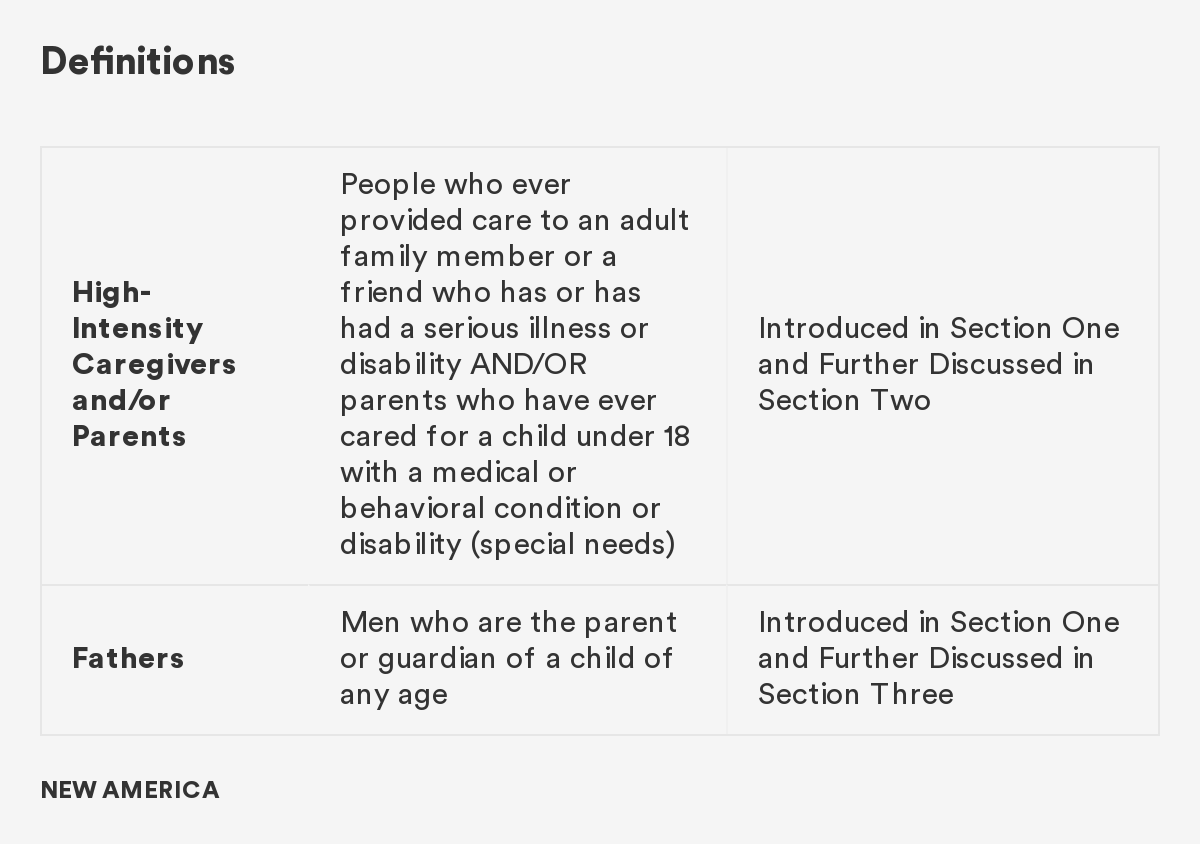
In analyzing our Men and Care survey data, we initially planned to focus on and discuss the experiences of three groups of men: men who care for adults, fathers, and men who are not caregivers. However, it quickly became clear that a significant number of respondents have both provided care for an adult family member or close friend, and are – at the same time – parents who have cared for a child under 18 with a medical or behavioral condition or disability (special needs).
High-Intensity Caregivers and/or Parents: In our survey, 60 percent of parents who have cared for children with special needs have also cared for an adult. Conversely, nearly one-third of those who have cared for an adult are also parents who have cared for children with special needs. And across 27 comparisons, we found only three statistically significant differences in attitudes between individuals who care for adults, parents who care for children with special needs, and those who fall into both categories. For these reasons—because there is so much overlap in actual people and because of the similarities in attitudes – we chose to group these adults together as High-Intensity Caregivers and/or Parents, abbreviated in this report as HICP.
To parents who have never cared for a child with special needs, we assigned the group label, Other Parents (or Other Fathers, when discussing men exclusively).
Caregiving: The word “caregiving” means different things to different people, and even is defined differently in national surveys conducted by different organizations.1 For some, it encompasses a wide variety of caring activities—parenting, caring for an adult, self-care, paid and unpaid care work—performed on behalf of a variety of people. Others define the word narrowly. For instance, federal legislation and some advocacy organizations refer to “family caregivers” as adult family members or others, who provide ongoing assistance to people with a “chronic or other health condition, disability, or functional limitation.”2 For the purposes of this report, we use the term “caregiving” to refer to a broad range of care tasks and responsibilities, including hands-on and hands-off care and parenting. Thus, we also refer to two of our three groups—the HICP and Other Parent groups—as “caregiver” groups, because individuals in both these categories perform the broad range of tasks and responsibilities that we consider to be caregiving.
How this terminology is used in A Portrait of Caring Black Men
In section one, this report provides a broad overview of caregiving Black men — who they are and whom they care for. The second section of this report focuses on Black men who are HICPs, and the third section of this report concentrates on Black men who are fathers. This third section focuses on all Black men in our sample who said they were parents, including those who have cared for a child with special needs as well as those who have not, and regardless of whether they have ever cared for an adult. We are not able to disaggregate Black fathers by their caregiving status (i.e. Black fathers in the HICP group vs. Other Black Fathers) since we cannot draw meaningful and robust conclusions based on sample sizes under 50. (This is further discussed in the Methodology section).
Key Findings
- Eighty-six percent of Black men who are High-Intensity Caregivers and/or Parents (HICP) have helped adults with hands-off tasks (instrumental activities of daily living), and almost two-thirds (65 percent) have provided hands-on care (basic/physical activities of daily). More Black male HICPs than white male HICPs have performed hands-on medical or nursing tasks.
- Black male HICPs are more likely to say work demands—not family responsibilities—make it difficult for them to balance the demands of work and family responsibilities. More than half of all Black male HICPs think that an inability to afford leave from work is a major reason why men don’t take time off to give care.
- Black male HICPs are extremely similar to their white counterparts as it pertains to how they value care, how they fulfill their roles, and how they perceive access to leave and work as barriers to caregiving. Only about half of HICP men in both racial groups have access to paid leave.
- When it comes to how they value and provide care, few differences exist between Black and white fathers. Still, our survey found that more Black fathers than white fathers think that it's very important that they feed, dress, and provide childcare to younger children.
- Both Black and white fathers in our survey face barriers to caregiving. While a similar percentage of Black and white fathers used savings to cover the costs associated with their recent leaves—paid or unpaid—twice as many of Black fathers (30 percent) than white fathers (15 percent) used savings they had specifically set aside for health needs to fund their time off from work.
Citations
- American Psychological Association, “How Caregiving is Defined,” updated November 2020, source.
- Family Caregivers Alliance, “Definitions,” January 31, 2014, source; United States House of Representatives 115th Congress, “Recognize, Assist, Include, Support, and Engage Family Caregivers Act of 2017,” Pub. L. No. 115–119, § Two, H.R. 3759 (2018), source.