A Portrait of Caring Black Men
Abstract
This report provides a portrait of Black men as active contributors to the care economy—discussing what they do, how they experience care work, the barriers that make it difficult to provide care, and recommendations for supportive policies. This report also assesses the similarities and differences between Black and white men who are High-Intensity Caregivers and/or Parents (HICP)—and between Black and white fathers. Based on the findings of a nationally representative survey, this study finds that few differences exist between Black and white men as it pertains to how they value and fulfill their caregiving and/or parenting responsibilities. In the context of parenting, this finding adds to the growing body of research and evidence that is helping to dispel the harmful myth of the “absent Black father,” an idea perpetuated by structural racism and white supremacy. Such stereotypes have historically been used to wrongly attribute socioeconomic inequities to the perceived shortcomings of Black men, rather than to systemically racist policies that undermine Black men’s ability to raise their children and take care of loved ones.
Acknowledgments
This study was conducted with support from the Robert Wood Johnson Foundation and Pivotal Ventures, an investment and incubation company created by Melinda Gates. Special thanks to the team at NORC for their collaboration on the quantitative portion of this study, and to the Better Life Lab’s data consultant, Melissa Saphir, for assisting in the analysis of data featured in this report.
The author would like to thank her Better Life Lab colleagues—Brigid Schulte, Vicki Shabo, Haley Swenson, Roselyn Miller, Sade Bruce, Stavroula Pabst, and Emily Hallgren—for their support, guidance, perspective, and edits. A special thanks goes out to former team members Elizabeth Weingarten, Alieza Durana, and Leah Crowder—this report wouldn’t have been possible without their contributions.
The author is immensely grateful to the outside reviewers who provided invaluable feedback: Rita B. Choula, Director of Caregiving Projects at AARP; Karen Linsey Marshall, Director of Advocacy & Engagement at the National Alliance for Caregiving; and Gabriela Prudencio, the Hunt Research Director at the National Alliance for Caregiving.
The author would also like to express her gratitude for her New America colleagues, especially Maria Elkin, who helped launch this report into the world.
Finally, thank you to all the participants of this study without whom this report would not exist. To all the Black caregivers who tirelessly pour their love, life, and energy into their families — know that you are seen, appreciated, and valued.
Executive Summary
This report provides a portrait of Black men as active contributors to the care economy—discussing what they do, how they experience care work, the barriers that make it difficult to provide care, and recommendations for supportive policies. This report also assesses the similarities and differences between Black and white men who are High-Intensity Caregivers and/or Parents (HICP)—and between Black and white fathers. Based on the findings of a nationally representative survey, this study finds that few differences exist between Black and white men as it pertains to how they value and fulfill their caregiving and/or parenting responsibilities. In the context of parenting, this finding adds to the growing body of research and evidence that is helping to dispel the harmful myth of the “absent Black father,” an idea perpetuated by structural racism and white supremacy. Such stereotypes have historically been used to wrongly attribute socioeconomic inequities to the perceived shortcomings of Black men, rather than to systemically racist policies that undermine Black men’s ability to raise their children and take care of loved ones.
Terminology in the Men and Care Reporting Series
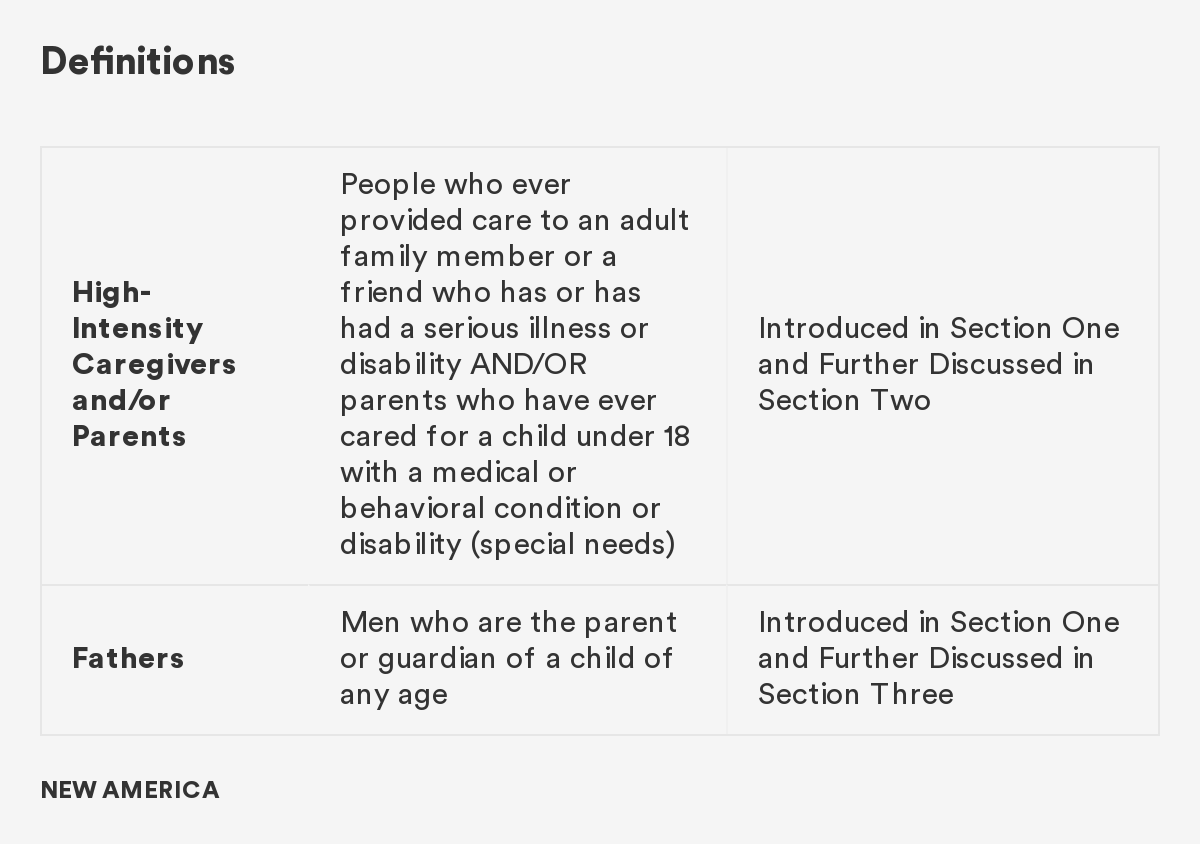
In analyzing our Men and Care survey data, we initially planned to focus on and discuss the experiences of three groups of men: men who care for adults, fathers, and men who are not caregivers. However, it quickly became clear that a significant number of respondents have both provided care for an adult family member or close friend, and are – at the same time – parents who have cared for a child under 18 with a medical or behavioral condition or disability (special needs).
High-Intensity Caregivers and/or Parents: In our survey, 60 percent of parents who have cared for children with special needs have also cared for an adult. Conversely, nearly one-third of those who have cared for an adult are also parents who have cared for children with special needs. And across 27 comparisons, we found only three statistically significant differences in attitudes between individuals who care for adults, parents who care for children with special needs, and those who fall into both categories. For these reasons—because there is so much overlap in actual people and because of the similarities in attitudes – we chose to group these adults together as High-Intensity Caregivers and/or Parents, abbreviated in this report as HICP.
To parents who have never cared for a child with special needs, we assigned the group label, Other Parents (or Other Fathers, when discussing men exclusively).
Caregiving: The word “caregiving” means different things to different people, and even is defined differently in national surveys conducted by different organizations.1 For some, it encompasses a wide variety of caring activities—parenting, caring for an adult, self-care, paid and unpaid care work—performed on behalf of a variety of people. Others define the word narrowly. For instance, federal legislation and some advocacy organizations refer to “family caregivers” as adult family members or others, who provide ongoing assistance to people with a “chronic or other health condition, disability, or functional limitation.”2 For the purposes of this report, we use the term “caregiving” to refer to a broad range of care tasks and responsibilities, including hands-on and hands-off care and parenting. Thus, we also refer to two of our three groups—the HICP and Other Parent groups—as “caregiver” groups, because individuals in both these categories perform the broad range of tasks and responsibilities that we consider to be caregiving.
How this terminology is used in A Portrait of Caring Black Men
In section one, this report provides a broad overview of caregiving Black men — who they are and whom they care for. The second section of this report focuses on Black men who are HICPs, and the third section of this report concentrates on Black men who are fathers. This third section focuses on all Black men in our sample who said they were parents, including those who have cared for a child with special needs as well as those who have not, and regardless of whether they have ever cared for an adult. We are not able to disaggregate Black fathers by their caregiving status (i.e. Black fathers in the HICP group vs. Other Black Fathers) since we cannot draw meaningful and robust conclusions based on sample sizes under 50. (This is further discussed in the Methodology section).
Key Findings
- Eighty-six percent of Black men who are High-Intensity Caregivers and/or Parents (HICP) have helped adults with hands-off tasks (instrumental activities of daily living), and almost two-thirds (65 percent) have provided hands-on care (basic/physical activities of daily). More Black male HICPs than white male HICPs have performed hands-on medical or nursing tasks.
- Black male HICPs are more likely to say work demands—not family responsibilities—make it difficult for them to balance the demands of work and family responsibilities. More than half of all Black male HICPs think that an inability to afford leave from work is a major reason why men don’t take time off to give care.
- Black male HICPs are extremely similar to their white counterparts as it pertains to how they value care, how they fulfill their roles, and how they perceive access to leave and work as barriers to caregiving. Only about half of HICP men in both racial groups have access to paid leave.
- When it comes to how they value and provide care, few differences exist between Black and white fathers. Still, our survey found that more Black fathers than white fathers think that it's very important that they feed, dress, and provide childcare to younger children.
- Both Black and white fathers in our survey face barriers to caregiving. While a similar percentage of Black and white fathers used savings to cover the costs associated with their recent leaves—paid or unpaid—twice as many of Black fathers (30 percent) than white fathers (15 percent) used savings they had specifically set aside for health needs to fund their time off from work.
Citations
- American Psychological Association, “How Caregiving is Defined,” updated November 2020, source.
- Family Caregivers Alliance, “Definitions,” January 31, 2014, source; United States House of Representatives 115th Congress, “Recognize, Assist, Include, Support, and Engage Family Caregivers Act of 2017,” Pub. L. No. 115–119, § Two, H.R. 3759 (2018), source.
Introduction
Families want to take care of one another, even when confronted by barriers beyond their control. Historically, the work associated with care has disproportionately fallen heaviest on the shoulders of women, and Black women, often underpaid and undervalued despite their essential contributions, disproportionately staff the direct care workforce.3 However, as cultural norms and expectations change, and as the need for caregiving increases, more people are likely to step into the role of a High-Intensity Caregiver and/or Parent—either of children with special needs, aging parents, or spouses who have fallen ill. Especially now, in the midst of a home healthcare crisis, the United States relies upon family caregivers to fill the gaps of an ailing industry.4
In their in-depth report on family caregivers, Caregiving in the U.S. 2020, the National Alliance for Caregiving (NAC) and AARP discuss the demographics of the High-Intensity Caregivers and/or Parents population. In 2020, 53 million family members provided high-intensity care to adults, aged 18 and over, and/or a child with special needs—up from 43.5 million in 2015. The proportion of adults providing this level of care to a family member has already increased to 24 percent, from 18 percent in 2015, and will likely continue to rise.5
Across race and ethnicity, the composition of High-Intensity Caregivers and Parents (HICP) is diverse and closely resembles the demographic breakdown of the United States: 61 percent are non-Hispanic white, 17 percent are Latinx/Hispanic, 14 percent are Black, 5 percent are Asian American and Pacific Islander, and 3 percent are multiracial.6 Though women constitute a majority of the HICP population (61 percent), men also fulfill this role (39 percent).7
Recently, more research has emerged demonstrating the various characteristics and needs of this caregiving population as it pertains to their age, race, and relationship to care recipients. However, there is scant research that focuses specifically on the 2.3 million Black men in the United States who provide high-intensity care to adults.8 According to a 2017 AARP report, Breaking Stereotypes: Spotlight on Male Family Caregivers, Black men constitute 13 percent of all men providing this type of care.9 (For context, Black men make up about 13 percent of the total population of men in the United States.) In the caregiving landscape, Black men and their experience providing high-intensity care to adults and/or children with special needs have often gone undetected and under-discussed—they have been, to a degree, an invisible community.
This report primarily seeks to contribute to and engage with emerging literature about Black men as high-intensity caregivers and/or parents, which shifts the narrative from one of invisibility to one of representation and inclusion. Moreover, this report compares Black and white male HICPs and also provides a brief snapshot of Black fathers to further contextualize the portrait of Black men within the care economy, which encompasses unpaid care work performed by family members.10
Previous research has explored the roles and behaviors of Black fathers, though often in the limited context of poverty.11 This report briefly discusses key findings about how Black fathers parent and value care (see Part 3: Parenting). That said, there remain few studies that address the fullness of Black fathers’ experiences as well as their access to family supportive policies, or lack thereof, which shapes their choices, experiences, and health, as well as the wellbeing of their partners, children and families. As such, this report seeks to include Black fathers in this ongoing discourse.
Methodology
A part of the Better Life Lab’s (BLL) Men and Care project, this quantitative study relies upon a nationally representative survey of 2,966 respondents, conducted in partnership with NORC at the University of Chicago. The sample for this report includes a total of 209 Black men. Of them, 135 were fathers, 98 were high-intensity caregivers and/or parents, and 48 were both fathers and HICP. Although Black respondents were oversampled to ensure the results would be generalizable, the analyses for this study are limited by this relatively small sample size of Black men. In particular, this report does not disaggregate Black fathers by caregiving status, since we could not draw meaningful and robust conclusions based on sample sizes under 50. Instead, this report seeks to provide a portrait view of caring Black men – focusing primarily on Black male HICPs, and then presenting a brief snapshot of Black fathers, discussing what they do, how they experience parenting, and the barriers that make it difficult to raise their children.
To create the portrait of caregiving Black men, BLL’s survey, similar to existing surveys conducted by peer organizations, collected information about caregivers’ race, financial state, health and stress levels, caregiving activities, experience with work-family conflict, and access to family and medical leave. While it does not specify the type of relationship (spousal, elderly parent-child, in-laws, friendship, etc.) between Black men and adult care recipients, BLL’s survey does account for the parental status of Black men caring for children with special needs. (This distinguishes it from other existing research about Black men who provide high-intensity caregiving.)
Citations
- American Psychological Association, “How Caregiving is Defined,” updated November 2020, source">source.
- Family Caregivers Alliance, “Definitions,” January 31, 2014, source">source; United States House of Representatives 115th Congress, “Recognize, Assist, Include, Support, and Engage Family Caregivers Act of 2017,” Pub. L. No. 115–119, § Two, H.R. 3759 (2018), source">source.
- Stephen Campbell, “Racial Disparities in the Direct Care Workforce: Spotlight on Black/African American Workers, Research Brief,” PHI, February 2018, source.
- Robert Espinoza, “8 Signs the Shortage in Paid Caregivers Is Getting Worse,” PHI, February 2, 2017, source.
- National Alliance for Caregiving and AARP, “Caregiving in the U.S. 2020 – Executive Summary,” May 2020, source.
- United States Census Bureau, “U.S. Census Bureau QuickFacts: United States,” last accessed December 17, 2020, source; National Alliance for Caregiving and AARP, Caregiving in the U.S. 2020” (Washington, D.C: National Alliance for Caregiving, May 2020), source
- National Alliance for Caregiving and AARP, Caregiving in the U.S. 2020.”
- Rodney Brooks, “Hidden Truth: 2.3 Million Black Men Are Family Caregivers,” Next Avenue, October 5, 2020, source.
- Jean Accius, Breaking Stereotypes: Spotlight on Male Family Caregivers, (Washington, D.C.: AARP, March 2017), source.
- International Labour Organization, “Decent Work and the Care Economy (The Care Economy),” last accessed December 17, 2020, source.
- Maria Johnson and Alford Jr, “Diversity and Meaning in the Study of Black Fatherhood,” Du Bois Review: Social Science Research on Race 13 (March 1, 2016): 5–23, source.
Part 1: An Overview of Black Men and Care
The Experiences of Black Men who are High-Intensity Caregivers and/or Parents (HICP)
Almost 60 percent of Black adult respondents in our survey have ever been parents or guardians of children, and more than 44 percent have ever provided some form of care to an adult family member or friend.
In this study, more than a third of Black adults (38 percent) have children under the age of 18, and about 25 percent have at least one child between the ages of zero to eight years old. Over a third of Black parents (37 percent) in our survey have ever, at some point in their lives, personally taken care of a child or children with a medical or behavioral condition or other disability.
Often, the term “caregiving” evokes images of parenting and young children; however, this perception of care ultimately renders individuals who care for adults—parents, spouses, kin relatives, neighbors, and friends—invisible. In our survey, 44 percent of Black adults had ever provided ongoing or periodic living assistance on a regular basis to an adult family member or close friend.
Among men who provide care, nearly half of all the Black men in our survey report that they have ever been parents or guardians, and 43 percent of all Black men have ever provided care as high-intensity caregivers and/or parents.
There is obviously some overlap between these two caregiving groups, fathers and Black male HICPs. For example, one-third (33 percent) of Black fathers have had experience caring for an adult, just under one-third had experience giving care to a child with special needs, and 19 percent had experience caring for both an adult and a child with special needs. Among all Black fathers in this report, including those who have experience providing high-intensity care to adults or children with special needs, more than half have at least one child under the age of 18 and one-third have a young child between zero and eight years of age. Though this report does not separately discuss the unique experiences of Black men caring for both adults and children at the same time, a 2019 report by Caring Across Generations and the National Alliance for Caregiving, Burning the Candle at Both Ends, provides insightful findings about sandwiched caregivers across gender and race.12
Regarding the age of Black fathers in this study, 15 percent are between 18 and 29 years of age, about one-third are between 30 and 44 years of age, 31 percent are between the ages of 45 and 59, and 20 percent are 60 or older. The average age of Black male HICPs is 43 years old and the average income is $40,000 to $49,999. At the time of this survey, 64 percent of Black male HICPs were working, and 71 percent of Black fathers were also employed.
Citations
- American Psychological Association, “How Caregiving is Defined,” updated November 2020, <a href="source">source">source.
- Family Caregivers Alliance, “Definitions,” January 31, 2014, <a href="source">source">source; United States House of Representatives 115th Congress, “Recognize, Assist, Include, Support, and Engage Family Caregivers Act of 2017,” Pub. L. No. 115–119, § Two, H.R. 3759 (2018), <a href="source">source">source.
- Stephen Campbell, “Racial Disparities in the Direct Care Workforce: Spotlight on Black/African American Workers, Research Brief,” PHI, February 2018, source">source.
- Robert Espinoza, “8 Signs the Shortage in Paid Caregivers Is Getting Worse,” PHI, February 2, 2017, source">source.
- National Alliance for Caregiving and AARP, “Caregiving in the U.S. 2020 – Executive Summary,” May 2020, source">source.
- United States Census Bureau, “U.S. Census Bureau QuickFacts: United States,” last accessed December 17, 2020, source">source; National Alliance for Caregiving and AARP, Caregiving in the U.S. 2020” (Washington, D.C: National Alliance for Caregiving, May 2020), source">source
- National Alliance for Caregiving and AARP, Caregiving in the U.S. 2020.”
- Rodney Brooks, “Hidden Truth: 2.3 Million Black Men Are Family Caregivers,” Next Avenue, October 5, 2020, source">source.
- Jean Accius, Breaking Stereotypes: Spotlight on Male Family Caregivers, (Washington, D.C.: AARP, March 2017), source">source.
- International Labour Organization, “Decent Work and the Care Economy (The Care Economy),” last accessed December 17, 2020, source">source.
- Maria Johnson and Alford Jr, “Diversity and Meaning in the Study of Black Fatherhood,” Du Bois Review: Social Science Research on Race 13 (March 1, 2016): 5–23, source">source.
- Lisa Weber-Raley, Burning the Candle at Both Ends: Sandwich Generation Caregiving in the U.S., (Washington, D.C.: National Alliance for Caregiving and Caring Across Generations, November 26, 2019), source.
Part 2: High-Intensity Caregiving and/or Parenting by Black Men
Eighty-six percent of Black men who are High-Intensity Caregivers and/or Parents (HICP) have helped adults with hands-off tasks (instrumental activities of daily living), and almost two-thirds (65 percent) have provided hands-on care (basic/physical activities of daily). More Black male HICPs than white male HICPs performed hands-on medical or nursing tasks.13
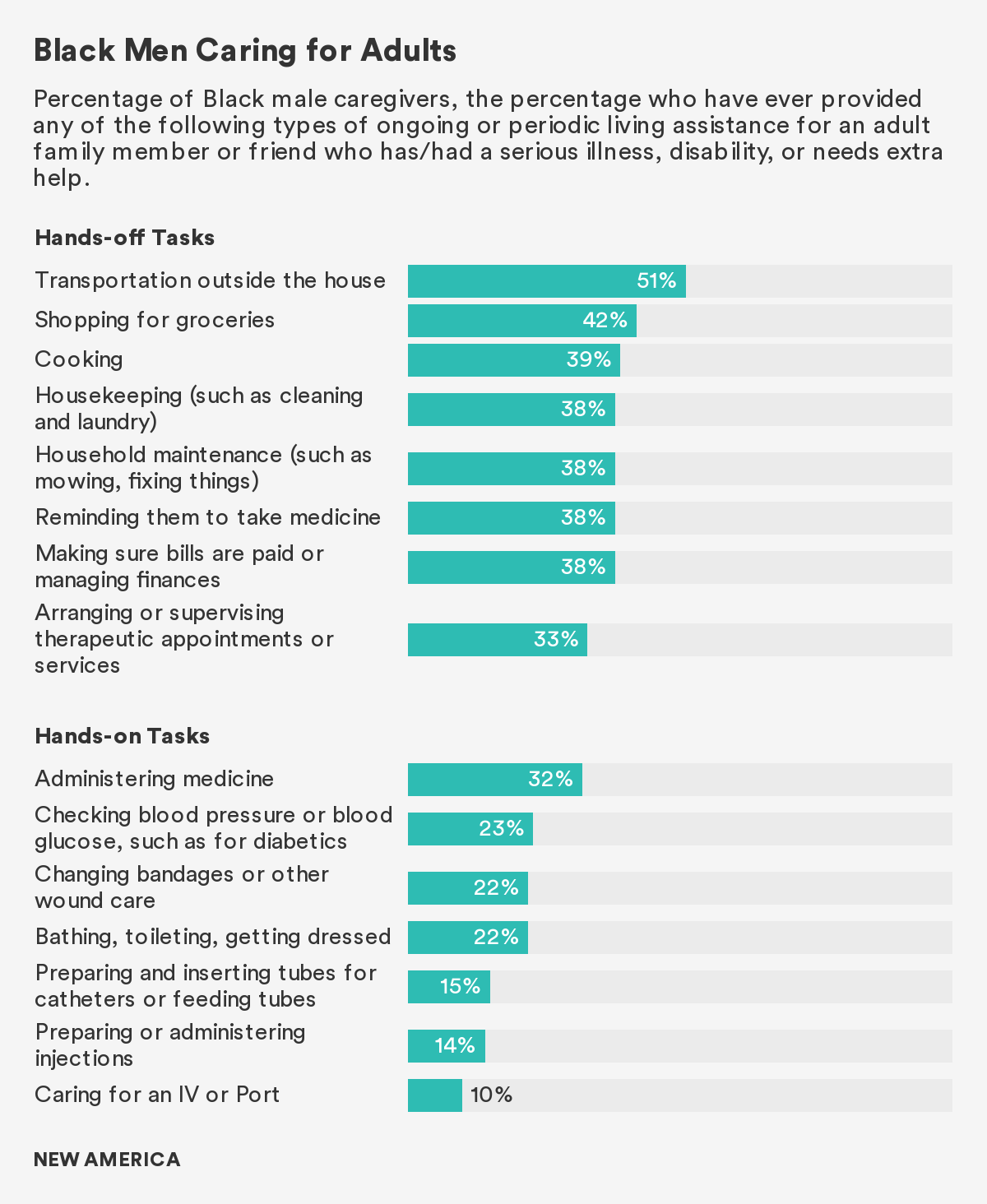
A majority of Black male HICPs play an active role in caring for adult family members or friends who have or have had a serious illness or disability. The vast majority (86 percent) say that they have supported adult care recipients with instrumental activities of daily living, like shopping for groceries, housekeeping, cooking, making appointments, paying bills, reminding care recipients to take medication, and providing transportation. Additionally, almost two-thirds (65 percent) have performed tasks that meet the medical needs of care recipients.
Medical or nursing tasks are those activities that resemble the paid work of in-home health aides and professional long-term care providers who receive some form of professional training. Fifty-three percent of Black men caring for adults have administered medication, 40 percent have performed blood checks or assisted with bathing, and about a quarter have performed injections.
Black male HICPs are among the 58 percent of adults in the United States providing nursing level assistance to adults they care for.14 Research from AARP’s 2019 report, Home Alone, finds that caregivers providing this level of hands-on care often do so with little support from the healthcare infrastructure, lack training, and face emotional challenges associated with the role.15 Moreover, the study finds that caregivers who perform medical or nursing level tasks report increased feelings of worry, stress, and financial strain.
Although half of all Black male HICPs find this work more stressful than other kinds of work they perform, 89 percent find caregiving satisfying, and 87 percent feel respected in their roles.
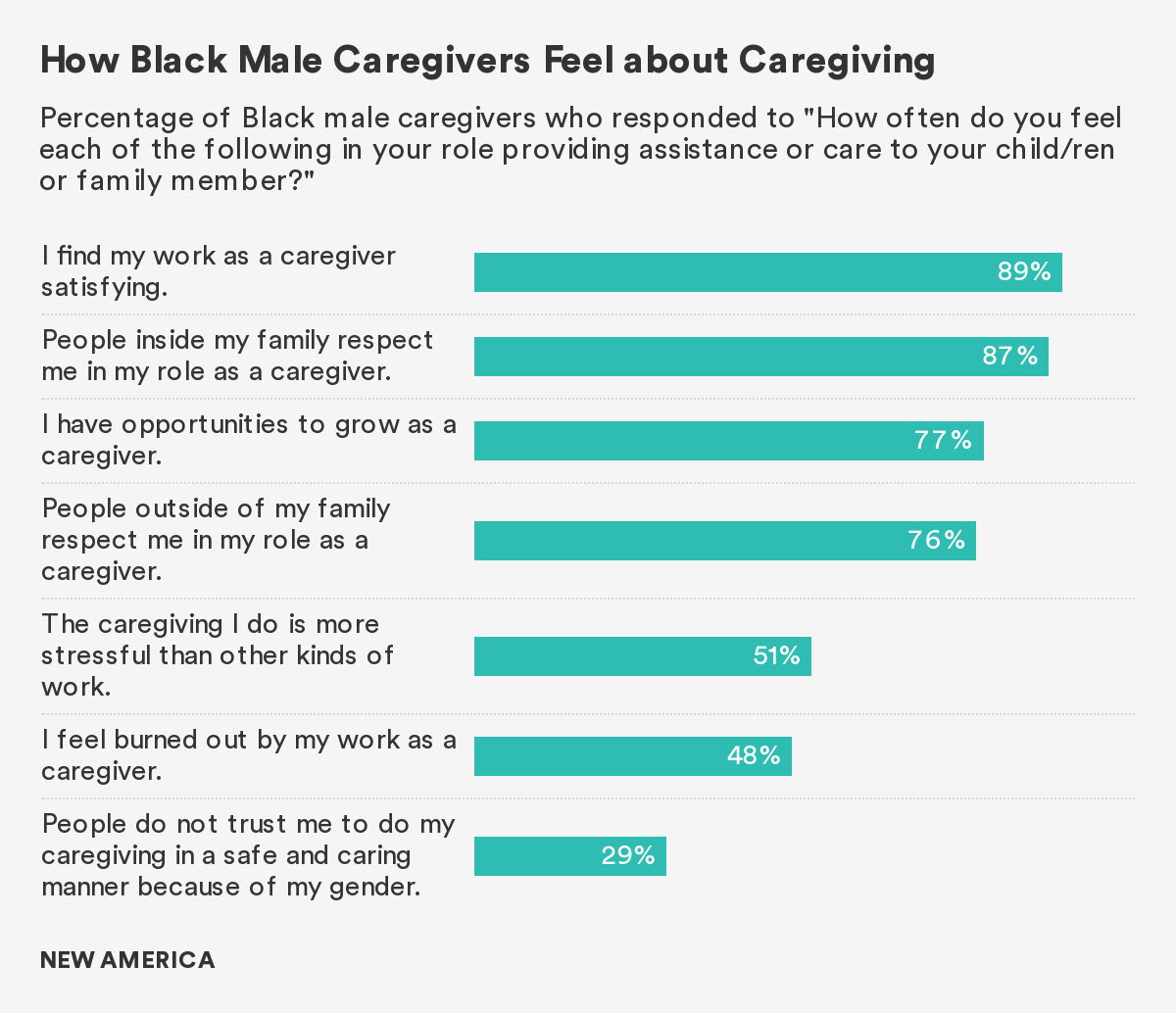
Providing care can be a gratifying experience. The vast majority of Black male HICPs who have cared for a child with special needs or an adult have had a positive caregiving experience. In this study, 89 percent of Black male HICPs say they find care work satisfying. When it comes to feeling appreciated in their roles as caregivers, about three-quarters say they feel respected by their family members (77 percent) or by individuals outside of their family (76 percent).
Despite the satisfaction that unpaid care work brings, for some Black male HICPs, caregiving comes with its own challenges and can, at times, feel like a heavy responsibility. A considerable number of Black men who have cared for a child with special needs or adults find caregiving stressful and experience emotional fatigue in their role. About half (51 percent) find caregiving more stressful than other kinds of work they perform and 48 percent feel burnt out by the unpaid care work they provide.
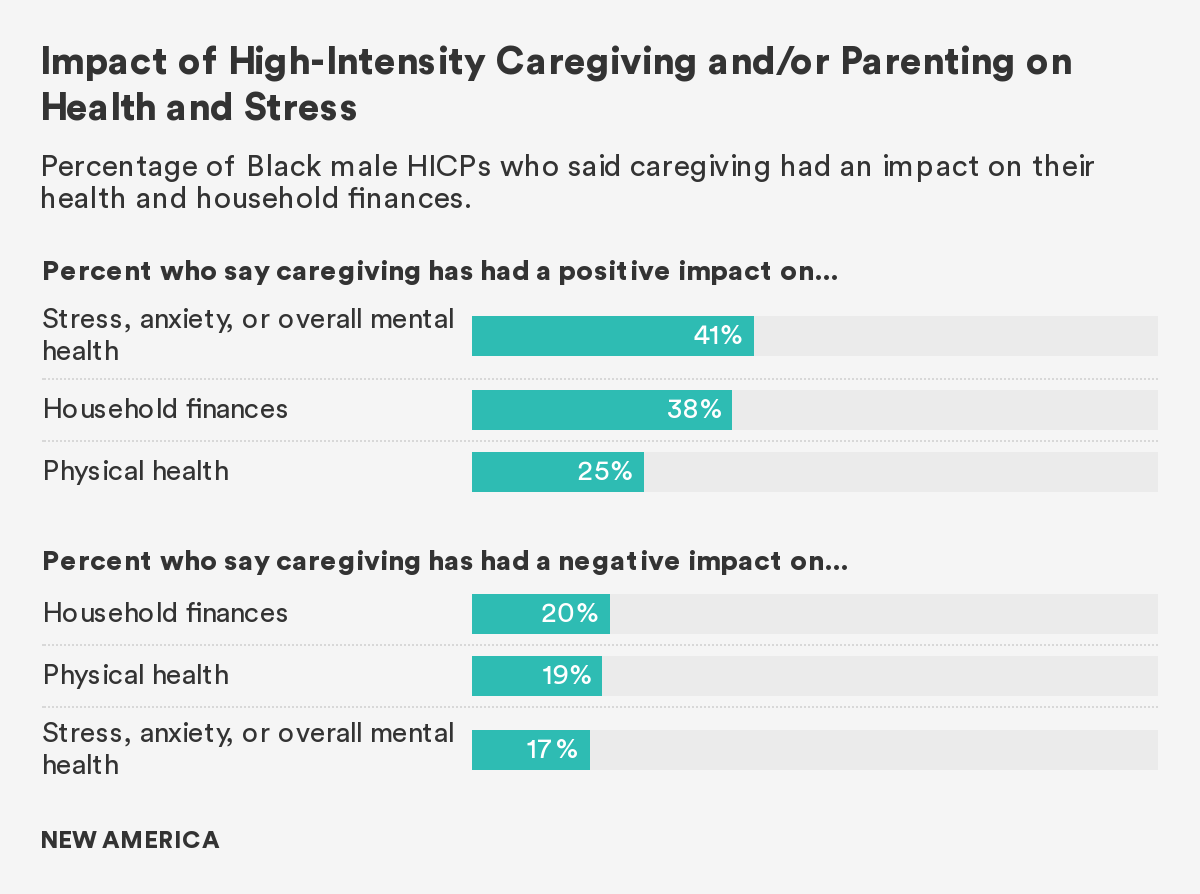
Surprisingly, a larger percentage of Black male HICPs said that caregiving had a positive—rather than a negative—effect on their health and finances. Forty-one percent said that caregiving positively affected their mental health, a quarter credited it with benefiting their physical health, and more than a third (38 percent) noted it had a positive impact on their household finances. These findings are complicated by other studies which examine the health and financial wellbeing of Black adult caregivers and Black individuals relative to that of their white counterparts.
Some research finds that Black caregivers of adults, despite reporting lower levels of stress, carry heavier care burdens.16 According to the National Alliance for Caregiving’s 2020 report, Caregiving in the U.S., on average, Black caregivers report providing more hours of care each week (31.2 hours) than either white (21.2 hours) or Asian American (24.1) caregivers.17 Other studies report that Black caregivers experience higher rates of depression and have lower scores of overall well-being than their white counterparts when they are living with care recipients.18 Research from the National Institute on Minority Health and Health Disparities find that Black individuals have a higher levels of chronic stress and depression in comparison to their white counterparts.19 Furthermore, it has been well documented that Black caregivers do experience the strain of caregiving on their pocketbooks; some cut back on savings or assume debt during their unpaid caregiving career.20
It’s worth noting that respondents in our Men and Care survey self-reported their levels of stress and financial state. Some research on mental health finds that Black individuals report low and high levels of psychological well-being depending on the assessment tool utilized.21 Moreover, researchers find that culture plays an integral role in shaping how people perceive their symptoms, adopt coping mechanisms, and approach treatment.22
Policy Recommendations
Black male HICPs would benefit from sustained investment in financial and supportive services at the federal and state level. Depending on the state they reside in, individuals providing high-intensity care to adults and/or children may receive some form of financial assistance to defray the costs of goods and services related to caregiving or for respite care.23 Respite care allows family caregivers to take a momentary break from supporting care recipients who need help with activities of daily living. The eligibility of a care recipient may indirectly inform whether or not a caregiver can receive financial assistance or compensation for time spent providing care. Apart from programs administered through the Veteran’s Administration which provide caregivers of adults with avenues for support, there currently exists no other widely accessible federal program that provides financial assistance or relief directly to caregivers.
Medicare, public insurance for people 65 years of age and older, does not provide any form of financial compensation for long-term services, like in-home care or adult day centers, which can be most beneficial to care recipients who need assistance with activities of daily living. In 2020, the federal government allocated $185,936,000 to the National Family Caregiver Support Program, which was established in 2000 through the Older Americans Act.24 The National Family Caregiver Support program provides states with funds to administer the program in collaboration with Area Agencies on Aging and local service providers. These regional and local programs then connect caregivers to supportive services (like respite care, caregiver training, and counseling), as well as information and additional assistance.
However, according to a 2016 program evaluation by the Administration for Community Living (ACL), all Area Agencies on Aging in all participating states had at least one waitlist and more than a quarter had multiple.25 A following 2018 report by the ACL concluded that caregivers who were able to access the National Family Caregiver Support program benefited from respite care, training and educational resources, but advocates note that in 2019, only 740,000 people—a mere fraction of the high-intensity caregiver population—had access to the services provided by the National Family Caregiver Support Program.26 The demands for the resources provided through this federal program are high, but historically, its accessibility has been low. Since 2016, there have been calls for increased funding.27
Federal lawmakers should seek additional opportunities and avenues to increase the accessibility of supports and services that promote the health and financial well-being of caregivers. In 2019 and 2020, Congress made progress on the Lifespan Respite Reauthorization Act, extending and revising the Lifespan Respite Care Program, which “supports state lifespan respite care services (i.e. services for family caregivers of children and adults with special needs).”28 The initial version of the legislation passed by the House of Representatives in 2019 allocated $200 million dollars to support coordinated respite services, increase access, and build up the respite care workforce and volunteer corps.29 At the state level, laws like the Caregiver Advise, Record, Enable (CARE) Act, championed by AARP, ensures that family caregivers who provide medical care receive adequate training and information from healthcare professionals when a care recipient is discharged from the hospital; already, 40 states have enacted or are in the process of enacting the law.30
Work-Family Conflict for Black Men who Provide High-Intensity Care to Adults and/or Children with Special Needs
In this study, over half of all employed Black men with unpaid high-intensity caregiving and/or parenting responsibilities find that work demands—more than family responsibilities—very often or sometimes make it difficult for them to spend time with and care for their families.
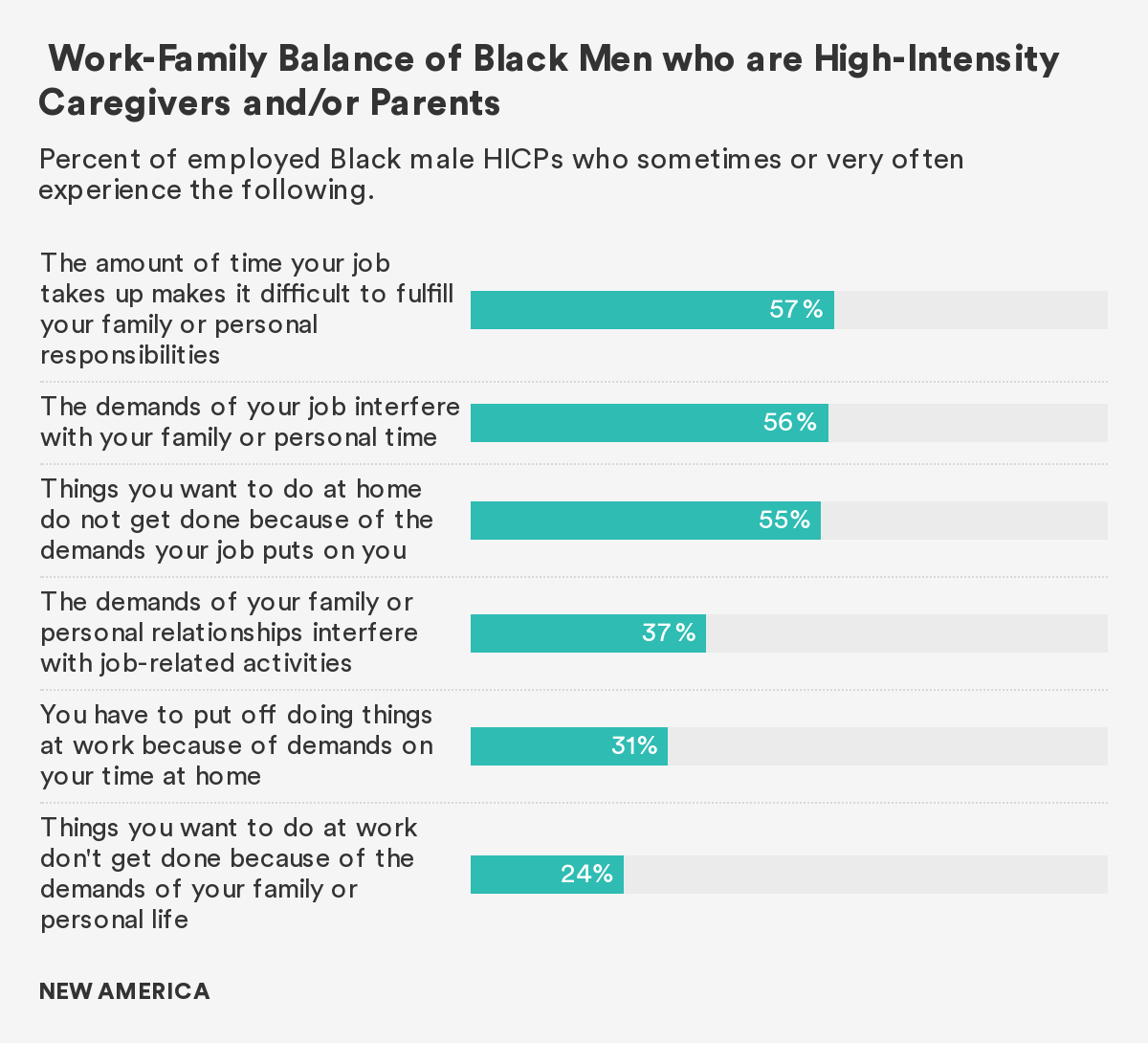
Black male HICPs in our survey point to their jobs, not their families, as the source of work-family conflict. Fifty-six percent of caregivers said that the demands of their jobs very often or sometimes interfered with their family and personal time. When it comes to accomplishing responsibilities at home, 55 percent of caregivers also find that they have to leave certain tasks undone because of the demands of their job. Moreover, 57 percent of caregivers say that the time their jobs take up makes it especially difficult for them to fulfill their family or personal obligations. For Black men, work—more so than family and caregiving responsibilities—is the problematic variable in the work-family balancing equation.
Far fewer Black male HICPs attribute untenable work-family situations to the demands of family life. About one-quarter (24 percent) of caregivers are unable to accomplish certain job-related tasks due to the demands of their family life, 37 percent have to put off doing things at work due to their with familial or personal relationships, and about one-third (31 percent) feel that the demands on their time at home conflicts with what they’d like to accomplish at work.
Policy Recommendations
Black male HICPs would benefit from access to flexible work arrangments with robust caregiver anti-discrimination and anti-retaliation statutes. The Society for Human Resource Management (SHRM) outlines possible flexible work arrangements which may include the following: telework, flextime to begin or end work earlier or later, and use of leave.31 Additional examples of flexible work options include: good part-time work with benefits and the possibility for advancement; the ability to dial up or dial back career progression, depending on caregiving needs and time of life; and stable, predictable schedules for hourly workers that give them more say and control in setting them.
Research demonstrates that access to flexible work arrangements can help reduce work-life conflict, increase employee engagement, and decrease work-related stress.32 Policies aimed at increasing workplace flexibility already exist. For example, in the United Kingdom, all workers have the right to request flexible work arrangements. In the City of San Francisco, caregivers can benefit from the San Francisco Family Friendly Workplace Ordinance, which permits workers to request flexible work arrangements or more predictable scheduling, allowing to care for a family member or child as needed.33
Barriers to Leave for Black Men who are High-Intensity Caregivers and/or Parents
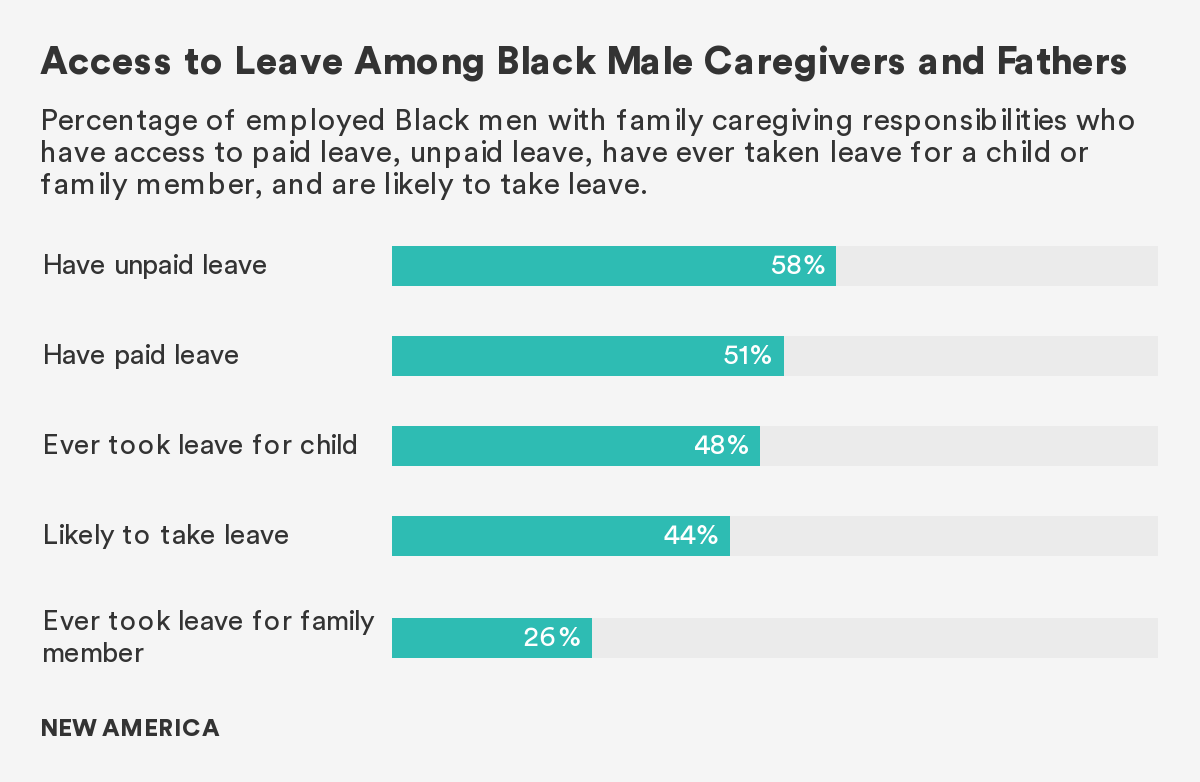
More Black men providing high-intensity care to adults and/or children with special needs have access to unpaid leave than to paid leave.
In 2019, the Better Life Lab published Lifting the Barriers to Paid Family and Medical Leave, which found that men anticipate needing to take time off from work for caregiving, and that a universal paid leave policy would best support them in their various roles.34 The report also highlighted the barriers that make it harder for men to access and take leave, among them an inability to afford unpaid or partially paid leave and workplace cultures (and practices) that disincentivize men from using it. In our survey, Black men find themselves in a similar predicament to men overall; they want to spend more time providing care, but face a number of barriers that prevent them from doing so.
Among employed Black men who are high-intensity caregivers and/or parents, a little more than half (51 percent) say they have access to some form of paid leave and 58 percent have unpaid leave. Only 46 percent say they have ever taken any kind of leave (sick time, vacation time, paid family-medical leave, or any other kind of leave) for more than a day or two following the birth or adoption of a child. Just 26 percent have ever taken leave for more than a day or two to care for a family member with a serious illness, or a disability, or who needs extra help as they get older. These findings show that even when Black men have access to leave, a smaller percentage actually use it. Accoring to our survey, forty-four percent of Black male HICPs anticipate needing to take time off sometime in the future; however, their decision and capacity to take leave will depend in large part on their ability to afford the costs associated with it.
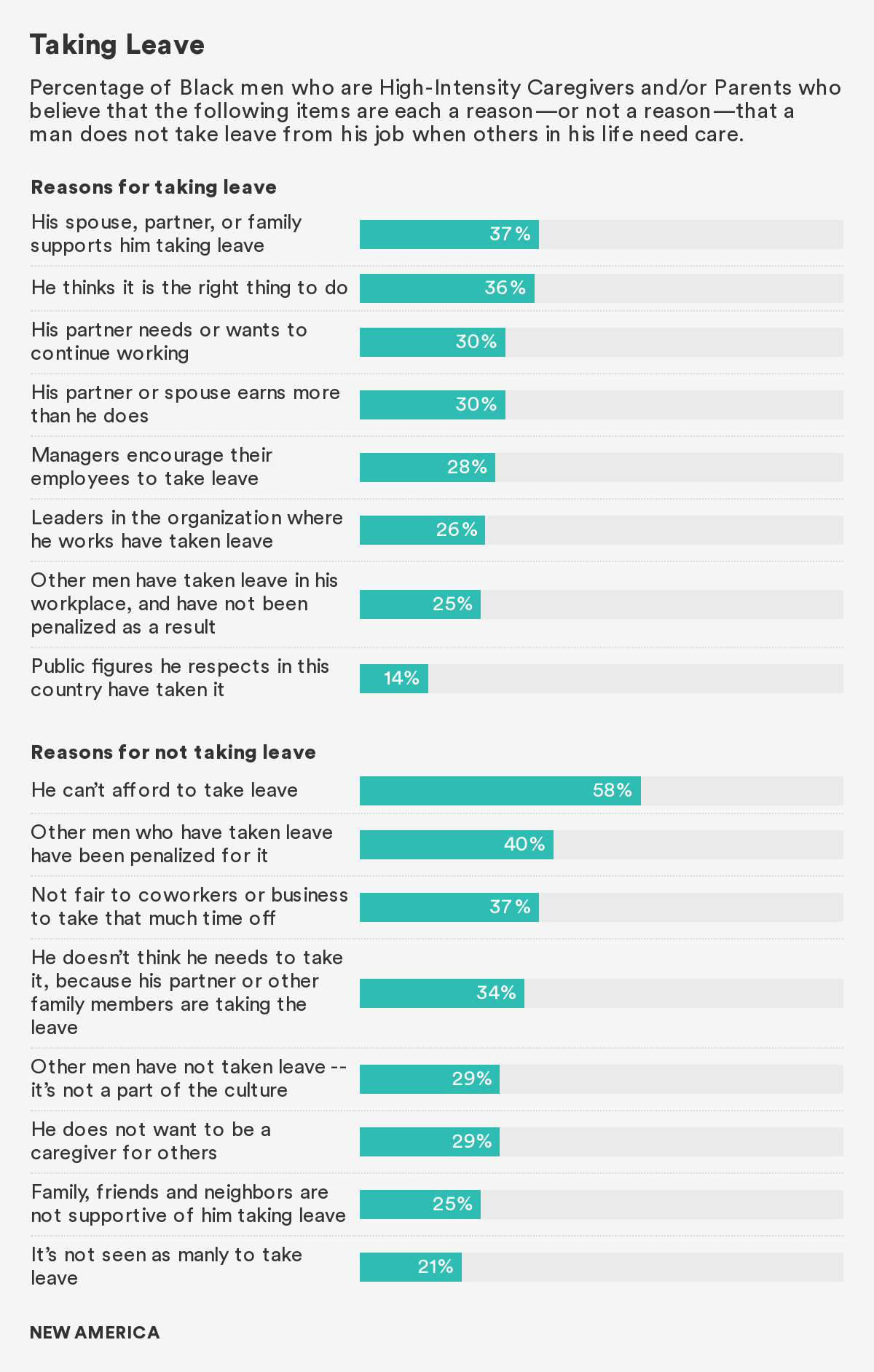
A majority of Black men who are high-intensity caregivers and/or parents think that the costs associated with taking leave prevents men from using it. More than one-third worry that workplace penalties disincentivize men from taking time off from work for caregiving.
Many caregivers struggle to afford taking time off from work to provide care to a loved one, and Black men are no exception. In the United States, the national leave policy—the Family and Medical Leave Act (FMLA)—only provides 56 percent of the workforce with twelve weeks of job-protected unpaid leave.35 According to the Bureau of Labor Statistics, just 20 percent of civilian workers have dedicated paid family and medical leave through their employer to care for a new child or an ill loved one—and those who are covered by an employer's policy tend to earn higher wages and work in professional, white-collar jobs.36
Fifty-eight percent of all Black men who provide high-intensity care to an adult or child with special needs think that a major disincentive to men’s use of leave is an inability to cover the costs associated with taking time off from work. In addition to affordability, there are a number of other reasons why men do not take advantage of leave (paid or unpaid) even if they have access to it.
Family expectations play a role in influencing men’s decisions around taking time off to provide care. Thirty-four percent do not think they need to take caregiving leave because their partner/spouse is taking it, 29 percent do not wish to provide care, and one-quarter face discouragement from those closest to them—family, friends, and neighbors. Of course, apart from personal motivations and perceived expectations of family and friends, structural barriers, namely workplace expectations and culture, prevent the use of leave amongst Black male HICPs.37
Fears and concerns about work inform whether or not men choose to take leave.
Workplace cultures in the United States by and large make it hard for employees to manage their work and care obligations. Though women, and particularly mothers, suffer most, men also face barriers to care and spending quality time with their families.
In our survey, 40 percent of Black male HICPs say men may not take leave if they fear being penalized at work. More than one-third (37 percent) think that men will not take time off if they think that their absence will burden their coworkers. Twenty-nine percent of Black male HICPs think that men, observant of their surroundings and the behaviors of their peers, will not take leave if they feel that it’s not part of the culture and don’t see other men using the benefit.
Despite worries that the inflexibility of workplace structures, cultures, and coworkers will disincentivize men from being the caregivers they’d like to be, more than a quarter of Black male HICPs think that certain characteristics in the workplace could actually encourage men to take time off to give care: men will take leave if there are no penalties (25 percent), if leaders in the organization take leave (26 percent), and if managers actively encourage workers to use the benefit (28 percent). Our findings corroborate years of research that demonstrates that workplace culture, expectations, and policies have the power to either disincentivize or encourage leave use amongst men.38
Policy Recommendations
Black male HICPs would benefit from a combination of federal, state, and workplace policies that provide them access to paid leave and promote their use of it. The existing national family leave law—FMLA—is unpaid and its eligibility requirements exclude millions of workers in the United States. Moreover, it does not protect a caregiver's right to take time off to tend to a family member who is not a spouse, a child, or a parent. Black men providing high-intensity care to adults and/or children with special needs, like all caregivers, may need to care for a sibling, a grandparent, an aunt, a cousin, or a friend; but these caregiving relationships are not accounted for in the FMLA. Additionally, as this report has shown, the existing national paid leave policy may not support Black male HICPs who cite affordability as one of the key reasons why men don’t take leave.
Forty-four percent of Black male HICPs anticipate needing to take time off. A robust, national paid family leave program would likely help ensure they have the financial security to do so. Congress passed the Families First Coronavirus Response Act of 2020 (FFCRA), as part of an emergency relief package. The act instituted the first, national, paid leave program in the U.S. Though temporary through the end of 2020—available only to those whose children were home because of school and childcare shutdowns—and largely inaccessible to millions due to generous exemptions for large and small businesses, it served as a first step toward a permanent, more robust policy.
A permanent paid leave policy that would best help Black men with high-intensity care responsibilities would not only be paid, but it would also have adequate wage replacement. States that have adopted paid leave programs have used a social insurance model, funded through small payroll deductions to provide benefits to workers who need to take time off to care for a child, seriously ill or disabled loved one, or for their own serious health issues. The states utilize different methods for compensating caregivers. The two most common are progressive/sliding scale wage replacements that provide a larger percentage of wages for low-income workers (up to 90 percent in Washington state) and fixed percentages.
Research demonstrates that low-wage replacements disincentivize the taking of leave among men. It also particularly impacts workers in industries with lower wages, which are disproportionately occupied by people of color who have less access to wealth and the resources needed to financially weather sudden emergencies. To be truly effective, especially for men and Black men, a national paid leave program would need to not only establish adequate wage-replacements, but also support policies and practices that actively promote the use of leave among all workers with caregiving needs. A robust policy must include job-protections so that caregivers can return to the same or a similar position after taking leave, and improved outreach to and educational resources for both workers and employers, to increase awareness and full utilization of the program.
Having access to paid leave isn’t enough; Black men providing high-intensity care to adults and/or children with special needs must feel supported in their decision to use paid leave. Forty percent of Black male HICPs in this study said that workplace penalties would deter men from taking leave. Workplaces can create environments that encourage rather than penalize leave taking among men employees. Using gender-inclusive language in employer leave policies could disrupt the cultural notion that men don’t take leave; it could begin to normalize the reality that they have care responsibilities that influence their performance and presence in the workplace.39 Moreover, Black male HICPS should see role models of men and leaders use the benefit, thereby making it “safe” for others to do so without undue fear or concern about retaliation. Modeling the use of leave at the leadership and managerial level could positively influence men’s decisions to take leave; research demonstrates that when leaders in the workplace model healthy behaviors or take advantage of work benefits, they create a culture that influences employees’ decisions to do the same.40
Policymakers and workplace leaders can craft, adopt, and implement robust, family-supportive policies that protect Black men's rights to give care and promote equitable access to resources that ensure they have opportunities to do so without the fear of losing pay or even their jobs. Introduced by the Senate in June 2020, the Protecting Family Caregivers from Discrimination Act is one example of proposed legisaltion that seeks to encourage family supportive workplaces.41
Increasing access to paid leave is a form of economic and racial justice. A national, permanent paid leave policy with robust job-protections and adequate wage-replacements would especially benefit Black male HICPs because it would lessen the compounding impact of current economic barriers to caregiving. A report from the Economic Policy Institute (EPI) outlines the various economic racial disparities that disadvantage Black individuals, particularly in the labor force.42 Black workers, both men and women, face a higher likelihood of unemployment in comparison to their white counterparts, regardless of their level of education.43
The Federal Reserve Board reports that as of July 2020, Black workers were more likely than their white counterparts to report a recent layoff. On average, Black workers receive less pay and face a growing wage gap.44 Moreover, they have less access to benefits, like paid sick days and flexible work arrangements. According to EPI, the median household incomes for Black families are 70 percent lower than that of white households. In 2016, the average Black family had $17,600 in wealth compared to white families’ average of $171,000. Lower wages, hence less income, contributes to the racial wealth gap.45
Such disparate economic outcomes have their roots in a long history of policies and practices that fueled employment discrimination, inequitable access to education, labor market segregation, and unequal access to wealth in the form of housing, savings, and other assets. Policies like FMLA do little to decrease the economic challenges disproportionately experienced by Black workers and families—if anything, they exacerbate them, especially if an emergency arises. Research finds that Black families have less access to savings, which serves as a financial safety net and are more likely to accumulate medical debt.46 For Black families, the median costs associated with taking unpaid leave for 12 weeks would amount to more than $8,077.47 Black men who provide high-intensity care—and their families—are among those who would stand to gain the most from a national paid leave policy.
Policies and programs would prove most equitable and impactful if crafted with an understanding of the various economic barriers sustained by systemic racism that inform how Black male caregivers navigate their lives and undoubtedly shape their caregiving experiences.
Comparing Black and White Men who are High-Intensity Caregivers and/or Parents
In our survey, Black and white men providing high-intensity care to adults and/or children with special needs are more similar than different from one another in how they value caregiving, what tasks they perform, and the barriers they face as caregivers. The policies and programs that would benefit Black male HICPs would likely benefit other caregiving men as well.
Valuing Care
As it pertains to attitudes about care, the similarities between Black and white men who are high-intensity caregivers and/or parents is striking. An overwhelming majority of both groups value caregiving, and on all six survey questions asked about this topic, there were no significant differences between men of the two races. For example, more than 70 percent of men in both groups say they are proud to talk with their family and friends about the role they play in caring for their family, and believe that being an engaged father is an important part of being a man.
When it comes to gender roles in the family, a majority of Black and white male HICPs (more than 80 percent of both groups) agree that men and women should divide caregiving responsibilities equally at home. While a majority of Black and white men espouse positive views of caregiving, a smaller percentage across both racial groups, actually observe men in their communities performing more care work than women. More than half of Black and white male HICPs say they live in a community where most men do less care work. Regardless of what they observe, a majority of both groups (more than 80 percent) believe that care work performed in the home is meaningful to society.
High-Intensity Caregiving and/or Parenting
Out of the eight physical and instrumental daily living care tasks our survey asked about, there was only one significant difference between Black and white men who have ever provided care to adults or children with special needs: More white men (78 percent) than Black men (61 percent) report shopping for groceries.
Apart from that, similar percentages of both groups remind adult care recipients to take their medication, handle care recipients’ bills, cook for them, provide household maintenance and cleaning, and manage their appointments. Across both groups, more than a third assist with bathing.
The most noteworthy differences between Black and white men pertain to nursing-level medical tasks. Twenty-seven percent of Black male HICPs perform or administer injections, 21 percent care for an IV or port, and 18 percent prepare or insert tubes for feeding or catheters. In contrast, 12 percent of white male HICPs administer injections, 8 percent care for an IV or port, and 7 percent insert or prepare feeding or catheter tubes. Also, more Black men (53 percent) than white men (37 percent) administer medications to care recipients who require them. Despite these differences, at least one-quarter of both groups perform other medical care tasks like checking blood pressure or blood glucose and changing bandages or caring for wounds.
Leave and Work-Family Balance
Unfortunately, Black and white men providing high-intensity care to adults and/or children with special needs are also similar in that they both face barriers that limit their ability to give care. On the issue of work-family balance described in the second part of this report, white male HICPs were more likely than Black men to say that the demands of their jobs prevent them from performing tasks at home (74 percent and 55 percent, respectively). Nevertheless, the pattern was the same for Black and white men who provide high-intensity care. In general, Black and white male HICPs were both more likely to indicate that their work, more so than their family responsibilities, caused conflict between the personal and professional spheres of their lives.
In addition to workplace demands, accessibility and affordability of leave pose another barrier to men’s abilities to provide care as high-intensity caregivers and/or parents. Only about half of male HICPs in both racial groups have access to paid leave—fewer Black men (58 percent) than white men (67 percent) have access to unpaid leave. About half have ever taken leave to care for a child, and at least one-quarter have taken leave to care for a family member. More than one-third of caregivers in both groups anticipate needing to take leave in the future. However, more than half of Black and white male HICPs (white men more than their Black counterparts), think that an inability to afford leave would be a disincentive from doing so.
For Black and white men fulfilling the role of high-intensity caregiver and/or parent, the decision to take leave also depends upon workplace culture and expectations. At least 40 percent of both groups worry that the potential for penalties will deter men from taking leave. Still, more than one-quarter of men in both groups are optimistic that men will take leave if managers encourage the practice, and one-quarter think that men will take leave if they see other men in the workplace using the benefit. Generally, when thinking about whether or not to take time off from work to provide care, men want reassurance—rather than the threat of punishment—from their colleagues and supervisors.
These findings demonstrate that caregiving is a universal experience and that the policies that would support Black men providing high-intensity care would likely benefit other men as well. Moreover, these results reinforce the reality that the caregiving challenges that Black men experience are not due to personal decisions nor behaviors–rather, they are due to structural problems that require structural responses.
Citations
- American Psychological Association, “How Caregiving is Defined,” updated November 2020, <a href="<a href="source">source">source">source.
- Family Caregivers Alliance, “Definitions,” January 31, 2014, <a href="<a href="source">source">source">source; United States House of Representatives 115th Congress, “Recognize, Assist, Include, Support, and Engage Family Caregivers Act of 2017,” Pub. L. No. 115–119, § Two, H.R. 3759 (2018), <a href="<a href="source">source">source">source.
- Stephen Campbell, “Racial Disparities in the Direct Care Workforce: Spotlight on Black/African American Workers, Research Brief,” PHI, February 2018, <a href="source">source">source.
- Robert Espinoza, “8 Signs the Shortage in Paid Caregivers Is Getting Worse,” PHI, February 2, 2017, <a href="source">source">source.
- National Alliance for Caregiving and AARP, “Caregiving in the U.S. 2020 – Executive Summary,” May 2020, <a href="source">source">source.
- United States Census Bureau, “U.S. Census Bureau QuickFacts: United States,” last accessed December 17, 2020, <a href="source">source">source; National Alliance for Caregiving and AARP, Caregiving in the U.S. 2020” (Washington, D.C: National Alliance for Caregiving, May 2020), <a href="source">source">source
- National Alliance for Caregiving and AARP, Caregiving in the U.S. 2020.”
- Rodney Brooks, “Hidden Truth: 2.3 Million Black Men Are Family Caregivers,” Next Avenue, October 5, 2020, <a href="source">source">source.
- Jean Accius, Breaking Stereotypes: Spotlight on Male Family Caregivers, (Washington, D.C.: AARP, March 2017), <a href="source">source">source.
- International Labour Organization, “Decent Work and the Care Economy (The Care Economy),” last accessed December 17, 2020, <a href="source">source">source.
- Maria Johnson and Alford Jr, “Diversity and Meaning in the Study of Black Fatherhood,” Du Bois Review: Social Science Research on Race 13 (March 1, 2016): 5–23, <a href="source">source">source.
- Lisa Weber-Raley, Burning the Candle at Both Ends: Sandwich Generation Caregiving in the U.S., (Washington, D.C.: National Alliance for Caregiving and Caring Across Generations, November 26, 2019), source">source.
- Physical activities of daily living are described as the tasks essential to maintaining one’s personal hygiene, like bathing, grooming, dressing, eating, and ambulating. Instrumental activities of daily living refers to tasks essential to navigating personal affairs like paying bills, managing medication, housekeeping, etc. In our survey question, we used different language and categorized these caregiving tasks into two categories: either hands-off, or hands-on. Refer to graph for more details. (Peter F. Edemekong et al., “Activities of Daily Living,” in StatPearls (Treasure Island (FL): StatPearls Publishing, 2020), source.)
- National Alliance for Caregiving and AARP, Caregiving in the U.S. 2020, source.
- Susan C. Reinhard, Heather M. Young, Carol Levine, and Kathleen Kelly, Rita B. Choula, Jean Accius, Home Alone Revisited: Family Caregivers Providing Complex Care, (Washington, D.C.: Founders of the Home Alone Alliance, April 2019), source.
- Family Caregiver Alliance, “Caregiver Statistics: Demographics,” April 17, 2019, source.
- National Alliance for Caregiving and AARP, Caregiving in the U.S. 2020, source.
- Ilene C. Siegler et al., “Caregiving, Residence, Race, and Depressive Symptoms,” Aging & Mental Health 14, no. 7 (September 2010): 771–78, source.
- National Institutes of Health (NIH), “African Americans and Latinos Are More Likely to Be at Risk for Depression than Whites,” May 24, 2018, source.
- National Alliance for Caregiving, “The ‘Typical’ African American Caregiver,” Fact sheet, May 2020, source.
- David R. Williams, “Stress and the Mental Health of Populations of Color:Advancing Our Understanding of Race-related Stressors,” Journal of Health and Social Behavior 59, no. 4 (2018): 466–485, source">source.
- Office of the Surgeon General et al., "Chapter 2 Culture Counts: The Influence of Culture and Society on Mental Health," Mental Health: Culture, Race, and Ethnicity: A Supplement to Mental Health: A Report of the Surgeon General, (Washington, D.C.: Office of the Surgeon General), August 2001, source">source.
- Family Caregiver Alliance, "Frequently Asked Questions," last accessed December 17, 2020, source; ARCA National Respite Newtork and Resource Center, "Fact Sheet: Nine Steps to Respite Care for Family Caregivers of Children and Adults with Intellectual and Developmental Disabilities," March 2018, source.
- Administration for Community Living, “Fiscal Year 2021 – Justification of Estimates for Appropriations Committees” (U.S. Department of Health and Human, June 2020): 103, source; “National Family Caregiver Support Program,” ACL Administration for Community Living, November 12, 2019, source; “Older Americans Act,” ACL Administration for Community Living, July 21, 2020, source.
- The Lewin Group, Inc, Process Evaluation of the Older Americans Act Title III-E National Family Caregiver Support Program: Final Report (Washington, D.C.: The Administration for Community Living, March 2016), source.
- Cecilia Avison et al., Outcome Evaluation of the National Family Caregiver Support Program, (Washington, D.C.: Administration for Community Living, December 2018), source; Lynn Friss Feinberg, “Strengthening the National Family Caregiver Support Program: The Time Has Come,” AARP Blog, March 11, 2019, source.
- National Academies of Sciences, Engineering, and Medicine, Families Caring for an Aging America, (Washington, DC: The National Academies Press, 2016), source.
- James R. Langevin, “Actions – H.R.2035 – 116th Congress (2019-2020): Lifespan Respite Care Reauthorization Act of 2019,” webpage, July 25, 2019, source.
- Policy Division of the ARCH National Respite Network, “Reauthorize Lifespan Respite,” last updated December 10, 2020, source.
- AARP, “New State Law to Help Family Caregivers,” accessed December 17, 2020, source.
- Ellen Ernst Kossek et al., “Leveraging Workplace Flexibility for Engagement and Productivity,” Effective Practice Guidelines Series (Alexandria, VA: Society for Human Resource Management, 2014), source.
- Ellen Ernst Kossek et al., “Leveraging Workplace Flexibility for Engagement and Productivity,” source.
- Gov.UK, “Flexible Working,” source, accessed December 17, 2020.; David Chiu, “San Francisco Family Friendly Workplace Ordinance Legislative Fact Sheet,” San Francisco Board of Supervisors, accessed December 17, 2020, source.
- Amanda Lenhart, Haley Swenson, and Brigid Schulte, “Lifting the Barriers to Paid Family and Medical Leave for Men in the United States” (Washington, D.C.: New America, December 4, 2019), source.
- Vicki Shabo, “Explainer: Paid and Unpaid Leave Policies in the U.S.,” New America, December 14, 2020, source.
- Eugene Scalia and William W. Beach, “National Compensation Survey: Employee Benefits in the United States” (Washington, D.C.: U.S. Bureau of Labor Statistics, March 2020), source; Trish Stroman et al., “Why Paid Family Leave Is Good Business” (Boston: Boston Consulting Group, February 2017), source.
- Deloitte, “Deloitte Survey: Less Than Half Of People Surveyed Feel Their Organization Helps Men Feel Comfortable Taking Parental Leave,” Cision PR NewsWire, July 15, 2016, source.
- Amanda Lenhart, Haley Swenson, and Brigid Schulte, “Lifting the Barriers to Paid Family and Medical Leave for Men in the United States,” source; “Working Dads across the United States Want Better Paid Family Leave.,” PL+US, June 16, 2019, source.
- AEI-Brookings Working Group and on Paid Family Leave, “The AEI-Brookings Working Group Report on Paid Family and Medical Leave” (Washington, D.C.: American Enterprise Institute and Brookings Institution, September 2018), source.
- Caroline Kranabetter and Cornelia Niessen, “Managers as Role Models for Health: Moderators of the Relationship of Transformational Leadership with Employee Exhaustion and Cynicism,” Journal of Occupational Health Psychology 22, no. 4 (2017): 492–502, source.
- Cory A. Booker, “Text – S.3878 – 116th Congress (2019-2020): Protecting Family Caregivers from Discrimination Act of 2020,” webpage, June 3, 2020, 2019/2020, source.
- Elise Gould and Valerie Wilson, “Black Workers Face Two of the Most Lethal Preexisting Conditions for Coronavirus—Racism and Economic Inequality,” (Washington, D.C.: Economic Policy Institute, June 1, 2020,) source.
- Valerie Wilson, “Racism and the Economy: Focus on Employment,” Working Economics Blog, Economic Policy Institute, November 21, 2020, source.
- Consumer and Community Research Section of the Federal Reserve Board’s Division of Consumer and, and Community Affairs (DCCA), “Update on the Economic Well-Being of U.S. Households: July 2020 Results,” (Washington, D.C.: Federal Reserve Board, September 2020), source.
- Aria Florant et al., “The Case for Accelerating Financial Inclusion in Black Communities,” McKinsey & Company, February 25, 2020, source.
- Angela Hanks, Danyelle Solomon, and Christian E. Weller, “Systematic Inequality: How America’s Structural Racism Helped Create the Black-White Wealth Gap” (Washington, D.C.: Center for American Progress, February 21, 2018), source.
- Diversity Data Kids, “Making Leave Affordable,” February 2018, source.
Part 3: Parenting
A Snapshot of Black Fathers
To contextualize the portrait of Black men within the larger landscape of the care economy, this part of the report focuses specifically on Black fathers, some of whom also identify as high-intensity caregivers and/or parents.
In the United States, there is a long legacy of pathologizing Black family life. Pathologization characterizes an individual or a group as abnormal or aberrant from the "norm"—medically, psychologically, culturally, or morally. Historical, political, cultural, and academic discourse has racially pathologized Black families, blaming them, rather than structural racism and white supremacy, for adverse and disparate socioeconomic outcomes.48 Racial pathologization points the finger at people of color, reinforcing the white supremacist belief that Black people are inferior to and inherently different from white people, and that these “differences” explain racial disparities in wealth, income, education, and health. The “absent Black father” stereotype is one manifestation of pathologization. This section of the report focuses specifically on Black fathers to disrupt this stereotype and the dangerous logic underpinning it.
The sample of Black men discussed in this section includes all Black fathers who said they were parents, including those who have cared for a child with special needs, as well as those who have not, and regardless of whether they have ever cared for an adult. As mentioned earlier in this report, 33 percent of Black fathers have had experience caring for an adult, 31 percent of Black fathers have had experience giving care to a child with special needs, and 19 percent have had experience caring for both an adult and a child with special needs.
A brief snapshot, this section presents key findings about Black fathers’ values and their experiences taking paid—or unpaid—leave from work to provide care, relative to white fathers’. When placed within the context of a larger ongoing discussion about reshaping the narrative about Black fathers, it may help provide a clearer, more accurate depiction of who Black fathers are.
Contributing to existing discourse, this report reinforces findings from previous research which demonstrates that Black fathers are more similar than they are different from their white peers. In doing so, it seeks to assist in the dismantling of the “absent Black father” myth, challenging the harmful assumptions underlying it, namely that Black fathers care less about their children than other fathers. Moreover, this report pushes back against centuries of pathologization that continues to harm Black families, parents, and men.
As explained by Color of Change and Family Story in their report, Changing the Narrative about Black Families: An anti-racist guide for avoiding the inaccurate and biased language that turns society against Black families, stereotypical narratives that pathologize or caricature Black men or perpetuate the false idea that Black people are inherently different from their white counterparts result in inaccurate depictions of Black people in the media.49 Ultimately infusing political discourse, such narratives also influence public policies and programs which not only fail to understand and meet the needs of Black families but also cause them harm.50 Again, the "absent Black father" myth rests upon the false assumptions that Black fathers simply value parenting less than other fathers and that individual choices, rather than structural and systemic racism, explain why some Black fathers may have difficulty engaging in the lives of their children.
For centuries, social and economic systems, laws, policies, and practices actively separated Black fathers from their families. Forcefully and brutally, the economic, political, and social institution of slavery tore Black children from their parents and husbands from their wives, most notably through the international and—after 1808—domestic slave trade.51 Following the Civil War and the final abolition of slavery in 1865, Black families invested money and energy into finding one another during the era of Reconstruction.52 Even then, industrial business owners and local farmers utilized state-facilitated convict leasing systems to obtain free labor through the arrest, detainment, and sentencing of Black men (and women) for petty “crimes,” like unemployment, simply walking, or even having a seizure.53 In these instances, Black men who were fathers, brothers, uncles, and friends were forcibly removed from their communities. Fast-forward to the 1960s, when, in some states, a mother’s eligibility for child welfare benefits required the absence of male “cohabitation.”54 Historically, systems and structures have played an integral role in separating Black fathers from their families.
According to the Center for Law and Social Policy (CLASP), today, mass incarceration policies, barriers in the child welfare system, and economic inequality resulting in higher levels of unemployment are a few of the main structural barriers that disproportionately harm Black families.55 Yet in spite of them, Black men are engaged in the lives of their children as fathers, as demonstrated by existing research and as shown in this report.56
Black fathers are more likely than white fathers to think that it’s very important that dads are active in raising younger children by way of feeding them, dressing them, and providing childcare.
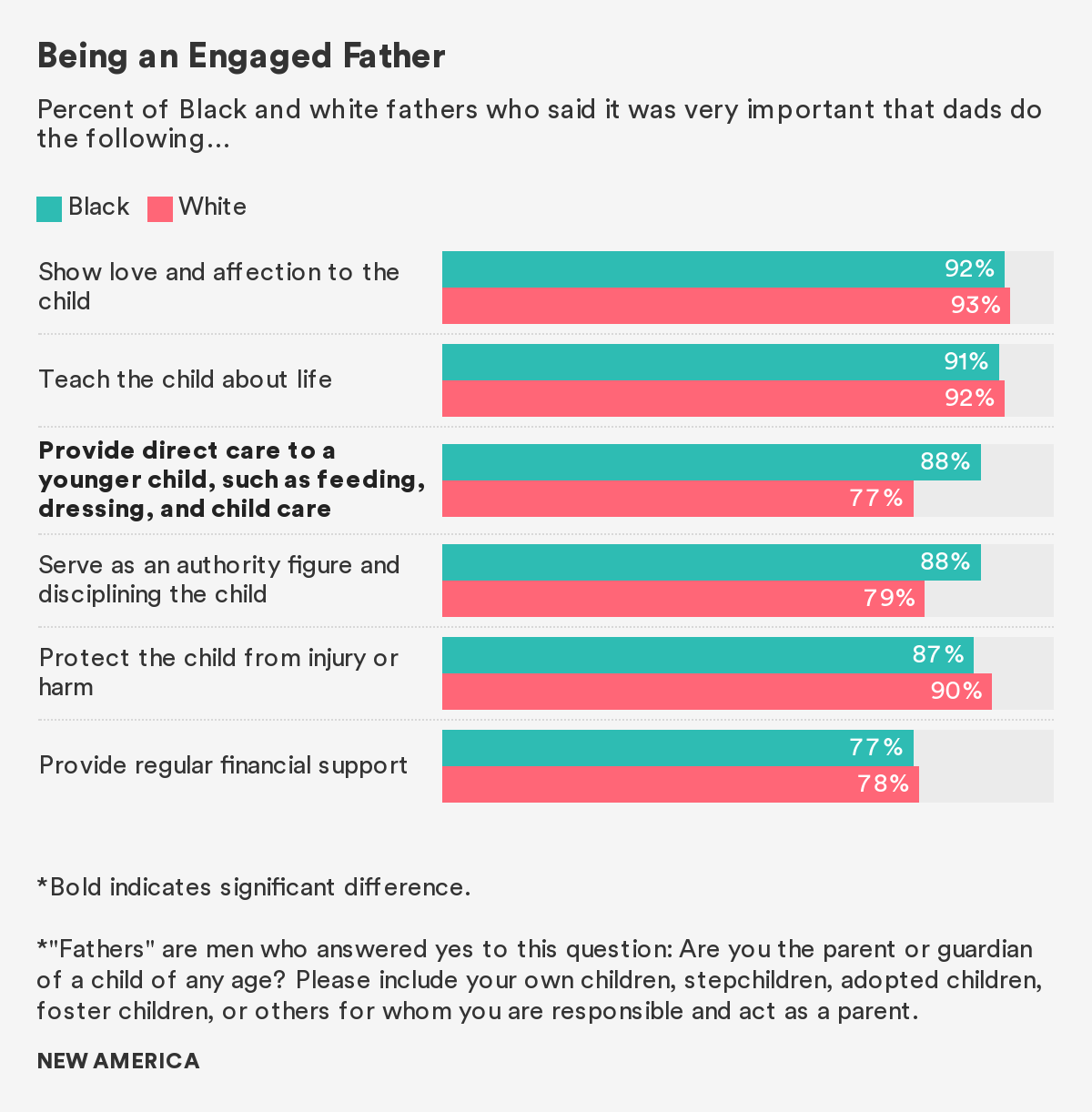
In our survey, Black fathers and white fathers have similar values around caring for their children. At least 90 percent of fathers of both races say that it is very important for fathers to teach their children about life and to show them love and affection. At least 85 percent of Black and white fathers say it is important for a father to protect his child from injury or harm. More than 70 percent of fathers in both racial groups say it is important to serve as an authority figure and to provide financial support.
However, one significant difference our survey found between the two groups of fathers in their parenting priorities was that more Black fathers (88 percent) than white fathers (77 percent) think that it’s very important that men are active in raising younger children by way of feeding them, dressing them, and providing childcare.
A majority of Black fathers are highly involved in caring for and raising their young children on a daily basis.
This study finds that more than two-thirds (69 percent) of Black fathers say they comfort, soothe, and emotionally support their children every day. Sixty-seven percent make meals and feed their kids daily, and 63 percent engage their children in play.
In addition to performing these hands-on tasks for their kids, Black fathers assist with other parenting duties necessary for maintaining a household suitable to raising children and family life. Within the domestic realm, 61 percent handle household chores daily and 62 percent provide transportation. A majority of Black fathers monitor their children’s educational progress and development: 59 percent take part in educational activities like managing homework, reading to their children, or attending parent-teacher conferences. Among Black fathers, 43 percent manage schedules regularly.
This study found no significant differences between Black and white fathers in terms of the parenting tasks they perform. Similar percentages of both groups feed, comfort, supervise, and provide transportation to their children.
Unfortunately, Black fathers and white fathers are also similar in that more than one-quarter of them say they encounter barriers that make it difficult for them to be the fathers they would like to be.
In our survey, more than 40 percent of fathers of both races, who have children under the age of eight years old, think that they do not spend enough time with their children. Additionally, the same percentage of Black and white fathers (only 47 percent) have ever taken leave following the birth or adoption of a child. Despite this similarity in experiences, there is a concerning difference in terms of how Black and white fathers financially cope with taking time off from work. Although a similar percentage of Black and white fathers used savings to cover the costs associated with their recent leaves, twice as many of Black fathers (30 percent) than white fathers (15 percent) used savings they had specifically set aside for health needs to fund their paid or unpaid leave.
An inability to have full wage replacement while on leave forces parents to dig into their own financial reserves to make ends meet. Considering more Black fathers than white anticipate needing to take leave for the adoption or birth of a child (36 percent to 20 percent, respectively), the disparity in access to paid leave is even more concerning. The fact that more Black fathers have to pull from their savings demonstrates that the existing unpaid federal leave policy in the United States may have the potential to cause more harm if it serves to increase, rather than diminish, the existing racial wealth gap between Black and white families. When social policies are not created within an equitable framework, they ultimately hurt people of color most. However, understanding how existing structures and policies harm Black fathers or fail to meet their needs reveals opportunities for reforms that will likely benefit all male caregivers.
Citations
- American Psychological Association, “How Caregiving is Defined,” updated November 2020, <a href="<a href="<a href="source">source">source">source">source.
- Family Caregivers Alliance, “Definitions,” January 31, 2014, <a href="<a href="<a href="source">source">source">source">source; United States House of Representatives 115th Congress, “Recognize, Assist, Include, Support, and Engage Family Caregivers Act of 2017,” Pub. L. No. 115–119, § Two, H.R. 3759 (2018), <a href="<a href="<a href="source">source">source">source">source.
- Stephen Campbell, “Racial Disparities in the Direct Care Workforce: Spotlight on Black/African American Workers, Research Brief,” PHI, February 2018, <a href="<a href="source">source">source">source.
- Robert Espinoza, “8 Signs the Shortage in Paid Caregivers Is Getting Worse,” PHI, February 2, 2017, <a href="<a href="source">source">source">source.
- National Alliance for Caregiving and AARP, “Caregiving in the U.S. 2020 – Executive Summary,” May 2020, <a href="<a href="source">source">source">source.
- United States Census Bureau, “U.S. Census Bureau QuickFacts: United States,” last accessed December 17, 2020, <a href="<a href="source">source">source">source; National Alliance for Caregiving and AARP, Caregiving in the U.S. 2020” (Washington, D.C: National Alliance for Caregiving, May 2020), <a href="<a href="source">source">source">source
- National Alliance for Caregiving and AARP, Caregiving in the U.S. 2020.”
- Rodney Brooks, “Hidden Truth: 2.3 Million Black Men Are Family Caregivers,” Next Avenue, October 5, 2020, <a href="<a href="source">source">source">source.
- Jean Accius, Breaking Stereotypes: Spotlight on Male Family Caregivers, (Washington, D.C.: AARP, March 2017), <a href="<a href="source">source">source">source.
- International Labour Organization, “Decent Work and the Care Economy (The Care Economy),” last accessed December 17, 2020, <a href="<a href="source">source">source">source.
- Maria Johnson and Alford Jr, “Diversity and Meaning in the Study of Black Fatherhood,” Du Bois Review: Social Science Research on Race 13 (March 1, 2016): 5–23, <a href="<a href="source">source">source">source.
- Lisa Weber-Raley, Burning the Candle at Both Ends: Sandwich Generation Caregiving in the U.S., (Washington, D.C.: National Alliance for Caregiving and Caring Across Generations, November 26, 2019), <a href="source">source">source.
- Physical activities of daily living are described as the tasks essential to maintaining one’s personal hygiene, like bathing, grooming, dressing, eating, and ambulating. Instrumental activities of daily living refers to tasks essential to navigating personal affairs like paying bills, managing medication, housekeeping, etc. In our survey question, we used different language and categorized these caregiving tasks into two categories: either hands-off, or hands-on. Refer to graph for more details. (Peter F. Edemekong et al., “Activities of Daily Living,” in StatPearls (Treasure Island (FL): StatPearls Publishing, 2020), source">source.)
- National Alliance for Caregiving and AARP, Caregiving in the U.S. 2020, source">source.
- Susan C. Reinhard, Heather M. Young, Carol Levine, and Kathleen Kelly, Rita B. Choula, Jean Accius, Home Alone Revisited: Family Caregivers Providing Complex Care, (Washington, D.C.: Founders of the Home Alone Alliance, April 2019), source">source.
- Family Caregiver Alliance, “Caregiver Statistics: Demographics,” April 17, 2019, source">source.
- National Alliance for Caregiving and AARP, Caregiving in the U.S. 2020, source">source.
- Ilene C. Siegler et al., “Caregiving, Residence, Race, and Depressive Symptoms,” Aging & Mental Health 14, no. 7 (September 2010): 771–78, source">source.
- National Institutes of Health (NIH), “African Americans and Latinos Are More Likely to Be at Risk for Depression than Whites,” May 24, 2018, source">source.
- National Alliance for Caregiving, “The ‘Typical’ African American Caregiver,” Fact sheet, May 2020, source">source.
- David R. Williams, “Stress and the Mental Health of Populations of Color:Advancing Our Understanding of Race-related Stressors,” Journal of Health and Social Behavior 59, no. 4 (2018): 466–485, <a href="source">source">source">source.
- Office of the Surgeon General et al., "Chapter 2 Culture Counts: The Influence of Culture and Society on Mental Health," Mental Health: Culture, Race, and Ethnicity: A Supplement to Mental Health: A Report of the Surgeon General, (Washington, D.C.: Office of the Surgeon General), August 2001, <a href="source">source">source">source.
- Family Caregiver Alliance, "Frequently Asked Questions," last accessed December 17, 2020, source">source; ARCA National Respite Newtork and Resource Center, "Fact Sheet: Nine Steps to Respite Care for Family Caregivers of Children and Adults with Intellectual and Developmental Disabilities," March 2018, source">source.
- Administration for Community Living, “Fiscal Year 2021 – Justification of Estimates for Appropriations Committees” (U.S. Department of Health and Human, June 2020): 103, source">source; “National Family Caregiver Support Program,” ACL Administration for Community Living, November 12, 2019, source">source; “Older Americans Act,” ACL Administration for Community Living, July 21, 2020, source">source.
- The Lewin Group, Inc, Process Evaluation of the Older Americans Act Title III-E National Family Caregiver Support Program: Final Report (Washington, D.C.: The Administration for Community Living, March 2016), source">source.
- Cecilia Avison et al., Outcome Evaluation of the National Family Caregiver Support Program, (Washington, D.C.: Administration for Community Living, December 2018), source">source; Lynn Friss Feinberg, “Strengthening the National Family Caregiver Support Program: The Time Has Come,” AARP Blog, March 11, 2019, source">source.
- National Academies of Sciences, Engineering, and Medicine, Families Caring for an Aging America, (Washington, DC: The National Academies Press, 2016), source">source.
- James R. Langevin, “Actions – H.R.2035 – 116th Congress (2019-2020): Lifespan Respite Care Reauthorization Act of 2019,” webpage, July 25, 2019, source">source.
- Policy Division of the ARCH National Respite Network, “Reauthorize Lifespan Respite,” last updated December 10, 2020, source">source.
- AARP, “New State Law to Help Family Caregivers,” accessed December 17, 2020, source">source.
- Ellen Ernst Kossek et al., “Leveraging Workplace Flexibility for Engagement and Productivity,” Effective Practice Guidelines Series (Alexandria, VA: Society for Human Resource Management, 2014), source">source.
- Ellen Ernst Kossek et al., “Leveraging Workplace Flexibility for Engagement and Productivity,” source">source.
- Gov.UK, “Flexible Working,” source">source, accessed December 17, 2020.; David Chiu, “San Francisco Family Friendly Workplace Ordinance Legislative Fact Sheet,” San Francisco Board of Supervisors, accessed December 17, 2020, source">source.
- Amanda Lenhart, Haley Swenson, and Brigid Schulte, “Lifting the Barriers to Paid Family and Medical Leave for Men in the United States” (Washington, D.C.: New America, December 4, 2019), source">source.
- Vicki Shabo, “Explainer: Paid and Unpaid Leave Policies in the U.S.,” New America, December 14, 2020, source">source.
- Eugene Scalia and William W. Beach, “National Compensation Survey: Employee Benefits in the United States” (Washington, D.C.: U.S. Bureau of Labor Statistics, March 2020), source">source; Trish Stroman et al., “Why Paid Family Leave Is Good Business” (Boston: Boston Consulting Group, February 2017), source">source.
- Deloitte, “Deloitte Survey: Less Than Half Of People Surveyed Feel Their Organization Helps Men Feel Comfortable Taking Parental Leave,” Cision PR NewsWire, July 15, 2016, source">source.
- Amanda Lenhart, Haley Swenson, and Brigid Schulte, “Lifting the Barriers to Paid Family and Medical Leave for Men in the United States,” source">source; “Working Dads across the United States Want Better Paid Family Leave.,” PL+US, June 16, 2019, source">source.
- AEI-Brookings Working Group and on Paid Family Leave, “The AEI-Brookings Working Group Report on Paid Family and Medical Leave” (Washington, D.C.: American Enterprise Institute and Brookings Institution, September 2018), source">source.
- Caroline Kranabetter and Cornelia Niessen, “Managers as Role Models for Health: Moderators of the Relationship of Transformational Leadership with Employee Exhaustion and Cynicism,” Journal of Occupational Health Psychology 22, no. 4 (2017): 492–502, source">source.
- Cory A. Booker, “Text – S.3878 – 116th Congress (2019-2020): Protecting Family Caregivers from Discrimination Act of 2020,” webpage, June 3, 2020, 2019/2020, source">source.
- Elise Gould and Valerie Wilson, “Black Workers Face Two of the Most Lethal Preexisting Conditions for Coronavirus—Racism and Economic Inequality,” (Washington, D.C.: Economic Policy Institute, June 1, 2020,) source">source.
- Valerie Wilson, “Racism and the Economy: Focus on Employment,” Working Economics Blog, Economic Policy Institute, November 21, 2020, source">source.
- Consumer and Community Research Section of the Federal Reserve Board’s Division of Consumer and, and Community Affairs (DCCA), “Update on the Economic Well-Being of U.S. Households: July 2020 Results,” (Washington, D.C.: Federal Reserve Board, September 2020), source">source.
- Aria Florant et al., “The Case for Accelerating Financial Inclusion in Black Communities,” McKinsey & Company, February 25, 2020, source">source.
- Angela Hanks, Danyelle Solomon, and Christian E. Weller, “Systematic Inequality: How America’s Structural Racism Helped Create the Black-White Wealth Gap” (Washington, D.C.: Center for American Progress, February 21, 2018), source">source.
- Diversity Data Kids, “Making Leave Affordable,” February 2018, source">source.
- Ta-Nehisi Coates, “50 Years After the Moynihan Report, Examining the Black Family in the Age of Mass Incarceration,” The Atlantic, October 2015, source.
- Rashad Robinson and Nicole Sussner Rodgers, Changing the Narrative about Black Families (Oakland California: Color of Change and Family Story, October 13, 2020), source; Evi Taylor et al., “The Historical Perspectives of Stereotypes on African-American Males,” Journal of Human Rights and Social Work 4, no. 3 (September 1, 2019): 213–25, source.
- Joy Moses, “Moving Away from Racial Stereotypes in Poverty Policy” (Washington, D.C.: Center for American Progress, February 2012), source; Ann Cammett, “Deadbeat Dads & Welfare Queens: How Metaphor Shapes Poverty Law,” Boston College Journal of Law & Social Justice 34, no. 2 (May 22, 2014): 233.
- Social Welfare History Project, “Act to Prohibit the Importation of Slaves 1807,” December 5, 2015, source.
- National Museum of African American History and Culture, “The Historical Legacy of Juneteenth,” June 19, 2019,source.
- William Andrew Todd, “Convict Lease System,” New Georgia Encyclopedia, July 16, 2020, source; “What Is Convict Leasing?” Exhibit, Sugar Land Convict Leasing – Woodson Research Center, source; Ta-Nehisi Coates, “The Case for Reparations,” The Atlantic, June 2014, source.
- Linda Gordon, “Aid To Dependent Children: The Legal History,” Social Welfare History Project, January 19, 2011, source.
- Center for Law and Social Policy, “Fatherhood and Families” (Washington, D.C.: Center for Law and Social Policy, n.d.), source.
- Jo Jones and William D. Mosher, “Fathers’ Involvement With Their Children: United States, 2006–2010,” National Health Statistics Report (Atlanta: Center for Disease Control and Prevention, December 20, 2013), source.
Implications
When it comes to attitudes and experiences related to care, our findings show that few differences exist between Black and white men who are high-intensity caregivers and/or parents, and between Black and white fathers. The finding about fathers, in particular, further disrupts stubborn narratives that attribute adverse social and economic outcomes to the “absent Black father,” a myth that obscures the very real impact of systemic racism, the main driver of inequity. Moreover, a major takeaway of this study is that Black men are crucial to the health and wellbeing of their families and the development of young children. However, without adequate access to workplace accommodations and paid leave, Black men face barriers to fulfilling the role of caregiver or father. Especially in 2021, the publication year of this report, the need for family-supportive policies that meet the needs of Black men with care responsibilities proves urgent.
The United States in 2020 went through one of the most challenging years in the nation’s recent history. By December 2020, the COVID-19 virus had infected more than 14 million people and led to the loss of 274,00 lives,. The pandemic also precipitated an economic recession, resulting in high unemployment rates, which peaked at a staggering 14 percent in April of 2020.57 As eviction rates shot up and food banks increased their supply to meet the growing demand, across the nation, workers and families weathered tremendous financial, emotional, and personal losses. While the pandemic left no corner of the U.S. population untouched, it had a disproportionate impact on Black households. Although Black people constitute just 13.4 percent of the U.S. population, they accounted for more than one-quarter of all COVID-19 related hospitalizations and continue to face heightened risk of death or illness due to higher occurrences of health complications, like chronic disease.58
Public health officials tie these stark disparate racial health outcomes to social determinants of health, the social conditions which inform our physical, mental, and communal well being. These determinants, outlined by the Office of Disease Prevention and Promotion, include economic stability, education, social and community context, health and health care, and neighborhood or built environment.59 COVID-19 has worsened the financial well-being, housing security, educational opportunity and health of Black families and workers. All determinants are in some way informed by the presence or absence of social policies like paid family and medical leave.
Federal lawmakers had an opportunity to address these health inequities through coronavirus legislation aimed at providing job-protected leave, but only scratched the surface. The legislation Congress did pass in 2020, though momentous in that it included paid sick days and paid family medical leave provisions, excluded many workers in low-paying occupations and in the health sector, which are disproportionately staffed by people of color.60 These federal benefits, if universally accessible, would have likely supported even more Black men, who would have been able to use leave to care for family members who contracted the virus. A greater number of Black caregivers, regardless of their occupation, could have used emergency paid leave to care for older adults who could no longer access professional caregiving services like, adult day care. More Black fathers could have also used the leave to assist their school-age children with virtual schooling or provide needed supervision for young children in the absence of accessible childcare services. Too many Black families lacked access to job-protected paid family leave when they needed it most.
This report demonstrates that Black men perform valuable unpaid care work for the people in their lives and play an integral role in promoting the wellbeing of Black families. Before the pandemic, especially during the pandemic, and certainly after the pandemic, policymakers and employers must implement equity centered family-supportive policies and programs that acknowledge the caregiving responsibilities of Black men. It’s a matter of racial, economic, and health justice.
Citations
- American Psychological Association, “How Caregiving is Defined,” updated November 2020, <a href="<a href="<a href="<a href="source">source">source">source">source">source.
- Family Caregivers Alliance, “Definitions,” January 31, 2014, <a href="<a href="<a href="<a href="source">source">source">source">source">source; United States House of Representatives 115th Congress, “Recognize, Assist, Include, Support, and Engage Family Caregivers Act of 2017,” Pub. L. No. 115–119, § Two, H.R. 3759 (2018), <a href="<a href="<a href="<a href="source">source">source">source">source">source.
- Stephen Campbell, “Racial Disparities in the Direct Care Workforce: Spotlight on Black/African American Workers, Research Brief,” PHI, February 2018, <a href="<a href="<a href="source">source">source">source">source.
- Robert Espinoza, “8 Signs the Shortage in Paid Caregivers Is Getting Worse,” PHI, February 2, 2017, <a href="<a href="<a href="source">source">source">source">source.
- National Alliance for Caregiving and AARP, “Caregiving in the U.S. 2020 – Executive Summary,” May 2020, <a href="<a href="<a href="source">source">source">source">source.
- United States Census Bureau, “U.S. Census Bureau QuickFacts: United States,” last accessed December 17, 2020, <a href="<a href="<a href="source">source">source">source">source; National Alliance for Caregiving and AARP, Caregiving in the U.S. 2020” (Washington, D.C: National Alliance for Caregiving, May 2020), <a href="<a href="<a href="source">source">source">source">source
- National Alliance for Caregiving and AARP, Caregiving in the U.S. 2020.”
- Rodney Brooks, “Hidden Truth: 2.3 Million Black Men Are Family Caregivers,” Next Avenue, October 5, 2020, <a href="<a href="<a href="source">source">source">source">source.
- Jean Accius, Breaking Stereotypes: Spotlight on Male Family Caregivers, (Washington, D.C.: AARP, March 2017), <a href="<a href="<a href="source">source">source">source">source.
- International Labour Organization, “Decent Work and the Care Economy (The Care Economy),” last accessed December 17, 2020, <a href="<a href="<a href="source">source">source">source">source.
- Maria Johnson and Alford Jr, “Diversity and Meaning in the Study of Black Fatherhood,” Du Bois Review: Social Science Research on Race 13 (March 1, 2016): 5–23, <a href="<a href="<a href="source">source">source">source">source.
- Lisa Weber-Raley, Burning the Candle at Both Ends: Sandwich Generation Caregiving in the U.S., (Washington, D.C.: National Alliance for Caregiving and Caring Across Generations, November 26, 2019), <a href="<a href="source">source">source">source.
- Physical activities of daily living are described as the tasks essential to maintaining one’s personal hygiene, like bathing, grooming, dressing, eating, and ambulating. Instrumental activities of daily living refers to tasks essential to navigating personal affairs like paying bills, managing medication, housekeeping, etc. In our survey question, we used different language and categorized these caregiving tasks into two categories: either hands-off, or hands-on. Refer to graph for more details. (Peter F. Edemekong et al., “Activities of Daily Living,” in StatPearls (Treasure Island (FL): StatPearls Publishing, 2020), <a href="source">source">source.)
- National Alliance for Caregiving and AARP, Caregiving in the U.S. 2020, <a href="source">source">source.
- Susan C. Reinhard, Heather M. Young, Carol Levine, and Kathleen Kelly, Rita B. Choula, Jean Accius, Home Alone Revisited: Family Caregivers Providing Complex Care, (Washington, D.C.: Founders of the Home Alone Alliance, April 2019), <a href="source">source">source.
- Family Caregiver Alliance, “Caregiver Statistics: Demographics,” April 17, 2019, <a href="source">source">source.
- National Alliance for Caregiving and AARP, Caregiving in the U.S. 2020, <a href="source">source">source.
- Ilene C. Siegler et al., “Caregiving, Residence, Race, and Depressive Symptoms,” Aging & Mental Health 14, no. 7 (September 2010): 771–78, <a href="source">source">source.
- National Institutes of Health (NIH), “African Americans and Latinos Are More Likely to Be at Risk for Depression than Whites,” May 24, 2018, <a href="source">source">source.
- National Alliance for Caregiving, “The ‘Typical’ African American Caregiver,” Fact sheet, May 2020, <a href="source">source">source.
- David R. Williams, “Stress and the Mental Health of Populations of Color:Advancing Our Understanding of Race-related Stressors,” Journal of Health and Social Behavior 59, no. 4 (2018): 466–485, <a href="<a href="source">source">source"><a href="source">source">source.
- Office of the Surgeon General et al., "Chapter 2 Culture Counts: The Influence of Culture and Society on Mental Health," Mental Health: Culture, Race, and Ethnicity: A Supplement to Mental Health: A Report of the Surgeon General, (Washington, D.C.: Office of the Surgeon General), August 2001, <a href="<a href="source">source">source"><a href="source">source">source.
- Family Caregiver Alliance, "Frequently Asked Questions," last accessed December 17, 2020, <a href="source">source">source; ARCA National Respite Newtork and Resource Center, "Fact Sheet: Nine Steps to Respite Care for Family Caregivers of Children and Adults with Intellectual and Developmental Disabilities," March 2018, <a href="source">source">source.
- Administration for Community Living, “Fiscal Year 2021 – Justification of Estimates for Appropriations Committees” (U.S. Department of Health and Human, June 2020): 103, <a href="source">source">source; “National Family Caregiver Support Program,” ACL Administration for Community Living, November 12, 2019, <a href="source">source">source; “Older Americans Act,” ACL Administration for Community Living, July 21, 2020, <a href="source">source">source.
- The Lewin Group, Inc, Process Evaluation of the Older Americans Act Title III-E National Family Caregiver Support Program: Final Report (Washington, D.C.: The Administration for Community Living, March 2016), <a href="source">source">source.
- Cecilia Avison et al., Outcome Evaluation of the National Family Caregiver Support Program, (Washington, D.C.: Administration for Community Living, December 2018), <a href="source">source">source; Lynn Friss Feinberg, “Strengthening the National Family Caregiver Support Program: The Time Has Come,” AARP Blog, March 11, 2019, <a href="source">source">source.
- National Academies of Sciences, Engineering, and Medicine, Families Caring for an Aging America, (Washington, DC: The National Academies Press, 2016), <a href="source">source">source.
- James R. Langevin, “Actions – H.R.2035 – 116th Congress (2019-2020): Lifespan Respite Care Reauthorization Act of 2019,” webpage, July 25, 2019, <a href="source">source">source.
- Policy Division of the ARCH National Respite Network, “Reauthorize Lifespan Respite,” last updated December 10, 2020, <a href="source">source">source.
- AARP, “New State Law to Help Family Caregivers,” accessed December 17, 2020, <a href="source">source">source.
- Ellen Ernst Kossek et al., “Leveraging Workplace Flexibility for Engagement and Productivity,” Effective Practice Guidelines Series (Alexandria, VA: Society for Human Resource Management, 2014), <a href="source">source">source.
- Ellen Ernst Kossek et al., “Leveraging Workplace Flexibility for Engagement and Productivity,” <a href="source">source">source.
- Gov.UK, “Flexible Working,” <a href="source">source">source, accessed December 17, 2020.; David Chiu, “San Francisco Family Friendly Workplace Ordinance Legislative Fact Sheet,” San Francisco Board of Supervisors, accessed December 17, 2020, <a href="source">source">source.
- Amanda Lenhart, Haley Swenson, and Brigid Schulte, “Lifting the Barriers to Paid Family and Medical Leave for Men in the United States” (Washington, D.C.: New America, December 4, 2019), <a href="source">source">source.
- Vicki Shabo, “Explainer: Paid and Unpaid Leave Policies in the U.S.,” New America, December 14, 2020, <a href="source">source">source.
- Eugene Scalia and William W. Beach, “National Compensation Survey: Employee Benefits in the United States” (Washington, D.C.: U.S. Bureau of Labor Statistics, March 2020), <a href="source">source">source; Trish Stroman et al., “Why Paid Family Leave Is Good Business” (Boston: Boston Consulting Group, February 2017), <a href="source">source">source.
- Deloitte, “Deloitte Survey: Less Than Half Of People Surveyed Feel Their Organization Helps Men Feel Comfortable Taking Parental Leave,” Cision PR NewsWire, July 15, 2016, <a href="source">source">source.
- Amanda Lenhart, Haley Swenson, and Brigid Schulte, “Lifting the Barriers to Paid Family and Medical Leave for Men in the United States,” <a href="source">source">source; “Working Dads across the United States Want Better Paid Family Leave.,” PL+US, June 16, 2019, <a href="source">source">source.
- AEI-Brookings Working Group and on Paid Family Leave, “The AEI-Brookings Working Group Report on Paid Family and Medical Leave” (Washington, D.C.: American Enterprise Institute and Brookings Institution, September 2018), <a href="source">source">source.
- Caroline Kranabetter and Cornelia Niessen, “Managers as Role Models for Health: Moderators of the Relationship of Transformational Leadership with Employee Exhaustion and Cynicism,” Journal of Occupational Health Psychology 22, no. 4 (2017): 492–502, <a href="source">source">source.
- Cory A. Booker, “Text – S.3878 – 116th Congress (2019-2020): Protecting Family Caregivers from Discrimination Act of 2020,” webpage, June 3, 2020, 2019/2020, <a href="source">source">source.
- Elise Gould and Valerie Wilson, “Black Workers Face Two of the Most Lethal Preexisting Conditions for Coronavirus—Racism and Economic Inequality,” (Washington, D.C.: Economic Policy Institute, June 1, 2020,) <a href="source">source">source.
- Valerie Wilson, “Racism and the Economy: Focus on Employment,” Working Economics Blog, Economic Policy Institute, November 21, 2020, <a href="source">source">source.
- Consumer and Community Research Section of the Federal Reserve Board’s Division of Consumer and, and Community Affairs (DCCA), “Update on the Economic Well-Being of U.S. Households: July 2020 Results,” (Washington, D.C.: Federal Reserve Board, September 2020), <a href="source">source">source.
- Aria Florant et al., “The Case for Accelerating Financial Inclusion in Black Communities,” McKinsey & Company, February 25, 2020, <a href="source">source">source.
- Angela Hanks, Danyelle Solomon, and Christian E. Weller, “Systematic Inequality: How America’s Structural Racism Helped Create the Black-White Wealth Gap” (Washington, D.C.: Center for American Progress, February 21, 2018), <a href="source">source">source.
- Diversity Data Kids, “Making Leave Affordable,” February 2018, <a href="source">source">source.
- Ta-Nehisi Coates, “50 Years After the Moynihan Report, Examining the Black Family in the Age of Mass Incarceration,” The Atlantic, October 2015, source">source.
- Rashad Robinson and Nicole Sussner Rodgers, Changing the Narrative about Black Families (Oakland California: Color of Change and Family Story, October 13, 2020), source">source; Evi Taylor et al., “The Historical Perspectives of Stereotypes on African-American Males,” Journal of Human Rights and Social Work 4, no. 3 (September 1, 2019): 213–25, source">source.
- Joy Moses, “Moving Away from Racial Stereotypes in Poverty Policy” (Washington, D.C.: Center for American Progress, February 2012), source">source; Ann Cammett, “Deadbeat Dads & Welfare Queens: How Metaphor Shapes Poverty Law,” Boston College Journal of Law & Social Justice 34, no. 2 (May 22, 2014): 233.
- Social Welfare History Project, “Act to Prohibit the Importation of Slaves 1807,” December 5, 2015, source">source.
- National Museum of African American History and Culture, “The Historical Legacy of Juneteenth,” June 19, 2019,source">source.
- William Andrew Todd, “Convict Lease System,” New Georgia Encyclopedia, July 16, 2020, source">source; “What Is Convict Leasing?” Exhibit, Sugar Land Convict Leasing – Woodson Research Center, source">source; Ta-Nehisi Coates, “The Case for Reparations,” The Atlantic, June 2014, source">source.
- Linda Gordon, “Aid To Dependent Children: The Legal History,” Social Welfare History Project, January 19, 2011, source">source.
- Center for Law and Social Policy, “Fatherhood and Families” (Washington, D.C.: Center for Law and Social Policy, n.d.), source">source.
- Jo Jones and William D. Mosher, “Fathers’ Involvement With Their Children: United States, 2006–2010,” National Health Statistics Report (Atlanta: Center for Disease Control and Prevention, December 20, 2013), source">source.
- Bureau of Labor Statistics, U.S. Department of Labor, “Unemployment Rate Rises to Record High 14.7 Percent in April 2020,” May 13, 2020, source.
- Tracie White, “More than Half of In-Hospital Deaths from COVID-19 among Black, Hispanic Patients, Study Finds,” Stanford Medicine News Center, November 17, 2020, source.
- Office of Disease Prevention and Health Promotion, “Social Determinants of Health,” updated November 8, 2020, source.
- Center for Law and Social Policy, "Fact Sheet: Paid Sick Days and Paid Leave Provisions in FFCRA and CARES Act," May 6, 2020, source.
Conclusion
This report paints a portrait of caring Black men, rendering them visible by showing who they are, what they do, how they feel about their caregiving experience, and how they fit care into their lives. In their roles caring for adults or children with special needs, Black men who fulfill the role of high-intensity caregiver and/or parent are actively engaged in helping care recipients with activities of daily living as well as medical and health related tasks. Almost two-thirds of Black male HICPs have performed tasks that meet the daily and/or medical needs of care recipients.
Work is one major barrier that renders high-intensity care work challenging. Leaders in both the private and public sector will need to implement policies and practices amenable to the needs of Black male HICPs. Nearly half of all Black men providing high-intensity care anticipate needing to take leave for caregiving in the future. While half of all Black male HICPs also experience stress and work-family conflict, the vast majority find caregiving satisfying and feel respected as caregivers. Moving forward, further study should be done to investigate the experiences of Black male HICPs along the lines of income, geographic location, sexual orientation, and age.
Black men provide essential support and services to ensure the health and wellbeing of children with special needs and adults. As parents, Black fathers are actively engaged in raising the next generation. Ultimately, this report seeks to include Black men in the larger conversation around care and parenting to ensure that their experiences are represented, their labor is valued as part of the care economy, and their needs are acknowledged in ongoing family-supportive policymaking.
Citations
- American Psychological Association, “How Caregiving is Defined,” updated November 2020, <a href="<a href="<a href="<a href="<a href="source">source">source">source">source">source">source.
- Family Caregivers Alliance, “Definitions,” January 31, 2014, <a href="<a href="<a href="<a href="<a href="source">source">source">source">source">source">source; United States House of Representatives 115th Congress, “Recognize, Assist, Include, Support, and Engage Family Caregivers Act of 2017,” Pub. L. No. 115–119, § Two, H.R. 3759 (2018), <a href="<a href="<a href="<a href="<a href="source">source">source">source">source">source">source.
- Stephen Campbell, “Racial Disparities in the Direct Care Workforce: Spotlight on Black/African American Workers, Research Brief,” PHI, February 2018, <a href="<a href="<a href="<a href="source">source">source">source">source">source.
- Robert Espinoza, “8 Signs the Shortage in Paid Caregivers Is Getting Worse,” PHI, February 2, 2017, <a href="<a href="<a href="<a href="source">source">source">source">source">source.
- National Alliance for Caregiving and AARP, “Caregiving in the U.S. 2020 – Executive Summary,” May 2020, <a href="<a href="<a href="<a href="source">source">source">source">source">source.
- United States Census Bureau, “U.S. Census Bureau QuickFacts: United States,” last accessed December 17, 2020, <a href="<a href="<a href="<a href="source">source">source">source">source">source; National Alliance for Caregiving and AARP, Caregiving in the U.S. 2020” (Washington, D.C: National Alliance for Caregiving, May 2020), <a href="<a href="<a href="<a href="source">source">source">source">source">source
- National Alliance for Caregiving and AARP, Caregiving in the U.S. 2020.”
- Rodney Brooks, “Hidden Truth: 2.3 Million Black Men Are Family Caregivers,” Next Avenue, October 5, 2020, <a href="<a href="<a href="<a href="source">source">source">source">source">source.
- Jean Accius, Breaking Stereotypes: Spotlight on Male Family Caregivers, (Washington, D.C.: AARP, March 2017), <a href="<a href="<a href="<a href="source">source">source">source">source">source.
- International Labour Organization, “Decent Work and the Care Economy (The Care Economy),” last accessed December 17, 2020, <a href="<a href="<a href="<a href="source">source">source">source">source">source.
- Maria Johnson and Alford Jr, “Diversity and Meaning in the Study of Black Fatherhood,” Du Bois Review: Social Science Research on Race 13 (March 1, 2016): 5–23, <a href="<a href="<a href="<a href="source">source">source">source">source">source.
- Lisa Weber-Raley, Burning the Candle at Both Ends: Sandwich Generation Caregiving in the U.S., (Washington, D.C.: National Alliance for Caregiving and Caring Across Generations, November 26, 2019), <a href="<a href="<a href="source">source">source">source">source.
- Physical activities of daily living are described as the tasks essential to maintaining one’s personal hygiene, like bathing, grooming, dressing, eating, and ambulating. Instrumental activities of daily living refers to tasks essential to navigating personal affairs like paying bills, managing medication, housekeeping, etc. In our survey question, we used different language and categorized these caregiving tasks into two categories: either hands-off, or hands-on. Refer to graph for more details. (Peter F. Edemekong et al., “Activities of Daily Living,” in StatPearls (Treasure Island (FL): StatPearls Publishing, 2020), <a href="<a href="source">source">source">source.)
- National Alliance for Caregiving and AARP, Caregiving in the U.S. 2020, <a href="<a href="source">source">source">source.
- Susan C. Reinhard, Heather M. Young, Carol Levine, and Kathleen Kelly, Rita B. Choula, Jean Accius, Home Alone Revisited: Family Caregivers Providing Complex Care, (Washington, D.C.: Founders of the Home Alone Alliance, April 2019), <a href="<a href="source">source">source">source.
- Family Caregiver Alliance, “Caregiver Statistics: Demographics,” April 17, 2019, <a href="<a href="source">source">source">source.
- National Alliance for Caregiving and AARP, Caregiving in the U.S. 2020, <a href="<a href="source">source">source">source.
- Ilene C. Siegler et al., “Caregiving, Residence, Race, and Depressive Symptoms,” Aging & Mental Health 14, no. 7 (September 2010): 771–78, <a href="<a href="source">source">source">source.
- National Institutes of Health (NIH), “African Americans and Latinos Are More Likely to Be at Risk for Depression than Whites,” May 24, 2018, <a href="<a href="source">source">source">source.
- National Alliance for Caregiving, “The ‘Typical’ African American Caregiver,” Fact sheet, May 2020, <a href="<a href="source">source">source">source.
- David R. Williams, “Stress and the Mental Health of Populations of Color:Advancing Our Understanding of Race-related Stressors,” Journal of Health and Social Behavior 59, no. 4 (2018): 466–485, <a href="<a href="<a href="source">source">source">source"><a href="<a href="source">source">source">source.
- Office of the Surgeon General et al., "Chapter 2 Culture Counts: The Influence of Culture and Society on Mental Health," Mental Health: Culture, Race, and Ethnicity: A Supplement to Mental Health: A Report of the Surgeon General, (Washington, D.C.: Office of the Surgeon General), August 2001, <a href="<a href="<a href="source">source">source">source"><a href="<a href="source">source">source">source.
- Family Caregiver Alliance, "Frequently Asked Questions," last accessed December 17, 2020, <a href="<a href="source">source">source">source; ARCA National Respite Newtork and Resource Center, "Fact Sheet: Nine Steps to Respite Care for Family Caregivers of Children and Adults with Intellectual and Developmental Disabilities," March 2018, <a href="<a href="source">source">source">source.
- Administration for Community Living, “Fiscal Year 2021 – Justification of Estimates for Appropriations Committees” (U.S. Department of Health and Human, June 2020): 103, <a href="<a href="source">source">source">source; “National Family Caregiver Support Program,” ACL Administration for Community Living, November 12, 2019, <a href="<a href="source">source">source">source; “Older Americans Act,” ACL Administration for Community Living, July 21, 2020, <a href="<a href="source">source">source">source.
- The Lewin Group, Inc, Process Evaluation of the Older Americans Act Title III-E National Family Caregiver Support Program: Final Report (Washington, D.C.: The Administration for Community Living, March 2016), <a href="<a href="source">source">source">source.
- Cecilia Avison et al., Outcome Evaluation of the National Family Caregiver Support Program, (Washington, D.C.: Administration for Community Living, December 2018), <a href="<a href="source">source">source">source; Lynn Friss Feinberg, “Strengthening the National Family Caregiver Support Program: The Time Has Come,” AARP Blog, March 11, 2019, <a href="<a href="source">source">source">source.
- National Academies of Sciences, Engineering, and Medicine, Families Caring for an Aging America, (Washington, DC: The National Academies Press, 2016), <a href="<a href="source">source">source">source.
- James R. Langevin, “Actions – H.R.2035 – 116th Congress (2019-2020): Lifespan Respite Care Reauthorization Act of 2019,” webpage, July 25, 2019, <a href="<a href="source">source">source">source.
- Policy Division of the ARCH National Respite Network, “Reauthorize Lifespan Respite,” last updated December 10, 2020, <a href="<a href="source">source">source">source.
- AARP, “New State Law to Help Family Caregivers,” accessed December 17, 2020, <a href="<a href="source">source">source">source.
- Ellen Ernst Kossek et al., “Leveraging Workplace Flexibility for Engagement and Productivity,” Effective Practice Guidelines Series (Alexandria, VA: Society for Human Resource Management, 2014), <a href="<a href="source">source">source">source.
- Ellen Ernst Kossek et al., “Leveraging Workplace Flexibility for Engagement and Productivity,” <a href="<a href="source">source">source">source.
- Gov.UK, “Flexible Working,” <a href="<a href="source">source">source">source, accessed December 17, 2020.; David Chiu, “San Francisco Family Friendly Workplace Ordinance Legislative Fact Sheet,” San Francisco Board of Supervisors, accessed December 17, 2020, <a href="<a href="source">source">source">source.
- Amanda Lenhart, Haley Swenson, and Brigid Schulte, “Lifting the Barriers to Paid Family and Medical Leave for Men in the United States” (Washington, D.C.: New America, December 4, 2019), <a href="<a href="source">source">source">source.
- Vicki Shabo, “Explainer: Paid and Unpaid Leave Policies in the U.S.,” New America, December 14, 2020, <a href="<a href="source">source">source">source.
- Eugene Scalia and William W. Beach, “National Compensation Survey: Employee Benefits in the United States” (Washington, D.C.: U.S. Bureau of Labor Statistics, March 2020), <a href="<a href="source">source">source">source; Trish Stroman et al., “Why Paid Family Leave Is Good Business” (Boston: Boston Consulting Group, February 2017), <a href="<a href="source">source">source">source.
- Deloitte, “Deloitte Survey: Less Than Half Of People Surveyed Feel Their Organization Helps Men Feel Comfortable Taking Parental Leave,” Cision PR NewsWire, July 15, 2016, <a href="<a href="source">source">source">source.
- Amanda Lenhart, Haley Swenson, and Brigid Schulte, “Lifting the Barriers to Paid Family and Medical Leave for Men in the United States,” <a href="<a href="source">source">source">source; “Working Dads across the United States Want Better Paid Family Leave.,” PL+US, June 16, 2019, <a href="<a href="source">source">source">source.
- AEI-Brookings Working Group and on Paid Family Leave, “The AEI-Brookings Working Group Report on Paid Family and Medical Leave” (Washington, D.C.: American Enterprise Institute and Brookings Institution, September 2018), <a href="<a href="source">source">source">source.
- Caroline Kranabetter and Cornelia Niessen, “Managers as Role Models for Health: Moderators of the Relationship of Transformational Leadership with Employee Exhaustion and Cynicism,” Journal of Occupational Health Psychology 22, no. 4 (2017): 492–502, <a href="<a href="source">source">source">source.
- Cory A. Booker, “Text – S.3878 – 116th Congress (2019-2020): Protecting Family Caregivers from Discrimination Act of 2020,” webpage, June 3, 2020, 2019/2020, <a href="<a href="source">source">source">source.
- Elise Gould and Valerie Wilson, “Black Workers Face Two of the Most Lethal Preexisting Conditions for Coronavirus—Racism and Economic Inequality,” (Washington, D.C.: Economic Policy Institute, June 1, 2020,) <a href="<a href="source">source">source">source.
- Valerie Wilson, “Racism and the Economy: Focus on Employment,” Working Economics Blog, Economic Policy Institute, November 21, 2020, <a href="<a href="source">source">source">source.
- Consumer and Community Research Section of the Federal Reserve Board’s Division of Consumer and, and Community Affairs (DCCA), “Update on the Economic Well-Being of U.S. Households: July 2020 Results,” (Washington, D.C.: Federal Reserve Board, September 2020), <a href="<a href="source">source">source">source.
- Aria Florant et al., “The Case for Accelerating Financial Inclusion in Black Communities,” McKinsey & Company, February 25, 2020, <a href="<a href="source">source">source">source.
- Angela Hanks, Danyelle Solomon, and Christian E. Weller, “Systematic Inequality: How America’s Structural Racism Helped Create the Black-White Wealth Gap” (Washington, D.C.: Center for American Progress, February 21, 2018), <a href="<a href="source">source">source">source.
- Diversity Data Kids, “Making Leave Affordable,” February 2018, <a href="<a href="source">source">source">source.
- Ta-Nehisi Coates, “50 Years After the Moynihan Report, Examining the Black Family in the Age of Mass Incarceration,” The Atlantic, October 2015, <a href="source">source">source.
- Rashad Robinson and Nicole Sussner Rodgers, Changing the Narrative about Black Families (Oakland California: Color of Change and Family Story, October 13, 2020), <a href="source">source">source; Evi Taylor et al., “The Historical Perspectives of Stereotypes on African-American Males,” Journal of Human Rights and Social Work 4, no. 3 (September 1, 2019): 213–25, <a href="source">source">source.
- Joy Moses, “Moving Away from Racial Stereotypes in Poverty Policy” (Washington, D.C.: Center for American Progress, February 2012), <a href="source">source">source; Ann Cammett, “Deadbeat Dads & Welfare Queens: How Metaphor Shapes Poverty Law,” Boston College Journal of Law & Social Justice 34, no. 2 (May 22, 2014): 233.
- Social Welfare History Project, “Act to Prohibit the Importation of Slaves 1807,” December 5, 2015, <a href="source">source">source.
- National Museum of African American History and Culture, “The Historical Legacy of Juneteenth,” June 19, 2019,<a href="source">source">source.
- William Andrew Todd, “Convict Lease System,” New Georgia Encyclopedia, July 16, 2020, <a href="source">source">source; “What Is Convict Leasing?” Exhibit, Sugar Land Convict Leasing – Woodson Research Center, <a href="source">source">source; Ta-Nehisi Coates, “The Case for Reparations,” The Atlantic, June 2014, <a href="source">source">source.
- Linda Gordon, “Aid To Dependent Children: The Legal History,” Social Welfare History Project, January 19, 2011, <a href="source">source">source.
- Center for Law and Social Policy, “Fatherhood and Families” (Washington, D.C.: Center for Law and Social Policy, n.d.), <a href="source">source">source.
- Jo Jones and William D. Mosher, “Fathers’ Involvement With Their Children: United States, 2006–2010,” National Health Statistics Report (Atlanta: Center for Disease Control and Prevention, December 20, 2013), <a href="source">source">source.
- Bureau of Labor Statistics, U.S. Department of Labor, “Unemployment Rate Rises to Record High 14.7 Percent in April 2020,” May 13, 2020, source">source.
- Tracie White, “More than Half of In-Hospital Deaths from COVID-19 among Black, Hispanic Patients, Study Finds,” Stanford Medicine News Center, November 17, 2020, source">source.
- Office of Disease Prevention and Health Promotion, “Social Determinants of Health,” updated November 8, 2020, source">source.
- Center for Law and Social Policy, "Fact Sheet: Paid Sick Days and Paid Leave Provisions in FFCRA and CARES Act," May 6, 2020, source">source.
More About the Authors