
Challenges to Parties in the United States and Beyond
Didi Kuo
Does democracy require parties, and if so, what are the consequences of weaker parties on democratic governance? At its simplest, democracy is a set of formal institutions and rules that govern how citizens select leaders and hold them to account. The relationship between citizens and government, however, is indirect. Representative democracy relies on parties to do most of the work of organizing politics. Parties groom and select candidates for office, coordinate election campaigns, and mobilize and educate voters. They also respond to voters’ needs by devising and passing policies, through deliberation and consensus.
The history of representative democracy is inextricably intertwined with that of parties. In the United States, the founders were wary of parties but were unsuccessful in keeping parties out of national politics. Proto-party factions predated mass suffrage in many countries of western Europe, and became the primary vehicle to integrate citizens into democratic politics. In many other regions of the world, party building has been a challenging and critical component of democratic transition itself. Strong parties serve democracy, and there has long been a relationship between robust, stable party systems and successful democratic1 and economic2 outcomes.
Inside and outside the United States, parties continue to be central to democracy. They command significant financial resources, have become more ideologically cohesive, and, of course, continue to win elections. Money and partisanship, however, do not make for strong parties. As Julia Azari has written, what makes today’s politics so volatile is the precise combination of weak parties and strong partisanship.3
This series of essays for Polyarchy shows that parties have weakened over time in two respects. The first is that they no longer perform as significant a role as gatekeepers in the political process, particularly over candidate selection. Changes to the party nomination process, combined with new communications technologies, make it easier for candidates to run outside the party system.
Second, parties’ capacity to respond to the needs of voters has declined. The erosion of local parties, civic associations, and trade unions makes it harder for parties to maintain connections to voters. Parties also shifted their bases of support in the late twentieth century away from working-class interests toward more educated and affluent interests.
After the “third way” politics of the 1990s, parties came to broad agreement over many aspects of economic policy. On areas as varied as trade, welfare austerity, and corporate and financial regulation, parties embraced, to varying degrees, neoliberal approaches. The narrowed space for policy contestation led the noted political scientist Peter Mair to lament that4 “the age of party democracy has passed.”
The implications of these changes—of less party gatekeeping and less responsiveness—are significant. When parties perform their duties effectively, they integrate citizens into politics,5 keep radical candidates out of power,6 and negotiate between7 competing powerful interests. As these essays make clear, however, there are real concerns about the role of parties today. Weaker parties have significant consequences: They make democracy more vulnerable to instability, backsliding, and insurgent candidates.
Further, distrust in parties makes it harder for citizens to understand the value of democracy itself, since parties are a crucial vehicle for citizen mobilization and education. When parties are not responsive to the demands of citizens, they make it more likely that citizens will find fault with all of democratic government, rather than simply with parties themselves.
The Decline of Trust in Parties
Parties have long been considered imperfect vehicles of democracy. In the early years of the American republic, the founders decried the perils of faction. George Washington warned of the “baneful effects” and “constant danger” of parties in his farewell address, arguing that they served to inflame anger and jealousy, or as conduits of corruption. Centuries later, Dwight D. Eisenhower claimed that unless parties advanced “a cause that is right and that is moral,” it is not a party at all—only a “conspiracy to seize power.”
Citizens now report record levels of distrust in parties as part of a slow decline in trust in government more generally. Fewer than 20 percent8 of Americans report that they can trust the government to do what is right most of the time. After the federal government shutdown of 2013, trust in Congress plummeted to a mere 7 percent, although it has been low since the financial crisis.
While these trends parallel a decline in trust across institutions, including the media, big business, and organized religion, they also relate to partisanship. Republicans are more likely to trust government when their party is in power, and less likely to trust it when out of power; the same is true for Democrats.
Parties have also become more ideologically cohesive in the United States. While this kind of polarization is often useful in helping voters identify a clear party of the left and right, partisanship today has resulted not in more trust in parties, but more antipathy. Political rhetoric has grown more hostile, and negotiation and compromise between the parties seems, at times, impossible. Among voters, partisans increasingly map their social identities onto their partisan ones. As a result, Liliana Mason finds that Democratic and Republican voters are less willing to accept compromise.
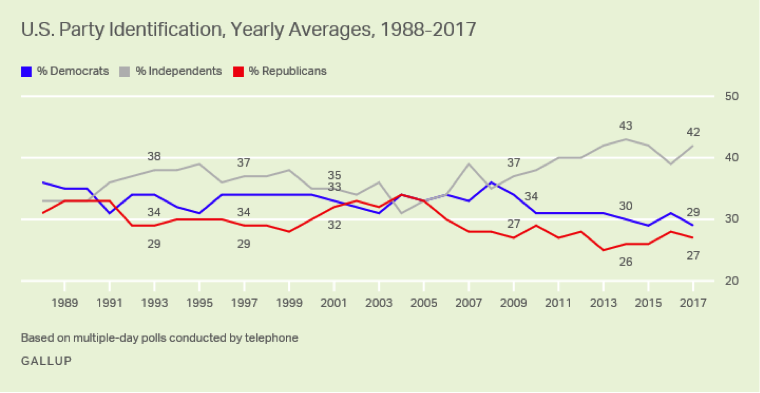
Intense partisans stand in contrast to those who feel turned off by partisanship. Voters identifying as independents now outnumber those who identify as Republicans or Democrats, and the share of independents in the electorate has been rising steadily. What are the effects of these trends in party identification? In a study of self-identified independents9, Samara Klar and Yanna Krupnikov show that while some independent voters may lean toward one of the main parties, they are not reliable partisans. Instead, they are likely to be alienated from parties and politics and to be more concerned with, say, corruption than with policy issues, such as the economy or health care.
Unease with parties is not limited to the United States. In western European countries, where party membership is often formalized—party members pay dues and receive formal party benefits—partisan voters are also on the decline. Party membership has been reduced by nearly half 10since 1980; this trend is particularly pronounced in the Nordic countries, France, Italy, and Britain. Party members’ educational and professional backgrounds are similar to those of party elites, and party members are also more likely to work in the public sector than non-party members; they are not representative11 of the broader population. Sheri Berman’s history of social democratic parties12 shows how these parties have pivoted away from the organizational forms that once defined them.

Voters’ ambivalence towards established parties is often attributed to changes beyond the scope of domestic politics. Globalization, economic inequality, declines in manufacturing, immigration, and a new assertiveness among illiberal leaders all play a role in voter discontent. However, in this period, party organizations themselves have remained robust. Parties run sophisticated operations with large paid staff, professional party elites, and a network of affiliated public relations and marketing firms. Parties maintain sophisticated databases of their supporters; there is an industry of firms that help with outreach and mobilization. This prioritization of electoral strategy has traded off, however, with parties’ ability to serve as gatekeepers, and to respond to the needs of voters.
Gatekeeping
One reason for the robust empirical relationship between strong parties and stable democracy is related to the important role that parties perform as gatekeepers. Party leaders have a stake in the longevity of the party itself, rather than any individual politician. Because democracy is a repeated game, party leaders have incentives to sustain party organizations across successive elections. Political parties therefore function as gatekeepers in the democratic process, keeping radical candidates and ideas out of mainstream politics. Daniel Ziblatt’s history of conservative parties13 in Europe found that strong parties—those with salaried professionals and widespread local associations—were able to contain reactionary forces, while weak parties were instead susceptible to them.
Candidates in the United States and Europe almost always run under the banner of a party, and party leaders tend to support candidates who have a chance of winning. This has often entailed choosing moderates over extremists. However, the candidate selection process has become distorted by a number of factors.
First, American and European parties have adopted more internal democracy, letting members choose candidates instead of relying on party elites alone. This has undermined the traditional role of party elites in candidate selection, and it is this plebiscitary trend,14 according to Frances Rosenbluth and Ian Shapiro, that makes it impossible for party leaders to form consensus over nominees and policies.
In How Democracies Die,15 Ziblatt and Levitsky lay the blame for the rise of political outsiders squarely on the inability of parties to manage candidate selection. Daniel Schlozman and Sam Rosenfeld’s history of the Democratic Party16 shows how the McGovern-Fraser reformers sought to wrest control of the party from a small group of party bosses, which led voters to make greater participation synonymous with legitimacy.
Another challenge to gatekeeping is money in politics. Parties used to have more control over financing of campaigns and party activities. The world of campaign finance, however, has become more diffuse. The Bipartisan Campaign Finance Reform Act limited the soft money parties could raise and use, and a series of Supreme Court decisions protects political money as a constitutional right.
There are debates about what this means for parties. While there is some evidence17 that states that allow parties greater control over financing elect more moderate politicians, others argue that the diffuse world of finance is simply an extension of party18 control. Regardless, candidates for office now face a set of stakeholders and donors beyond their own parties and constituencies. Outside groups can also perform many of the duties once left to parties, including campaign advertising and get-out-the-vote efforts.
A final challenge to gatekeeping has to do with technology and the ease with which outsiders can connect with voters. The internet and social media provide individual candidates with cheap forms of outreach, circumventing traditional ways of coming up through the party system. The Five Star party in Italy, which has the most seats in Parliament, began as an internet party.
These new candidates are not always extremists; Emmanuel Macron’s La République En Marche was a new party, as was the party of Slovakia’s new president, the activist and reformer Zuzana Caputova. In March, the Ukrainian actor Volodymyr Zelensky won the presidency; much of his campaign was organized online. Donald Trump, already a celebrity in his own right, relied (and continues to rely) heavily on direct communication with voters through Twitter. Technology reduces the barriers to entry for new politicians who can outflank parties, therefore undermining the ability of parties to claim they are necessary gatekeepers in politics.
Responsiveness
In addition to playing less of an important role as gatekeepers, parties also do not serve the representative functions that they once did. Historically, parties were created to represent distinct interests among citizens—working-class and labor interests, landowning and business interests, rural and urban constituencies, etc. Not only did they sustain ties to these groups at the local level, but they also reflected these interests in the policies they pursued. Both of these mechanisms of responsiveness have eroded, as parties focus increasingly on professional services and national elections, and as many areas of policy have been removed from the legislative arena.
As Berman argues, social democratic parties were once embedded in the quotidian lives of voters: They provided educational and job opportunities, scholarships, and leisure activities. Parties were organizing principles for local communities. And while the United States does not have a history of social democratic parties, American parties used to be much more robust networks of state and local organizations. These mid-century parties institutionalized relationships with professional and civic associations.
The decline of unions and civic associations has therefore had a profound impact on parties across the advanced industrial nations. In the United States, a proliferation in right-to-work laws across conservative states has had the effect of reducing19 both the vote share and labor contributions to Democrats. Union membership is also associated with greater representation20 of working-class interests in policy.
Finally, policymaking itself has changed. Many policy issues fall outside the scope of public deliberation and contestation, which leaves parties with few ways to demonstrate responsiveness in the form of policy. The European Union makes decisions about trade, migration, and economic policy that affect its member states, but its connection to domestic voters is highly attenuated.
Ironically, the European Union has indirectly assisted the rise of new parties (particularly on the far right), which emerged to compete in elections to the European Parliament. In the 2014 European parliamentary elections, the UK Independence Party won more seats than the Conservative or Labour parties; the far-right Alternative for Germany and Swedish Democrats and the populist-left Podemos party in Spain also won seats that year. Parties in the European Parliament receive financing and party-building resources that they can use to influence national elections.
While no similar dynamic exists in the United States, the scope of policymaking has nonetheless contracted due to centrist politics that produced greater consensus over economic and social policy between the parties. In the 1990s, center-left parties in the United States and western Europe embraced lowered trade barriers, greater financial integration, welfare retrenchment, deregulation, and privatization. Lily Geismer traces the roots of this Democratic move to the right, showing how a new generation of Democrats embraced neoliberalism21 and mobilized educated, urban professionals. When the ideological distinctions between parties become blurred, voters are more likely to reject22 parties altogether.
Thirty years ago, the Italian political scientist Angelo Panebianco described a future of “electoral-professional parties”23 that outsourced candidate selection and policy to interest groups and bureaucrats, while focusing on services (such as advertising and polling) for candidates. This represented a dramatic shift from the mass organizational parties that served critical functions of gatekeeping and representation in politics. Today, the foremost theory24 of American parties concedes this basic premise, describing parties as mere groups of policy demanders rather than robust organizations that connect citizens to their governments.
But the rich history of parties both in and outside the United States tells us that successful democratic outcomes are dependent on the strength of parties. These parties need institutionalized mechanisms to absorb citizen demands, and need to use the levers of policy to respond. Further, they need greater control over aspects of representative government—including the cultivation and selection of candidates, and the ability to negotiate and compromise—that voters feel are increasingly broken.
Although it is hard to see how we might go back to the organizationally dense parties of the mid-century, party reformers must prioritize shoring up the capacities of parties in order to forestall greater public disaffection with democracy.
Citations
- Scott Mainwaring and Timothy R. Scully, Building Democratic Institutions:Party Systems in Latin America (Palo Alto, CA: Stanford University Press, 1995).
- Fernando Bizzarro, John Gerring, and Carl Henrik Hudson et al, “Party Strength and Economic Growth,” World Politics 70(2) (April 2018): 275-320.
- Julia Azari, “Weak parties and strong partisanship are a bad combination,” Vox, November 3, 2016, source
- Peter Mair, Ruling the Void: The Hollowing of Western Democracies (London: Verso, 2013).
- Nancy L. Rosenblum, On the Side of Angels: An Appreciation of Parties and Partisanship (Princeton, NJ: Princeton University Press, 2008).
- Daniel Ziblatt, Conservative Parties and the Birth of Democracy (Cambridge, UK: Cambridge University Press, 2017).
- Nathaniel Persily, Solutions to Political Polarization in America (New York: Cambridge University Press, 2015).
- Pew Research Center, Public Trust in Government 1958-2019, (Washington D.C., Pew Research Center, April 2019).
- Samara Klarr, Independent Politics: How American Disdain for Parties Leads to Political Inaction (Cambridge, UK: Cambridge University Press, 2016).
- Ingrid Van Biezen, Peter Mair, Thomas Poguntke, “Going, going…gone? The decline of part membership in contemporary Europe,” European Journal of Political Research 51(1) (May 2011): 24-56. source
- Susan Scarrow, Beyond Party Members: Changing Approaches to Partisan Mobilization (Oxford, UK: Oxford University Press, 2015).
- Sheri Berman, “The development and decay of democracy,” Vox, June 18, 2019, source
- Daniel Ziblatt, Conservative Parties and the Birth of Democracy (Cambridge, UK: Cambridge University Press, 2017).
- Frances Rosenbluth and Ian Shapiro, Responsible Parties: Saving Democracy from Itself (New Haven, CT: Yale University Press, 2018).
- Steven Levitsky and Daniel ZIblatt, How Democracies Die (New York: Broadway Books, 2019).
- Sam Rosenfeld and Daniel Schlozman, “The dilemmas for Democrats in 3 past visions for the party,” Vox, June 13, 2019,
- Raymond J. La Raja and Brian F. Schaffner, Campaign Finance and Political Polarization: When Purists Prevail (Ann Arbor, MI: University of Michigan Press, 2015).
- Thomas E. Mann and Anthony Corrado, Party Polarization and Campaign Finance, (Washington DC: Brookings, 2014). source
- James Feigenbaum, Alexander Hertel-Fernandez, and Vanessa Williamson, From the Bargaining Table to the Ballot Box: Political Effects of Right to Work Laws, (Washington, DC: The National Bureau of Economic Research, 2018), source
- Patrick Falvin, “ Labor Union Strength and the Equality of Political Representation” British Journal of Political Science 48(4) (October 2018) 1075–1091. source
- Lily Geismer, “Democrats and neoliberalism,” Vox, June 11, 2019, source
- Noam Lupu, Party Brands in Crisis: Partisanship, Brand Dilution, and the Breakdown of Political Parties in Latin America (Cambridge, UK: Cambridge University Press, 2015).
- Angelo Banebianco, Political Parties: Organization and Power, (Cambridge, UK: Cambridge University Press, 2003).
- Kathleen Bawn, Martin Cohen, David Karol, Seth Masket, Hans Noel, and John Zaller, “A Theory of Political Parties: Groups, Policy Demands and Nominations in American Politics,” Perspectives on Politics 10(3) (September 2012): 571–597, doi:10.1017/S1537592712001624.