Political Parties: What Are They Good For?
Abstract
How democratic do political parties have to be to serve democracy? Parties receive much of the blame for the current crisis of democracy. At times, they are decried for being undemocratic: Party elites are described as out of touch with voters, currying favor with donors, special interests, and ideological extremists at the expense of the majority of citizens. Yet they are also criticized for being too democratic, valuing electoral expediency over all else, refusing to place principle over party.
In this series, leading scholars of parties and politics update this long debate by looking at American parties as they stand today, and what the future might hold. Across Europe and the United States, Didi Kuo shows that parties face ongoing challenges related to responsiveness and gatekeeping. In the next essay, Sheri Berman traces the specific decline of social democracy across Western Europe. While social democratic parties once relied on everyday ties—through grassroots associations and party meetings, for example—to their members, these ties began to erode. As she argues, this had significant consequences for democracy itself. Though the United States does not have a traditional social democratic party, Daniel Schlozman and Sam Rosenfeld describe the fractured Democratic party of the 1960s, and the way reformers embraced internal party democracy—at the expense of party control. Lily Geismer traces how factions such as the Atari Democrats and Democratic Leadership Council modernized the party by mobilizing new social bases of support and offering policies that combined elements of social democracy with neoliberal economics. Finally, as a result of these developments, social issues and identity have assumed a new prominence in politics, as Lily Mason, John V. Kane, and Julia Wronski demonstrate.
Acknowledgments
This report originated as individual posts on the Vox blog “Polyarchy,” based on a selection of papers prepared for a conference organized by Didi Kuo. The resulting series was edited by Lee Drutman, Mark Schmitt, and Didi Kuo.
Many thanks to Vox editor Tanya Pai for her editorial work and facilitation help. Thanks to our New America communication team, Maria Elkin, Joe Wilkes, Joanne Zalatoris, LuLin McArthur, and Alison Yost, for their help preparing this report; to Monica Estrada for her help with footnotes; and to Elena Souris for packaging the report.
Downloads
Introduction
Didi Kuo
How democratic do political parties have to be to serve democracy? Parties receive much of the blame for the current crisis of democracy. At times, they are decried for being undemocratic: Party elites are described as out of touch with voters, currying favor with donors, special interests, and ideological extremists at the expense of the majority of citizens. Yet they are also criticized for being too democratic, valuing electoral expediency over all else, refusing to place principle over party.
Political parties are still the central organizing feature of modern democracy. Every aspect of representative government—from assessing what voters need, to fielding candidates, to assembling coalitions for policy passage—is mediated through parties. But the fact that parties are crucial to democracy also makes us ambivalent about the role they play, historically and through the present day.
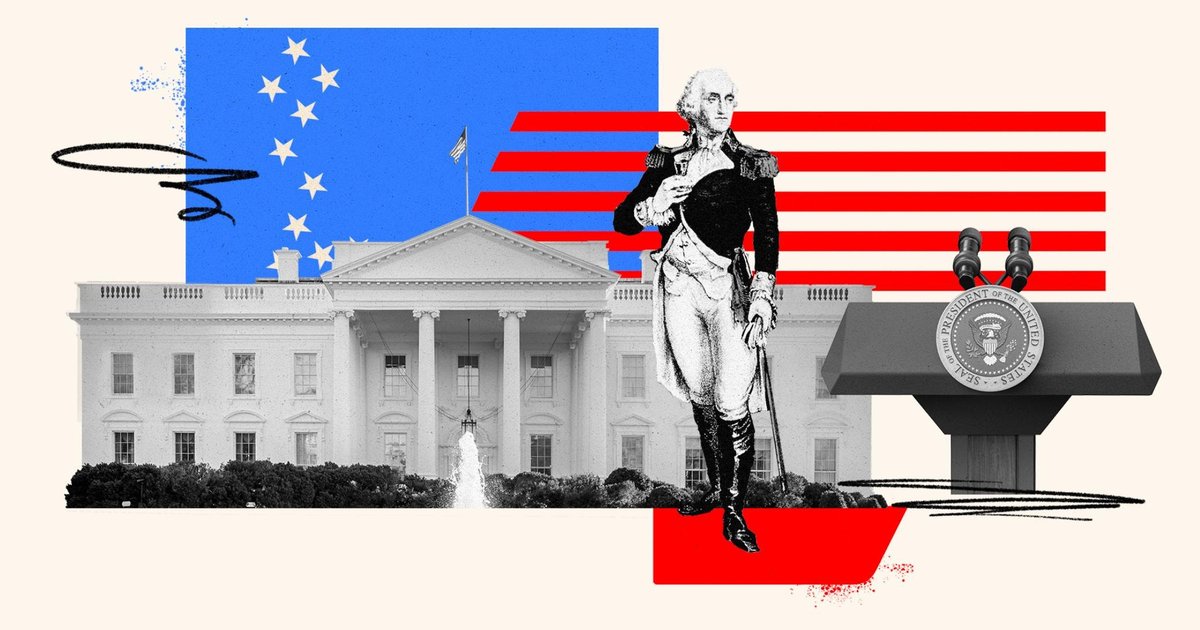
Democracy is a set of institutions that places checks on power, while the pursuit of power is often a party’s raison d’etre. President Dwight D. Eisenhower once argued that this pursuit of power was justified only if a party’s cause was “right” and “moral.” His sentiment echoed a longstanding fear that parties are incompatible with democracy. In the Federalist Papers, James Madison warned about the dangers of faction. In his Farewell Address, President George Washington railed against parties for enfeebling public administration, kindling animosity and riot, and opening the door to corruption.And it was a study of German parties that led sociologist Robert Michels to develop the iron law of oligarchy, a theory that all organizations tend to centralize power among a small elite. Voters, for their part, have also become more wary of parties over time. Today, the growing distrust of parties fits a larger pattern of declining faith in formal and informal democratic institutions across the advanced democracies.
Yet parties are also crucial to democracy. They have been the vehicles for leaders, ideologies, and groups to expand the state’s rights and obligations, to grow the economy, to protect new and marginalized citizens, and to broker compromises between extremism and moderation. At the local level, parties have been particularly important as sources of information and education. Parties help individuals organize their complex political views and interests, and work collectively.
But owing to the developments of the past 50 years, voters today are more likely to identify drawbacks of party politics than any of these benefits. After Watergate and the economic crises of the 1970s, trust in government began to decline. The rise of polarization and inequality date to this period, as the parties became more ideologically cohesive. Economic policies also drove a shift away from manufacturing, towards freer trade and globalization. Parties devoted more resources to national campaigns and elections, rather than local and state party organizations. In an era of fewer unions, civic associations, and local parties, the connections between citizens and parties became even more tenuous.
In this series, leading scholars of parties and politics update this long debate by looking at American parties as they stand today, and what the future might hold. Across Europe and the United States, Didi Kuo shows that parties face ongoing challenges related to responsiveness and gatekeeping. In the next essay, Sheri Berman traces the specific decline of social democracy across Western Europe. While social democratic parties once relied on everyday ties—through grassroots associations and party meetings, for example—to their members, these ties began to erode. As she argues, this had significant consequences for democracy itself. Though the United States does not have a traditional social democratic party, Daniel Schlozman and Sam Rosenfeld describe the fractured Democratic party of the 1960s, and the way reformers embraced internal party democracy—at the expense of party control. Lily Geismer traces how factions such as the Atari Democrats and Democratic Leadership Council modernized the party by mobilizing new social bases of support and offering policies that combined elements of social democracy with neoliberal economics. Finally, as a result of these developments, social issues and identity have assumed a new prominence in politics, as Lily Mason, John V. Kane, and Julia Wronski demonstrate.
As these papers show, the consequences of party decline are significant. Given the scale of contemporary political challenges, and a rising tide of illiberalism at home and abroad, the question of how governments connect with their citizens is paramount. Ultimately, to shore up liberal democracy, political parties will need to reestablish their commitments to voters, and better secure their position as pillars of our democractic system.
The Development and Decay of Democracy
Sheri Berman
Over the past generation, party systems in Europe have changed radically as new parties on the left and especially the populist right1 have increased their vote share at the expense2 of traditional parties of the center-right and center-left. The decline of the latter has been particularly dramatic.3 In some European countries, social democratic parties have practically disappeared from the political scene, and even in former strongholds like Germany and Scandinavia their vote shares are at historic lows. The fate of social democracy should worry not only those on the left, but anyone concerned with democracy in Europe.
European socialist parties were the first “modern” parties, progenitors of a type of political organization that would play a critical role in making democracy work. In addition, during the late nineteenth and early twentieth centuries, social democratic parties were the most forceful advocates of democratization, and after the Second World War the stabilization of liberal, capitalist democracy in Europe depended critically on them.
It is simply impossible, in short, to understand the development of democracy in Europe during the late nineteenth and first two-thirds of the twentieth century without paying careful attention to social democratic parties. It is also impossible to understand the challenges facing democracy in Europe today without understanding how these parties have changed over the past decades. In particular, the organizational decay and watering down of social democratic parties’ traditional economic profiles contributed to growing political disenchantment and disengagement, the increasing salience of social and cultural issues in political life, and the rise of populism in many European countries.
Organizational Innovators and Champions of Democracy
Up through the late nineteenth century, most European parties had little in the way of formal or permanent organization, internal discipline, or strong ties to voters. This was because few democracies existed at this time—with very few men (women were not enfranchised until the 20th century) eligible to vote in most European countries, extensive internal organization, ties to civil society associations, cultivating members, and retaining their loyalty was unnecessary.
During the second half of the nineteenth century, however, a large working class emerged in Europe, but was for the most part excluded from political power. Lacking direct political influence and subject to harassment by the authorities, power and protection could only come through organization and discipline. And so in contrast to most liberal and conservative parties, as socialist parties anchored in the working class developed during the late nineteenth century, they developed strong internal organizations, extensive grassroots networks, disciplined activists, ties to civil society associations (primarily but not exclusively unions), and educational and cultural programs that created encompassing “subcultures” that in turn generated what we would today call deeply partisan loyalties or identities.
These parties provided workers—the disenfranchised and disadvantaged of the day—with a political “voice” or champion, as well as the solidarity, loyalty, and commitment necessary for a long-term struggle against a deeply unjust political and economic status-quo. The German Social Democratic Party (SPD) epitomized this model. The SPD’s hold over its members would make an extreme Republican partisan green with envy. As one famous study put it, so extensive and encompassing was the SPD’s organization that its supporters could live in it “from cradle to grave”:
An SPD member could read the party’s newspapers, borrow from its book clubs, drink in its pubs, keep fit in its gyms, sing in its choral societies, play in its orchestra, take part in its … theater organizations, compete in its chess clubs and join, if a woman, the SPD women’s movement and if young, the youth organization. When members were ill, they would receive help from the Working Men’s Samaritan Federation. When they died, they would be cremated by a social democratic burial club.4
The astonishing breadth and ambition of this new type of political organization was directly related to its sweeping aspirations: preparing the working class for the struggle to change the world. The SPD’s first program5 called for a slew of practical reforms including freedom of association, speech, and thought; an end to child labor and other laws protecting workers; free and universal education; and democratization.
Indeed, in the decades before the First World War, socialist parties were the most forceful and consistent advocates of democratization. Conservatives, of course, rejected democratization, but liberals were wary of it as well. They favored giving the vote to the educated middle class but generally opposed universal suffrage because they feared empowering workers would lead to “tyranny of the majority” and threats to their property and prerogatives.
Social Democratic Foundations of Successful Democracy in Europe
The end of the First World War unleashed a wave of democratization across Europe but few of these new democracies survived the interwar period6. It was only after the Second World War that stable liberal democracy became the norm in western Europe. A significant reason for this was that a social democratic understanding of the relationship between capitalism and democracy came to dominate not only the left, but other mainstream parties as well.
This shift was based on a recognition that for democracy to finally succeed in western Europe, the social conflicts and divisions that had fed left- and right-wing extremism and helped scuttle democracy in the past would have to be confronted head-on. In addition, the experience of the Great Depression—where capitalism’s failures produced social chaos, conflict, and growing support for Communism and fascism—led many to accept that political stability required avoiding economic catastrophes and ensuring that the benefits of growth were shared equitably.
After 1945, accordingly, western European nations constructed a new political-economic order that differed greatly from what liberals preferred, namely as free a rein for markets and as small a role for states as possible, as well as what communists and democratic socialists advocated, namely an end to capitalism. Instead, after 1945 capitalism remained, but it was capitalism of a very different type than had existed before the war, one tempered and limited by a democratic state that openly committed to protecting citizens from markets’ most destructive and destabilizing consequences.
This social democratic order worked remarkably well: The 30 years after 1945 were Europe’s fastest period of growth ever while economic inequality7 declined and social mobility increased. This, in turn, undermined support for radicalism. In another remarkable shift from the interwar period when European party systems had been pulled to the extremes by communists on the left and fascists on the right, after 1945 European party systems became dominated by parties of the center-left and center-right that accepted the legitimacy of liberal capitalist democracy.
Social Democratic Decline and Challenges to Democracy
During the last decades of the twentieth century, however, social democratic parties changed in dramatic ways, weakening them and the democracies they were embedded in.
By the late 1970s and 1980s the organizational features pioneered by social democratic parties and adopted by other traditional political parties—extensive grassroots networks, ties to civil society associations, committed activists, immense memberships,8 and so on—began to decline, hindering their ability to link citizens to governments, mobilize them for elections and other types of political activity, facilitate information flows from the grassroots to leadership, and determine what issues dominated the political agenda. The result was growing electoral9 volatility10 and political disengagement,11 which probably contributed to growing disillusionment with political institutions overall,12 as well as accelerating the role played by the media in providing information to citizens and setting the political agenda.
During the late twentieth century, social democracy’s programmatic profile also shifted, as the party watered down or even abandoned its commitment to the postwar social democratic consensus, instead embracing much of the emerging new neoliberal one. This shift had profound political consequences.
First and most obviously, it is an essential part of the backstory of the rise of the populist-right.
Most European right-wing populist parties have their roots in the 1970s and 1980s, during the period when social democratic and other traditional parties began losing hold of their voters. But initially most new-right parties, including the French National Front, the Austrian Freedom Party, the Italian League, and the Danish Progress Party, had conservative economic profiles: They favored lower taxes, a smaller state, and cutbacks to welfare programs. In the late 1980s, for example, Jean-Marie Le Pen boasted13 that he had adopted the principles of Reaganomics and Thatcherism before they became fashionable. But social democracy’s economic shift created a golden opportunity for these parties.
Voters from low socioeconomic backgrounds like workers and those with low levels of education have always been fairly conservative on social and cultural issues; they also, however, generally have left-wing economic preferences. As long as right-wing populists advocated conservative economic policies (and flirted openly with fascism, which was universally rejected by European voters), voters with left-wing economic preferences would have trouble voting for them. But social democracy’s economic shift during the late twentieth century, along with growing discontent generated by the fallout from neoliberalism and then the financial/euro crisis, created incentives for these parties to shift course.
And indeed, by the early twenty-first century, all populist right parties had altered their profiles, breaking ties with fascist movements and anti-democratic individuals and moving left economically. Almost all of these parties now advocate strong states, protectionism, social safety nets, and so on. Once the populist-right underwent this reorientation, voters with conservative social views and left-wing economic preferences no longer had to choose between them when deciding how to vote. Given this, it is not surprising that many voters who in an earlier era would have voted for the left, most notably workers, shifted to the populist-right.14 So dramatic has this shift been that in many European countries, including France and Austria, right-populist parties rather than social democratic ones are now the largest “working-class” parties in their systems.
But social democracy’s watering down or even abandonment of its previous economic profile also helped the populist-right in another way: by increasing the salience of social issues in political competition.
As social democracy’s economic profile grew less distinct, party leaders had an incentive to stress non-economic issues to distinguish themselves from competitors. By the late twentieth century, accordingly, social democratic parties became increasingly associated with support for immigration, multiculturalism, etc. This coincided with and was probably partially caused by a shift in the nature of center-left party leadership toward a highly educated elite15 whose preferences, particularly on issues like immigration, cultural change, and the EU, diverged greatly from those of their traditional voters16 and who presented their parties and their goals in technocratic, managerial terms.
Voters also, of course, had reason to focus increasing attention on social issues as the economic profiles of the center-left and center-right converged. (This tendency was further aggravated when center-left and center-right parties formed grand coalitions,17 making it harder for voters to distinguish their positions and enabling the populist-right to present itself as the real “political alternative.”) As one study put it, as the salience of economic issues as well as traditional parties’ differences on them,
declined in most Western European countries, the opposite trend can be identified for non-economic issues, including immigration, law-and-order, identity, and so on. These changes on the supply side of party competition cause working-class voters to base their vote decisions on their authoritarian, non-economic preferences and not—as in the past—on their left-wing economic demands.18
But shifting the focus of political competition to social issues from economic ones hurts the center-left and benefits the populist-right as well as new-left parties, like the Greens, since the latter are unified by these issues while traditional left voters are divided by them. The more political competition focuses on social issues, in other words, the harder it is for social democratic parties to build and maintain broad, cohesive electoral coalitions.
But beyond electorally disadvantaging social democratic parties, when political competition focuses on social issues, democracy can run into problems. Such issues touch on questions of morality and identity, often making them difficult to bargain and compromise over and leading some citizens to view debate and competition over them as a zero-sum game.
Social Democracy and the Future of Democracy
It is difficult, in short, to detangle the decline of social democracy from the challenges facing European democracies. In particular, social democracy’s decline raises some key questions.
The successful consolidation of democracy in western Europe after 1945 was built on a foundation of organizationally strong, moderate parties of the center-left and -right. Social democratic parties in particular had high membership levels, strong ties to civil society groups, especially unions, and committed activists. This enabled them to organize and mobilize voters, communicate effectively with the grassroots, and provide an institutionalized link between citizens and governments. But these features of social democratic and other traditional parties have declined over the past decades, raising the question of whether other parties or organizations can take over the representational, social, informational, and governance functions they provided. If not, how well can democracy function without them?
Successful democratic consolidation in Europe was also built on a social democratic consensus that committed the democratic state to tempering capitalism and protecting citizens from its most destabilizing and destructive consequences. This differed from what Marxists, communists, and democratic socialists hoped for—namely, an end to capitalism—as well as what liberals preferred—namely, as free a rein for markets as possible. But during the late twentieth century this consensus frayed, raising the question of how well democracy can function if the major players in it do not recognize the potential tensions between it and capitalism and are committed to overcoming them.
The contemporary neoliberal right believes firmly in markets but has worked to roll back the social democratic limits placed on them during the postwar era: favoring a less interventionist state, deregulation, paring back welfare protections, and so on. But this offers little to citizens suffering from stagnating incomes, inequality, and declining social mobility and is therefore ill-equipped to address their frustration, anger, and disillusionment with democracy.
The populist-right, on the other hand, forthrightly address the fears of the economically “left behind” and supports an activist state and welfare policies—but only for those it views as legitimate members of the national community. The populist-right’s welfare chauvinism is thus paired with illiberal and anti-pluralist positions, raising the question of how well democracy can function if such parties continue to gain support.
On the left, meanwhile, new-left parties like La France Insoumise and Podemos as well as major European intellectuals like Wolfgang Streeck and Thomas Piketty have brought democratic socialist and even Marxist critiques of capitalism back to the fore, questioning whether democracy and capitalism are compatible. Streeck,19 for example, forthrightly asserts that “there is an inherent conflict between democracy and capitalism” and that it is a utopian fantasy to believe they can be reconciled.
For those who believe that capitalism is necessary to ensure the economic growth and separation of economic and political power that healthy democracy requires, the growth of voices that lack a commitment to one or the other or do not believe they can be reconciled should be worrying. In the past, social democracy stood for the view that the democratic state could and should use its power to maximize capitalism’s upsides when minimizing its downsides. And it believed in organizing workers and other voters for the long-term struggle to create a better world.
The twenty-first century is, of course, different from the twentieth. But during the last century, successful democracy in Europe depended upon the organizational model and political-economic vision associated with social democracy. Whether well-functioning democracy can survive in the twenty-first century should these things disappear is a question we may now be facing.
Citations
- Timbro Authoritarian Populism Index. source
- David Keohane, “The rise of the angry voter, charted,” Financial Times, October 24, 2016. source
- Kyle Taylor, “Swedish election highlights decline of center-left parties across Western Europe,” Pew Research Center, September 12, 2018, source
- Vernon Lidtke, The Alternative Culture. Socialist Labor in Imperial Germany (Oxford, UK: Oxford University Press, 1985).
- J. H. Robinson, ed.“The Gotha Program 1875”,Readings in European History, (Boston: Ginn, 1906), 2: 617-619. In Hanover Historical Texts Project, ed. Jonathan Perry, Angela Rubenstein, and Brooke Harris. (Hannover College Department of History, 2001). source
- Sheri Berman, Democracy and Dictatorship in Europe: From the Ancien Regime to the Present Day, (New York: Oxford University Press, 1965)
- World Inequality Database. source
- Ingrid van Biezen, ”The decline in party membership across Europe means that political parties need to reconsider how they engage with the electorate,” EUROPP (Blog), The London School of Economics and Political Science, May 6th, 2013, source
- Peter Mair, The West European Party System (New York: Oxford University Press, 1990).
- Mair, 1990.
- Russell J. Dalton,The Participation Gap: Social Status and Political Inequality (Oxford, UK: Oxford University Press, 2017).
- Edelman, 2019 Edelman Trust Barometer (Edelman, 2019). source
- Jean-Marie Le Pen, L’espoir (Albatros, 1989). source
- Eelco Harteveld, “Winning the ‘losers’ but losing the ‘winners’? The electoral consequences of the radical right moving to the economic left,” Electoral Studies, no. 4 ( Aug 2016), source
- Mark Bovens and and Anchrit Wille, Diploma Democracy: The Rise of Political Meritocracy (Oxford, UK: Oxford Press, 2017).
- David Brady, John A. Ferejohn, and Aldo Paparo, “Immigration Attitudes and the Politics of Globalization,”SSRN (August 2016), source
- Kai Arzheimer and Elisabeth Carter,“Political opportunity structures and right‐wing extremist party success,” ECPR (May 2006),source
- Dennis C. Spies, “Explaining working class-support to extreme right parties: A party competition approach,” Acta Politica 48(3) (July 2013), 296-325. source
- Wolfgang Streek, “The Crises of Democratic Capitalism,” New Left Review 71 (Septmber-October 2011), source
Challenges to Parties in the United States and Beyond
Didi Kuo
Does democracy require parties, and if so, what are the consequences of weaker parties on democratic governance? At its simplest, democracy is a set of formal institutions and rules that govern how citizens select leaders and hold them to account. The relationship between citizens and government, however, is indirect. Representative democracy relies on parties to do most of the work of organizing politics. Parties groom and select candidates for office, coordinate election campaigns, and mobilize and educate voters. They also respond to voters’ needs by devising and passing policies, through deliberation and consensus.
The history of representative democracy is inextricably intertwined with that of parties. In the United States, the founders were wary of parties but were unsuccessful in keeping parties out of national politics. Proto-party factions predated mass suffrage in many countries of western Europe, and became the primary vehicle to integrate citizens into democratic politics. In many other regions of the world, party building has been a challenging and critical component of democratic transition itself. Strong parties serve democracy, and there has long been a relationship between robust, stable party systems and successful democratic1 and economic2 outcomes.
Inside and outside the United States, parties continue to be central to democracy. They command significant financial resources, have become more ideologically cohesive, and, of course, continue to win elections. Money and partisanship, however, do not make for strong parties. As Julia Azari has written, what makes today’s politics so volatile is the precise combination of weak parties and strong partisanship.3
This series of essays for Polyarchy shows that parties have weakened over time in two respects. The first is that they no longer perform as significant a role as gatekeepers in the political process, particularly over candidate selection. Changes to the party nomination process, combined with new communications technologies, make it easier for candidates to run outside the party system.
Second, parties’ capacity to respond to the needs of voters has declined. The erosion of local parties, civic associations, and trade unions makes it harder for parties to maintain connections to voters. Parties also shifted their bases of support in the late twentieth century away from working-class interests toward more educated and affluent interests.
After the “third way” politics of the 1990s, parties came to broad agreement over many aspects of economic policy. On areas as varied as trade, welfare austerity, and corporate and financial regulation, parties embraced, to varying degrees, neoliberal approaches. The narrowed space for policy contestation led the noted political scientist Peter Mair to lament that4 “the age of party democracy has passed.”
The implications of these changes—of less party gatekeeping and less responsiveness—are significant. When parties perform their duties effectively, they integrate citizens into politics,5 keep radical candidates out of power,6 and negotiate between7 competing powerful interests. As these essays make clear, however, there are real concerns about the role of parties today. Weaker parties have significant consequences: They make democracy more vulnerable to instability, backsliding, and insurgent candidates.
Further, distrust in parties makes it harder for citizens to understand the value of democracy itself, since parties are a crucial vehicle for citizen mobilization and education. When parties are not responsive to the demands of citizens, they make it more likely that citizens will find fault with all of democratic government, rather than simply with parties themselves.
The Decline of Trust in Parties
Parties have long been considered imperfect vehicles of democracy. In the early years of the American republic, the founders decried the perils of faction. George Washington warned of the “baneful effects” and “constant danger” of parties in his farewell address, arguing that they served to inflame anger and jealousy, or as conduits of corruption. Centuries later, Dwight D. Eisenhower claimed that unless parties advanced “a cause that is right and that is moral,” it is not a party at all—only a “conspiracy to seize power.”
Citizens now report record levels of distrust in parties as part of a slow decline in trust in government more generally. Fewer than 20 percent8 of Americans report that they can trust the government to do what is right most of the time. After the federal government shutdown of 2013, trust in Congress plummeted to a mere 7 percent, although it has been low since the financial crisis.
While these trends parallel a decline in trust across institutions, including the media, big business, and organized religion, they also relate to partisanship. Republicans are more likely to trust government when their party is in power, and less likely to trust it when out of power; the same is true for Democrats.
Parties have also become more ideologically cohesive in the United States. While this kind of polarization is often useful in helping voters identify a clear party of the left and right, partisanship today has resulted not in more trust in parties, but more antipathy. Political rhetoric has grown more hostile, and negotiation and compromise between the parties seems, at times, impossible. Among voters, partisans increasingly map their social identities onto their partisan ones. As a result, Liliana Mason finds that Democratic and Republican voters are less willing to accept compromise.
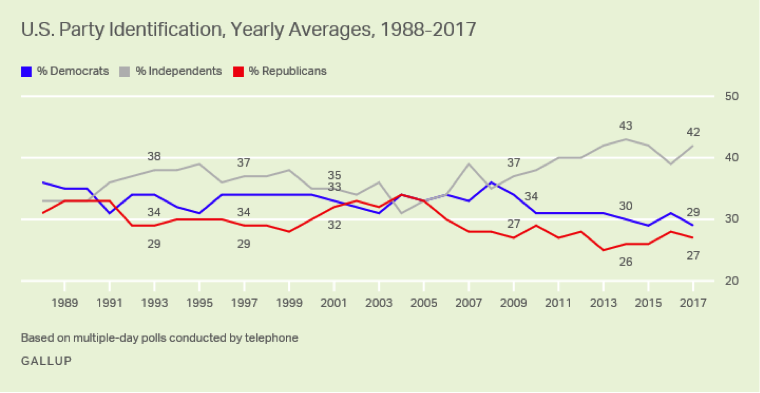
Intense partisans stand in contrast to those who feel turned off by partisanship. Voters identifying as independents now outnumber those who identify as Republicans or Democrats, and the share of independents in the electorate has been rising steadily. What are the effects of these trends in party identification? In a study of self-identified independents9, Samara Klar and Yanna Krupnikov show that while some independent voters may lean toward one of the main parties, they are not reliable partisans. Instead, they are likely to be alienated from parties and politics and to be more concerned with, say, corruption than with policy issues, such as the economy or health care.
Unease with parties is not limited to the United States. In western European countries, where party membership is often formalized—party members pay dues and receive formal party benefits—partisan voters are also on the decline. Party membership has been reduced by nearly half 10since 1980; this trend is particularly pronounced in the Nordic countries, France, Italy, and Britain. Party members’ educational and professional backgrounds are similar to those of party elites, and party members are also more likely to work in the public sector than non-party members; they are not representative11 of the broader population. Sheri Berman’s history of social democratic parties12 shows how these parties have pivoted away from the organizational forms that once defined them.

Voters’ ambivalence towards established parties is often attributed to changes beyond the scope of domestic politics. Globalization, economic inequality, declines in manufacturing, immigration, and a new assertiveness among illiberal leaders all play a role in voter discontent. However, in this period, party organizations themselves have remained robust. Parties run sophisticated operations with large paid staff, professional party elites, and a network of affiliated public relations and marketing firms. Parties maintain sophisticated databases of their supporters; there is an industry of firms that help with outreach and mobilization. This prioritization of electoral strategy has traded off, however, with parties’ ability to serve as gatekeepers, and to respond to the needs of voters.
Gatekeeping
One reason for the robust empirical relationship between strong parties and stable democracy is related to the important role that parties perform as gatekeepers. Party leaders have a stake in the longevity of the party itself, rather than any individual politician. Because democracy is a repeated game, party leaders have incentives to sustain party organizations across successive elections. Political parties therefore function as gatekeepers in the democratic process, keeping radical candidates and ideas out of mainstream politics. Daniel Ziblatt’s history of conservative parties13 in Europe found that strong parties—those with salaried professionals and widespread local associations—were able to contain reactionary forces, while weak parties were instead susceptible to them.
Candidates in the United States and Europe almost always run under the banner of a party, and party leaders tend to support candidates who have a chance of winning. This has often entailed choosing moderates over extremists. However, the candidate selection process has become distorted by a number of factors.
First, American and European parties have adopted more internal democracy, letting members choose candidates instead of relying on party elites alone. This has undermined the traditional role of party elites in candidate selection, and it is this plebiscitary trend,14 according to Frances Rosenbluth and Ian Shapiro, that makes it impossible for party leaders to form consensus over nominees and policies.
In How Democracies Die,15 Ziblatt and Levitsky lay the blame for the rise of political outsiders squarely on the inability of parties to manage candidate selection. Daniel Schlozman and Sam Rosenfeld’s history of the Democratic Party16 shows how the McGovern-Fraser reformers sought to wrest control of the party from a small group of party bosses, which led voters to make greater participation synonymous with legitimacy.
Another challenge to gatekeeping is money in politics. Parties used to have more control over financing of campaigns and party activities. The world of campaign finance, however, has become more diffuse. The Bipartisan Campaign Finance Reform Act limited the soft money parties could raise and use, and a series of Supreme Court decisions protects political money as a constitutional right.
There are debates about what this means for parties. While there is some evidence17 that states that allow parties greater control over financing elect more moderate politicians, others argue that the diffuse world of finance is simply an extension of party18 control. Regardless, candidates for office now face a set of stakeholders and donors beyond their own parties and constituencies. Outside groups can also perform many of the duties once left to parties, including campaign advertising and get-out-the-vote efforts.
A final challenge to gatekeeping has to do with technology and the ease with which outsiders can connect with voters. The internet and social media provide individual candidates with cheap forms of outreach, circumventing traditional ways of coming up through the party system. The Five Star party in Italy, which has the most seats in Parliament, began as an internet party.
These new candidates are not always extremists; Emmanuel Macron’s La République En Marche was a new party, as was the party of Slovakia’s new president, the activist and reformer Zuzana Caputova. In March, the Ukrainian actor Volodymyr Zelensky won the presidency; much of his campaign was organized online. Donald Trump, already a celebrity in his own right, relied (and continues to rely) heavily on direct communication with voters through Twitter. Technology reduces the barriers to entry for new politicians who can outflank parties, therefore undermining the ability of parties to claim they are necessary gatekeepers in politics.
Responsiveness
In addition to playing less of an important role as gatekeepers, parties also do not serve the representative functions that they once did. Historically, parties were created to represent distinct interests among citizens—working-class and labor interests, landowning and business interests, rural and urban constituencies, etc. Not only did they sustain ties to these groups at the local level, but they also reflected these interests in the policies they pursued. Both of these mechanisms of responsiveness have eroded, as parties focus increasingly on professional services and national elections, and as many areas of policy have been removed from the legislative arena.
As Berman argues, social democratic parties were once embedded in the quotidian lives of voters: They provided educational and job opportunities, scholarships, and leisure activities. Parties were organizing principles for local communities. And while the United States does not have a history of social democratic parties, American parties used to be much more robust networks of state and local organizations. These mid-century parties institutionalized relationships with professional and civic associations.
The decline of unions and civic associations has therefore had a profound impact on parties across the advanced industrial nations. In the United States, a proliferation in right-to-work laws across conservative states has had the effect of reducing19 both the vote share and labor contributions to Democrats. Union membership is also associated with greater representation20 of working-class interests in policy.
Finally, policymaking itself has changed. Many policy issues fall outside the scope of public deliberation and contestation, which leaves parties with few ways to demonstrate responsiveness in the form of policy. The European Union makes decisions about trade, migration, and economic policy that affect its member states, but its connection to domestic voters is highly attenuated.
Ironically, the European Union has indirectly assisted the rise of new parties (particularly on the far right), which emerged to compete in elections to the European Parliament. In the 2014 European parliamentary elections, the UK Independence Party won more seats than the Conservative or Labour parties; the far-right Alternative for Germany and Swedish Democrats and the populist-left Podemos party in Spain also won seats that year. Parties in the European Parliament receive financing and party-building resources that they can use to influence national elections.
While no similar dynamic exists in the United States, the scope of policymaking has nonetheless contracted due to centrist politics that produced greater consensus over economic and social policy between the parties. In the 1990s, center-left parties in the United States and western Europe embraced lowered trade barriers, greater financial integration, welfare retrenchment, deregulation, and privatization. Lily Geismer traces the roots of this Democratic move to the right, showing how a new generation of Democrats embraced neoliberalism21 and mobilized educated, urban professionals. When the ideological distinctions between parties become blurred, voters are more likely to reject22 parties altogether.
Thirty years ago, the Italian political scientist Angelo Panebianco described a future of “electoral-professional parties”23 that outsourced candidate selection and policy to interest groups and bureaucrats, while focusing on services (such as advertising and polling) for candidates. This represented a dramatic shift from the mass organizational parties that served critical functions of gatekeeping and representation in politics. Today, the foremost theory24 of American parties concedes this basic premise, describing parties as mere groups of policy demanders rather than robust organizations that connect citizens to their governments.
But the rich history of parties both in and outside the United States tells us that successful democratic outcomes are dependent on the strength of parties. These parties need institutionalized mechanisms to absorb citizen demands, and need to use the levers of policy to respond. Further, they need greater control over aspects of representative government—including the cultivation and selection of candidates, and the ability to negotiate and compromise—that voters feel are increasingly broken.
Although it is hard to see how we might go back to the organizationally dense parties of the mid-century, party reformers must prioritize shoring up the capacities of parties in order to forestall greater public disaffection with democracy.
Citations
- Scott Mainwaring and Timothy R. Scully, Building Democratic Institutions:Party Systems in Latin America (Palo Alto, CA: Stanford University Press, 1995).
- Fernando Bizzarro, John Gerring, and Carl Henrik Hudson et al, “Party Strength and Economic Growth,” World Politics 70(2) (April 2018): 275-320.
- Julia Azari, “Weak parties and strong partisanship are a bad combination,” Vox, November 3, 2016, source
- Peter Mair, Ruling the Void: The Hollowing of Western Democracies (London: Verso, 2013).
- Nancy L. Rosenblum, On the Side of Angels: An Appreciation of Parties and Partisanship (Princeton, NJ: Princeton University Press, 2008).
- Daniel Ziblatt, Conservative Parties and the Birth of Democracy (Cambridge, UK: Cambridge University Press, 2017).
- Nathaniel Persily, Solutions to Political Polarization in America (New York: Cambridge University Press, 2015).
- Pew Research Center, Public Trust in Government 1958-2019, (Washington D.C., Pew Research Center, April 2019).
- Samara Klarr, Independent Politics: How American Disdain for Parties Leads to Political Inaction (Cambridge, UK: Cambridge University Press, 2016).
- Ingrid Van Biezen, Peter Mair, Thomas Poguntke, “Going, going…gone? The decline of part membership in contemporary Europe,” European Journal of Political Research 51(1) (May 2011): 24-56. source
- Susan Scarrow, Beyond Party Members: Changing Approaches to Partisan Mobilization (Oxford, UK: Oxford University Press, 2015).
- Sheri Berman, “The development and decay of democracy,” Vox, June 18, 2019, source
- Daniel Ziblatt, Conservative Parties and the Birth of Democracy (Cambridge, UK: Cambridge University Press, 2017).
- Frances Rosenbluth and Ian Shapiro, Responsible Parties: Saving Democracy from Itself (New Haven, CT: Yale University Press, 2018).
- Steven Levitsky and Daniel ZIblatt, How Democracies Die (New York: Broadway Books, 2019).
- Sam Rosenfeld and Daniel Schlozman, “The dilemmas for Democrats in 3 past visions for the party,” Vox, June 13, 2019,
- Raymond J. La Raja and Brian F. Schaffner, Campaign Finance and Political Polarization: When Purists Prevail (Ann Arbor, MI: University of Michigan Press, 2015).
- Thomas E. Mann and Anthony Corrado, Party Polarization and Campaign Finance, (Washington DC: Brookings, 2014). source
- James Feigenbaum, Alexander Hertel-Fernandez, and Vanessa Williamson, From the Bargaining Table to the Ballot Box: Political Effects of Right to Work Laws, (Washington, DC: The National Bureau of Economic Research, 2018), source
- Patrick Falvin, “ Labor Union Strength and the Equality of Political Representation” British Journal of Political Science 48(4) (October 2018) 1075–1091. source
- Lily Geismer, “Democrats and neoliberalism,” Vox, June 11, 2019, source
- Noam Lupu, Party Brands in Crisis: Partisanship, Brand Dilution, and the Breakdown of Political Parties in Latin America (Cambridge, UK: Cambridge University Press, 2015).
- Angelo Banebianco, Political Parties: Organization and Power, (Cambridge, UK: Cambridge University Press, 2003).
- Kathleen Bawn, Martin Cohen, David Karol, Seth Masket, Hans Noel, and John Zaller, “A Theory of Political Parties: Groups, Policy Demands and Nominations in American Politics,” Perspectives on Politics 10(3) (September 2012): 571–597, doi:10.1017/S1537592712001624.
Democrats and Neoliberalism
Lily Geismer
The fallout from the 2016 election has created many surreal moments for historians of American politics and parties, but surely one of the oddest has been the introduction of the term neoliberal1 into the popular discourse. Even stranger still is that it has become a pejorative largely lobbed by the left less at Republicans and more at Democrats.2 As neoliberal has come to describe a wide range of figures, from Bill and Hillary Clinton3 to Ezra Klein4 and Ta-Nehisi Coates,5 its meaning has become stretched thin and caused fuzziness and disagreement. This muddle of meanings creates an opportunity to seek a more precise understanding of what I call “Democratic neoliberalism.”
It is actually not the first time Democrats have been called neoliberal. In the early 1980s, the term emerged to describe a group of figures also called the Watergate Babies, Atari Democrats, and New Democrats, many of whom eventually became affiliated with the Democratic Leadership Council(DLC). In this iteration, the term neoliberal was embraced not as opprobrium. Rather, it used a form of self-description and differentiation to imply that they were “new Democrats.” In 1982, Washington Monthly Editor Charles Peters published “A Neo-Liberal’s Manifesto,”6 which aimed to lay out the core principles of this group; two years later, journalist Randall Rothenberg wrote a book called The Neoliberals7 that sought to codify and celebrate this cohort’s ascendency.
The DLC and its allies have largely received attention from political historians for their electoral strategy instead of their policies. Yet, even more than electoral politics, this group had an impact on shaping the ideas and policy priorities of the Democratic Party in key issues of economic growth, technology, and poverty. They also created a series of initiatives that sought to fuse these arenas together in lasting ways.
The realm of policies is where parties can have an impact that reaches beyond elections to shape the lives of individual people and intensify structures and patterns of inequality. It thus points to the importance of expanding the study of U.S. political parties writ large, beyond simply an examination of political strategy and electoral returns and instead thinking about the ways in which parties come to reflect and shape ideas and policy. It also demonstrates the importance of treating neoliberalism less as an epithet and more as a historical development.
Unlike their counterparts in fields like sociology and geography and even in other historical subfields, historians of the United States were long reluctant to adopt the term neoliberal. Many still argue that the neologism has become, in the words of Daniel Rodgers, “a linguistic omnivore”8 that is anachronistic and potentially “cannibalizing.” In the past few years, scholars of twentieth century American political history, however, have increasingly embraced neoliberalism and sought to understand its historical evolution. Building and drawing on the work of influential theorists like David Harvey,9 these inquiries have been important in the efforts to understand the relationship between capitalism and politics and the power dynamics within them.
Yet these accounts have largely depicted the rise of neoliberalism in the 1970s as inextricably intertwined with conservative ascent and the Reagan Revolution, and situated the Clinton era and the rise of the New Democrats as a piece of a larger story about the dominance of the free market and the retreat of government. This approach flattened and obscured the important ways that the Clintons and other New Democrats’ promotion of the market and the role of government was distinct from Ronald Reagan, Milton Friedman, and their followers.
The principles and policies Clinton and the DLC espoused were not solely a defensive reaction to the Republican Party or merely a strategic attempt to pull the Democratic Party to the center. Rather, their vision represents parts of a coherent ideology that sought to both maintain and reformulate key aspects of liberalism itself. In The Neoliberals, Rothenberg observed that “neoliberals are trying to change the ideas that underlie Democratic politics.” Taking his claim seriously provides a means to think about how this group of figures achieved that goal and came to permanently transform the agenda and ideas of the Democratic Party.
From Watergate Babies to New Democrats
The group of policymakers and politicians that circulated around the DLC suggests that the roots of many aspects of neoliberalism emerged less from free market conservatism than from the ideology, institutions, and social commitments of liberalism. This group updated and extended many of the core tenets of post-New Deal liberalism, especially the emphasis on technocratic expertise, individualist solutions to structural problems, growth over redistribution, and development of strong partnerships between public and private sectors, particularly nonprofits, businesses, and foundations. The efforts to portray the DLC as indicative of the rightward shift of the party, therefore, fail to acknowledge the ways in which they advocated retaining key aspects of liberalism.
This faction emerged in the early 1970s as a response to the economic problems and political realities of the decade. This group, first called the Watergate Babies, swept into capitals and statehouses around the country in 1974 largely with a base in the white suburban areas. They promised to stop the war in Vietnam, end corruption, and make government more efficient and transparent.
The group took aim not just at Richard Nixon and Republicans, but also at the Democratic establishment. While they agreed with the postwar liberals’ commitment to stimulating economic growth, they eschewed the Great Society for increasing bureaucracy and begun shifting away from the party’s traditional emphasis on industrial manufacturing and labor unions in the 1970s and 1980s. Figures like Michael Dukakis, Paul Tsongas, Bill Bradley, Tim Wirth, and Al Gore abided by the maxim “the solutions of the thirties will not solve the problems of the eighties.”
The group received criticism and consternation from more traditional liberals and members of the left who feared they were simply “rejiggering” the ideas of Reagan. Yet as Gary Hart explained, “what is changing are not our principles, goals, aspirations, or ideals, but methods.” He and his allies believed that New Economy sectors and tools such as finance and tech and market-based policies and global trade offered the means to create not just economic growth but also justice, individual opportunity, and rights.
This group was heavily influenced by the work of figures like Lester Thurow, whose 1980 book The Zero-Sum Society10 essentially became something of a guidebook. Thurow argued that the solution to the multifaceted problems of the 1970s lay in “accelerating the growth of productivity,” which he believed could happen by investing public and private resources in sunrise rather than sunset industries. No arena seemed more on the rise than computers and high tech, and the group’s intense promotion of the technology would lead to their nickname of “Atari Democrats.”11 Also influenced by the work of Robert Reich,12 these politicians stressed education and retraining as a way to address the problems of deindustrialization and make the United States a leader in the global economy.
In the early 1980s, Rep. Gillis Long (D-La.) and his chief of staff Al From brought together several members of this cohort in Congress as part of the Committee on Party Effectiveness. The group met weekly to develop a unified platform in order to “rejuvenate”13 the party. They eventually issued a series of reports titled “Rebuilding the Road to Opportunity,”14 primarily authored by Wirth and From. While the reports did call for full employment (something this wing of the Democratic Party would later abandon), the thrust of “Rebuilding” bore the direct influence of Thurow and Reich in its commitment to national investment in high-tech and job retraining and stemming the growth of government. The leaders of the effort built upon its institutional infrastructure to form the DLC in 1985 with the goal of reconstructing the party’s electoral coalition and recapturing the White House.
In the aftermath of Dukakis’s defeat in the 1988 election, the DLC leadership came to realize that it needed to develop a more coherent set of principles and policies in order to achieve its larger goals. Thus, the DLC leadership founded a think tank called the Progressive Policy Institute (PPI) led by DLC policy director Will Marshall to help it further deepen its intellectual infrastructure and formulate clearer policy proposals.
David Osborne, an early fellow at PPI, was especially influential in helping achieve and shape this mission. Osborne’s research centered largely on the rise of public-private partnerships and “third sector institutions”15 such as nonprofits and other community organizations, which he argued offered a more effective means of providing social services and economic development than traditional government bureaucracies. Osborne reduced the argument of his 1988 book, Laboratories of Democracies, to a slogan: “if the thesis was government as solution and the antithesis was government as problem, the synthesis is government as partner.”
Along with co-author Ted Gaebler, Osborne expanded on this argument in Reinventing Government: How the Entrepreneurial Spirit Is Reinventing the Public Sector,16 published in 1992. The book’s model of “entrepreneurial government” advocated both efficiency techniques to make government more results-oriented and less costly as well as ways to decentralize authority and to shift more responsibility and control onto the community. It also suggested that the government should serve not as a service provider but as a “catalyst” in connecting the public and private sectors. Clinton, who served as the head of the DLC in the early 1990s, emerged as the most influential advocate of the ideas in Reinventing Government, praising it as a “blueprint” to “revitalize government.”
The Clinton Revolution
When Clinton and Gore made their bid for the White House in 1992, these themes were central to their campaign. Clinton repeatedly promised “a new approach to government” that “offers more empowerment and less entitlement … that expands opportunity, not bureaucracy.”17 The DLC and PPI continued to exert an influence as Clinton made the transition to Washington. In fact, From and DLC staffer Bruce Reed headed the domestic policy transition team. In a homage to Reagan, From and Reed penned a report called “The Clinton Revolution” with a clear plan for the new president’s first 100 days.
Just after the election, PPI also published “Mandate for Change,”18 as a more public-facing guidebook for the incoming administration. Fusing the arguments of Reinventing Government with the DLC’s other principles, “Mandate for Change” called for “introducing choice, competition and market incentives into the public sector” and the need to “emphasize economic growth generated in free markets as the prerequisite for opportunity for all.” The book outlined programs and initiatives for shoring up economic growth through the high-tech sector and for advancing free trade, as well as programs for addressing poverty and other social issues.
During the late 1980s and early 1990s, the PPI actively promoted ideas like enterprise zones, microenterprise in both the United States and the developing world, welfare-to-work, charter schools, and cap and trade. These proposals came to directly influence many of the policies the Clinton administration advocated and implemented during its tenure.
The version of neoliberalism embedded in these policies understood a distinct role for government to stimulate market-oriented solutions to address social ills such as unemployment and poverty. It thereby aimed not to eradicate the welfare state but rather to reformulate it. It extended the importance of poverty alleviation, which had long served as a benchmark of liberal policy, and had many similarities with the basic ideas of the war on poverty.
In a clear divergence from previous liberal initiatives, however, this approach largely sought to use the tools and techniques of the New Economy to address problems like economic inequality, capital flight, and racial segregation. It also advocated a collaborative and mutually constitutive vision of the relationship between the public and private sectors, which in the process made private sector actors and ideas deeply embedded in government policy.
Although questionable if it fully “reinvented government,” the Democratic version of neoliberalism forged in the 1970s that came to fruition in the Clinton era has had an enduring influence. It lasted well beyond when Bill Clinton left office and the DLC officially closed up shop in 2011. The mainstream Democratic Party—as demonstrated by the Obama administration and its allies—remained committed to growth and investment over redistribution and celebrated market-orientated solutions, public-private partnership, especially with the tech industry, and nonprofits and foundations as the main mechanism for addressing problems of inequality. In promoting the market and private sector as a means to do good and solve problems of poverty, the Democrats helped make market ever more embedded in government policy and American life.
Historians and pundits have often overemphasized the ideological coherence of the Republican Party, but there has been less willingness to recognize the ways Democrats have maintained a consistent vision through much of the past 30 years. Bernie Sanders’s campaign in 2016 represented one of the first sustained challenges to the party’s orthodoxy, especially on economic matters. Sanders and many of the other candidates in the crowded 2020 Democratic presidential primary field have tried to provide an alternative to the party’s longtime approach. It remains to be seen if there will be a true break or more of the same.
Citations
- Mike Konczal, “Neoliberalism isn’t an empty epithet. It’s a real, powerful set of ideas,” Vox, Dec. 20, 2017,source
- Jonathan Chait, “How Neoliberalism became the Left’s Favorite Insult for Liberals,” Intelligencer, July 16th, 2017, source
- Naiomi Klein, “It was the Democrats' embrace of neoliberalism that won it for Trump,” The Guardian, November 9, 2016, source
- Walker Bragman, “The Sad Decline of VOX: How a Once-Promising Media Outlet Became a Bastion of Neoliberal Corporatism,” Paste, August 29, 2016, source
- Cornel West, “Ta-Nehisi Coates is the neoliberal face of the black freedom struggle,” The Guardian, December 17, 2017, source
- Charles Peters, “A Neo-liberal’s Manifesto”, The Washington Post, September 5, 1982, source
- Randall Rothenberg, The Neo-liberals: Creating the New American Politics (New York: Simon and Schuster, 1984).
- Daniel Rodgers, “The Uses and Abuses of Neoliberalism,” Dissent, Winter 2008, source
- David Harvey, A Brief History of Neoliberalism (Oxford, UK: Oxford University Press, 2005).
- Lester C. Thurow, The Zero Sum Society: Distribution and the Possibilities for Change (New York: Basic Books, 1980).
- Robert B. Reich, The Next American Frontier (London: Penguin Books, 1984).
- Reich, 1984.
- Kenneth S. Baer, Reinventing Democrats: The Politics of Liberalism from Reagan to Clinton (Lawrence, Kansas: University Press of Kansas, 2000).
- House Democratic Caucus, Special Task Force on Long-Term Economic Policy. Rebuilding the Road to Opportunity: Turning Point for America’s Economy, The Caucus, 1982. source
- David Osborne, Laboratories of Democracy (Brighton, MA: Harvard Business School Press, 1990).
- David Osborne, Reinventing Government: How the Entrepreneurial Spirit is Transforming the Public Sector (Boston, MA: Addison-Wesley Publishing Company, 1992)
- Bill Clinton, Democratic Nomination Acceptance Speech (Democratic National Convention, New York City, July 13-16, 1992). source
- Will Marshall and Martin Schram, eds., Mandate for Change (Washington, DC: PPI, 1993).
The Dilemmas for Democrats in Three Past Visions for the Party
Sam Rosenfeld and Daniel Shlozman
To recognize a distinctly Democratic tendency in American politics, one need only contemplate this fact: The major American party that didn’t nominate Donald Trump for president in 2016 was the one that subsequently rewrote its rules for nomination. Modifying a recommendation made by the party’s Unity Reform Commission, the Democratic National Committee voted in August 2018 to deny “unpledged party leader and elected official delegates”—so-called superdelegates—a vote on the first convention ballot of a contested presidential nomination.1
With yet another round of procedural tinkering,2 the Democrats took a further step toward a plebiscitary vision of intraparty democracy, one in which formal party actors lack any special authority. That view remains dominant in popular discussion,3 if decidedly not in contemporary party scholarship.4 Hovering in the background of debates over rules lie deeper concerns over how to render disparate coalitional interests into a cohesive partisan vision. The Democratic Party has been asking these questions, in various forms, for a long time.
This essay explores three partisan visions from the 1930s to the 1970s—respectively, those of programmatic liberals, mid-century pragmatists, and McGovern-Fraser reformers. In the decades spanning the “New Deal order,”5 decisive battles over the shape of American politics were waged as intraparty family conflicts, quarrels inside the Democrats’ big tent. Theirs were not just squabbles between factions, but deeper disputes over the purposes of the Democratic Party as it strove to win elections and wield power.
Postwar programmatic liberals sought to retrofit the party system to the new ideological cleavages over national policy that the New Deal had produced. This goal pushed them into battles with the pragmatists, who placed the brokerage of intraparty compromise at the very center of their political vision. The pragmatists clung to local and state power, the overhang of nineteenth century-style party organization, even as they paddled upstream to adapt to new and often adverse political currents.
Finally, activists emerging from the social ferment of the 1960s to engage party politics via insurgent campaigns and, eventually, the transformative procedural reforms of the Commission on Party Structure and Delegate Selection (known more commonly as the McGovern-Fraser Commission) promulgated a vision of parties as fully permeable vessels for movement politics. Reflecting who had power in and around party councils, this story is largely a white and male, in sharp contrast to a party that would become, though at times dragged kicking and screaming, far more diverse in the years that followed.
As for the Democrats’ key dissident faction at mid-century, Southern Democrats largely sidestepped parties as shapers of politics6 in their struggle to defend Jim Crow. At home in Dixie, fluid factionalism reigned, with the Democratic primary the decisive election. In national politics, Southern Democrats proved masterful and ruthlessly instrumental practitioners of bipartisanship in the service of maintaining their bloc’s clout within the existing system.
By the end of the period, the Democratic Party faced a new, far less congenial era, at once better sorted as the country’s center-left party and yet seemingly less capable of generating a compelling vision and project for power. In the oft-difficult decades since the 1980s, Democrats have rarely tackled so explicitly as their predecessors at mid-century the question of how the party’s organizational form relates to its goals in wielding power. And so, as 2020 looms, it seems an apposite moment to look back.
Programmatic Liberals
In the decades after the Second World War, issue-oriented liberals sought a Democratic Party that would fulfill the New Deal’s incomplete political transformations. These programmatic Cold War liberals grounded their arguments about political reform and party practice, with varying though at times striking degrees of explicitness, in a scholarly doctrine with pre-New Deal roots: responsible party government.
Parties, mid-century reformers argued, should mobilize voters and organize governance on the basis of issues and program—not patronage, personality, or the ties of geography or demography. The programs that would define the national parties and the agendas of their nominees to office should concern national issues—not a hodgepodge of parochial interests. And voters would only be provided a meaningful choice and a mechanism for holding officials accountable if the two parties’ programs were distinct—not blurred by crosscutting coalitions and rampant bipartisanship in policymaking.
James Q. Wilson’s famous study7 of voluntarist Democratic activism distinguished the outlook of the “amateurs” from that of professionals: “The amateur takes the outcome of politics—the determination of policies and the choice of officials—seriously, in the sense that he feels a direct concern for what he thinks are the ends these policies serve and the qualities these officials possess.” Their prescription for nationalized, disciplined, ideologically distinct parties resonates unmistakably with facets of our contemporary polarized era, but with a key difference: “issue politics” then were channeled into formal partisan activism rather than paraparty networks or nonpartisan advocacy groups.
These champions of programmatic partisanship were Democratic party-builders. Reformist parties provided the springboards for a slew of activist, multiterm governors—Orville Freeman in Minnesota,8 Mennen “Soapy” Williams in Michigan,9 Pat Brown in California10—and liberal congressional leaders—Hubert Humphrey,11 Eugene McCarthy, Phil Hart, Phil Burton.12
They mobilized the support of the rising organized exponents of postwar liberalism: middle-class issue activists, organized labor (especially the unions once in the CIO that in 1955 merged into the AFL-CIO), and civil rights advocates. The identities of their factional enemies served to clarify the nature of their project. For control of subnational organizations, the reformers did battle with patronage-based Democratic organizations oriented toward local and state politics. Nationally, they fused civil rights advocacy13 with a congressional reform agenda14 as they set their sights on the conservative southern Democrats who, through their control over congressional committees, exerted a chokehold over national politics.
The programmatic liberals succeeded, for a time, in showcasing an alternative model of party vitality to the machines. But they never adequately deciphered how to nationalize party politics without aggrandizing presidential power, and without hollowing out state and local party organizations. In this realm, the purportedly “issueless” politics of the mid-century pragmatists had the relative virtue of prioritizing local organizational strength.
Mid-Century Pragmatists
For James Q. Wilson, parties ought to serve as “neutral agents which mobilize majorities for whatever candidates and programs seem best suited to capturing public fancy.” A system of unprincipled professionals pursuing elected office in a free political market was, he believed, to be celebrated for its unmatched capacity to integrate diverse participants and to foster stability through steady, practical, incrementalist bargaining.
Jim Farley,15 Franklin Roosevelt’s loyal party chair until his break in 1940 over a third term, defined politicians’ role in similar terms: “It is they who must harmonize conflicting points of view; who must reach compromises, who must always look for the greatest common divisor of public opinion, and give the result form and substance.”
In a postwar context in which effective party bosses had integrated themselves into the New Deal order while battling the zealous reformism of the programmatic liberals, such a political ethic amounted to a kind of vision in its own right. Supportive, if often by default, of the party’s policy agenda at the national level while engaged centrally in the task of sustaining local control, the adaptive machines became the postwar era’s most explicit champions of both pragmatism and pluralism in national party affairs. For these actors, particular issues and policies came and went, while the prerogatives of the formal party and the principle of party regularity always remained central.
Racial conflict16 belied mid-century pragmatists’ claims of being the great conciliators of American politics, as the Great Migration and suburbanization transformed urban demographics in the postwar years. Machines faced an ultimately unsustainable balancing act. They had to accommodate white supporters’ intransigent opposition to residential integration and ongoing demands for jobs while incorporating vast new numbers of African Americans through the traditional incentives of patronage and welfare services.
By the 1960s, the tensions inherent in such efforts surfaced explosively in cities across the country. The increasingly recalcitrant posture17 of Chicago Mayor Richard J. Daley18 toward African American protest movements for fair housing, school integration, and economic development epitomized the failed bargain.
Programmatic liberals had rarely targeted the mixed convention system. Their bête noire in national politics was Congress. In 1964, however, presidential nomination became the arena in which latent tensions burst into open conflict. The biracial Mississippi Freedom Democratic Party aimed to unseat the state’s lily-white official delegation.
With Hubert Humphrey and Walter Reuther of the United Auto Workers carrying out Lyndon Johnson’s orders to thwart them, they failed, emerging with just two at-large seats. But in 1968, the mixed system finally exploded into crisis. The Democratic National Convention in Chicago19 would bear the crudest marks20 of a party committed to regularity at all costs. Hubert Humphrey ineffectually attempted to invoke and resuscitate his own legacy as a reformist crusader. And outside the convention hall, the police forces of the last great machine-organized city proved much more than crude in their bloody engagement with radical protesters. In the fallout of this catastrophe, a nascent reform vision soon emerged that cast organizational prerogatives out of party process entirely.
As they reckoned with those new reformers, activists, and operators associated with the AFL-CIO’s majority wing under George Meany would take the lead in articulating the regulars’ vision one last time. They attacked the reformist upstarts as party-wreckers whose efforts, in the one words of one report, “run against the grain of American political tradition and the unique coalitional character of the Democratic Party.” But to the basic question of how to reconcile the party practices they championed with the legitimacy crisis that followed Chicago ’68, the anti-reformers had no answer. Their silence has echoed loudly across the ensuing decades.
McGovern-Fraser
In the aftermath of Chicago ’68, the Commission on Party Structure and Delegate Selection, named in common parlance after its successive chairmen, Sen. George McGovern (D-S.D.) and Rep. Donald Fraser (D-Minn.), established uniform standards for state delegate selection that emphasized openness to “meaningful” popular participation. A practical byproduct of states’ implementation of these reforms—unintended by the reformers—was the rapid proliferation of direct primaries to choose convention delegates.
The youthful activists at the heart of the reform effort, labeled at the time as exponents of a “New Politics,” brought to their engagement with mainstream party politics an outlook that bore some clear continuities with their programmatic liberal forebears. The critique of closed bossism and the goal of nationalizing party power both shaped the new authority that the national party would exercise to force state delegate selection practices to adhere to detailed standards and guidelines.
So, too, McGovern-Fraser reformers sustained their predecessors’ belief in the centrality of substantive, programmatic motivations for party activism. “The real heart and soul of a political party is its policy, its philosophy, its stand on the great issues of the day,” McGovern said at a commission hearing. “Really the only purpose of party reform is to provide a vehicle through which those policies can be determined by the people rather than by the bosses.”
The sweep of that final “the people,” however, indicated a key distinction between the mid-century liberals and the McGovern-Fraser project. The latter reformers emerged from movement cultures that emphasized participation and looked askance at hierarchy. Those values carried over into a view of party renewal that valorized institutional openness to continual, self-generating mobilizations. Parties in the strongest version of McGovern-Fraser’s theory would serve as the instruments of grassroots will. But open participation hardly implied informality. Lest parties backslide, clear standards and detailed procedures for inclusion would keep them in line. In place of organization would be process.
Though the historical resonance of such views helped to saddle the reformers with a reputation as anti-party neo-Progressives, in fact the framers of McGovern-Fraser envisioned highly active and institutionalized political parties. They supported, for example, a party charter proposal coauthored by Donald Fraser in 1972 that called for dues paying party membership and biennial issue conventions.
In their concern with what Eugene McCarthy in 1968 had called “democracy in party procedure,” they hewed fast to the venerable notion that, suitably updated, all the inherited machinery from the Jacksonian era—committees and conventions, delegates, and platforms—could still define the essence of the political party.
The parties prophesied by McGovern-Fraser activists would serve as vessels for movement politics. Through proper procedures and permanent mobilization, they would continually sidestep the iron law of oligarchy21 and thus avoid turning into career politicians’ playthings. When movement politics simmered down in the 1970s, however, the pursuit of process—the eternal refinement of rules—came itself to constitute an intrinsic value to reformers as much as it was a means to party renewal.
With critics having so fully shaped their long-term reputation, due recognition of the McGovern-Fraser reformers’ affirmative party vision is important, but so is identifying the legacy of those reforms for contemporary party hollowness. Three developments stand out. First was their effect on subnational party organizations. Though the gradual ascension since the New Deal of ideological activism centered on national issues already posed challenges to state and local parties, when McGovern-Fraser directly and explicitly ended state parties’ discretionary control over the methods by which delegates would be selected, it denied those organizations a key source of energy and power.
Second, the reformers’ call for parties that privileged the voices of grassroots activists drawn from movements and issue advocacy came just as issue-driven politics beat a rapid and enduring retreat from formal party politics. That exodus from formal party activism both presaged and embodied a broader shift from federated mass membership groups22 to professionalized, staff-driven operations.23
New players eschewed the moribund and embattled party organizations for candidate campaigns and direct issue advocacy. In short, ideological activists in the postreform system would wield new influence over party politics—but from outside via the unwieldy networks of paraparty blobs rather than from within by a mobilized activist membership. And contrary to claims that formal parties and paraparty groups amount to a distinction without a difference,24 the dynamics of a system in which outside entities dominate internal decisions render parties distinctly vulnerable. If they lack the social rootedness and legitimacy to command positive popular loyalties, then polarized parties deepen rather than alleviate problems of democratic legitimacy.
Legitimacy connects directly to the third, most profound legacy of the McGovern-Fraser era for our own. The drafters of McGovern-Fraser’s final report, “Mandate for Reform,” brought out an old chestnut to justify their work: “The cure for the ills of democracy is more democracy.” Critique and prescription alike were grounded on the principle of democracy—and little else.
The reformers’ refusal to defend a special role and clout for formal party organizations left them rhetorically and politically ill-equipped to resist the rapid proliferation of direct primary systems that followed as an unintended consequence of reform. The spread of presidential primaries has in turn encouraged Americans to blur categorical distinctions between party nomination and general election procedures and to presume that unmediated participation sets the benchmark for legitimacy in both. With “more democracy” left as the only normative game in town, formal party leaders lack grounds to make the affirmative case for parties: to celebrate their democratic and egalitarian commitments, and to build up the organizational strength required to honor them.
McGovern-Fraser’s children have grown up to become the party establishment, but, squeezed between the regular and reform traditions, they have not found the role an easy one. After 1981, Democrats spent decades largely in the wilderness,25 asking again and again, in conversations that meandered from cycle to electoral cycle and that ranged across race, class, gender, ideology, and region, what ideological vision and coalitional strategy might possibly bring their disparate factions together, and achieve victory for candidates up and down the ticket. Though newly mobilized in a wide-ranging civic and electoral “Resistance,” Democrats still find themselves groping for answers.
On the one side comes accommodation to the party’s many stakeholders, itself a reflection not only of the party’s coalitional diversity but of the less reformist strands in its heritage. At their most candid, some Democrats echo their pragmatist forebears in emphasizing the unromantic exigencies of elections and the political inevitability of mammon.
Far more often, with the language of participation the coin of the realm, they dare to voice old defenses of party regularity and pluralism only sotto voce. On the other side lies the high-minded commitment, tinged with technocracy, to continual reform in search of a common good—devoid of any need to make connection with grubby party politics.26 Critical of both tendencies, in ways at once similar to and different from the charges leveled in the 1960s, left dissidents increasingly assail an out-of-touch party and its insular establishment. Lost in all these approaches is a call to meaningful party purpose, voiced with the expectation that it will resonate. In moments of conflict or crisis when it may be needed most, the party’s own voice, as a party, rings hollow.
Citations
- Adam Levy, “DNC changes superdelegate rules in presidential nomination process,” CNN, August 25, 2018, source
- Philip A. Klinkner, The Losing Parties, (New Haven and London, Yale University Press,1994)
- “Conventional Wisdom: Delegates, Conventions and Nominations,” Roper Center for Public Opinion Research. Cornell University. July 8, 2016. source
- Seth Masket, “How to Improve the Primary Process? Make it Less Democratic.” Pacific Standard, September 16, 2018. source
- Steve Fraser and Gary Gerstle, eds., The Rise and Fall of the New Deal Order, 1930-1980 (Princeton, NJ: Princeton University Press, 1990), reprint edition.
- V.O. Key and Alexander Heard, Southern Politics in State and Nation (Knoxville, TN: University of Tennessee Press, 1984), 1.
- James Q. Wilson, Amateur Democrat: Club Politics in Three Cities (Chicago, IL: Phoenix Books, University of Chicago Press, 1962).
- Jennifer A. Delton, Making Minnesota Liberal: Civil Rights and the Transformation of the Democratic Party (Ann Arbor, MI: Univesity of Minnesota Press, 2002).
- Dudley W. Buffa, Union Power and American Democracy: The UAW and the Democratic Party, 1935-72 (Ann Arbor, MI: University of Michigan Press, 1984).
- Jonathan Bell, California Crucible: The Forging of Modern American Liberalism (Philadelphia, PA: University of Pennsylvania Press, 2012).
- Timothy N. Thurber, The Politics of Equality (New York, NY: Columbia University Press, 1999).
- John Jacobs, A Rage for Justice: The Passion and Politics of Phillip Burton (Berkeley, CA: University of California Press, 1997).
- Eric Schickler, Racial Realignment: The Transformation of American Liberalism, 1932–1965 (Princeton, NJ: Princeton Univesrity Press, 2016).
- Julian E. Zelizer, On Capitol Hill: The Struggle to Reform Congress and its Consequences, 1948–2000 (Cambridge, UK: Cambridge University Press, 2006).
- Daniel Scroop, Mr. Democrat: Jim Farley, the New Deal and the Making of Modern American Politics (Ann Arbor, MI: University of Michigan Press, 2009).
- Thomas J. Sugrue, Sweet Land of Liberty: The Forgotten Struggle for Civic Rights in the North (New York, NY: Penguin Random House, 2009).
- William J. Grimshaw, Bitter Fruit: Black Politics and the Chicago Machine ,1931-1991 (Chicago, IL: University of Chicago Press, 1992).
- Mike Royko, Boss: Richard J. Daley of Chicago (New York: NY: Penguin Random House, 1988).
- David Farber, Chicago ’68 (Chicago, IL: University of Chicago Press, 1988).
- “Ribicoff vs. Daley at Democratic National Convention 1968,” YouTube video, 1:41, “historycomestolife,” June 11, 2011, source
- Wikipedia. 2019. “Iron law of oligarchy.” Last modified 24 November 2019. source
- Theda Skocpol, Diminished Democracy: From Membership to Management in American Civic Life (Norman, OK: University of Oklahoma Press, 2004).
- Jeffrey M. Berry, The New Liberalism: The Rising Power of Citizen Groups (Washington, DC: Brookings Institution Press, 2010).
- Kathleen Brawn, Martin Cohen, David Karol, Seth Masket, “A Theory of Political Parties: Groups, Policy Demands and Nominations in American Politics,” Perspectives on Politics 10(3) (September 2012): 571-597. source
- Daniel Schlozman, “Getting Past 270: On Jon Favreau’s The Wilderness,” N Plus One Magazine, November 1, 2018, source
- Daniel J. Galvin and Chloe N. Thurston, “The Democrats’ Misplaced Faith in Policy Feedback,” The Forum 15(2) (2017): 333–343. DOI 10.1515/for-2017-0020.
Trump Support is Not Normal Partisanship
Is Trump Actually Appealing to Motives that Differ from “Normal” Partisan Battles?
Lilliana Mason, Julie Wronski, John V. Kane
President Trump is known for his antagonistic and controversial comments aimed at political opponents,1 and the marginalized social groups who support them. From referring to Mexicans as “rapists” and “child smugglers,”2 to blocking immigrants from “shithole countries”3 and enacting a Muslim ban,4 Trump’s insensitive comments on race and ethnicity are now par for the course.5 Yet, his critics often state that this behavior is not “normal” politics.
But is President Trump actually appealing to motives that differ from “normal” partisan battles? In our preliminary and ongoing research,6 we find evidence that the appeal of Donald Trump is different from the appeal of the Republican (and, obviously, Democratic) Party.
In particular, support for Trump is characterized more by out-group hatred than by in-group affection. That is, Trump approval is best explained by a disdain for the Democratic groups he so often attacks. Republican Party approval, on the other hand, is best explained by affection towards the groups who actually vote for Republican candidates.
Intolerance: The Sordid Consequence of Social Sorting
Certain social groups tend to be Republican (i.e., whites, Christians, rural voters, men, etc.), while others tend to be Democratic (i.e., non-whites, non-Christians, metropolitan voters, women, etc.). Partisan identities are now matched up with ideological, religious, racial, and other cultural and geographical identities. In Lilliana Mason’s recent book,7 this is referred to as “social sorting,” and it generates an increasingly emotional and visceral dislike of partisan opponents.
The social psychologist Marilynn Brewer, along with a number of her colleagues, repeatedly found8 that white individuals with a very well-sorted set of national, religious, political, occupational, and recreational identities are significantly less accepting of cultural diversity and affirmative action, and more intolerant of social out-groups including African Americans, Mexican immigrants, Muslims, and gays and lesbians, even when accounting for age, education, and ideology.
This increasing alignment between our partisan and other identities pushes us toward intolerance of out-groups. This is particularly true among the Republican Party, which is made up mostly of voters with fewer, and better-aligned religious and racial identities. We have previously shown9 that while Democrats come from a variety of racial, ethnic, and religious backgrounds, nearly all Republicans fit the white Christian profile.
Further, as voters’ racial and religious identities align with their party, their partisan identity strengthens. For Republicans, this means that the closer they feel to fellow whites and Christians, the closer they feel toward the Republican Party: an ideal recipe for intolerance of “the other.”
In-Group Love and Out-Group Hate
However, Brewer also argues that favoring in-group members does not always coincide with hostility toward out-group members. Sometimes a desire for our own group to win motivates us, and other times, we are motivated by a wish for the hated “other” to lose.
Does this in-group love and out-group hatred dynamic exist in current American politics? Are some partisans motivated by affection for the groups in their own party, while others are motivated by animosity toward the groups in the opposing party? And, furthermore, do feelings toward Trump himself—often characterized by distinctly hostile rhetoric towards Democratic groups—differ from feelings toward the two parties?
Some Well-Timed Data
Conveniently, the Democracy Fund’s Voter Study Group survey10 includes a random sample of several thousand US citizens who completed the initial online survey in 2011 and who took it again in 2017. Importantly, respondents in 2011 were not yet familiar with Trump as a political candidate, which means their feelings towards various social groups at that time were not influenced by Trump’s rhetoric or policies.
We can also use these 2011 respondents as a baseline against which we can compare their 2017 survey responses. In other words, those who would become Trump supporters today were (largely11) not yet Trump supporters in 2011. This enables us to, in a sense, travel back in time to figure out which pre-Trump feelings towards social groups contribute to later President Trump approval—and identify the types of people who eventually turned to Trump.
In order to do this, we used this Democracy Fund data to predict 2017 Trump approval (as well as Republican and Democratic Party approval) based on 2011 feelings toward a number of party-linked groups, controlling for party and ideological identification in 2011, along with 2011 measures of socio-demographic variables (i.e., political interest, race, religion, educational attainment, gender, age, and income).
We measured feelings toward each group using a “feeling thermometer,” a scale in which individuals can rate how favorable or unfavorable they feel towards certain social groups including: African Americans, Hispanics, Muslims, Christians, whites, and LGBT people. Values on these feeling thermometers range from “least hostile” to “most hostile” feelings. In the graphs below, higher scores on the feeling thermometer mean that people feel more hostile towards that group in 2011.
We predict 2017 approval ratings for Trump, the Republican Party, or the Democratic Party using 2011 feelings toward the specified group, controlling for all of the other variables. Higher approval values represent more approval, and the scores range from 0 to 1.
Why Support for Trump is Not “Normal” Party Support
We expect that warmer feelings in 2011 toward African-Americans, Hispanics, Muslims, and LGBT people—all groups aligned with the Democratic Party—will predict higher approval of the Democratic Party in 2017, as a form of “in-group love.” Put simply, when you like the people who make up the party, you like the party. As shown in the graphs below, less hostile feelings toward these groups predicts higher support for the Democratic Party.
More importantly, can dislike of these Democratic groups lead to approval for Trump and the GOP?
We find mixed evidence of a link between out-group hatred and Republican Party support. Hostile feelings toward African Americans and Hispanics do not drive future Republican Party support (effects are not statistically significant), but hostile feelings toward Muslims and LGBT people do slightly drive future Republican Party support.
But hostility toward these groups very consistently predicts Trump support. For African-Americans, Hispanics, Muslims, and LGBT people, support for Trump is strongly associated with dislike of these Democratic groups. In every case, the people who felt hostile towards Democratic groups in 2011 are most likely to be Trump supporters today. The same cannot be said of Republican partisans.
The way to see this is to look at the slope of the lines. While the “GOP Approval” and “Dem Approval” lines tend to go downward or stay relatively flat, the “Trump Approval” line consistently goes upward. This indicates that, for African-Americans, Hispanics, Muslims, and LGBT people, support for Trump is strongly associated with great dislike of these Democratic groups. You can also compare levels of approval at the “least hostile” and “most hostile” points of the graphs.
For Democrats, in-group love drives party support. For Republicans, out-group hatred plays a mixed role. But for Trump supporters, out-group hatred wins the day.

Feelings Toward Republican-Linked Groups
The Republican-linked groups with feeling thermometers in 2011 were whites and Christians. For these groups, we expected to see in-group love affecting Republican Party and Trump support. We didn’t know whether dislike of these groups would drive Democratic Party support.
We found that Republican support is powerfully fueled by in-group love. Support for the GOP is strongly related to feelings of warmth toward whites and Christians. On the other side, Democratic approval is not at all related to feelings towards whites or Christians. If anything, hostility to these Republican-aligned groups decreases support for the Democratic Party.
We should note that there is a key difference between Republican and Democratic party-linked groups. Very few African-Americans, Hispanics, Muslims, and LGBT people (the Democratic-linked groups) identify as Republican. However, many whites and Christians (the Republican-linked groups) identify as Democrats. For instance, in the 2018 midterm election, 44 percent12 of white voters reported voting for a Democratic candidate. Ninety percent of black voters voted for a Democratic candidate, and nearly 80 percent13 of African-Americans identify as Christian.
This makes it more difficult for Democrats to consider Republican-linked groups to be completely outside of their group. For Republicans, most Democratic party-linked groups truly are social out-groups, in the sense that they tend not to be affiliated with the Republican Party.
Even with these differences, Democratic and Republican Party support is strongly motivated by in-group love. For President Trump, this isn’t quite the case. Trump support is rooted somewhere in between in-group love and out-group hate. His support does increase as feelings toward whites and Christians grow warmer, just not as strongly as the effect for the Republican Party. But more importantly, Trump support is uniquely dependent upon out-group hatred.
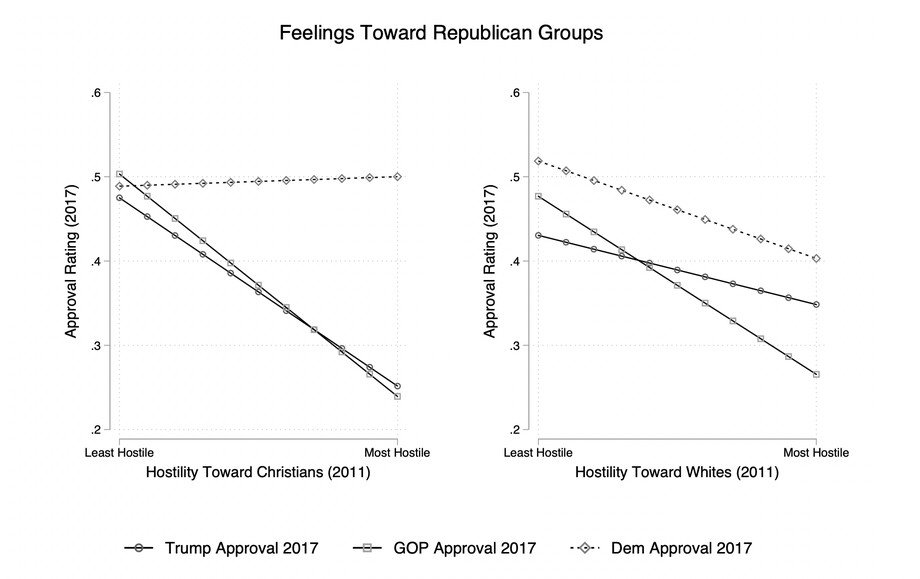
What Drives Trump Support?
A consistent hatred towards Democratic-aligned groups is what differentiates Trump approval from overall approval of the Republican Party. As social sorting promotes both in-group love and out-group hatred, we see that both are used to Trump’s advantage. In contrast, it is mainly in-group member positivity that relates to support for the Republican and Democratic parties.
We emphasize that the feelings towards racial and religious groups shown in our graphs predate Trump’s candidacy. Trump, in other words, did not create out-group animosity. He simply tapped into these existing reservoirs of negative out-group feelings and activated them to his benefit. As Trump’s rhetoric about blacks, Hispanics, and Muslims repeatedly exploited anger towards these groups—much to the chagrin of his own party’s leaders—he solidified support among voters who already held disdain and resentment towards a diversifying American landscape.
This work is not the first to find that Trump support is uniquely driven by out-group hatred. In the new book Identity Crisis,14 political scientists find that even in the 2016 Republican presidential primary, out-group hatred predicted support for Trump, but not for Cruz, Rubio, or Kasich. This means that support for Trump is distinct from the support that Republicans have traditionally received. Trump was uniquely attracting voters who had already been feeling increasingly uncomfortable with racial, religious, and social diversity. We tend to think of partisans as being generally intolerant of outsiders, but our findings suggest that Trump supporters are unique in terms of their out-group hatred.
This all raises the possibility that the Trump era is ushering in a new “normal” to American politics, in which support is derived not just from appealing to in-group affection, but from the outright belittlement and denigration of the opposition party and the social groups that comprise its members.
When support for a party’s candidate comes from active hatred for certain social groups (as we have found in the case of President Trump), this fundamentally changes how political candidates construct their campaign strategy and messaging. In this new “normal” of American politics, a candidate’s coalition building isn’t about finding groups of people who support their cause, but finding people who actively hate and want to harm the other side. The chance for national cross-partisan coalitions recedes as this type of politics proliferates.
Base Politics
Our findings also imply that Trump could encourage more compromise from Democrats on common ground issues such as infrastructure spending if he stopped committing wanton affronts to Democratic groups (e.g., by delaying the Harriet Tubman $20 bill15 indefinitely). This is because support for the Democratic Party comes from support for marginalized groups. Should Trump change his behavior towards African-American, Latinos, and Muslims, even symbolically, it could potentially go a long way in building bridges with Democrats.
However, there is less cause for optimism when it comes to Trump-loyal Republicans who comprise 90 percent16 of the party. In a new “normal” of out-group hatred-driven partisanship, there is little incentive to sit at the negotiating table with Democratic leaders like Sen. Schumer (D-N.Y.) or Speaker Pelosi (D-Calif.). This is precisely because a key ingredient driving support for Trump is antipathy toward marginalized groups and, presumably, anyone who represents the interests of those groups.
Certainly, politicians are sometimes willing to go against the wishes of their own political base (see recent research on this in Political Research Quarterly17 and Public Opinion Quarterly18). But Trump doesn’t just eschew bipartisan compromise. He actively focuses on belittling his opponents to score points with his most loyal supporters.
Until Trump is willing to tamp down his adversarial rhetoric and behavior against Democrats and their voters, the prospects for political compromise on any matters of substance appear intractably grim. And from all the available evidence, Trump’s political incentives point him further down the road of identity-based conflict. The voters who support Trump today are the same people who hated the idea of racial, religious, and cultural diversity well before Trump appeared on a debate stage.
Citations
- K.K. Rebecca Lai and Karen Yourish. “The Insults Trump Has Hurled at 2020 Democrats,” New York Times, May 26, 2019. source
- Dylan Scott. “Trump is repeating his most explosive immigration rhetoric during the family separation crisis,” Vox, Jun 19, 2018. source
- Josh Dawsey, “Trump derides protections for immigrants from ‘shithole’ countries,” Washington Post, January 12, 2018.source
- Saba Hamedy, “Everything you need to know about the travel ban: A timeline,” CNN, June 26, 2018. source
- Darran Simon, “President Trump’s other insensitive comments on race and ethnicity,” CNN, January 13, 2018. source
- Julie Wronski, Lilliana Mason, and John Kane. “Ingroup Lovers or Outgroup Haters? The Social Roots of Trump Support and Partisan Identity” (presentation, Midwest Political Science Association, Chicago, IL, April 4-7, 2019). source
- Lilliana Mason, Uncivil Agreement: How Politics Became Our Identity (Chicago, IL: University of Chicago Press, 2018).
- Marilynn B. Brewer and Kathleen P. Pierce, “Social Identity Complexity and Outgroup Tolerance,” Personality and Social Psychology Bulletin 31(3) (March 1, 2005): 428-437. source
- Lilliana Mason and Julie Wronski, “One Tribe to Bind Them All: How Our Social Group Attachments Strengthen Partisanship,” Advances in Political Psychology 39(S1) (February 18): 257-277. source
- “Democracy Fund Voter Study Group,” Democracy Fund, accessed November 29, 2019, source
- Maggie Haberman, “Trump’s poll numbers collapse,” POLITICO, May 10, 2011. source
- Alec Tyson, “The 2018 midterm vote: Divisions by race, gender, education,” Pew Research, November 8, 2018. source
- David Masci, Besheer Mohamed, and Gregory A. Smith, “Black Americans are more likely than overall public to be Christian, Protestant,” Pew Research, April 23, 2018. source
- John Sides, Michael Tesler, Lynn Vavreck, Identity Crisis: The 2016 Presidential Campaign and the Battle for the Meaning of America (Princeton, NJ: Princeton University Press, 2018).
- Alan Rappeport, “Harriet Tubman $20 Bill Is Delayed Until Trump Leaves Office, Mnuchin Says,” New York Times, May 22, 2019. source
- “Presidential Job Approval Center,” Gallup. source
- Kane, John V. “Fight Clubs: Media Coverage of Party (Dis)Unity and Citizens’ Selective Exposure to It.” Political Research Quarterly, (February 2019). doi:10.1177/1065912919827106
- Kane, John. (2019). Enemy or Ally? Elites, Base Relations, and Partisanship in America. Public Opinion Quarterly. Forthcoming. source
More About the Authors

Lilliana Mason

Daniel Schlozman

Julie Wronski

Mark Schmitt
Senior Director, Political Reform Program

Lee Drutman
Senior Fellow, Political Reform Program

Didi Kuo
Fellow, Political Reform Program; Eric & Wendy Schmidt Fellow, 2018

Sheri Berman

Lily Geismer

Sam Rosenfeld
John Kane