
Lee Drutman
Senior Fellow, Political Reform Program
This paper was jointly published with the Democracy Fund Voter Study Group.
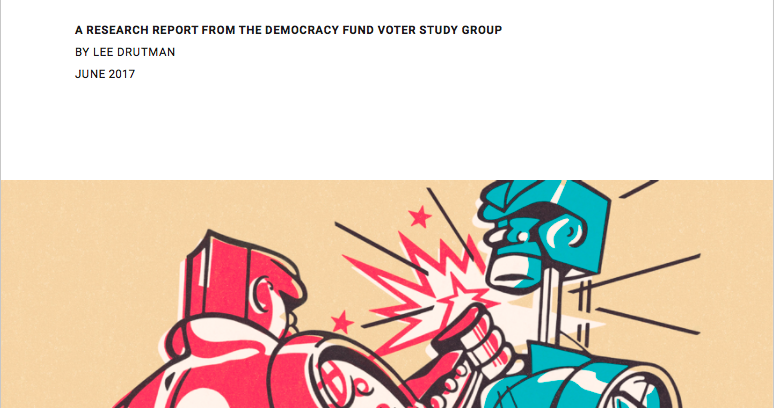
It is a truism of modern American politics that the United States is a deeply divided nation. By almost all measures, the two parties are further apart from each other, both at the elite level, and in the electorate, than in the past. There are more and more politically lopsided counties, and only a small percentage of states and congressional districts swing from one party to another. Partisan unity scores in Congress are very high.
Yet, while the parties are far apart from each other, there are also tensions within them—tensions that were clearly on display in the 2016 primaries. In both parties, primaries revealed rifts, though Democrats were generally more cohesive than Republicans. As it appeared that Hillary Clinton would win the election, it became fashionable for political observers to write about the coming Republican civil war.
While Trump’s victory quieted some of that talk, there are still deep tensions within the Republican coalition, divisions that are now re-emerging as the exigencies of legislating return. Most notably, the nativist populism on which Donald Trump campaigned is at odds with much of what Republicans have traditionally embodied. It is unclear how Trump can both deliver the policies he promised while holding onto support from the more traditional conservatives who stuck with him.
This paper investigates the nature of the political conflict both between and within the two major political parties. The primary conflict structuring the two parties involves questions of national identity, race, and morality, while that the traditional conflict over economics, though still important, is less divisive now than it used to be. This has the potential to reshape the party coalitions.
The key findings of this report include:
View and download the paper here.
Senior Fellow, Political Reform Program