
Building the Future 2020
Table of Contents
- I. Introduction
- II. Executive Summary
- III. Engaging the Next Generation: Strategies for Supporting Students
- IV. Promoting Innovation and Interdisciplinary Research: Department-Centered Interventions
- V. Breaking Down Barriers: An Institutional Approach
- VI. Near-Term Opportunities for PIT
- VII. Conclusion
- List of Interviewees
Abstract
This 2019 report is an update to the 2018 report drawing from interviews with 30 practitioners and leaders to highlight key features of the maturing PIT ecosystem. The Public Interest Technology University Network (PIT-UN), then an intangible hope for the field, is now a robust collaboration that enables leaders from 21 institutions to share best practices and spur collaboration, for example. The network held its first annual PIT-UN convening at Georgetown University in October 2019, at which over $3.1 million in PIT grants were announced. And the network is poised to grow in membership in 2020 after a successful application cycle.
Acknowledgments
Thank you to our academic partners and inaugural members of PIT-UN: Arizona State University, Carnegie Mellon University, Columbia University, Florida International University, Georgia Institute of Technology, Georgetown University, Harvard University, Howard University, Miami Dade College, Massachusetts Institute of Technology, Olin College of Engineering, Pepperdine University, Princeton University, Pardee RAND Graduate School, Stanford University, The City University of New York, University of California, Berkeley, University of Chicago, University of Michigan, University of Texas at Austin, and University of Virginia.
The authors would like to thank Cecilia Muñoz and Afua Bruce for their valuable contributions.
This report was developed with the generous support of the Ford Foundation. The authors would particularly like to thank Jenny Toomey and Michelle Shevin for their insights.
Downloads
I. Introduction
The past year has illuminated technology issues facing public interest organizations in stark contrast. From biased algorithms blocking access to credit for marginalized communities to ongoing threats to our elections from mis- and disinformation campaigns, the need for a public interest lens on technology is well documented.1
In the face of these issues, this report relays recent successes to advance the field of public interest technology (PIT) in one of its numerous key focus areas: higher education.2 The report draws from interviews with many of those leading the way in academia, and updates the state of play outlined in the 2018 report Building the Future: Educating Tomorrow’s Leaders in an Era of Rapid Technological Change.3
The scope of the opportunities and challenges for public interest advocates is broad. Speaking to Kara Swisher on the podcast Recode, Decode, Meredith Whitaker, co-founder of the AI Now Institute at New York University, succinctly outlined the importance of an interdisciplinary approach to addressing issues related to technology: 4
We can’t be resolving these issues just from computer science and from engineering departments, we actually need a much bigger lens … We need to be drawing on social science, on humanistic disciplines, on law, philosophy, as well as anthropology, sociology, criminal justice. If you actually want to build tools that affect social institutions, you need to have experts in the room, but you also need affected communities.
In an interview for this report, Provost Bob Groves of Georgetown University recognized the imperative for academia to engage with these challenges through PIT. He said, “The rate of speed of development of technology has vastly exceeded society’s ability to absorb it. Normative structures, regulatory frameworks, and laws can’t keep up with the technological change, and we have obligations to address that.”
“The rate of speed of development of technology has vastly exceeded society’s ability to absorb it. Normative structures, regulatory frameworks, and laws can’t keep up with the technological change, and we have obligations to address that.”
–Bob Groves, Georgetown University
The 2018 Building the Future report stems from a recognition of both the need for and momentum in PIT as it connected engineers, programmers, designers, researchers, advocates, and more. The report surfaced three key findings for PIT in academic institutions:
- Students are demanding cross-disciplinary training at an increasing rate;
- Practitioners are racing to respond with innovative programming; and
- Academic leaders are recognizing the importance of public interest technology.
Thirty-three interventions were illuminated in that report that could improve the health of PIT in colleges and universities, and many have had marked success since the report’s publication. With the support of the Ford Foundation and a number of other foundations and individual funders, great progress has been made toward strengthening the academic infrastructure of public interest technology. This report offers a summary of key successes, lingering challenges, and what this corner of the broader public interest technology field has learned since 2018.
This update to the 2018 report draws from interviews with 30 practitioners and leaders to highlight key features of the maturing PIT ecosystem. The Public Interest Technology University Network (PIT-UN), then an intangible hope for the field, is now a robust collaboration that enables leaders from 21 institutions to share best practices and spur collaboration, for example. The network held its first annual PIT-UN convening at Georgetown University in October 2019, at which over $3.1 million in PIT grants were announced. And the network is poised to grow in membership in 2020 after a successful application cycle.
Drawing from examples like the PIT-UN, this report plots out key successes, lingering challenges, and potential next steps for the primary intervention points discussed first in 2018. This report may be used by PIT practitioners, institution leaders, funders, and others to plan for PIT’s future. As outlined in the pages that follow, with creative, collaborative, and visionary leadership, recent progress in the field can be cemented and scaled.
Citations
- “The Week in Tech: Algorithmic Bias Is Bad. Uncovering It Is Good.” New York Times, 2019. source ; “New Facebook features fight election lies everywhere but ads.” Tech Crunch, 2019. source
- Along with higher education, there are many other established areas of practice in the public interest technology ecosystem, including civic technology, information and communications technology, media justice, some areas of open source, and others. To learn more, visit the Microsoft Civic Tech Taxonomy at: source
- “Building the Future: Educating Tomorrow’s Leaders in an Era of Rapid Technological Change.” New America, 2018. source
- “How will AI change your life? AI Now Institute founders Kate Crawford and Meredith Whittaker explain.” Vox, 2019. source
II. Executive Summary
As public interest organizations from civil society to government strive to understand, weigh in on, and make use of new technologies, a novel area of study and research has emerged: public interest technology (PIT). While PIT serves many functions, in higher education it aims to imbue colleges and universities across the country with creative curricula, research, and career opportunities, and is advanced by numerous stakeholders in the academy.
This report analyzes the momentum generated for PIT in and by these colleges and universities in the last year. The report stems from a 2018 counterpart, Building the Future: Educating Tomorrow’s Leaders in an Era of Rapid Technological Change, which outlined needs and opportunities for students, for college and university departments, and within and across institutions.1
The 2018 report found both real successes and significant challenges. Across student-facing, curricular, and institutionally focused needs and opportunities, a dearth of interdisciplinary pathways that help students understand and prepare for rapidly proliferating real-world opportunities was found. Thirty-three potential interventions that could advance the nascent field of PIT were also offered in that report.
Methodology
This report draws from 30 interviews with leaders in academia, alongside numerous conversations at the first annual Public Interest Technology University Network (PIT-UN) convening at Georgetown University in October 2019.
To help the academy continue its forward progress, it is critical to examine where PIT currently stands. This report captures much of the progress that has been made with respect to students, departments, and institutions since the report was published in 2018. It also highlights some key challenges and potential next steps.
At the highest level, interviewees consulted for this report identified several successes to celebrate since 2018. These successes include:
- In 2019, for the first time in the history, entire schools, departments, and degree programs were established with the aim of expanding students’ access to the interdisciplinary focus that undergirds PIT. Massachusetts Institute of Technology’s Schwarzman College of Computing and Arizona State University’s new master’s degree in public interest technology stand out as leading examples.2
- Twenty-one academic institutions came together to form the Public Interest Technology University Network (PIT-UN), which facilitates collaboration in public interest technology through curriculum development, faculty research opportunities, and experiential learning opportunities.3 The network has seen considerable interest, including in a New York Times article, helping to create a positive feedback loop of attention for the field.4
- Seven funders seeded the first annual PIT University Network Challenge with $3.1 million, culminating in 27 grants to academic leaders within the PIT-UN. Awards struck at the heart of challenges facing the field, with winning projects focused on developing experiential curricula at the University of California, Berkeley that exposes students to ethical, political, and societal implications of technology;5 building open education resources for PIT-related materials at the City University of New York;6 and identifying constraints and potential solutions or interventions for people of color in PIT at the University of Michigan;7 among 24 others.
These successes and others are leading the field to new territory and deserve to be celebrated. At the same time, interviews conducted for this research illustrated the importance of advancing this progress with awareness of the challenges and obstacles ahead. A summary of these successes and obstacles discussed by interviewees is below, and further details are discussed throughout this report.
| Student-Focused Efforts | Department-Focused | Institution-Focused Efforts | |
|---|---|---|---|
| Key Successes | • Creation of interdisciplinary efforts for students like MIT’s Schwarzman College of Computing and UVA’s School of Data Science • Expansion of innovative curricula, like Georgia Tech’s scenario curriculum with topics like autonomous vehicle policy • Increased number of partnerships with local communities, like Miami Dade College’s GIS course that addresses environmental problems |
• Proliferation of criteria for promotion and job security that facilitate interdisciplinary and project-based work, such as at Olin and Pardee RAND • Development of research centers that specifically target interdisciplinary work, like Princeton’s Center for Information Technology Policy • Sponsorship of interdisciplinary work for pre-tenure faculty, like at Georgia Tech |
• Creation of a community of practice for university leaders through the PIT-UN collaboration • Emerging platforms to share models and best practices, including a collaboration between Howard, Georgetown, and Stanford to develop a repository of PIT case studies • University leaders have steadily bought in on PIT, exemplified by an interdisciplinary steering committee at Georgetown that reports to the provost |
| Lingering Challenges | • Lack of diversity among interdisciplinary program participants - Unwieldy to scale experiential programming • Specific investment needed to develop career pipelines • Unclear/unshared terminology due to marketing difficulties |
• Hesitation among pre-tenure faculty to engage in PIT unless they know it will result in promotion and/or tenure • Traditional tenure model an obstacle due to lack of incentives for interdisciplinary work |
• Competing priorities for presidents and provosts wanting to lead on PIT • Legacy academic structures stand as obstacles to silo-breaking • Risk tolerance critical yet difficult to achieve in universities |
| Lessons Learned | • Standalone schools and inter-departmental curricula can both be effective paths to interdisciplinary instruction • Experiential and scenario-based learning encourage critical thinking, even if students don’t reach consensus on the “right” approach to tech policy questions • Student demand for interdisciplinary coursework outpaces funding and capacity • Successful community engagement on tech policy issues that affect vulnerable populations requires an inclusive approach where affected populations can provide input • PIT job applicants will benefit from having position information in a central location, but this is a first rather than last step – investment in creating PIT opportunities is also essential |
• Widespread adoption of tenure-track hiring of people with an interdisciplinary focus is a lynchpin for success • Creating new structures within departments (e.g., less-rigid hiring criteria, interdisciplinary research centers, and a culture of interdisciplinary work) can help bridge the gap for pre-tenure faculty • Facilitating interdisciplinary work is possible without creating new academic infrastructure |
• Engagement from university leaders can spur academic, logistical, and financial momentum • Support from a community of practice can give inspiration for leaders to adopt interventions from elsewhere • Formal structures like the PIT-UN make collaboration easier to define and execute • Issues surrounding ethics and innovation are not restricted to digital technology, and therefore are not an entirely new form of study |
This landscape of recent successes and challenges in PIT led interviewees to identify several near-term opportunities for the field, illustrated below.
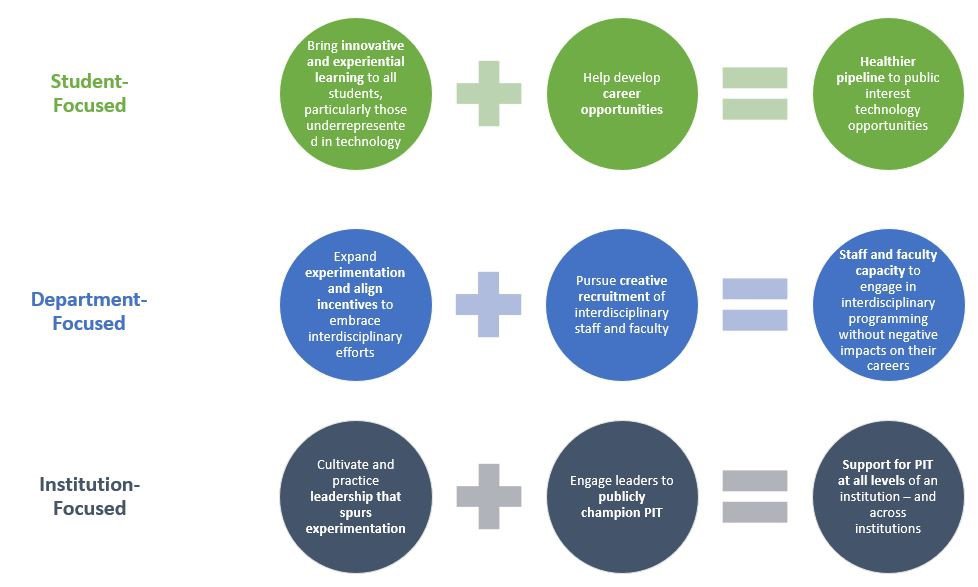
The examples discussed in this report show the promising future of public interest technology—while still nascent, the field has seen important growth in the last year. Though obstacles remain in the academy, with concerted effort and continued investment, the infrastructure, support, and community of practice being built will enable the field to learn and break through existing barriers.
As Louis Nelson from the University of Virginia said, “I want to make sure we’re paying attention to the public interest—and equip technologists with evidence-based learning and best practices developed in other disciplines.” With cultivation of and attention to these best practices, the field will undoubtedly flourish in the coming year.
Citations
- “Building the Future: Educating Tomorrow’s Leaders in an Era of Rapid Technological Change.” New America, 2018. source
- “MIT reshapes itself to shape the future.” MIT. source
- For more information on the Public Interest Technology University Network, see source
- “Top Universities Join to Push ‘Public Interest Technology.’” New York Times, 2019. source
- “UC Berkeley receives grant from PIT-UN to enhance curriculum and elevate the next generation of civic-tech leaders.” Medium, 2019. source Berkeley-receives-pit-un-grant-to-enhance-public-interest-technology-curriculum-c432d47a8
- “CUNY Receives Grants From Public Interest Technology University Network To Expand Access, Support Development Of Burgeoning Field.” CUNY, 2019. source
- “$3.1 Million Awarded to Grow Field of Public Interest Technology at Leading Colleges and Universities.” New America, 2019. source
III. Engaging the Next Generation: Strategies for Supporting Students
Integrating PIT fully and intentionally into the student experience is a core priority. “Students are naturally interdisciplinary, and we often train them to not be,” said Eric T. Meyer, dean of the School of Information at the University of Texas at Austin. “The best universities are ones that give students opportunities to transcend disciplines in thinking about complex problems that excite them.”
Colleges and universities across the country have made great strides in expanding interdisciplinary opportunities, though challenges remain. Key challenges include:
- Interdisciplinary programs still lack essential diversity among participants;
- Scaling experiential programming is unwieldy;
- Need for universities to be deliberate in building pipelines and job opportunities; and,
- Lack of a clear and shared terminology makes it difficult to broadly market opportunities.
Progress toward addressing these challenges falls into three main categories: a) expanding and developing innovative curricula, b) promoting experiential learning, and c) developing a career pipeline.
A. Expanding and Developing Innovative Curricula
With high-profile scientific- and technological-policy issues from climate change to artificial intelligence dominating the headlines, students are increasingly eager for a curriculum that prepares them to address real-world challenges. In some cases, this interest expressed itself in increased enrollment in classes and programs that already tackle these issues.
At the University of Michigan, for example, enrollment in the graduate-level Science, Technology, and Public Policy certificate program jumped from an average of 15 students per year to 35 in just one year. Faculty partially credited the increase to the current political environment, though they said it also reflects a larger recognition of the increasing role technology occupies in day-to-day life. Two key strategies interviewees identified for ensuring curricula include a PIT lens were transforming the classroom to emphasize practical applications of technology-related issues and leveraging university resources to build cross-disciplinary student cohorts between historically technical and non-technical fields.
- Transforming the Classroom
Beyond supporting existing interdisciplinary instruction, colleges and universities have also adjusted existing curricula and created entirely new ways to bring PIT into the classroom. These innovations are happening at all levels, starting at the very beginning of a student’s undergraduate years.
“We have a design sequence that starts in your first year where you start thinking about your responsibility as an engineer that isn’t just about solving a challenge but adding something to this world,” said Erhardt Graeff, assistant professor of social and computer science at Olin College of Engineering. In the Design Nature course at the beginning of the design sequence, students create a playtime experience for fourth-grade students from an area elementary school and produce prototypes that the fourth graders themselves test. According to Graeff, having students engage directly with users in the beginning of their course work encourages them to consider questions like, “How do we understand the language of responsibility that is deeply entwined with engineering?”
Spotlight: Georgia Tech Scenario Curriculum
- What it is: A scenario-based exercise where students engage with timely policy questions (e.g., use and testing of autonomous vehicles)
- How it works: Students are assigned to groups and are assigned roles based on different stakeholders and asked to come to a decision based on the scenario (e.g., whether to allow autonomous vehicle testing)
- Who it’s offered to: Undergraduate freshmen
At Georgia Tech, Fleming Professor Ellen Zegura and her colleagues are developing scenarios they plan to use with freshmen that model the types of technical and social interactions that local policymakers regularly contend with.1 In a pilot of the curriculum this past summer, students played roles of different community members and were asked to reach an agreement on whether or not their community would be a test site for autonomous vehicles. About half of the roles were designed to be against the proposal and half were designed to be in favor, but the groups came to different conclusions about whether or not to allow the agreement.
At Georgia Tech and other institutions leveraging scenario-based learning, the idea is not necessarily to come to a consensus, but to thoughtfully and comprehensively engage with complicated questions of values and community priorities. “Even if you teach students nothing substantive about what decisions they should reach, getting students to start thinking about themselves as ethical actors, and their work as ethically important, is huge,” said Karen Levy, assistant professor in the Department of Information Science at Cornell University.
2. Removing Barriers to Form Cross-Disciplinary Student Cohorts
As demand for interdisciplinary instruction intensifies, some institutions have taken the step of creating new schools to support cross-disciplinary cohorts. For example, last year Massachusetts Institute of Technology announced the creation of the Schwarzman College of Computing.2 Along with advancing the field of computer science, the college is focused on integrating computer science with other disciplines and using those cross-disciplinary insights to explore the social implications of computing.
“Students were saying that they were interested in computer science in various fields, like biology, urban studies, economics … We realized that we needed a new college for this, and this came from observant leadership,” said Melissa Nobles, the dean of the School of Humanities, Arts, and Social Sciences at Massachusetts Institute of Technology.
“Students were saying that they were interested in computer science in various fields … We realized that we needed a new college for this, and this came from observant leadership.”
–Melissa Nobles, Massachusetts Institute of Technology
Similarly, University of California, Berkeley (UC Berkeley) launched an interdisciplinary Division of Data Science and Information meant to make it easier for faculty from a wide range of disciplines, including computer science, engineering, the natural sciences, and social sciences, to collaborate and learn from each other. According to Deirdre Mulligan, an associate professor at UC Berkeley, this division provides much-needed scaffolding, including data science training for professors from other disciplines, that enhances student learning. “[The Division] means that there are more faculty that can speak to each other because it breaks down some of the knowledge barriers that can sometimes be substantial when trying to do interdisciplinary work,” Mulligan said.
B. Promoting Experiential Learning
Creating schools devoted to the cross-section of technology and other disciplines is one way to build a cohort of students with interdisciplinary expertise, but not all institutions are positioned to take that step. New or existing departments, or even individual classes, can also be venues for experimentation. Interviewees described two main approaches for promoting experiential learning: offering practical applications within courses and engaging with the community.
1. Offering Practical Applications
Increased attention to experiential learning has been another important point of progress in recent years towards strengthening public interest technology in the academy. An early model of this approach came from Georgetown’s use of practicums, often in consultation with other universities. In one practicum, Georgetown Law students and MIT (Massachusetts Institute of Technology) engineering students come together to work on privacy legislation. Interdisciplinary practicums allow universities to leverage expertise from faculty in different disciplines or even different schools, while using a specific policy problem as a lens for applying that expertise.
Spotlight: Iron Tech Lawyer Invitational
- What it is: A nationwide competition for student-created, tech-based solutions that address inequities in the justice system
- How it works: Cross-disciplinary student teams from different universities attend a one-day pitch competition in Washington D.C. to showcase their projects
- Who it’s offered to: Participating students need to create their tools as part of an academic course, clinic, or supervised independent study, incentivizing the creation of formal courses
In another Georgetown practicum, students develop tools to deliver legal services or address other problems in the justice system. “Ninety percent of people are navigating the courts by themselves, and so there is a huge opportunity for how technology can help address these problems,” said Alexandra Givens, founding executive director of the Institute for Technology Law and Policy at Georgetown Law. One project that an interdisciplinary team of students created for the course this year was an app that transgender people can use to guide them through the legal process of changing their name. While Georgetown has taught the course since 2013, for the first time this year, it was billed as an invitational to which other schools could submit curricula. Faculty from 23 different schools did so, surpassing Georgetown’s expectations.
Of course, there is still more demand for these types of opportunities than universities may currently be able to meet. Deirdre Mulligan at UC Berkeley, for example, mentioned that one of her undergraduate data science courses had 75 students, with an entire additional class worth of students on the waitlist.
Another challenge is that these interdisciplinary programs largely attract students already well represented in the technology sector. This limits the perspectives that participants are exposed to when contemplating complex technological issues. As universities continue to experiment with creative approaches to practical learning, many are working to ensure that students from a variety of backgrounds understand that these programs are not just open to them, but to an extent designed for them. The very questions that public interest technology programming is built to confront impact a wide cross-section of communities, making different perspectives essential in developing solutions. “Recruiting diverse students is a priority … you are more likely to have a well thought-out process if you have a diverse group than if you don’t,” said Tithi Chattopadhyay, associate director of the Center for Information Technology Policy at Princeton University.
“You are more likely to have a well thought-out process if you have a diverse group than if you don’t.”
–Tithi Chattopadhyay, Princeton University
2. Engaging the Community
To fully explore the impact of technological advancement, colleges and universities are also forming partnerships with community organizations to engage students with contemporary policy questions around science and technology. For example, Miami Dade College offers computer science students the opportunity to work in social impact projects to provide community-based organizations with technological solutions that help them advance their mission. “Our approach at Miami Dade College is always a hands-on approach, always asking the government, nonprofits, or the private sector what we can be doing to apply this,” said Antonio Delgado, dean of engineering at Miami Dade College. Currently, a group of computing science students is working in partnership with Microsoft, Code Miami, and the City of Miami to create the Miami Budget website—a bilingual open source platform for citizen inclusion in the budget of the City of Miami.
“Our approach is always a hands-on approach, always asking the government or the private sector what we can be doing to apply this.”
–Antonio Delgado, Miami Dade College
Similarly, the University of Texas at Austin (UT Austin) views community engagement as a core component of its overall mission and approach to public interest technology. “One of the things that underpins our school is this idea is that we should use technology to advance the public interest and promote social justice,” said Eric T. Meyer of UT Austin. For example, students in the Master of Science in Information Studies program (MSIS) must complete a capstone project for a local partner, whether it’s a company, NGO, or government agency. Last year, one student won the UT Austin iSchool Dean’s Choice Award for her project with the Austin Public Library. She worked directly with library staff and patrons on a plan to make the library’s new building easier to navigate, and the library board has already voted to implement many of her recommendations.
Stronger connections between colleges and universities and the communities they operate in can be mutually beneficial, and university leaders stressed the importance of a collaborative, thoughtful approach. At the University of Virginia, a new Equity Center is overseen by faculty who consult a local advisory council. The council includes affordable housing residents, local health equity leaders, and other members of the community with the authority to review and approve university projects. Currently, at the request of the community, the Equity Center is supporting a data mapping exercise exploring how big data affects vulnerable communities.
Spotlight: University of Virginia Local Advisory Council
- What it is: A council of community leaders who have the authority to review and approve university projects in their neighborhoods
- How it works: Faculty overseeing the Equity Center are required to consult the council prior to engaging in community engagement projects
- Who is included: Affordable housing residents, local health equity leaders, and other community members
“We need communities at the table, and need to be responsive to their concerns about data and technology,” said Louis Nelson, vice provost for academic outreach at the University of Virginia. With this framework, a responsible partnership involves being cognizant of both past and potential harms that can come from misuse of technological innovations.
C. Developing a Career Pipeline
The expanding opportunities for students to learn about PIT are exciting and essential for preparing future professionals to address the most challenging policy questions of our time. But those graduates need somewhere to go to apply that knowledge. While there has been progress, challenges remain for university leaders as they advise students on how to pursue PIT careers. “We have to train the next generation of translators,” said Todd Richmond, professor and director of the Tech and Narrative Lab at Pardee RAND. “They need to be able to have an intelligent conversation with an engineer or technologist, policymakers, and communities, and they need to be able to move seamlessly between these worlds.”
The PIT framework also offers a lens for university leaders to prepare students for a workforce that is changing rapidly. “So much of the future of work is defined by fields that haven’t even been invented yet, and by scholars who are able to more fully understand the problems and develop solutions. PIT fits seamlessly into that for us,” said Saif Ishoof, vice president of engagement at Florida International University (FIU).
Key areas of opportunity include expanding internships and fellowships, meeting employer demand, and marketing existing opportunities.
1. Expanding Internships and Fellowships
To fully prepare students to both fulfill the promise of technological advancement and address its challenges, colleges and universities have increasingly focused on connecting students with internship and fellowship opportunities. These often come from partnerships with local government, companies, and nonprofits at universities across the country, which offer students opportunities to gain work experience. “We can theorize how to do these things, but in reality, when thinking about public interest technology, it is applied work,” said Farida Laha, associate university provost for research administration & compliance at City University of New York (CUNY).
Internships are also an area where collaboration between universities can expand opportunity. “Most of our internship offerings are generally focused on students at Princeton, but with this program, CITP is expanding the scope to open up opportunities to students from other universities,” said Tithi Chattopadhyay of Princeton University. Currently, Princeton is working on giving computer science students from other schools the opportunity to attend a summer program where they will learn about consumer protection law before being matched with internships at government agencies.
The creativity that university faculty are demonstrating through different types of partnerships reflects great progress in designing pathways for students to directly apply their learning. To make sure these programs are sustainable and replicable, however, they do need to be fully resourced. “To me, when we are approached by these organizations to work with us, there is a question on how to sustain these efforts,” said Azer Bestavros, associate provost for computing and data sciences at Boston University (BU). At BU, students have opportunities to work with local and state governments on key technology issues like juvenile justice and algorithmic decision-making, but the work could use additional support. “We are putting a lot of our resources to keep these relationships, but this is a place where everyone needs some help,” Bestavros added.
Like the practical learning opportunities mentioned above, internships and fellowships face a scale problem, in that more students apply than can be connected to opportunities. For example, leadership at the nonprofit Coding it Forward noted that they are only able to accept five percent of applicants for their Civic Digital Fellowship (a government internship for students with technical backgrounds).
Part of the goal of offering hands-on professional experience is to expose students to potential careers in both the public and private sector. At Stanford, the Center for Comparative Studies in Race and Ethnicity is partnering with the university’s Digital Society Lab and Institute for Human-Centered AI on a fellowship program aimed at giving students experience and exposure with careers at the intersection of racial justice and technology. “Students can test out what a career path might be and the different ways of expertise that people can have in the space,” said Jennifer DeVere Brody, director of the Stanford Center for Comparative Studies in Race and Ethnicity. “People in the same space with a common goal will generate new and practical solutions to get public interest technology out there as an idea.”
2. Meeting Employer Demand
While these challenges remain, some university leaders contend that the framework provided by recent efforts to define and publicize PIT can support continued progress. While the jobs universities are preparing students for may currently be in short supply or hard to identify, the interdisciplinary skills students are building can nevertheless be marketable to employers in ways they may not expect.
In highlighting the potential for PIT, David Guston, founder of the School for the Future of Innovation in Society at Arizona State University, pointed to an experiment. “I directed a nanotechnology and society center previously, and we did a survey of the job market of employers who were interested in students with experience with nanotechnology,” he noted. “They were actually just as interested in people with broad technical knowledge and familiarity with nanotechnology from the perspective of regulation, public affairs, and advertising as they were in people with deep technical knowledge of nano.”
While employers across sectors are increasingly recognizing the importance of public interest technology expertise, some university leaders argue that this understanding is still in its early stages. “The biggest problem that we have is that computer science-related firms don’t understand what social scientists do, and they’re better off than the other group,” said Dan Black, professor of public policy at the University of Chicago. “Much more problematic is the places that are not that technology-oriented. The tremendous change in the marketplace has made these places incapable of understanding what they are missing.” To bridge this gap, higher education institutions will need to be deliberate in building mechanisms to link potential employers to the students being trained in interdisciplinary skills. If successful, these efforts will show employers what is possible and help them create the types of jobs that can put these valuable skill sets to use efficiently and effectively.
3. Marketing Existing Opportunities to Students and Employers
In some cases, interviewees suggested, the challenge is not necessarily that public interest technology jobs do not exist. Instead, these experts suggested that potential PIT jobs may not be clearly identified as such, since that terminology is relatively new. Graduates do not necessarily know where to look. When students ask directly for advice, university faculty may be able to reach out to their own individual networks to refer students or access job openings.
But interviewees suggested that robust career pipeline infrastructure is still lacking. “The career search is very resource intensive, and you need to have subject matter expertise,” said Alexandra Givens of Georgetown University. “Career services offices could not do this because these partners need to feel like an expert is coming to them.”
The good news for those working to strengthen the career pipeline is that progress is ongoing. Increasingly, the curriculum innovations mentioned above are also adopted with the career pipeline in mind. Experiential learning, including internships and partnerships with area employers, is beneficial not only for students but also for employers, who experience the benefits of a PIT skill set being applied to their sector. Strengthening these relationships can therefore lead to an eventual increase in opportunities as employers are exposed to what an interdisciplinary skill set prepares workers to do.
Also important to this work is ensuring that faculty are equipped with a variety of techniques to support students trying to navigate a limited job market. The University of Texas at Austin and the University of Michigan, for example, are partnering to organize the first annual Undergraduate Informatics Education for Public Interest Technology conference in 2020. The conference will focus on providing an opportunity for PIT educators to share information and best practices for providing an informatics education that prepares students for public interest technology careers.
Along with encouraging efforts to embed PIT into different sectors through experiential learning, The PIT-UN could be a venue for identifying and tracking job opportunities across sectors that require or would benefit from a PIT skillet. “I think that would be a great thing to come out of the network, to get a shared understanding of where these opportunities are,” said Professor Christopher Goranson of Carnegie Mellon University.
| Key Lessons for Student-Focused Interventions |
|---|
| • Standalone schools and interdepartmental curricula can both be effective paths to interdisciplinary instruction • Student demand for interdisciplinary coursework can outpace funding and faculty capacity • Successful community engagement work requires a collaborative, inclusive approach with direct involvement from community members • Even if PIT jobs are difficult to identify or are in short supply, a key step is identifying which ones do exist and collecting this information in a central location |
IV. Promoting Innovation and Interdisciplinary Research: Department-Centered Interventions
Encouraging interdisciplinary research and teaching has been a top priority for individual departments at colleges and universities within the PIT-UN since 2018. At the same time, difficulties have persisted in incentivizing interdisciplinary work within the traditional tenure model, which discourages pre-tenure faculty from doing interdisciplinary research and teaching that is often valued less within prestigious journals and academic circles.
While the PIT-UN small grants fund has worked to address the lack of financial incentives and support to do interdisciplinary research, the problem of promotion and tenure remains one of the largest barriers to the effective integration of public interest technology into institutions at the department level. Accordingly, key challenges include:
- Pre-tenure faculty remain hesitant to engage in PIT unless they know it will result in promotion and/or tenure; and
- The traditional tenure model remains an obstacle due to lack of incentives for interdisciplinary work.
Progress toward addressing these challenges falls into three main categories: reinventing tenure and promotion, developing research centers and departments, and fostering a culture of interdisciplinary work.
A. Reinventing Tenure and Promotion
Interviewees noted that one of the biggest challenges toward tenure-level faculty evaluating pre-tenure faculty doing interdisciplinary research is that evaluation models are lacking. “Tenure often causes more problems than it solves. The traditional metrics for measuring faculty performance don’t necessarily reflect the quality of work,” said Todd Richmond of Pardee RAND. On a similar note, Justin Pearlman, vice provost for communications and engagement at Columbia University, noted, “One big challenge is to find and engage the right people in relevant departments at peer schools who can evaluate this type of interdisciplinary work, and right now that task can often be difficult.”
“Tenure often causes more problems than it solves. The traditional metrics for measuring faculty performance don’t necessarily reflect the quality of work.”
–Todd Richmond, Pardee RAND
Other interviewees expressed similar sentiments. “Tenure and promotion are the biggest challenges to the development of a public interest technology field,” said Daniel Murray, executive director at the Center for Comparative Studies in Race and Ethnicity at Stanford University.
Other public interest technologists noted that while they personally value interdisciplinary research and teaching, traditional criteria still govern tenure decisions at their institutions. “Tenure expectations present challenges, but they are not insurmountable,” said Louis Nelson, vice provost for academic outreach at the University of Virginia. Nelson noted that encouraging pre-tenure faculty to do interdisciplinary work is merely “a gentle mediation against the prevailing reality, which is that cross-disciplinary work is not always encouraged pre-tenure. We and our partners nationally need to find ways to mitigate that.”
1. Broadening the Scope of Work for Tenure Consideration
For some universities, like the Olin College of Engineering and the Pardee RAND Graduate School, departments have reinvented the concept of tenure for modern academia by broadening the scope of work for tenure consideration and by eliminating tenure altogether. Although Pardee RAND and Olin are at the forefront of reconceptualizing tenure, many interviewees at other institutions noted the importance of rethinking tenure. Jennifer DeVere Brody at Stanford University said, “Something that would be helpful from the network is to rewrite the rules on tenure and promotion to show how to evaluate a successful file of doing public interest technology work.”
“Something that would be helpful from the network is to rewrite the rules on tenure and promotion to show how to evaluate a successful file of doing public interesting technology work.”
–Jennifer DeVere Brody, Stanford University
Olin College of Engineering has broadened the scope of work considered for promotion to dovetail with its nontraditional institutional model. Much of Olin’s “do learn” curriculum is scaffolded with engineering and design projects, including capstones where students partner with corporations and nonprofit organizations on hands-on engineering projects, including developing many social ventures. Accordingly, Olin’s model of promotion broadens the scope of work that is typically considered for promotion. Erhardt Graeff, assistant professor of social and computer science, said that Olin’s model for promotion of faculty encourages interdisciplinary work by “developing students in important and meaningful ways … [and] creating external impact, which is usually defined [at other institutions] as research that is recognized as valuable by their [disciplinary] peers.”
By defining “external impact” broadly to encapsulate public interest technology work, Graeff said, Olin’s early-career and tenure-equivalent faculty have the freedom to conduct meaningful work without fearing those contributions will be ignored. With a total enrollment of around 350 students and an entrepreneurial spirit built into the school’s mission, Olin might not serve as a replicable model for all other institutions looking to shift away from established tenure-granting models. Nonetheless, Olin’s vision for an academic institution beyond the confines of department-based tenure serves as an example for institutions looking to modify traditional structures.
2. Promoting Interdisciplinary Work by Eliminating Tenure
Similarly, Pardee RAND Graduate School provides an alternative model for tenure, specifically considering how they teach public policy graduate students. Pardee is known for its emphasis on project-based learning and interdisciplinary focus, which naturally leads faculty to consider a variation of the traditional tenure model. In doing so, there is no tenure model at Pardee. All faculty are full-time researchers within the larger think tank of the RAND Corporation, and they choose to lead courses or workshops with graduate students. “[Faculty] teach because they want to … [and] they don’t need to be recognized by the department because teaching is not a metric for their regular performance reviews,” said Todd Richmond, director of the Tech & Narrative Lab at Pardee RAND.
Without the constraints of tenure and associated pressures of traditional academic publishing, interdisciplinary work at Pardee RAND is often conducted through project work, labs, and experimentation. In particular, Richmond’s Tech & Narrative Lab focuses on policy problems and implications related to emerging technologies such as artificial intelligence and machine learning, virtual and augmented reality, the Internet of Things (IoT), and digital gaming. The lab emphasizes the importance of storytelling in policy analysis, and the method of experimentation without the pressure of tenure permits a unique learning environment.
“Research has historically involved submitting a proposal to a granting agency with well-defined hypotheses and experiments. What I found in working in emerging technology is that until we start playing with the technology capabilities, I don’t even know what the questions are,” said Todd Richmond from Pardee RAND. Richmond contends that “exploring the problem spaces through building and breaking things is critical, and there is an assumption of risk, acknowledging that a lot of experiments won’t work.” In this way, Pardee can bring together policy analysts and technologists on pressing projects in public interest technology through lab- and experimentation-based learning.
B. Developing Research Centers and Departments
Other institutions, like Princeton University, Stanford University, University of Virginia, and UC Berkeley have not completely solved the problem of tenure, but they have created innovative research centers and designed interdisciplinary departments to bolster interdisciplinary research and teaching. Deirdre Mulligan at UC Berkeley noted the importance of centers and departments, saying, “Centers and working groups … are an excellent way of incentivizing social scientists and domain experts to better understand the human experience through data science and technology.”
“Centers and working groups … are an excellent way of incentivizing social scientists and domain experts to better understand the human experience through data science and technology.”
–Deirdre Mulligan, UC Berkeley
1. Creating Innovative Research Centers
One way that institutions have encouraged interdisciplinary work is through the creation of research centers within institutions. Princeton’s Center for Information Technology Policy serves as an example for institutions looking to pair pre-tenure with tenure-level faculty doing cutting-edge research in the field of public interest technology.
The center has published groundbreaking work on every public interest technology issue from artificial intelligence and bias to data privacy and the regulation of cryptocurrency, and has become a model for the co-location of diverse faculty such as computer scientists, sociologists, and ethicists. The center has seen success in its fellows program, in which fellows partner with senior faculty on interdisciplinary projects lasting between one and three years. Tithi Chattopadhyay from Princeton University credited both committed university support and the development of a scholarly community for the success of the research center.
The Center for Comparative Studies in Race and Ethnicity (CCSRE) at Stanford University encourages interdisciplinary work through a few innovative strategies. CCSRE conducts research at the intersection of race and technology and teaches undergraduate and graduate students. CCSRE is notable in its recognition of the need to circumvent obstacles to tenure by hiring program staff and research staff to foster the partnerships necessary for community-engaged learning and research.
Spotlight: Center for Information Technology Policy Fellows Program at Princeton University
- What it is: Fellowship program for visiting faculty and postdoctoral researchers in information technology policy
- How it works: Lasting between one and three years, Fellows work alongside senior faculty on interdisciplinary projects ranging from AI to cryptocurrency
- Who is included: Visiting faculty and postdoctoral researchers
“We and others have to think about how to bring in people from the outside who are experienced in that work,” said Daniel Murray from Stanford University. “That is why it is important to bring in people through practitioner fellowships, collaborations, and center programs.”
2. Designing Interdisciplinary Departments
The University of Virginia is spurring interdisciplinary work through the creation of its new School of Data Science, which draws on the university’s practice of hiring in interdisciplinary clusters. “Clusters try to draw faculty from across the university—in cohorts where domains/topical areas overlap but research methodologies are fairly different. This optimizes the chances of using a variety of approaches to achieve a common goal or solve a grand challenge,” said Louis Nelson from the University of Virginia.
Similarly, UC Berkeley created the Division of Data Science and Information (DDSI) in November 2018 as an interdisciplinary department comprised of faculty and students from the College of Engineering, College of Letters and Science, and the School of Information. “The goal of educating students in DDSI is to make sure they have domain-specific competencies and also technical competencies,” said Deirdre Mulligan at UC Berkeley. DDSI employs data science and computational methods to solve complex problems in the social sciences, natural sciences, and humanities and gives students the data literacy to engage critically with public interest technology work. Alongside the creation of DDSI, UC Berkeley created a Data Science major and Master of Information and Data Science degree, both of which pair computational modeling courses with a requisite course on Human Contexts and Ethics.
C. Fostering a Culture of Interdisciplinary Work
Carnegie Mellon University, Georgia Tech, UT Austin, Harvard University, and others are aiming to foster a culture of interdisciplinary work without creating new academic infrastructure. They have done this through creating non-tenure public interest technology roles and integrating public interest modules and principles into their teaching and research.
“If you want people to teach this and have this practical applied knowledge that can’t be learned from a textbook, then you have to be more flexible in how you hire.”
–Christopher Goranson, Carnegie Mellon University
1. Creating Non-Tenure Public Interest Technology Roles
Creating non-tenure roles for technologists is crucial to the success of public interest technology at the department level, and faculty tasked with hiring these roles are looking for successful models. “Finding visiting faculty and adjunct faculty who have the ability to teach this work is a challenge right now,” said Pete Peterson, dean of the School of Public Policy at Pepperdine University.
Carnegie Mellon University’s Heinz College of Information Systems and Public Policy is a pioneer in leveraging data science and computing for the public interest. Heinz College faculty work with Allegheny County and the Pittsburgh community in tackling homelessness, child abuse, and service delivery problems though informed data analysis, and Carnegie Mellon facilitates public interest and government-focused research through creating new non-tenure public interest technology roles. Said Christopher Goranson, distinguished service professor at Heinz College:
If you want people to teach public interest technology who have a practical applied knowledge that can’t be learned from a textbook, then you have to be more flexible in how you hire. It can’t just be an adjunct. If a university can open up pathways to offer fulltime roles and maybe not a tenured path, then there is a foundation laid for public interest technology to be an actual discipline down the road.
2. Integrating Public Interest Principles into Teaching and Research
Given the role of science and technology in explaining and addressing contemporary policy issues, public interest technology represents the next frontier for advancing cutting-edge, interdisciplinary approaches to academic pursuits. “Our earth scientists have been plugged into the public policy landscape in Miami to drive solutions creation at the nexus of earth sciences and policy through climate change planning for municipalities,” said Saif Ishoof, vice president of engagement at FIU. “For us, public interest technology is an extension of the success that we have had bringing together hard sciences and public policy to provide deeper pathways of learning.”
Georgia Tech College of Computer is promoting interdisciplinary work in two new ways. Instead of convincing tenure-level faculty to reinvent tenure and engage in interdisciplinary work, Ellen Zegura, Fleming professor of computer science, noted the importance of training undergraduate and graduate teaching assistants in interdisciplinary and ethical models of teaching computer science courses.
Zegura and her colleagues conduct workshops with teaching assistants to show them how they can effectively integrate ethics into the computing curriculum. With their recent grant from PIT-UN, Zegura and Georgia Tech more broadly will be pairing STEM professors at Georgia Tech with the Sociology and Criminal Justice Departments at Georgia State University to give pre-tenure faculty and graduate students an opportunity to conduct interdisciplinary research with leading scholars in fields other than their own.
Spotlight: Good Systems at UT-Austin
- What it is: Bridging Barriers project coordinating public interest technology researchers doing interdisciplinary work
- How it works: Eight-year, $8 million grant and educational program intended to analyze how society can ensure that AI is beneficial to humanity
- Offered to: Graduate students and affiliated faculty
UT Austin is another university that has successfully encouraged interdisciplinary work without creating entirely new administrative superstructures. Through their Bridging Barriers incubator for interdisciplinary projects, a UT Austin team of faculty from English, information, engineering, architecture, computer science, and journalism departments created the Good Systems project. Existing with limited administrative support, the eight-year $8 million project analyzes how society can ensure that AI is beneficial to humanity and analyze any unintended consequences that may be overlooked in developing emerging technologies. The Good Systems project brings together students, researchers, and faculty leaders through research grants that incentivize interdisciplinary work in public interest technology. In doing so, the Good Systems project bolsters a culture of interdisciplinary work without creating entirely new departmental structures.
In a similar light, professor David Eaves, lecturer at the Harvard Kennedy School, is developing teaching resources to promote interdisciplinary training for students with the recently awarded PIT-UN small grant. The project brings together faculty from public policy programs and internal government training programs across the country to help faculty members better integrate public interest technology principles into their teaching modules.
| Key Lessons for Department-Focused Interventions |
|---|
| • Widespread adoption of tenure-track hiring of people with an interdisciplinary focus is a lynchpin for success • Creating new structures within departments, like less-rigid hiring criteria, interdisciplinary research centers, and a culture of interdisciplinary work, can help bridge the gap for pre-tenure faculty • Facilitating interdisciplinary work is possible without creating new academic infrastructure, and this can be done by creating non-tenure public interest technology rules and integrating public interest principles into existing teaching frameworks |
V. Breaking Down Barriers: An Institutional Approach
Positioning higher education to play an active part in the future of public interest technology involves work beyond what can be done by individual faculty or departments. Key challenges in this area include:
- Leadership buy-in is essential, but presidents and provosts juggle competing priorities;
- Legacy academic structures built around separate departments and schools continue to stand as obstacles to the silo-breaking required for PIT to be successful; and
- Given the early stage of PIT, risk tolerance is critical in universities.
Interviewees emphasized that institutional buy-in is behind three key levers for continued progress: creating a community for institutional collaboration, activating university leadership, and encouraging experimentation.
A. Creating a Community of Practice
One of the foundational values underlying public interest technology is the importance of breaking down silos—between disciplines, between individuals, and between entire departments and schools. That commitment to collaboration extends to the institutional level. When universities come together around common goals for building the workforce of the future, they can build a stronger platform and bolster credibility. “The sharing of examples and practices among network members, along with opportunities for collaboration, can encourage us to stretch our ambitions to grander institutional and cross-institutional scales,“ said David Guston, founder of the School for the Future of Innovation in Society at Arizona State University.
According to interviewees, this approach is useful when it provides two key functions: formalizing structures and uplifting models and best practices.
1. Formalizing Structures
Through the University Network, university leaders have access to formal structures that make collaboration easier to define and execute. “UVA has really benefited from joining the PIT-UN collaborative, if for no other reason than that it gives a frame, focus, and deadlines for work that lots of us really care about and want to make sure we get done,” said Louis Nelson, vice provost for academic outreach at the University of Virginia. “Ideally, we will be able to work with colleagues throughout the collaborative who share common aims.”
“UVA has really benefited from joining the PIT UN collaborative, if for no other reason than that it gives a frame, focus, and deadlines for work that lots of us really care about and want to make sure we get done.”
-Louis Nelson, University of Virginia
The infrastructure currently offered by the University Network includes formal convenings where university faculty, staff, and leadership can share information and advice with their counterparts, often with additional perspective provided by other experts. Between convenings, network members can join quarterly calls to share updates on their work and ask each other specific questions. Members also have the option of joining working groups related to the thematic focus areas of the network.
“Everyone has challenges that are a little bit unique, but we are mainly dealing with the same challenges,” said Dan Black, public policy professor at the University of Chicago. “The network has heterogeneity in it, and having a broad network where people can talk about the difficulties is very valuable.”
The network’s small grants fund, which announced its first grants this fall, also represents progress toward providing formal support for network members. Some noted that the application process exposed them to efforts on their own campus that they had not known much about previously.
Spotlight: PIT-UN Small Grants Fund
- What it is: Grants totaling $3.1 million offered to 27 programs at the 21 PIT-UN member institutions
- Examples: Example projects include:
- Development of a case study platform at Howard University
- Practitioner fellows at the Race and Technology Praxis Program at Stanford University
- Partnership between Miami Dade, Microsoft, Code Miami, and the City of Miami to develop a participatory web platform for the Miami budget
Taken together, the convenings, calls, working groups, funding, and other activities make the network more tangible for its members, sometimes providing the encouragement needed to take risks. “With structure comes a little more freedom,” said Andreen Soley, project manager for public and private partnerships for New America's Public Interest Technology program.
2. Uplifting Models and Best Practices
A key benefit of the network that many members articulated was its role as a forum for universities to explore different models for integrating PIT into their work. “I think it’s a great public good where you can both contribute to and benefit from the members of the network,” said Ramayya Krishnan, dean of the Heinz College of Information Systems and Public Policy at Carnegie Mellon University. “It’s been an invaluable opportunity to share best practices.”
“I think it’s a great public good where you can both contribute to and benefit from the members of the network. It’s been an interesting opportunity to share best practices."
–Ramayya Krishnan, Carnegie Mellon University
To make those lessons even more concrete, members are eager for resources that formally capture this learning. Howard University is currently developing a repository of case studies based on that demand. “If someone is trying to create another course in the same light that you have created, then you don’t have to reinvent the wheel. You can look at the teaching strategies and future ideas,” said Noha Hazzazi, assistant professor at Howard University.
Universities are not uniform, but nor does interdisciplinary programming need to be in order to provide valuable lessons, according to interviewees. Even the fact that universities, and even individuals, have different definitions of public interest technology does not necessarily hinder collaboration. “What is evident is that it is okay in the early stage of the field that we have different understandings of public interest technology,” said Pete Peterson, dean of Pepperdine University’s School of Public Policy. “Seeing what my colleagues [at other institutions] are doing in curriculum and experiential learning is extremely helpful.”
Network members see the diversity of the involved institutions as a key benefit, since schools with different sizes, structures, and locations can experiment with different models and share their learning. As the network grows, some members even mentioned the potential benefits of welcoming international members.
The ability to share models and best practices is especially helpful considering that many universities face similar challenges. “I’ve found it very helpful because we see that other universities are dealing with similar issues, particularly with respect to work that does not fit and benefit from being in the buckets that academia creates for them,” said Tithi Chattopadhyay, associate director of the Center for Information Technology Policy at Princeton University.
Collecting best practices also gives network members the opportunity to draw from previous work. Issues surrounding ethics and innovation aren’t restricted to digital technology, and therefore are not an entirely new form of study. Universities can look at existing structures on their own campuses and at other institutions for additional models of interdisciplinary programming and instruction. For example, the 13-year-old Science, Technology, and Public Policy Program at the Gerald R. Ford School of Public Policy at the University of Michigan has trained over 100 people in how to produce socially responsible technology.
B. Engaging University Leadership
University presidents and provosts play a critical role in supporting institutional progress on public interest technology. Using their platform and ability to set strategic priorities, university leadership can draw needed attention to the important work taking place on their campuses. Beyond that, they can garner additional support from collaborators, employers, funders, and other key stakeholders. “The role of the provost is to create an environment where people who want to work together can work together,” said Provost Bob Groves of Georgetown University.
Interviewees identified two key areas where leadership support has made a significant difference: building buy-in across the institution to support interdisciplinary work, and fostering an environment where taking risks and experimenting is encouraged.
1. Building Buy-in
The development of the University Network and the rise in public interest technology-related efforts at universities across the country represents a key opportunity for additional collaboration. At this pivotal moment, commitment from leadership can build momentum not just in individual institutions, but across academia. “To be able to see other deans take it on will encourage other deans to take on the PIT work. I think a lot of the momentum is helpful here so that there can be institutional buy-in,” Andreen Soley of New America said.
“Provosts and presidents have the ability to rally folks around ideas to mobilize behavior and providing where appropriate the necessary support to move forward.”
–Provost Mark Searle, Arizona State University
When university leaders use their platform to validate current efforts, that can also open up avenues to additional sources of logistical and financial support, particularly at the president and provost level. “Provosts and presidents have the ability to rally folks around ideas to mobilize behavior and providing where appropriate the necessary support to move forward,” said Provost Mark Searle of Arizona State University. For example, Eric T. Meyer, the dean of the School of Information at the University of Texas at Austin, credited supportive university leadership with spearheading efforts to expand PIT work on campus through support for initiatives like cluster hires spread across units. “If you show commitment from the top, that sets the tone,” Meyer said. “Our president and provost care about collaboration, and so they are creating opportunities to do this work.”
At Georgetown, a steering committee on technology and society with members from the law, medical, and main campuses reports directly to two executive vice presidents of the University: the provost and the dean of the law school. “Having senior leadership so directly involved has helped from a centralization perspective, so all faculties feel like they get their voices heard in a central space rather than in one faculty. For fundraising purposes, people need to see the buy-in from the top,” said Alexandra Givens, founding executive director of the Institute for Technology Law and Policy at Georgetown Law. The PIT-UN was possible in part because of support from the president and senior leadership. High-profile leaders make especially strong validators for the value of public interest technology programs, and their continued advocacy will be important for future progress.
2. Encouraging Risk
Leadership also plays a vital role in fostering an environment where faculty and staff feel comfortable experimenting with different approaches. “For me what’s critical is that you allow many different models—you don’t say this is how it’s meant to be,” said Ryan Calo, co-director of the University of Washington Tech Policy Lab, an interdisciplinary research unit involving the Law School, Information School, and School of Computer Science and Engineering. “But whatever the model is, you have to provide resources to support it, and try to remove barriers to interdisciplinary work.” For the Tech Policy Lab, that model includes having three co-equal directors with a rotating lead, and the Lab does not pursue projects that do not include two or more types of training. This is to ensure that the different disciplines involved are treated equally.
Spotlight: Carnegie Mellon Policy Innovation Lab
- What it is: An experiential learning course offered by professor Christopher Goranson, where students work outside the traditional structures of government on contemporary policy challenges
- How it works: Students work in partnership with federal, state or local organizations and governments to develop user-centered approaches to policy issues like improved access to voting information, developing a landslide mitigation plan, or improving transportation equity
- Who it’s offered to: Students in the Heinz College of Information Systems and Public Policy
Part of this support includes tolerance for risk from university leadership. “I was surprised with how open they were with risk,” said Christopher Goranson, who runs the Carnegie Mellon Policy Innovation Lab. Goranson was able to design his course from the bottom up, not knowing how students would respond. “When I spoke to the associate dean, she was supportive of innovating in the classroom and also recognized that we would have to learn from each iteration. The new opportunities that this course provided—both to students and the government—was too great not to try something new,” he said. That flexibility also opened up opportunities for other parts of the university to benefit from experimentation. When an initial partner for Goranson’s class expressed interest in using a consulting model, Goranson and his colleagues were able to direct that partner to a different course that would be a better fit. “This was a good example of how if you have enough robust capacity in the university then you can satisfy a variety of needs,” Goranson said.
| Key Lessons for Institutions |
|---|
| • Engagement from university leaders can spur academic, logistical, and financial momentum • Support from a community of practice can give inspiration for leaders to adopt interventions from elsewhere at their own institutions • Formal structures like the PIT-UN make collaboration among universities easier to define and execute • Issues surrounding ethics and innovation are not restricted to digital technology, and therefore are not an entirely new form of study |
VI. Near-Term Opportunities for PIT
Individual recommendations for student-, department-, and institution-focused interventions first outlined in Building the Future have largely remained constant in the time that has passed. Recent successes, though, have highlighted a need in a number of key areas.
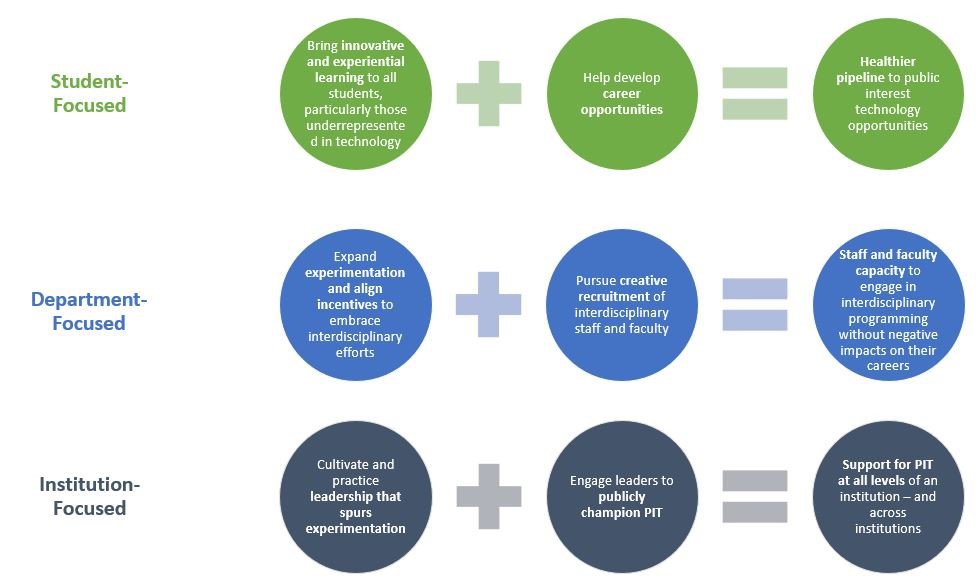
With eyes toward the horizon—and alongside efforts to continue successes in traditional areas—interviewees challenged PIT practitioners to redouble the efforts below.
VII. Conclusion
From the opening of MIT’s Schwarzman College of Computing to the $3.1 million in awards distributed for the first PIT University Network Challenge, the academy’s engagement with public interest technology has seen seismic shifts since 2018. Interviewees were energized about what the future holds, as well as by what collaboration and innovation can do for the field’s maturation in higher education. Moreover, with initial results and experiences from PIT programs expanding, practitioners have an ever-increasing number of best practices and lessons to draw from, many of which are highlighted throughout this report.
At the same time, real challenges exist that interviewees are eager to engage with, from a tenure system that is slow to incentivize interdisciplinary work to a lack of structured career opportunities for students. Among the most pressing is the need for the field to embrace its responsibility to students. “In terms of our social contract with students, we have to find ways to make sure we are at the edge of where technology is moving,” Executive Vice President and University Provost Mark Searle of Arizona State University said.
“In terms of our social contract with students, we have to find ways to make sure we are at the edge of where technology is moving.”
–Mark Searle, Arizona State University
As the work of advancing the public interest increasingly takes place in a digital environment, the cultivation of leaders ready to take on that challenge is not only necessary but inevitable. The pioneers in the academic community who have risen to the task have already built a valuable community of practice and look to continue it moving forward. “I couldn’t imagine the Twenty-First Century without taking computing and technology head-on,” said Melissa Nobles of MIT.
“I couldn’t imagine the 21st Century without taking computing and technology head-on.”
–Melissa Nobles, Massachusetts Institute of Technology
Fueled by the enthusiasm of a generation of students motivated to create change and the support of visionary leaders at all institutional levels, public interest technology is poised to capitalize on the opportunity ahead. Commitment and collaboration across the academy can make that a reality, and not a moment too soon. The pace of technological innovation must be matched in efforts to define, analyze, and evaluate it if we are to build the world we need to sustain our future.
List of Interviewees
We are grateful for the time and insights of the public interest technology experts and practitioners we interviewed for this research. In addition to conversations at the first annual convening of the PIT-UN at Georgetown University in October 2019, we spoke with the following interviewees:
● Azer Bestavros, Boston University
● Dan Black, University of Chicago
● Jennifer DeVere Brody, Stanford University
● Jyothsna Buddharaju, Boston University
● Ryan Calo, University of Washington
● Tithi Chattopadhyay, Princeton University
● Antonio Delgado, Miami Dade College
● David Eaves, Harvard University
● Rayid Ghani, Carnegie Mellon University
● Alexandra Givens, Georgetown University Law Center
● Christopher Goranson, Carnegie Mellon University
● Erhardt Graeff, Olin College of Engineering
● Provost Robert Groves, Georgetown University
● David Guston, Arizona State University
● Noha Hazzazi, Howard University
● Saif Ishoof, Florida International University
● Ramayya Krishnan, Carnegie Mellon University
● Farida Lada, The City University of New York
● Karen Levy, Cornell University
● Eric T. Meyer, University of Texas at Austin
● Deirdre Mulligan, University of California—Berkeley
● Daniel Murray, Stanford University
● Louis Nelson, University of Virginia
● Melissa Nobles, Massachusetts Institute of Technology
● Shobita Parthasarathy, University of Michigan
● Justin Pearlman, Columbia University
● Pete Peterson, Pepperdine University
● Todd A. Richmond, Pardee RAND Graduate School
● Provost Mark Searle, Arizona State University
● Ellen Zegura, Georgia Institute of Technology
More About the Authors

Emily Van Dusen
Kyle Doran
Elijah Scott
Issues
Programs/Projects/Initiatives
Topics
Related