Aaron Loewenberg
Senior Policy Analyst, Early & Elementary Education
On May 19, 2015, Philadelphia voters went to the polls and overwhelmingly supported a ballot measure to create an independent Commission on Universal Pre-Kindergarten that would be asked to develop a plan to fund and expand pre-K access to the city’s three- and four-year-olds. The Commission was tasked with finding a remedy to the problem that only one in three of Philadelphia’s 42,500 three- and four-year-olds currently have access to affordable, quality pre-K. After meeting for the better part of a year, the 17-member panel recently released its final report to the mayor and City Council, complete with 17 recommendations related to the program’s design and source of funding.
While the recommendations made by the commission are non-binding, it’s likely that most will be adopted in Philadelphia Mayor Jim Kenney’s final pre-K plan since it was Kenney himself who appointed several of the commission’s members. Here are some highlights from the commission’s recommendations:
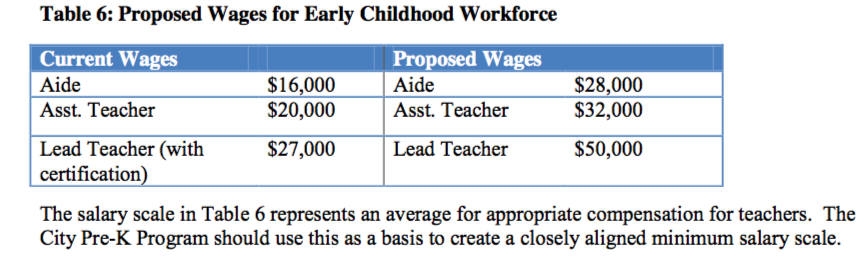
Make funding contingent on compliance with salary scales that provide teachers with appropriate compensation. The commission proposes a significant increase in wages for teaching aides, assistant teachers, and lead teachers (see table below).
It’s the specifics over how to fund the pre-K program that are proving to be contentious. Mayor Kenney has proposed a tax of three cents per ounce on sugar-sweetened beverages, starting in January 2017. This tax is estimated to raise $95 million per year – enough tax revenue to cover the $256 million cost of adding 6,500 pre-K seats over five years as well as the cost of upgrading city parks and libraries. The tax requires approval by members of the City Council, several of whom have expressed concerns over the possible regressive nature of such a tax.
For his part, Mayor Kenney is taking a hard line on the soda tax. Lauren Hitt, the mayor’s director of communication, recently stated that, “if the tax doesn’t pass there will be no city funded pre-K. Period.” And Deena Gamble, a spokesperson for the mayor’s office on education, emphasized that, “there really isn’t another Plan B right now. This is the way we think we need to go right now.”
Debate over the fairness of a soda tax for funding universal pre-K has grown beyond Philadelphia to become a source of disagreement on the presidential campaign trail. Hillary Clinton recently made news when she came out in favor of the mayor’s proposed tax, stating that, “we need universal pre-school. And if that’s a way to do it, that’s how we should do it.” For his part, Bernie Sanders has slammed the proposed tax as an unfair burden on the poor. In a press release, Sanders made clear that he shares the mayor’s goal of universal pre-K, but feels that funding the program through a soda tax is wrong because, “you don’t have to fund child care on the backs of the poorest people in this city. That is a regressive way to raise funds.” The Republican presidential candidates, for their part, have been silent on the issue of using a soda tax to fund pre-K, though Ted Cruz has opposed similar measures in the past.
The proposed soda tax has also raised the ire of the beverage industry. The American Beverage Association is spending more than $1.5 million on ads attacking the tax. Mayor Kenney has not shied away from defending the tax, however. Kenney argues that the proposed tax is “a corporate tax” because the tax would be levied on beverage distributors, rather than at the point of sale. Opponents of the tax argue that the cost of the tax would ultimately be passed onto consumers in the form of higher prices for sugary drinks.
Taxes like these are not new ways of funding early education programs. California funds its pre-K program through a cigarette tax that was approved by voters in 1998. Arizona approved a similar cigarette tax in 2006 in order to fund early education programs. Between 2001 and 2007, Arkansas provided additional funding for its pre-K program through the use of an excise tax on beer. And, in 2013, President Obama proposed funding his “Preschool for All” program through an increase in tobacco taxes.
It’s the controversy over funding that makes the future of universal pre-K in Philadelphia so uncertain. The commission’s recommendations are a strong start for building a high-quality pre-K program throughout the city. But until the City Council votes on Mayor Kenney’s proposed budget in June, it remains unclear whether the commission’s recommendations will have the financial support necessary to become a reality.”
Senior Policy Analyst, Early & Elementary Education