Looking Ahead: Climate Change
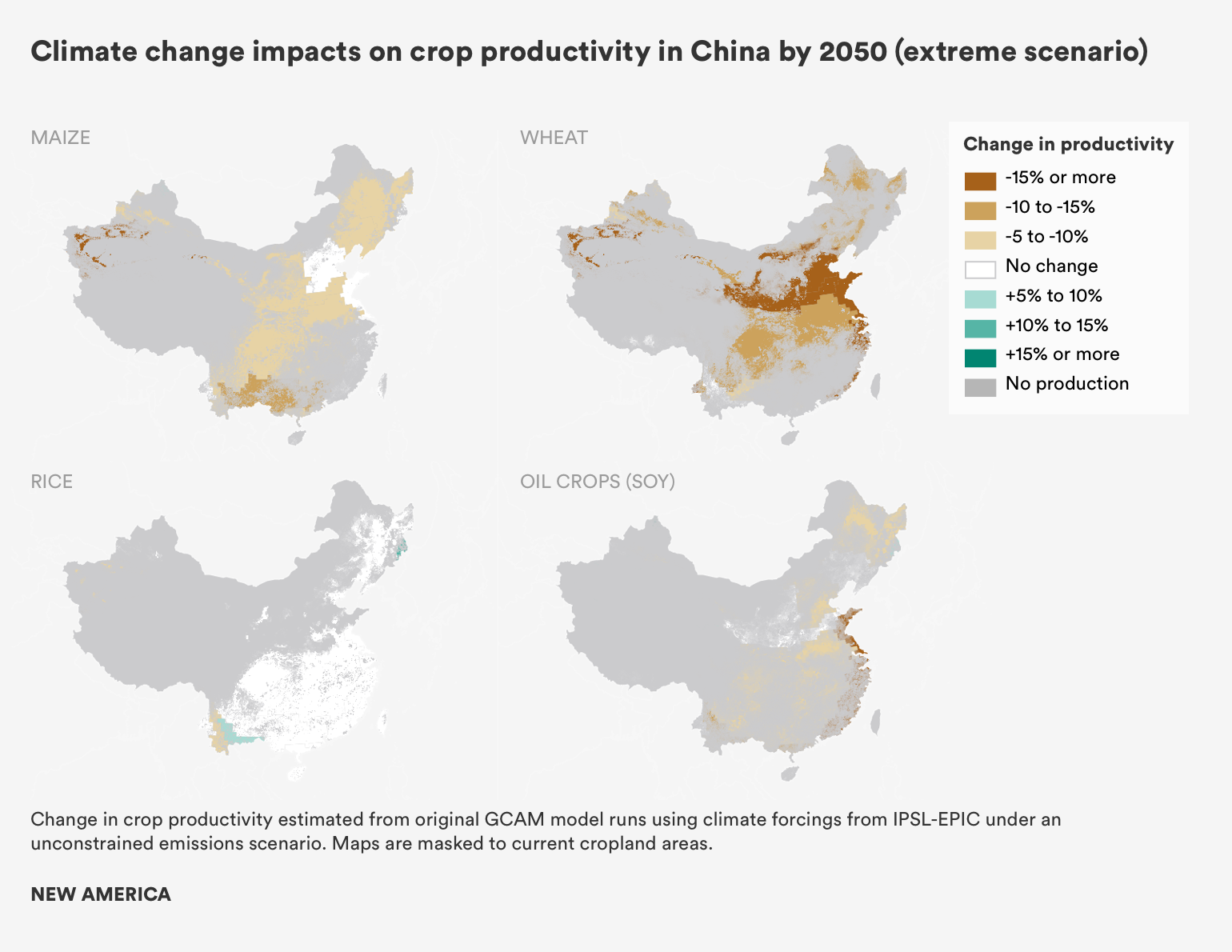
Climate change poses significant challenges for China’s future natural security, across all categories.1 This map, for example, is drawn from forthcoming research by Phase Zero and the Joint Global Change Research Institute, which looks at how climate change may affect China’s agricultural production. In this scenario, with a business-as-usual level of greenhouse gas emissions (i.e., no significant reduction or increase over the current trend), China may see significant decreases in production of wheat, rice, and root crops by 2050.
Today, the country is the number one contributor to global greenhouse gas emissions, more than the United States, Europe, and Japan combined.2 On the other hand, China’s per capita emissions are less than half those of the United States. The high total emissions reflect China’s economic growth and the size of the population, but also an overwhelming reliance on coal and a swiftly-growing transportation sector.3 Even with the country’s ambitious plans for promoting low- and no-carbon fuels, China’s demand for fossil fuels is likely to remain high to mid-century, with significant environmental, human health, geopolitical, and market implications. China’s commitment to increasing its use of renewable energy and electric vehicles also implies more demand for the critical minerals these technologies require, such as lithium, tellurium, niobium, nickel, and cobalt.4
humphrey / Shutterstock
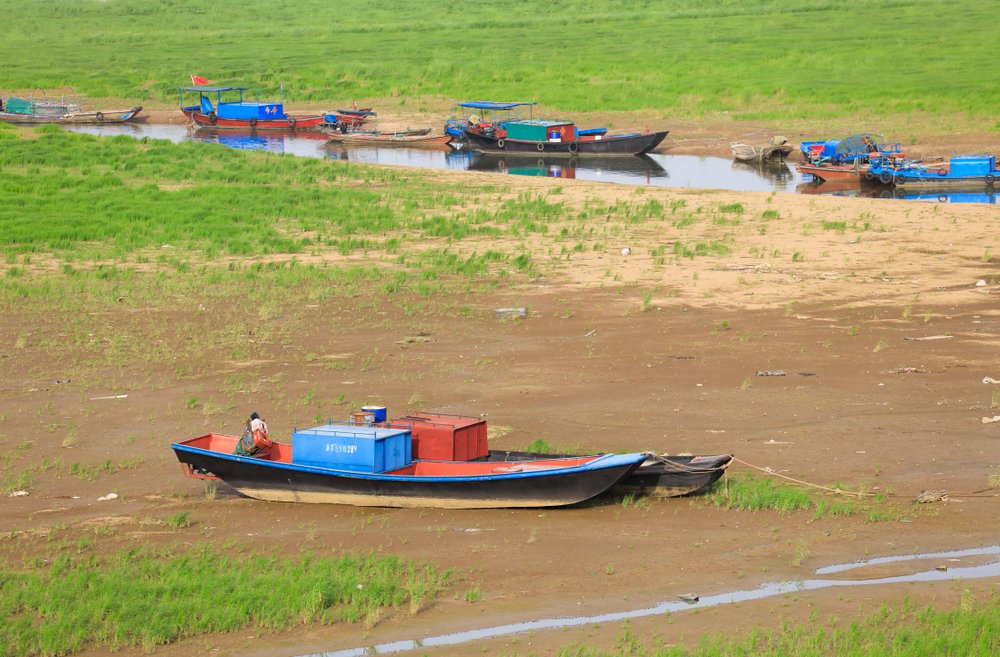
Climate change will have a range of impacts in China, given the size of the country (it is comparable in size to the United States) and in ecosystems that vary from desert to rainforest.5 Projected effects include more high heat days, shifts in precipitation patterns, sea level rise along the coasts, glacier melt, and more frequent or severe extreme weather events.6 The results of these changes may include more floods and droughts, saltwater intrusion into freshwater and productive land, and more frequent or more severe sudden onset natural disasters, such as cyclones.7 There will be consequences for agriculture, water, thermal and hydroelectric energy generation, human health, and disaster recovery. In addition, if China succeeds in cutting its greenhouse gas emissions, it will need to shift its primary energy mix away from coal, but it may become more reliant on other resources, as noted above. Indeed, a global transition away from fossil fuels, along with the ongoing information revolution, will generally increase demand for these materials, which is likely to increase international competition for both terrestrial and ocean bed mineral resources.
Citations
- National Intelligence Council (NIC), “China: Impact of Climate Change to 2030,” NIC Special Report (April 2009), available at source.
- United States Environmental Protection Agency (EPA), “Greenhouse Gas Emissions,” EPA, available at source.
- International Energy Agency (IEA), “World Energy Outlook to 2017: China,” IEA (14 November 2017), available at source.
- International Energy Agency (IEA), “China 13th Renewable Energy Development Five Year Plan (2016-2020),” IEA (01 June 2018), available at source.
- Jingyun Fang et al., “Climate Change, Human Impacts, and Carbon Sequestration in China,” PNAS 115, no. 16: pp. 4015-4020, (17 April 2018), available at source.
- Li Y et al., “Projecting Future Climate Change Impacts on Heat-related Mortality in Large Urban Areas in China,” Environmental Research 163: pp. 171-185, (May 2018), available at source.
- Chris Sall, “Climate Trends and Impacts in China,” The World Bank (September 2013), available at source.