Table of Contents
- Introduction
- Pathways Into the Teaching Profession
- Barriers Along the Pathway into Teaching
- Profile: Skagit Valley’s Supported Teacher Pathway
- Profile: San Antonio’s P–20 Partnerships
- Profile: Chicago’s Bilingual Teacher Residency Program
- Key Findings
- Policy Recommendations to Strengthen Pathways into Teaching
- Appendix A: List of Profile Interviews
Profile: Skagit Valley’s Supported Teacher Pathway

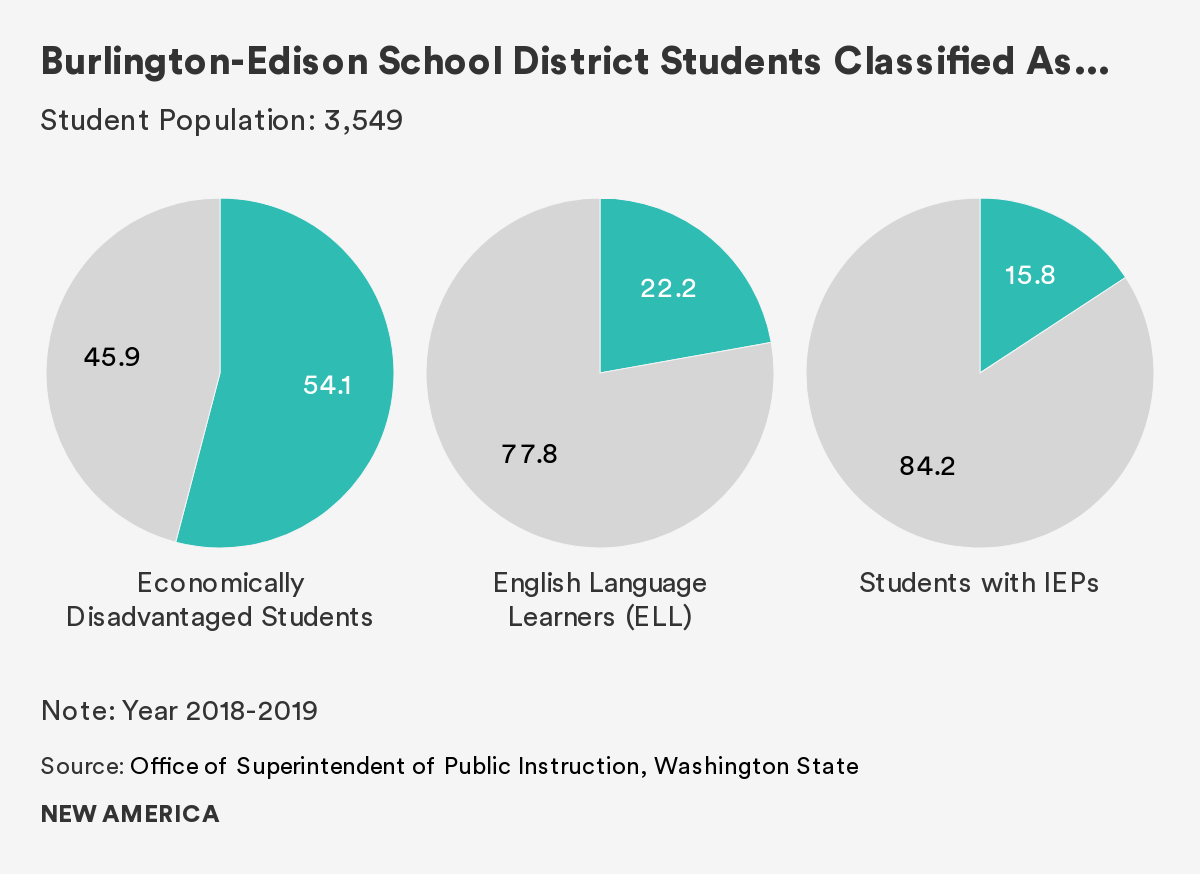
In 2012, a group of educators in Skagit Valley, just west of the Cascade mountains in northwestern Washington State, decided they needed to better serve their Latinx students. Schools in the region had experienced a rise in the Latinx student population over the last decade, with districts like Burlington-Edison surging in the decade between 2007 and 2017 from 27 percent to 43 percent. But schools were not adequately serving this growing Latinx student population, which generally had high dropout rates and were unable to meet the academic standards to enter and succeed in higher education.
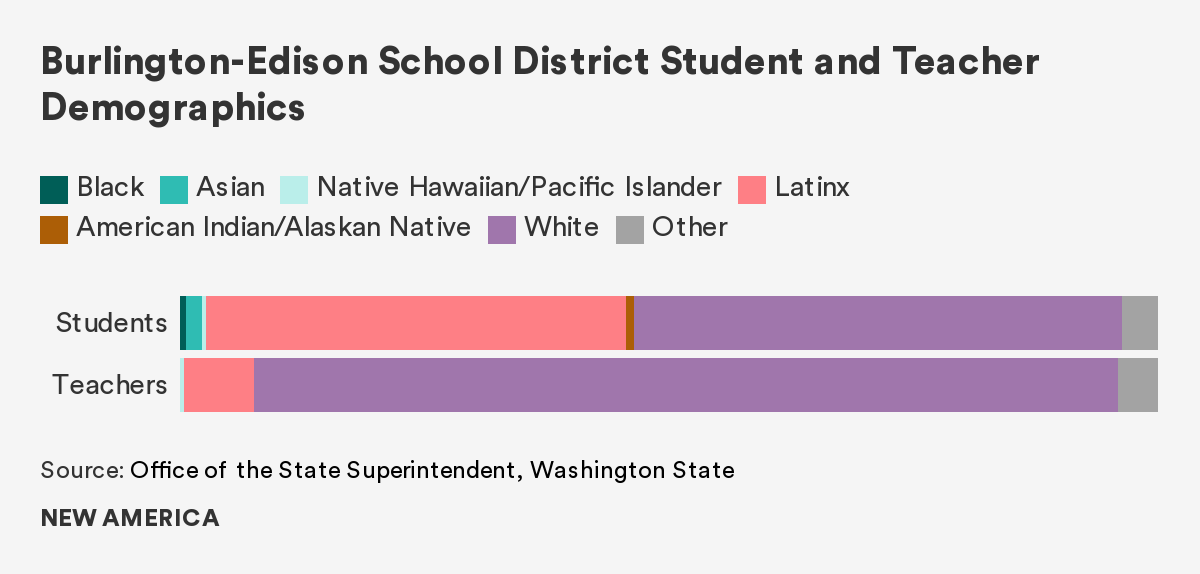
The educators believed that reducing the stark difference between students’ and teachers’ racial/ethnic identities—only 7 percent of Burlington-Edison’s teachers are Latinx—was one key strategy to improving student outcomes.1 Soon after, two local high schools (Burlington-Edison High School and Mount Vernon High School) worked with Skagit Valley College and Western Washington University’s Woodring College of Education to create the Maestros Para el Pueblo (“Teachers for the Community”) program in an effort to “grow their own” Latinx teachers.
The state of Washington already had a program that focused on diversifying the educator workforce through targeted recruitment and preparation of high school students from underrepresented backgrounds, which was run by its Professional Educator Standards Board (PESB). Named Recruiting Washington Teachers (RWT),2 the program recruits and supports students from underrepresented backgrounds, uses a curriculum focused on equity, and gives students an opportunity to tutor students in elementary and middle schools. In fact, the RWT program was having great success in boosting graduation and college enrollment for students of color: 96 percent of RWT students graduated high school on time, and 87 percent of RWT students applied to college and were accepted.3
But the Skagit Valley educators group realized that if RWT’s primary goal was to grow its own diverse teacher workforce, that goal was mostly unrealized.4 About half of the former RWT students were pursuing other career goals in college and the other half struggled to complete their degrees without the support they had in their high school program. While RWT had helped high school students overcome academic challenges, the group felt that it needed to bring some of the RWT elements like mentorship, professional relationships, and contextualized learning to the higher education level to help shepherd students through the pathway into teaching. The group also identified other challenges on the route to becoming a teacher for this community of students: the teacher candidate entrance exam, particularly for bilingual students; the need for academic advising and guidance; and a lack of financial resources.
The dean of Western Washington University’s Woodring College of Education; the president of Skagit Valley College; and teachers, staff, and superintendents of the Mount Vernon and Burlington-Edison school districts formed a leadership group for the Maestros Para el Pueblo (Maestros) program. The two districts, community college, and university hired dedicated staff in 2014 to provide comprehensive support as students make their way along each step of the path from high school to teacher certification. (see below).

Recruiting Washington Teachers (RWT) at Burlington-Edison High School
In 2006, Michael Sampson was in his first year of teaching ELs at Burlington-Edison High School when he saw the need for a course focused on college and career readiness for his mostly Latinx students.5 Three years later, in 2009, Burlington-Edison received its first RWT grant and the “Latinos in Action” course he had brought to the school transitioned into the school's RWT program.6
A decade later, students in the RWT program at Burlington-Edison are getting the chance to explore the teaching profession, while also surpassing their peers academically. State legislation mandates that the RWT program be evaluated every year to gauge its effectiveness and impact. The 2018 program evaluation highlighted the program’s success at recruiting and graduating Latinx students: at Burlington-Edison High School, 89 percent of RWT students were Latinx, and 97 percent of RWT seniors graduated on time. Although students who chose to participate in RWT may have already been more likely to graduate from high school, these graduation rates were described by grantees as “unheard of for students of comparable backgrounds in their districts.”7
| 2017–2018 | Burlington-Edison RWT (47 students) | Burlington-Edison High School (1,048 students) | State |
|---|---|---|---|
| Percent Latinx | 89% | 33% | 23% |
| Graduation rate | 97% | 83% | 81% |
Juniors and seniors start their pathway to teaching through the RWT course, which is organized into two semesters. The first semester is focused on leadership, identity/cultural background, and training for the tutoring placement they have their second semester at local elementary and middle schools. The course is articulated with Skagit Valley College as an introduction to education course and a leadership seminar—students are able to receive up to seven college credits for the year-long sequence.
The RWT course is open to any student who wants to participate, but recruitment is targeted at students from groups that are underrepresented in the field of education. Most students report hearing about the program from the RWT teacher or from a friend or classmate. In 2018–2019, the course served 22 seniors and 18 juniors, with 34 of the 40 students identifying as Latinx. Additionally, 20 of the 40 students qualified as ELs. While the program’s focus is on recruiting and training potential future teachers, Sampson’s RWT class also focuses on supporting bilingual students in exploring their culture, building leadership skills, and encouraging them to enroll in postsecondary education.
Since 2014, Sampson has had the support of Nallely Carreón Carrillo, bilingual graduation specialist at Burlington-Edison and an alumna of the school’s RWT program. Carreón Carrillo co-facilitates the course and offers guidance and support to its students. Having Carreón Carrillo support the program has helped raise students’ perceptions of what they can accomplish. One current student said, “I think what this class provides for students is the opportunity to see yourself in a successful and driven person. And you think, if she did it, I can do it too.”8
Sampson and Carreón Carrillo have helped build a strong community within the program. Reflecting on her own experience as an RWT student, Carreón Carrillo noted that by the end of the class, it felt as if they were a family. Similarly, students in the program described the benefit of being in a class with students from similar backgrounds. One current student said, “Being in a class where you all have similar backgrounds, you come from parents who are Latinos, it feels good. You feel very welcome. And you don't feel different at all; it would be great to have this in every school.”9
When asked about how he talks to RWT students about pursuing a career in teaching, Sampson said, “we're working with [teenagers] … to [expect them to] know exactly what they're going to do in the future is a little bit naive. So, our approach is much more subtle. But we hope that we're modeling a real, legitimate career choice for them.”10
Like most programs that recruit high school students, Burlington-Edison struggles to comprehensively track how many students ultimately pursue careers in education. Anecdotal evidence indicates that some do. When describing the impact of the program, one alumna who works as an elementary EL/family advocate said, “The class really made me realize how much I love working with kids. And I don't know if I'd be where I am today if I hadn't taken that class.”11 Another program alumnus who is pursuing his master’s at Woodring said, “The first time I thought of being an educator was probably my sophomore or junior year in high school. I really didn't know what I wanted. I’m a first-generation [college]student, you know. These questions don't really come up in my household. But I think the reason why I felt like I wanted to be in education was that I had a lot of teachers in high school who really pushed me to graduate.” He added, “once I got into the [RWT] career in education class, that opened up my eyes a lot. It really helped me solidify that I wanted to become a teacher.”12
Whether students end up pursuing a career in teaching or not, it is clear that Sampson makes a significant impact on his students and their future. Sampson's current and former students speak about him with deep admiration and appreciation. One former student said that Sampson provided a level of support that was rare: "Knowing that I had [a person] that I knew I could go to, even if I thought maybe it was a dumb question, [he] was there to support me whatever it was … pushed me to become better."13 Another alumna referred to Sampson as a “Swiss Army knife” because he offers to help by connecting students with colleges, accessing financial aid, helping to make decisions about their future, and more.
When reflecting on his students’ outcomes, Sampson said,
I think that students leave us with a sense of self that is incredibly strong. It is connected to their cultural/familial heritage which allows them to grow and mature in ways that are quite powerful. They are adept at navigating spaces that are incredibly diverse, and they do so with confidence. Whether they are speaking to a legislator, a big audience, or to a kindergartener, you can see that they are aware of how they fit and that they each have something important to bring to the table. When they achieve, it comes from a deep understanding of who they are, which allows them to go forward with an intention that is uncommon for high school and young college students.
Maestros Para el Pueblo at Skagit Valley College
After high school graduation, RWT students who decide to enroll at Skagit Valley College (SVC) become part of the Maestros Para el Pueblo program, which provides support by connecting them to financial resources and providing one-on-one guidance, counseling, and an articulated pathway to a degree in teaching.
In 2014, SVC and Western Washington University’s Woodring College of Education jointly hired a multicultural recruitment and retention specialist in order to help formalize the partnership and provide coherence to their respective effort. This individual is at the heart of the efforts to support RWT students’ transition from high school, persistence at SVC, and ultimately transition to WWU’s college of education.
However, Daisy Padilla-Torres, the program’s counseling and advising navigator, believed it was critical to start building relationships with students before they get to college.14 She spent time at the two partner high schools talking to RWT students about what pathway they want to pursue after high school and what they need to do in order to get there. Students who want to pursue the elementary/secondary teaching pathway, which requires transferring to a four-year university to attain a bachelor’s degree, are encouraged to attain an associate in arts Direct Transfer Agreement (AA-DTA) degree at SVC. Doing so allows all of their credits to transfer to Western Washington University, or any other four-year college in Washington state.15
Padilla-Torres saw the Maestros program as an opportunity to humanize the higher education experience, as the program is not only focused on the transactional pieces of the transition from high school to higher education, but also the humanitarian piece of it. While most institutions of higher education have historically divided the two, or ignored the latter, Padilla-Torres said she tended to mix them: “I want to get to know the students holistically. I'm not only interested in Juan the student, and what he's going to come and study here, I'm also interested in Juan the person.”16
The Maestros program has served 150 students since 2014, including 39 Burlington-Edison graduates. In 2018–2019, there were 57 Maestros students actively enrolled at SVC, 10 of whom graduated from SVC in spring 2019. In 2018–2019, the retention rate for Maestros students at SVC was 86 percent, 5 percent higher than the general student body retention rate that same year.
Continuing on the Maestros Pathway at Woodring College of Education
Nat Reilly, diversity recruitment and retention specialist at Western Washington University’s Woodring College of Education (Woodring), worked with transferring Maestros students.17 Like Padilla-Torres at SVC, Reilly started to develop relationships with students while in high school and at SVC to help them with their transition to Woodring. Even though students were not enrolled at Woodring yet, Reilly saw her time investment as an opportunity to increase the likelihood that students would actually make it to Woodring, given the challenges students have with transferring from a two-year to a four-year college.
In addition to connecting students to resources at the university and offering guidance, Reilly worked with Woodring and the university at large to understand better ways to structure and support teaching pathways for RWT and Maestros students. To strengthen the partnership between institutions, SVC and Woodring agreed to a conditional admissions process for students that come through the Maestros program and have met program entrance requirements. In order for students to apply for conditional admission, students must:18
- Complete the Recruiting Washington Teachers program in high school.
- Enroll in a Direct Transfer Agreement (DTA) associate degree program at SVC.
- Participate quarterly in SVC advising sessions to prepare to meet requirements for Woodring programs.
- Complete a minimum of 45 transferable college credits with a minimum GPA of 2.75.
- Complete a brief online pre-application.
Reilly saw a lot of potential in the conditional admissions process for keeping Latinx students on the path to teaching. “We have a shortage of not only teachers of color, but bilingual teachers, [and we] have this hand-picked [group of students] who have already demonstrated their ability and their proficiency. So why not minimize barriers for them to be able to persist?”19 Reilly said. For students going through the Maestros pathway, it is an opportunity for them to pursue their interest in teaching and stay in their local community. “The Maestros program is specifically for people who want to go back and teach in the [Skagit] valley. That's why it’s called Maestros Para el Pueblo,” said one alumnus who is currently enrolled at Woodring. “That's why I wanted to do it originally, go back to the valley and serve my community because I've lived there my whole life. Just seeing students who are like me growing up and not having somebody who looks like them or somebody that they feel connected to. That's what I missed out on.”
There are 61 students currently enrolled at Western Washington University who came up through the Maestros pathway. Three students from the first Maestros cohort graduated from Woodring in 2017–2018, and three students were expected to graduate in spring of 2019. Woodring hopes to place them in teaching positions in local districts.
Challenges
Leaders and educators in Skagit Valley have taken several steps to help students along the pathway into teaching, but challenges still exist in moving students from high school to community college to a four-year college.
Staffing and Capacity
Implementation for each program is highly dependent on one person. At the high school level, it is the RWT teacher; at the community college level, it is the navigator for the Maestros program; and at the four-year college level, it is the recruitment and retention specialist. When students talked about their experiences, it was clear that they were talking about the very personalized support that they received from these individuals, and less about systematized processes. This brings into question how much of the positive outcomes are due to the pathway itself, versus the specific staff members who are interacting with the students. It highlights the importance of hiring the right individuals for these roles.
But the fact that each program is being supported primarily by one person means that one person has a large caseload and is stretched thin. One Woodring student said, “Daisy works with 60, 70 students. It's always hard to find a time to meet with her. And usually [Daisy and Nat] are taking their days off meeting with students. I've met with Daisy a number of times on a Saturday morning, over coffee, just because we need help [and] we can never find time to meet with her. It's something that needs to change in order for us to be successful, in order for them to recruit and retain teachers of color.”
While districts receive grant funding from Washington’s PESB to run RWT—each grantee received $21,250 in FY 2017–2018—the Maestros Para el Pueblo program does not have targeted grant funding. The program is funded through the four institutions that make up the partnership, which pays for the navigator position at SVC, as well as a limited goods and services fund that supports additional programming for students, such as conferences or tutoring sessions for testing. Maestros students receive a $1,500 scholarship from Woodring, and the scholarships are paid for with donor funds. But as both staff and students pointed out, the pathways would benefit from additional personnel to meet the needs of current students. One Woodring student said that she thought Reilly deserved more support and resources, since “it's so much work that Nat has. [Woodring] only has one person of color for all the students of color that want to be in education. That doesn't help. Everybody else who's not a person of color has multiple people to go to. It’s hard to schedule a meeting with this one person who has like 70 students coming up to her for help.”20
As a result, staff burnout is a concern: Padilla-Torres and Reilly both left their roles during the course of this research.
Teacher Preparation Entrance Exams
Padilla-Torres and Reilly both highlighted how requiring students to attain a specific score on the West-B (a basic skills assessment in reading, writing, and math) before being admitted into the college of education is a significant barrier for Latinx students trying to enter the teaching workforce. In many cases, the need to take and retake the test added more than a year to students' time to complete their degree. One Woodring student discussed the difficulty she had passing the writing section of the West-B: “If students are not getting the support [they need], this is when they start wanting to drop out, especially if they are first-generation students. This is when they start to think, ‘this isn't for me.’” She said, “I started to think that. I wasn’t passing the West-B test. And I just started to tell Daisy and Nat, ‘I can't do this anymore. I can't keep spending out of my pocket to take a test. I'm just not passing it.’ And I would always think that I just might not be a good teacher. They just kept telling me that this test does not reflect how good of a teacher you'll be one day.”21
Recognizing how this test created a barrier to education program entry, the governor of Washington signed a law in April of 2019 that removed the requirement of meeting a specific score on the West-B before admission to an educator preparation program.22 While the test will still be required for admission to educator preparation programs and for teacher certification at the end of the program, it will now be one of multiple measures used to assess candidates’ skills.
Student Support Through Transitions
In interviews with students, we heard that students, particularly Latinx, first-generation students, need guidance getting into college and persisting once there. One Woodring student said, “The only college I applied to was Skagit. I am a first-generation student, so I was scared of going off to a university. I mean, just going to Skagit, I had no idea what I was getting myself into, and I just knew that I wanted to go to college. And my parents wanted me to go to college too but we just didn't know all the steps to get there.” But looking back on her experience, she said, “Maestros was a very helpful program. I've noticed how Maestros supports their students. I really enjoy how they acknowledge [students’] hard work, because they do a celebration in May [whether] students graduated or not. I feel like sometimes students need that to keep going. Like, ‘okay, someone sees my hard work. Let's go again for another year.’”
Without support during their transition to higher education, it is difficult for students to stay on the path to teaching. Student surveys and interviews of former RWT students—including students not in the Maestros program—conducted by the PESB in 2018 highlight the challenges they face once they leave high school when they do not have the necessary support to make that transition.23 A majority of surveyed students (75 percent) felt a moderate to great deal of concern about the financial challenge of paying for college while simultaneously trying to support themselves and/or a loved one.24 Former RWT students also reported that they had experienced a lack of support from their higher education institution in pursuing and persisting in their goal to become teachers. As one RWT instructor shared, many students felt ignored once they got onto their college campuses and described not getting responses to their emails and questions from faculty and staff.
Reilly said that the transition supports for students who come to Woodring straight from high school are stronger than for those coming from Skagit through the Maestros program. She attributes this to Woodring’s work to tweak the curriculum to align with that of the RWT program, but the college’s greater difficulty is in replicating this approach for transfer students who come in from various other colleges having already completed their general course requirements. Two students at Woodring who transferred from SVC commented on having a rocky experience at first. One student we interviewed described how he had trouble transferring credits and difficulty with the distribution of his scholarship when he transferred. He said, “The pipeline from high school to Skagit works very well. I think the problem is the pipeline between Skagit and [Western Washington University] … the whole scholarship situation could have been avoided if there was more communication.” The school is trying to figure out how to improve the transition for transfer students. The question is, Reilly said, “how do you get all the departments [in the college of education] to buy in to the fact that we each have a role in supporting this overarching program that's going to benefit all of teacher education, even if it's not directly your specific program?” She said, “That's a big and very long conversation, but I'm always positive that we're getting a little closer to solving [that issue].”
Additionally, Woodring is trying to figure out a system for helping students land teaching positions in the local district. Currently, it has a verbal agreement with Burlington-Edison School District that the district will interview students that came up through this pathway. While a step in the right direction, Reilly said they want to create systems that embed these interviews as the next step in the Maestros pathway process. But questions remain as to how to do so. “With these being our first students graduating, what is [this system] going to look like? Who's going to contact the district? Will there be a … letter from the dean? [If so,] is there going to be … some way to upload this letter [to the district]? [If not,] should [the letter] come from our certification office?” Those were some of the questions that Reilly was working with the district to help answer.
Data
While data are collected through the RWT program evaluation, student privacy policies and lack of longitudinal data have made it difficult to track key success metrics, such as college enrollment, retention, graduation, and eventual entry into the teaching profession. But in 2017, Washington State added an RWT student program code to its Comprehensive Education Data and Research System. Moving forward, the state anticipates being able to track these longer-term outcomes for students that go through the RWT program so that it can have a better idea of what is working and what is not.
Citations
- The history and rationale for the program came from Marilyn Chu, Maestros Para el Pueblo: Creating a Pathway from High School to Teaching (Bellingham, WA: Western Washington University, 2015).For district demographics, see Office of Superintendent of Public Instruction, Washington State Report Card (website), “Burlington-Edison School District,” source
- Legiscan (website), “Washington House Bill 1139: Expanding the Current and Future Workforce Supply (2019),” source
- Beth Geiger and Megan Rosenberg, Recruiting Washington Teachers Program: 2017–18 Annual Report (Olympia, WA: Professional Educator Standards Board, November 2018),source
- Marilyn Chu, Maestros Para el Pueblo: Creating a Pathway from High School to Teaching (Bellingham, WA: Western Washington University, 2015).
- Michael Sampson started a Latinos in Action chapter in 2007-2008. For more on the Latinos in Action course, see Latinos in Action (website), source
- The RWT program, funded by Washington State, currently operates in four school districts: Renton, Burlington-Edison, Mount Vernon, and Tacoma. During the spring of 2019, we conducted site visits at Burlington-Edison High School and Mount Vernon High School. We met with Mount Vernon’s RWT teacher (he is currently on leave for duties related to being Washington’s 2018 Teacher of the Year). We focus this piece on Burlington-Edison because we were able to speak with more students and staff there. The program at Burlington-Edison has also been operating for a longer period of time (since 2009).
- Beth Geiger and Megan Rosenberg, Recruiting Washington Teachers Program: 2017–18 Annual Report (Olympia, WA: Professional Educator Standards Board, 2018), source
- Author site visit, April 19, 2019.
- Author site visit, April 19, 2019.
- Phone interview with author, March 13, 2019.
- Author site visit, April 19, 2019.
- Phone interview with author, June 21, 2019.
- Author site visit, April 19, 2019.
- As of September 2019, Daisy Padilla-Torres is no longer at Skagit Valley College.
- The AA-DTA transfers to any four-year college in Washington State. For more, see Washington State Board for Community and Technical Colleges (website), “Direct Transfer Agreement,” source
- Phone interview with author, March 22, 2019.
- As of June 2019, Nat Reilly is no longer at Western Washington University.
- Marilyn Chu, Maestros Para el Pueblo: Creating a Pathway from High School to Teaching (Bellingham, WA: Western Washington University, 2015).
- Phone interview with author, April 24, 2019.
- Phone interview with author, June 21, 2019.
- Phone interview with author, June 21, 2019.
- Washington State Legislature (website), “HB 1621: Concerning basic skills assessments for approved teacher preparation programs,” source;
- Survey respondents include all RWT participants, not only Burlington-Edison students.
- Beth Geiger and Megan Rosenberg, Recruiting Washington Teachers Program: 2017–18 Annual Report (Olympia, WA: Professional Educator Standards Board, 2018), source