Table of Contents
- Introduction
- Pathways Into the Teaching Profession
- Barriers Along the Pathway into Teaching
- Profile: Skagit Valley’s Supported Teacher Pathway
- Profile: San Antonio’s P–20 Partnerships
- Profile: Chicago’s Bilingual Teacher Residency Program
- Key Findings
- Policy Recommendations to Strengthen Pathways into Teaching
- Appendix A: List of Profile Interviews
Introduction
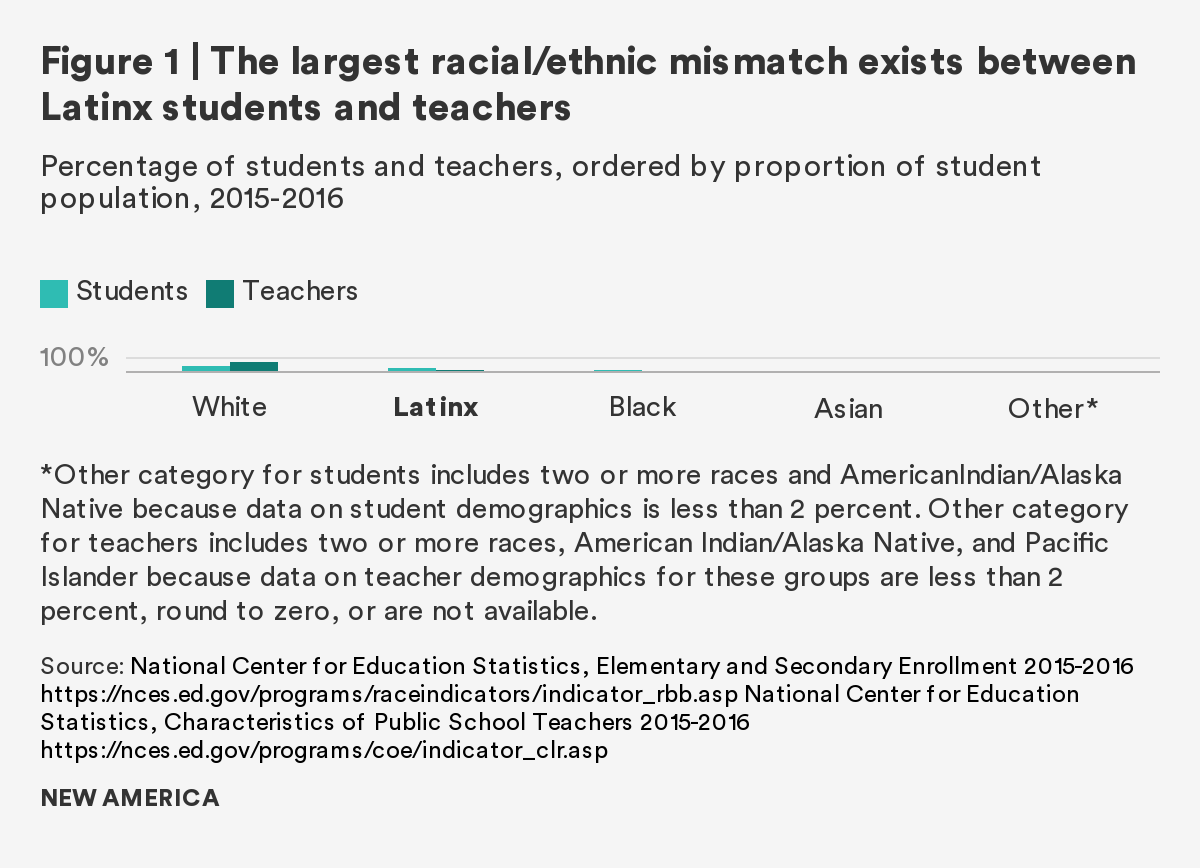
Early recruitment into the teaching profession. Ongoing mentorship from high school to postsecondary education. Structured partnerships between PreK–12 and higher education. These are a few promising steps communities across the United States are taking to fill the large and growing demographic gap that exists between students and teachers in our public elementary and secondary schools. In 2015–2016, 51 percent of students in public schools were non-White, compared to only 20 percent of teachers.1 The Latinx2 population is the largest ethnic group in American public schools, making up about a quarter of the student population and expected to grow to one-third by 2027.3 While demographic gaps exist between the other non-White student populations and teachers, this one is the largest, with Latinx teachers making up only 9 percent of the teacher workforce.4
Why does this demographic mismatch matter? While the Latinx student population has experienced some positive academic gains, its academic attainment still lags behind their White peers. The high school dropout rate is higher for Latinx students than other racial/ethnic subgroups, and four-year degree attainment is lower. Research on student-teacher racial/ethnic matching indicates that one high-potential strategy for improving Latinx student outcomes is to increase the number of effective Latinx teachers available to teach, mentor, and support them.5
While research has largely focused on the impact of Black teachers on Black students,6 some studies have found that Latinx students who are assigned to a teacher who reflects their cultural, racial, and/or linguistic backgrounds experience an array of benefits. These include more positive perceptions of their teachers,7 higher achievement scores,8 and an increase in the likelihood of attending college.9 Other studies have found that Latinx students in schools with more Latinx teachers took more advanced placement courses and international baccalaureate courses than in schools with fewer Latinx teachers,10 and that Latinx teachers improve Latinx students’ aspirations and feelings of connectedness.11
Of course non-Latinx teachers can effectively teach Latinx students,12 and not every Latinx teacher will be equally effective at doing so. This is particularly true given the wide heterogeneity of the Latinx population: any given Latinx teacher may not share the same race, country of origin, language, and/or socioeconomic background with all, or even any, of their Latinx students.13
But research suggests that, overall, Latinx teachers are more likely to be well-positioned to support Latinx students’ academic, emotional, and social success than non-Latinx teachers.14 For example, Latinx teachers who share their students’ cultural experiences are able to more easily establish confianza—trust that leads to openness and sharing of information, and which is critical to forming authentic relationships with students and their families.15 And because Latinx teachers sometimes have experienced the same inequities as their students, they are more likely to be aware of school policies and practices that affect students of color and to advocate for changes, like implementing restorative justice practices to address school discipline or adopting culturally relevant curricula.16
Latinx teachers can often bring linguistic diversity into the classroom as well. In 2016, there were roughly 13 million Latinx students in public schools. At the same time, there were approximately 4 million Latinx English learners (ELs)17—making up the majority of ELs (77 percent) in public schools.18 Not surprisingly, most states report teacher shortages in bilingual, dual language, and English as a Second Language (ESL) in their public schools.19
While the number of Latinx teachers has more than quadrupled over the last three decades—from approximately 69,000 in 1987–1988 to 338,000 in 2015–201620—the rate of growth is still not quick enough to narrow the wide gap between student and teacher demographics.
In order to really narrow the demographic gap between Latinx students and teachers, more Latinx individuals will need to first be eligible to become teachers. This will require more of them to complete high school, enroll in college, and complete a bachelor’s degree. This report takes a close look at pathways into teaching for Latinx students and the barriers they face at each of these transition points. In the sections that follow, we explore how Latinx teachers enter the profession and examine the barriers along the way. We then profile three Latinx-focused pathways into teaching that are attempting to reduce those barriers. Finally, we reflect on our four key findings and offer five recommendations for policymakers and practitioners.
Our Research Approach
To conduct this work, we engaged in:
- a literature review of peer-reviewed articles, books, and policy reports on Latinx teachers;
- semi-structured interviews with experts in the field—researchers, advocates, policy experts, and practitioners—that informed our selection of pathway programs;
- interviews with students, teachers, administrators, and researchers, associated with the three selected pathways; and
- site visits to the selected pathways.
Each of the three selected pathways—in Chicago, Illinois; in San Antonio, Texas; and in Skagit Valley, Washington—employ a variety of structured partnerships to provide academic, financial, and social support to participants. The three were selected based on their focus on innovative approaches to recruiting and preparing Latinx teachers.
Citations
- National Center for Education Statistics (website), Digest of Education Statistics, “Table 203.50. Enrollment and percentage distribution of enrollment in public elementary and secondary schools, by race/ethnicity and region: Selected years, fall 1995 through fall 2028,” March 2019, source; and National Center for Education Statistics (website), Digest of Education Statistics, “Table 209.10. Number and percentage distribution of teachers in public and private elementary and secondary schools, by selected teacher characteristics: Selected years, 1987–88 through 2015–16,” September 2017, source
- Throughout this paper, we use the term Latinx, a gender-neutral or non-binary alternative to Latino or Latina.
- Cristobal de Brey, Lauren Musu, Joel McFarland, Sidney Wilkinson-Flicker, Melissa Diliberti, Anlan Zhang, Claire Branstetter, and Xiaolei Wang, Status and Trends in the Education of Racial and Ethnic Groups, “Indicator 6: Elementary and Secondary Enrollment” (Washington, DC: U.S. Department of Education, February 2019), source, source
- Joel McFarland, Bill Hussar, Jijun Zhang, Xiaolei Wang, Ke Wang, Sarah Hein, Melissa Diliberti, Emily Forrest Cataldi, Farrah Bullock Mann, and Amy Barmer, The Condition of Education 2019, section 1.12, “Characteristics of Public School Teachers” (Washington, DC: U.S. Department of Education, May 2019), source source
- For more information on how Latinx teachers can improve Latinx student outcomes, see Cristóbal Rodríguez, Melissa A. Martinez, and Fernando Valle, “Latino Educational Leadership across the Pipeline: For Latino Communities and Latina/o Leaders,” Journal of Hispanic Higher Education 15, no. 2 (October 2016): 136–153, source; Carline S. Turner, Pedro X. Cosmé, Laura Dinehart, Raquel Martí, David McDonald, Martin Ramirez, Lester Sandres Rapalo, and Juan Zamora, Improving Diverse and Inclusive Teacher Pipelines with a Focus on Latinas/Latinos/Hispanics (Washington, DC: White House Initiative on Educational Excellence for Hispanics: 2017), source; and Mary Louise Gomez and Terri L. Rodriguez, “Imagining the Knowledge, Strengths, and Skills of a Latina Prospective Teacher,” Teacher Education Quarterly 38, no. 1 (Winter 2011): 127–146.
- Most research, particularly quantitative research, has been focused on Black teachers and Black students. One study by Travis J. Bristol found that, “to date, no quasi-experimental studies have explored the impact on Latinx students’ learning when taught by Latinx teachers.” While we can extrapolate from the various studies done on the impact of Black teachers on Black students, these effects may play out differently for different racial/ethnic groups. See Travis J. Bristol and Javier Martin-Fernandez, The Added Value of Latinx and Black Teachers for Latinx and Black Students: Implications for the Reauthorization of the Higher Education Act (Providence, RI: Annenberg Institute at Brown University, 2019), source
- Hua-Yu Sebastian Cherng and Peter F. Halpin, “The Importance of Minority Teachers: Student Perceptions of Minority versus White Teachers,” Educational Researcher 45, no. 7 (October 2016): 407–420, source
- Beatriz C. Clewell, Michael J. Puma, and Shannon A. McKay, "Does It Matter if My Teacher Looks Like Me? The Impact of Teacher Race and Ethnicity on Student Academic Achievement" (paper presented at the meeting of the American Educational Research Association, Montreal, 2005).
- Patricia Gándara, Leticia Oseguera, Lindsay Pérez Huber, Angela Locks, Jongyeon Ee, and Daniel Molina, Making Education Work for Latinas in the U.S. (Los Angeles, CA: The Civil Rights Project, 2013), source
- Todd Kettler and Luke T. Hurst, “Advanced Academic Participation: A Longitudinal Analysis of Ethnicity Gaps in Suburban Schools,” Journal for the Education of the Gifted 40, no. 1 (March 2017): 3–19.
- Belinda Bustos Flores, Ellen Riojas Clark, Lorena Claeys, and Abelardo Villarreal, “Academy for Teacher Excellence: Recruiting, Preparing, and Retaining Latino Teachers Through Learning Communities,” Teacher Education Quarterly 34, no. 4 (Fall 2007): 53–69, source
- Tara Stevens, Mary Frances Agnello, Janie Ramirez, Aretha Marbley, and Doug Hamman, “Project FUTURE: Opening Doors to Diverse West Texas Teachers,” Teacher Education Quarterly 34, no. 4 (Fall 2007): 103–120, source; Kip Téllez, “Preparing Teachers for Latino Children and Youth: Policies and Practice,” The High School Journal 88, no. 2 (2004): 43–54, source; and Barry M. Goldenberg, “White Teachers in Urban Classrooms: Embracing Non-White Students’ Cultural Capital for Better Teaching and Learning,” Urban Education 49, no. 1 (January 2014): 111–144.
- For more on the diversity of the U.S. Latinx population, see Antonio Flores, “How the U.S. Hispanic Population is Changing,” Fact Tank, Pew Research Center, September 18, 2017, source
- Ana Maria Villegas and Jacqueline Jordan Irvine, “Diversifying the Teaching Force: An Examination of Major Arguments,” The Urban Review 42, no. 3 (September 2010): 175–192; and Mary Louise Gomez, Terri L. Rodriguez, and Vonzell Agosto, “Who are Latino Prospective Teachers and What do They Bring to US Schools?” Race Ethnicity and Education 11, no. 3 (September 2008): 267–283.
- Evelyn M. Weisman, Susana Y. Flores, and Christine Valenciana, “Building Bilingual–Bicultural Learning Communities: Experiences of Latino Teacher Candidates,” Journal of Hispanic Higher Education 6, no. 3 (July 2001): 191–208.
- For more information on Latinx teachers’ experiences and how they advocate for their students, see Margarita Ines Berta-Avila, “Critical Xicana/Xicano Educators: Is It Enough to be a Person of Color?” The High School Journal 87, no. 4 (April–May 2004): 66–79; Rene Galindo, “Reframing the Past in the Present: Chicana Teacher Role Identity as a Bridging Identity,” Education and Urban Society 29, no. 1 (1996): 85–102; Mary Louise Gomez, Terri L. Rodriguez, and Vonzell Agosto, “Who are Latino Prospective Teachers and What do They Bring to US Schools?” Race Ethnicity and Education 11, no. 3 (September 2008): 267–283; Gilda L. Ochoa, Learning from Latino Teachers (San Francisco, CA: Jossey-Bass, 2007); and Zhixin Su, “Teaching as a Profession and as a Career: Minority Candidates' Perspectives,” Teaching and Teacher Education 13, no. 3 (April 1997): 325–340; Christopher Redding, “A Teacher Like Me: A Review of the Effect of Student-Teacher Racial/Ethnic Matching on Teacher Perceptions of Students and Student Academic and Behavioral Outcomes,” Review of Educational Research 89, no. 4 (August 2019): 499–535.
- The U.S Department of Education defines an English Learner (EL) as "an individual who, due to any of the reasons listed below, has sufficient difficulty speaking, reading, writing, or understanding the English language to be denied the opportunity to learn successfully in classrooms where the language of instruction is English or to participate fully in the larger U.S. society. Such an individual (1) was not born in the United States or has a native language other than English; (2) comes from environments where a language other than English is dominant; or (3) is an American Indian or Alaska Native and comes from environments where a language other than English has had a significant impact on the individual’s level of English language proficiency.” See Joel McFarland, Bill Hussar, Jijun Zhang, Xiaolei Wang, Ke Wang, Sarah Hein, Melissa Diliberti, Emily Forrest Cataldi, Farrah Bullock Mann, and Amy Barmer, The Condition of Education 2019, “Glossary,”section 1.7, “English Language Learners in Public Schools” (Washington, DC: U.S. Department of Education, May 2019), source, source, and source
- Joel McFarland, Bill Hussar, Jijun Zhang, Xiaolei Wang, Ke Wang, Sarah Hein, Melissa Diliberti, Emily Forrest Cataldi, Farrah Bullock Mann, and Amy Barmer, The Condition of Education 2019, section 1.7, “English Language Learners in Public Schools” (Washington, DC: U.S. Department of Education, May 2019), source, source; and National Center for Education Statistics (website), Digest of Education Statistics, “Table 203.50. Enrollment and percentage distribution of enrollment in public elementary and secondary schools, by race/ethnicity and region: Selected years, fall 1995 through fall 2025,” March 2019, source
- For a complete list of teacher shortage areas, see Freddie Cross, Teacher Shortage Areas: Nationwide Listing 1990–1991 through 2017–2018 (Washington, DC: U.S. Department of Education, June 2017), source
- National Center for Education Statistics (website), Digest of Education Statistics, “Number and percentage distribution of teachers in public and private elementary and secondary schools, by selected teacher characteristics: Selected years, 1987–88 through 2015–16,” September 2017, source