Table of Contents
- Executive Summary
- I. Introduction
- II. What We Know about Parler and Publicly Available Parler Data
- III. Contesting the Election Results: The Road to the Capitol and Indictments
- IV. Elite Signaling and Parler’s Influencers: Topic Modeling & Link Analysis
- V. Examining The Objector Parler Accounts
- VI. What the Parler Metadata Tells Us
- VII. Implications & Takeaways
V. Examining The Objector Parler Accounts
On January 6, 2021, after the attack on the Capitol, eight Republicans in the Senate and 139 in the House objected to Arizona’s or Pennsylvania’s 2020 election results. As reported in the news, many of Trump’s Republican allies spent months openly challenging the election results.1 While more Senate Republicans and House members had publicly stated their intention to vote in favor of objections, some lawmakers changed their votes after the attack on the Capitol. The 147 members of Congress who did not change their vote to object to the election, represent some of the loudest and most influential voices circulating misinformation about the election.
We examined the social media presence of the 147 election objectors through the lenses of their official Twitter accounts, deleted tweets from their official Twitter accounts, and compared that content with what they posted to their Parler in the lead-up to January 6. Using profile information from the Aliapoulios, et al. dataset, we were able to find Parler accounts for 46 of the 147 objectors. Of those accounts, 34 did not have a post or comment history.
The Parler account statistics for the remaining 13 objectors are displayed in the table below. The creation date of these 13 accounts is important because many objectors joined Parler in May or June of 2020. This was a period when many prominent right-wing figures were leaving mainstream social media platforms for Parler due either to a perception that mainstream platforms were prone to censoring conservative content or because they were banned after posting false content related to conspiracy themes like QAnon or inciting hatred or violence. Except for Rick Crawford, the objectors verified their accounts with Parler. Verified accounts display an official badge on the account—similar to Twitter’s verified account program. The presence of a verified badge indicates that the account is “official” and not a parody or fake account. Verification is not an automatic process; it requires the account holder to submit a photo and photo ID card.
Figure 16: Parler accounts of the 13 members of Congress who objected to the certification of the elections who we were also able to identify and that had a post or comment history.
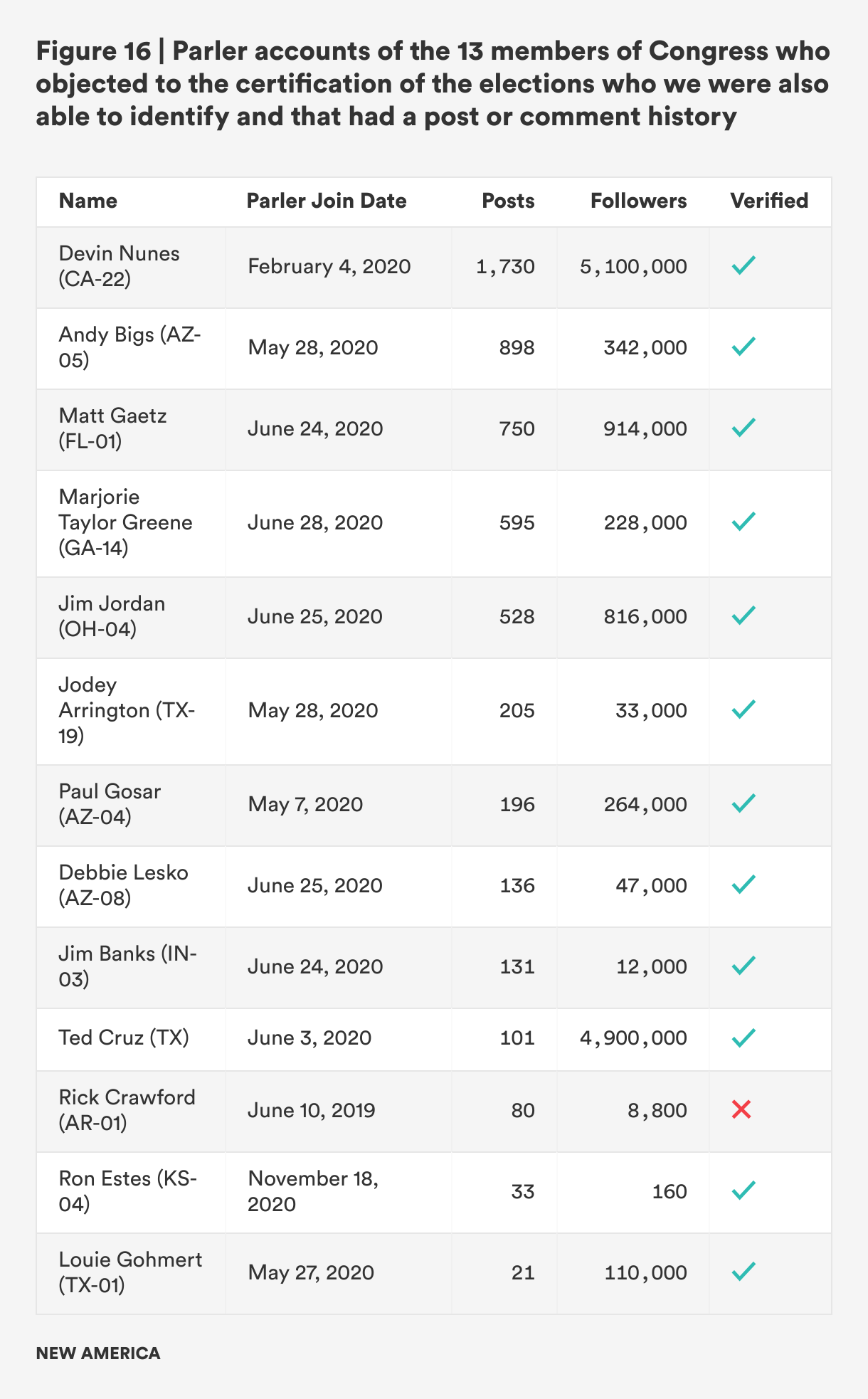
Devin Nunes and Ted Cruz had the highest number of followers. Ted Cruz, Matt Gaetz, Jim Jordan, Andy Biggs, Paul Gosar, and Majorie Taylor Greene also had followers in the hundreds of thousands before the platform was temporarily shut down. The high follower counts meant that any content posted by these accounts would have a high likelihood of being prominently displayed when a user logged into Parler. This would have been true for users who already followed those accounts as well as new users. On the one hand, high follower content was promoted to their followers. Users who followed these prolific accounts would be more likely to see the content from high-follower count users. On the other, high follower count accounts were promoted to new users and non-followers as suggested users they should follow. In other words, the objectors enjoyed outsized influence on Parler.
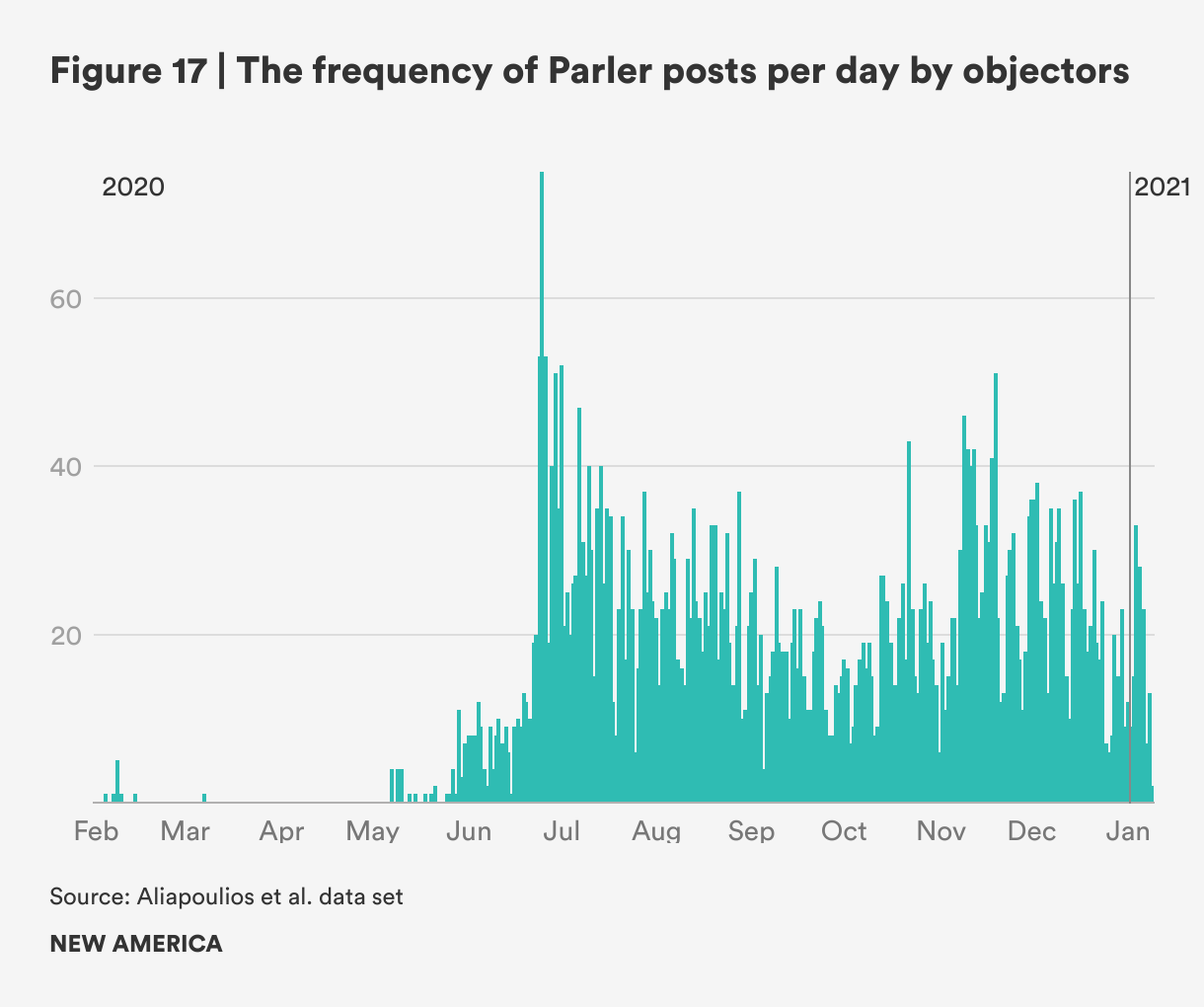
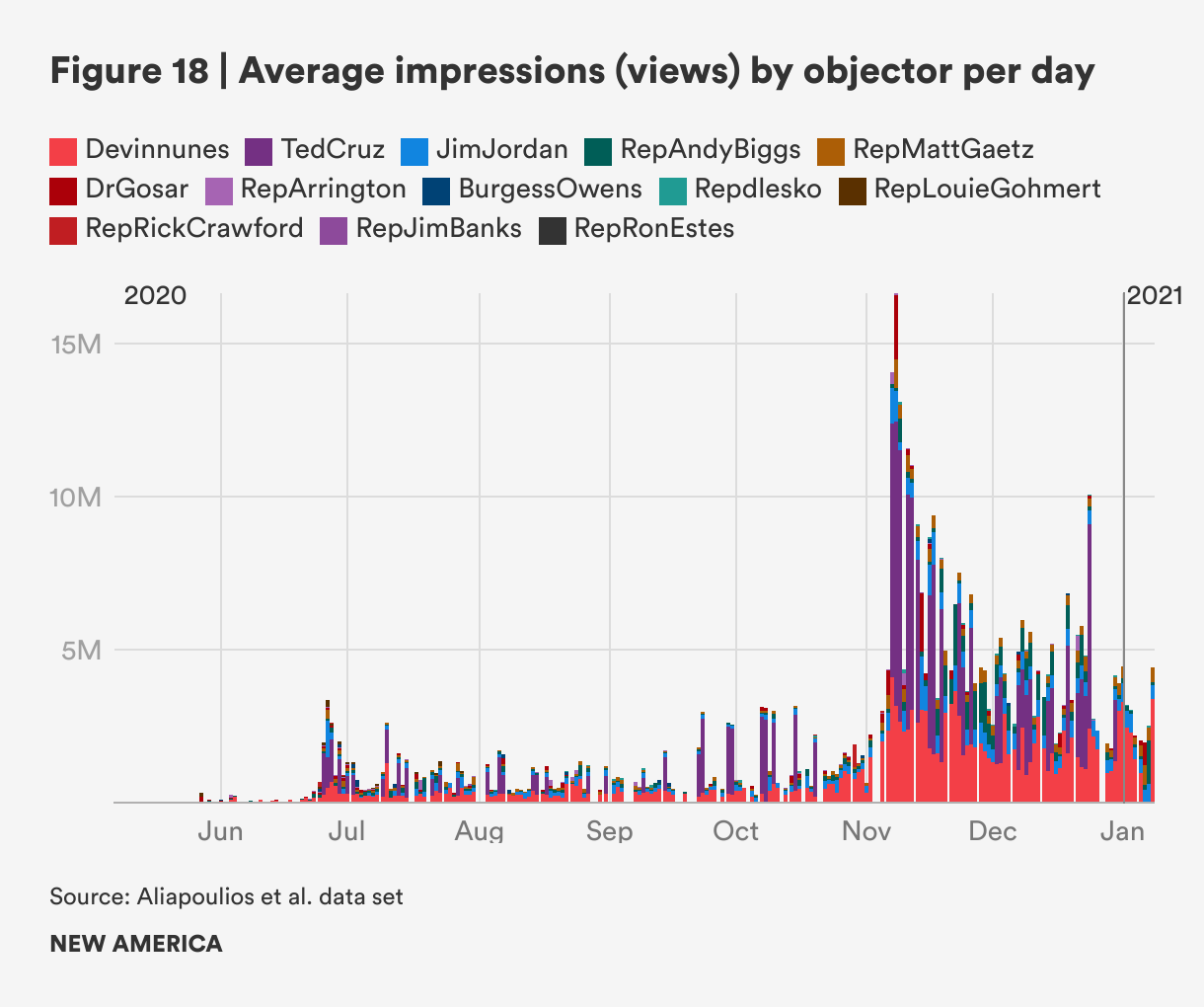
In Figure 17, we can see the posting frequency of the objectors per day. We can see that the highest posting days are clustered during the period right after many of the accounts were created. In Figure 18, we see the average number of impressions (views) by users on each day during the same period. Posts by objectors receive the most attention in the days after the election through the end of December. The peak occurred on November 7 with Devin Nunes, Ted Cruz, Paul Gosar, and Jim Jordan receiving the lion’s share of impressions. The posts associated with each of those accounts received impressions ranging from 1 million to over 8 million. The high impression numbers show just how influential the objector accounts are in the period after the election and in the build-up to January 6.
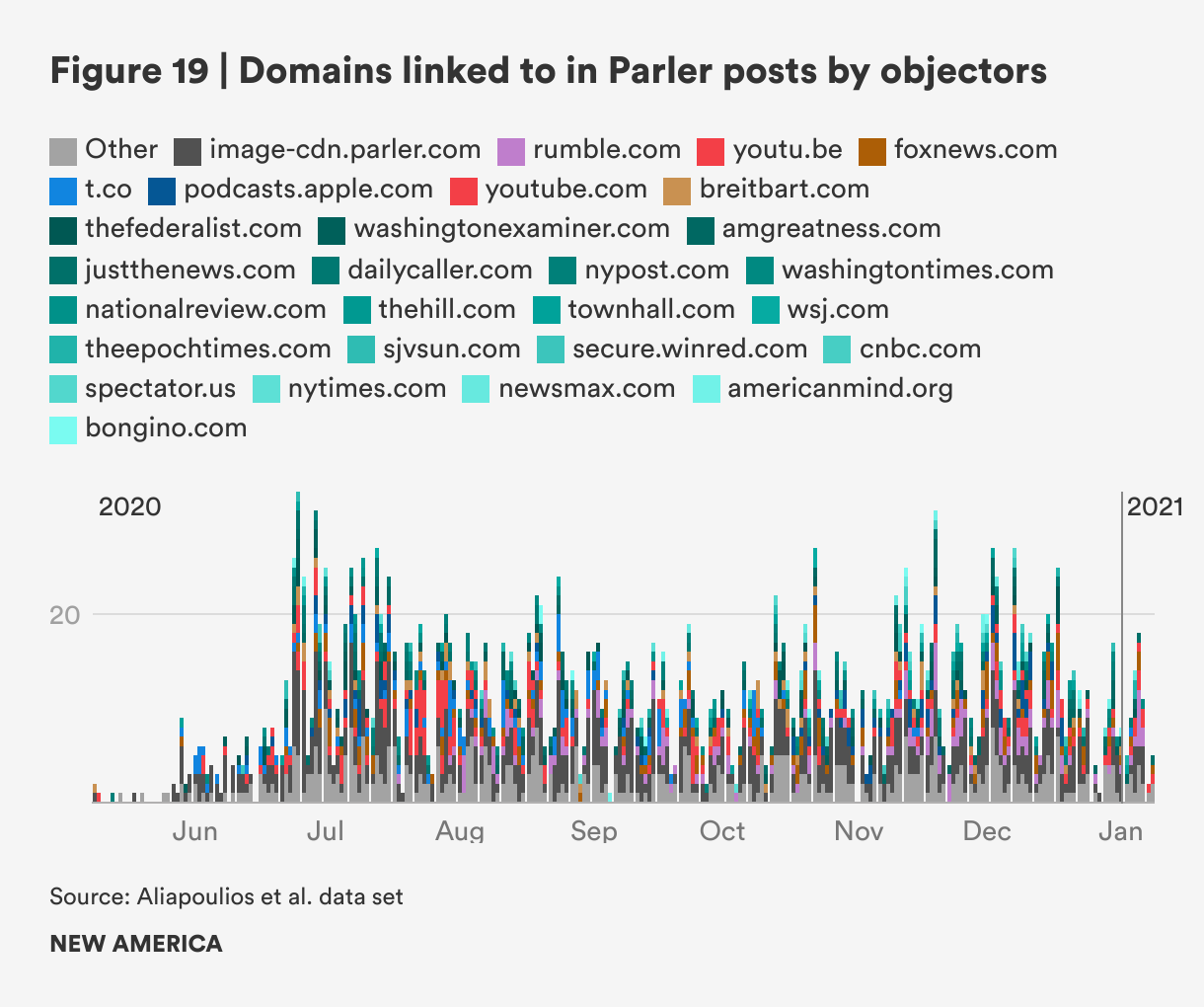
When examining the links circulated by the objectors within Parler, we see that most “news” links in these posts point readers to sites known for circulating misinformation and conspiracy theories.2,3 A little over half (52 percent) of all posts from the objectors contain links to other sites. The objectors both brought external content into Parler and provided substantial commentary without external links.
Comparing Parler and Twitter Activity
We see the Twitter accounts as a form of official, everyday communication and Parler accounts as a way to communicate more extreme political content. To compare the activities of objectors in these two spaces, we used topic modeling to understand the salient combinations of terms that co-occur within each set of social media data. The three datasets consisted of publicly available tweets from official accounts, deleted tweets collected via Politwoops,4 and Parler posts.
The topic models were very similar for the tweets that were publicly accessible on the objectors’ official Twitter accounts as well as the tweets they deleted from those accounts. Topics from the tweets were clustered around two main areas: 1) thank you notes to groups and news media who met with the objectors, and 2) policy issues related to topics like taxes, the U.S.-Mexico border, and immigration. None of the topic clusters focused on the election. This stands in contrast to the topics found in their Parler posts. The topics in the objector’s Parler posts clustered around questioning the integrity of the election, resistance to COVID-19 restrictions (i.e. in favor of reopening schools), and references to Joe Biden and Hunter Biden. Overall, these topics show that the objectors were posting different types of content to their Twitter accounts vs. Parler.
Citations
- For a full list of objectors in the U.S. Senate and House of Representatives, see Zhou, Li. “147 Republican Lawmakers Still Objected to the Election Results after the Capitol Attack.” Vox, January 6, 2021. source.
- Sites such as the Epoch Times and Western Journal are heavy circulators of misinformation and conspiracy theories. For more information see Roose, Kevin. “How The Epoch Times Created a Giant Influence Machine.” The New York Times, October 24, 2020, sec. Technology. source
- The AllSides Media Bias Chart provides information about the political bias of media sites. See source for the latest version of the chart.
- See: source.