Table of Contents
- Executive Summary
- I. Introduction
- II. What We Know about Parler and Publicly Available Parler Data
- III. Contesting the Election Results: The Road to the Capitol and Indictments
- IV. Elite Signaling and Parler’s Influencers: Topic Modeling & Link Analysis
- V. Examining The Objector Parler Accounts
- VI. What the Parler Metadata Tells Us
- VII. Implications & Takeaways
III. Contesting the Election Results: The Road to the Capitol and Indictments
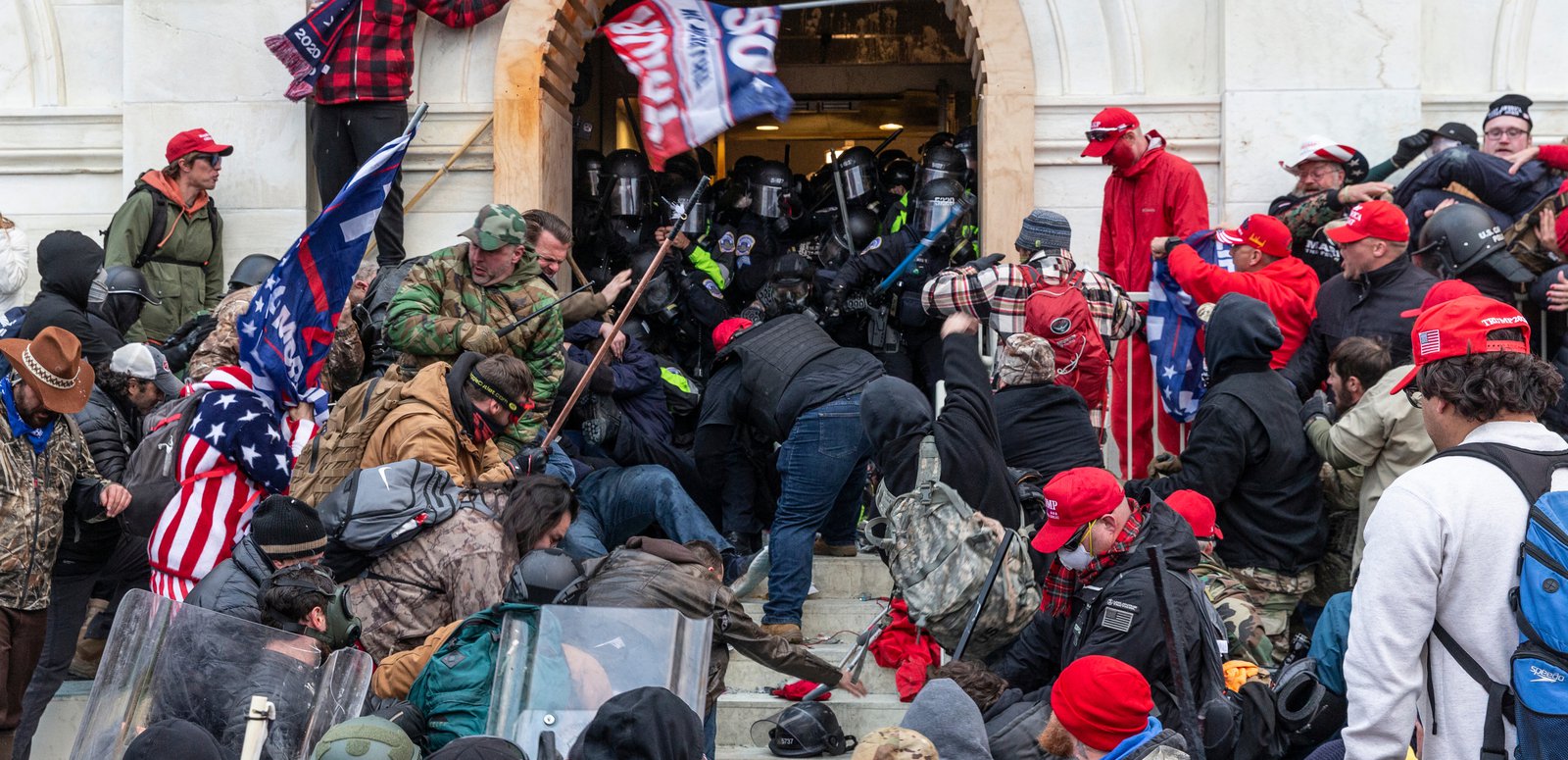
The thousands of Americans who answered President Trump’s call to gather in Washington, D.C. on January 6, 2021 ranged from run-of-the-mill supporters to organized militias. They were unified in their intention to contest the certification of an election they viewed as fraudulent. Their plans for doing so, however, varied. Some who turned up at the Capitol to contest the election results, like a contingent of Oath Keepers, said they intended to conduct citizen’s arrests of uncooperative politicians.1 Others simply wanted to show support for Trump.2 Some, according to their subsequent defenses, entered the Capitol spontaneously, believing that Trump himself had invited them in.3 Others planned from the start to raid the seat of U.S. democracy and force election outcomes their way.4
As of October, federal prosecutors had charged nearly half of those indicted with misdemeanors, such as trespassing,5 and misdemeanors constitute the majority of guilty pleas to date.6 More serious felony charges include assaulting police officers, obstruction of a Congressional proceeding, and conspiracy to injure an officer or obstruct law enforcement.7 Members of organized groups present at the attack such as the Proud Boys, Oath Keepers, and Three Percenters face some of the most serious charges to date.
As of August 2021, prosecutors had charged 17 Oath Keepers with conspiracy to obstruct a Congressional proceeding, namely the certification of the Electoral College vote.8 Prosecutors have also charged members of the Proud Boys with conspiracy to obstruct Congress and conspiracy to obstruct, impede, and interfere with law enforcement officers.9 Media coverage of the attack has focused heavily on these groups, as well.1011 All three are far-right organizations with a countrywide presence that rose to prominence during the Obama and Trump administrations.
As of early October 2021, federal authorities had arrested and charged 632 individuals for their actions on January 6.12 We created a catalog of individuals charged for their participation in the January 6 attacks by extracting data from case documents released by the U.S. Attorney’s Office for the District of Columbia and related on their website.13 A majority of news sources have used the location of arrest to analyze these defendants because that data is easily accessible via the U.S. Attorney’s Office website. The charging data in our set includes a total of 632 indicted individuals as of early October 2021.14
In some instances, the location of arrest listed in the charging documents does not match the place of residence of the defendant, however. To drill down further, we analyzed the content of charging documents, as well as local news reports, to find city and state of residence15 for each defendant as well as other attributes and status information about each case. This unique dataset, when combined with location-based event data on demonstrations across the country collected by ACLED, allows us to examine the local conditions surrounding each defendant’s residence instead of where they were arrested.
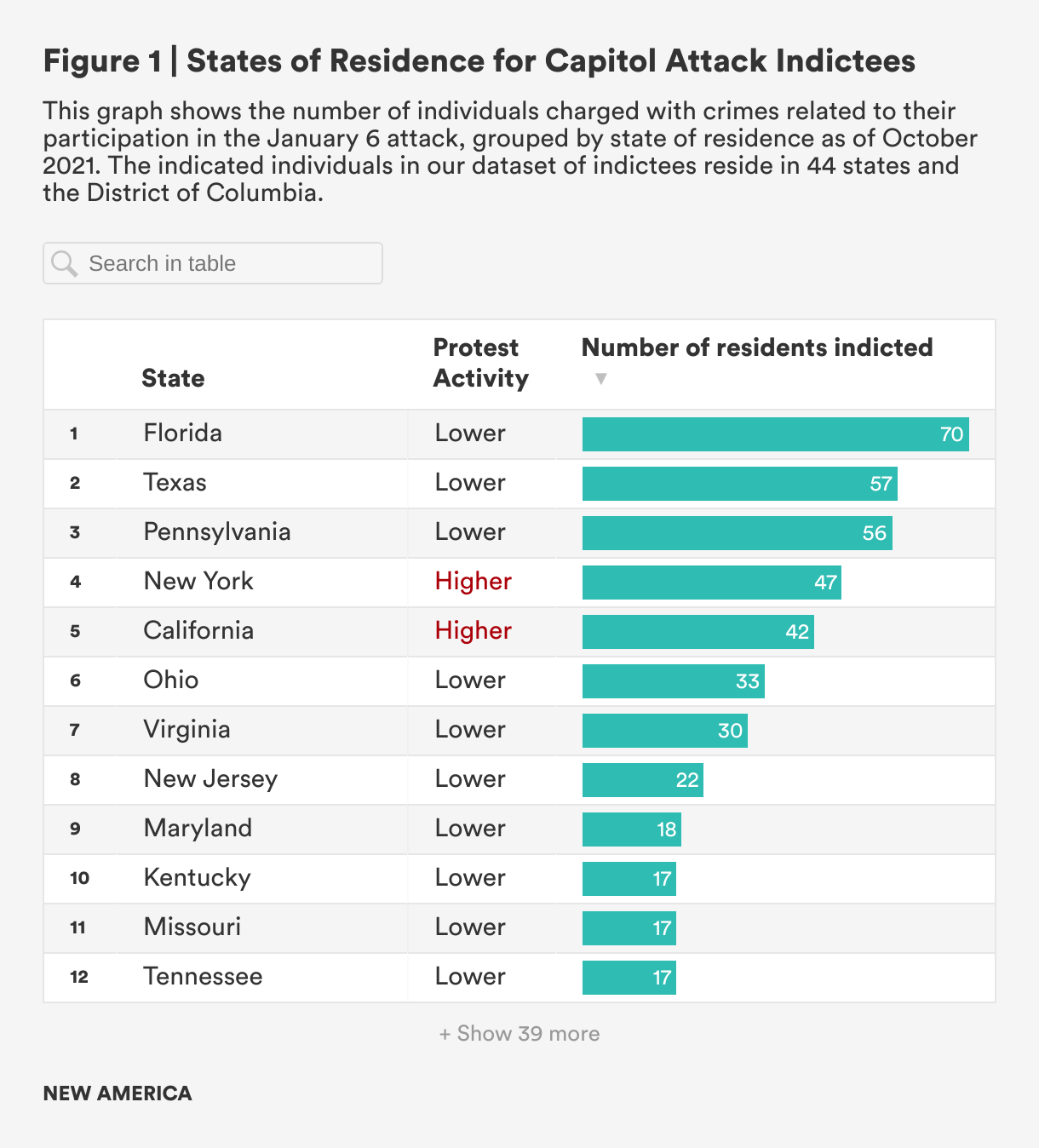
We found that the residences of those arrested span 45 states and include the District of Columbia. Population-wise, the states with the highest number of arrestees were Florida (70), Texas (57), Pennsylvania (56), and New York (47). A substantial number of arrestees also came from states where Trump and lawyers representing his campaign filed lawsuits contesting the results; besides Pennsylvania, those states included Arizona, Georgia, Nevada, Michigan, Wisconsin.16 Many arrestees—some 12 percent—had military experience, including one active duty Marine major.17 Current and former police officers were also arrested for participating in the attack.18 Of all the contesters, 86 percent are male, and their average age is 39.19
We were curious about whether there were any other discernible patterns in the arrest data that could tell us more about who showed up at the Capitol on January 6. So we examined the relationship between on-the-ground demonstrations in the lead-up to the siege and the residence of those charged with crimes related to their participation in the January 6 attack.20 Working together with the Bridging Divides Initiative (BDI) at Princeton University, we analyzed the locations of residences for 632 people charged in connection with January 6 and event location contained in the ACLED dataset with information about 24,662 demonstration events in the United States from January 1, 2020 to January 31, 2020 recorded by ACLED as part of the U.S. Crisis Monitor project.21 Together, this data captures the vast numbers of peaceful protest events and the contentious activity taking place during 2020 in the lead up to the January 6 attack, such as Black Lives Matter and “Back the Blue” counter-demonstrations, “Stop The Steal” election demonstrations, and protests related to COVID-19 restrictions.
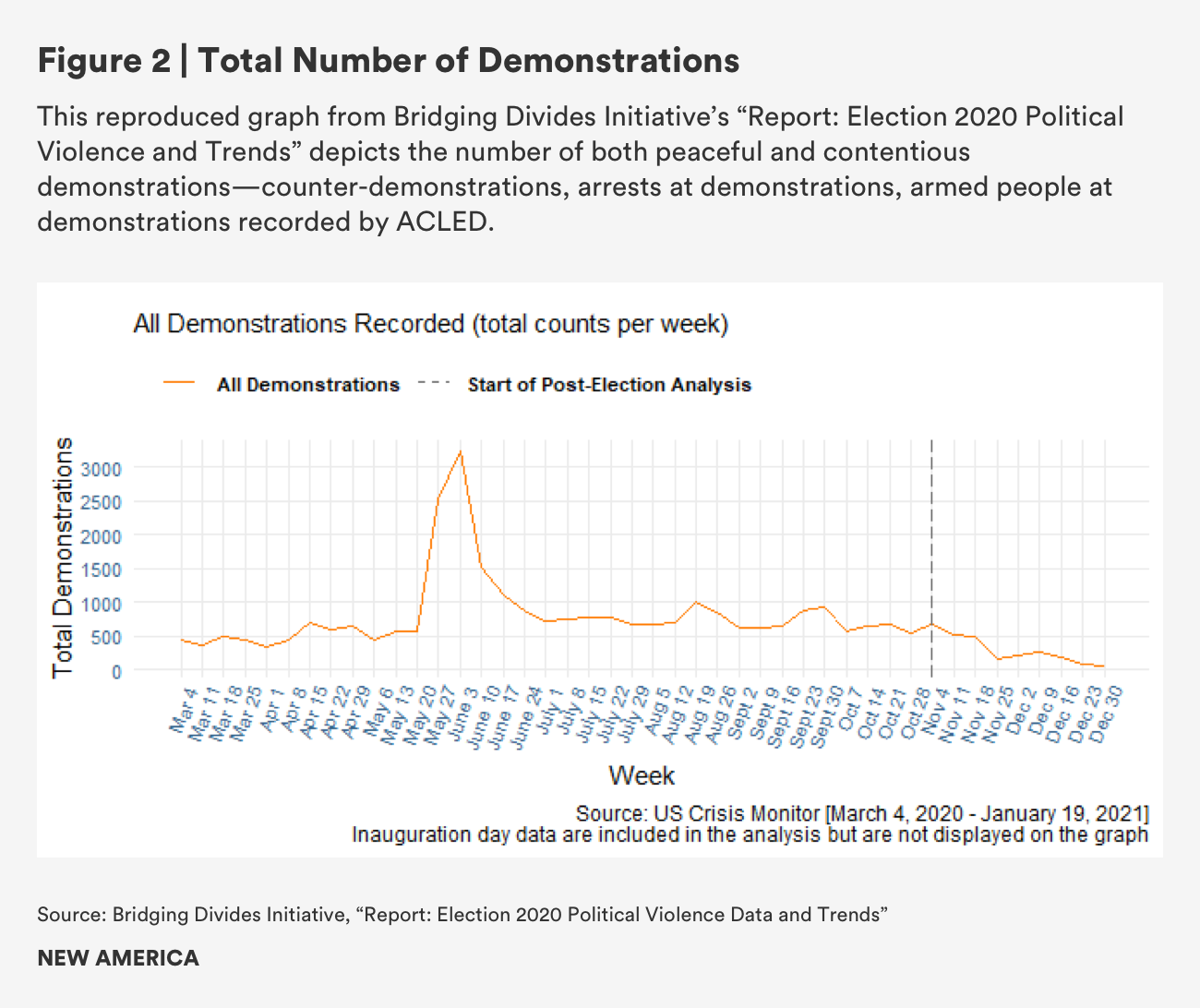
As noted by BDI in its year-end report on the 2020 elections, there were early indications of the potential for violence in the lead up to the Capitol attack.22 While the data cited in the report shows high levels of demonstration activity during the summer months when a combination of social justice protests related to police practices and COVID-19 lockdowns spurred activity in the streets, it also notes that procedural election events that were once considered routine also triggered high levels of activity.23 In the graphs below produced by the Bridging Divides Initiative with ACLED data,24 the spike in the number of demonstrations surrounding significant events related to the BLM movement and election events is readily visible.25
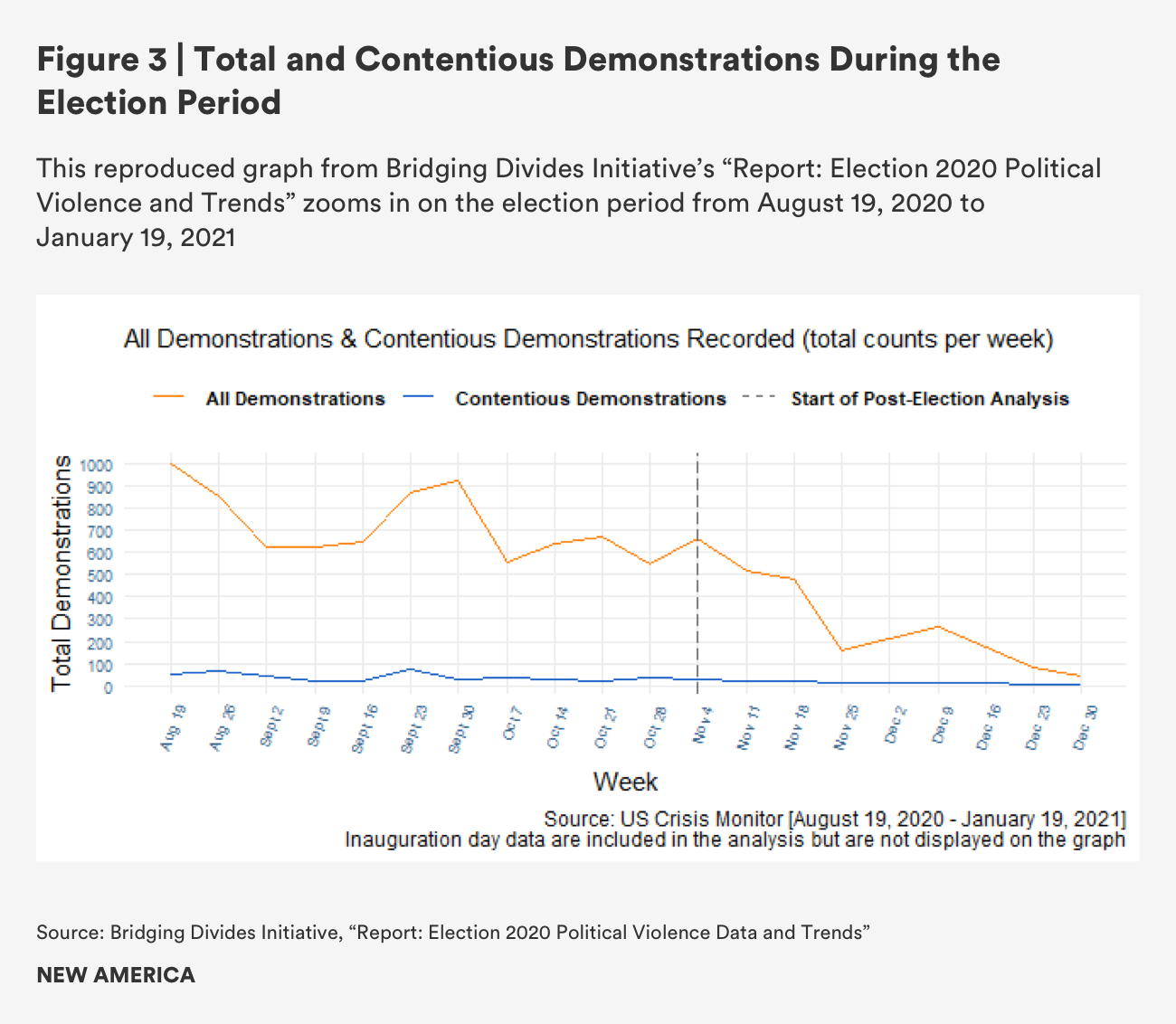
The BDI report also notes that the January 6 pro-Trump rally at the White House Ellipse marked the third “Million MAGA March” event to take place in Washington over a roughly six-week period. While, overall, the 11 week period leading up to elections showed more demonstration activity than the 11 week post-election period, there was a remarkable increase in the number of demonstrations involving unlawful militias or armed actors during the post-election period.26 Especially notable was the substantial level of counter-protest and paramilitary activity in key swing states where the Trump campaign also filed election related lawsuits, including Arizona, Georgia, Michigan, Nevada, Pennsylvania, and Wisconsin.
A statistical analysis we conducted shows that at a variety of geographic scales, the residences of those charged in the January 6 attack tended to cluster near areas where all types of demonstrations and counter protests took place, to a greater degree than anticipated under complete spatial randomness.27 That suggests that the proximity of protest activity prior to January 6 may have been an influencing factor for a substantial number of those indicted in connection with the Capitol breach.
As can be seen below, the clustering of demonstrations around an indictee’s residence is more significant—meaning looking at the local level in cities, towns and counties is more useful than generalizing to the state-level.28 That matters because a closer look at geotagged social media content from those localities like that found in videos could deliver more insights about warning signs of violence before Election Day and leading up to January 6. More research is needed, but it is possible that, combined with other types of anonymized geotagged sensing data and ethnographic analysis, the contours of early warning signs of escalating violence may be more discernible.
Figure 4
Map of locations of 24,662 demonstration events in the United States from January 1, 2020, to January 31, 2020 recorded by ACLED as part of the U.S. Crisis Monitor project and represented as orange and yellow clusters, combined with location of residences for individuals indicted from January 2021 to October 2021 for their role in the January 6th insurrection. The dataset includes 632 indicted individuals, which are represented on the map by red ringed circles.
Looking at the states with the highest number of indicted individuals related to the January 6 attack, we see that the number of demonstrations in Florida, Texas, and Ohio are less than expected given their population size. In Pennsylvania, New York, California, and Virginia, we see more demonstrations than expected. Moving our level of analysis from the state to local level, the map above combines the location of residence of individuals indicted for their role in the January 6 riot with the location of demonstrations in the United States from January 1, 2020 – January 31, 2021. The dataset includes 632 indicted individuals and 24,662 demonstration events. Zooming in on the map allows us to see the residences of indicted individuals and the protest events surrounding them.
The analysis points to a set of complex interactions between local and national demonstration events as well as external factors when looking at charging and demonstration data at the state level. The primary takeaway is that those charged with crimes related to the Capitol attack live in locations near clusters of demonstration events in both densely populated and less densely populated areas. This points to a potential relationship between local demonstrations near the residences of the 632 people charged as of October 2021 and their involvement in the Capitol attack.
It also suggests that there was likely a relationship between the galvanizing force of online mis- and dis-information about the elections and other issues that mobilized the public in the lead up to January 6. As discussed further below, hints of the relationship between demonstration activity, the polarizing rhetoric of political elites and online influencers, and mobilization to violence are mirrored at the individual level among arrestees who turned up in Washington to contest the election outcome and on a larger scale in millions of Parler posts on the early version of the site.
Data Mining Social Media for More Evidence: A Closer Look at Two Contesters
Charging documents also show the extent to which federal investigators mined social media activity in building cases against the Capitol rioters—many mention participants’ social media profiles, including those on Parler. We identified references to the social media accounts of 58 defendants in federal charging documents.29 While many usernames referenced in the documents appeared to refer to incriminating posts related to the Capitol breach on Twitter and Facebook, a substantial number also mentioned Parler handles for specific arrestees. We chose to profile two defendants from the resulting list.
What follows is a closer look at two of the contesters arrested for involvement in the January 6 attack. We chose these individuals because they illustrate many of the trendlines described elsewhere in this report. Both were active on Parler in the period leading up to and including January 6 and amplified the “StopThe Steal” messaging that dominated the platform during that time. They have ties to two of the groups central to the Justice Department’s ongoing conspiracy investigations—the Oath Keepers and Proud Boys. One resided in Ohio, home to 33 contesters, a top home state for many arrestees, while the other lived in Arizona, a pivotal target in Trump’s effort to overturn the 2020 election. Moreover, both hailed from areas with widespread demonstrations and protests throughout 2020. Finally, both contesters exemplify the complex crossover between online and offline political messaging, organizing, and networking.
An open-source investigation into these two arrestees linked to the Oath Keepers and Proud Boys reveals the extent to which online organizing, particularly on platforms like Parler, Gab, and Telegram, gave greater coherence to what might otherwise have been disparate groups. It also showed that Parler was integral to forging online and offline networks between those who showed up to the Capitol on January 6. The two cases we chose to focus on revealed substantial crossover between online instigation and offline activation. This suggests the relationship between the real and the virtual is not unidirectional, but rather a complex call-and-response dynamic in which online networks, memes, and messaging are reproduced at in-person protests, only for those in-person gatherings to generate more grist for the internet mill.
Backing the Blue, Keeping the Oath
One arrestee, Jessica Watkins, a 38-year-old small business owner from Ohio, faces several charges including conspiracy to obstruct the certification of the Electoral College vote and destruction of government property.30 The other, Micajah Jackson, 25-years old, grew up in Montana but now lives in Arizona and was charged with trespassing, as well as violent entry and disorderly conduct, on restricted Capitol grounds.31 We attempted to contact lawyers for Watkins and Jackson, but we did not receive a response before this report was scheduled to go to press.32
Watkins, the self-described commanding officer of the Ohio State Regular Militia and “a dues-paying subset of the Oath Keepers,” is one of the most visible of the 632 people that investigators have charged for the January 6 attack as of October 2021.33 This is largely thanks to the fact that Watkins, who is transgender, documented her role in the riot on her @OhioStateRegulars Parler account.34 An affidavit filed by federal prosecutors in January 2021 includes screenshots of selfies Watkins posted to the @OhioStateRegulars account.35 While she was not a particularly prolific user of the platform before January 6, she posted photos and videos of herself participating in the attack on Parler, stating “[w]e stormed the Capitol today.”36 Federal authorities claimed she was also part of a “stack” of military-clad Oath Keepers who cut through the crowd on their way inside the Capitol building.37
An Army veteran who served in Afghanistan, Watkins lived and tended to a bar in the small Ohio town of Woodstock.38 According to her one-time boyfriend and business partner, she founded her militia in 2019 to assist local first responders in weather emergencies after tornadoes tore through the region in May of that year.39 However, as Trump’s administration entered its final full year, Watkins and her militia appeared to grow more politically engaged.
In May 2020, the murder of George Floyd sparked nationwide Black Lives Matter protests, and Watkins’s Oath Keeper contingent went into action, patrolling some 12 events over the next six months.40 In response to a nationwide call from Oath Keeper leadership, Ohio State Regular Militia traveled to Louisville, Kentucky, amidst protests against the police killing of Breonna Taylor.41 Louisville was a major locus of protest events and demonstrations in 2020, with the U.S. Crisis Monitor recording 139 events in the city, compared to 72 and 109 in nearby, comparably sized Indianapolis and Nashville.42 Seven of those 139 entries either name Oath Keepers as the principal actor or mention the group. The U.S. Crisis Monitor also records 93 events in Columbus, the closest major city to Watkins’s hometown. One such protest was on November 7, 2020, at the Ohio State House where Watkins and two compatriots patrolled the area in military gear and guns after Joe Biden was projected to win the election.43
The action in Kentucky and Ohio involving BLM protests and “Back the Blue” counter protests related to the police shooting of Taylor began to pick up in early June around the time the Louisville city council passed legislation dubbed “Breonna’s Law,” which outlawed the type of no-knock warrant that triggered the police shooting that killed Taylor.44 Perhaps not surprisingly, parallel spikes in activity were visible online on Parler with posts containing the words “Back the Blue” increasing in late May and early June as Black Lives Matter protests swept across the country.
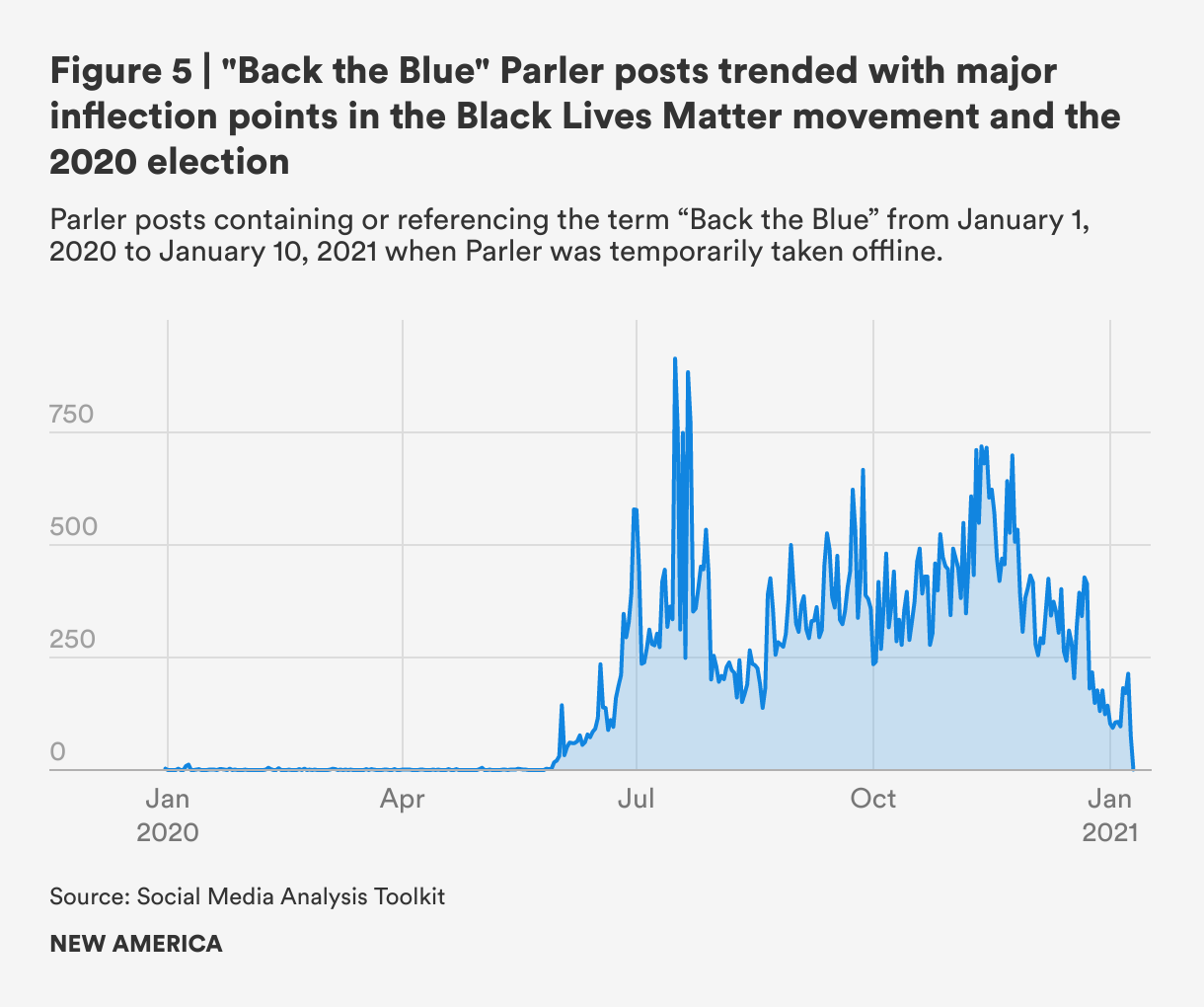
Related posts first spiked upward early in the summer of 2020 with 144 “Back the Blue''-related posts notched on June 2, a day after President Trump’s photo op in front of St. John’s Church on Lafayette Square, a move that intensified the unrest and ongoing Black Lives Matter protests in Washington that summer. The pro-police catchphrase hit its highest peak on Parler on July 16, 2020 with 914 posts that day, and then ebbed and flowed over time as protests and counter-protests swept across the country. The phrase appeared to lose salience progressively after the elections with only a handful of posts in the period from January 8-10, 2021.
The drop-off in “Back the Blue''-related posts scans with other noticeable trends visible on Parler, which progressively saw election-related slogans gain salience right after Election Day on November 3. There was a significant increase in Parler posts containing the phrase or referencing “Stop the Steal” after news outlets called the election in Biden’s favor on November 7, 2020. There was a big jump with November 13, 2020 which marked the first time Trump spoke publicly after Biden was declared the winner. On that day, 13,857 related Parler posts mentioning the “Stop the Steal” rallying cry were uploaded, according to an assessment we conducted using the Social Media Analysis Toolkit (SMAT) analysis tool, a publicly available application for tracking online trends on niche platforms.
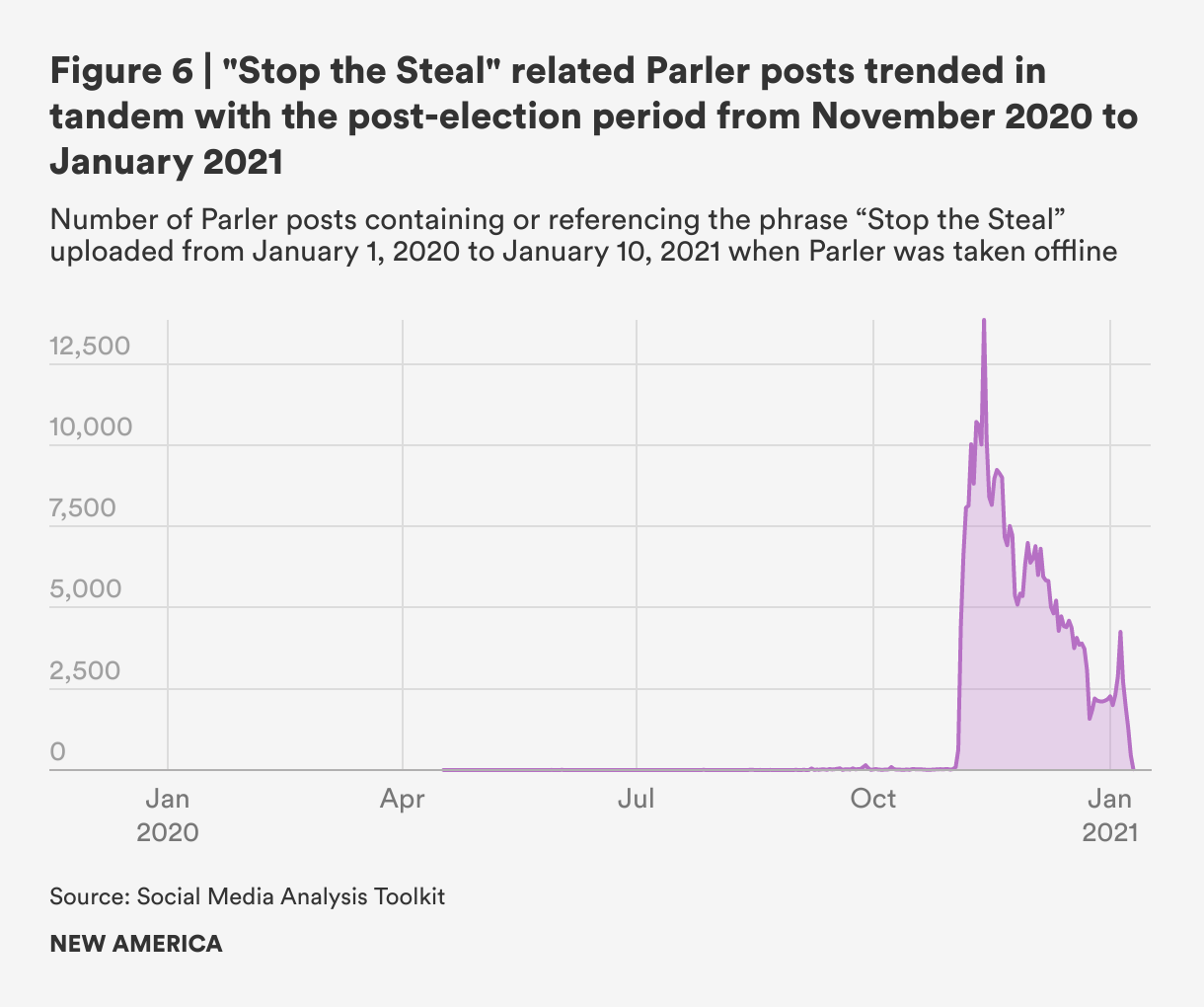
Watkins’s online activity in Parler appears to track loosely with the above trends. In early December 2020, Watkins began posting on Parler under the handle @OhioStateRegulars, which she used as a recruiting tool for her militia.45 Her first post, dated December 5, 2020, read, “Feel free to reach out. We are very active as a militia. We've been to 11 protests, and defended a MAGA truck parade. We also do training all the time.”46

Watkins also repeatedly complained about pandemic-related business restrictions,47 writing, “I own a small business, a Bar in a lockdown state. This. This is fact. We lost 60% of our revenue. If we didn't own and rent an apartment in the building, we'd have gone under already.”48 Although her post was minor in the scheme of things, it was part of a spike in activity on Parler that peaked shortly after the November 3 election but remained elevated through January 6, 2021, compared to historical rates for the platform. Analysis of post creation dates on Parler in the Aliapoulios, et al. dataset shows a substantial increase in the rate of posts on the platform after most major news media outlets declared Biden the winner of the presidential election on November 7.
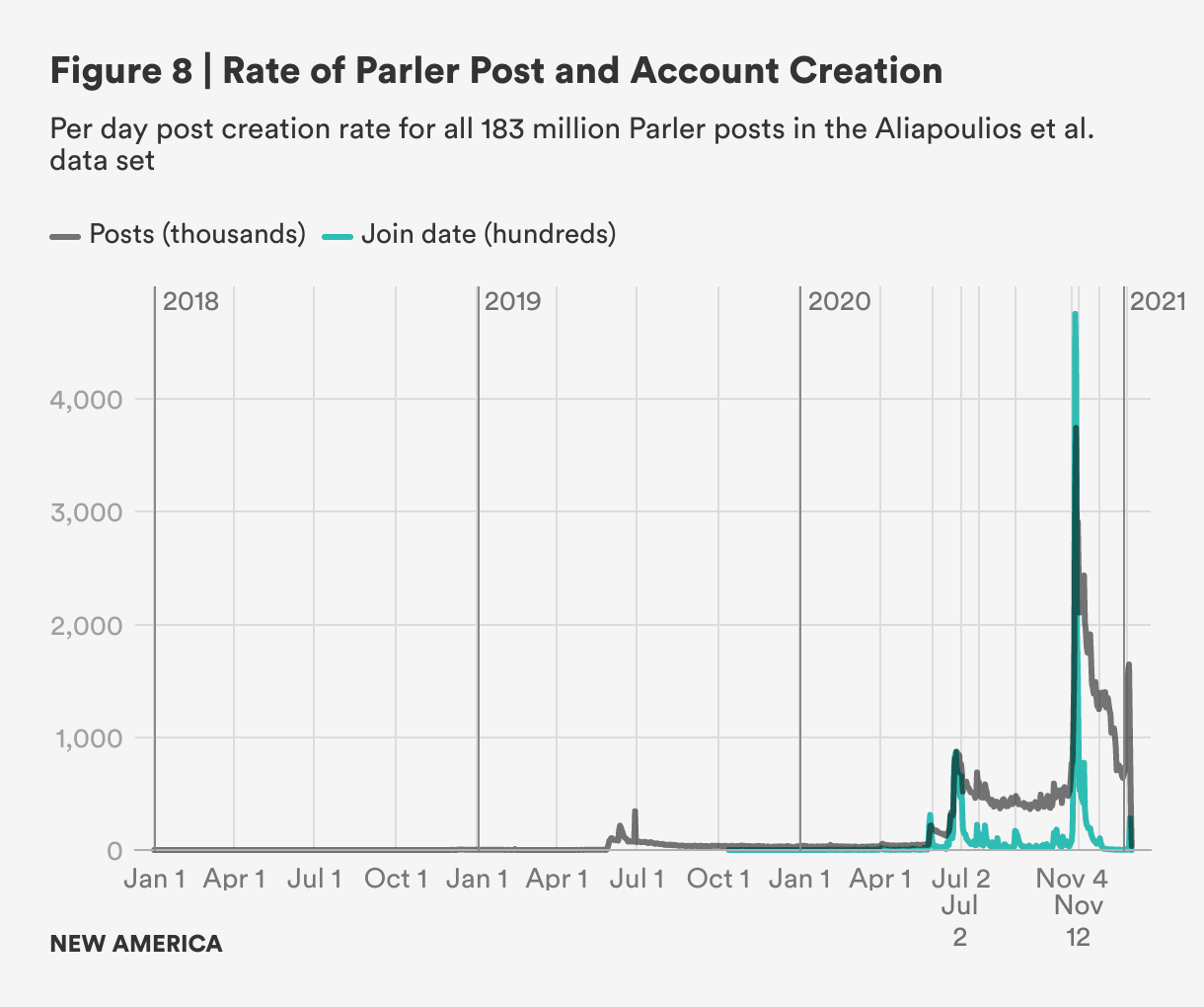
Watkins appears to be part of a wave of social media users who flocked to Parler shortly after Election Day. Publicly available posts we collected indicate she began posting to Parler beginning in December and her engagement ended when Parler was taken offline on January 10. During this brief period, she posted at least 64 times, a mix of complaints about Covid-related restrictions and Democrats, threats against Antifa, arguments with fellow Parler users over martial law, and advertisements for her militia group.49 Yet, even before Parler was deplatformed, Watkins had already made her profile private in response to growing attention from media and federal investigators.
Memes in support of law enforcement also figured prominently on Watkins’ Parler page, with her profile header featuring the popular Parler call to “Back the Blue.”50 Watkins and the network of Parler users with which she interacted boosted “Stop the Steal” messaging, as well as the hashtag itself, which Watkins appended to posts.
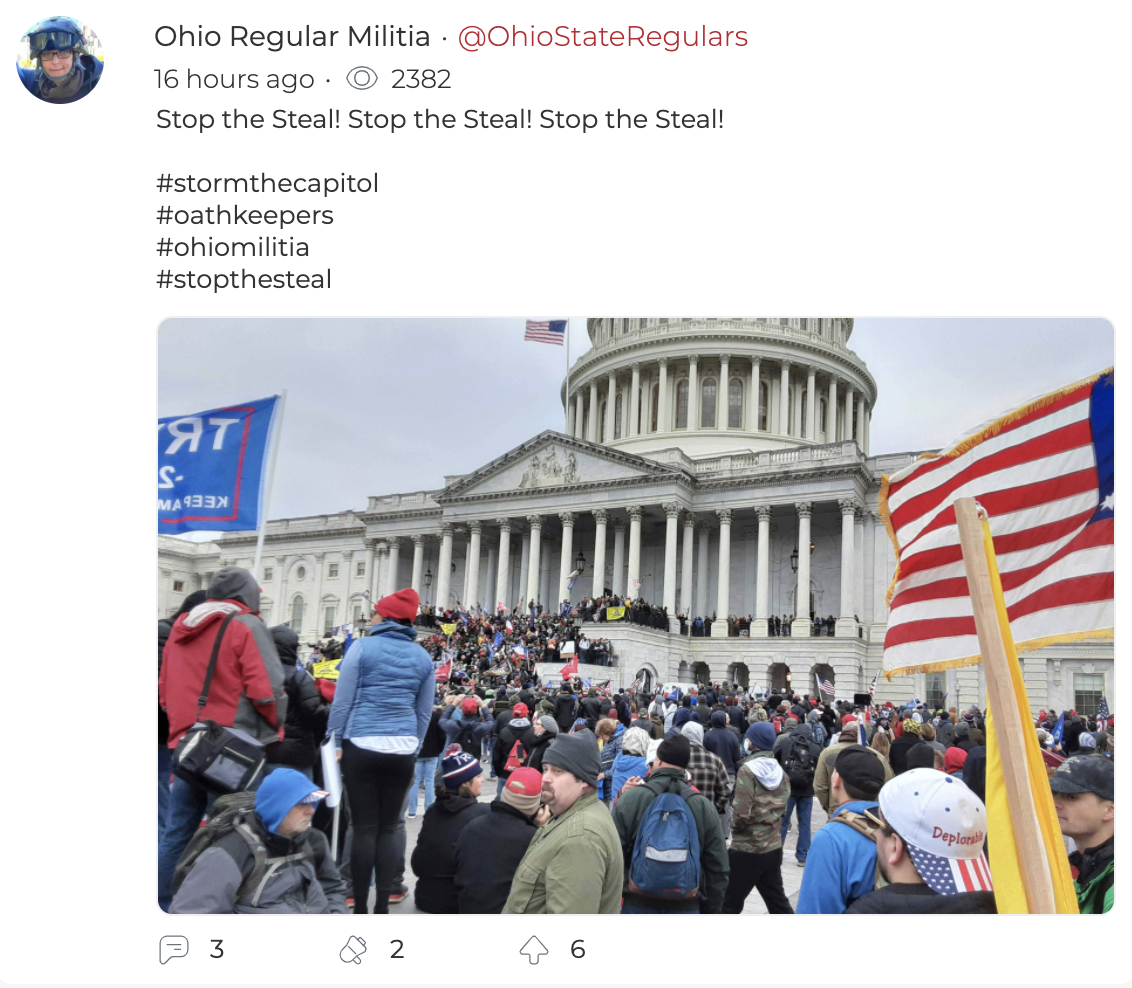
Few of Watkins’s posts, however, drew engagement from other Parler users until the day of the attack. Her most viewed post, according to Parler’s own public count of impressions, was from January 6, 2021, in which she wrote, “Yeah. We stormed the Capitol today. Teargassed, the whole, 9.”51 By January 7, the post had received 10,111 impressions. Her most commented upon post, from January 1, 2021, criticized Ohio Gov. Mike DeWine and received 184 comments.52
Watkins’s online and offline lives merged on the day of the Capitol attack. In a more than two-hour recording of the Oath Keepers’ January 6 communications on Zello, a walkie-talkie app, published by On the Media, an NPR radio show, the group can be heard planning for the “citizen’s arrest” of members of Congress.53 Watkins herself announces that she is heading toward the Capitol with “a good group” of “about 30-40 of us. We’re sticking together and sticking to the plan.”54 Then, she repeats nearly verbatim a line she had previously posted on Parler: “Trump's been trying to drain the swamp with a straw. We just brought a shop-vac.”55 As of November 2021, all of Watkins’s other known social media profiles appear to have been taken down.
Contesting the Elections from the Heart of “Stop the Steal” Country
On May 18, 2021, federal authorities arrested Micajah Jackson on charges of illegally entering Capitol grounds, and in October 2021, Jackson announced his intention to plead guilty to a single misdemeanor charge.56 Video and photos from the attack showed Jackson, a Montana native living in Arizona, marching alongside a Proud Boys contingent.57 Dressed in a plaid shirt, khaki pants, and a bright orange armband used by the Proud Boys to identify one another, Jackson was one of several in the cluster to overrun police barricades, according to federal charging documents.58 Jackson has, nonetheless, maintained in court proceedings that he had no connection to the Proud Boys prior to January 6, 2021.59
Yet, analysis of Jackson’s online activity indicates he has links to a Phoenix-based network of far-right media personalities with a strong online presence and ties to the Proud Boys and “Groyper” movements.60 Jackson’s social media accounts also feature photos of him with Rep. Paul Gosar (R-Ariz.), one of the most vocal House of Representatives members to raise a formal objection to the certification of the 2020 election results on January 6.61
Like many inspired to join the pro-Trump rally in Washington, Jackson is part of a wave of “citizen journalists,” who have sprung up all over the country in the wake of the QAnon movement. According to posts on the @conservative_embassy Instagram account, Jackson is a frequent contributor to HUB Radio Phoenix,62 an online radio program hosted via Facebook and YouTube.63 Hosted by Ron Ludders, a member-at-large of the Arizona GOP and one-time Republican party delegate, HUB Radio Phoenix bills itself on its Facebook page as a “[n]ews talk station providing truthful reporting, community events and political commentary countering false reporting presented by the main stream [sic] media.”64
An online hub for conversations with the streaming radio program hosts conversations with local Republican office holders and candidates, in particular those promoting “Stop the Steal” narratives and efforts to audit the Arizona election.65 HUB Radio Phoenix also platforms Arizona Proud Boys, as they did at a September 25, 2021 rally where Jackson was a speaker.66 While representing HUB Radio Phoenix, Jackson covers anti-vaccination67 protests and has confronted local reporters for wearing masks.68
During summer and fall 2021, Jackson regularly posted videos of himself at these events to his @conservative_embassy Instagram account. Active since March 2020, the account belonged to Arizona Stop the Steal coordinator Caden Husar until April 2021, when Husar handed it off to Jackson.69 After Instagram removed Jackson’s user account handle @thejfkreport, he began posting regularly to Instagram under @conservative_embassy, which also showed signs of occasional input from Husar. During his tenure, Husar posted QAnon-related conspiracy theories70 and “Stop the Steal” messaging.71 Since Jackson took over, he has used the account to promote the Arizona audit,72 claim that the January 6 attack was a “government psyop,”73 and spread anti-vaccination messaging.74
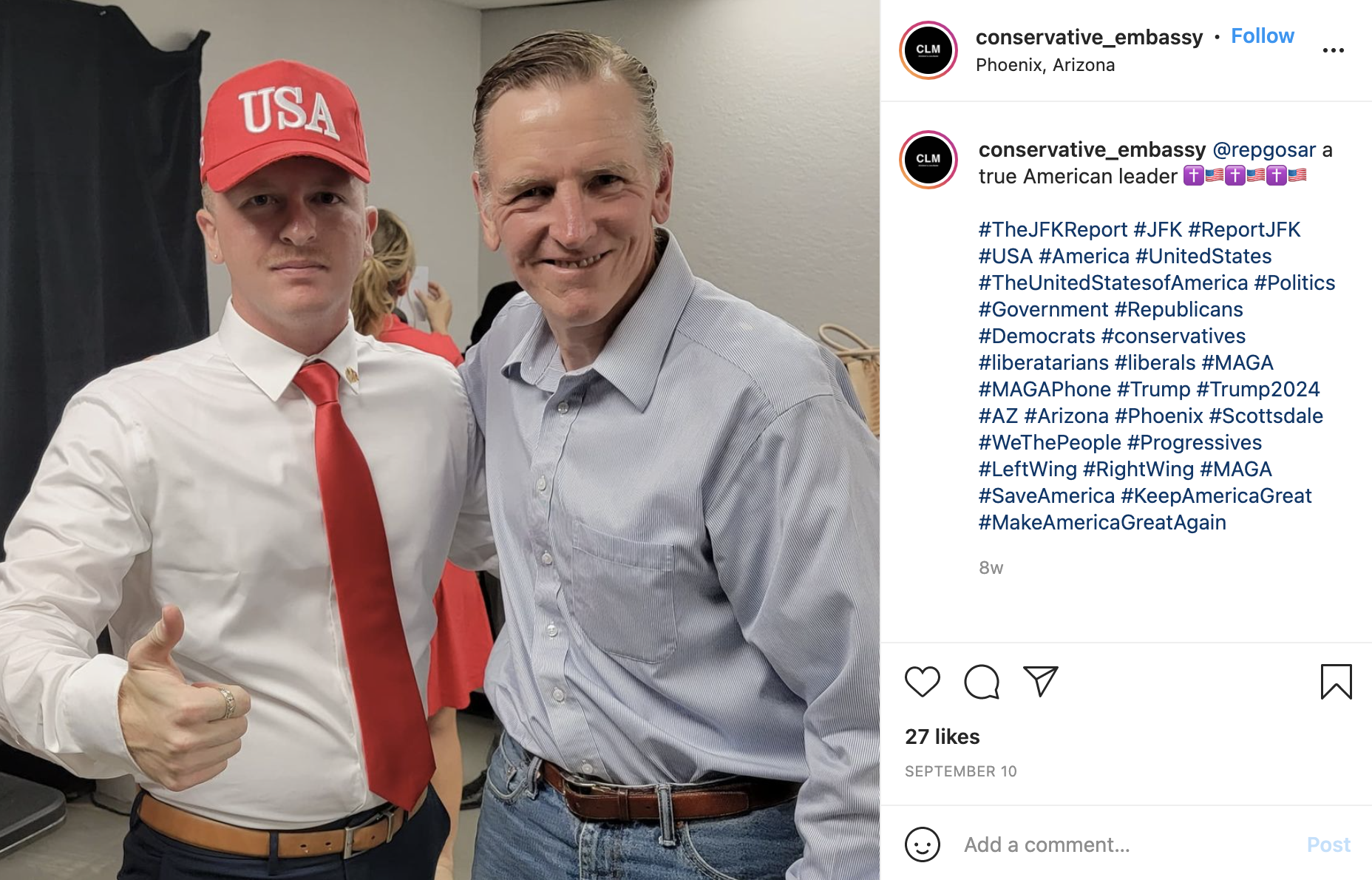
@Conservative_embassy Instagram account
Jackson’s online activity indicates he has collaborated on several occasions with a network of far-right media personalities espousing extremist views. For example, one frequent collaborator is Ethan Schmidt, creator of Phoenix's “Anti Maskers Club,” who films himself entering businesses and confronting shoppers for wearing masks.75 Jackson sometimes appears in these videos or posts them to his @conservative_embassy Instagram account.76 Schmidt maintains a variety of social media profiles, including at least two on Telegram, on which he posts videos of himself posing with Proud Boys77 and destroying what he calls “Satanic” LGBTQ+ iconography.78 One instance in this second category—Schmidt breaking a rainbow sign in an Arizona Target—earned him accolades on Alex Jones’ Infowars network.79 Schmidt also posted videos of himself forcibly removing a man’s mask80 and Arizona police seemingly arresting him for trespassing on a private business.81
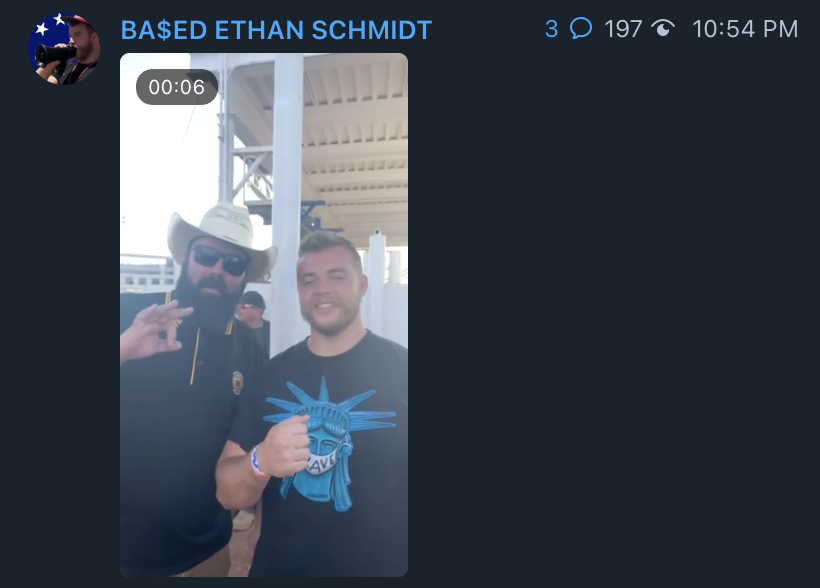
Ethan Schmidt's Telegram channel.
Jackson’s social media posts also indicate that he has collaborated at times with Greyson Arnold, a podcaster with ties to the “Groyper” movement, which the Anti-Defamation League calls “a loose network of alt right figures who are vocal supporters of white supremacist and ‘America First’ podcaster Nick Fuentes.”82 Under his aliases “Pure Politics” and “American Greyson,” Arnold runs a host of social accounts across multiple platforms, on which he cross posts and promotes content linked to Fuentes, Gosar, Schmidt, and Jackson.83 Arnold was also present at and has posted videos from a series of violent anti-transgender protests in California that included Proud Boys.84 Arnold also posted photos and videos to Telegram and YouTube of Proud Boys marching through Washington, D.C. on December 12, 2020.85 Arnold was present at the Capitol on January 6, but he has not been charged with a crime.86 On his Telegram channel, Arnold shares content from figures such as Ron Watkins,87 a key figure in the QAnon conspiracy theory network, and an anonymous account, “The Western Chauvinist,”88 that has over 53,0000 followers, appears linked to the Proud Boys, and has shared Micajah Jackson’s videos.89
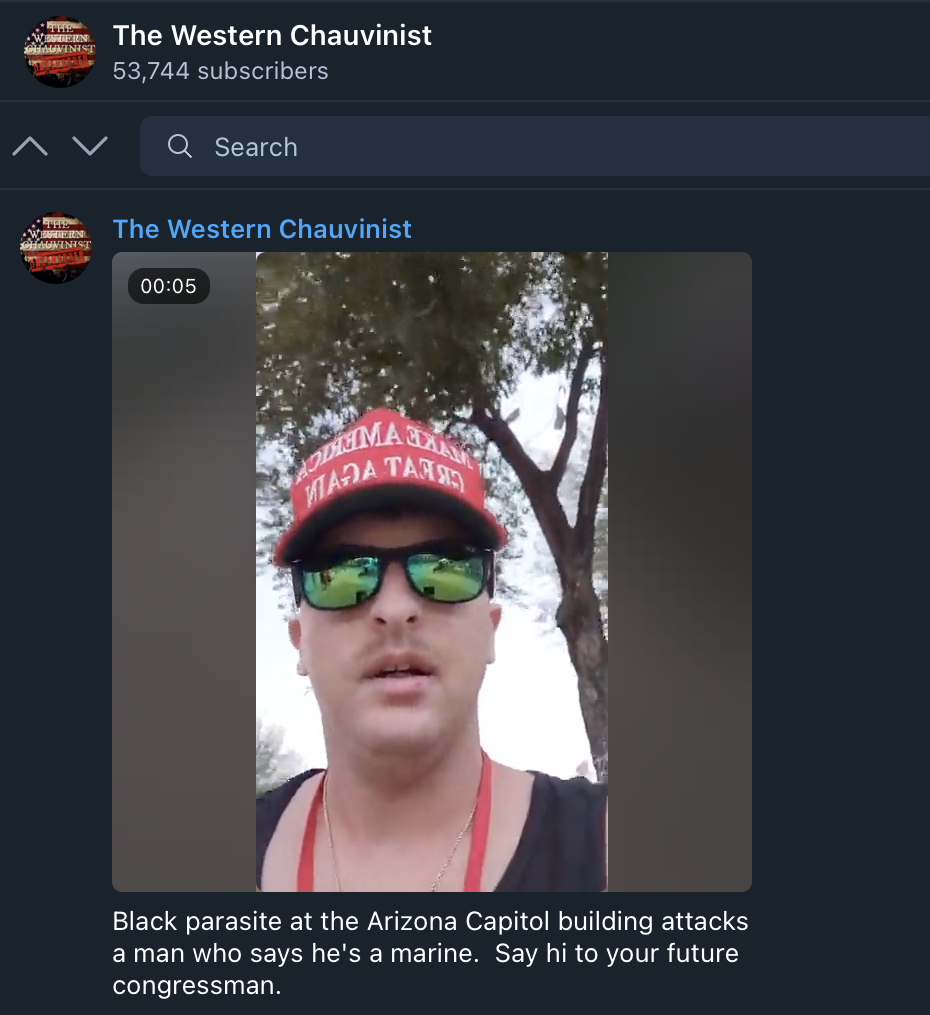
Telegram/Instagram
Mainstream platforms such as Facebook, Twitter, and Instagram have repeatedly banned Jackson and his associates, but such bans tend to be short-lived.90 Several in Jackson’s network appear to navigate around content moderation rules after they have been banned by operating under a different name or, as Jackson did, taking over an existing account.91 Repeated bans make it difficult to determine how long Jackson has collaborated with this network.
However, a review of Jackson’s deleted Parler account, which he first posted to on October 24, 2020, indicates Jackson attended several “Stop The Steal” protests. His posts also show a pattern of echoing Proud Boys content and threats of violence.92 Just days after the election, on November 16, 2020, for example, Jackson complained that an unnamed platform suspended him for 30 days “for sharing a peaceful statement from one of the Arizona Proud Boys.” On November 18, in response to a post about Maricopa County, Jackson wrote that he had been “protesting everyday there.” Several days later, Jackson wrote, “If the law will not prosecute. We the people will give justice. Death by rope,” and, in a different post, “Omar should be first,” possibly referring to Rep. Ilhan Omar (D-Minn.).
In a July 22, 2021 interview posted to HUB Radio Phoenix’s YouTube channel, Jackson characterizes his decision to attend Trump’s January 6 rally almost as a whim, something he chose to do because he was already in the area.93 “I called my mom. She stays in Ohio,” Jackson told the hosts. “And I’m like, ‘hey, can I come home for Christmas?’ ‘Yeah, that’s fine.’ I get there and talk about, ‘hey, can you watch my dog? I want to go to DC. It’s only an eight-hour drive.” Although Jackson appeared to suggest he was going to Washington on the fly, there is plenty of evidence that his journey to the Capitol that day was the culmination of a long campaign to cultivate influence online.
Far from a casual protester caught up in events, Jackson’s actions online and off show him to be a committed activist and commentator with ties to local Arizonan influencers and national figures like Rep.Gosar. As a local influencer in his own right, Jackson provides a window into the flow of false and violent content within a tightly clustered online network of media influencers, elected politicians, and high-profile members of anti-government street movements like the Proud Boys that led to the storming of the Capitol. While it is difficult to fully gauge the effects of online and offline exchanges, the posts from Parler and other platforms within Jackson’s networks make clear that elite signaling from politicians who raised objections to the certification of election results like Gosar and the desire of grassroots Trump followers to gain influence online proved potent in influencing outcomes on January 6.
Citations
- Alanna Durkin Richer, “Oath Keeper Charged in Capitol Riot Renounces Militia Group,” Associated Press, February 26, 2021. source
- Dan Barry, Mike McIntire and Matthew Rosenberg, “‘Our President Wants Us Here’: The Mob That Stormed the Capitol,” New York Times, January 9, 2021. source
- Jan Wolfe, “'He Invited Us': Accused Capitol Rioters Blame Trump in Novel Legal Defense,” Reuters, February 2, 2021. source
- Alan Feuer, “Oath Keepers Plotting Before Capitol Riot Awaited ‘Direction’ From Trump, Prosecutors Say,” New York Times, February 11, 2021. source
- Spencer S. Hsu, Tom Jackman, Ellie Silverman and Rachel Weiner, “Court hearings, guilty pleas belie right-wing recasting of Jan. 6 defendants as persecuted patriots,” Washington Post, September 17, 2021. source
- Roger Parloff, “What Do—and Will—the Criminal Prosecutions of the Jan. 6 Capitol Rioters Tell Us?” Lawfare, November 4, 2021. source
- See “Capitol Breach Cases” for a list of individuals that the Justice Department has charged following investigations into the events of January 6, 2021. The chart lists charges for each person and links to relevant charging documents. source
- “Oath Keepers Fifth Superseding Indictment,” United States Department of Justice, August 4, 2021. source; Southern Poverty Law Center (SPLC), “The Oath Keepers,” source
- “Nordean Biggs Rehl Donohoe – Indictment,” United States Department of Justice, March 10, 2021. source
- Dan Barry, Mike McIntire and Matthew Rosenberg, “‘Our President Wants Us Here’: The Mob That Stormed the Capitol,” New York Times, January 9, 2021. source
- Aaron C. Davis, “Red Flags,” Washington Post, October 31, 2021. source
- The FBI posts regular updates to information about those charged in connection with the Capitol attack on a dedicated webpage here: source. As of December 1, 2021 when this report was going to print, federal prosecutors had charged a total of 673 in connection with the siege.
- The list of defendants charged by federal authorities in connection with the Capitol attack can be found here: source
- Any indictments occurring after October 7, 2021 are not reflected in this dataset.
- Location of residence was generalized to a city/town and state pair. Exact addresses were not used in our analysis to preserve the privacy of the defendants.
- William Cummings, Joey Garrison and Jim Sergent, “By the Numbers: President Donald Trump's Failed Efforts to Overturn the Election,” USA Today, January 6, 2021. source
- Roger Parloff, “What Do—and Will—the Criminal Prosecutions of the Jan. 6 Capitol Rioters Tell Us?” Lawfare, November 4, 2021. source
- Jon Seidel, Matthew Hendrickson, and Fran Spielman, “CPD Officer Used N-word, Shared Pictures When Bragging About Role in US Capitol Riots: Feds,” Chicago Sun Times, June 11, 2021. source
- “Capitol Hill Siege,” George Washington University Program on Extremism. source
- The Bridging Divides Initiative (BDI) at Princeton University is a non-partisan research initiative that tracks and mitigates political violence in the United States. The mission of the initiative is to grow and build local community resilience throughout elections and other periods of heightened risk, laying a foundation for longer-term work to bridge the divides across communities in the United States. More information about the initiative and its collaboration with ACLED can be found on its website here: source
- The information about 24,662 demonstration events in the United States from January 1, 2020, to January 31, 2020, included only the protests and riot categories recorded by ACLED as part of the U.S. Crisis Monitor project; incidents categorized by ACLED as strategic developments were not included in our analysis.
- Bridging Divides Initiative, “Report: Election 2020 Political Violence Data and Trends,” p. 2.
- Bridging Divides Initiative, “Report: Election 2020 Political Violence Data and Trends,” pp. 2-3.
- Bridging Divides Initiative, “Report: Election 2020 Political Violence Data and Trends,” 2021, pp. 7-8. source; The website for the ACLED U.S. Crisis Monitor Project can be found here: source
- Bridging Divides Initiative, “Report: Election 2020 Political Violence Data and Trends,” 2021, pp. 7-8. source; The website for the ACLED U.S. Crisis Monitor Project can be found here: source
- Bridging Divides Initiative, “Report: Election 2020 Political Violence Data and Trends,” pp. 6-8.
- It should be noted that both point patterns (residences and demonstrations) tend to follow the spatial contours of population density in the U.S. In spite of all three patterns coinciding, it's still notable that the residences point pattern and the demonstrations point pattern do not deviate from each other. That they would follow each other isn't necessarily a given, even when they both track population density. Put another way, we could have seen arrestees only from rural areas–that's not the case.
- Using a regression analysis performed by the Bridging Divides Initiative, which takes into account that states with greater populations are more likely to see greater numbers of demonstrations, we can highlight states with deviations from the national average. Calculations are based on states’ residual values from a linear regression for total counter-protests by state population (2019 population estimates) and numbers of protests recorded in the ACLED data. See p.16 in the full Bridging Divides Initiative report for more details of this analysis at: source.
- Our team scraped and performed optical character recognition (OCR) of all charging documents available on the Justice Department website as of October 2021, then ran a Python script to identify mentions of specific social media profiles, revealing 58 defendants with named social accounts.
- Ages for Watkins and Jackson are from the time of arrest, per Department of Justice charging documents. “Oath Keepers Fifth Superseding Indictment,” United States Department of Justice, August 4, 2021. source
- “Jackson, Micajah Noel – Information,” United States Department of Justice, July 21, 2021.source
- Emails to Shelli Peterson, Jessica Watkins’s lawyer, on November 23, 2021, and Maria Jacob, Micajah Jackson’s lawyer, on November 24, 2021 did not receive a response before this publication was set to go to press. Peterson, Watkins’s lawyer, and Jacob, Jackson’s attorney, are listed with the office of the Federal Public Defender for the District of Columbia. For background on these defendants cases, see: Jessica Garrison, Ken Bensinger, and Zoe Tillman, “Jessica Watkins, An Oath Keeper Charged In The DC Attack, Fears Harsh Treatment Because She Is Transgender, BuzzFeed News, February 21, 2021. source. Peter Wade, “Judge Ordered Jan. 6 Rioter Not to Associate with Proud Boys,” Rolling Stone, October 23, 2021. source
- “Jessica Mare Watkins – Affidavit,” United States Department of Justice, January 16, 2021, accessed October 25, 2021, source
- Jessica Garrison, Ken Bensinger, Zoe Tillman, “Jessica Watkins, An Oath Keeper Charged In The DC Attack, Fears Harsh Treatment Because She Is Transgender,” BuzzFeed News, February 21, 2021. source; “Jessica Mare Watkins – Affidavit,” United States Department of Justice, January 16, 2021, accessed October 25, 2021, source
- “Jessica Mare Watkins – Affidavit,” United States Department of Justice, January 16, 2021, accessed October 25, 2021, source
- “@OhioStateRegulars – Ohio Regular Militia,” The Wayback Machine, January 7, 2021. source
- “Caldwell, Crowl, Watkins, Parker, Parker, Young, Steele, Meggs, Meggs – Indictment,” United States Department of Justice, February 19, 2021. source
- Erin Snodgrass, “'Oath Keeper' Jessica Watkins Denounced the Extremist Group But Will Stay in Jail Before Her Trial, Judge Says,” Business Insider, February 26, 2021. source
- Jessica Garrison and Ken Bensinger, “Meet The Woman Facing Some Of The Most Serious Capitol Riot Charges,” BuzzFeed News, January 26, 2021. source
- Jake Zuckerman, “Ohio Bartender and Her ‘Militia’ Drove to D.C. to Join the Capitol Breach,” Ohio Capital Journal, January 13, 2021. source
- Zuckerman, “Ohio Bartender and Her ‘Militia’ Drove to D.C. to Join the Capitol Breach.”
- U.S. Crisis Monitor, Armed Conflict Location & Event Data Project (ACLED). source
- Jake Zuckerman, “Militia Group Appears at Statehouse to ‘Protect People’ at Rallies for Trump, Biden,” Ohio Capital Journal, November 12, 2020. source
- Christina Carrega and Sabina Ghebremedhin, “Timeline: Inside the investigation of Breonna Taylor's Killing and Its Aftermath,” ABC News, November 17, 2020. source
- Unless attributed to a different source, this and subsequent posts by Watkins under the @OhioStateRegulars handle are taken from the Aliapoulis, et al., dataset of Parler posts uploaded to the Zenodo data sharing platform, which our team downloaded and ported to Kibana data visualization software. The dataset does not include any posts by Watkins after December 23, 2020. Later posts she made between January 1 and January 7, 2020 are accessible on the Internet Archive’s Wayback Machine at source.
- Aliapoulis, et al. dataset of Parler posts.
- Watkins’s Parler posts are drawn from the Aliapoulis, et al., dataset of Parler posts uploaded to the Zenodo data sharing platform, which our team downloaded and ported to Kibana data visualization software.
- Aliapoulis, et. al. dataset of Parler posts.
- This count of total posts combines the 44 posts in the Aliapoulis, et al. dataset of Parler posts and the 20 posts archived on the Internet Archive’s Wayback Machine. Therefore, it does not include any posts Watkins’ made between December 23, 2020, her final post in the Aliapoulis, et al. dataset, and January 1, 2021, her first post in the Internet Archive.
- “@OhioStateRegulars – Ohio Regular Militia,” The Wayback Machine, January 7, 2021. source
- “@OhioStateRegulars – Ohio Regular Militia,” The Wayback Machine, January 7, 2021. source
- “@OhioStateRegulars – Ohio Regular Militia,” The Wayback Machine, January 7, 2021. source
- “The Zello Tapes: The Walkie-Talkie App Used During The Insurrection,” On the Media, January 15, 2021.source
- “The Zello Tapes: The Walkie-Talkie App Used During The Insurrection,” On the Media.
- Aliapoulis, et al. dataset of Parler posts. In a post from December 22, 2020, Watkins wrote, “The swamp is deep. Trump has been siphoning the swamp with a straw, when clearly a shop-vac is called for.”
- Marshall Cohen and Em Steck, “US Capitol Rioter with Proud Boys Ties to Plead Guilty, lawyer says,” CNN, October 27, 2021. source
- “Jackson, Micajah Noel – Statement of Facts,” United States Department of Justice, May 14, 2021. source
- “Jackson, Micajah Noel – Statement of Facts,” United States Department of Justice.
- “Jackson, Micajah Noel – Statement of Facts,” United States Department of Justice.
- A review of Jackson’s social media accounts on Instagram (source), Twitter (source; archived version: source), Gab (source; archived version: source), and Telegram (source; archived version: source) between October and November 2021 shows him to associate, cross-promote, and collaborate with Arizonan influencers like anti-mask activist Ethan Schmidt and podcaster Greyson Arnold. As detailed below in this report, Schmidt posted video of himself with a member of the Proud Boys, while Arnold posted video of Proud Boys protests and material from Nick Fuentes, founder of the Groyper movement.
- In a September 10, 2021, post on the @conservative_embassy Instagram account, Jackson appears with Gosar. The caption reads, “@repgosar a true American leader” [sic] (source). A similar post appears on the @TheJFKReport Gab account on July 17, 2021 (source; archived version: source).
- Much of what is publicly known about Jackson is drawn from monitoring his @conservative_embassy Instagram account between October and November 2021. Caden Husar, an acquaintance of Jackson, began posting to the account in March 2020 and handed predominant control of it to Jackson in April 2021. An August 13, 2021, post to the account showed Jackson holding a press badge for HUB Radio Phoenix with his name and “media correspondent.” A July 29, 2021, post showed the same press badge with the caption “Hard work pays off. The JFK Report is slowly taking off.” The account can be found at source.
- HUB Radio Phoenix YouTube channel: source; archived version: source.
- A 2019 document posted on rightlanenetwork.com listed Ludders as a member of the Arizona GOP see: source; and Jude-Joffe Block, “For Many Arizona Delegates, Trump's Speech Exceeded Expectations,” KJZZ, July 22, 2016. source; HUB Radio Phoenix Facebook page: source; archived version: source
- “Exclusive: Senator Wendy Rogers Reveals Never Before Seen Ballots That are 100% Fraud Resistant!” HUB Radio Phoenix, June 21, 2021. source; archived version: source
- BrieAnna J. Frank and Haleigh Kochanski, “A Day After Audit Announcements, Small Group Rallies in Support of Jan. 6 Insurrection at U.S. Capitol,” AZ Central, September 25, 2021.source
- In an August 14, 2021, video posted to the @conservative_embassy Instagram account, Jackson interviews a nurse at an anti-vaccination protest. The caption reads, “Americans stood in unity against the force vaccination” [sic]. source
- Twitter account @az_rww, which monitors the far-right in Arizona, posted a video on September 24, 2021, in which Jackson and anti-masking activist Ethan Schmidt confront two media workers for wearing masks. Jackson appears in the video wearing his HUB Radio Phoenix press badge. source; archived version: source.
- Husar identifies himself as a “Stop The Steal Coordinator” on his Twitter account. source; archived version: source.
- For example, a September 30, 2020, post showed an outline for a proposed documentary that listed “torture videos,” “missing child cases,” and “Haiti child trafficking” with reference to John Podesta and Hillary Clinton—all common tropes within the QAnon community. source
- A December 3, 2020, post promoted a “Stop the Coup” protest at the Arizona State Capitol. source
- A July 16, 2021, post on the @conservative_embassy Instagram account promoted a rally in support of the Arizona audit with a caption that reads, “Come on out this Sunday afternoon for another #StopTheSteal Rally hosted by @caden_husar. Caden, myself and many others will be speaking!” source
- In a July 24, 2021, video posted to the @conservative_embassy Instagram account, Jackson addresses a crowd with a bullhorn, saying, “The FBI set up January 6…It was a government psyop. And it's time to rise up against Antifa, BLM, and the radical federal government.” source
- An August 14, 2021, post to the @conservative_embassy Instagram account stated, “NO MANDATORY VACCINATIONS.” source
- Schmidt posts videos of himself entering businesses to spread anti-masking messaging to Twitter (source; archived version: source), Telegram (source; archived version: source), Gab (source; archived version: source), and Instagram (source). Our team monitored Schmidt’s social accounts between October and November 2021. National media have covered Schmidt’s anti-mask activities. For example, see: Em Steck and Andrew Kaczynski, “Trump-Endorsed Gubernatorial Candidate Appears with Nazi Sympathizer and QAnon-Linked Activists at Campaign Events,” CNN, November 8, 2021. source
- In an April 11, 2021, anti-masking video posted to the @conservative_embassy Instagram account, Schmidt begins the video by saying he’s joined by “the JFK Report,” Jackson’s alias. source
- An October 22, 2021, video on Schmidt’s BA$ED ETHAN SCHMIDT Telegram channel showed Schmidt posing with an Arizona Proud Boy. source; archived version: source.
- An October 22, 2021, video on Schmidt’s ANTIMASKERSCLUB Telegram channel is titled “Exposing Satanic Propaganda at Target” and showed Schmidt asking shoppers at a Target whether they support LGBTQ+ “Satanic propaganda.” source; archived version: source.
- An October 22, 2021, video clip on Schmidt’s BA$ED ETHAN SCHMIDT Telegram channel showed Infowars host Owen Shroyer featuring Schmidt destroying a rainbow sign in a Target. source; archived version: source.
- An August 9, 2021, video posted to Schmidt’s BA$ED ETHAN SCHMIDT Telegram channel showed him ripping the mask off a Costco shopper. source; archived version: source.
- On August 5, 2021, a series of videos posted to the ANTIMASKERSCLUB Telegram channel appeared to show Scottsdale, AZ, police arresting Schmidt after warning him that he could not protest on private property. source; archived version: source
- Posts on the @conservative_embassy Instagram account show Jackson and Arnold spending time together (source). The two men share one another’s posts (source; archived version: source) and have advertised themselves as appearing at the same events (source; archived version: source). On his Telegram channel Pure Politics, Arnold shares pro-Groyper content from figures like Nick Fuentes (source; archived version: source) and Stew Peters (source; archived version: source). In a December 3, 2020, video of a #StoptheSteal rally posted to his YouTube channel, Arnold said, “I came out here for Nick [Fuentes] as well” (source; archived version: source). For more on Groypers and Nick Fuentes, see “Groyper Army and ‘America First’,” Anti-Defamation League. source
- Greyson Arnold maintains accounts on Twitter (source; archived version: source), Telegram (source; archived version: source), Instagram (source), and YouTube (source; archived version: source). Between October and November 2021, the period we monitored Arnold’s accounts, he crossposted or praised Fuentes (source; archived version: source), Gosar (source; archived version: source), Schmidt (source; archived version: source), and Jackson (source; archived version: source).
- Multiple videos on the Pure Politics Telegram channel on July 3, 2021 and July 17, 2021, show violent clashes between pro- and anti-transgender groups outside an LA spa. source; archived version: source. For reporting on the presence of Proud Boys at the protest, see: Leila Miller, Anita Chabria, Laura J. Nelson, “How Protests over Transgender Rights at an L.A. Spa Ended in Violence,” Los Angeles Times, July 20, 2021.source
- A December 12, 2020, post on Arnold’s Pure Politics Telegram channel shows a large crowd of Proud Boys with the caption, “Thousands of Proud Boys out patrolling, Antifa has already thrown explosives at Trump supporters, multiple PB patrols now happening due to the DC police being complicit in aiding local Antifa.” [sic] source; archived version: source. A longer video of the same event appeared on the Pure Politics YouTube channel on December 16, 2020. source; archived version: source
- A November 1, 2021, video on the Pure Politics Telegram channel showed Arnold outside the Capitol on January 6, 2021. source; archived version: source.
- On November 6, 2021, the Pure Politics Telegram account shared a post from Ron Watkins’s Telegram channel in which Watkins endorsed Arnold’s Telegram channel. source; archived version: source.
- Arnold’s Pure Politics Telegram channel reposts content from The Western Chauvinist Telegram channel (source; archived version: source). “Western Chauvinist” seems to be a reference to the Proud Boys, who refer to themselves as such. Since it was created in May 2019, the Western Chauvnist Telegam channel has featured dozens of posts in support of the Proud Boys, as well as posts containing white supremacist and anti-Semitic content (source; archived version: source). On September 24, 2021, the channel posted a video by Micajah Jackson in which Jackson gets into an altercation at the Arizona Capitol building (source; archived version: source). The same video appeared on the @conservative_embassy Instagram account one day later. source
- “Western Chauvinist” seems to be a reference to the Proud Boys, who refer to themselves as such. Since it was created in May 2019, the channel has posted dozens of times in support of the Proud Boys, as well as white supremacist and anti-Semitic content (source; archived version: source). On September 24, 2021, the channel posted a video by Micajah Jackson in which Jackson gets into an altercation at the Arizona Capitol building (source; archived version: source). Jackson posted the same video to the @conservative_embassy Instagram account one day later. source
- For example, Jackson’s Twitter account @TheJFKReport, created in November 2020 and which was online on January 9, 2021 (source), appears to have been removed at some point between then and May 2021, when he created a new account under the same handle, according to the account’s public join date (source; archived version: source). Instagram removed both of Jackson’s accounts @thejfkreport and @micajahjackson.
- On November 10, 2021, Ethan Schmidt posted to his personal Telegram channel a request for someone to send him an existing Instagram account that he could use. source; archived version: source.
- Jackson’s deleted Parler posts are drawn from the Aliapoulis, et al. dataset of Parler posts uploaded to the Zenodo data sharing platform, which our team downloaded and ported to Kibana data visualization software. Jackson first posted to the account on October 24, 2020. His final post in the Aliapoulis, et al., dataset was on December 15, 2020. Some of Jackson’s later posts are available on the Internet Archive’s Wayback Machine. source.
- “HUB Radio Phoenix -Fighting Back Show W Josh Bernstein Guest Micajah Jackson seg 2 07 21 2021,” HUB Radio Phoenix, July 22, 2021. source; archived version: source.