Table of Contents
- Executive Summary
- I. Introduction
- II. What We Know about Parler and Publicly Available Parler Data
- III. Contesting the Election Results: The Road to the Capitol and Indictments
- IV. Elite Signaling and Parler’s Influencers: Topic Modeling & Link Analysis
- V. Examining The Objector Parler Accounts
- VI. What the Parler Metadata Tells Us
- VII. Implications & Takeaways
Executive Summary
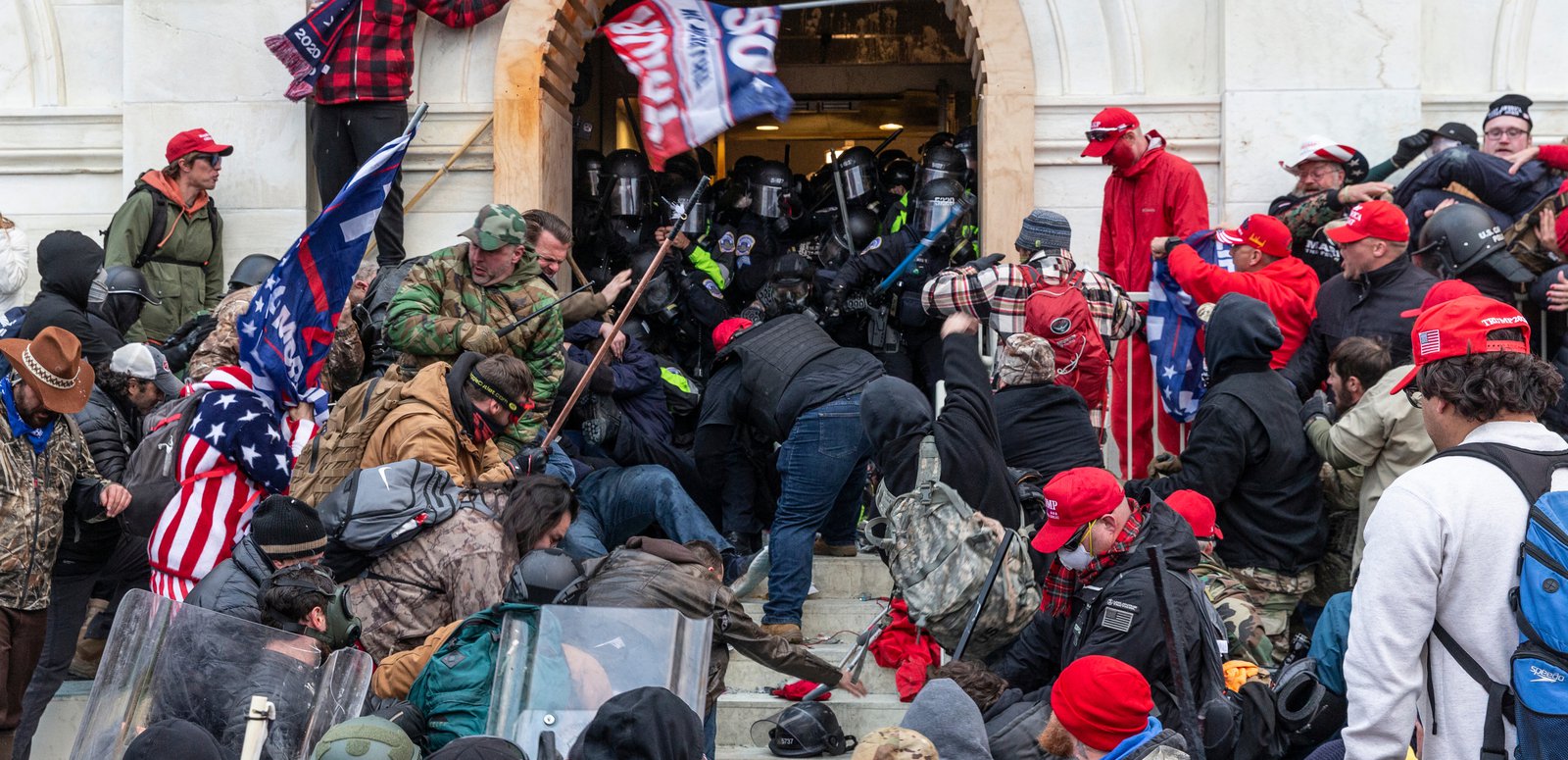
The mob assault on the U.S. Capitol on January 6, 2021, exposed deep fissures between Americans and shook the very foundations of the country. The violence that day and the tech industry’s response to it reignited public debate over how tech companies operate and the impact of social media content moderation policies on polarization, extremism, and political violence in the United States. That debate is also now playing out in Congress where the House Select Committee to Investigate the January 6th Attack on the United States Capitol.
The storming of the seat of American democracy and explosion of violent online content prompted Twitter and Facebook to ban Donald Trump from their platforms while Apple, Google, and Amazon all moved to cut off access to Parler, a social media site popular with conservatives and the far-right. As of late October 2021, when the analysis for this report was reaching an end, federal authorities had charged 632 individuals in connection with the storming of the Capitol. That number has since increased to more than 700, and, in many cases, evidence collected from social media posts was a key factor in the indictments. A comprehensive review of the indictments related to January 6 indicates, in fact, that much of that digital evidence collected to date came from Facebook, Twitter, and Parler. But one persistent question remains unanswered: How much did niche platforms like Parler and their interplay with mainstream platforms contribute to the January 6 siege and the rise of extremism in the country?
The centrality of digital data in the narrative of January 6 implicates social media and tech companies across the board. But it is not coincidental that the political unrest leading up to the assault on Congress took place against a backdrop of explosive growth in the so-called “alternative tech” or “alt-tech” movement that sprang up from the right during Trump’s presidency. Although Parler’s reach appeared to be smaller than its competitors’, Amazon's move to deplatform the social media site on January 10, four days after the Capitol attack, sent shockwaves through the tech industry. It also prompted new calls in Congress for reform of internet governance regulations. Yet nearly one year on from the Capitol attack and Parler’s shutdown, there are still many unknowns about how online content factored into the attack.
Data-driven investigations into how Parler operated before Amazon took it offline offer clues as to what happened and why on January 6. Publicly available data from the 1.0 version of Parler offers a rare opportunity to begin asking and answering questions on an empirical basis about the role of social media in undermining governance institutions and fomenting political violence in the United States and elsewhere. Data culled from across multiple platforms also provides unique insights into how the alt-tech movement that sprang up just after Trump first took office in 2017 and spawned Parler will impact future elections, and, more broadly, democratic institutions in the United States.
Working together with researchers at Arizona State University and the Bridging Divides Initiative at Princeton University, New America’s Future Frontlines team set out to learn more about the interplay between niche platforms like Parler, mainstream platforms like Twitter and Facebook, and real-world social networks. Our preliminary analysis suggests that there are grounds to be skeptical of competing claims made by all three tech companies that their platforms were no more or less culpable in spreading false, misleading, and violent content linked directly or indirectly to the #StoptheSteal movement.
Still, the focus on Parler is warranted. The initial picture that has emerged from a joint analysis conducted by researchers at New America and Arizona State University (ASU) under the auspices of the Future Frontlines program is a portrait of a social media company whose very business model appeared to be predicated on the idea that it could grow its user base by promoting the discourses of the deplatformed and the disaffected among Trump’s followers.
An examination of publicly available data from the early 1.0 version of Parler indicates that its unique business model and content moderation policies were likely a contributing factor in fomenting some of the violence that occurred in Washington, D.C. on January 6. However, as outlined in this report and in the key findings below, it is also quite clear that the platform management practices, ad hoc content moderation policies, and client services agreements adopted by big tech’s Big Five—Facebook, Twitter, Amazon, Apple, and Google—are driving the market for alt-tech social media platforms like Parler.
Key Findings:
- On the streets and online, the networked effects of poor platform governance across the internet on the 2020 elections were notable. Analysis clearly shows how instrumental mainstream platforms like Facebook and Twitter were in popularizing the “Stop the Steal” campaign and the January 6 attack itself. But the combined impact of Parler’s loose content moderation scheme as well as data management practices and platform features produced a unique hothouse effect.
- Initial analysis of links posted by a subset of influential Trump campaign insiders and militia group users found that there are few instances where Parler users posted content from the platform to other mainstream social media platforms. Instead, information and links primarily flow in one direction from external social media platforms into Parler.
- The early 1.0 version of Parler appeared to be especially vulnerable to strategic influence campaigns that relied heavily on inauthentic behavior like automated content amplification and deceptive techniques like astroturfing.
- Traveling from almost every state in the country, the pro-Trump merry band of big-name influencers, citizen journalists, militia members, and other activist election contesters who were active on Parler, were clearly spurred to action after soaking for months in targeted messaging that took critical aim at the nation’s democratic institutions as well as private and public individuals and organizations.
- During the 2020 election cycle, being banned by Twitter, Facebook, or other mainstream platforms served as both a badge of honor and call to arms for some of the more prolific influencers who were close to the Trump campaign and militia groups on the 1.0 version of Parler.
- Users in a select subset of these influential Parler users characterize other platforms like Twitter as being in the pocket of partisan forces, while Parler itself acts as a kind of refuge in a world in which apocalyptic forces are seen to be pervasive.
- All of the major topics of concern for these users involve some kind of institution-ending or epoch-ending crisis, or recruitment for white supremacist organizations as a response to crisis.
- Being “banned from Twitter” is such a prominent theme among users in this subset that it raises troubling questions about the unintended consequences and efficacy of content moderation schemes on mainstream platforms.
- In fact, further analysis of the types of data and links shared by influential users in this small group indicates that there is a good deal of collaboration between users that may have also contributed to a sense of common purpose and shared identity that acted as a mobilizing force for less well-networked users on the platform.
- At least 46 members of the 147 members of Congress who formally raised an objection to the certification of the 2020 Electoral College count joined Parler. Many Congressional objectors joined the platform in May or June of 2020. The timing is significant because this is also around the time prominent right-wing figures were leaving mainstream social media platforms for Parler due to their concerns about censorship of conservative content.
- Rep. Devin Nunes (R-Calif.) and Sen.Ted Cruz (R-Texas) had the highest number of followers. Rep. Matt Gaetz (R-Fla.), Rep. Jim Jordan (R-Ohio), Rep. Andy Biggs (R-Ariz.), Rep. Paul Gosar (R-Ariz.), and Rep. Marjorie Taylor Greene (R-Ga.) also had followers in the hundreds of thousands. The high follower counts mean that any content posted by these accounts would likely be prominently displayed when a user logged into the first version of Parler.
- Content posted on Parler 1.0 by these members of Congress received millions of impressions each day before the platform was taken offline. The objectors were large players in the Parler information ecosystem. Users paid attention to the content they posted.
- Notably, objectors posted more extreme political content on Parler than on Twitter, focusing on false claims of election fraud in the period right after Election Day 2020. They also posted content objecting to COVID-19 restrictions and mitigation measures.
- An analysis of Parler post timestamps embedded in the available metadata for over 13.25 million users and over 1 million video posts show alignment while increases in the number of posts coincide closely with significant political events and demonstrations. Some notable peak moments when there was a sharp increase include:
- The May 31, 2020 peak rises rapidly and tails off slowly, and coincides with the May 31 George Floyd protests.
- The broad July 2, 2020 peak begins its rise with the resumption of Trump campaign rallies and culminates with the Mount Rushmore campaign rally.
- The sharp July 22, 2020 peak coincided with a riot in Portland, Oregon in which protesters tried to set fire to the Portland courthouse.
- The post-election peaks on November 11-12, 2020 and on November 14-15, 2020 coincides with the competing pro-Trump rallies, March for Trump and Million MAGA March, in Washington, D.C. and nationwide, organized by Amy Kremer and Ali Alexander, respectively.
- Initial analysis suggests geotagged social media content could strengthen insight into potential warning signs of violence leading up to January 6, when combined with offline event data and ethnographic analysis, though more research is needed.
- At a variety of geographic scales, the residences of those indicted in connection with the January 6 attack tended to cluster near areas where all types of demonstrations and counter protests took place over the course of the 2020 election year, to a greater degree than anticipated.
- This points to the demonstrations in close proximity of the locality of a charged individual having greater potential predictive weight than those at the state level. Substantial hints of the relationship between demonstration activity, polarizing rhetoric of political elites and online influencers, and mobilization to violence are mirrored at the individual level among arrestees who turned up in Washington to contest the election outcomes and at scale in the Parler data.
- Statistical analysis confirmed that many of the geotagged videos cluster around the prosperous suburbs and exurbs of major metropolitan areas. Many geotagged video posts also fan out across rural areas, particularly in the more densely populated and privately owned rural areas east of the Rocky Mountains.