Introduction
PreK–12 districts are currently considering multiple options for the 2020–21 school year and beyond. Fully returning to traditional in-person settings seems unlikely next year, and recent guidance from the Centers for Disease Control lists the many safeguards that would need to be in place before buildings reopen and students are back to classrooms that resemble what they had before.1 It is clear that some type of distance learning—as well as efforts to ensure all students can get online—must be a part of districts' planning for the next school year and beyond. But terms used to describe distance learning are often muddled and misused, leading to misunderstandings about what students, parents, and teachers should expect.
As educators with expertise in designing, planning for, and implementing learning experiences using online tools and digital materials, we have created this resource to clarify the various types of distance learning that will likely take place this fall, as well as propose four possible scenarios for PreK–12 during and in the wake of this pandemic. In addition, we provide categorized lists of questions and considerations that school and district leaders will need to keep in mind. Where possible we provide links to resources and guidance published by organizations we know and trust that have specialized knowledge on the topics we outline.
These new models of teaching and learning require frequent and transparent communication. In the likelihood of these proposed scenarios, we encourage leaders to be as clear as possible to ensure every student, teacher, support staff, parent, and caregiver remains safe, healthy, and connected. Teachers and support staff need to know they are supported through successes and failures. Students need to know they are seen and heard, despite not always being together in person in school buildings. Parents also need to know they are seen, heard, and supported through these transitions. The well-being of every single stakeholder in and around the school is of utmost importance, and we encourage leaders to check in regularly with their community.
Context
The multidisciplinary field of distance education has been growing for decades, with new models and research emerging regularly to add to an already robust body of knowledge and expertise. Scholars have defined distance education as “planned learning that normally occurs in a different place from teaching, requiring special techniques of course design and instruction, communication through various technologies, and special organizational and administrative arrangements.”2 It is critical to emphasize “planned” within this definition to help us position the systematic considerations, resources, training, and development that are implemented to support distance learning.
The history of K–12 distance learning in the United States began in 1910 in the form of an instructional film.3 As technology evolved, so did distance learning. For example, in the 1920s, the Wisconsin School of the Air used educational radio to serve K–12 students.4 By 1994, K–12 learning via the web emerged from Laurel Springs School, a private school in California.5 At the turn of the century, in the 2000–01 academic school year, 40,000 to 50,000 students were estimated to have enrolled in at least one online course.6 Now, according to the Snapshot 2020 report from the Digital Learning Collaborative, “the percentage of students using digital content for instructional purposes in some form or fashion is approaching 100%” and, while data do not exist on how many online courses are completed by primary or secondary students each year, the report estimates it is at least “several million.”7
In the vast distance education landscape, communication technologies such as radio, television, mobile technology, and the internet act as the delivery methods for distance learning and distance education.8 However, communication technologies are not the sole focus of distance education; rather, distance education is a system that encompasses the benefits and challenges of teaching, learning, policy, and administration. In this context, online learning and online education are the most contemporary methods of delivering and accessing learning experiences in the field of distance education.9 According to Randy Garrison, an education professor at the University of Calgary, there are two approaches to online education.10 The first provides access to tools and employs techniques to deliver content for students to receive independently. The second transforms teaching and learning at a distance by leading educators and students to engage in collaborative communities of inquiry (COI).
During the past two-and-a-half months, educators, parents, and students were thrown into what may be described as crisis distance learning, or an impromptu pivot to distance learning delivery to meet the demands of state-wide shelter-in-place orders and federal recommendations. The spectrum of crisis distance learning ranged from “drive-by” course material pickups to telephone check-ins to haphazard online lesson plans and ad-hoc video conferences, all of which can be considered a low-fidelity migration to support continuity. Not only were students and their families challenged in unique situations, but educators were taking on multiple roles which, in a planned move to a well-structured online distance education system, would typically be distributed to an instructional designer, academic tutor, technology coordinator, librarian, media specialist, or guidance counselor. Furthermore, educational systems were forced to hastily develop and unveil continuity of learning and instructional plans to communicate a path forward. Most of these plans acted as “living documents” (meaning they were being updated even as they were being implemented) to address emergency needs as resources were identified, policies were formalized, and structures were developed.
Crisis distance learning exposed existing inequities in schools and districts. Those with broad access to devices and broadband internet, teachers and support staff already trained to use remote technologies, and families who remained employed and financially secure were vastly more prepared to slip into remote mode and support students. And schools and districts across the board were forced to acknowledge that they did not have systems in place to provide services to students with a range of needs, from English learners to students with disabilities. For example, the application of universal design principles (UDL) and accessibility guidelines was a challenge. In a more planned approach, mobile learning (a subfield of distance learning) could be leveraged to deliver instruction and communicate both synchronously or asynchronously with students if access to the internet or computers is limited. Also, some mobile design principles (such as a focus on intuitive and simple interfaces) are closely related to UDL and accessibility policies; features like voice recognition and the ability to zoom in on text can support students with disabilities while also affording younger learners an opportunity to engage with the content.
A more planned approach will also take better advantage of delivery methods that are both asynchronous (when interactions happen over time) and synchronous (happening in real time). For example, we can shift away from traditional teacher-centered models—in which an educator presents in a one-way delivery method, utilizes a static artifact such as a textbook, and works through a linear assessment plan—and move towards a student-centered learning design. By putting students in the center of the learning process, educators can employ active learning strategies including problem-based learning to encourage both critical thinking and reflection in a meaningful way.11 This kind of teaching and learning can occur in any number of environments, whether in-person, blended, or at a distance (see diagram below on how these overlap). Distance learning is usually facilitated through learning management systems (LMS), online learning environments (OLE), and the integration of asynchronous discussion forums and synchronous video conferencing. These tools help to promote student interactions with classmates, teachers, and class content.
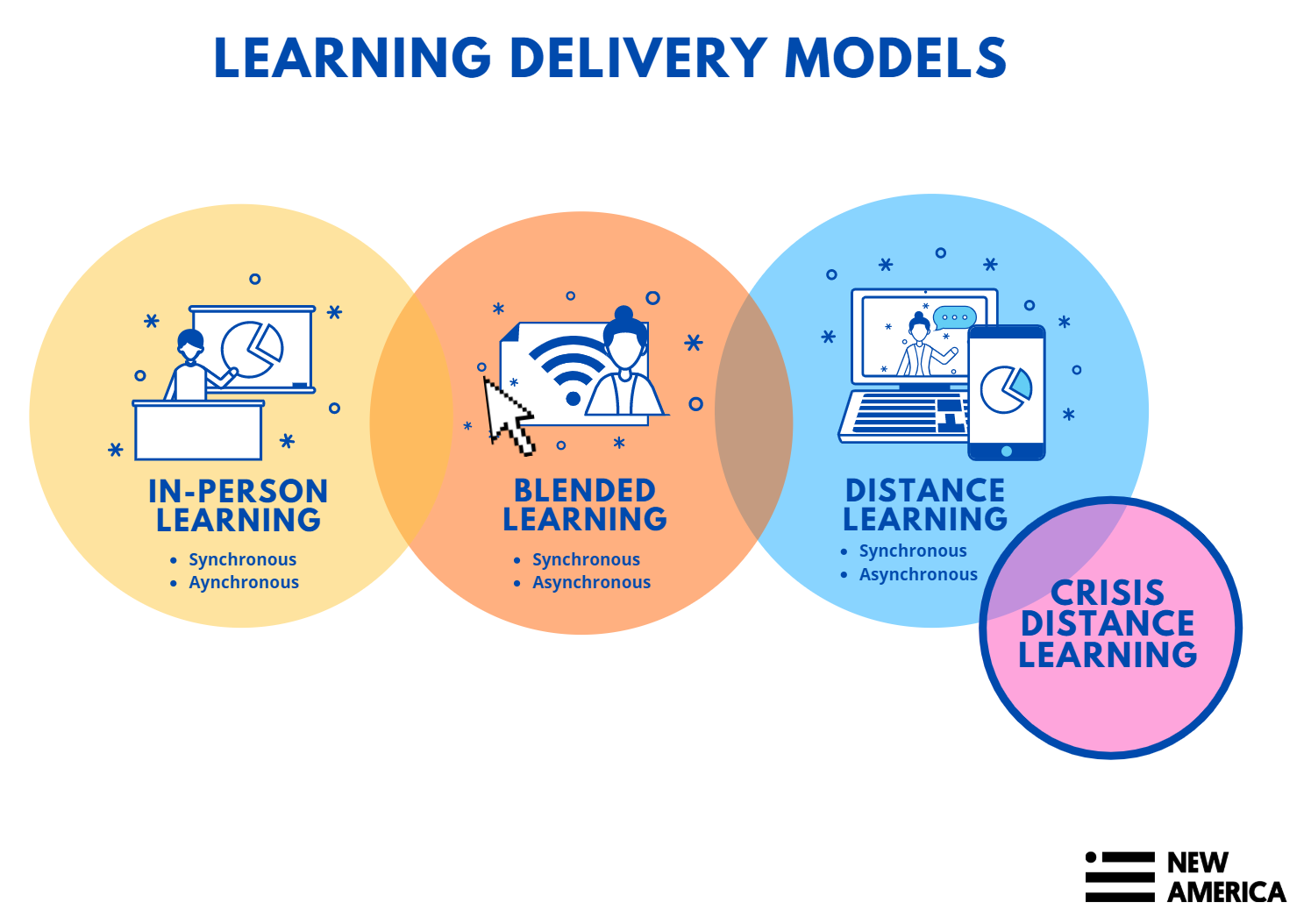
Distance learning, as with other modalities and models, offers advantages and limitations. However, the advantages are not achieved by merely replacing face-to-face content with online content. Instead, we need to map the complexity of the learning delivery models and balance the exchange of educational theory with pragmatic decisions including costs, technical support, accessibility, functionality, and quality assurance standards. We should use self-reflection, inquiry, and analysis to share our experiences, findings, and best practices in order to adopt solutions, strategies, and processes within our own professional communities. Now, with a few months to prepare for the 2020–21 academic school year, we can use lessons from the field of distance education to make decisions from a systems perspective.
Citations
- See the Centers for Disease Control and Prevention (website), source
- Michael Moore and Greg Kearsley, Distance Education: A Systems View of Online Learning, 3rd ed. (Boston, MA: Cengage Learning, 2011), 2, source
- Paul Saettler, The Evolution of American Educational Technology (Charlotte, NC: Information Age Publishing, 2004), source
- William Bianchi, “Education by Radio: America's Schools of the Air,” TechTrends: Linking Research and Practice to Improve Learning 52, no. 2 (April 2008): 36–44, source
- Michael Barbour, “The Promise and the Reality: Exploring Virtual Schooling in Rural Jurisdictions,” Education Faculty Publications 128 (2011), source Laurel Springs School (website), “Laurel Springs School, Pioneer in Online K–12 Education, Marks 20th Anniversary,” January 17, 2012, source
- Tom Clark, "Virtual Schools: Trends and Issues. A Study of Virtual Schools in the United States," a paper commissioned by WestEd for the Digital Learning Resource Network (October 2001), source.
- Snapshot 2020: A Review of K–12 Online, Blended, and Digital Learning (Durango, CO: Digital Learning Collaborative, February 2020), 5, 21, source
- In this report, we use the term distance learning to emphasize the learning that takes place through these methods; we use the term distance education when we are reflecting the terminology more commonly used in research studies and historical literature and when we are referring to a full system of education delivered at a distance.
- Joi L. Moore, Camille Dickson-Deane, and Krista Galyen, "e-Learning, Online Learning, and Distance Learning Environments: Are They the Same?" The Internet and Higher Education 14, no. 2 (2011): 129–135, source
- Randy Garrison, "Implications of Online Learning for the Conceptual Development and Practice of Distance Education," Journal of Distance Education 23, no. 2 (2009): 93–103,source
- Rebecca Heiser and Penny Ralston-Berg, “Active Learning Strategies for Optimal Learning,” in Handbook of Distance Education, eds. M. Moore and W. Diehl (New York: Routledge, 2019), 281–294.