
II. Innovative Options to Connect All Students to Online Learning

The homework gap has hindered efforts to modernize education for everyone, as millions of students live in households that cannot access or afford broadband internet service at home. Local school districts have been at the forefront of finding solutions to this connectivity gap, adopting innovative strategies tailored to the needs of their communities. This section profiles some of the pioneering and precedent-setting efforts to expand connectivity to students and teachers for educational purposes. These include community wireless networks, leveraging unlicensed spectrum to extend school networks, school bus Wi-Fi networks, and using spectrum-sharing frameworks to create local networks.
A. School District Community Wi-Fi Networks

When schools shut down due to the pandemic, several local school districts were ready from day one to shift nearly all of their mostly low-income students to remote learning. Over the preceding several years, they had built out school-owned Wi-Fi networks with the goal, at the time, of closing the homework gap by extending free, basic wireless internet access to the homes of students in the neighborhoods most in need. The districts had all determined that building their own community Wi-Fi network was the most cost-effective and sustainable long-term way to address the steadily growing disadvantage suffered by students without access to broadband at home. This section profiles three local districts that have pioneered community Wi-Fi initiatives that allow their mostly low-income students to continue—and enhance—their education online. These districts overcame very difficult but different challenges by partnering with their municipality and the private sector to extend their networks directly to students at home using community Wi-Fi.
Lindsay Unified School District—A Farmworker Community in California’s Central Valley
Perhaps one of the most impactful examples of a K-12 school district taking action to close its homework gap—and prepare itself proactively for remote learning—is Lindsay, an agricultural community of 13,000 in California’s Central Valley. Nearly all students at every grade level are connected to the school district’s free community Wi-Fi network.1 More than 90 percent of Lindsay Unified’s 4,100 students are eligible for the federal free or reduced lunch program. Most parents are farmworkers who share their homes with other families. Nearly 90 percent of the students are Latinx and half enter school lacking English language proficiency.2
In 2014, Lindsay Unified decided that it needed to ensure all students had internet access at home to enrich its innovative, performance-based learning model. “Known for personalized learning, Lindsay educators are building a competency-based system where they know exactly where students are in their academic journey and how they are progressing,” wrote Tom Vander Ark, a nationally recognized education expert.3 Students set their own goals as part of a “blended learning” curriculum that relies on technology and a performance-based learning platform to advance at their own pace. Their teachers “rely on analytics that continuously track their progress.”4 “Given Lindsay’s innovative, technology-enabled approach, having access to the Internet isn’t a luxury, but a need,” Vander Ark said.5
Lindsay Unified initially considered giving students MiFi hotspot devices with internet service provided by a cellular provider. Where mobile signals are adequate, students can use Wi-Fi to connect their laptops to these small portable routers in the same way that many cellular data plans allow consumers to turn their smartphone into a Wi-Fi hotspot, a practice called “tethering.” A national mobile carrier offered the district 2,000 free MiFi hotspot devices if it would purchase the monthly data subscription. However, the district concluded that the total cost of nearly $1 million annually was unsustainable. In addition, the indoor signal strength for mobile carrier 4G networks in much of Lindsay is spotty at best. As an alternative, the district devised a plan in 2015 to initially connect 75 percent of student homes using a meshed network of Wi-Fi access points (APs) mounted on schools, city property, and, as needed, student homes. The district initially tested the concept by installing Wi-Fi hotspots in an apartment complex next to one of the district’s six elementary schools, providing access to 40 students. The pilot period confirmed the viability of the solution, and the district initially extended the network by installing APs on each of its schools, as well as on city property and staff homes.6
By relying on free, unlicensed spectrum in the 5 GHz band, the district’s Community Wi-Fi Project is able to deliver a broadband connection to student homes in the town’s more densely populated neighborhoods. The district is able to reach outlying areas and to penetrate into public housing by using lower-frequency Educational Broadband Service (EBS) spectrum at 2.5 GHz, which is licensed free to the county for educational purposes.7 EBS spectrum propagates better because it’s lower in frequency. However, the district uses it only where needed because the LTE equipment made for this band is more expensive, as it is carrier grade and sold in small volumes. Approximately 500 APs were needed to cover the district which, thanks to the cooperation of the municipality, were installed at an average cost of $600 each.8
The primary limitation on student connectivity for education in Lindsay is FCC policy. The commission effectively penalizes Lindsay for relying on the district’s fiber backhaul to give students direct access to the school’s filtered network at home. According to Lindsay officials, the district is forced to throttle the bandwidth available to students at home to reduce cost, even though the school itself pays for more bandwidth than it needs.9 And, of course, students are not using the school network’s bandwidth when they are at home. This perverse outcome is due to the FCC’s interpretation of E-Rate, which requires Lindsay to cost-allocate and use funds other than E-Rate to pay for a larger portion of the bandwidth the district purchases from the Central Valley Independent Network (a private ISP consortium that extends the state’s K-12 fiber backbone to rural schools and libraries) than it otherwise would. Although the district’s fiber network has excess capacity, because it is a poor community and receives a 90 percent E-Rate discount for Category One backhaul, Lindsay Unified loses E-Rate funding for using school district fiber to enable its award-winning blended learning curriculum.10
Like nearly all California public schools, Lindsay began the 2020-2021 school year remotely. Lindsay Unified officials say that if they had greater flexibility to reprogram their 2020-2021 E-Rate budget, they could use some of their Category Two funding (for internal connections) to upgrade connectivity to students at home. In addition, under current E-Rate rules Lindsay Unified cannot repurpose Wi-Fi APs that they have funds to upgrade. If they had the flexibility, “the old APs could be redeployed as hotspots around the community,” improving the quality of connections for students.11
Another innovative aspect of the Lindsay Community Wi-Fi Project is that it’s funded primarily through savings on hard-copy textbooks and print materials that the schools no longer purchases. A Digital Promise profile of the project noted that the district decided “to repurpose budgets and avoid textbook adoptions to instead invest in digital formats and systems that support equity and all learners’ needs, giving us infinitely more bang for our buck” and “a critical investment in the future of [all] students.”12
Lindsay Unified believes that the community Wi-Fi network—and ensuring that every student is connected at home—plays a critical role in the proven educational success of the district’s performance-based learning strategy. They boast that 75 percent of their students are going on to college, more than any high school in their county, and that so far their college graduation rate is 59 percent.13
Council Bluffs Iowa—A School and City Community Wi-Fi Partnership
Council Bluffs, Iowa, provides another example of a public school district that found itself well-prepared for the pandemic-induced remote learning crisis. Beginning in 2014, the Council Bluffs Community School District (CBCSD) partnered with the city and local technology companies to build out a multi-purpose community Wi-Fi network in phases, as funding allowed, beginning with the most high-poverty neighborhoods.14 The BLink-Bluffs Free Community Wi-Fi Network is currently in phase six of a 10-phase plan to cover the entire city, neighborhood by neighborhood, as funding becomes available. Google, Iowa West Foundation, and other private donors provide annual expansion funding. “When completed over the next five years in 10 phases, the BLink coverage area will reach more than 20 square miles, providing Wi-Fi access to more than 40,000 people and reaching the doorsteps of nearly every home and business in Council Bluffs,” according to a statement by the mayor of Council Bluffs.15
The impetus for the network began when Google, which operates a large server farm in Council Bluffs, contributed Chromebooks for a one-laptop-per-student initiative. Teachers quickly realized that integrating technology for homework and team-based projects outside of school was impractical given the share of students lacking access to broadband internet at home. The city of Council Bluffs was already provisioning Wi-Fi as an amenity in some public spaces and agreed to partner with the district to build a joint, free community Wi-Fi network citywide. The city contributes fiber backhaul, locations to mount access points (e.g., street lights), and most of the ongoing operating expenses (roughly $50,000 annually for the entire network), which is mostly electric power.16 In exchange for the city’s support, the Wi-Fi network is open for use by any resident or visitor who logs in through the city’s separate SSID (the 32-character code that uniquely identifies a wireless network). The school’s Chromebooks are configured to automatically authenticate to the school district’s separate SSID so that students are tunneled directly to the school’s content-filtered network. The municipal Wi-Fi service is limited to 5 megabits of symmetrical service (5/5 mbps), which is very slow compared to most cable or other home broadband connections, because the city does not intend it to be a replacement for fixed broadband services to the home.17
The neighborhood-by-neighborhood deployment has prioritized high-poverty areas where the largest share of students lacked internet access. For example, phase one targeted a neighborhood that is home to multiple homeless shelters, food banks, and a human services campus. As of June 2020, BLink Wi-Fi connected a total of 4,700 students at home directly to the school district’s network. The district’s goal is to cover at least one additional neighborhood per year. The current phase six, covering the Carter Lake neighborhood, is connecting an additional 800 students at an estimated cost of $186,000. After phase 10, nearly 70 percent of all students will be covered. The CBCSD believes that at least for now, it will not be economical to use Wi-Fi operating on 5 or 6 GHz unlicensed spectrum to connect the roughly 30 percent who live in less densely populated, outlying areas.18 Some of this gap is filled by an offer for free installation and $10/month service from Cox Communications, the local cable provider.
As in Lindsay, CBCSD officials lament that the FCC’s current interpretation of E-Rate rules limits their flexibility to decide how best to allocate their IT resources to meet the learning needs of students. According to district CTO David Fringer, the FCC’s 2014 E-Rate reforms were a huge boost. Because the FCC allowed the district to use Category One funding to lease dark fiber, “we can light our own fiber and so we have our own fiber ring.” However, he said the lack of flexibility in using Category Two funding both encourages unnecessary internal upgrades and deters other initiatives such as Wi-Fi connectivity to needy students at home. “Now what districts need is an option to use Cat Two to extend their networks, such as for Wi-Fi extensions of the school network,” Fringer said.19 He added that the Council Bluffs perspective is that “when the student is using the school device [Chromebook], that is the classroom. The bandwidth paid by E-Rate would be used only for student use on school-issued devices, so we don’t believe it matters where the student is located while learning.”20
San Jose’s East Side Union School District—Community Wi-Fi Funded by a Tech Bond
San Jose’s East Side may be immediately adjacent to Silicon Valley, but it is a world apart when it comes to broadband connectivity. An estimated 30 percent of student households lack broadband internet service. Among students, two-thirds are considered socioeconomically disadvantaged and a majority are eligible for free and reduced-price meals at school.21 Yet, as in Lindsay and Council Bluffs, nearly all of the 24,000 middle and high school students in the East Side Union High School District (ESUHSD) had direct internet access to their school’s network when remote learning began with little warning in March 2020. The district’s students no longer suffer from a homework gap, thanks to a “Wi-Fi for Everyone” partnership with the City of San Jose that has built out a dual-use, mesh Wi-Fi network, which is currently being expanded into additional neighborhoods.
In 2014 the ESUHSD raised $2.7 million through a voter-approved school technology bond dedicated to closing the digital divide among its students. The district began by deploying 24,000 Chromebooks so that every student had an internet-connected device. It also upgraded the on-campus Wi-Fi coverage at its 11 largest schools. It learned, though, that this would be inadequate so long as 30 percent or more of the students had no access to adequate broadband connectivity at home. As one high school student told the local paper: “Most of our work is online. If you don’t have Wi-Fi at home, how are you going to finish it?”22
In 2017, the district partnered with the city on an initial pilot that extended free Wi-Fi internet access to the homes of 1,700 students at a large high school, as well as to 6,000 households within the coverage area.23 Coverage required 211 Wi-Fi access points. The total cost of the pilot was $1.6 million, which includes a set-aside for five years of operating and maintenance costs for the district (this corresponds to the roughly five-year life of the APs). Ongoing operating costs are estimated at $60,000 per year.24 The largest cost overall is not equipment, but installation.
As in Council Bluffs, the city provided the fiber backhaul through its municipal fiber network, as well as construction support and free access to city-owned street lights and traffic signals, including the cost of electric power (which was already connected in most locations). In return, the city has opened the network to the general public as a free amenity and source of connectivity for those who cannot afford broadband at home. The city was already providing free Wi-Fi in downtown business areas and at Mineta International Airport, but the partnership with the schools was the first step toward extending basic Wi-Fi connectivity citywide. Like in Council Bluffs, the students are authenticated on the school district’s separate SSID and tunneled directly to the school network and its content-filtered access to the internet.
According to Randal Phelps, the district's CTO and project lead, the district put pen to paper and concluded that, in the long term, building a community mesh Wi-Fi network was far more cost-effective than buying monthly broadband subscriptions for low-income students from mobile or cable ISPs. He also estimated that, with the experience and infrastructure developed for the James Lick High School pilot deployment, all students across San Jose (including some adjacent neighborhoods just outside the city) could be covered for a total cost of $24 million.
The next expansion of the ESUHSD Wi-Fi network, announced in August 2020, is a partnership with the county that will extend coverage to the rest of the East Side, including neighborhoods where more than 305,000 people reside in the attendance areas of eight high schools. Because the pandemic has extended remote learning into the 2020-2021 school year, the city is also immediately upgrading Wi-Fi at libraries and other facilities, as well as distributing 8,000 hotspots with unlimited 4G LTE data plans to unconnected students through a partnership with AT&T.25
As in Lindsay, the district found that ensuring its high school students have both laptops and 24/7 broadband access has allowed teachers to enhance the curriculum, with measurable educational benefits. An educational outcome assessment through a partnership with the Accrediting Commission for the Western Association of Schools and Colleges and the California Department of Education found many positive outcomes, including:
- 71 percent of graduates in 2018 matriculated to a two-year college or four-year university;
- 11 percent increase in SAT, ACT, and State Assessments scores for the past five years;
- 58 percent of graduates passed the English college competency exam the first time;
- 88 percent increase in GPAs since 2014 (44 percent of growth occurring since 2017); and,
- 94 percent of students reported feeling more connected and proud of their school (a noticeable increase from 57 percent in 2014).26
B. Harnessing Spectrum Sharing Frameworks to Connect Students
In addition to Wi-Fi, there are new and innovative options for extending broadband access to students who lack service at home using recently-authorized shared spectrum bands. Most promising is the spectrum-sharing framework in the new Citizens Broadband Radio Service (CBRS) located in the 3.5 GHz band—mid-band spectrum that is considered to offer the best balance between propagation and capacity for wireless broadband. Although the FCC only opened the band for public use in early 2020, CBRS is already providing novel solutions for connecting students to the broadband access they need during the coronavirus crisis and beyond.27 For example, some school districts are using small-cell CBRS networks to connect home Wi-Fi hotspots provided to students and teachers—a higher-quality and financially sustainable alternative to monthly mobile carrier subscriptions.
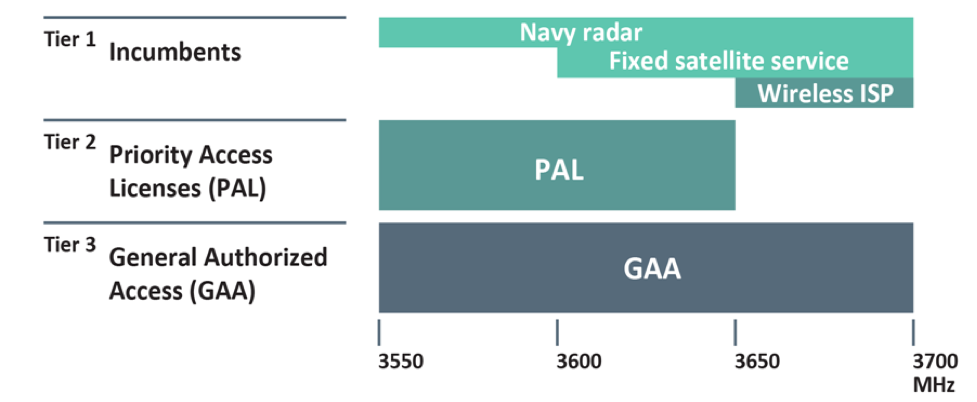
The FCC adopted rules for the shared public use of the 3.5 GHz band, now known as CBRS, back in 2015. Until then most of the band was allocated exclusively for U.S. Navy radar, but was unused in most locations. The FCC opened the band for public access and commercial use through a three-tiered sharing framework that allows both federal and non-federal users to share the band. The spectrum’s prime mid-band propagation has great promise for both mobile 5G services and for high-speed fixed wireless connections needed to bridge the homework gap.
The three tiers of CBRS consist of the federal incumbents (Navy radar), a second tier for “priority access,” which is licensed by county based on an auction completed in August 2020, and a third tier for General Authorized Access (GAA). GAA is effectively an unlicensed spectrum that is open and free for any user as long as they do not cause harmful interference to licensed users in the two higher tiers. More than half of the band (80 megahertz) is set aside solely for GAA use, although the portion of the band that is licensed (70 megahertz) is also available in areas where a priority access licensee has not commenced service, as well as in many rural counties where the licenses were not sold.
The FCC’s framework empowers schools and other enterprises to become their own fixed or mobile broadband providers using 3.5 GHz spectrum, a key benefit that school districts and telecommunications providers are starting to leverage to help solve the homework gap. CBRS spectrum is most effectively used by schools as a substitute for mobile carrier connectivity. Using similar and widely-available equipment, a school, library or any enterprise can build a private LTE network that beams internet connectivity to receiving devices, including Wi-Fi hotspots or other home gateway routers.
CBRS Education Networks in Maryland, Texas, and California
Since the beginning of the coronavirus crisis, school districts and telecommunications companies have harnessed the capability of CBRS to deliver service to students who need broadband access. The most ambitious of these initiatives may be the state of Maryland's plan to develop a high-speed broadband network using 3.5 GHz unlicensed spectrum.28 Maryland’s CBRS network is intended not only for rural areas of the state, but also urban areas where students may live in households that cannot afford broadband. The director of Maryland’s Office of Rural Broadband told the Baltimore Sun that the state chose the 3.5 GHz band both because it could deploy on the GAA spectrum without a license, and because service deployed on the mid-band spectrum can reach homes at distances up to six miles and deliver data at high speeds.29 In addition, because CBRS is already used by dozens of commercial wireless ISPs (WISPs), and soon will be used by Verizon and other large operators, 4G LTE base stations and other needed equipment is widely available and relatively inexpensive.
McAllen Independent School District in McAllen, Texas, has procured what might be the most robust early example of a CBRS-powered educational broadband network. McAllen has been hit hard by the pandemic and had a 2.5 percent infection rate among its 145,000 residents as the 2020-2021 school year began.30 Faced with such a significant threat to the local population, preparing to continue remote learning was a no-brainer. However, about a quarter of the residents of McAllen live below the poverty line.31 The district provides Chromebooks to all 21,000 of its students for use in school, but it did not assign homework online because only about 37 percent of households have broadband subscriptions.32 This reflects a common reality in lower-income areas nationwide: Millions of families simply cannot afford to purchase the broadband access needed to support online learning and help keep people safe during the pandemic.
The district knew it had to do something to connect its students, but getting a large number of homes connected to high-speed service on a quick timeline is difficult. In fact, the district originally opted to lend 8,000 Wi-Fi hotspots to students without home broadband access, but the district superintendent quickly realized this solution was inadequate. Too many families still had to resort to going to parks and fast food restaurants to actually connect to their online learning materials.33 Problems included spotty mobile service, both in terms of coverage and bandwidth, as well as the ongoing costs of mobile carrier monthly subscriptions for connectivity, a financially unsustainable long-term remedy for the homework gap.
As a more sustainable alternative, the McAllen city government is using some of its CARES Act funding to build a network to connect students without access at home.34 McAllen’s network uses free CBRS spectrum on a GAA basis as the connectivity for Wi-Fi access points distributed to student households that lack internet access. CBRS currently allows the use of all 150 megahertz (until auction winners commence service) and at least 80 megahertz of shared spectrum long term. Antennas for CBRS base stations are being mounted on city-owned water towers and light poles.35 The network, constructed with equipment from WISP supplier Cambium Networks, combines 24 point-to-multipoint CBRS base stations and, initially, 1,000 Wi-Fi hotspots for student homes.36 Another 5,000 Wi-Fi hotspots are planned as the network is built out further. Essentially, the CBRS base stations create a private LTE network that beams connectivity to MiFi-like hotspots in student homes, which use Wi-Fi to connect the student’s Chromebook directly to the school’s network (and the internet beyond). Federated Wireless is donating spectrum management services to make sure this effort does not cause harmful interference with the Navy or priority licensed users.37
The city of McAllen’s project is a perfect example of how CBRS spectrum can be paired with Wi-Fi to bridge the homework gap. One of the co-founders of the consulting company the city worked with noted that CBRS spectrum works particularly well in McAllen because several WISPs in the area are already heavily using the unlicensed 5 GHz band that operators rely on for fixed Wi-Fi deployments.38 The CBRS network has been such a success that it is providing service to all residents in McAllen who want and need it. By actually owning network infrastructure that offers wireless broadband connections to students and families who cannot afford it, the city has a resilient, multi-purpose network that will offer much-needed connectivity both during the pandemic and for years to come.
“The deployment of this network delivers on one of the core capabilities of CBRS, which is to extend wireless connectivity to rural areas that traditionally have not had a level playing field with the rest of the country,” Matt Mangriotis, director of product management at Cambium Networks, told Fierce Wireless in a statement.39 While the mid-band CBRS spectrum is well suited for rural areas due to its propagation characteristics, it can also work well in urban areas, where more than 30 percent of households often lack connectivity. Kurt Schaubach, CTO of Federated Wireless, told LightReading that the company has been receiving requests from urban school districts, noting: "Affordability is the issue… School districts can't pay for a subscription service and they need a lower cost alternative."40
School districts in California are also turning to publicly-available CBRS spectrum to bridge the remote learning gap. Fontana Unified School District (USD), in partnership with Crown Castle Fiber, is constructing a wireless network to deploy high-speed service using CBRS spectrum. Fontana is a city of 200,000 in San Bernardino County, 50 miles east of Los Angeles. The district’s goal is to provide service to over 36,000 of its students.41 “We’ve estimated that 55 to 60 percent of our students do not have reliable internet access outside of school,” explained Fontana USD Superintendent Randal S. Bassett.42 The community is overwhelmingly low income, with 85 percent of the district’s elementary school students eligible for the free or reduced school lunch program.
Bassett estimates that approximately 400 cellular access points will be needed to cover the areas where 98 percent of its students reside.43 While the network remains under construction, its basic architecture appears similar to the McAllen network described above. The 400 CBRS base stations will transmit connectivity to thousands of Wi-Fi hotspots (or similar home Wi-Fi gateway devices) made available for student use at home.
Crown Castle Fiber will own and operate the network. Although the Fontana CBRS network will cost an estimated $40 million over the next five years, Crown Castle will absorb most of the initial costs since it expects the network to be multi-purpose and serve multiple tenants.44 The school district is the anchor tenant making the project feasible, but the city is expected to be another tenant, spreading the cost over more parties and providing the wireless connectivity needed for city telehealth, public safety, and 5G smart city infrastructure in the future. Bassett said the district decided it is a more cost-effective solution than buying bandwidth monthly from mobile carriers, particularly since it creates 5G-ready infrastructure that can be multi-purposed for Internet of Things applications.45 The total estimated monthly cost is $14 per student for the initial five years, but only $7 per student thereafter since the basic network infrastructure will be in place.46
Bassett noted that the FCC has effectively increased the cost of extending connectivity to students at home, since E-Rate rules are forcing the district to lease a separate strand of fiber to carry the traffic from students and teachers back and forth to the school’s E-Rate supported network. This cost is on top of the cost the district already pays to lease fiber optic cable with 30 GB of capacity. Another extra cost is interconnecting the on-campus and off-campus networks. “The backhaul should follow the students: Even if there was no excess capacity on the Cat One fiber, when the students are at home, that capacity is not in use at the school,” he explained.47
Patterson Unified School District in Patterson, California, is similarly building a wireless 4G LTE network using GAA spectrum in the CBRS band to connect 100 student homes without internet access. While this will directly connect only a small percentage of student households, the network demonstrates how CBRS and the unlicensed GAA spectrum in particular can be quickly utilized by schools as a gap-filler to economically extend high-speed broadband to students.48
Districts are Investing CARES Act Funds in CBRS Networks in Utah and Colorado
CBRS spectrum offers an efficient option for school districts seeking to invest pandemic-related funding in a high-speed broadband network that offers a greater long run return on investment. The Murray City School District in Salt Lake City, Utah, qualifies for E-Rate funding, but has been restricted from using it to extend connectivity to students because of the FCC restrictions described above. During the pandemic, the district has taken advantage of CARES Act relief and charitable contributions to leverage CBRS spectrum to deploy a private LTE network for students lacking broadband. District and state funds are being used to purchase the CBRS radios and other network infrastructure, while charitable donations are being used to provide the Wi-Fi hotspots loaned out to students in need.49 According to the district’s CTO, users receive average speeds of 134 mbps downlink and 16 mbps uplink, with latency (delay) consistently below 38 milliseconds.50 The district is also using the network for security cameras around its buildings and playing fields.
Similarly, the Roaring Fork School District in Colorado opted to use CARES Act funding secured from the state to build a private 4G LTE network that relies on the CBRS band to connect students and teachers throughout the 2020–2021 academic year, and potentially even longer.51
The Utah Education and Telehealth Network (UETN), which connects 1,700 schools and other public facilities across the state, is using CARES Act funding to expand an initiative using CBRS access points for internal networks at 25 schools.52 The initial goal is to provide LTE connectivity ubiquitously on school property, both throughout the buildings and in school parking lots and playing fields. Jim Stewart, CTO of UETN, told Fierce Wireless that the system started investigating private LTE and CBRS well before the pandemic because it seemed an attractive alternative to relying on mobile ISPs. “I don’t want the carriers to get into that space and start charging me for every bit that I pass inside… all the 1,700 buildings that we connect,” Stewart said.53
CBRS is working out well enough for education networks that there have been suggestions that the FCC reserve some 3.5 GHz spectrum specifically for schools to connect students who lack access at home. Scott Imhoff, vice president of product at Cambium Networks, which sells CBRS access equipment, suggested to Fierce Wireless that the FCC could hold some CBRS spectrum for education institutions, or even issue special priority access licenses for educational services to ensure school districts would not have to go up against commercial interests in the bidding process.54 Reserving CBRS spectrum for schools would be problematic, however, particularly now that the CBRS auction has already concluded. Something similar could be done with a portion of the immediately adjacent 3450-3550 MHz spectrum that the FCC is currently deciding how to license. Like CBRS, it will be shared with the military, but it’s expected to be available at higher power levels since the military has agreed to move many of its radar operations off that 100 megahertz segment. This approach might be most appropriate in rural areas where there is less demand from mobile carriers. Short of that, the FCC’s Notice of Proposed Rulemaking (released on October 2, 2020) asks whether a portion of the band should be reserved for GAA use, or at least available for GAA use until operators that buy licenses commence service in a local area.55 That could give schools access to considerably more than 80 megahertz on a GAA basis when combined with the current CBRS band.
School Networks also Use the Educational Broadband Service Spectrum at 2.5 GHz
CBRS is proving to be a successful model, but it is not the only option. In addition to the purely unlicensed spectrum bands used for Wi-Fi (at 2.4 GHz, 5 GHz, and soon 6 GHz), the 2.5 GHz band was, until recently, fully reserved for the Educational Broadband Service (EBS), with licenses held by colleges and school systems across the country.56 Although 2.5 GHz can propagate signals farther than spectrum bands higher in frequency, such as the 5 GHz unlicensed bands used for wide-area Wi-Fi networks, it is not available everywhere and licensees typically have limited capacity. As noted in the previous section, the school district in rural Lindsay, California relies on meshed Wi-Fi to connect homes clustered together, but relies on the EBS spectrum to reach the 20 percent of students in less densely populated outlying areas.
The most extensive EBS network is operated by Northern Michigan University (NMU) and connects both college and K-12 students across a wide area in Michigan’s rural and sparsely-populated Upper Peninsula. NMU received its EBS license in 2008 and initially launched a carrier-grade WiMAX network aimed at connecting its own students off campus within 35 miles of the university.57 In 2017, after receiving a 66 percent matching grant from the state economic development corporation, NMU began a $10 million expansion of the network to connect K-12 students and other unserved residents in neighboring rural communities.58 Using LTE, the NMU network aims to provide 25/5 mbps connections, which can drop to 10/3 mbps at greater distances away from the tower. According to Eric Smith, NMU’s director of broadcast and audio-visual services, even the lower throughput works for remote learning because the network is optimized for streaming video.59 Smith stated that NMU charges individual K-12 students $20 per month for the service, although most are connected through wholesale deals negotiated with local schools to provide free connections to low-income students eligible for the free and reduced lunch program. There are no data caps and non-student households can also purchase the service for $35 per month.
In Virginia, the Fredericksburg City Public Schools district has applied for a special temporary authorization (what the FCC calls a STA) to deploy wireless broadband internet services using EBS spectrum to provide access to the 14 percent of the school district’s population who do not have high-speed broadband access at home.60 Similar to McAllen and other examples, the school district leaders believe the biggest issue is affordability, not a lack of infrastructure. In the case of Fredericksburg, the EBS network is on hold since T-Mobile is opposing the district’s application for a license. The FCC decided in 2019 to auction non-licensed EBS spectrum, which is mostly in small town and rural areas, and T-Mobile seems to be taking the posture that no additional EBS licenses should be awarded.
Although Fredericksburg has not begun to deploy its network, its plan to use 2.5 GHz spectrum offers a potential blueprint for districts nationwide with access to EBS spectrum, or if the FCC reconsiders its decision to stop granting EBS licenses.61 According to the senior vice president of product management at Cambium Networks, many school districts have contacted the company about using 2.5 GHz spectrum in a potential partnership with commercial WISPs for connectivity solutions. “We’ve got a number of school districts that are looking at longer-term solutions using that EBS spectrum,” the senior vice president of product management, Scott Imhoff, told Fierce Wireless, adding that schools have existing fiber assets, real estate, and in some cases tall buildings for the antennas necessary to build a network.62 The 2.5 GHz band has great promise for improved connectivity and remote learning for tribal areas as well.63
Library Strategies to Extend Wi-Fi Access to Students and their Communities
Libraries have also been trying to help students access broadband since the pandemic began, despite being closed for long periods. Many have relocated or increased the power of their Wi-Fi routers to enable students and other individuals to get online from the parking lot or other areas just outside the building.64 Some libraries expanded their programs for lending out Wi-Fi hotspots, with the backhaul provided by mobile carriers. Others have parked “bookmobiles” with Wi-Fi in neighborhoods close to students lacking broadband.65
In Pottsboro, Texas, a town of 2,500 north of Dallas, the local library went even further. First it put a Wi-Fi access point on the library roof to extend the network’s connectivity to cars in the parking lot.66 The Pottsboro Area Public Library also dedicated its $25,000 CARES Act relief grant to a partnership with an EBS licensee to provide Wi-Fi access points to the 40 local high school students lacking broadband at home.67
At the start of the pandemic, the FCC attempted to facilitate pilot projects to demonstrate how the mostly unused 5.9 GHz band could be used to connect the disconnected when it issued Special Temporary Authority (STA) grants to about 100 wireless providers, allowing them to use 5.9 GHz band spectrum to support these providers’ networks and keep people online.68 The FCC’s pending proposal to reallocate 45 megahertz of the 5.9 GHz band would make free public access permanent, and combined with the adjacent Wi-Fi band at 5.8 GHz, create the potential for gigabit-fast Wi-Fi networks both indoors and outdoors on 160 megahertz of contiguous unlicensed spectrum.69 The large new band of unlicensed spectrum in the 5.9 GHz and 6 GHz band will also provide a way for school districts to build networks to empower students to continue learning remotely.
C. Wireless Extensions of School Networks

Technology companies, school districts, and ISPs have teamed up in pilot projects to demonstrate exactly how schools could use spectrum to extend their networks and resources directly to students at their homes. These projects were developed years ago, long before COVID-19, but could offer a quick and targeted option for schools and other community and educational pillars to extend broadband networks to student homes, housing projects, community centers and other locations—particularly those within a few miles of a school or other municipal building with fiber backhaul.
Districts Using “Super Wi-Fi” to Extend School Networks to Students at Home
Four years ago, school districts in two states filed petitions with the FCC urging the agency to issue waivers allowing them to use rooftop transmitters to extend their E-Rate-funded networks from the school directly to the homes of students lacking internet access.70 One petition was filed by two rural Virginia districts—the Charlotte and Halifax County public schools—along with Microsoft, a local fiber provider and a WISP. The other was filed by the Boulder Valley School District, in Boulder, Colorado. Both efforts sought FCC permission to leverage a combination of innovative spectrum technologies and E-Rate-supported fiber backhaul to connect students without internet access in rural and outlying areas.
The projects rely on the unused broadcast television channels in each local media market —vacant broadcast frequencies known as TVWS. Because the low-frequency spectrum allocated for TV broadcasting has exceptional propagation characteristics, TVWS spectrum allows schools, libraries, rural ISPs, and others to beam high-speed broadband connections over greater distances and to easily penetrate obstacles such as trees and outer walls of buildings. While most Wi-Fi used by consumers at home or work will cover only relatively small areas, the superior propagation of TV spectrum led a former FCC chairman to describe the unlicensed use of TVWS as facilitating “super Wi-Fi.” TVWS technology has been particularly effective at expanding broadband access in rural, tribal, and other hard-to-serve areas.
The Southern Virginia districts began their pilot project in 2016, working with 18 schools that receive E-Rate funds and teach about 7,500 students.71 The participating schools were selected based on the deployment of fiber optic cables to these schools (giving them plentiful bandwidth), the availability of towers or high sites at the schools to mount transmitters, and the dearth of broadband service providers in the rural and small town communities around the schools. The population living near the schools is low-income and the petitions emphasized that about half of the students at these schools do not have home broadband access.72 Because the population density is low—and the population has been shrinking—it is very costly to build and deploy high-speed wireline broadband services.73 The school districts’ petition for waiver described the unique advantages of TVWS in rural areas:
This project will employ Dynamic Spectrum Access (“DSA”) technology . . . [that] allows devices to opportunistically use available radio spectrum, including unused or unassigned TV broadcast channels (known as “TV White Spaces”). Signals broadcast over TVWS can travel long distances to deliver high bandwidth internet service at low network costs. The areas surrounding the Participating Schools are well-suited for TVWS deployment because they contain a large number of vacant UHF channels eligible for TVWS transmission. . . . These TVWS base stations will enable students to connect from home to safe school district networks and access content and applications needed to complete their homework assignments and engage in other school-sanctioned educational activities. Students will connect via a specialized, in-home, TVWS access point, . . . allowing Wi-Fi-enabled devices within the home to connect to the network.74
These pilot projects provide a roadmap for how TVWS technology can extend connectivity directly from a school to student homes or community hotspot locations in rural and remote areas. Unfortunately, the FCC never acted on the petitions. However, the pilots continue to play an important role, both in those communities and as a model for potential future TVWS initiatives, which could be even more robust now that the FCC has updated its TVWS rules.
After the pandemic began last March, the Boulder Valley School District (BVSD) expanded its TVWS pilot program, called ConnectME (Connect My Education), extending it beyond a few schools in Lafayette and Boulder to every single school in the district. ConnectME helps students without broadband access receive the service needed to participate in remote learning during school shutdowns due to COVID-19.75 BVSD Chief Information Officer Andrew Moore has stated that even if mobile carrier hotspots were sustainable financially, neighborhoods with the greatest need also typically have the worst cell phone coverage. “With multiple students in a household, you can run into issues pretty quickly,” he told the Daily Camera.76 In an October blog post, Moore explained that even the discounted programs offered by cable and other ISPs to low-income students were often inadequate for learning because the uplink throughput is capped at a lower level (typically 3 mbps) that wasn’t working for households with more than one student. Even worse, CenturyLink DSL connections are limited to 2 mbps in many areas, he said.77
Since the FCC has still not granted BVSD’s waiver request, the district has forged a partnership with a local WISP to use CBRS spectrum to reach students lacking connectivity. The public-private partnership not only offers free 25/5 mbps broadband service to students in the school district’s free or reduced lunch program. The partnership also gives the district 25 percent of the proceeds earned by LiveWire, the partner ISP, which uses the same network to sell fixed wireless broadband to households in the same areas.78 To avoid running afoul of the FCC’s E-Rate rules, the company relies on school district fiber backhaul funded by public bonds, rather than already-paid-for school district fiber.79
In response to the pandemic, Microsoft has urged the FCC to grant the 2016 petition filed by the Virginia districts. In its filing, Microsoft noted that the 2016 TVWS pilot in rural Virginia extended broadband connections from 18 schools to more than 200 student households.80 Microsoft reports that although the pilot project ended before the FCC acted on the petition, its partner Adaptrum and a local WISP still provide free broadband to around 80 households. Expanding on this work, Microsoft is collaborating with the Nebraska Education Service Unit, and Grand Island Public Schools to use TVWS technology to bridge the homework gap in Grand Island, Nebraska. The initiative will offer free TVWS devices for connectivity at home to students who do not have access to home broadband and normally depend on Wi-Fi at school for homework and school assignments.81
These successful pilots suggest the FCC should be facilitating these efforts by giving districts greater flexibility to extend their networks beyond the walls of the classroom. As detailed above, the FCC has the authority to do so, but the current chairman is relying on a narrow reading of its authority to reject requests to use E-Rate funding or E-rate funded facilities to extend connectivity beyond school property.
D. School Bus Wi-Fi and Community Hotspots
The use of school buses as Wi-Fi hotspots dates back to 2016, but the strategy became more widespread after the coronavirus shutdowns created an urgent need to bring internet connections closer to low-income students at home. The original idea was to address the homework gap by strategically locating Wi-Fi-enabled school buses after school hours, when students could use them as an option for completing homework. Schools install a Wi-Fi router on the roof of a bus, which is then parked in a high-need location where students who come within 200 or 300 feet can share a mobile broadband connection. When schools are open, school bus Wi-Fi allows students to study and complete homework on what can be long commutes to and from school or sporting events. When schools are closed, the buses can provide continuous hotspot access in targeted locations. As a stop-gap measure, school bus Wi-Fi can be particularly cost-effective where students without internet access are clustered in low-income neighborhoods, or in targeted locations such as public housing, trailer parks, or community centers.
A related innovation has been to locate more permanent and high-speed Wi-Fi hotspots at community centers or public housing locations where low-income students can more easily get online outside of school hours. More than five years prior to the coronavirus shutdowns, the school district in Kent, Washington (just south of Seattle), placed three Wi-Fi kiosks in community centers at public housing complexes and also coordinated with local businesses and organizations to establish a network of school-sponsored Wi-Fi hotspots.82 The district used donations and partnerships to help defray some of the costs associated with the $6,500 kiosks. The kiosks transmit free Wi-Fi in a 75-foot radius and feature a 42-inch LED screen to display the latest district news—very much like the hundreds of LinkNYC kiosks that provide free Wi-Fi access by connecting to fiber at former Verizon pay phone locations up and down the commercial avenues in Manhattan. “For many students who live in nearby public housing and go to school in the surrounding 27,400-student school system, the kiosk acts as a bridge between the digital connectivity they have through laptops and other devices at school and the lack of Internet access they cope with at home,” according to a report in Education Week.83
The use of school bus Wi-Fi burst onto the scene in the Coachella Valley School District in California in 2015. The buses were fashioned to essentially serve as mobile hotspots in a school district where over 95 percent of the students live below the poverty line and a high percentage live in households that cannot afford home broadband.84 When schools were fully open, the buses’ mobile hotspots gave students internet access on the drive to and from school. The district also left eight Wi-Fi buses parked in targeted neighborhoods after school hours.85
School-Bus Wi-Fi has Become Widespread Since the COVID-19 Shutdowns
School districts across the country have adopted this tactic to connect students during the pandemic. In South Bend, Indiana, schools equipped 20 buses with Wi-Fi hotspots. Wi-Fi routers on the buses connect to student Chromebooks within 300 feet in any direction at over 30 sites throughout the city initially, with the goal of adding even more.86 One rural school district in Oregon, Crook County, parked 30 school buses with Wi-Fi hotspots in targeted locations to offer the service for students who do not have internet service at home.87
This method has not only been used in rural districts, but also in urban areas. Montgomery Public Schools (MPS), in Alabama, installed Wi-Fi transmitters on 11 buses to serve as hotspots at different locations. MPS Superintendent Dr. Ann Roy Moore told a local news outlet: “The idea is that any parent, any child in any neighborhood where they see that yellow school bus, they can access the WiFi hotspot… They don’t have to be right down the street from their home. If they’re at home, it’s fine, but if they’re at their grandma’s house and there’s a bus down the road, they can also access from that location.”88
School bus hotspots have been used on a larger scale as well. When the schools closed due to the pandemic, Austin Independent School District, a large public school district in Texas, outfitted 110 school buses with Wi-Fi and sent them out to neighborhoods and apartment buildings that the district targeted as needing internet access the most.89 The buses were parked in those areas every weekday from 8 a.m. to 2 p.m. and had the capability to connect to school-issued laptops (not personal devices) from up to 300 feet away.90 On an even larger scale, the state of South Carolina started parking hundreds of school buses with Wi-Fi capability around low-income neighborhoods—all 3,000 school district school buses were already equipped with Wi-Fi modems, but mostly the larger districts had actually activated the service previously.91
The initiatives described above represent just a few of the many school districts using school bus hotspots to bridge the connectivity gap—even if only temporarily in an imperfect way. School districts in southern Illinois;92 Hoover, Alabama;93 Clark County School District, Nevada;94 Abilene, Texas;95 Victor Valley Union High School District, California;96 Topeka, Kansas;97 and Mosinee School District, Wisconsin,98 are among the many that have also adopted this solution. School districts with drastically different characteristics have all used school bus-powered hotspots, demonstrating how powerful a solution school buses can be.
School bus hotspots are certainly an imperfect solution. Hours are often limited and the cellular connections for mobile hotspots often suffer from weak connections, particularly in less affluent or rural areas where mobile carriers have had little incentive to invest in high-capacity infrastructure. Reaching a larger share of the households that need internet connectivity using this method is difficult. Students typically cannot connect from home and often need to travel a considerable distance to do so, possibly to or through areas their parents would consider unsafe. However, the use of school bus hotspotses as a stopgap option for students who have no other way to access broadband is still an important development and has been an innovative solution for school districts and families during the pandemic.
School bus and community hotspot connectivity can be improved through the use of TVWS spectrum (described in the previous section) and other wireless extensions of networks, particularly where cellular network signals are weak or monthly subscription costs are high. In response to the coronavirus shutdowns, Microsoft told the FCC that its own projects with partner ISPs have shown “how TV White Space technology could be used to provide wireless connectivity to Wi-Fi hotspots on school buses during their morning and afternoon pickups and dropoffs.”99 These signals would likely be much stronger and closer to a consistent Wi-Fi signal than those offered by mobile hotspots, and as this technology develops, more school districts could adopt TVWS to connect school buses with more reliable high-speed broadband for trips to and from school, and for future emergencies similar to the current pandemic.
Citations
- OTI Interview with Peter Sonksen, Network Administrator, and Barry Sommer, Director of Advancement, Lindsay Unified School District, June 1, 2020 (“Lindsay USD Interview”).
- See Ed Data, Education Data Partnership, Lindsay Unified District Profile, available at source.
- Tom Vander Ark, “How a California Farming Community is Leading the Global Shift to Competency,” Getting Smart, June 6, 2018, available at source.
- Lindsay USD Interview, supra.
- “Lindsay Unified’s Path to Community-Wide Wi-Fi: Connecting All Learners,” The Learning Accelerator (Sept. 2016) (“Learning Accelerator Profile”).
- Learning Accelerator Profile, supra, at 4.
- Lindsay USD Interview, supra. See “Lindsay Unified Community Wi-Fi Project,” Overview Video, Digital Promise, Innovation Portfolios, Lindsay Unified School District, available at source
- Learning Accelerator Profile, supra, at 3.
- Ibid.
- Ironically, Lindsay has been able to indirectly offset some of this financial penalty thanks to merit-based grants from the U.S. Department of Education. For example, Lindsay USD announced on Sept. 30, 2020 that it “is proud to announce that we have been awarded a continued Teacher and School Leader (TSL) grant from the federal Department of Education.” See source. In 2012 LUSD was one of only 16 districts nationwide to receive a Race to the Top District award based on its innovative personalized learning strategy.
- Lindsay USD Interview, supra.
- Digital Promise, “Lindsay Unified School District,” Innovation Profiles, description and video available at source.
- Lindsay USD Interview, supra.
- See Video Overview, BLink-Bluffs Free Community Wi-Fi Network, source.
- “Blinks-Bluffs Free Community Wi-Fi,” City of Council Bluffs, Office of the Mayor, available at source. See also “BLink: Bluffs Community Wi-Fi, source.
- OTI Interview with David Fringer, Chief Technology Officer of Council Bluffs CSD, May 28, 2020 (“CBCSD Interview”).
- Ibid.
- Ibid.
- Ibid.
- Ibid.
- See Ed Data, Education Data Partnership, East Side Union High District Profile, available at source.
- Sharon Noguchi, “Free Wi-Fi: San Jose, East Side Schools to Bring Internet to Neighborhoods,” The Mercury News (Oct. 3, 2016), available at source.
- “Free Community Wi-Fi Expanded for East San Jose High Schools,” Office of the Mayor, City of San Jose, Press Release (Nov. 19, 2019) (“San Jose Mayor’s Release”), available at source. Between 25,000 and 30,000 people live in the coverage area.
- OTI Interview with Randal Phelps, Chief Technology Officer, ESUHSD, May 7, 2020.
- “San Jose Partners with AT&T to Expand Internet Connections to Bridge the Digital Divide for 11,000 San Joseans,” Office of the Mayor, City of San Jose, Press Release (Aug. 3, 2020), available at source.
- San Jose Mayor’s Release, supra.
- Ray Sabourin, “Shared Spectrum Could Solve Internet Access Challenges During COVID,” CBRS Alliance (April 29, 2020), source.
- Lillian Reed, “Internet network set to beam into Md.’s rural areas won’t help students this fall,” The Baltimore Sun (Aug. 29, 2020), available at source.
- Ibid.
- Martha DeGrasse, “CBRS bridges digital divide for McAllen, Texas,” FierceWireless (Sep. 24, 2020), source; Sue Marek, “Texas town uses CBRS spectrum to deliver free Wi-Fi to students,” LightReading (Sep. 24, 2020), source.
- Ibid. See source.
- Sue Marek, “Texas town uses CBRS spectrum to deliver free Wi-Fi to students,” LightReading (Sep. 24, 2020), source.
- Martha DeGrasse, “CBRS bridges digital divide for McAllen, Texas,” FierceWireless (Sep. 24, 2020), source.
- Martha DeGrasse, “CBRS bridges digital divide for McAllen, Texas,” FierceWireless (Sep. 24, 2020), source; Sue Marek, “Texas town uses CBRS spectrum to deliver free Wi-Fi to students,” LightReading (Sep. 24, 2020), source.
- Ibid.
- Joan Engebretson, “CBRS Backhaul Supports Texas Citywide Hotspot Deployment Targeting Students,” Telecompetitor (Sept. 22, 2020), available at source supports-texas-citywide-hotspot-deployment-targeting-students/.
- Ibid.
- Sue Marek, “Texas town uses CBRS spectrum to deliver free Wi-Fi to students,” LightReading (Sep. 24, 2020), source.
- Martha DeGrasse, “CBRS bridges digital divide for McAllen, Texas,” FierceWireless (Sep. 24, 2020), source.
- Sue Marek, “Texas town uses CBRS spectrum to deliver free Wi-Fi to students,” LightReading (Sep. 24, 2020), source.
- “FUSD will launch private network, offer wireless access to all students at home,” Fontana Herald News (April 17, 2020), source.
- “Fontana Unified to Launch Private Network, Offer Wireless Access to All Students at Home,” Fontana USD, Press Release (April 2020), available at source.
- OTI Interview with Randal S. Bassett, October 20, 2020 (“Bassett Interview”).
- Ibid.
- Ibid.
- Ibid.
- Ibid.
- Mike Dano, “California school district builds its own LTE network for online learning,” Light Reading (Aug. 3, 2020), source.
- Martha DeGrasse, “CBRS private network put to the test by Utah school district,” Fierce Wireless (July 28, 2020), available at source.
- Ibid.
- Alisha Meherally, “CBRS serving the Education Vertical Rural School Districts and CBRS in the Era of Covid-19,” GeoVerse (Sep. 17, 2020), available at source; Ike Fredregill, “Roaring Fork School District to supply private network for online learning,” PostIndependent (Aug. 16, 2020), available at source.
- Martha DeGrasse, “25 Utah schools to deploy private LTE using CBRS,” Fierce Wireless (Oct. 15, 2020), available at source.
- Ibid.
- Martha DeGrasse, “CBRS enables private wireless networks for education,” Fierce Wireless (May 19, 2020), source.
- FCC, Report and Order and Notice of Further Proposed Rulemaking, Facilitating Shared Use in the 3100-3550 MHz Band, WT Docket No. 19-348 (rel. Oct. 2, 2020).
- See Internet Society, “What is Educational Broadcasting Service?” available at source.
- “Building a Network on Michigan’s Upper Peninsula,” National EBS Association (NEBSA), EBS in Action Profile, available at source.
- Ibid. See also “FCC Grants Northern Michigan University’s EBS Waiver Request” (July 22, 2019), available at source.
- Presentation of Eric Smith, Northern Michigan University, “Successful Strategies for Obtaining and Deploying Wireless Broadband,” Schools Health Libraries Broadband (SHLB) Coalition webinar (Oct. 9, 2020), source.
- Adele Uphaus, “Fredericksburg City Public Schools wants to bridge the digital divide by broadcasting wireless internet,” The Free Lance-Star (Aug. 12, 2020), available at source.
- Ibid.
- Martha DeGrasse, “WISPs and schools take a fresh look at 2.5 GHz spectrum,” FierceWireless (Aug. 6, 2020), source.
- “MuralNet and Cisco Launch Sustainable Tribal Networks Program,” Yahoo! Finance (Sep. 9, 2020), available at source. In September 2020 the FCC closed the final window period during which educational institutions in tribal areas can apply for an EBS license prior to the expected auction of the remainder of the band in 2021.
- See American Library Association, “ALA Recommends Libraries Leave Wi-Fi Open During Closures” (March 23, 2020), available at source.
- James K. Wilcox, “Libraries and Schools are Bridging the Digital Divide During the Pandemic Crisis,” Consumer Reports (April 29, 2020), available at source. “In Kansas, the Topeka and Shawnee County Public Library repurposed two of its bookmobiles as WiFi hotspots . . . to support local high school students who lack internet access at home.”
- Ibid.
- See Texas State Library and Archives Commission, “TSLAC CARES Grants for Texas Libraries,” available at source; “Two Tales from Texas and EBS Too!,” Gigabit Libraries Network webinar, Eventbrite (July 10, 2020), available at source.
- Kelly Hill, “FCC touts use of 5.9 GHz by WISPs to bolster rural and suburban broadband,” RCR Wireless (May 5, 2020), source.
- FCC, Notice of Proposed Rulemaking, Use of the 5.850-5.925 GHz Band, ET Docket No. 19-138 (rel. Dec. 19, 2019).
- Joint Petition For Clarification or, in the Alternative, Waiver of Microsoft Corporation, Mid-Atlantic Broadband Communities Corporation, Charlotte County Public Schools, Halifax County Public Schools, GCR Company, AND Kinex Telecom, WC Docket No. 13-184 (June 7, 2016), available at source (“Southern Virginia Schools Coalition E-Rate Petition”); Petition for Waiver on behalf of Boulder Valley School District Samuelson-Glushko Technology Law & Policy Clinic (TLPC), WC Docket No. 13-184, WC Docket No. 10-90 (May 16, 2020), available at source.
- Southern Virginia Schools Coalition E-Rate Petition at 8.
- Ibid.
- Ibid.
- Id. at 11-12.
- Matt Zalaznick, “How one school district connected (almost) all its students,” District Administration (May 20, 2020), source; “LiveWireNet and BVSD Expand ConnectMe Partnership,” Press Release (April 17, 2020), source.
- Amy Bounds, “Local school districts work to solve internet access challenges,” Daily Camera (Sept. 5, 2020), available at source.
- Andrew Moore, “Inadequate Internet May Impact Children’s Lives for Decades to Come,” BVSD Technology Blog (Oct. 4, 2020), available at source.
- Ibid.
- Ibid.
- Ex Parte Communication of Microsoft, ET Docket No. 20-36, CC Docket No. 02-6, WC Docket No. 10-90, WC Docket No. 13-184, WT Docket No. 18- 353 (March 17, 2020), source (“Microsoft Ex Parte”).
- Ibid.
- Michelle R. Davis, “District Extends Wi-Fi to Students in Public Housing,” Education Week (April 13, 2015), available at source.
- Ibid.
- Carter Evans, “Calif. school district puts Wi-Fi on wheels to close digital divide,” CBS News (April 6, 2016), source.
- Ibid.
- Allie Kirkman, “Where South Bend students can find buses with free access to Wi-Fi,” South Bend Tribune (March 18, 2020), source.
- James Sinks, “The Wheels on the Bus Bring WiFi and Lunches,” My Oregon News (April 24, 2020), source.
- Sally Pitts, “Montgomery Public Schools using buses as WiFi hotspots for quarantined students,” WSFA 12 News (April 14, 2020), source.
- Alaa Elassar, “Austin school district deployed over 100 school buses equipped with WiFi for students without internet access,” CNN (April 14, 2020), source.
- Ibid.
- Evie Blad, “S.C. to Send Wi-Fi Enabled School Buses Around State for Online Learning,” Digital Education (March 23, 2020), source; Jacob Reynolds, “S.C. likely to roll out wifi-enabled buses on Monday as students learn at home,” News 19 (March 18, 2020), source.
- Lee V. Gaines, “While Schools Are Closed, Illinois District Uses Buses As Wi-Fi Hotspots,” Illinois Public Media (March 19, 2020), source.
- Lauren Walsh, “Hoover to deploy school buses as mobile hotspots for students to access wifi,” ABC3340 (March 31, 2020), source.
- Jackie Valley, “WiFi-enabled Buses Bring Internet To Students Lacking Access At Home,” KUNR (May 30, 2020), source.
- Timothy Chipp, “'Park and Learn' initiative another Abilene ISD attempt to bridge technology divide,” Abilene Reporter News (April 14, 2020), source.
- “VVUHSD brings WiFi to neighborhoods in need,” Victor Valley News Group (May 20, 2020), source.
- Dan Garrett, “Topeka Public Schools set up buses with WIFI for online learning,” KSNT (March 30, 2020), source.
- Chase McNamara, “Local school district offers ‘WiFi on Wheels’,” WAOW (March 31, 2020), source.
- Microsoft Ex Parte at 3.