
I. Pandemic Disruption: From Homework Gap to Remote Learning Chasm

The digital divide has left tens of millions of individuals in the United States without access to the broadband connectivity needed for education and work, as well as to access a wide range of essential information and services central to equal opportunity in today’s economy and society. The COVID-19 pandemic exacerbated a number of longstanding inequities in the United States, and the relationship between internet access and education is no different. The pandemic resulted in the near total shutdown of schools last spring, impacting 55.1 million students at 124,000 U.S. public and private schools.1 Schools shifted to remote learning almost overnight. The prevalence of remote learning continued into the 2020-2021 school year, with only 24 percent of school districts returning to in-person instruction full-time. Nearly half of all districts (49 percent) relied on remote learning, while 27 percent began with hybrid instruction.2 Among the 100 largest school districts, 74 percent chose to begin the school year relying entirely on remote learning for their more than nine million students.3
Unfortunately, due to systemic inequities that reflect broader societal problems, students in historically marginalized communities lack broadband at disproportionate rates. Students in rural areas also struggle to get connected.4 The digital divide is a problem of both availability and affordability. Together these barriers have left the United States with a large gap in connectivity that policymakers have failed to close. Access to high-speed broadband at home is increasingly critical to modern education, as the Open Technology Institute (OTI) and broad coalitions of advocacy groups have argued for years. Without adequate internet access at home, students have trouble finishing homework, conducting research, or pursuing their curiosity in directions that lead to more learning and lifelong passions. This is why the lack of broadband access as it relates to education has been dubbed the “homework gap.”
The necessity of remote learning in 2020 has turned the homework gap into a chasm. When schools closed last spring, the lack of a high-speed internet connection meant that a student could not go to school at all. Students without access to reliable broadband at home have had to struggle to keep up with the shift to remote learning. Even those students who manage to get online intermittently from a fast food parking lot, on a parent’s smartphone, or on a slow connection at home, are far less likely to absorb a lesson plan that is already being delivered in a sub-optimal way compared to in-person instruction. The homework gap is turning into a cavernous divide that will harm students without robust reliable broadband at home for the rest of their lives, as they lose learning opportunities that students with adequate broadband at home do not.
The Federal Communications Commission (FCC) has both the authority and the resources to mitigate the homework gap and yet it has refused to act. The federal E-Rate program, which is one component of the Universal Service Fund (USF) established by Congress to ensure access to advanced communications for all Americans, is specifically designed to improve broadband access for educational purposes. A recent survey of 2,000 schools and libraries that participate in E-Rate found that 93 percent would use current E-Rate funds to help students get online if the FCC allowed it.5
The E-Rate program has historically been centered on strengthening connectivity in schools and libraries, but there is precedent for extending connectivity to students who lack home broadband to ensure that they have the internet access necessary for school work. OTI and other advocates have argued the FCC should move swiftly to increase both E-Rate funding and flexibility to allow schools to connect students beyond the walls of the classroom, at least on a temporary basis for the duration of the pandemic. Remote learning moved the classroom to students’ homes, but without adequate high-speed broadband at their households, these home classrooms are ill-equipped for remote learning.
A. The Homework Gap is a Longstanding Problem Hugely Exacerbated by the Pandemic
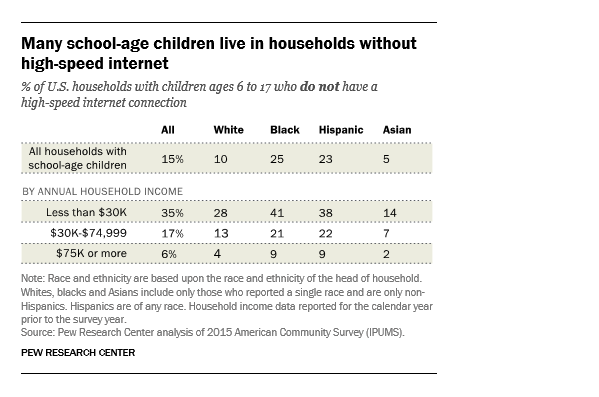
Even before the current pandemic forced the nation’s schools to implement remote learning, the homework gap reinforced educational inequities for the approximately 16 million students who lack broadband access at home.6 Students who live in households without an adequate home internet connection are unable to complete homework that requires online access. This is particularly problematic since seven in 10 teachers surveyed said that they assign homework that requires internet access, and that number increases as students advance to high school.7
Internet access at home is not merely about homework, though. Students who have access to broadband at home consistently score higher in reading, math, and science than those who do not.8 Students who either do not have home broadband access—or who need to depend entirely on mobile broadband—need more time to complete homework and tend to have lower grade point averages, according to a study done by Michigan State University.9 “After controlling for socioeconomic factors, quality of home Internet access has an impact on a range of student performance outcomes,” the study states.10 The study found that “students who do not have access to the Internet from home, or who are dependent on a cell phone alone for access, perform lower on a range of metrics, including digital skills, homework completion, and grade point average.”11 For students who are not able to use the internet at home, that lack of access precludes students’ ability to conduct research for essays and reports, or their ability to read and learn more about personal interests that could grow into academic endeavors or careers.
Other studies have further underscored just how a lack of broadband access at home can harm students, even in non-pandemic times. A Pew Research Center study in 2018 found that 17 percent of teenagers surveyed in the United States reported that they often or sometimes cannot complete homework because of a lack of a reliable computer or internet connection.12 More generally, a 2016 study by the Joan Ganz Cooney Center at Sesame Workshop found that “children without home Internet access are less likely to go online to look up information about things that they are interested in: 35% of those with mobile-only access say they ‘often’ do this, compared to 52% of those with home access.”13
Research released since the pandemic began has detailed the full extent of the homework gap that was already starkly on display when schools closed. A report published by the Alliance for Excellent Education (All4Ed), National Indian Education Association (NIEA), National Urban League (NUL), and UnidosUS found that 16.9 million children—or 8.4 million households—do not have high-speed broadband access at home.14
A separate report from Common Sense Media found that an estimated 15 to 16 million K-12 public school students lack either sufficient broadband access or the devices needed to adequately participate in remote learning—a group that represents 30 percent of the more than 50 million students who needed to learn remotely from home when schools closed in March or April 2020.15 Students in rural areas also lack the broadband connectivity needed for remote learning at higher rates—37 percent of students in rural areas lack access to the broadband needed for online learning compared to 21 percent of students in urban areas.16
As detailed further below, this divide harms historically marginalized communities and low-income households at higher rates. The Pew Research survey found that 25 percent of Black teenagers reported that they at times were unable to finish homework due to these constraints, as did 17 percent of Hispanic teenagers, and 24 percent of teenagers from households making less than $30,000 annually.17 The All4Ed et al. report found that one out of every three Black, Latinx, and American Indian/Alaska Native households do not have high-speed internet access at home.18 According to that report 34.2 percent of American Indian/Alaska Native households with one or more children age 17 or younger lack high-speed broadband at home, as do 31.2 percent of Latinx households, and 30.6 percent of Black households, compared to 20.9 percent of white households.19
Cost plays a central role in the homework gap, as it is arguably the biggest barrier to broadband adoption in the United States. Nearly 45 percent of households with one or more children age 17 or younger and a yearly income of $25,000 or less lack access to high-speed broadband at home, while only 8 percent of those with an annual income of more than $150,000 lack that access.20 Studies such as OTI’s recent Cost of Connectivity 2020 report have consistently shown that relatively high costs and affordability are central to explaining why millions of people in the United States do not have access to high-speed broadband at home.21 A recent survey of low-to-moderate-income families with children ages six to 13 found that “[t]he dominant reason for not being connected at home is financial. . . . 42% of those without home Internet access indicated that cost is the main reason that they do not have it. This is particularly true among families below the poverty level, where half of those without a home computer (53%) or home Internet access (50%) cite money as the main reason.”22
The lack of affordable broadband options exacerbates the racial digital divide: The Department of Education found that 46 percent of Black children and 44 percent of Hispanic children surveyed who reported not having internet access at home did not have it because the service was too expensive, compared to just 28 percent of white children who did not have access.23
The homework gap is particularly harmful when schools and libraries are closed, leaving millions of students without internet access even during the school day. A 2018 report from the National Center for Children in Poverty highlighted that “children are overrepresented among our nation’s poor; they represent 23 percent of the population but comprise 32 percent of all people in poverty. Many more children live in families with incomes just above the poverty threshold.”24
These inequities have wreaked havoc on educators’ ability to teach during the pandemic. Common Sense Media found that in states with the deepest digital divides, half of all students do not have sufficient internet access for remote learning, and that even in states with smaller gaps in connectivity, a quarter of students lack this access.25 Teachers feel this impact as well. An estimated 400,000 teachers are unable to teach from home because of a lack of internet access.26 And in some cases when too many students could not participate in remote learning, schools or teachers gave up on it in favor of distributing packets of worksheets on paper.
Local news outlets and the national media have detailed the impact of the homework gap on pandemic-induced remote learning efforts. Connectivity issues in the San Francisco Bay Area demonstrate that these disparities are severe even in a relatively prosperous and tech-savvy region: The Oakland Public Education Fund reported that about half of Oakland’s 50,000 students lack either a computer or internet access and 14,000 of San Jose’s 36,000 students reportedly also do not have access to digital resources.27 A report from the Mercury News in August described one 15 year old who had internet access so slow that he missed deadlines when his assignments did not upload, a problem that worsened when his sister had class at the same time. The article also highlighted one student whose family could not afford broadband service, forcing him to go to friends’ houses to access the internet despite the pandemic. He told the paper: “I’d rather get a nice education and finish my work instead of my health.” Students are being forced to make impossible choices because of the failure to ensure all Americans are able to access and afford broadband access at home. The failure to provide reliable broadband access to all households has pit public health against students’ education and futures. Even in the nation’s capital, the D.C. public school system estimates that roughly 30 percent of the students do not have broadband access or a computer at home.28
Students in lower-income areas are experiencing the greatest inequities. Students in one Cleveland family had to share one laptop and as the pandemic progressed, reduced income led them to cancel their broadband service to save money and rely on their phone as a hotspot, but they ran out of data quickly. They later paid a neighbor to use their signal, which turned out to be too weak.29 Students cannot be expected to follow along with their online lessons and absorb the material to the fullest extent if they can only barely get online in the first place.
Many students have been connected in areas where a large cable company or other internet service provider (ISP) is offering free or reduced-price basic service for K-12 students in low-income households. A leading example is Comcast’s longstanding Internet Essentials program, which is partnering during the pandemic with many districts to identify and connect eligible students across the country.30 Among mobile carriers, the most ambitious initiative appears to be T-Mobile’s Project 10Million, which offers students in eligible, low-income households in participating schools a free Wi-Fi hotspot and 100 gigabytes of data over a 12-month period.31
While these ISP initiatives can connect many students quickly and often affordably in the context of the COVID-19 crisis, they don’t work for millions more and can be unsustainable long term. The most obvious shortcoming is that the ISPs with the most generous offers, such as Comcast, are only available in certain communities. Millions of student households have no access to any high-capacity internet service, particularly in rural areas. Even if a student is eligible to receive free or discounted service where they live, those offers often come with caveats that often make it difficult for households to actually establish or maintain service. For example, households with a previously unpaid balance or poor credit are typically shut out of these programs.32 The offers, particularly those using mobile networks, often limit the bandwidth students can consume without paying for a higher tier of service. For example, the T-Mobile 10Million offering noted just above is limited to 100 GB of data per year, which the company says is enough for 320 hours of online learning.33 These offers are also time-limited and rely on the good will of private companies and/or the ability of local school districts to help fund the ongoing monthly costs.
B. The Homework Gap is Harming Students’ Education, Especially During the Pandemic

The negative impacts of the homework gap on students’ ability to learn has been greatly exacerbated due to coronavirus school closures, inflicting long-lasting educational disadvantages and inequities. For some students, such as those applying to college, or for others who are at crucial stages of their educational careers, this disruption could be particularly harmful to their futures. A recent study published by the Organization for Economic Cooperation and Development (OECD) examined the problem of lost learning and its economic impact. The study projected that if schools in the United States stay out of the building for a full year (e.g., until March 2021), students could face a 9.1 percent loss in lifetime earnings due to “suffering cognitive learning losses typical of different proportions of the school year.”34
A McKinsey analysis estimated that even if students return to traditional in-person class as it was taught pre-pandemic in January 2021 (which is unlikely in many areas given the current trajectory of COVID-19 in the United States), students with “low-quality remote learning” would have lost at least seven months of learning, and those with no instruction would fall at least a school year behind under that scenario.35 The McKinsey study projected that learning loss would be much worse for Black, Hispanic, and low-income students—and that the subsequent lag in learning and increase in dropout rates would drastically harm students’ financial futures as well as the nation’s gross domestic product (GDP).36 The OECD report notes that if the United States loses two-thirds of a year in classroom learning, it would reduce long-term U.S. GDP by nearly $28 billion.37
When the share of students without internet access is high, as it is in very low-income areas, it often harms all students, even those with high-speed broadband at home. Districts across the country have grappled with the reality that so many students lack reliable broadband connections at home that schools are forced to offer everyone an alternative set of lessons, typically on paper. After the spring 2020 shutdowns, many schools in low-income areas decided it would be both inequitable and infeasible for teachers to run two parallel instruction programs for students depending on whether their family had internet access at home.
In the Detroit Public Schools Community District, which teaches 51,000 students that live in high poverty, around 90 percent of students lacked home broadband access at the beginning of the pandemic. As a result, teachers resorted to distributing paper packets with lessons to conduct remote learning.38 That deprives all students of interaction and feedback. An elementary school near Pittsburgh conducted lessons over the radio since most families had access to a radio, but not necessarily a computer and home internet.39 Teachers in low-connectivity areas across the country typically sent home paper packets and tried to individually answer questions and help students over the phone.40
C. The E-Rate Program Could Mitigate the Problem—But the FCC has Refused to Act
During the coronavirus crisis, homes have become classrooms for most U.S. students. As noted above, in the spring of 2020 nearly every school shut down, impacting more than 55 million students; and as the new school year began, 76 percent of all school districts began the 2020–2021 school year relying on remote learning exclusively (49 percent) or partially (27 percent).41 Unfortunately, even before the crisis, approximately 15 to 16 million K-12 students, as many as 30 percent of all students, lacked the broadband internet access or devices needed to engage in remote learning at home.42 At the outset of the pandemic, the National Center for Education Statistics (NCES) estimated that 14 percent of school-age children lacked internet access at home and 9 million K-12 students faced difficulty completing assignments online or participating in remote learning.43
FCC inaction on E-Rate since March 2020 meant that the millions of students who could have been connected to remote learning from home remained disconnected as the new 2020–2021 school year began. The FCC could be doing far more to connect these temporary home classrooms to schools’ online educational resources with internet access. The commission could allocate as much as $2 billion in additional E-Rate funding on an emergency basis and could also waive restrictions on the use of E-Rate-funded facilities to extend school or library connectivity to students off campus for educational purposes. These two separate measures should be straightforward and non-controversial steps to take in the context of the pandemic.
One fast and relatively low-cost way to get students online is to fund “hotspots” (personal Wi-Fi routers known as MiFi devices) served by established wireless carriers—predominantly cellular mobile carriers, but also potentially by fixed wireless and satellite ISPs. Hotspots could be distributed efficiently through schools and libraries already receiving support through the FCC’s E-Rate program. Many districts are using coronavirus relief funding and donations to purchase and loan out mobile hot-spot devices as a stop-gap, but both funding and the availability of MiFi-type devices are inadequate.
School districts also need the flexibility to use E-Rate funds and E-Rate-funded facilities to leverage innovative and proven solutions, including the use of school buses as Wi-Fi hotspots,44 locating Wi-Fi access points in public housing and other locations,45 extending the reach of the school’s own network using a rooftop transmitter and unlicensed spectrum,46 and building out community Wi-Fi and other local wireless networks that cover even more students. These innovative solutions are described in the next section. The FCC can readily waive current E-Rate restrictions and grant that flexibility.
There is considerable and diverse support for FCC action to tap funds from the agency’s USF to support local school district initiatives to connect students in their home-schooling classrooms. The Schools Health & Libraries Broadband (SHLB) Coalition suggested at the inception of the school-closure crisis that the “FCC could make emergency funding available from the USF for hot spot lending programs operated by schools, libraries, and other community organizations in areas where schools and libraries close.”47 The USTelecom Association (USTA), a major ISP trade association, similarly recommended that the commission use its available authority to “allow schools to apply for funding to purchase wired or wireless broadband connectivity on behalf of students and/or teachers that do not currently have broadband access from home during the COVID-19 pandemic."48
In March 2020, 16 U.S. senators called on the FCC to use $2 billion in emergency E-Rate funding to help schools buy Wi-Fi hotspots to distribute to students lacking adequate connectivity, an idea endorsed by the nation’s most prominent associations of principals, teachers, and school technologists.49 There is at least $2 billion in money immediately available within USF for E-Rate that does not require action from Congress to act. These funds are derived from the combination of $1 billion in carry-forward funding and that total demand for funds was $1.2 billion below the E-Rate funding cap of $4.15 billion for 2019.50
The March 2020 letter from 16 U.S. senators, led by the legislative author of E-Rate, Sen. Edward J. Markey (D-Mass.), similarly stated: “We believe that the FCC can use its emergency powers to temporarily waive relevant E-rate program rules and allow its beneficiaries to utilize universal service funding to provide home wireless service to existing school devices and hotspots for students who lack internet access at home.”51 In September 2020, 38 U.S. senators reiterated their belief the FCC had all the authority it needed to expand funding and flexibility to address the homework gap in the context of the COVID-19 crisis.52 The senators also noted that the U.S. Department of the Interior “similarly requested that the FCC update its interpretation of what constitutes a school campus under the E-Rate program in order to allow funding to support virtual classrooms.”53
More broadly, advocates for mitigating the homework gap called on the FCC to waive restrictions on current E-Rate funding so that schools have the flexibility to decide how best to meet the connectivity needs of their students and teachers. In April 2020, OTI filed an “Emergency Request” at the FCC that described in detail why the agency had the authority to both increase E-Rate funding and to waive restrictions on using E-Rate funds and E-Rate-funded facilities to connect students at home and wherever needed.54 In September 2020, the State of Colorado filed a formal Petition for Waiver similarly asking the FCC for an “emergency waiver of current restrictions on the use of E-Rate funds and E-Rate-funded facilities to allow schools to extend their broadband network connectivity to students’ homes, or other safe and convenient community access points.”55
The commission should also waive many of E-Rate’s cumbersome application procedures and instead define eligibility and authorize reimbursements to schools and libraries that purchase and loan the necessary equipment (e.g. hotspots), as well as for the cost of ISP services.56 A maximum reimbursement per eligible household should also be established. To multiply the impact, the FCC, schools, and local officials should solicit commitments from participating ISPs to provide service at no cost or at a deep wholesale discount. E-Rate competitive bidding restrictions should also be waived temporarily during the crisis so that orders for hotspots and wholesale agreements for ISP connectivity can be completed as expeditiously as possible.
The FCC Has the Legal Authority to Designate an Emergency Set Aside of New USF Funding to Connect Students Lacking Broadband Internet Service
The FCC should be actively helping schools as they shoulder the Herculean task of solving a digital divide that decades of inaction from policymakers allowed to fester. Instead, the agency has taken no action and offered no formal decision stating its views. Opponents of expanding E-Rate rely on the objection that the advanced telecommunications services for education described in one provision of the Communications Act refers to “public and nonprofit elementary and secondary school classrooms.”57 In a letter responding to Sen. Amy Klobuchar (D-Minn.), Chairman Pai expressed his belief that the Act "expressly limits the FCC's use of E-Rate program funding to broadband and other services delivered to school classrooms and libraries. Connectivity and devices supplied to students at home unfortunately do not qualify for E-Rate support under the law."58
However, as OTI’s Emergency Request and the State of Colorado’s Petition for Waiver both explain in detail, a single reference to classrooms in the provisions authorizing E-Rate is not a persuasive reason to ignore all the other statutory provisions and FCC precedents that support FCC authority. More essentially, in the context of the COVID-19 crisis, homes are very often the only classrooms available while schools are closed. Many educators view “Zoom rooms” and the online sessions provided by Webex, Google Meets, and Microsoft Teams as the new equivalent of classrooms since that is where lessons are actually taking place.
Chairman Pai’s assumption that the FCC is powerless to use E-Rate to mitigate the homework gap is mistaken based on both a fair reading of the statute and FCC precedent. First, the commission has the authority to respond to widespread school closures by designating a new emergency category of E-Rate funding that prioritizes internet access for remote learning where student’s lack broadband at home. Section 254 of the Communications Act requires the FCC to oversee the USF based on a set of “universal service principles” that include “[a]ccess to advanced telecommunications services for schools, health care, and libraries.” As the FCC recognized in its 2014 E-Rate Order, multiple sections of the Communications Act “collectively grant the Commission broad and flexible authority to set the list of services that will be supported for eligible schools and libraries, as well as to design the specific mechanisms of support.”59 Section 254(c)(1)(A) requires the commission, in designating supported services, to consider the extent to which services “are essential to education, public health, or public safety”60 and “consistent with the public interest, convenience, and necessity.”61
In addition, the Communications Act explicitly gives the Commission discretion to add “special services” for schools from time to time, as needed. Section 254(c)(3) states:
In addition to the services included in the definition of universal service under paragraph (1), the Commission may designate additional services for such support mechanisms for schools, libraries, and health care providers for the purposes of subsection (h).
This authority reflects a recognition by Congress that the technology needs of schools and libraries are constantly evolving in light of “advances in telecommunications and information technologies and services.”62 Moreover, Congress gave the FCC “specific authority to alter the definition [of services] from time to time, and to provide a different definition for schools, libraries, and health care facilities.”63 Certainly, during this period of school closures, there are few things more “essential to education” than broadband internet access for students and teachers.
Moreover, the need to fund equipment or services that extend broadband to students where they are learning, such as Wi-Fi hotspot connectivity, is further supported by Section 254(h)(2)(A). The statute directs the commission to “enhance, to the extent technically feasible and economically reasonable, access to advanced telecommunications and information services” for schools and libraries.64 Although the commission has long maintained that Section 254’s focus on access to services precludes funding for end-user devices, such as laptops,65 Wi-Fi-enabled hotspots represent network equipment and perform the same function as Wi-Fi routers and other internal connections that distribute wireless broadband connectivity to students and teachers in a school.
Importantly, as the State of Colorado’s Petition for Waiver emphasized, in April the FCC embraced this same authority, under the same statutory provision, to extend funding and flexibility for USF telehealth services to rural patients and veterans at home. In its Report and Order creating a new $100 million Connected Care Pilot Program, the FCC clearly concluded it has the statutory authority under the same Section 254(h)(2)(A)—which applies to schools, libraries, and health care providers—to create a discrete new category of USF support dedicated to “funding health care provider purchase of broadband Internet access service for participating patients,” particularly low-income patients and veterans in rural areas.66 The Order described the goal of extending connectivity to reach patients where they are with these services, which apply equally to schools attempting to extend essential education services to students the home:
For the Pilot Program, funding patient broadband Internet access services would expand health care providers’ digital footprints for purposes of providing connected care services and allow health care providers to serve more eligible low-income patients and veterans through the Pilot Program and, thus, enhance health care providers’ access to “advanced telecommunications and information services.”67
The Commission defends its conclusion by arguing it previously determined it has “broad discretion regarding how to fulfill this statutory mandate” under section 254(h)(2)(A).68 The Order also relies on the fact that “the costs of broadband Internet access service for patient use in their homes or mobile locations, . . . are an obstacle for certain health care providers and their patients to adopt connected care services.”69 To remedy this obstacle, the Order concludes that enhancing program services to extend its reach to patients lacking connectivity represents an “advancement of universal service [based] on the principles outlined in section 254(b) of the Act.”70
These circumstances are as true for students and teachers needing home internet access for education as they are for telehealth patients in the Connected Care Pilot Program. If the FCC can adopt these measures for rural telehealth, it should certainly take this opportunity to do so for connected learning as well. Additionally, the telehealth pilot program is not limited to the duration of the pandemic, but designed to continue for three years. Like home-schooling classrooms, while the need for this program is greatest now, the commission is certainly correct that the ability of advanced telecommunications to extend the benefits of USF-supported services to locations where they are most needed advances the congressional goals of universal service set out in Section 254.
The Order notes further that relying on Section 254(h)(2)(A) “also ensures that the pilot program is health care provider-driven and enables participating health care providers to select from the broadest range of broadband Internet access service providers to meet the health care needs of participating patients.”71 Similarly, in the case of E-Rate, funding to extend services to students and teachers off campus should be school-driven and give schools the flexibility to select the ISP that is most cost-effective and appropriate to their needs.
The Commission Should Waive Restrictions on the Use of E-Rate Funded Facilities to Extend Connectivity Off Campus for Educational Purposes
Even in the absence of an emergency increase in USF or E-Rate program funding, the Commission could go further to encourage schools and libraries to expand internet access for unconnected students and teachers at home or in public places. OTI’s Emergency Request, the State of Colorado’s Petition for Waiver, the SHLB Coalition, and other parties have all demonstrated that the FCC has the authority to waive any restrictions on the ability of schools to use their current E-Rate funding or E-Rate-funded facilities (e.g., fiber optic and other high-capacity connections to the internet, known as backhaul) to connect students at home or at community access points. As former Florida Governor Jeb Bush wrote recently: “Done right, we see now that virtual classrooms can be an effective approach to teaching our kids whether in the pandemic or as an enhancement to classroom education.”72
Unfortunately, under current E-Rate rules, while the general public can use Wi-Fi networks funded by E-Rate on school property,73 schools and libraries do not have the flexibility to use E-Rate funds to extend those networks to students and teachers lacking adequate internet access at home. Existing rules require schools to allocate a share of the cost of E-Rate supported networks or devices used off school property so that E-Rate funds are not used. This is a cumbersome and costly deterrent for schools and districts with the greatest need that also prohibits E-Rate funding for home-school hotspots.74 Denying schools flexibility to use E-Rate funds based on local circumstances and needs imposes the sort of “Washington knows best” approach that many advocates for deregulation often deride. As Chairman Pai stated in his dissent to the 2014 E-Rate Order, which greatly expanded funding designated for in-school Wi-Fi, the FCC should “let local communities set their own education-technology priorities… The FCC has no business micromanaging the technology priorities of our local schools and libraries.”75
Students should not have to rely on school or fast food parking lots to do their homework, especially in cases where the school (or library) could extend network services to reach them at home, at a community center, or other safer and/or more convenient locations. Connectivity at the home is always necessary for students to learn, but this is particularly true during a pandemic. Schools and libraries should have the flexibility to adopt the sort of remedial connectivity strategies described in the sections below. These include allowing schools to purchase and loan Wi-Fi hotspot connectivity to students at home, or in public locations (such as school-bus hotspots in parks and access points in public housing), or to use TV White Spaces (TVWS) and other advanced wireless technologies to extend the reach of the school’s network to connect students off campus.76
The Commission acknowledged that it has the authority to give school districts this flexibility when it adopted the E-Rate Deployed Ubiquitously (EDU) Pilot Program in 2011. The order “authorize[d] up to $10 million for funding year 2011 to support innovative and interactive off-premise wireless device connectivity for schools and libraries.”77 At the time it adopted the EDU Pilot Program, the FCC never questioned its authority to allow E-Rate funding for wireless internet access for students and teachers, provided it served primarily “educational purposes” that met the E-Rate standard of “activities that are integral, immediate, and proximate to the education of students.”78 The order discussed how even by 2010, teaching and learning had evolved in ways that made access to online learning resources outside the school more and more important: “Advances in technology have enabled students to continue to learn well after the school bell rings, including from their homes or other locations, for example, youth centers.”79 The Commission further stated that comments received in response to the National Broadband Plan “generally agreed that students need to learn ‘anytime/anywhere,’ which would require Internet access outside schools and libraries.”80 The FCC’s description of modern education as of last decade is even more applicable to 2020 even prior to the pandemic that forced learning online.
The FCC has also modernized the E-Rate program more recently, allowing school districts to enhance the functionality of their broadband networks to reflect the realities of student and teacher needs. The E-Rate program now has two categories of funding: Category One, which subsidizes a high-capacity internet connection to the school; and Category Two, which can be used to extend the school’s network internally and even outdoors on school property, using Wi-Fi and other internal connections.81 In 2014 the FCC updated its funding rules to expand Category Two for the explicit purpose of using Wi-Fi routers to extend the reach and utility of the school’s internet connection throughout the school.82 Schools now routinely rely on Category Two funding to extend connectivity to every student, teacher, and location where it is useful, including outdoors on playing fields where students could use connectivity to do homework. That change magnified the value of E-Rate’s traditional Category One funding for high-capacity connections to the school building.83
Extending the reach of school network connectivity to students or teachers off campus is conceptually no different than adding Wi-Fi access points to extend access within a school, or between buildings on a school campus, to reach more classrooms, students, and teachers at the location where the network can best serve the school’s educational purpose. Functionally, the use of TVWS or other wireless technology to transmit internet access to students at home, or at a community center, is equivalent to a wireless extension cord.
Finally, even if more data and a broader pilot program is needed to inform a permanent change in the E-Rate rules, a temporary authorization of the use of E-Rate funds (or E-Rate funded facilities) for off-campus educational connectivity during the COVID-19 pandemic would both provide suffering communities across the country with immediate relief and offer an opportunity to analyze the long-term possibilities of a similar pilot program to that of 2011.
Citations
- “Map: Coronavirus and School Closures in 2019-2020,” Education Week (last updated May Sept. 16, 2020), available at source.
- For more on the distinctions between remote or distance learning, online learning, and hybrid or blended learning, see the report published in May 2020 by New America’s Education Policy Program, Pandemic Planning for Distance Learning: Scenarios and Considerations for PreK-12 Education Leaders, available at source.
- “School Districts’ Reopening Plans: A Snapshot,” Education Week (updated Sept. 23, 2020), available at source.
- Letter From Civil Rights Advocates, Inquiry Concerning Deployment of Advanced Telecommunications Capability to All Americans in a Reasonable and Timely Fashion, GN Docket No. 20-269 (Sep. 17, 2020), available at source; Civil Rights Broadband Access Letter, Bridging the Digital Divide for Low-Income Consumers, WC Docket No. 17-287, Establishing the Digital Opportunity Data Collection, WC Docket No. 19-195 (Dec. 19, 2019), available at source.
- Mark Lieberman, “Many Students Still Lack Home Internet, Here’s How Big the Problem Is,” Education Week (Oct. 14,2020), available at source.
- Chandra, S., Chang, A., Day, L., Fazlullah, A., Liu, J., McBride, L., Mudalige, T., Weiss, D., “Closing the K–12 Digital Divide in the Age of Distance Learning,” Common Sense Media and Boston Consulting Group (2020) (“Common Sense Media Report”), available at source.
- Sean Cavanagh, “Students’ Lack of Home Internet Access Becomes Priority for District Tech Leaders,” EdWeek Market Brief (Feb. 19, 2016), source; Alia Wong, “Why Millions of Teens Can't Finish Their Homework,” The Atlantic (Oct. 30, 2018), source (“One federal survey found that 70 percent of American teachers assign homework that needs to be done online; 90 percent of high schoolers say they have to do internet-based homework at least a few times a month. Nearly half of all students say they get such assignments daily or almost daily.”).
- Angelina KewalRamani et al., “Student Access to Digital Learning Resources Outside of the Classroom,” National Center for Education Statistics (April 2018), available at source.
- Hampton, K. N., Fernandez, L., Robertson, C. T., & Bauer, J. M., Broadband and Student Performance Gaps, James H. and Mary B. Quello Center, Michigan State University (March 2020), available at source.
- Id. at 5.
- Id. at 5.
- Monica Anderson and Andrew Perrin, Nearly one-in-five teens can’t always finish their homework because of the digital divide, Pew Research Center (Oct. 26, 2018) (“Pew Research Survey”), source.
- Victoria Rideout and Vikki S. Katz, Opportunity for All? Technology and Learning in Lower-Income Families, The Joan Ganz Cooney Center at Sesame Workshop (Winter 2016) (“Opportunity for All Report”), available at source.
- John B. Horrigan, “Students of Color Caught in the Homework Gap,” Alliance for Excellent Education (All4Ed) et al. (July 2020) (“FutureReady Report”), source.
- Common Sense Media Report, supra note 8.
- Id. at 3.
- Pew Research Survey, supra note 14.
- FutureReady Report, at 1.
- Id. at 2.
- Id. at 2.
- Becky Chao and Claire Park, “The Cost of Connectivity 2020,” New America’s Open Technology Institute (July 15, 2020), source.
- Opportunity for All Report, supra note 15, at 14.
- “Student Access to Digital Learning Resources Outside of the Classroom,” U.S. Department of Education, Institute of Education Sciences, National Center for Education Statistics (Apr. 2018), source.
- Heather Koball and Yang Jiang, “Basic Facts about Low-Income Children,” National Center for Children in Poverty (Jan. 2018), source.
- Id. at 3.
- Ibid.
- Daniel Wu, “Coronavirus shutdowns expose low-income Bay Area students’ struggle to get online,” The Mercury News (Aug. 3, 2020), source.
- Perry Stein, “As D.C. students struggle to get online, schools and parents rush to fill the void,” The Washington Post (April 7, 2020), source.
- Moriah Balingit, “‘A national crisis’: As coronavirus forces many schools online this fall, millions of disconnected students are being left behind,” The Washington Post (Aug. 16, 2020), source.
- See, e.g., “Comcast Launches New Internet Essentials Programs as Nation Gears Up for the Academic Year,” Comcast (Aug 13, 2020), available at source.
- See T-Mobile, Project 10Million, available at source.
- Ibid.; Alia Malik, “Digital divide suddenly wider,” San Antonio Express-News (March 22, 2020), source.
- Ibid.
- Eric A. Hanushek Ludger Woessmann, “The Economic Impacts of Learning Losses,” Organisation for Economic Co-operation and Development (Sep. 2020), source at 8 (“OECD Report”).
- Emma Dorn et al., “COVID-19 and student learning in the United States: The hurt could last a lifetime,” McKinsey & Company (June 1, 2020), source.
- Ibid. Another study by the Annenberg Institute at Brown University estimated that as students return to school for the 2020–2021 year they will have already lost anywhere from 32 to 37 percent of their otherwise projected learning in reading and between 50 to 63 percent of their advances in math. Kuhfeld, Megan, James Soland, et al., “Projecting the potential impacts of COVID-19 school closures on academic achievement,” EdWorkingPaper: 20-226, Annenberg Institute at Brown University (2020), available at source.
- OECD Report at 11.
- Valerie Strauss, “Coronavirus pandemic shines light on deep digital divide in U.S. amid efforts to narrow it,” The Washington Post (April 29, 2020), source.
- Kris B. Mamula and Alexandra Wimley, “Lessons on the radio, in the parking lot,” The Pittsburgh Post-Gazette (May 5, 2020), source.
- See e.g. Tony Romm, “‘It shouldn’t take a pandemic’: Coronavirus exposes Internet inequality among U.S. students as schools close their doors,” The Washington Post (March 16, 2020), source (“Many of the roughly 136,500 students in Prince George’s County, Md., likely have some way to get online at home. But local officials last week said they still came to the conclusion they couldn’t ensure all of them did — so the district couldn’t shift classes fully to the Web starting Monday, when state schools close for the next two weeks. Instead, district educators have put together packets of instructional materials.”).
- “School Districts’ Reopening Plans: A Snapshot,” Education Week (Sept. 23, 2020), available at source.
- Common Sense Media Report, supra note 8, at 6.
- See USA FACTS, “Children don’t have consistent access to computers for online learning during the pandemic” (April 6, 2020). In 2018 the Department of Commerce estimated that at least 7 million K-12 students lived in homes without internet access. Rafi Goldberg, “Digital Divide Among School-Age Children Narrows, but Millions Still Lack Internet Connections,” NTIA Blog (Dec. 11, 2018), available at source. See also “America’s Digital Divide,” U.S. Congress Joint Economic Committee (Sept. 2017) (estimating 12 million children live in homes without internet access), source.
- Some districts are parking school buses equipped with Wi-Fi hotspots in parks and parking lots where students can safety (if not always conveniently) get internet access. See, e.g., Lee V. Gaines, “While Schools Are Closed, Illinois District Uses Buses As Wi-Fi Hotspots,” Illinois Public Media (March 19, 2020), source; Allie Kirkman, “Where South Bend students can find buses with free access to Wi-Fi,” South Bend Tribune (March 18, 2020), source; Carter Evans, “Calif. school district puts Wi-Fi on wheels to close digital divide,” CBS News (April 6, 2016), source.
- Michelle R. Davis, “District Extends Wi-Fi to Students in Public Housing,” Education Week (April 13, 2015) (Kent, Washington, school district deployed nine Wi-Fi kiosks in three community centers at public housing projects and donated hotspots outside six district schools in poor neighborhoods), source.
- In response to the ongoing homework gap, two districts in southern Virginia used unlicensed TV White Space frequencies to extend internet access from schools to students within range who lacked broadband access at home. See Ex Parte of Microsoft, ET Docket No. 20-36, CC Docket No. 02-6, WC Docket No. 10-90, WC Docket No. 13-184, WT Docket No. 18- 353 (March 17, 2020) at 1-2.
- Letter from John Windhausen, Executive Director, Schools Health & Libraries Broadband (SHLB) Coalition, at 5 (March 17, 2020).
- Letter from Jonathan Spalter, President & CEO, US Telecom—The Broadband Association, at 5 (March 27, 2020), source. USTA further recommended that the FCC “support the purchase of, and distribution to students and/or teachers that do not currently have access at home, devices such as laptop computers, tablet computers, hotspots, smartphones or similar devices capable of connecting to mobile broadband internet access service, either by receiving such service directly or through the use of Wi-Fi, as well as applications that protect students from accessing inappropriate content to support e-learning outside of the school premise during the COVID-19 pandemic.”
- Letter from Senators Edward J. Markey, Brian Schatz, Michael Bennet, et al., to Chairman Ajit Pai (March 16, 2020) (“Letter from 16 Senators”), available at source. Commissioner Jessica Rosenworcel, in her March 2020 FCC monthly meeting statement, noted support for emergency E-Rate funding for hotspots by AASA—the Superintendents Association, the American Federation of Teachers, the American Library Association, the Association of Educational Service Agencies, the Association of School Business Officials International, CoSN—the Consortium for School Networking, the Council of Chief State School Officers, the International Society for Technology in Education, the National Association of Elementary School Principals, the National Association of Independents Schools, the National Association of Secondary School Principals, the National Association of State Boards of Education, the National Catholic Education Association, the National Education Association, the National PTA, the National Rural Education Advocacy Consortium, the National Rural Education Association, the National School Boards Association, State Educational Technology Directors Association, the United States Conference of Catholic Bishops, and many other organizations.” Statement of Commissioner Jessica Rosenworcel on Agenda Meeting (March 31, 2020).
- Public Notice, “Wireline Competition Bureau Directs USAC to Fully Fund Eligible Category One and Category Two E-Rate Requests,” CC Docket No. 02-6, at 1 (July 17, 2019), available at source. E-Rate appears to continue to have this level of budget availability for the current 2020 budget year that began July 1, 2020. See FCC Wireline Competition Bureau, Order, Schools and Libraries Universal Service Support Mechanism, CC Docket No. 02-6 (Sept. 16, 2020) (“During the [2020 application] window, USAC received 38,207 applications requesting $2.91 billion in discounts for eligible services.”).
- Letter from 16 Senators, supra.
- Letter from Senators Edward J. Markey, Charles E. Schumer, Maria Cantwell, et al., to Chairman Ajit Pai (Sept. 17, 2020) (“Letter from 38 Senators”), available at source.
- Ibid.
- See Emergency E-Rate Letter, New America’s Open Technology Institute, WC Docket Nos. 02-6, at 9-11 (Apr. 8, 2020), available at source.
- Petition for Waiver on behalf of The State of Colorado, Attorney General Philip J. Weiser, Modernizing the E-Rate Program for Schools and Libraries, WC Docket No. 13-184 (Sept. 2, 2020) (“Colorado Petition”), at 1.
- To obtain E-Rate support, an applicant must comply with the Commission’s competitive bidding rules, enter into an agreement with a service provider, and then file an FCC Form 471 with USAC to request E-Rate discounts for the purchase of the services. See 47 CFR § 54.503.
- 47 U.S.C. § 254(h)(2)(A) (emphasis added).
- See Response of FCC Chairman Ajit Pai to Sen. Amy Klobuchar (June 22, 2020) (“the Communications Act . . . expressly limits the FCC's use of E-Rate program funding to broadband and other services delivered to school ‘classrooms’”), available at source.
- Report and Order, Modernizing the E-Rate Program for Schools and Libraries, WC Docket 13-184, at ¶ 67 (rel. July 23, 2014) (“2014 E-Rate Order”), citing 47 U.S.C. §§ 254(c)(1), 254(c)(3), 254(h)(1)(B), 254(h)(2), Telecommunications Act of 1996, Pub. L. No. 104-104, 110 Stat. 56 (1996).
- Id. at ¶ 73, citing 47 U.S.C. § 254(c)(1)(A).
- 47 U.S.C. § 254(c)(1)(D). See State of Colorado Petition, supra, at 4.
- 47 U.S.C. § 254(c)(1).
- Joint Explanatory Statement of the Committee of Conference, Telecommunications Act of 1996, Report 104-458, 110 Stat. 56, 104th Cong., 2d Sess. at 131 (Jan. 31, 1996), available at source.
- See 47 U.S.C. §§ 254(h)(1)(b) and 254(h)(2)(A) (emphasis added); 2014 E-Rate Modernization Order at ¶ 69. See also Texas Office of Public Utility Counsel v. FCC, 183 F.3d at 444 (the Commission’s “primary directive is to ‘enhance access to advanced telecommunications and information services’ for schools and libraries”).
- See, e.g., Modernizing the E-rate Program for Schools and Libraries, Order, 33 FCC Rcd 11219, 11231, Appendix B, Eligible Service List for Funding Year (WCB 2018) (“Examples of items that are ineligible components of Internet access services include applications . . . and end-user devices and equipment such as computers, laptops, and tablets.”).
- Report and Order, In the Matter of Promoting Telehealth for Low-Income Consumers, WC Docket No. 18-213, WC Docket No. 20-89 (rel. April 2, 2020), at ¶ 88 (emphasis added).
- Ibid (emphasis added).
- Id. at ¶ 90.
- Ibid.
- Id. at ¶ 91. For support, the Order cites to a Lifeline pilot and states: “In 2012, the Commission previously relied in part on the universal service principles in section 254(b) to establish a limited duration pilot program to explore how USF funding could increase broadband adoption among Lifeline consumers. See Lifeline Link Up Reform and Modernization, Report and Order and Further Notice of Proposed Rulemaking, 27 FCC Rcd 6656, 6797, paras. 328-330 (2012).” Id. at ¶ 91, n. 352.
- Ibid.
- Jeb Bush, “Broadband Internet is an Imperative, Not a Luxury,” Slate (Oct. 2, 2020), available at source.
- Schools and libraries “are permitted to allow the public to access E-Rate funded services even when they are closed to the public due to the coronavirus pandemic.” Public Notice, “Wireline Competition Bureau Confirms that Community Use of E-Rate Supported Wi-Fi Networks is Permitted During School and Library Closures Due to Covid-19 Pandemic,” WC Dockets 02-6, 13-184 (March 23, 2020). The Commission adopted this off-hours, community-use exception in its Sixth E-Rate Report & Order in 2010. See Sixth E-Rate Report and Order, at ¶¶ 25-26.
- Government Accountability Office, “FCC Should Assess Making Off-School Premises Access Eligible for Additional Federal Support” (July 2019) at 23 (“School districts we met with said that existing E-Rate program rules that require cost-allocation . . . limit their ability to address the homework gap and providing off-premises access remains a challenge for schools and school districts.”) (“GAO Report”). Id. at 27-28.
- Dissenting Statement of Commissioner Ajit Pai, 2014 E-Rate Order, WC Docket No. 13-184, at 170, 172.
- A Petition for Rulemaking, filed by several school districts and Microsoft in 2016, requested a waiver or clarification allowing schools to extend internet access from the school’s E-Rate supported network to students without connectivity using TV White Space and other wireless technologies. The Petition received widespread support. It remains pending. See Joint Petition for Clarification or, in the Alternative, Waiver by Microsoft Corporation, Charlotte and Halifax County Public Schools, et al., WC Docket 13-184 (March 22, 2016) (“TV White Space E-Rate Petition”).
- Sixth E-Rate Report & Order ¶ 46.
- Id. at ¶ 20. See 47 C.F.R. §54.500(b).
- Id. at ¶ 42. The Order further stated: “We recognize the benefits of enabling innovation in learning outside the boundaries of the school building and the traditional school day, as well as of enabling libraries to innovate with new models of delivering service to library patrons. We note the potential for meaningful gains in student achievement that new devices and applications may deliver. We also see significant utility in devices that allow remote access to the Internet for library patrons.” Id. at ¶ 43.
- Id. at ¶ 42.
- According to the FCC: “Funding may be requested under two categories of service: category one services to a school or library (telecommunications, telecommunications services and Internet access), and category two services that deliver Internet access within schools and libraries (internal connections, basic maintenance of internal connections, and managed internal broadband services). Discounts for support depend on the level of poverty and whether the school or library is located in an urban or rural area. The discounts range from 20 percent to 90 percent of the costs of eligible services. E-rate program funding is based on demand up to an annual Commission-established cap of $4.15 billion.” FCC, “E-Rate—Schools & Libraries USF Program,” available at source.
- Modernizing the E-Rate Program for Schools and Libraries, Second Report and Order and Order on Reconsideration, 29 FCCRcd 15538 (2014).
- See Comments of New America’s Open Technology Institute, Center for Rural Strategies, National Hispanic Media Coalition, Public Knowledge, X-Lab, and United Church of Christ OC, Inc., WC Docket No. 13-184, WC Docket No. 10-90, CC Docket No. 02-6 (Nov. 3, 2016) at 2.