Mass Incarceration in the U.S.

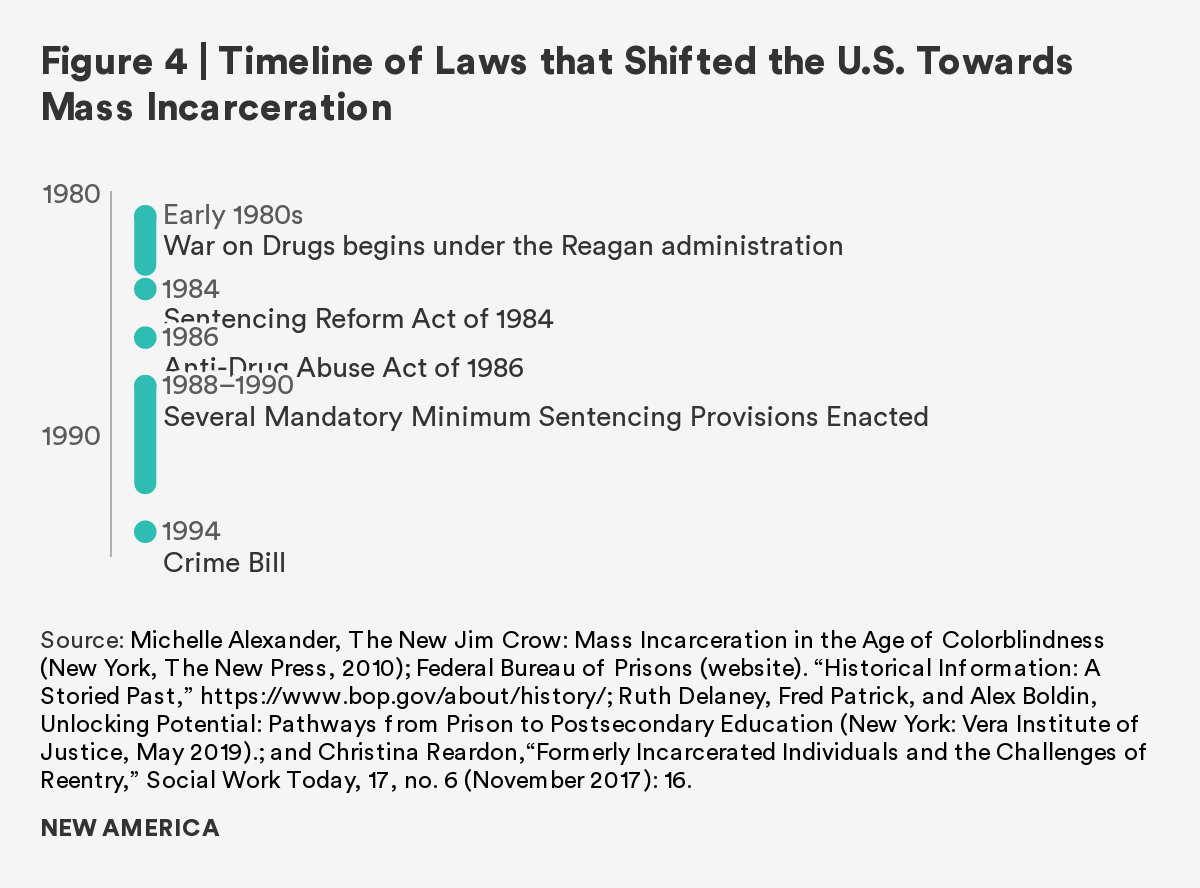
The United States has the largest population of incarcerated individuals and the highest imprisonment rate in the world.1 By the end of 2015, approximately 7 million individuals were under supervision of the U.S. adult correctional system (including federal and state prisons, local and county jails, and probation or parole).2 The shift towards mass incarceration in our country began with the Reagan administration’s War on Drugs in the early 1980s and intensified when the Clinton administration imposed longer sentences and tougher sentencing standards for drug offenders.3 As a result, the majority of those incarcerated were and still are charged with non-violent drug convictions. During this era, appropriations for federal law enforcement agencies increased, while funding for federal and state agencies responsible for drug rehabilitation, prevention, education, and economic investments in impoverished communities drastically declined.4

Tougher sentencing laws coupled with a decrease of investments in community rehabilitative services escalated the incarceration rates in America. The 1980s witnessed rising crime rates, racial tensions, and the emergence of cocaine and crack parallel to both federal and state adoption of “tough-on-crime” laws.5 For example, the Sentencing Reform Act of 1984 established consistency for federal offenses with determinate sentencing that narrowed the broad discretion of federal judges, abolished the option for parole for those in federal prisons, and reduced opportunities to earn time off a sentence in exchange for good behavior.6

Congress approved several mandatory minimum sentencing laws during the Reagan and George H. W. Bush administrations.7 The most consequential legislation during the War on Drugs era was the Anti-Drug Abuse Act of 1986, which established minimum sentences for the distribution of cocaine and severe sentences for the distribution of prohibited controlled substances related to marijuana and crack. Legislation in 1988 birthed the substantial lifelong punitive justice system that continues today, enforcing civil penalties for those with drug offenses. In addition, the revisions removed access to federal financial aid for higher education, such as student loans for those convicted of a drug offense.8

A few years later, the crime bill signed by former President Bill Clinton in 1994 maintained the momentum of increased incarceration rates and solidified correctional facilities as punitive institutions by neglecting opportunities for rehabilitation within prisons. This bill also removed incarcerated adults’ eligibility to receive federal financial need-based aid for college.9
In response, funding for construction of new federal and state prisons skyrocketed,10 with more than $16 billion going toward state prison grants and the expansion of state and local police agencies. The Clinton administration witnessed the largest increase of incarceration within federal and state prisons in our nation’s history. Harsh political rhetoric and sentencing laws of “three strikes and you’re out” significantly contributed to this prison explosion.11

The federal laws of the 1980s and 1990s drastically altered sentencing, increasing the number of those in both federal and state prisons to the irreversible result of mass incarceration that we now know today. From 1970 to 2008, the number of people behind bars grew an unprecedented 700 percent.12 Because of these laws, minor low-level infractions were criminalized, resulting in mandatory prison sentences13 with very little correctional programming being offered to rehabilitate individuals.

Mass incarceration has had a devastating economic impact on individuals, especially for racial and ethnic minorities and their families. It has, in fact, been a significant contributor to the racial wealth gap within the United States.14 People of color have been disproportionately affected by mass incarceration, as the leading demographic imprisoned primarily for drug convictions.15 In some states, incarceration rates for Black men are 20 to 50 times greater than for white men.16 Black youth are five to seven times more likely to be convicted compared to white youth.17 Within our nation’s capital, research indicates that three out of every four young Black men will serve some time in prison and the data are even worse in D.C.’s poorest communities.18

Research shows that white men convicted of felonies have less difficulty receiving job offers compared to Black men without a criminal record. And the impact of mass incarceration on future job employment compounds those challenges; formerly incarcerated Black men are the least likely of any other formerly incarcerated demographic to gain employment. Job prospects for formerly incarcerated Black men are even worse when looking for jobs in suburban areas.19

These glaring racial disparities cannot be understood without acknowledging racial prejudices within our country’s criminal justice system. Research shows that all racial/ethnic groups distribute and use prohibited illegal drugs at remarkably similar rates, yet U.S. federal and state prisons are oversaturated with Black and brown drug offenders.20

The devastation of mass incarceration follows justice-involved individuals for the rest of their lives. Federal, state, and local laws confine formerly incarcerated individuals to the margins of society. Finding employment is particularly challenging, from checking the box on employment applications to being denied access for licensure for a range of professions and trades.21 For example, some states prohibit formerly incarcerated individuals from obtaining a professional/trade license in health care or becoming a barber. Because of the difficulties these laws make to successful reentry, many formerly incarcerated individuals are permanently excluded from society, with limited access to participate in the economy. These laws function as an invisible punishment, where their debt to society is never paid.22


“I hope [a college degree] helps getting a job easier. I am sure it helps employers look at us in a different way. I’ve never had a real job, so I hope it helps.”

— currently incarcerated student, June 2019


Congress Weighs In: Higher Education in Prison

The systemic disparities within our nation reproduce inequities as to who can access higher education. For example, racial and ethnic minorities are more likely to be involved with the criminal justice system. This is partially due to punitive K–12 school disciplinary policies that disproportionately punish students of color, deterring them from higher education pathways.23 In addition, inequities of access to quality K–12 educational and economic opportunities act as sorting and sifting mechanisms to determine who is granted access to postsecondary education.24 In the context of prisons, a combination of limited funding, limited space, bureaucratic resistance to modernizing technology, outdated facilities, distant location from educational providers, and political resistance function as powerful socializing forces that exclude incarcerated populations from higher education.

However, the Higher Education Act initially allowed incarcerated adults to be eligible for Pell Grants, the federal government’s primary source of need-based aid for low-income college students. As a result, hundreds of college-in-prison programs emerged across the nation. Some states (like New York, for example) had a college-in-prison program in just about every state correctional facility by the early 1990s.25 By 1993, about 23,000 students in federal and state prisons were supported by the Pell Grant.26 Although these grants impacted a substantial incarcerated population, spending on incarcerated adults eligible for Pell Grants made up less than 1 percent of the financial aid program’s total annual budget.27

Despite the fact that a minute fraction of Pell dollars supported those in prison, a false narrative began to pick up momentum: The Pell Grant for incarcerated individuals was taking away funds from students at traditional college campuses.28 This intense debate led to legislation in 1992, where Pell Grant eligibility was removed for individuals on death row or serving a life sentence without parole.29 Two years later, then-President Clinton signed the Violent Crime Control & Law Enforcement Act of 1994, which prohibited all incarcerated adults in federal and state prisons from receiving Pell Grants.30 The crime bill, short for the Violent Crime Control & Law Enforcement Act of 1994, was the catalyst for dismantling college-in-prison programs, since it removed the main funding source for these programs.31

Violent Crime Control & Law Enforcement Act of 1994

“No basic grant shall be awarded under this subpart to any individual who is incarcerated in any Federal or State penal institution.”

Section 401(b)(8) of the Higher Education Act of 1965 (20 U.S.C. 1070a(b)(8))

The 1994 crime bill amended the Higher Education Act to ban incarcerated adults from receiving Pell Grants to pay for college programs starting on September 13, 1994.32 Furthermore, the bill enforced additional limitations on the amount of federal adult education and vocational funds available for correctional education programs.33 This legislation reinforced the idea of prison as a place of punishment rather than rehabilitation.

Within a year of the crime bill’s passage, participation in college-in-prison programs decreased by 44 percent.34 Part of the reason that the decline was so drastic was that many states quickly followed the federal government’s lead by reducing state funding for correctional postsecondary education.35 Low state appropriations for correctional postsecondary education persist today. A recent review of federal policies and state laws found that many states explicitly prohibit incarcerated adults in state prisons from receiving state financial aid.36 The limited access to college in prisons leave incarcerated adults vulnerable to low-quality, non-credit bearing, and/or non-transferable education from predatory external providers.


“This program was through correspondence education, paper-based. I go through the program [i.e., graduate] but find out the school was not accredited. Before starting this program, there was no process available to us to ensure the school was accredited or the transferability of the degree. …Without internal vigor or family resources to do the research for you, access to this information was non-existent.”

— formerly incarcerated student, May 2019


Research on Correctional Education

Beyond recidivism (the tendency to reoffend), there are limited data on the value of correctional education, especially in terms of return on investment.37 The laser focus on recidivism is problematic, given that re-offenses cannot capture metrics of educational success used for traditional college populations, such as retention rates, graduation rates, and post-college employment. Still, federal and state prisons’ evaluation of correctional programming is limited to the outcome data they have traditionally collected, which is recidivism.

In 2013, an extensive literature review and meta-analysis published by RAND found that correctional education significantly reduces recidivism and improves employment outcomes upon release.38 Other studies focus on societal and individual economic benefits to prison education programs, such as reduction in crime, improved prison culture, psychological well-being, and an increased sense of purpose.39 Nonetheless, there remains a gap in the literature on how higher education affects reentry via increasing incarcerated adults’ skills. A 2013 meta-analysis of studies on correctional educational programs found that only 4 of the 58 existing studies evaluated math and reading skills to measure the effectiveness of correctional educational programming.40

Research suggests that successful reentry for formerly incarcerated adults benefits not only the individuals, but also their families and their communities.41 These studies show that when parents, including incarcerated parents, obtain a postsecondary degree, their children are more likely to complete a college degree as well.42 As one incarcerated student told us, “I’m the first in my family to graduate from high school. But since I’ve been locked up, my daughter dropped out of high school. But now that I have been part of the college [program], now she is telling me she wants to get her GED and then go into nursing. It’s like my second chance is becoming her second chance!” From both empirical research and anecdotal evidence, educational attainment of parents is predictive of the educational attainment of children.

A 2011 report by the Institute for Higher Education Policy (IHEP) of a 50-state survey in 2009–2010 found that only 6 percent of incarcerated individuals were enrolled in postsecondary education at the time and that these programs had extremely low completion rates.43 In speaking with currently and formerly incarcerated students during our prison site visits, we found that low completions were typically attributable to a number of factors. Among other things, some students were released before they could complete their degrees, while others were transferred to other facilities before finishing. Some took a break for personal reasons such as to prepare for parole; and some experienced difficulty managing their college courses with the scheduling of their prison job and/or mandatory programming that some state departments of corrections prioritize. Unfortunately, college programming has not fully translated as a rehabilitative program into the culture of prisons and is often not highly prioritized for those with less than a year to reentry.

Although there are many reasons to explain why some formerly incarcerated adults successfully transition back into society and others do not, limited education and limited skills are key factors. A meta-analysis of a systematic review conducted by RAND (2014) found that correctional education may increase post-release employment for formerly incarcerated adults. The RAND (2014) study found that for those who completed either academic or vocational programs, the odds of obtaining employment were 13 percent higher compared to those who did not.44 A study this year by the Vera Institute of Justice complemented RAND’s work: It predicted that if 50 percent of incarcerated adults who are academically eligible to enroll in postsecondary education actually enrolled, post-release employment for incarcerated adults would increase, on average, by 10 percent.45

Current Landscape of Higher Education & Job Training in Prison

Currently, there is no comprehensive understanding about postsecondary education within U.S. prisons. This is partly due to the dynamic nature of college-in-prison programs and the absence of standardization for implementing correctional college programs. The most recent attempt to document the number of in-prison credit-bearing postsecondary education programs offered by a college or university was conducted by Erin Castro and colleagues in 2018. Their analysis found that a little more than one-third of college-in-prison programs are located in the West, with the remaining programs evenly distributed among the other three regions in the country. They also found that only 4 percent (202) of nearly 5,000 degree-granting institutions within the country provided credit-bearing college courses to at least one U.S. prison. Over half (55 percent) of the existing programs were offered by public two-year colleges.46

Policymakers have become increasingly interested in college access for incarcerated populations. In 2016, the Obama administration reignited the idea of college-in-prison programs with the launch of the Second Chance Pell pilot by selecting 69 U.S. colleges and universities to provide a college education to incarcerated adults through the use of the Pell Grant.47 Defined by the pilot program, these experiments were created “to test whether participation in high quality education programs increases after expanding access to financial aid for incarcerated individuals,” with a “goal of helping them get jobs and supporting their families when they are released.” Under the direction of the U.S. Department of Education, the experiment has been extended for an additional fourth year, for the current 2019–2020 academic year.48 With increased bipartisan support of Second Chance Pell, the likelihood of a legislative solution is growing, with bipartisan legislation recently introduced in both the House and Senate.49

Despite the ban on federal funding and restricted state funding for college programs in correctional facilities, there are college-in-prison programs across the country, about 202 credit-bearing programs as documented by Castro and colleagues. However, there is a wide variation in the type of postsecondary education provided to incarcerated populations. Postsecondary education opportunities may be vocational programming or apprenticeships that could lead to industry-recognized credentials; some others may include credit-bearing courses that lead to a formal degree. Results from the 2013 RAND survey found that 32 states reported that they offered some form of postsecondary education within prisons. These programs include access to college correspondence courses, college-in-prison programs, or online courses. However, many states only fund vocational programs or apprenticeships, with no opportunities to earn an associate degree or beyond.50

Due to the limited access to earn a formal postsecondary degree while incarcerated, many students turn to correspondence education. However, incarcerated students are responsible for paying the costs, and some have raised concerns about the quality of the education.51


“I was taking correspondence classes before and it was just a memory test and I would just forget everything I memorized after I took the test. But with this program [college-in-prison program], I get to interact with teachers and my peers.”

— currently incarcerated student, July 2019


Although correspondence education is an option to access and even go beyond the associate degree for many incarcerated individuals, the programs are not always of high quality or accredited. Correspondence education typically relies on a paper-based curriculum where the school will mail students lessons and students complete course exams from prison.52 However, the qualitative field work we collected for the enclosed report found that when we asked over 50 incarcerated students about their preference for either correspondence or in-person modalities, an overwhelming majority preferred in-person college instruction. One currently incarcerated student we spoke with noted, “Why do correspondence education when every other aspect of our lives is correspondence? We do correspondence with our family and everyone else. I’d rather a teacher come in and take interest in us because it changes our outlook.”

Aside from the Second Chance Pell experiment, incarcerated adults who aspire to pursue higher education are limited to very few options other than paying out of pocket for correspondence courses or being one of the lucky few to be housed in a prison with a privately funded college program (from foundations or donations, state funding, and/or college funds).53 Furthermore, the availability of postsecondary education programs varies between federal and state prisons, as well as within a given state’s prison system based on proximity to educational providers.


“The amount of programming we have here is an anomaly. Not every state prison has this [college] program. If you visit other prisons in the state, it looks very different.”

— currently incarcerated student, July 2019


Across states, there is variation in state financing programs to fund postsecondary education in prisons. For example, the state of California enables community colleges to provide in-person credit and non-credit courses in both prisons and jails at no expense to incarcerated students. North Carolina allocates state appropriations towards funding credit-bearing programs in prisons, but limits institutions to programs that result in an associate of applied science (AAS) degree.54 And many states fund only vocational programs55 with federal funding as a result of the 1994 crime bill, which withdrew Pell Grant eligibility but continued to fund correctional job training programs.56 A federal corrections administrator we spoke with confirmed this paradox, noting that “there is resistance in political will to provide traditional higher education to incarcerated individuals. However, the political will is more so willing to give them an opportunity to take up a trade and become a mechanic as opposed to a lawyer or sociologist.”

For students, practitioners, and government constituents, there are concerns that an associate degree is becoming the final destination in correctional postsecondary education, referred to by currently incarcerated students we spoke with as a glass ceiling.


“From my perspective, it’s furthering my education past an associate's … The negative part is that it’s a “glass ceiling” in the education program. I can’t obtain a bachelor’s degree. That’s the reason I have three associates. That’s the biggest negative about this program.”

— currently incarcerated student, June 2019


Our prison site visits revealed that there is a vast difference in the implementation of correctional job training programs between prisons. Some of the job training programs are affiliated with external vocational education providers and others function as part of the correctional programming. While some correctional job training programs follow the vocational curricula of a community college or trade school, other facilities do not measure comparable learning outcomes or hold programs accountable for their results.

Due to the lack of a standard understanding of correctional job training across federal and state prisons, it is difficult to evaluate its effectiveness on incarcerated populations. Nonetheless a study by RAND (2013) found that participating in vocational/job training programs while incarcerated increased the odds of post-release employment by 28 percent.57 Additional research shows employment after release is 13 percent higher for individuals who participated in either academic or job training programs while incarcerated.58

In spite of the benefits of postsecondary education and job training for incarcerated populations, the majority of those who are released into society are more likely to not have participated in either type of program during incarceration.59

Across the United States, states, higher education institutions, and communities are now reimagining the traditional boundaries to higher education for incarcerated adults and rethinking innovative ways to expand access. These conversations include questions like: How do we better prepare individuals for reentry? What educational opportunities do they need? And how do we keep the educational continuum advancing post-release?60 These questions are important because the majority of incarcerated adults will be released back into the community and will need skills to successfully transition.

Citations
  1. Nation Behind Bars: A Human Rights Solution (New York: Human Rights Watch, 2014), source
  2. Christina Reardon, “Formerly Incarcerated Individuals and the Challenges of Reentry,” Social Work Today 17, no. 6 (November 2017): 16.
  3. Michelle Alexander, The New Jim Crow: Mass Incarceration in the Age of Colorblindness (New York: The New Press, 2010); and Christina Reardon, “Formerly Incarcerated Individuals and the Challenges of Reentry,” Social Work Today 17, no. 6 (November 2017): 16.
  4. Michelle Alexander, The New Jim Crow: Mass Incarceration in the Age of Colorblindness (New York: The New Press, 2010).
  5. Nation Behind Bars: A Human Rights Solution (New York: Human Rights Watch, 2014), source
  6. Federal Bureau of Prisons (website), “Historical Information: A Storied Past,” source
  7. Federal Bureau of Prisons (website), “Historical Information: A Storied Past,” source
  8. Michelle Alexander, The New Jim Crow: Mass Incarceration in the Age of Colorblindness (New York: The New Press, 2010).
  9. Ruth Delaney, Fred Patrick, and Alex Boldin, Unlocking Potential: Pathways from Prison to Postsecondary Education (New York: Vera Institute of Justice, May 2019).
  10. Ruth Delaney, Fred Patrick, and Alex Boldin, Unlocking Potential: Pathways from Prison to Postsecondary Education (New York: Vera Institute of Justice, May 2019).
  11. Michelle Alexander, The New Jim Crow: Mass Incarceration in the Age of Colorblindness (New York: The New Press, 2010).
  12. Ruth Delaney, Fred Patrick, and Alex Boldin, Unlocking Potential: Pathways from Prison to Postsecondary Education (New York: Vera Institute of Justice, May 2019). pp. 2.
  13. Nation Behind Bars: A Human Rights Solution (New York: Human Rights Watch, 2014), source
  14. Abigail Strait and Susan Eaton, Post-Secondary Education for People in Prison, Social Justice Funders Opportunity Brief no. 1 (Waltham, MA: Sillerman Center, 2017), 1–8, source
  15. Christina Reardon, “Formerly Incarcerated Individuals and the Challenges of Reentry,” Social Work Today 17, no. 6 (November 2017): 16; and Beyond the Box: Increasing Access to Higher Education for Justice-Involved Individuals (Washington, DC: U.S. Department of Education, 2016), source
  16. Jamie Fellner, Punishment and Prejudice: Racial Disparities in the War on Drugs (New York: Human Rights Watch, May 2000)
  17. E. Ann Carson and William J. Sabol, “Prisoners in 2011,” Bulletin, U.S. Department of Justice, Bureau of Justice Statistics, December 2012, source
  18. Donald Braman, Doing Time on the Outside: Incarceration and Family Life in Urban America (Ann Arbor: University of Michigan Press, 2004), 3, citing D.C. Department of Corrections data for 2000.
  19. Michelle Alexander, The New Jim Crow: Mass Incarceration in the Age of Colorblindness (New York: The New Press, 2010).
  20. Michelle Alexander, The New Jim Crow: Mass Incarceration in the Age of Colorblindness (New York: The New Press, 2010).
  21. Michelle Alexander, The New Jim Crow: Mass Incarceration in the Age of Colorblindness (New York: The New Press, 2010).
  22. Michelle Alexander, The New Jim Crow: Mass Incarceration in the Age of Colorblindness (New York: The New Press, 2010).
  23. Beyond the Box: Increasing Access to Higher Education for Justice-Involved Individuals (Washington, DC: U.S. Department of Education, 2016), source
  24. Abigail Strait and Susan Eaton, Post-Secondary Education for People in Prison, Social Justice Funders Opportunity Brief no. 1 (Waltham, MA: Sillerman Center, 2017), 1–8, source
  25. Kritika Agarwal, “Inside Higher Education: College-in-Prison Programs Flourish but for How Long?” Perspectives on History, American Historical Association, January 1, 2018, source
  26. Diana Ali, “Pell Grants for Prisoners: Considerations in the New Administration,” NASPA Student Affairs Administrators in Higher Education (website), September 22, 2017, source
  27. Institute for Higher Education Policy, “Pell Grants: Are Prisoners the Program’s Biggest Problem?” Policy Steps 1, no. 1 (Spring 1994).
  28. Gerard Robinson and Elizabeth English, The Second Chance Pell Pilot Program: A Historical Overview (Washington, DC: American Enterprise Institute, September 2017), source
  29. Institute for Higher Education Policy, “Pell Grants: Are Prisoners the Program’s Biggest Problem?” Policy Steps 1, no. 1 (Spring 1994).
  30. Kritika Agarwal, “Inside Higher Education: College-in-Prison Programs Flourish but for How Long?” Perspectives on History, American Historical Association, January 1, 2018, source
  31. Institute for Higher Education Policy, “Pell Grants: Are Prisoners the Program’s Biggest Problem?” Policy Steps 1, no. 1 (Spring 1994).
  32. Violent Crime Control and Law Enforcement Act of 1994, U.S. House, 103rd Congress, 2nd Session, H.R. 3355, source
  33. Lois M. Davis, Jennifer L. Steele, Robert Bozick, Malcolm V. Williams, Susan Turner, Jeremy N. V. Miles, Jessica Saunders, and Paul S. Steinberg, How Effective is Correctional Education, and Where Do We Go from Here? The Results of a Comprehensive Evaluation (Santa Monica, CA: RAND Corporation, 2014), source
  34. Lois M. Davis, Jennifer L. Steele, Robert Bozick, Malcolm V. Williams, Susan Turner, Jeremy N. V. Miles, Jessica Saunders, and Paul S. Steinberg, How Effective is Correctional Education, and Where Do We Go from Here? The Results of a Comprehensive Evaluation (Santa Monica, CA: RAND Corporation, 2014), source
  35. Ruth Delaney, Fred Patrick, and Alex Boldin, Unlocking Potential: Pathways from Prison to Postsecondary Education (New York: Vera Institute of Justice, May 2019).
  36. Bradley D. Custer, “States—Not Just Congress—Should Unlock Student Financial Aid for People in Prison,” The Conversation, May 17, 2019, source
  37. Lois M. Davis, Michelle A. Tolbert, and Mathew Mizel, Higher Education in Prison: Results from a National and Regional Landscape Scan, working paper (Santa Monica, CA: RAND Corporation, June 2017).
  38. Lois M. Davis, Robert Bozick, Jennifer L. Steele, Jessica Saunders, and Jeremy N. V. Miles, Evaluating the Effectiveness of Correctional Education: A Meta-Analysis of Programs That Provide Education to Incarcerated Adults (Santa Monica, CA: RAND Corporation, 2013), source
  39. Kritika Agarwal, “Inside Higher Education: College-in-Prison Programs Flourish but for How Long?” Perspectives on History, American Historical Association, January 1, 2018, source ; Ellen C. Lagemann, Liberating Minds: The Case for College in Prison (New York: The New Press, 2016); and Abigail Strait and Susan Eaton, Post-Secondary Education for People in Prison, Social Justice Funders Opportunity Brief no. 1 (Waltham, MA: Sillerman Center, 2017), 1–8, source
  40. Jinghong Cai, Anirudh V. S. Ruhil, and Dianne M. Gut, Prison-Based Education: Programs, Participation and Proficiency in Literacy/Numeracy (Washington, DC: American Institutes for Research, February 2019). pp.15,
  41. Beyond the Box: Increasing Access to Higher Education for Justice-Involved Individuals (Washington, DC: U.S. Department of Education, 2016), source
  42. Vera Institute of Justice, “Expanding Access to Postsecondary Education in Prison,” Fact Sheet, January 2017, source
  43. Lois M. Davis, Michelle A. Tolbert, and Mathew Mizel, Higher Education in Prison: Results from a National and Regional Landscape Scan, working paper (Santa Monica, CA: RAND Corporation, June 2017).
  44. Lois M. Davis, Jennifer L. Steele, Robert Bozick, Malcolm V. Williams, Susan Turner, Jeremy N. V. Miles, Jessica Saunders, and Paul S. Steinberg, How Effective is Correctional Education, and Where Do We Go from Here? The Results of a Comprehensive Evaluation (Santa Monica, CA: RAND Corporation, 2014), source
  45. Patrick Oakford, Cara Brumfield, Casey Goldvale, Laura Tatum, Margaret diZerega, and Fred Patrick, Investing in futures: Economic & Fiscal Benefits of Postsecondary Education in Prison (New York: Vera Institute of Justice, January, 2019), source
  46. Erin L. Castro, Rebecca K. Hunter, Tara Hardison, Vanessa Johnson-Ojeda, and H. Suzuki, “The Landscape of Postsecondary Education in U.S. Prisons,” Research Collaborative on Higher Education in Prison, University of Utah, June, 2018, source
  47. Kritika Agarwal, “Inside Higher Education: College-in-Prison Programs Flourish but for How Long?” Perspectives on History, American Historical Association, January 1, 2018, source
  48. Meagan Wilson, Rayane Alamuddin, and Danielle Cooper, Unbarring Access: A Landscape Review of Postsecondary Education in Prison and Its Pedagogical Supports (New York: Ithaka S+R, May 30, 2019), pp.8-9, source
  49. See, for instance, the REAL Act of 2019 and the Expanding Educational Opportunities for Justice-Impacted Communities Act of 2019 (U.S. House. 116th Congress. 1st Session. H.R. 2168, REAL Act of 2019).
  50. Lois M. Davis, Michelle A. Tolbert, and Mathew Mizel, Higher Education in Prison: Results from a National and Regional Landscape Scan, working paper (Santa Monica, CA: RAND Corporation, June 2017).
  51. See David Whitman, The Cautionary Tale of Correspondence Schools (Washington, DC: New America, December 2018), source
  52. David A. Tomar, “Prison Education: Guide to College Degrees for Inmates and Ex-Offenders,” The Quad, source
  53. Abigail Strait and Susan Eaton, Post-Secondary Education for People in Prison, Social Justice Funders Opportunity Brief no. 1 (Waltham, MA: Sillerman Center, 2017), 1–8, source ; and Lois M. Davis, Michelle A. Tolbert, and Mathew Mizel, Higher Education in Prison: Results from a National and Regional Landscape Scan, working paper (Santa Monica, CA: RAND Corporation, June 2017).
  54. Lois M. Davis, Michelle A. Tolbert, and Mathew Mizel, Higher Education in Prison: Results from a National and Regional Landscape Scan, working paper (Santa Monica, CA: RAND Corporation, June 2017).
  55. Lois M. Davis, Michelle A. Tolbert, and Mathew Mizel, Higher Education in Prison: Results from a National and Regional Landscape Scan, working paper (Santa Monica, CA: RAND Corporation, June 2017); and National Institute of Corrections (website), “Provide Post Release Employment Services,” source
  56. National Institute of Corrections (website), “Provide Post Release Employment Services,” source
  57. Lois M. Davis, Robert Bozick, Jennifer L. Steele, Jessica Saunders, and Jeremy N. V. Miles, “Serving Time or Wasting Time? Correctional Education Programs Improve Job Prospects, Reduce Recidivism, and Save Taxpayer Dollars,” infographic, RAND Corporation, 2013, source
  58. Department of Justice Archives, Federal Bureau of Prisons, Federal Bureau of Prisons Education Program Assessment (Chicago, IL: Bronner Group, November 29, 2016), source
  59. James P. Lynch and William J. Sabol, Prisoner Reentry in Perspective, Crime Policy Report no. 3 (Washington, DC: The Urban Institute, September 2001).
  60. Michelle Tolbert, A Reentry Education Model: Supporting Education and Career Advancement for Low-Skill Individuals in Corrections (Washington, DC: U.S. Department of Education, 2012), source

Table of Contents

Close