No NCAA Showdown Over Academic Penalties

When the National Collegiate Athletic Association announced its penalties for poor athlete academic performance this week, it let many high-profile Division I college basketball and football teams off the hook.
 After four years of collecting data, the organization was set to enact full scholarship penalties for teams that fail to keep their athletes on track to graduate. But because of the NCAA’s generous use of waivers for wealthy, high-profile athletic programs, as well as a flawed penalty structure, many teams with poor academic records found themselves in the clear.
Under the NCAA’s Academic Progress Rates (APR) system, teams get points each semester for retaining athletes and for keeping them academically eligible. The NCAA has a system of penalties for teams that post low APRs. For the past three years, most teams have not been subject to the penalties, however, because of squad-size adjustments, or exemptions due to insufficient data.
This year, the full penalties came into effect, and any team with an APR below 925 (which corresponds to a 50 percent federal graduation rate) was supposed to be subject to “immediate penalties,” or reductions in scholarships. Any team with an APR below 900 was supposed to be subject to “historical penalties,” which are more severe and range from reductions in practice time to restrictions on postseason competition and Division I membership.
The APR isn’t a rigorous test of academic performance: athletic programs are awarded one point for each athlete who simply remains enrolled in school and another point for each athlete who maintains their academic eligibility. The goal is to make sure that players are actual students, in a very minimal sense of the word.
But many teams are struggling to meet even these low standards. Over 40 percent of men’s basketball teams (137 teams) and nearly 34 percent of football teams (81 teams) posted a four-year average APR (2003-07) below 925.
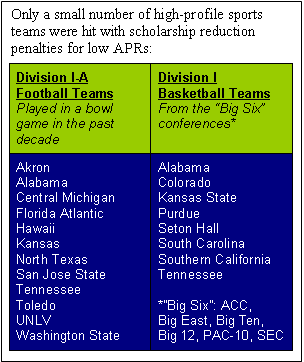 Yet this week the NCAA announced that only 37 college football teams and 53 college basketball teams would be penalized next season—about 40 percent of those with APRs below 925. What gives?
One reason that many teams escaped being hit with scholarship reductions involves the NCAA’s penalty structure. If a team posts an APR below 925, it loses scholarships only if a player leaves the college early in poor academic standing (otherwise known as a “0-for-2” players—those who drop out when they are also academically ineligible).
Take, for example, Maryland’s basketball team, which recorded a very low APR score of 906. The team did not lose any scholarships because the players who left the school without graduating had already exhausted their academic eligibility (and thus technically weren’t “0-for-2” because they didn’t drop out early). This is a pretty large loophole, especially for a basketball team with such a low APR—and a most recent graduation rate of zero percent (for players who entered between 1997 and 2000).
In addition, the NCAA granted waivers to some low-performing football and basketball teams at “low resource institutions,” including many historically black college and universities. Such waivers are considered appropriate, so long as the NCAA requires the athletic programs at these schools to demonstrate improvement over time.
But the NCAA also granted waivers to wealthy, big-time sports schools that have plenty of money to spend on academic support. Instead of standing up to these universities and penalizing them for their academic failings, the NCAA quietly consented to their waiver requests.
Ohio State University’s basketball team is a perfect example: with an APR of 909, and a most recent federal graduation rate of 27 percent, the program should have been subject to scholarship reductions for next year. But Ohio State submitted an “APR Improvement Plan” to the NCAA, with promises of more tutoring and monitoring of athletes, and thus avoided the penalty.
Other high-profile teams that were granted waivers include the University of South Carolina’s football team, Purdue University’s football team, and Indiana University’s basketball team. The NCAA granted waivers to 11 percent of teams of teams with APRs below 925 in this category.
If the NCAA is serious about academic reform, it should make an example of these high-profile sports schools. And if it wants to force real change, it needs to strengthen its penalty system. Little will change if fewer than half of the men’s basketball and football teams with scores below 925 are actually punished.
In announcing the recent penalties, Myles Brand, the president of the NCAA, passed the ball. It might make sense, he said, for schools “to put money into the development of academic resources than into the development of new [football stadium] suites.”
We hate to break it to you Mr. Brand, but no big-time sports school is going to shift money to academics by choice. You need to force them to by implementing and enforcing academic penalties with teeth.
More About the Authors
Issues
Programs/Projects/Initiatives
Related

Like Baylor, the University of Alabama Steered Many Low-Income Families to Parent PLUS Loans

State Legislatures Weighing in on Workforce Pell
A Trump Official’s Thin Legal Case Against Accreditors’ DEI Policies