Table of Contents
- Executive Summary and Community Scan
- Overview: The State of the Cybersecurity Gender Gap
- Section 1: Goals and Motivations
- Section 2: Construction and Curation
- Section 3: Themes and Selected Strategies
- Section 4: The Way Forward
- Appendix A: Implementable Strategies as Proposed by Discussion Groups
- Appendix B: Details on Audience Demographics
- Appendix C: What Can You do to Bring More Women and Girls Into and Up Through Cybersecurity?
Section 2: Construction and Curation
We had a blueprint for constructing our November 2018 event in collaboration with NICE. In 2015, New America hosted an event in collaboration with the Hewlett Foundation that was similarly characterized by an interactive format and drew insights from participants. However, where the 2015 convening was intended as a scoping workshop to detect a broader sense of the recurring issues faced by women in the field, our 2018 convening focused specifically on ideation—crafting and refining specific and implementable ways to increase the number of women in the cybersecurity workforce.
With our 2015 lessons and strategies in mind, we set off in collaboration with NICE to curate and run a session that would convene a diverse group of individuals who would work together for two half-day sessions to generate implementable strategies to bring more women into and up through cybersecurity. The New America-based team brought in Jill Hellman, a strategist and innovator who is also a professional meeting facilitator. Together, we determined that the strategies we were looking for would come from four main groupings:
- Proven strategies that are already working, but would benefit from renewed vigor
- Potentially relevant strategies that are working in other industries that could be applied to cybersecurity
- Strategies that were not able to gain traction in the past but can be revisited
- New strategies
In order to design a convening that would be maximally engaging, especially for the participants who had been around the proverbial block, there were four main dimensions of the planning that required fresh thinking and ideas to get outside of the average women in cybersecurity event.
Attendee Curation
Our goal was to curate a room full of people who were diverse, in terms of age, professional backgrounds, gender, race, and geography. We also sought to represent a mix of people with institutional knowledge of the ecosystem of efforts supporting women in cybersecurity, as well as individuals who were newer to the conversation. In order to achieve this optimal mix of participants, we worked with NICE to produce lists and groupings of individuals who represented these different groups and perspectives, and began to invite people in rounds that allowed us to continuously balance and shape the group according to participant responses as we received them.
The project team deliberately enabled Hellman to have a major role in shaping the guest list as an outside perspective, recognizing that the New America team was also subject to some entrenched patterns of thought from our close involvement in the community working on diversity and inclusion in cybersecurity. Once we confirmed our 46 participants, we broke that list down into smaller groups of approximately six people each, working to make each small group equally representative of diverse identities and experiences as the larger group.
From the Participants
“Cybersecurity as a field is at once completely unique and very similar to many others that struggle with low involvement of women. As a first step, we can build on decades of research on advancing women in organizations as well as success stories from specific companies and sectors. For example, de-biasing hiring and talent management processes inside organizations has been shown to meaningfully increase recruitment and retention of women."
Pre-Event Calls
Our project team, led by Hellman, conducted pre-calls with each attendee. These calls allowed our project team to ensure that everyone knew what they were walking into (i.e., not your average conference and/or roundtable session), and to learn about their expectations and ideas so that they might help to inform and shape the program.
Experience and Environment
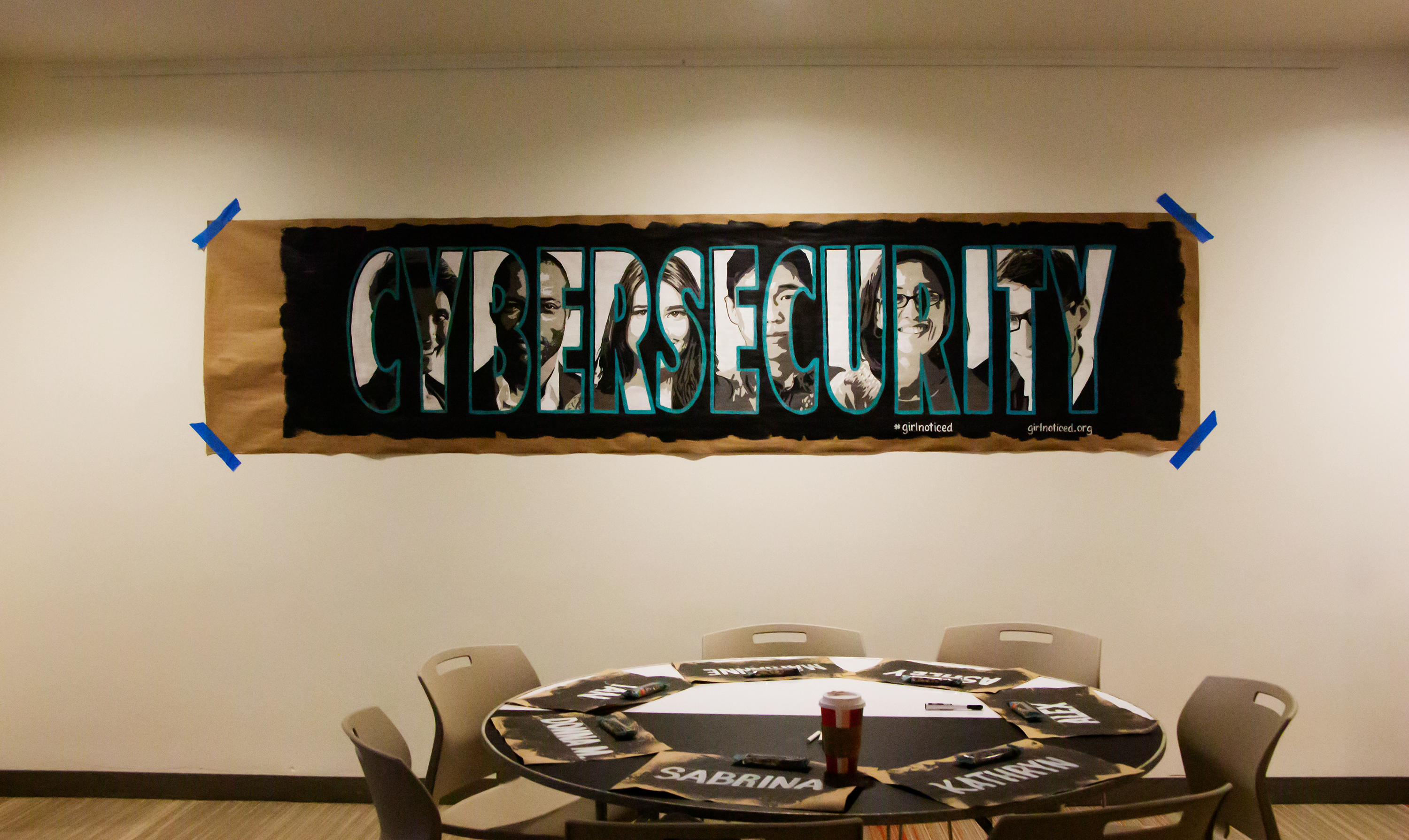
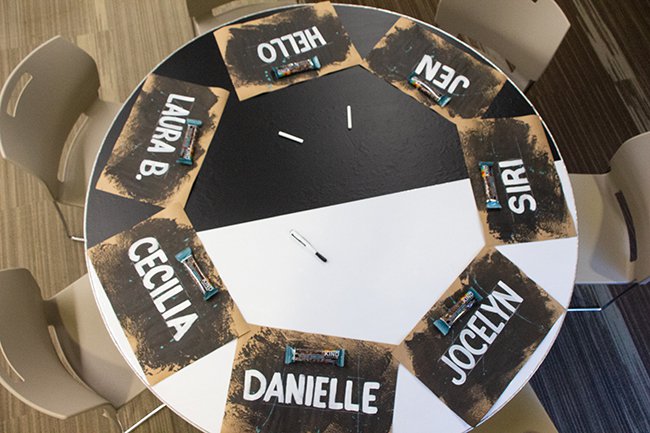
In order to ensure that all participants felt comfortable sharing their ideas in small groups and felt engaged and prepared to think outside of the box, we knew we had to create an atmosphere that was upbeat, welcoming, casual, inspirational and, crucially, interesting. The last thing we wanted was for our attendees to be bored before they had even began the work. To do this, we made several intentional choices about the environment. For example, we used round tables so that everyone was equal in terms of where they sat, and could hear and see each other easily. Details from whiteboard and blackboard table coverings to a professionally painted banner that read “CYBERSECURITY” helped to create an informal, artsy, coffee-shop vibe to encourage franker and more generative conversation. Attendees were encouraged to come an hour (or earlier) before the convening started to meet people and get ready.
Program
After the video and an opening story and remarks, each group worked as a team to choose one of four “missions,” which were written as questions that each group would answer or solve with an implementable strategy. All of the missions were related to bringing more women into, and/or up through, cybersecurity. These included:
- How do we have a more inclusive narrative?
- How do we build greater sponsorship for diverse humans in the current status quo?
- How can women get more power and influence (mindset, new plays, fair shot) now and in a world that is changing?
- What can be done to make diversity in cybersecurity a major business factor, alongside other major business factors?
The missions were informed by the strategies and ideas that participants shared in the pre-calls. Groups could also “go rogue” and choose a different mission than the ones suggested, and several groups chose to tailor their own missions. These “rogue missions” included: “How do we influence organizational behavior, practice, and culture to create a more inclusive and empowering environment for women?” and “How do we promote more diverse humans than in the current status quo?”
In her role as meeting facilitator, Hellman then led participants through several exercises that forced people to first generate ideas and solutions that they had not thought about before and then helped people to quickly sort through ideas and decide which ones to keep. Finally, the groups selected their “proposed” implementable strategies, and drafted multi-year plans of major milestones for those strategies (Appendix A). This gave their strategies some context, forced them to think through other potential challenges and opportunities, increased the stickiness of the ideas, and allowed all participants to walk away with plans that they felt were implementable.