Table of Contents
Can Networks Supercharge American Ingenuity?
Findings from research on 25 networks of local practitioners working in over 270 communities to advance solutions to criminal justice challenges, climate change, open government, and economic opportunity
By Tara McGuinness, Denice Ross, Anne-Marie Slaughter
"It’s not that the network itself is smart; it’s that the individuals get smarter because they’re connected to the network."
— Steven Johnson (Where Good Ideas Come from: The Natural History of Innovation)
There is a growing cadre of local practitioner networks in places like Rancho Cucamonga, Chattanooga, South Bend, Albuquerque, Anchorage, and Lincoln, getting smarter by learning from the successes and failures of other communities.
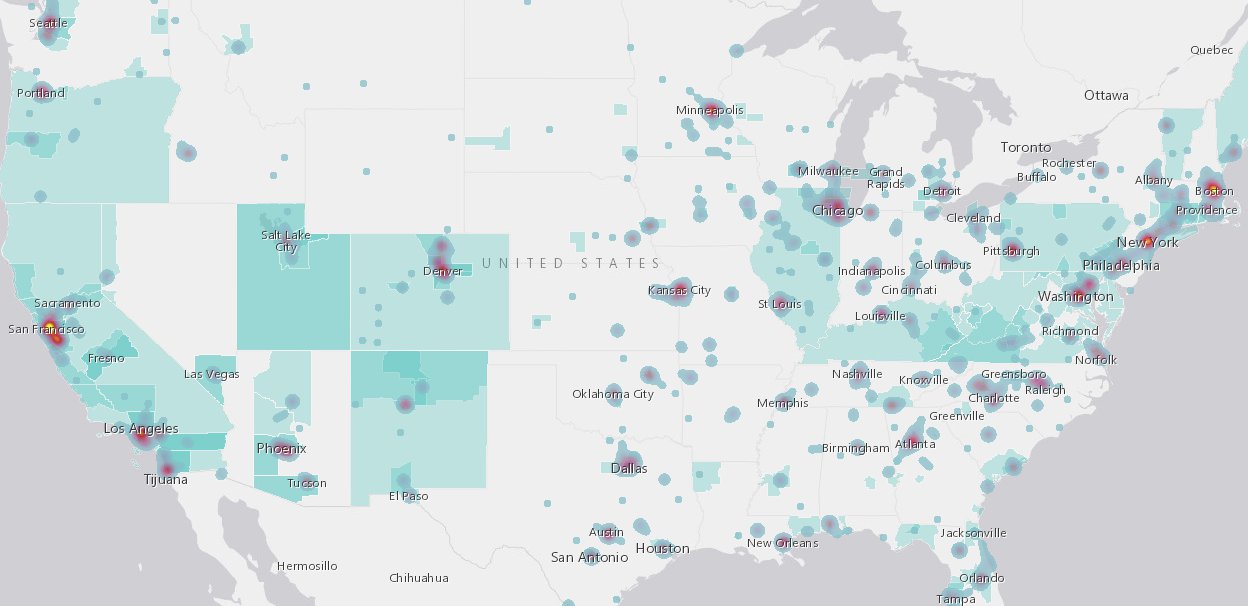
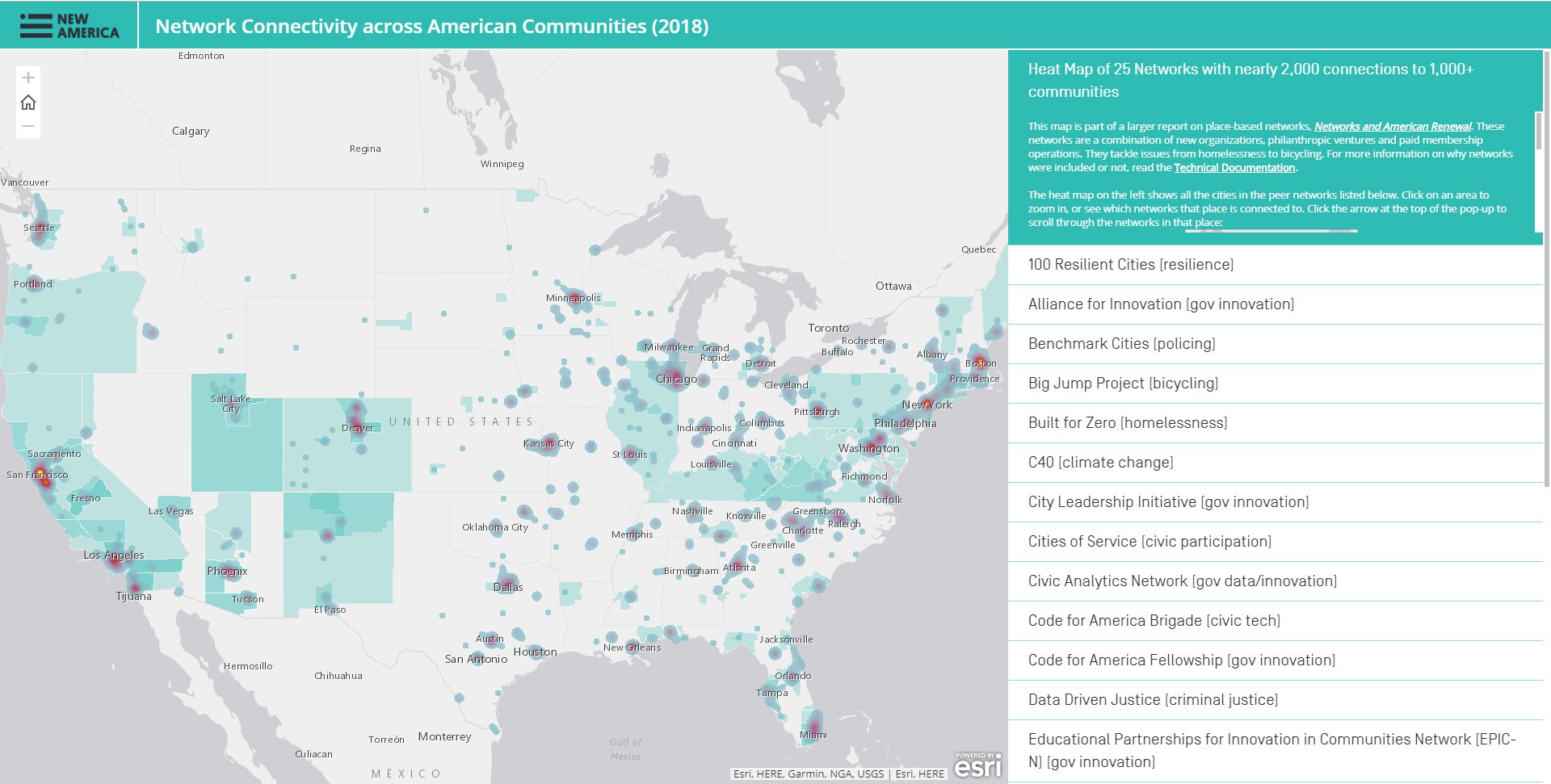
We collected data about 25 such networks in over 270 U.S. metro- and micropolitan areas working to advance solutions in criminal justice, climate change, open government, and economic opportunity.1 We used a uniform questionnaire and conducted more than two dozen interviews to build an interactive map of these networks (as of September 2018) and the resources they make available for their members.
Visit the map to see geographic patterns of network participation and zoom in to learn what networks different places are connected to.
As communities are dealing with complex crises such as climate change, rising housing costs, and the opioid epidemic, they are increasingly tapping into networks to help them learn new ways to engage these emerging challenges with smarter interventions. They are looking to learn from other communities who have faced similar obstacles and succeeded. “A network is a way to organize collective action and impact,” according to experts Plastrik, Taylor, and Cleveland.2 Networks are becoming a model that is changing the way businesses operate, philanthropists scale, and communities gather the wisdom of other places. Anne-Marie Slaughter’s research on networks as foreign policy tools for solving global problems also highlights scores of networks linking governments, corporate, civic, and philanthropic actors. When researchers commissioned by Bloomberg Philanthropies studied more than 80 active networks of international city governments, they observed a surge of city network initiatives founded in the early 1990s.
Two thirds of the two-dozen networks interviewed for this research were founded in the last six years. Many are the result of a recent proliferation of philanthropic investment in networks helping cities and counties, and a focus in the Obama administration on place-based initiatives. These networks range in tools and intensity from Bloomberg Philanthropies What Works Cities, which provides technical assistance using data and evidence to improve city services to a network of 100 cities, to #GoOpen, a network of school districts using open source curricula that started in federal government and supports self-replication.
| Networks Interviewed for Our Research | |
|---|---|
| #GoOpen | Educational Partnerships for Innovation in Communities Network (EPIC-N) |
| 100 Resilient Cities (100RC) | FUSE Corps |
| Alliance for Innovation | Innovation Teams (i-teams) |
| Benchmark Cities | Living Cities |
| Big Jump Project | MetroLab Network |
| Built for Zero | National Neighborhood Indicators Partnership (NNIP) |
| C40 | Next Century Cities |
| Cities of Service | Police Data Initiative (PDI) |
| City Leadership Initiative | StriveTogether |
| Civic Analytics Network | TechHire |
| Code for America Brigade | Urban Sustainability Directors Network (USDN) |
| Code for America Fellowship | What Works Cities (WWC) |
| Data-Driven Justice |
Networks are by no means a panacea for solving intractable problems. We heard many stories of places unable to take advantage of the benefits of network participation due to a lack of local bandwidth and resources, and also the lack of alignment with local organizational priorities. We also heard of “network fatigue” where places were so active on the national stage that their ability to focus and deliver at the local level was diminished.
That said, we also heard that when the challenge is bigger than any one place can solve alone, access to the right resources, tools, and colleagues through a network can be transformative for local practitioners. For example, in less than two years, “three communities in the Built for Zero network have ended chronic homelessness, eight have ended homelessness for veterans, and another 37 communities have driven a reduction in homelessness” using better data and aligning efforts across community stakeholders, confirmed Jake Maguire, Principal at Community Solutions. When the Police Data Initiative was founded in 2015, police departments had never released open data about things like use of force or citizen complaints. Now, the network has more than 140 agencies who collectively have released more than 350 datasets, effectively shifting the culture of policing toward more transparency.
The smallest network in our database is the three-year-old Big Jump Project, which uses data to increase bicycling infrastructure and ridership in 10 jurisdictions. The largest network, Cities of Service, is 240 cities strong with city leaders engaging citizens to collaboratively identify and solve public problems. Nearly two thirds of the networks in our research are working in 75 or fewer places. Some of these networks have an intensive backbone of organizational support behind them, while others provide human capital support through personal or technical assistance, or through grant making that complements the network’s goals. Some networks are offered through paid membership, others by application. Nearly all provide annual summits and tools to connect with other members of the cohort. Some even sponsor travel for cohorts to visit sites where they can see emerging solutions first-hand.
Our research revealed trends across places and networks, and lessons for those building and improving networks and those working at the community level.
Communities are either hyper-networked or off-the-grid. The geography of membership is not evenly distributed. While every region of the country has networks in our survey, there are some places that are more connected than others. Of the 25 networks we studied with nearly 2,000 connections to 270 metro- and micropolitan areas, the top 10 super-networked areas account for fully a quarter of all the connections. And the United States has another nearly 700 metro- and micropolitan areas that are un-connected to the 25 networks in our study. The table below shows each of the 270 metro- and micropolitan areas that are connected to the 25 networks in our research, ranked by its number of connections to the networks.
The more populous a place, the more likely it is to be highly networked. This is likely due to the higher capacity and greater resources found in population centers like San Francisco, Chicago, New York, and Boston. The graph below shows the top ten most networked metro areas and their high populations. It also shows the clustering of lightly-networked, low population metro/micropolitan areas.
It takes capacity to get into and take advantage of these networks. The capacity required to participate in nearly all networks is significant. The National Neighborhood Indicators Partnership (NNIP), run out of the Urban Institute, demonstrates the barriers for low capacity communities. Its “Guide to Starting a Local Data Intermediary” demonstrates the level of capacity and vision a community needs before joining a capacity building network:
“Prospective organizations submit an application that includes references, a data inventory, and a letter of intent pledging to develop further local collaboration around data dissemination and applications in their area in the future.”
We spoke with people in several places who aspired to be a part of NNIP and could imagine the concrete ways their communities would benefit from that type of civic infrastructure, but lacked the resources and capacity needed to derive those benefits. Most network organizations are seeking to work in geographies with a vision and ability to “succeed,” so if there is a selection process, they are seeking local leadership, ability to use best practices, and capacity to deliver. Some places don’t have these resources to allocate to participation in a network.
In their 2018 report, Cities Joining Ranks—Policy Networks on the Rise, Lusk and Gunkel also identified this phenomenon, labeling two types of network membership models "High-Hurdle" (selective membership) and "Big Tent" (drawing larger numbers of cities with diverse capacities).
Conclusion
Connectedness is the flavor of the day. Many studies of individual, organizational, and municipal health conclude that isolation is bad and participation is good. Networks are the preferred institutional form for a more horizontal world, in which the hierarchy of traditional firms and organizations seems stiff, old-fashioned, and limiting. Connecting places through partnerships, coalitions, alliances, and networks holds out the promise of large scale success, maximizing impact through cross-fertilization and replication without the difficulties and conflicts of merging into one large organization.
Some of this promise holds true. But simply creating or joining a network is at best a first step and at worst a step backward, if capacity to actually participate in and learn from the network is lacking. Indeed, our research shows that many of the cities that most need what networks can offer are the least well placed to participate in them. Network designers and builders take heed: more attention to the specific factors that actually make networks work can make more networks work for more places.
Citations
- To learn more about what networks we included and didn’t in this research, see the Methodology page.
- For more information on the philanthropic roles in building networks, see Kresge Foundation’s 2015 guide to Investing Strategically In Social-Impact Networks and Connecting to Change the World by Peter Plastrik, Madeleine Taylor, and John Cleveland.