
What Are States Doing?
The potential of high-quality, standards-aligned curricula in the classroom, combined with the cost savings of OER, means that states are thinking of ways to support the identification, development, and effective use of these resources. We found four primary approaches that states are taking to support local implementation. First, they are working to better incorporate OER into their curriculum review processes. Some states are filling gaps in available curriculum by developing OER that reflect their specific standards and local needs. This free and open content is also creating new opportunities for states to connect curriculum to professional learning. Finally, they are finding ways to store and share newly adopted and developed OER through state websites and repositories.
1. Reviewing Curriculum and Instructional Materials
Ensuring that the curriculum and instructional materials available to teacher and students meet the highest quality standard is of paramount importance. Because not all materials that claim to be standards-aligned are actually high quality, several states have established curriculum and instructional materials review processes intended to provide information about quality to district and school leaders. A number of states have included open curricula in this work, holding all content—regardless of license—to the same high standard. With a growing number of printed and digital instructional materials available, states have developed strategies that range from state-led reviews to teacher-user crowdsourced reviews.
While many states have stepped back from mandating adoption of specific curricula,1 at least 36 states continue to provide information and guidance to districts on curriculum quality.2 According to our research, 20 of those states lead curriculum reviews, judging the quality of content against standards and other state-specific criteria. Due to limited staff capacity or policy barriers that keep states from directly reviewing curricula,13 states point districts toward external reviews, rubrics, and other resources to assess content quality. At least five states rate materials through teacher-user reviews, giving teachers themselves the opportunity to evaluate and curate well-designed classroom materials.3 Some states use more than one strategy for reviewing educational materials. This information is made publicly available and shared with district and school leaders in order to support them in making decisions about instructional materials.
Through our interviews, we have identified several states in each of these categories that have explicitly integrated OER into the information and guidance they provide districts about curriculum quality. Aligning reviews for all curricula, regardless of license, is important because education leaders have expressed a natural skepticism about the quality of openly licensed content. Rather than make assumptions about quality based upon content licensing, the state and local leaders we interviewed in the following examples are holding all resources to the same high bar.
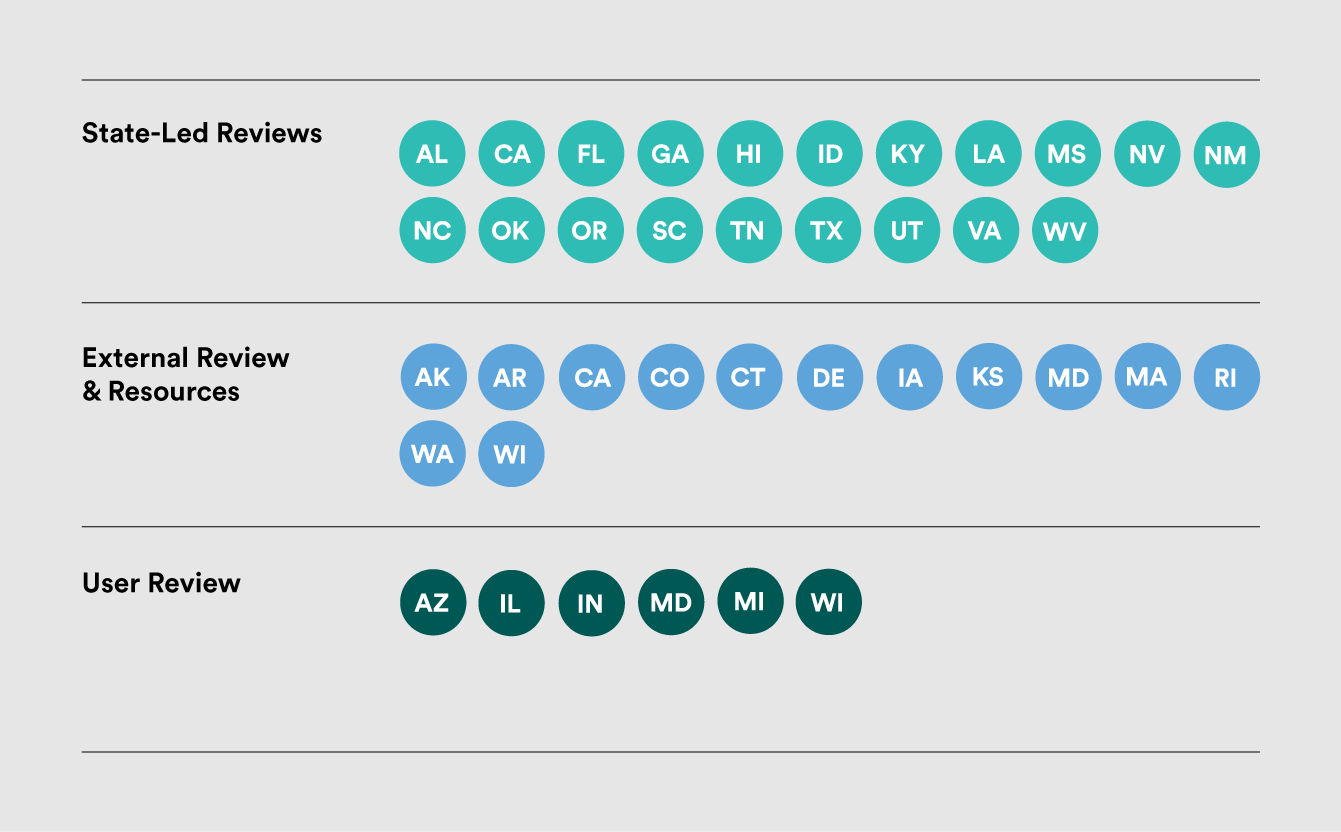
Sources: Data are based on author research, including state website scans and interviews with education leaders; data were also checked against other sources, including “Instructional Materials Adoption, Association of American Publishers, http://publishers.org/our-markets/prek-12-learning/instructional-materials-adoption; and “Alignment of Instructional Materials to State Readiness Standards,” Southern Regional Education Board, May 2017, https://insights.sreb.org/#/programarea/instructionalmaterials.
State-led Reviews
In Louisiana, education leaders continue to review curricula at the state level to determine whether available resources align to the state’s new content standards. Though the state agency does not require districts to adopt state-reviewed materials, it continues to ensure districts have clear information about available curricula, including both proprietary and open content. Specifically, the state posts instructional materials reviews on its state website, classifying a Tier 1 resource as exemplifying quality, a Tier 2 resource as approaching quality, and a Tier 3 resource as not representing quality.4 These quality ratings are derived from the extent to which curricula aligns with the state standards, a determination made by teacher leaders hired by the Louisiana Department of Education. Louisiana only reviews full-year curricula rather than units or lesson banks; the reason for doing so, Assistant Superintendent of Academic Content Rebecca Kockler explained that “coherence and completeness matters.”
Using Louisiana’s review process as a model, the Texas Education Agency has developed its own quality review process to determine which instructional materials will be eligible for local adoption. TEA is working to tier instructional materials according to their alignment to its academic standards—the Texas Essential Knowledge and Skills (TEKS)—as determined by a review panel comprised of educators, academic experts, parents, and state board members.5 Penny Schwinn, chief deputy commissioner of academics in the Texas Education Agency, said that rather than focusing on offering a breadth of supplemental resources, the review process has tasked the state agency with prioritizing the depth of instructional content. Texas has identified and developed open curriculum and instructional materials that align with TEKS through the state review process.
Similarly, Utah leverages teacher expertise from across the state to vet materials by evaluating state standards alignment. State leaders work to evaluate OER using the same criteria as any other instructional resources and post these materials reviews online. They have also launched a special task force that not only reviews and rates OER, but also curates open content based on teacher recommendations and research into other state resources. During the curation and review process, Utah prioritizes comprehensive OER units rather than supplemental resources. Alan Griffin, Utah’s curriculum content specialist, said, “curriculum that meets only a single objective is hard to review and to utilize because the focus is so narrow.”
External Reviews and Resources
In many states, education leaders do not have the authority or capacity to provide information and guidance on specific curricula. Washington’s Office of Superintendent of Public Instruction (OSPI), for example, is prohibited from providing specific guidance on the standards-alignment of curricula. OSPI can, however, point districts to external reviews such as EdReports to assess the rigor, alignment, and quality of instructional materials.6 Many states also direct districts toward commonly used curriculum review tools and rubrics. By pointing to these resources on their websites, states are able to help establish a shared understanding of how to evaluate the quality of materials. One commonly used rubric is IMET (Instructional Materials Evaluation Tool), which aims to help evaluators determine the quality and alignment of curriculum.7
Rubrics provide a basis for quality, but states and districts also recognize the need to provide adequate training on their use. In Washington State, officials spend time working with district leaders to help them understand how to look for quality materials, according to Barbara Soots, OER and instructional materials program manager for OSPI. “We spend a lot of time building district capacity around using OER,” she said.
User Reviews and Content Curation
Other states find that OER can be valuable supplements to comprehensive curricula. These single learning artifacts are not intended to replace full-year, but rather offer opportunities to personalize and adapt learning to meet diverse student needs. For smaller OER grain-sizes, states have turned to user ratings grounded in standardized rubrics to allow teachers to learn from each other and crowdsource reviews. A commonly used tool is Achieve’s EQuIP (Educators Evaluating the Quality of Instructional Products) rubric, which helps to identify standards-aligned lessons and resources.8
Michigan sees promise in the potential to use OER to personalize student learning. Michelle Ribant, director for 21st Century Learning in the Michigan Department of Education, explained: “OER started as online resource support for curriculum and has evolved to provide materials for more personalized learning that may better address student needs.” Michigan’s model is user driven, allowing teachers to rate supplemental OER online by evaluating them against the rubric that is baked into the OER Commons platform. In this way, teachers keep content relevant to their classrooms, evaluate the adapted content for alignment, and share what they know about effective materials with their colleagues.
As users review content, some states find a need to better organize materials flagged as high quality. They are working to actively curate OER specific to local needs and house them in accessible state resource libraries. For example, Val Emrich, director of instructional technology at Maryland State Deparment of Education, noted that her office hosts a series of curation and creation workshops. During these trainings, district leaders and teachers learn about the benefits of OER, interact with open content, and create, sort, and organize resources appropriate for their schools and classrooms.
2. Developing Standards-Aligned Curriculum
For many states, evaluating available content has led them to put more effort into developing curriculum and other educational resources, especially when reviews have identified clear gaps in high-quality curricular materials. States that have taken on this work have pursued different strategies for content development, based on context and capacity. Each state, however, specified that the content it developed would be openly licensed. Louisiana’s Rebecca Kockler encapsulated why states are choosing to make these resources available as OER: “If we’re going to take taxpayer dollars and build instructional content and materials,” Kockler said, “making those resources proprietary seems ludicrous.”
We have identified 12 states (including the District of Columbia) that have been directly involved in partnerships to develop new open curricula and resources. Across the country, states have contributed to the development of comprehensive, standards-aligned curricula in ELA, math, science, social studies, and a range of other content areas.

Source: Data are based on author research, including state website scans and interviews with education leaders.
State education leaders have partnered with a range of other organizations to develop open curricula: smaller education publishers, institutions of higher education, other state agencies, and school districts and educators. Often, states have collaborated with multiple organizations on one or more open curriculum initiatives. (Many organizations have worked to develop open content without state involvement—those valuable efforts are beyond the scope of this report.)
Education Publishers
One of the most significant state investments in curriculum to date is New York’s work to develop its EngageNY materials, which include comprehensive PreK–12 ELA and math curricula. New York requested proposals from writers across the country interested in developing these resources, but with an important new requirement: “the materials would be available on the [state] website for free,” John King, former commissioner of education in New York and previous U.S. secretary of education, shared. As a result, he said, “we ended up with a set of vendors that had to believe in our OER approach.”9
After putting out a request for proposals, state leaders identified four organizations to develop ELA curriculum for specific grade ranges. Core Knowledge developed the PreK–2 curriculum; Expeditionary Learning created grade 3–8 resources; and the Public Consulting Group developed high school materials. Additional units were added by Odell Education for grades 6–12. One organization, Great Minds, won the bid to develop math curriculum for every grade level, PreK–12. The resulting curricula have been widely adopted: not only have districts and schools within New York leveraged these materials, but other states have embraced these resources as well.
Similarly, Texas identified a need for curricular resources in high-enrollment high school STEM courses. In 2015, the state put out a request for proposals to identify partners to develop the materials. In the initial phase of the project, Penny Schwinn said, “there was conversation around how the state could be more effective with taxpayer dollars. Could OER free up dollars in other places?” Initially, the state did not require that all materials created with state funds be released under an open content license, but moving forward, any additional materials created using state funds will be released as OER. In the long term, Schwinn said, the state hopes that investing in open resources will free up funds to allow districts to spend dollars differently.
After putting out a request for proposals, the state identified two organizations, OpenStax and Study Edge, to develop curricular resources for nine high school STEM courses that are aligned with the state’s academic standards, the Texas Essential Knowledge and Skills. The resources from OpenStax are similar to traditional textbooks, while the resources from Study Edge are video-based lessons. (OpenStax has released its materials using an open content license; Study Edge materials are available online free of charge but are not openly licensed.) These materials were developed with Texas learning standards in mind, but several of the textbooks developed by OpenStax were developed for Advanced Placement (AP) courses and have been added to the College Board’s list of approved texts, meaning that AP educators across the country could easily adopt these materials. “While Texas is a very proud, independent state,” said Schwinn, “there are a lot of ways that we’re open and willing to share materials with any state in the country.”
State Institutions of Higher Education
Soon after adopting its new academic standards, the Utah State Office of Education solicited bids from potential writers to create middle school math textbooks. Unlike New York and Texas, however, the responses that Utah received were from state institutions of higher education. Two of the criteria the state used to choose between proposals were demonstrated ability to create the curricula, and the expertise of the staff; many colleges and universities have significant experience and expertise in curriculum development. (Indeed, several of the organizations listed above have university affiliations—for example, OpenStax is based at Rice University in Texas.) In the summer of 2012, state leaders selected the University of Utah to develop seventh and eighth grade math textbooks.10
In a separate effort, Utah also worked to create high school math curricula. “In the secondary space, [our state] chose to go to an integrated mathematics model,” said Sarah Young, digital teaching and learning coordinator in the Utah State Office of Education. “It created an instance where there weren’t curricular resources that were off the shelf, based on the standards,” she said. The resulting curriculum, known as the Mathematics Vision Project (MVP) was developed based on Brigham Young University’s Comprehensive Mathematics Instruction Framework. All of the resulting math curricula for middle and high school have been evaluated by EdReports and found to be highly aligned with the Common Core standards.11
Other State Agencies
In the state of Washington, the legislature has passed several bills addressing curriculum requirements. For example, it passed a bill in 2015 that required the incorporation of a tribal curriculum in schools so that districts teach students about tribal sovereignty and the state’s local tribes. Washington has the third-largest number of federally recognized tribes after California and Oklahoma, and few resources existed that captured the unique history of the area’s indigenous peoples.
To provide districts with the materials they needed to meet this requirement, Barbara Soots said that her office of public instruction partnered with state agencies and a number of Washington’s 29 federally recognized tribes to develop a comprehensive open curriculum aligned with the Common Core standards for ELA. These materials tackle essential questions about tribal sovereignty, examining complex issues such as the legal status of tribes who negotiated settlements for the loss of their homelands.12 The curriculum is specific to the tribes located within the state of Washington, but the framework could be adapted by other states and districts looking to educate their students about the history of tribes in their area.
Districts and Educators
In addition to working with publishers, institutions of higher education, and other agencies, states have also partnered with districts and teachers to create new content. For example, Washington has provided districts with financial support to adapt, develop, or implement standards-aligned OER to meet specific local needs. The state provided a modest grant to Tumwater School District, a small district right outside the state capital, to adapt its open high school math curriculum—it chose the Math Vision Project, originally created for Utah—to create interventions for students struggling with key math concepts. As a part of this work, districts have made their adapted resources available through Washington’s state content repository.13
In Maryland, state leaders have worked with district leaders to create OER cohorts to develop a better understanding of OER with the goal of creating local curricula that can be shared across the state. Val Emrich said that this started with a meeting of the state’s 24 assistant superintendents for instruction that aimed to develop a deep understanding of OER and establish e-communities to share ideas and resources.
In Louisiana, state leaders found gaps in available ELA resources that the state could help to fill by working with teachers across the state. To fill this need, Rebecca Kockler said that the state brought together master teachers from districts across Louisiana, in partnership with national experts, to develop ELA units for grades 3 through 12. The resulting Guidebooks are available online under an open content license, free for other districts to adapt and use. Similarly, Michigan’s Open Book Project has funded and coordinated efforts with educators from across the state to develop social studies resources. This multi-year effort has resulted in social studies curricula for most grade levels: educators have developed comprehensive curricula for grades K–3 and 7–8, as well as high school curricula for U.S. history, world history, and civics.14
3. Connecting Curriculum to Professional Learning
Good content helps to improve teaching, but content alone is not enough. As state leaders evaluate and create curricula, they have increasingly seen how OER can more intentionally connect curriculum with professional learning. In contrast to professional learning that focuses on general teaching practices, professional learning built around open content is “curriculum-embedded.” This supports teachers in deepening their knowledge of the content they are using in the classroom.
High-quality open curricula offer a unique opportunity for districts, as freely accessible materials can offset some of the costs associated with any corresponding professional learning. That is to say, OER gives districts the opportunity to invest more in professional learning opportunities, which is more difficult to do when districts allocate more money to accessing the content itself. Further, in order to effectively use OER, district leaders and teachers need new kinds of professional learning opportunities. District leaders and teachers can more successfully use OER when they have in-depth knowledge of open licenses, best practices for adapting and combining different kinds of content, and an understanding of how OER supports state standards.

Source: Data are based on author research, including state website scans and interviews with education leaders.
That said, connecting curriculum to professional learning through OER is an emerging practice in states. Based on our research, state interviews, and publicly available data, we have identified 14 states (including the District of Columbia) that are connecting curriculum and professional learning through OER, though we recognize that this likely does not capture the full range of work happening. Across the country, states are connecting professional learning and curriculum in three main ways: developing state guidance on professional learning; providing free, on-demand digital modules; and offering in-person opportunities for collaborative learning.
State Guidance on Professional Development
In Louisiana, the state provides guidance on professional learning opportunities that are curriculum-embedded. The state not only offers districts information on high-quality resources, but also provides a guide detailing professional development opportunities that are aligned with Tier 1 curriculum. Further, state leaders host quarterly, regional collaborations with their teacher leaders throughout the school year. Linking professional learning to curriculum has been easier in an OER environment.15 Rebecca Kockler explained that OER has allowed Louisiana to more fully integrate its education system, meaningfully aligning curriculum with professional learning for teachers, training for school leaders, and even some assessment systems. “When materials aren’t open, it’s really hard to build an integrated system because we don’t have permissions—that’s the power of OER,” she said. “The curriculum can play its true role as the center of the instructional vision, and everything can reinforce it.”
In North Carolina, state leaders are elevating teacher professional learning connected to their work around OER. “We need to make sure our teachers are good consumers of digital content,” said Verna Lalbeharie, director of digital teaching and learning with North Carolina’s Department of Public Instruction. “We need professional development around how to use rubrics wisely and make sure the content will help meet learning objectives,” she said. Lalbeharie also stressed the value of OER in helping to integrate curriculum within professional development to better support student learning.
Digital Opportunities for Professional Learning
Illinois’ ED360 platform not only links to its OER repository, iOER, but also links to the digital professional learning platform, Ed Leaders Network.16 The fact that most OER are provided in digital formats has allowed the state to provide digital opportunities for professional learning that are on-demand, available anytime, anywhere an educator can connect online. Through this platform, educators can access learning modules specific to their practice. This has the potential to promote more equitable opportunities to deepen content understanding, regardless of local capacity. Mary Reynolds, Illinois’ executive director of Innovation and Secondary Transformation, said that interoperability is vital between where OER content and professional development modules are stored: “the key is to help teachers find these resources, and align it to all the other pieces and initiatives they are looking for.”
California also has begun to use a new digital platform, Collaboration in Common, to house instructional training resources. According to Julia Agostinelli, education programs consultant in the California Department of Education, these resources primarily come from the county offices of education. The Instructional Leadership Corps, a Stanford Center for Opportunity Policy in Education (SCOPE) that brings together more than 200 teachers each quarter to deepen their understanding of instructional standards, also uses the platform to collaborate and share self-made training resources. Housing professional learning resources from these in-person meetings online allows teachers to access them later and share them with their districts, enabling ongoing conversations.
In-Person Professional Learning
Each year, Washington hosts in-person OER meetings across the state. Barbara Soots described the content of the sessions as ranging from the general basics of OER to the impact of OER on specific content areas. Louisiana also offers an annual summit that brings together 6,500 educators, focusing on building content knowledge of high-quality instructional materials.17
Regional OER meetings are also emerging across the country to engage neighboring states, districts, and educators in shared OER learning. These meetings, hosted by states such as Virginia and Michigan, offer opportunities for classroom, state, and district leaders to learn about and collaborate on OER topics applicable to their region’s standards, students, and priorities. OER meetings acknowledge the breadth of information needed to fully understand and use OER, addressing topics like vetting resources, accessibility for individuals with disabilities, privacy considerations, copyright and licensing, and the permissions granted through OER.
4. Building State Websites and Repositories
As state leaders have delved into the work of reviewing curricula, developing new content, and connecting content to teacher professional learning, states have been focused on identifying space to organize and share high-quality resources with districts. Because so much of the curriculum and instructional materials that states have reviewed, developed, and curated—often in partnership with districts—is openly licensed, states have been able to more easily share these resources online.
While the majority of states have some kind of web presence to share resources, many leaders have found that as their needs have evolved, the online tools they have used in the past are no longer sufficient. As a result, a number of state websites and repositories are currently in flux as leaders work with contractors, vendors, and other organizations to find tools that meet a variety of identified needs. One of the most pressing concerns for every education leader interviewed for this report has been interoperability, making sure that the different resources and tools that have been created can be easily used together.
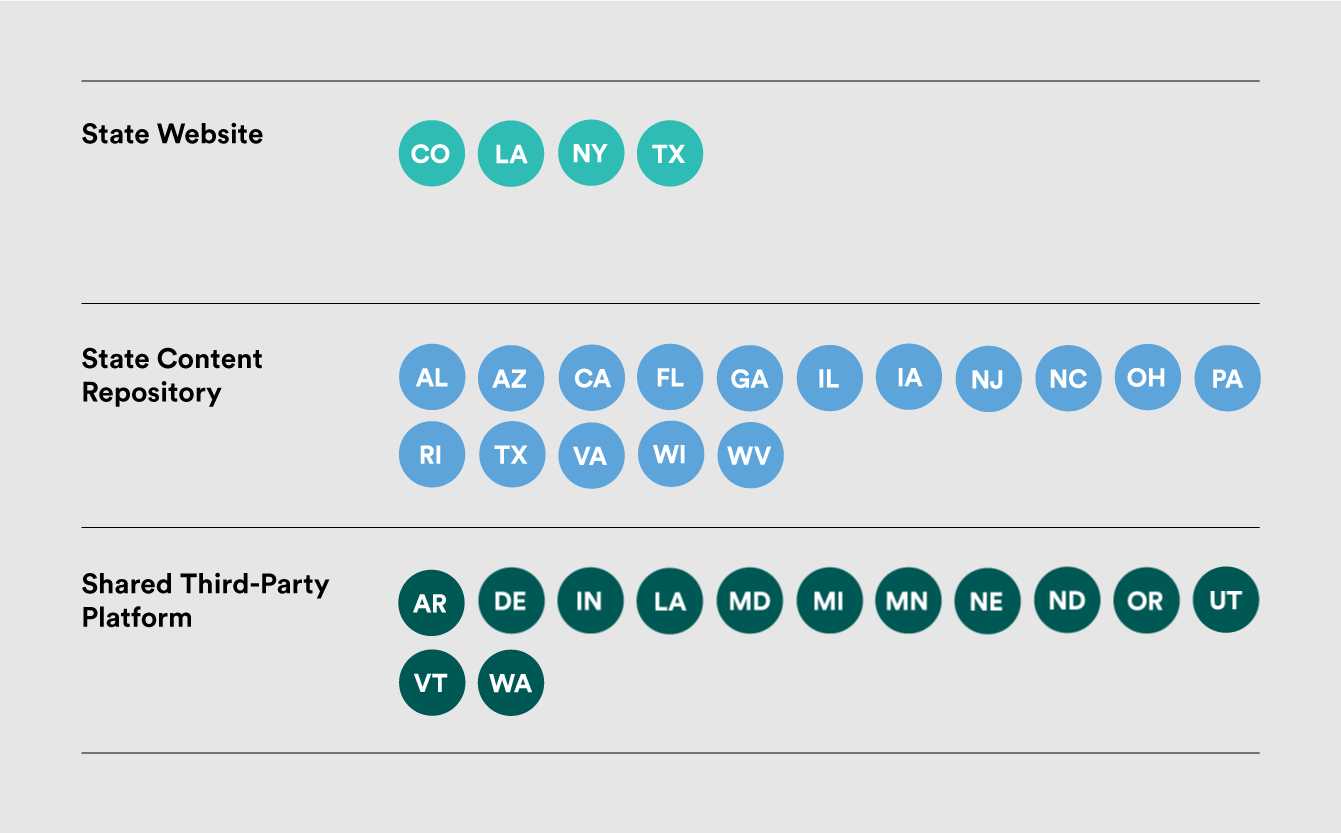
Sources: Data are based on author research, including state website scans and interviews with education leaders; data were also checked against other sources, including “Digital Instructional Materials Acquisition Policies for States,” State Education Technology Directors Association (SETDA), October 2015, http://dmaps.setda.org/.
While states acknowledge that much of this continues to be a work in progress, we have found that 31 states currently are sharing high-quality curriculum and instructional materials online. Currently, we found that four states have gotten started by using their state websites to share the content they have created. Further, 16 states have built their own content repositories, and 13 states have used third-party platforms to share their work.18
State Websites
While the state of Texas is working to both review and develop content for its teachers, it is still developing its portal to share these resources. The portal will contain quality review information as well as the content that the state has developed. But while Texas works to find a partner to help build its portal, it has already created valuable, high-quality curriculum and instructional materials that were made available as soon as they were ready through the state agency website. Similarly, Louisiana has used its Louisiana Believes website to share content reviews, link to high-quality resources, and promote the open ELA curriculum developed in partnership with its teachers.
In New York, the state created a dedicated website to host its new ELA and math curricula, EngageNY.org. That website started with the two curricula but has been built out over the past several years to include additional state resources focused on professional learning, including a video library of expert instructors.
State Content Repositories
As Illinois considered how to share OER with educators, it developed a state-specific content repository. The state platform, iOER, hosts a range of open content, from individual lessons to more comprehensive curricula. As Illinois has built out its larger portal for educators, ED360, it has been important to ensure that iOER connects with that portal to provide greater interoperability and easy access for teachers. State leaders wanted to be sure that they connected OER to other efforts to improve high-quality, personalized instruction. The platform now connects with the state data system, online professional learning opportunities, and other tools for educators.
Similarly, Georgia’s state office of technology services has built a content repository to meet the needs of its educators. Angela Baker, technology services manager in the Georgia Department of Education, explained that her team is robust enough to be able to build its own tools, rather than work with a third party to develop a platform. As the state has continued to refine its platform for sharing content, Baker said, “the thing I’m most excited about is that there’s a take-off in the quality of open resources.”
Shared Third-Party Platforms
States have also turned to outside organizations to meet their needs. Many have partnered with OER Commons, an online library of open educational resources and other free content, to create a state platform for resources. While OER Commons maintains a freely accessible platform for anyone to use, it has also worked with individual states to develop state-specific microsites hosted on their platform. Leaders in Utah, Washington, and Michigan highlighted how they are working together to share resources through this platform.
States have also partnered with a variety of other third-party organizations to share OER. For example, while Louisiana has additional plans for how it will share out its ELA Guidebooks, currently those resources are hosted on Learnzillion, a website that provides a library of interactive curricular resources, along with other tools. (While Louisiana’s Guidebooks are OER, other content on Learnzillion is not openly licensed, and access to some vetted content is fee-based.) Delaware has partnered with Schoology, while Indiana is working with Amazon Inspire.
Citations
- Catherine Gewertz, “States Ceding Power Over Classroom Materials,” Education Week, February 17, 2015, source
- Data are based on author research, including state website scans and interviews with education leaders; data were also checked against other sources, including: “Instructional Materials Adoption,” Association of American Publishers, source; and “Alignment of Instructional Materials to State Readiness Standards,” Southern Regional Education Board, May 2017, source
- For more on state curriculum and instructional materials adoption policies, see “Digital Instructional Materials Acquisition Policies for States,” State Education Technology Directors Association (SETDA), October 2015, source; “Alignment of Instructional Materials to State Readiness Standards,” Southern Regional Education Board, May 2017, source; and “Instructional Materials Adoption,” Association of American Publishers, 2015, source
- Julia H. Kaufman, Lindsey E. Thompson, and V. Darleen Opfer, Creating a Coherent System to Support Instruction Aligned With State Standards: Promising Practices of the Louisiana Department of Education (Santa Monica, CA: RAND Corporation, October 2016), source
- “The Review and Adoption Process,” Texas Education Agency, source
- Lauren Weisskirk (chief strategy officer, EdReports.org), phone interview with authors, March 30, 2018.
- “Toolkit for Evaluating the Alignment of Instructional and Assessment Materials to the Common Core State Standards,” Achieve (website), source
- The Achieve website says that “EQuIP (Educators Evaluating the Quality of Instructional Products) is an initiative designed to identify high-quality materials aligned with the Common Core State Standards (CCSS) or Next Generation Science Standards (NGSS).” See source
- John King (former commissioner of education, New York State Education Department), phone interview with Lindsey Tepe, August 25, 2017.
- “A Review of Allegations Concerning the Math Textbook Procurement: Report to the Utah Legislature,” Office of the Legislative Auditor General, State of Utah, June 2014, source
- “The Utah Middle School Math Project,” EdReports.org, source; “Mathematics Vision Project,” EdReports.org, source
- “Since Time Immemorial: Tribal Sovereignty in Washington State,” Office of Superintendent of Public Instruction, Washington, source
- “2016–2017 Open Educational Resources Project Grant Awards,” Office of Superintendent of Public Instruction (Washington State), Learning and Teaching Department, August 1, 2016, source
- Michigan Open Book Project, source
- Julia H. Kaufman, Lindsey E. Thompson, and V. Darleen Opfer, Creating a Coherent System to Support Instruction Aligned With State Standards: Promising Practices of the Louisiana Department of Education (Santa Monica, CA: RAND Corporation, October 2016), source; Hiding in Plain Sight: Leveraging Curriculum to Improve Student Learning (Washington, DC: Chiefs for Change, August 2017), source
- “Illinois Open Educational Resources,” Illinois Department of Commerce and Economic Opportunity and Illinois State Board of Education, source
- “2018 Teacher Leader Summit Overview,” Louisiana Believes, source
- Author research and interviews with state education leaders; “Digital Instructional Materials Acquisition Policies for States,” State Education Technology Directors Association (SETDA), October 2015, source