Part 2: Gender Representation
Empowerment and other barriers to inclusivity and inclusive representation.
In 2016 and 2018, all policymakers and influencers we spoke with said that bringing more women into the national security and foreign policy community would lead to improved outcomes. However, the driver behind this assumption seems to have changed. In 2016, we heard a more passive approach: “The door should be open to anyone.” In 2018, policymakers and influencers recognized the need to more actively seek out those with different experiences than them in order to strengthen policies. Opening the door is no longer seen as sufficient.
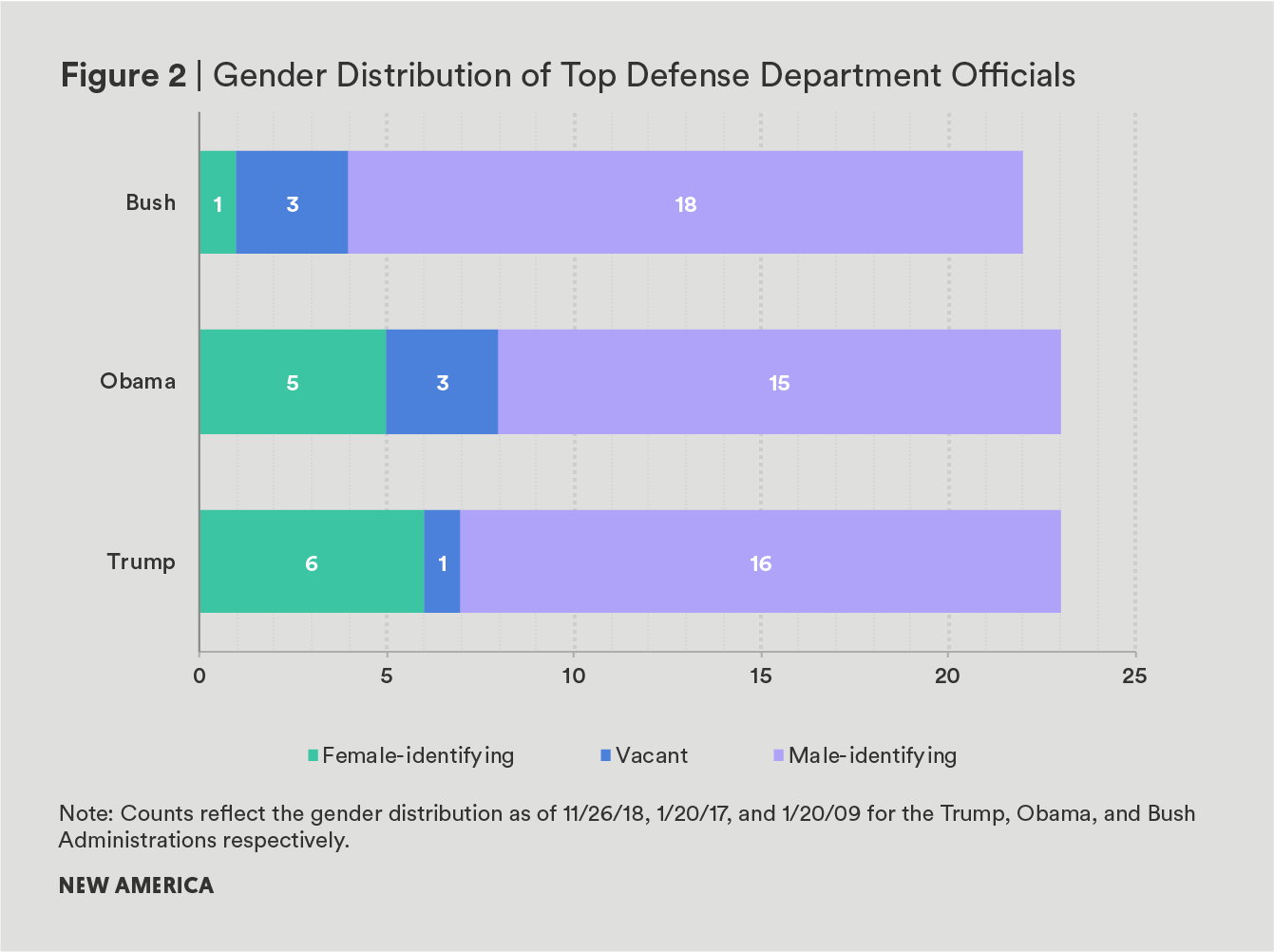
Gender representation differs dramatically between administrations, and among agencies. While comparisons are difficult because so many slots are unfilled, particularly at State, as of November 26, one in thirteen senior positions (Assistant Secretary and above) are permanently filled by women at State, compared to six at DoD. Neither number represents a significant shift from the final Obama years.

On the surface, men and women we spoke with favor making the security space more inclusive than it has been in the past. Below the surface, however, we found significant gender gaps.
“I think it’s already quite inclusive,” one male respondent said. “I’m trying to think how it could be more inclusive.”
When the men we interviewed discuss inclusivity, their approach tended toward the gender-blind: Just don’t consider gender as a factor. It’s all about having the widest possible array of information possible, and making sure roles are open, at least technically, to all.
“I think it’s already quite inclusive,” one male respondent said. “I’m trying to think how it could be more inclusive.”
“I’m much more of a consequentialist. What is getting our best information: man, woman or drone?” one man said.
Another echoed this sentiment by saying, “I’m of the mindset you get the best people, really talented people on the ground and in the room, whether or not they are male or female.”
A third said of women on the ground in conflict situations, “Women are incredibly useful, but I don’t draw a gender distinction. I don’t think, ‘oh, if only we had a woman or a man who could get that information for us.’ It’s whoever can best get the information.”
Notably, male respondents struggled when pressed to articulate a formula for when to turn to a woman for a job versus a man.
Women, however, both saw a need for more attention to diversity and saw the physical representation of different kinds of people as an essential ingredient to achieving diversity of ideas, information and views.
“When demographics don’t represent the demographics of the broader population, there is progress to be made there,” one woman said.
A male peer echoed that sentiment, explaining inclusive representation is “very, very important from image to ability to personally relate to the population you’re protecting. If Group X is 75 percent of the police force, but only has one representative in parliament, I’d say you’re setting yourself up for a coup.”
“By having the broadest set of views and backgrounds in the process from the start, you eliminate, or at least lower, unintended repercussions down the line.”
“The richest, smartest foreign policy seeks a variety of experiences and outlooks, including those affected by the policy,” one woman said. “By having the broadest set of views and backgrounds in the process from the start, you eliminate, or at least lower, unintended repercussions down the line.”
Female respondents were conflicted, wanting to see everyone held responsible for promoting diverse viewpoints, but also recognizing that doesn’t always, or even often, happen: “It’ll always be a woman who chairs the proverbial Committee on Women’s Issues.” Yet all recognized they have unique points of view to bring to the decision-making process—even if it “pisses [them] off [they’re] still seen as providing the ‘female perspective.’”
“Men can’t see the ideas and opportunities women present,” one woman said. “[It’s] not out of malice; they simply haven’t had the same experiences.” Only one male respondent broached the idea that “men can be promoting issues, too.” “People think Latinos push Latino issues and women push women’s issues.”
“In general, women are more mindful of achieving win-win situations and making sure all parties are accounted for even if they aren’t at the table,” a female explained. “Trust me, I do not want men speaking on behalf of my experiences. But I’d love it if they’d think to include a female perspective. That’s what we need, really: leadership.”
Some cited leadership challenges at both national and global levels as barriers. “With the U.S. withdrawing from its leadership roles in some of these spaces, someone needs to take it on,” one respondent said. “The Swedish government has stepped up. We need more Swedish governments.”
In addition to an overall lack of understanding and leadership, respondents also mentioned funding, prioritization, and socialization as barriers to inclusive representation in security.
“Funding cannot be understated,” one person said. “There’s a budget-policy alignment process you have to have for anything we’ve ever implemented. Socialization is also important. For all of these things we’ve had public information campaigns, rollout plans—even if we don’t call it that. That has to continue. It takes years to socialize new concepts.”
While different forms of requiring diversity have gained support in the non-profit and corporate sectors, and some international bodies feel that their experience with gender quotas has been a positive one, attitudes toward quotas in the national security space remains uniformly negative.1 All interviewees felt they harm rather than help gender issues. “If you lay out the job requirements and desire diversity among the best candidates, that’s the better approach,” one person said.
“Trust me, I do not want men speaking on behalf of my experiences. But I’d love it if they’d think to include a female perspective. That’s what we need, really: leadership.”
Key barriers to women’s ascendance in the field
Policymakers agreed having more women at the table was critical to creating more effective policy. This marked a notable increase in male respondents’ perceiving the lack of women in national security and foreign policy as a problem, and stating beliefs that the more diversity around the table—e.g. gender, race, age, experience—the better the policy.
In 2016, most men and women we interviewed cited the influence of older generations, and women’s focus on family, as key reasons for the slowness of women to gain equal status within the national security apparatus. This time, we found male policymakers and influencers far more resistant to offering up their perspectives on such barriers, many suggesting we “ask [their] female colleagues,” and saying they did not feel qualified to answer—a response that never arose in 2016.
Women’s responses have also shifted in the last two years, falling into three buckets of explanations for women’s low representation in policymaking circles. However, all three categories stem from the same root cause: a lack of personal and structural empowerment. Women’s explanations for how that lack of empowerment is felt split along generational lines: Women above 40 more frequently cited a lack of empowerment at the cultural and institutional levels, acknowledging that gender was a factor that shaped their career. In contrast, women below 40 focused more on the personal level, blaming themselves for not applying for the more senior roles that their peers were.
First, women felt that the culture, both in and outside government, still doesn’t tell women they belong: “There’s a culture of assumption perpetuated by both men and women that women don’t have a role to play in security and foreign policy,” one woman said.
Education and training play a big role here, female policymakers and influencers said. Another female respondent said:
“A big systemic issue is there’s just a different system of grooming people for these jobs from the beginning. Are we telling women what their participation in foreign policy roles could look like? Are we showing them all the options like logistical management of special ops and intel analysis and coercive economics? It’s broader than just combat. It’s a decades-long challenge of integrating women to help them acquire the right skills. Promoting STEM could help, but is it enough?”
Once women do enter the broad field, we heard throughout the study that both cultural and institutional forces box women into certain policy areas and out of others. As one woman put it:
“Men are generally trained on conflict, politics, economics, rarely going into healthcare, human rights and children’s issues. Men feel much more comfortable in a very constrained area, so it’s been left with women to oversee anything related to education, women, the elderly, human rights and children. Those are good topics for women, but then the assumption is women are not interested in the other policies. Men have always had a more narrow issue scope and are to blame. Men say, ‘we’ve taken care of those differences now. Women are equally interested in foreign policy and economics.’ That again is trying to push women into this really small box that they inhabit as some kind of norm. I’d argue we need to redefine the norm as the broader spectrum of how policies impact societies, both economically and from a human rights perspective.”
A male policymaker with military and intelligence experience noted that these limiting misperceptions have been perpetuated over decades, and DoD still doesn’t do much to debunk them publicly.
“The majority of jobs in the military can be male or female. There are very limited jobs where having muscles and endurance [to] wear a ruck and walk for weeks through the desert in Afghanistan [is required], but that’s where it becomes very complicated. Given the particular sacrifice those people are making for country, we don’t want to put them in danger. The military is collecting and measuring this stuff now, so we all need to get behind policy changes and be open minded.”
Notably, two years ago numerous respondents volunteered their concerns about women in combat as a response to gender inclusion. This time, we only heard one reference, framed through a more forward-looking lens, which suggested to us that women’s combat roles have gained broad acceptance among national security leaders (contrasting, again, with ideological culture wars).
A few women, including one who ran policy coordination and development for two presidential campaigns, cited the field’s reliance on specific career achievements, or credentialing, as one reason it is so difficult to find females in foreign policy.
“It’s broader than just combat. It’s a decades-long challenge of integrating women to help them acquire the right skills. Promoting STEM could help, but is it enough?”
“Women face enormous issues around getting credentialed in foreign policy,” she said. “I had 200 men working on policy for the campaign, and ten, no, probably more like seven women, and that was very hard to get. How can you develop foreign policy without women at the table representing potential impacts of the policies on women?”
Generations see challenges differently
Notably, women cited struggles of balancing family and children as a professional obstacles less than in 2016. Women 40 and older bemoaned the cultural assumptions that still leave mothers with heavier burdens to shoulder.
“These jobs are often very demanding on time and travel,” one said. “We still have a social-professional demand on people that makes it hard to do it all for women. At daycare for my kids, there’s still the assumption women will be the primary contact and volunteer.”
They also mentioned how much goes into managing a household that all too often falls to the woman in the upper-middle class culture to which national security professionals typically belong or aspire.
“You have to be outstanding at your foreign policy role, as well as at the executive level in managing the household perfectly and the au pair and the housecleaner,” one woman in her mid-40s said. “You make it all happen, it just requires this whole process—and if you’re not really damn good with a Google Doc, you’re toast.”
For women under 40, they agreed that you just make it work, but framed the challenges differently. “Arguably I didn’t face the same issues my mother faced,” one woman in her 40s said. “For me, I didn’t feel like there were significant barriers to achievement.”
The younger set saw the challenge not so much as a lack of opportunities or the barriers to entry—but as having confidence in a difficult environment.
“Speaking internationally on behalf of the United States? I’m very comfortable with that,” one woman said. “But in those DAS [Deputy Assistant Secretary] and AS [Assistant Secretary] jobs, you were always filling in on those meetings for the secretary or undersecretary and sometimes it would be issues I didn’t work with every day. The challenge is the confidence and courage to stand up and speak up at the table.”
“We still have a social-professional demand on people that makes it hard to do it all for women. At daycare for my kids, there’s still the assumption women will be the primary contact and volunteer.”
And several of the younger women offered the same nuance on who, exactly, was helping them move forward: “I’ve had the best male bosses in both administrations I’ve worked,” one said. “They promoted me and I credit them with my career. But it’s the women who are better about asking for my opinion in meetings, encouraging me to speak up. It can be hard when you’ve got two generals at the table who have stars. The other men at the table might not even notice I haven’t spoken up or offered my opinion.”
Policymakers hesitate to identify gender as a factor that has influenced their working life.
For all the talk of empowerment of women in these interviews, this study found an extreme reticence in women and men, especially younger women, to ever call a gender issue a gender issue professionally.
One woman recently left the administration after nearly two decades of service and still grappled with what ultimately pushed her out earlier than planned.
“I’ve worked for great bosses, male and female, in Bush and Obama administrations, and gender was never an issue. Sadly, it’s changed a lot in the last year. With this administration, it was a whole new deal. My new boss came in and he was intolerable. He empowered a man who worked for me over me. Maybe it’s not a gender thing, I don’t know. It’s hard for me to accept that my boss really had an issue with women. Rumors existed from Transition Team and I just can’t believe it. Could have been a personality clash.”
Several male policymakers shared an inability to either decipher or admit when gender is, or is not, a factor in their own professional settings. One said:
“I’ve watched a lot of those power players work and it would be hard for me to say. I worked for [Robert] Gates early in my career then I read in his book he has a disdain for young people. Michèle [Flournoy] respected everyone, it was almost reverse sexism. Samantha [Power] was a bulldog and men would not want to engage she was so relentless … Gender plays a role for sure, [but] I just can’t put age, personality and gender into neat columns.”
Several men and women ranked the likeliest blame of workplace issues in the following order: personality, age and then gender.
When we asked interviewees whether they believed their colleagues shared their views, men were more likely to believe their views of gender to be typical of that of the national security apparatus. But compared to 2016, we heard more men hesitate this year. Several started their response with “I don’t know,” something we didn’t hear a lot of in 2016.
Women, however, didn’t hesitate. Many expressed a core view of the field at odds with the confident talk about empowerment.
“My generation changed over time and we didn’t have a chip on our shoulder,” one woman said. “We were deluded that you could have kids and a family and a career. We thought you could have it all. Nobody told us that gender was an issue. I’m still briefing people as a female? Really? I’m actually more pissed about it now at 50. It just never ends, the inequality. That drives me nuts. I didn’t want to be in a women's group. I didn’t want to be hired because I am a woman. I didn’t fully appreciate it, [but] there was a point where it worked for me to be a woman and I didn’t appreciate all of the obstacles and subtle things we deal with.”
Another woman summed up the sentiments of so many women with whom we spoke about what it means to redefine the norm.
“There have to be pioneers,” she said. “And being a pioneer is horrible.”
“It just never ends, the inequality. I didn’t want to be hired because I am a woman. I didn’t fully appreciate it, [but] there was a point where it worked for me to be a woman and I didn’t appreciate all of the obstacles and subtle things we deal with.”
Citations
- An extensive social science literature documents the experience with quotas globally. See Susan Franceschet, Mona Lena Krook, and Jennifer M. Piscopo, eds., The Impact of Gender Quotas, (New York: Oxford University Press, 2012). Mona Lena Krook, “Gender Quotas, Norms, and Politics” 2 (March 2006): 110-118.