
National Scan of Pathways to Becoming a First-TimevTeacher FINAL
Table of Contents
Abstract
Just as states require anyone interested in operating a motor vehicle to meet specific driver’s license requirements, state policies dictate that any individual interested in teaching in a public school must first fulfill a series of requirements to obtain a teaching credential. As schools increasingly struggle to find an adequate number of diverse, well-qualified teachers to fill their staffing needs, states are under pressure to open up new pathways for becoming a teacher or to modify existing ones.
To help teacher preparation and credentialing leaders, policymakers, researchers, and even prospective teachers, gain a clearer view of the state and national landscapes for earning a first-time teaching credential, we have created a first-of-its-kind public database detailing the attributes and requirements of each available state pathway into teaching. The database shows how state teacher preparation policies intersect with policies that determine who can obtain employment as a lead classroom teacher—an often overlooked but critical aspect influencing the quantity, diversity, and quality of the novice teacher workforce.
This resource can guide reflection and innovation as states seek to balance the inherent tensions between quantity, quality, and diversity that are present when shaping pathways into teaching and determining if and how teachers entering via these pathways can progress once in the profession.
Acknowledgments
Thank you to the many state staff members overseeing teacher preparation and credentialing who reviewed drafts of the database and responded to our questions to ensure we accurately represented their states’ policies governing first-time pathways into teaching. I am deeply grateful to the National Association of State Directors of Teacher Education and Credentialing (Jimmy Adams, Phil Rogers, and Lee Ann Truman) for providing access to their resources, and to external and internal colleagues who provided feedback on an early template of this database, including Laura Bornfreund, Cassidy Francies, Amaya Garcia, Shannon Holston, Tiffany McDole, Hannah Putman, and Phil Rogers. This database would not have been possible without the research and brainstorming assistance provided by Ellen Sherrat and Alice Rau, and the state outreach and database editing support provided by Kariel Bennett. This brief also benefited from the astute editorial guidance of New America colleagues Sabrina Detlef and Elena Silva, and from the valuable design and communication support of Mandy Dean and Fabio Murgia. This work was made possible thanks to the generous support of the Bill & Melinda Gates Foundation and the Joyce Foundation. The views expressed in this report are those of the author alone and do not necessarily reflect the views of these foundations.
Introduction
There is little disagreement that students attending America’s public PreK–12 schools need a diverse, talented teacher workforce to help them meet their full potential. But schools are increasingly struggling to find an adequate number of diverse, well-qualified teachers to fill their staffing needs. As a result, states are under pressure to open up new pathways for becoming a teacher or to modify existing ones.
How can states expand opportunities to enter teaching while ensuring the resulting workforce is as diverse and talented as it needs to be to meet the academic and social-emotional needs of every student?
The first step to answering this question requires understanding how states currently allow individuals to enter teaching; without this knowledge, it is nearly impossible to make decisions about whether or how to modify existing pathways into teaching.1 To help teacher preparation and credentialing leaders, policymakers, researchers, and even prospective teachers, gain a clearer view of the state and national landscapes for earning a first-time teaching credential, New America’s Education Policy program has created a first-of-its-kind database detailing the attributes and requirements of each available state pathway into teaching. The database illuminates how state teacher preparation policies intersect with policies that delineate who can obtain employment as a lead classroom teacher—an often overlooked but critical aspect influencing the quantity, diversity, and quality of the novice teacher workforce.
This resource can guide reflection and innovation as states seek to balance the inherent tensions between quantity, quality, and diversity that are present when shaping pathways into teaching and determining if and how teachers entering via these pathways can continue once in the profession.
Citations
- “Teacher” is used throughout this brief to refer to an individual who is considered the “teacher of record,” with full responsibility for a classroom of students in a public school (pre-K through 12th grade).
Pathways into Teaching: The Intersection of Teacher Preparation and Credentialing Policy
Just as states require anyone interested in operating a motor vehicle to meet specific driver’s license requirements, state policies dictate that any individual interested in teaching in a public school must fulfill a series of requirements to obtain a teaching license. For much of history, states offered only one teacher preparation option as part of meeting these licensure requirements: completing an education degree program (often referred to as the “traditional” pathway). But in the early 1980s, in the wake of the release of A Nation at Risk: The Imperative for Educational Reform, public debates began over whether this type of teacher preparation was necessary and/or sufficient. In response, states began modifying their rules and requirements in efforts to either limit or expand the pool of potential teachers.1 The result was a broad array of preparation method options and associated credentials that intersect to create pathways to the legal authority to teach.
In order to better understand this intersection, New America’s Education Policy program created a comprehensive database outlining all available pathways to becoming a first-time teacher of record in the United States. (Access the full database by clicking the “View the Full Database” button below, or peruse several key database elements presented in the “Pathways to First-Time Teaching Credentials Database Snapshot” table.) This resource offers a new way for policymakers, researchers, prospective teachers, and other stakeholders to compare and contrast the decisions states have made about how individuals can enter teaching, and to consider the effects of these decisions on who enters teaching, as well as who becomes a successful teacher and is retained within the profession.

Understanding the Pathways into Teaching Database
Appropriately interpreting the information contained in the database requires first understanding what information it does and does not encompass. The database outlines the attributes of all state pathways that allow an individual to become a full-time teacher of record in a public school for the first time, including details about required pre-service preparation (if any) and the teaching credential obtained (“full” licenses and certifications, as well as “interim” and “emergency” permits and authorizations).2
Pathways for current or prior teaching credential holders (in or out of state) are not included. The database also does not include pathways to teach career and technical education (CTE) or highly specialized subjects (e.g., military science), as the requirements for each are highly particular to the respective fields.
To collect the information incorporated in the database, New America’s Education Policy program reviewed information available on publicly accessible state websites—including statutory and regulatory policies, guidance documents, and credential application forms—and teacher preparation provider websites. To validate the information collected, we engaged in email and video call correspondence with state education leaders. (See Appendices A and B for further details on the methodology used in creating the database, and the Pathways into Teaching Database User Guide, respectively.)
Disclaimer and Feedback
- This database was developed to provide insights into every state's pathways to a first-time credential as a teacher of record. Despite all efforts to validate the accuracy of information in the database, state policy is constantly shifting. Because some of the materials consulted in collecting this information may reflect outdated approaches, the database should not be used by prospective teachers as a substitute for reviewing state-published materials detailing preparation and credentialing requirements.
- If you have corrections or other insights to offer about the contents of the database, please share it, using this Google form.
Citations
- Jennifer Husbands, “The Evolution of Alternative Certification,” Unboxed no. 1 (April 8, 2008), source.
- The database does not include long-term substitute teacher permits, with the exception of permits that are exclusively for full-time teaching for an entire school year. For more details on how New America is defining full, interim, and emergency teaching permits, see the Findings section of this report, or the User Guide in the Appendix.
Interactive Data Visualization Tool
Error: Data visualization bundle URL missing.
More About the Authors

Melissa Tooley
Director, Educator Quality
Issues
Programs/Projects/Initiatives
Topics




Key Findings
Finding #1: Five Core Categories of Pathways
Each state pathway into teaching requires prospective teachers to fulfill specific requirements for entering the pathway, for engaging in preparation activities, and ultimately for earning a first-time teaching credential. Although the names of pathways and associated credentials vary widely from state to state, a review of the recruitment objectives, requirements, and length of credential validity of the 358 pathways make it apparent that there are five core types of pathways: (1) Full Initial (33 percent); (2) Last Mile (8 percent); (3) Interim (32 percent); (4) Targeted (15 percent); and (5) Emergency (11 percent). The type of credential a prospective teacher earns often varies by category; for example, a “full initial” credential earned through completion of a master’s in education program often has a longer initial validity period, and fewer requirements to fulfill to continue in the profession, than an “interim” credential earned through an “alternative” pathway led by the employing local education agency (LEA).
Every state offers at least one full initial pathway, which always includes the “traditional” approach for this pathway, where individuals earn bachelor’s degrees while completing an educator preparation program (EPP). Many states also have full initial pathway(s) for completers of advanced degree-granting EPPs and/or for completers of non-degree-granting (i.e., certification-only) preparation programs based at an institution of higher education (IHE). Some states have distinct requirements for each type of teacher preparation approach and create separate pathways that correspond to each, while others have the same general requirements for several preparation approaches (e.g., all post-baccalaureate pathways) and combine them into a singular pathway. Most unusual are the District of Columbia and Minnesota, which have one set of requirements for completers of any EPP—whether pre-baccalaureate or not, degree-granting or not, IHE-based or not—to earn a full initial first-time credential.1 Twenty-three full pathways do not require completion of any type of educator preparation program (EPP), substituting instead non-credentialed experience teaching in a public charter or PreK–12 charter school; postsecondary teaching experience; or the demonstration of skills and knowledge equivalent to those of an EPP completer (e.g., through submission of a portfolio, oral board, live demonstration, and/or transcript review).
An increasingly common state pathway, labeled as last mile in the database, is for teacher candidates who have generally completed a “traditional” degree-granting pathway into teaching but have been unsuccessful in their attempts to meet one or more final credentialing requirements, typically the passing of an exam or a statutorily required course. Across the board, these pathways allow individuals to begin teaching while continuing to attempt to pass the required exam(s). However, states differ in whether they ultimately require the last-mile-credentialed teacher to pass the exam or whether they waive the requirement after a certain number of unsuccessful attempts, as North Dakota does, or require that the quality of their instruction is satisfactory, as Louisiana does. At least two states, Massachusetts and Mississippi, offer a last mile pathway as an option for near completers of non-degree-granting EPPs as well.
The most numerous type of pathway is the interim pathway, which includes the vast majority of the many non-traditional approaches that states offer to those who wish to become a first-time teacher of record. Interim pathways are open to a broad swath of candidates to begin teaching in a broad array of subjects and grades prior to completing substantive formal preparation. The typical candidate for this pathway is enrolled in a non-degree-granting EPP and is working as a teacher of record while completing any requirements for credential retention or progression. There is great variation in the entry requirements for the pathways that fall within this category, from those that require little more than a bachelor’s degree with a major in the subject to those that require the completion of a year-long clinical experience in a school with concurrent graduate level education courses. Similarly, the credentials earned in this pathway vary in length of validity and requirements for completing the EPP and obtaining a “full” credential.
Many states have also created targeted pathways (55) to recruit candidates with unconventional qualifications to become teachers if they possess specific personal attributes or expertise in a specific area of instructional need.2 School-need recruitment objectives include specific subjects (41), grade levels (12), and/or school types (5).The subject with the greatest number of targeted pathways is Native American language and culture (16), followed by world languages (8), art (8), STEM (5), and special education (2).There are 38 pathways targeted at recruiting for a specific grade level, especially the secondary level, including three pathways focused on staffing “dual credit” classes where students can simultaneously earn high school and college credits. Candidate profile recruitment objectives include demographic, cultural, and/or /linguistic profiles (21), academic subject knowledge (39), professional subject area experience (15), professional teaching or school experience (10), and others (5), such as military experience.3 Quite a few states are targeting more than one of these areas to meet their teacher recruitment goals. These pathways are distinctive in that they often do not require enrollment in any type of formal teacher preparation, and tend to lead to a discrete, terminal credential that cannot be progressed or expanded to include other subject area. In some cases, an LEA that wants to hire a candidate must request the credential on their behalf, with the candidate restricted to teaching in that particular LEA.
Nearly every state has at least one “emergency” pathway. These pathways are defined less by what they do require, than what they do not: they do not require an education degree; any demonstration of teaching knowledge, skill, or experience; a specific candidate profile; deep knowledge or experience in a specific subject; or prior enrollment in a teacher preparation program. Some of these pathways do not even require a postsecondary degree. One exception to this is Arkansas' one-year emergency teaching permit, which has subject knowledge requirements on par with many other states' multi-year interim pathways into teaching. But the three attributes these pathways generally share are that (1) they are designed to fill a staffing need that the LEA cannot otherwise fill; (2) the LEA requests the credential, not the teacher candidate; and (3) the candidate can only teach in the LEA requesting the credential. The credential earned via these pathways is typically called a “permit” or an “authorization” (not a license or certification) and is only valid for one school year, or less. However, some states allow LEAs to annually resubmit requests for the teacher to continue in the position as long as the LEA continues to be unable to identify an appropriately certified teacher to fill it. Utah offers a unique emergency pathway that, when requested and authorized by the state, provides an LEA with to establish the subject knowledge and pedagogical requirements for a specific teaching position in their jurisdiction at its school board’s discretion.
Beyond these emergency pathways, a few states, such as Montana and West Virginia, maintain discretion in unusual cases to grant licensure on a case-by-case basis. Beyond these emergency pathways, a few states, such as Montana and West Virginia, maintain discretion in unusual cases to grant licensure on a case-by-case basis.
Finding #2: Numerous Pathways, Fewer Credentials
While states most commonly offer between five and eight distinct pathways to obtaining a first-time teaching credential, the number of pathways each state makes available varies widely, from a low of three4 (District of Columbia) to a high of 12 (Arkansas, Kentucky, Louisiana, and South Carolina).
However, it is difficult to directly compare the number of pathways from one state to another due to inconsistencies in how states define their pathways. Some states lump all non-IHE-based preparation providers together into one pathway (despite each having their own unique requirements), while other states, including Arkansas and South Carolina, assign a separate pathway to each individual “alternative” preparation provider. Still others, such as Kentucky and Louisiana, take a middle approach, combining similar types of preparation providers into discrete pathways based on approach (e.g., LEA-led or certification-only post-baccalaureate).
In the vast majority of states, multiple pathways can lead to the same credential, leading states to have a greater number of pathways to earn a first-time teaching credential than distinct credential types. In some states, pathways with very different levels of preparation quality or candidate qualifications may lead to the same credential. This is concerning as it leads prospective teachers to make the rational decision to select the quickest and cheapest pathway to get to the desired goal of earning a teaching credential, regardless of the quality of preparation, especially since states do not typically collect or share meaningful information about pathway “quality.”5 Louisiana is the only state identified as having a separate credential for each of its pathways.
Finding #3: Efforts Focused on Boosting New Teacher Supply
With school demand for teachers far outweighing supply in many areas, most states’ current efforts appear to be almost singularly focused on ensuring that the pathways they offer help expand the pool of potential teachers. Even during the 12-month development period of this project, many states adopted or extended policies that seemed designed with this intent. And while roughly 40 percent of state pathways indicate a clear school need-focused recruitment objective, only one quarter of pathways (89) is more specific than an “urgent staffing need” (e.g., grade level, subject, and/or school type).
Some states have undertaken more nuanced, evidence-informed pathway refinements that appear designed to maintain quality and/or increase diversity within the ranks of first-time credentialed teachers, while simultaneously increasing their numbers. Some states are doing this by offering multiple but equally rigorous pathways to a given credential, and some are doing this by creating a variety of exceptions or multi-part requirements to obtain first-time credentials. While pros and cons exist for each approach, the latter is likely to provide the greatest flexibility to candidates and open the door to a more diverse set of teacher candidates who may have strong potential in the classroom but who have difficulty meeting a standard package of teaching credential requirements. For example, in Pennsylvania, the score candidates must earn on the subject exam is inversely related to their grade point average (GPA), within a defined range of acceptable scores and GPAs. The downside to this approach is that communicating these menu-style sets of requirements to prospective teachers can be challenging, as is evident from the complexity of some of the database entries for states like Alabama.
Some states have removed requirements that negatively impact the racial diversity of the teacher pool but have ambiguous links to teaching ability (such as general skills tests), others have stripped requirements with clearer relationships to future teaching ability, such as GPA.A significant number of states have designed pathways to focus on meeting their most prominent teacher staffing needs without lowering the standards for entry, such as secondary-level pathways which target candidates with subject knowledge and either professional experience or postsecondary teaching experience in the subject area. Eight pathways (within seven states) exist for paraprofessionals or other PreK–12 school staff as they have already demonstrated interest and commitment to working in schools, have a baseline understanding of what the teaching role entails, and are more likely to reflect the racial and cultural identities of students.6 Other states trying to recruit individuals with some prior teaching knowledge or skill are Oklahoma, with a pathway for individuals with experience as an early childhood educator, and New York, with a pathway for spouses of military personnel who completed an EPP in another state.
Finding #4: Varied Opportunities for Continuing in the Profession
The database also includes information about how long individuals can teach with a first-time teaching credential, as well as if teachers can or must progress in the profession once the validity period of their initial credential ends, and what requirements they must meet to do so. For example, for many states’ “emergency” pathways, there is no clear path to continue teaching once individuals have reached the maximum length of validity for the credential that does not entail formally enrolling in an educator preparation program. This information is critical for prospective teachers to understand if and how they must take additional steps to continue teaching, as well as for the public to understand how a pathway may contribute to the teacher workforce in the longer term. A handful of states—including Indiana, Michigan, Minnesota, and Washington—have created clear, supported steps for emergency-credentialed teachers to take to pursue a full teaching credential, while Colorado solely sources its emergency-credentialed teachers from individuals already enrolled in its EPPs.
Finding #5: Coherence and Clarity
At times, the pathways into teaching that each state offers do not appear to fit together to meet schools’ various staffing needs, which is likely a byproduct of piecemeal legislative policy changes. But some states’ pathway offerings seem more cohesive and coherent, pointing to a larger vision and strategy for attempting to meet teacher staffing goals. This seems to occur most often when a state has undertaken a comprehensive redesign of its pathways into teaching, as Washington state did in 2017 and Minnesota did in 2018.
Most states would benefit from improving the accessibility and clarity of the various options available to enter teaching. Prospective teachers should be able to easily find the information they need to make decisions about the best pathway for them in the short and long term without creating an account, beginning an application, or contacting multiple EPPs. When states explain the possible preparation options without providing details about the associated credential earned, or offer detailed, step-by-step directions for applying for a credential without providing a clear view of how that credential might compare to others, they miss an opportunity to help prospective teachers make more informed choices. A few states, such as Utah, and Washington, have created infographics for prospective teachers that explain the various pathways to become a classroom teacher, how the pathways compare, and which they would qualify for. Minnesota offers an elaborate, interactive tool. But states can also convey many of these details without investing a significant amount of time or many, in text, as Hawaii does in an online table and accompanying PDFs.
Many states have given their pathways vague names like “Alternative Certification Pathway” that obscure how each pathway differs from the others—so much so, that we took the liberty of applying more descriptive labels to many of them in our database. But several states (Louisiana and Maryland, for example) have labeled pathways in ways that clearly reflect the preparation method and/or recruitment objective and improve clarity about who might qualify, and how.
When making choices about the pathway they will pursue, prospective teachers would benefit from having information about the complete pathway. In addition to requirements for pathway entry and initial credential attainment, there should be details on the credential validity period and further requirements that must be met to continue in the profession at the end of that period. While some states, such as Massachusetts and New York, make at least some of this information easily accessible and understandable on their websites, most have overlooked the need for this kind of resource, or have made it difficult to locate.
Citations
- When there were clear distinctions between requirements for pre-baccalaureate and post-baccalaureate pathways in a state, we created separate pathways for them in the database, even if states themselves did not explicitly do so.
- Note that if it was unclear how a state-specified pathway recruitment target could be reached through the pathway’s design and/or specific requirements outlined, we did not include that target for the pathway.
- Types of non-credentialed teaching experience may include teaching in private PreK–12 schools, in industry, or in postsecondary settings.
- DC technically has four potential pathways, but one is not active because it requires public charter LEAs to have a policy in place that none have. Before the fall of 2022, New Jersey only offered two pathways, but it is currently piloting two additional ones. See the First-Time Pathways into Teaching Database for further details.
- Melissa Tooley, Taking Aim at Teacher Shortages with Better Data, (Washington, DC: New America Education Policy program, October 20, 2022).
- Amaya Garcia, “Why Grow Your Own Teachers is a Strategy Worth Sustaining,” EdCentral (blog), New America Education Policy program, July 28, 2020, source">source.
Guidance for State Leaders
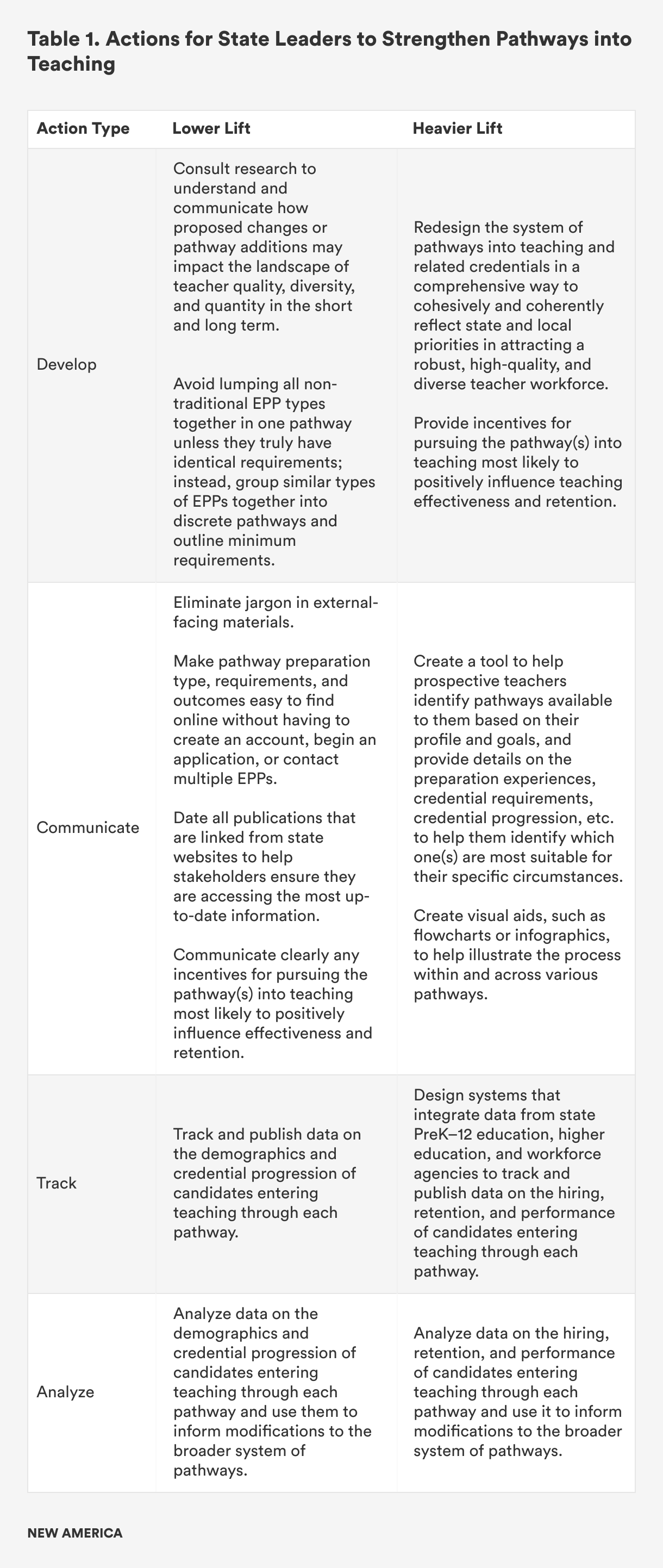
First-time pathways into teaching sit in a unique place within education. If one of these pathways was a three-legged stool, one leg would be in PreK–12 education, another leg would be in higher education, and the last leg would be in the labor and workforce space. So it follows that, in many states, the development and oversight of pathways into teaching is similarly split: responsibility for overseeing teacher preparation may sit with one entity (e.g., higher education commission), and teacher credentialing in another (e.g., professional standards board), with neither under the purview of the state education agency responsible for PreK–12 education. This somewhat fractured ownership of pathways into teaching can make them challenging to develop, communicate, track, and analyze.
Recognizing that the state entities overseeing preparation and credentialing are often insufficiently staffed for the array of responsibilities they hold, we offer simpler, low-lift recommendations in each of these four areas, as well as some heavier, but potentially more impactful ones.
Next Steps
These initial findings and guidance only scratch the surface of the abundant information contained in the Pathways to First-Time Teaching Credentials database. In the next phase of this work, New America’s Education Policy program will take a closer look at trends in specific pathway requirements, overall and through various lenses, such as the five pathway categories we have identified here. We will examine the evidence base for the various requirements that states have included, and how state requirement choices may influence the quantity, quality, and diversity of the prospective and novice teacher pool. We also plan to go deeper in profiling innovative, evidence-informed state approaches for preparing and authorizing first-time teachers that appear to balance the inherent tensions present in securing and maintaining a robust, high-quality, and diverse teacher workforce.
By clearly outlining how preparation and credential requirements intersect for each first-time pathway into teaching, we hope this database will catalyze questions and conversations across and within states about why states have chosen these pathways, with these particular requirements, to meet school staffing needs and the needs of their students.
Appendix A: Project Methodology
Initial Data Collection
Between March 2022 and April 2023, for each state and the District of Columbia, New America’s Education Policy program located, collected, and reviewed information related to available first-time pathways into teaching on publicly accessible state websites—including statutory and regulatory policies, guidance documents, and credential application forms. To validate the information collected, we engaged in email and video call correspondence with state education leaders.
When we were unable to locate a state-provided source of the information we were seeking, we relied on external sources to fill in missing data points and/or cross-check the information we had collected. Such sources include teacher preparation provider websites and staff members (e.g., American Board, Teach for America, and various university-based programs); the National Association of State Directors of Teacher Education and Credentialing’s (NASDTEC) proprietary database and annual report; and the National Council on Teacher Quality’s State Teacher Policy Database.1
Where discrepancies existed between various state sources, we flagged these for the state credentialing agency to review.
Verifying Information and Updating the Database
New America’s Education Policy program shared the information it collected in the database with each state office overseeing educator preparation and/or credentialing and asked staff to review it for accuracy. We also provided the official entity with a detailed list of questions regarding pieces of information that were unclear or were difficult to locate. When we received clarifying responses, we updated the database accordingly. We received a response from 39 states, although four of those declined to provide a review of the final database version (District of Columbia,, Louisiana, Maine, and Virginia). Non-responding states include Alabama, Alaska, Delaware, Michigan, Nebraska, New Mexico, Oklahoma, Oregon, Pennsylvania, South Carolina, South Dakota, and Wisconsin.
Appendix B: Pathways to First-Time Teaching Credentials Database User Guide
This guide explains the information included in New America’s Database of Pathways to First-Time Teaching Credentials, which covers all 50 states plus the District of Columbia.1
What Information Is Included
The database outlines the attributes of all state pathways that allow individuals to become teachers of record in a public school for the first time. To be included, a pathway must provide an individual with responsibility for a classroom and/or roster of students for the duration of at least one school year (at least 0.5 full-time equivalent). For each pathway, the database includes details about required pre-service preparation (if any); any candidate knowledge, skills, experiences, or other characteristics; and any commitments or actions that must be made by prospective employing schools. The database categorizes each pathway based on its requirements, from “full” licenses and certifications to “emergency” permits.2 With the exception of full-time, full-year substitute teaching permits, substitute teaching permits are not included.
The database does not include pathways for any currently or previously credentialed teachers (e.g., those used by teachers credentialed in one state to become licensed in another state, or by individuals prepared as teachers in other countries). It also does not include pathways to teach career and technical education (CTE) courses, highly specialized subjects (e.g., military science), or courses focused on developing a particular life skill (e.g., personal financial responsibility), as the requirements for each are typically highly specific to the individual field. However, it is possible that some pathways included here lead to credentials that can be used to teach CTE courses.
At times, state source materials only detailed credential types, not the various pathways to them. In these cases, we interpreted the eligible preparation types and other requirements to decipher the possible pathways to earning the credential.
Key Assumptions
We made some foundational assumptions in order to limit the length of entries and redundancy of phrases in the database:
- All pathways lead to teacher of record (TOR) positions, regardless of whether the accompanying credentials are called licenses, certifications, permits, or authorizations.
- For pathways that require completion of a degree- or non-degree-granting educator preparation program (EPP) to earn a credential, states require a formal recommendation for certification from the preparation entity.
- Postsecondary degrees or postsecondary teaching experience must be from a regionally or nationally accredited institution of higher education (IHE), unless otherwise specified.
- Pathways that do not require completion of a degree-granting EPP are only for approved in-state preparation providers, unless otherwise specified.
- An application to the state entity overseeing teacher licensure and certification is necessary to obtain an initial credential and to obtain any future credential in a candidate's career progression, unless otherwise specified.
- For pathways that are designed to meet a specific school need, individuals in it are excluded from teaching in any grade level, subject, and/or school type that is not explicitly specified as a pathway target.
- All licensure-area and endorsement-specific coursework requirements must be completed prior to EPP completion in order to be issued a credential in that area, unless otherwise specified.
- Some pathways may include specific subjects or fields that require a graduate degree, even if the minimum degree requirements for earning a credential via that pathway is a bachelor’s degree.
- Any reference to LEA (local education agency) offers of employment refers to employment as a teacher of record in the certification area sought, unless otherwise specified.
- The vast majority, if not all, states require some type of criminal and/or character background check that does not vary by pathway, so we have not spelled this out in the summary list of requirements for each specific pathway. We have included a column explaining whether a formal criminal background check is required, and by what entity.
Common Acronyms
ACTFL: American Council on the Teaching of Foreign Languages
AP exam: Advanced Placement exam
ASVAB: Armed Services Vocational Aptitude Battery
CEUs: Continuing education units
CTE: Career and Technical Education
EPP: Educator preparation program
ELA: English language arts
ESL: English as a second language
GPA: Grade point average
GRE: Graduate Record Examination
IHE: Institution of higher education
LEA: Local education agency
MACTE: Montessori Accreditation Council for Teacher Education
NASDTEC: National Association of State Directors of Teacher Education & Credentialing
PPAT: Praxis Performance Assessment for Teachers
STEM: Science, technology, engineering and mathematics
STEAM: Science, technology, engineering, arts, and mathematics
TOR: Teacher of record
Terminology
To enable easy comparison between states, the database uses standard terms for certain requirements with identical intent but different names across states (e.g., “subject exam” instead of “Praxis II” or “content pedagogy test”).
- “Alternative,” as used by New America’s Education Policy program in the database, refers to any pathway that does not require completion of a preparation program that results in an earned degree (although it is used by states to label an array of “non-traditional” pathways and credentials with varying attributes).
- "Approved" refers to approval by the state entity responsible for teacher credentialing and/or teacher preparation.
- “Certification-only” refers to teacher preparation programs that lead to a teaching credential, but not a degree.
- “Core subjects” refers to English language arts, math, science, and social science.
- "Educator preparation program (EPP)" refers to any bachelor's or master's degree-granting preparation teacher preparation program as well as any “certification-only” post-baccalaureate program sponsored by an IHE, LEA, or other entity, in or out of state, unless otherwise specified.
- “Endorsement” refers to the specific subject area(s) in which a teacher is certified to teach (e.g., secondary math, early childhood special education, etc.).
- "General skills test" refers to the Praxis Core Academic Skills for Educators, unless otherwise specified.
- “GPA” refers to the cumulative grade point average on a 4.0 scale at the undergraduate level, unless otherwise specified.
- "Employment" refers to a full-time teaching position in the area of certification (or intended certification) in a public school in the state, unless otherwise specified.
- “Endorsement” refers to a type of teacher certification that enables an individual to teach in a specific subject area.
- “NASDTEC Interstate Agreement” refers to a set of agreements that make it possible for an educator who completed an approved EPP in one state to earn a certificate or license in another state, provided the states are members of NASDTEC and have signed the Agreement.
- "Pedagogy performance assessment" refers to either the edTPA or the Praxis Performance Assessment for Teachers (PPAT), unless otherwise specified.
- "Reading instruction test" refers to either the Foundations of Reading or Teaching Reading assessment, unless otherwise specified.
- "Relevant subject area" refers to the specific field or subject certification or endorsement area requested.
- "Schools" refers to PreK–12 public schools, unless otherwise specified.
- "Subject exam" refers to Praxis® II or Fundamental Subjects: Content Knowledge test, unless otherwise specified.
- “Teaching credential” refers to a state-approved (and typically state-commissioned) license, certification, permit, or authorization that qualifies an individual to work as a full-time teacher in a public PreK–12 school for at least a full school year.
- "Teaching knowledge test" refers to the Praxis teaching and knowledge test, unless otherwise specified.
- "Traditional" refers to any degree-granting educator preparation program.3
Descriptions of Column Variables
- Pathway and Teaching Credential Earned (columns B and C): Provide the name and type of the overarching pathways to first-time teaching credentials (column B) and the credentials issued at the successful completion of all pathway requirements (column C). Many states have several pathways leading to the same credential type. While we tried to include the name of the credential almost exactly as it appears on state websites and/or in policy documents, we took some liberties to rename the pathways for clarity of comparison between states, while attempting to keep them recognizable to the states themselves.
- School Recruitment Need (column D): Captures whether a pathway is designed to fill positions in specific grade levels, subject areas, and/or school types. We elected not to include broad recruitment objectives that are articulated in the policy or associated documents but not specified further. In particular, we excluded:
- Objectives to address teacher shortages generally UNLESS the pathway is designed to respond to a specific LEA’s urgent documented hiring need (e.g., emergency permits).
- Objectives to recruit for “high-need” schools generally UNLESS it was clear how the pathway would specifically target these schools. An example of an exception is states that have a pathway into teaching that is only available to individuals teaching in Title I (low-income) schools.
- Candidate Profile (column E): Captures whether a pathway is designed to recruit candidates with specific attributes, such as deep subject area expertise, cultural/linguistic background, and past non-credentialed teaching experience. This column excludes vague candidate profiles, such as “career switchers” (without further specificity) or candidates who fail to meet all requirements of the standard initial credential. Note that “Subject Knowledge” (denoted in the database by a “K” in this column) must be demonstrated by having more than an undergraduate major or coursework in the field (e.g., having an advanced degree, having coursework plus professional experience, etc.).
- Excluded Certification Areas (column F): Captures which certification areas the state excludes from being obtained via the pathway, if any. Although not explicitly detailed in this column—for pathways that specify targeted grades, subjects, and/or school types in column D—any certification areas not specified in column D are implicitly excluded, although not explicitly detailed in this column.
- LEA Employment Offer (column G): Tracks whether a pathway requires candidates to receive an employment offer from a LEA in order to obtain the credential.
- Entity Requesting Credential (column H): Tracks whether a teacher candidate can submit an application for a teaching credential to the state directly (the standard approach), or whether the state requires the LEA and/or the EPP to request the credential (typically to fill a vacant position with a less-than-fully-qualified candidate).
- Conditions and/or Actions Required for LEA Credential Requests (column I): Specifies the circumstances that must exist and/or actions an LEA must take to initiate specific pathways and the associated credentials (typically demonstrating that it is unable to fill the position with a fully qualified candidate).
- General Requirements (column J): Summarizes a pathway’s requirements for obtaining a teaching credential for the first time. For the many “alternative” pathways that allow a candidate to work as the teacher of record while earning a “full” initial or standard professional teaching credential, only the requirements for earning the first credential that allows the candidate to work as a teacher of record are included here. Any requirements for further credential progression are included in column AL.
- Minimum Degree (column K): Specifies the minimum degree requirement for each pathway (e.g., requirements for “bachelor’s degree or higher” are included as “bachelor’s”).
- Minimum GPA Requirement (columns L, M, and N): Indicates whether the state requires a minimum GPA for entry (or for a degree-granting program, for exit) for the pathway, and if so, what the minimum GPA requirement is, and a characterization of whether it is high, medium, low, or very low. If a degree-granting pathway has a minimum GPA requirement for entry and exit, this column reflects the exit requirement (which is typically higher than for entry).
- General Skills Test (column O): Indicates whether the state requires a test of general knowledge and skill for pathway entry or exit, as well as whether the test needs to be passed or just taken for formative purposes. Includes teaching-specific basic skills tests such as Praxis Core, as well as more general tests, such as the ACT or SAT.
- Degree-Granting EPP (column P): Indicates whether a pathway requires enrollment in or completion of an educator preparation program that culminates in a degree in education (bachelor’s or higher).
- Non-Degree Granting EPP (column Q): Indicates whether a pathway requires enrollment in or completion of an educator preparation program that does not culminate in a degree or makes completion of a degree optional.
- Education Fundamentals Coursework (column R): Indicates whether a pathway specifies education fundamentals coursework (e.g., classroom management, student discipline) as a requirement for the first-time teaching credential. While recognizing that every EPP is unique, for this database we assumed that every “traditional” bachelor’s degree-granting EPP pathway would include some such coursework. Pathway requirements such as “training” or “institutes” are only included here if they outline specific coursework or “modules” as part of them.
- Knowledge of Teaching Exam (column S): Indicates whether a pathway requires the passage of a pedagogy test, and if so, names the required test (e.g. Praxis Principles of Learning and Teaching).
- Subject Area Coursework (column T): Indicates whether or not a pathway requires: (a) a bachelor’s degree major or minor in the subject area; (b) an advanced degree in the subject area; or (c) subject-specific coursework not associated with a degree program. Many states lay out in policy exactly which subject-specific education courses teacher candidates are required to take for each specific endorsement area. We did not attempt to review this information in detail, and instead made an assumption that every “traditional” bachelor’s degree-granting EPP pathway would include some such coursework.
- Subject Area Exam (column U): Indicates whether or not a pathway requires a candidate to pass a subject exam in the credential content area, and/or whether an alternative score is accepted under all or certain conditions. It also names the subject test (e.g., Praxis II).
- National or Statewide Performance-Based Pedagogy Assessment (column V): Indicates whether or not a pathway requires passing a performance assessment (e.g., edTPA), including those embedded as an exit requirement in degree-granting EPPs.
- Minimum Length of Pre-service Clinical Teaching Experience (column W): Categorizes the number of weeks of supervised pre-service student teaching (not including field experiences) that states require before granting the credential. Note that some states do not set a minimum and instead leave it to the discretion of the EPPs. Category breaks are based on raw internal data shared by the National Center for Teacher Quality (NCTQ) on the distribution of teacher preparation programs’ pre-service clinical experiences.4 As state clinical experience requirements employ different units of measurement (e.g., semester hours, semesters, or days), we consulted several sources to define these metrics, and ultimately convert states’ clinical teaching requirements into weeks:
- 1 week = 33.2 hours
- 1 semester = 14–17 weeks
- 1 semester hour = 45 hours
- Pre-service Mentor Qualifications (column X): Captures any qualifications required of clinical experience mentors (e.g., length of teaching experience, training, performance evaluation ratings).
- Professional Work Experience (column Y): Captures whether a pathway requires professional work experience in the credential endorsement area, in postsecondary or K–12 teaching, or in other areas, and the length of the required experience, when specified.
- Work-Based Artifacts or Demonstrations (column Z): Indicates any requirements to submit artifacts of work experience (such as publications or video footage), or to demonstrate skills (such as teaching a model lesson). It does not include resumes, recommendation letters, or writing samples.
- Formal Background Check (column AA): Indicates whether state law requires a formal FBI background check (indicated as “Y/S”), a formal LEA-led background check (“Y/L”), or just an informal, self-reported criminal history (“N”). Within each state, we assumed that if a background check is required for one pathway, it is required for all pathways.
- Other (column AB): Lists any requirements not captured in other columns. This often includes specific trainings (e.g., in recognizing/reporting child abuse) and reading instruction tests.
- Exceptions to Requirements (column AC): Indicates when there is:
- An option to pursue a less-preferred secondary option when failing to meet a specific requirement (e.g., if you do not pass the subject test, you can, as an exception, complete a certain amount of coursework in the content area).
- The ability to request a waiver for meeting a specific requirement.
- A requirement that the state explicitly says is or is not needed for certain grades or subject areas that differs from the general requirement.
- A circumstance where an additional requirement applies (e.g., if a degree was awarded more than five years ago, then additional subject coursework must be completed).
- Pathway Type (column AD): After analyzing trends across the state pathways, we categorized them into five types:
- Full: Requires completing a degree-granting EPP without exceptions or deficiencies OR passing the state’s teaching knowledge test, passing a pedagogy performance assessment, or having prior K–12 teaching experience.
- Last Mile: Requires completing an EPP with the exception of one temporary deficiency (typically failure to pass an exam or complete a course required for licensure).
- Targeted: Does not require completion of a degree-granting EPP, pedagogy testing, or prior teaching experience, but does require a specific candidate recruitment profile (e.g., native language speaker, advanced degree holder, etc.).
- Interim: Does not require completion of a degree-granting EPP, pedagogy testing, prior teaching experience, or a specific candidate recruitment profile but (1) is teacher initiated and (2) requires enrollment in an EPP.
- Emergency: Does not require completion of a degree-granting EPP, pedagogy testing, prior teaching experience, or a specific candidate recruitment profile and is either (1) teacher initiated but does not require enrollment in an EPP or (2) LEA initiated.
- Initial vs. Terminal “Full” First-Time Credential (column AE):
- Initial: A specific credential for novice teachers who have completed all requirements of an EPP; generally cannot be renewed indefinitely, and provides a first step on the path to a terminal professional license.
- Terminal: Progress to a more advanced credential is unnecessary and the credential can be renewed indefinitely, as long as certain requirements are met; typically reserved for more experienced teachers and may have a longer time frame between renewals (e.g., 5–10 years).
- First-Time Credential Validity Period (column AF): Captures the length of time the first-time credential is valid before it must be renewed, advanced to another credential, or expires.
- Ability to Continue Credential Validity Period (column AG): Indicates whether the first-time credential can be extended and/or renewed.
- How Long Credential Can be Continued (column AH): Indicates how many times and at what interval a credential can be renewed or extended.
- Requirements for Continuing Credential Validity (column AI): Describes any requirements for continuing to teach on the first-time credential.
- Total Time Can Teach Under First-Time Credential (column AJ): Provides the sum of the initial validity period and any additional credential validity periods.
- Next Credential Level (column AK): Indicates what type of credential teachers are expected to progress to after the first-time credential, if any. In some states, credentials classified as “full initial” may progress to another full initial license while, in others, progression can depend on how long an individual held the first-time credential before meeting specific requirements.
- Requirements to Progress to Next Credential Level (column AL): Indicates requirements that first-time credential holders in the pathway must meet in order to advance to the next credential level (e.g., years of teaching experience, professional development, performance evaluation ratings, testing, etc.). For terminal credentials, includes steps to voluntarily progress to a higher credential level, if this option is available.
Citations
- We attempted to collect information for Puerto Rico but were unsuccessful.
- As a general rule, teaching permits or authorizations have fewer requirements for obtainment, but have a more limited validity period; more restrictions on the teaching topic, grade span, and/or location; and more oversight than licenses or certifications (although some states use the license and certification labels for all pathways, including more restricted ones). For more details on how New America is defining “full,” “interim,” and “emergency” credentials, see the Findings section of this report, or the User Guide in the Appendix.
- While many states use the term “traditional” to refer to a degree-granting EPP pathway, some states include both bachelor's and advanced degree programs in their "traditional" definition, while others only include bachelor's programs. Others include any IHE-based EPP. To avoid confusion, New America has labeled pathways with more specific descriptive terms to ensure clarity.
- Email from Hannah Putman, National Council on Teacher Quality, to Melissa Tooley, May 25, 2022.
More About the Authors
Melissa Tooley
Director, Educator Quality