
Building a Secure, Scalable Digital Solution: From Pilot to Expansion
Progress in the public sector is often nonlinear, and political dynamics and bureaucratic constraints can introduce expedited timelines, delays, or obstacles that conflict with proper agile, data-driven, and user-centered development. We share a brief operational narrative as an example in transparency, not as the only way to spark better outcomes in the digital government ecosystem.
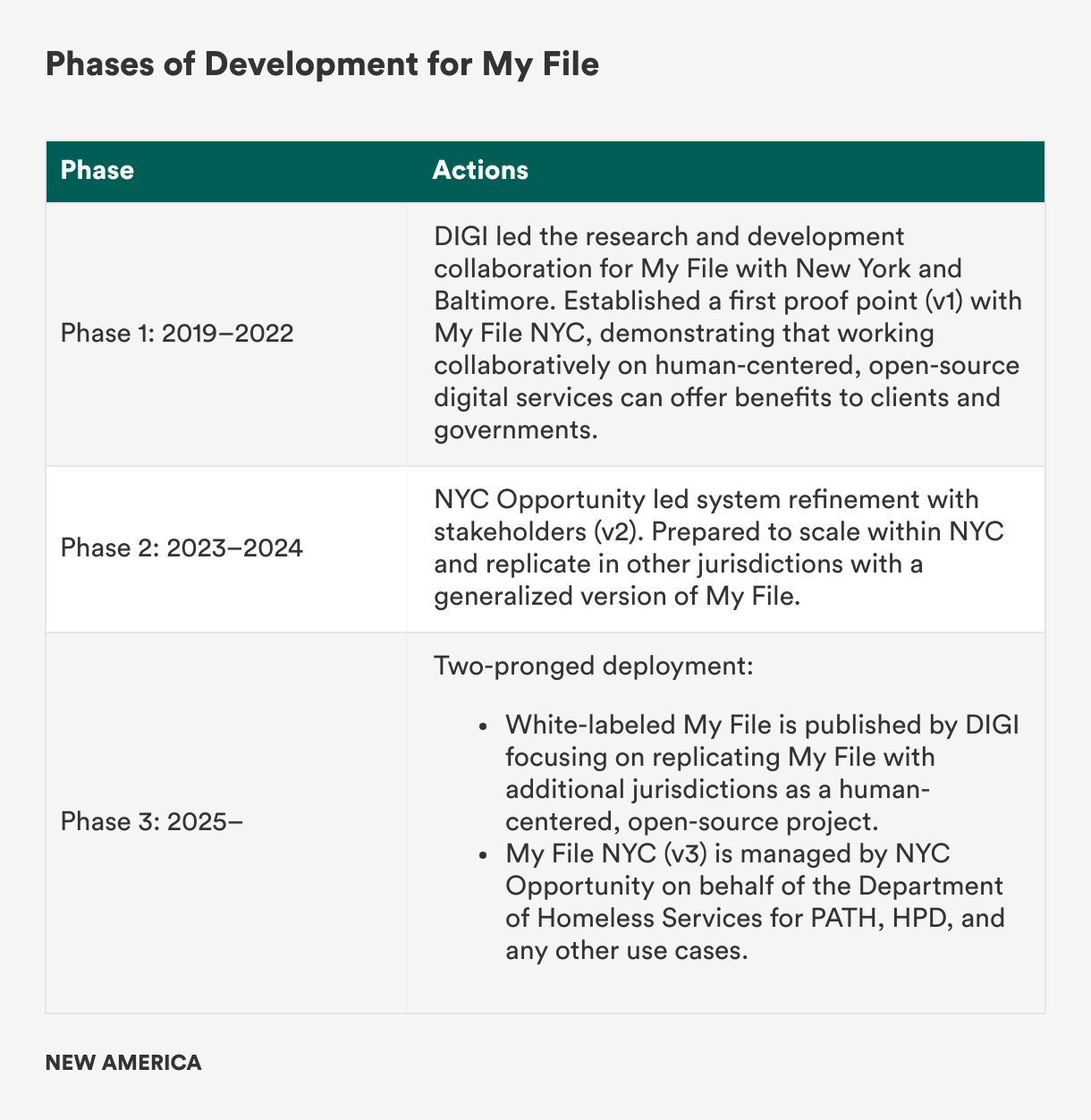
Phase 1: Design and Pilot
Research
DIGI collaborated with NYC Opportunity and the Baltimore Mayor’s Office of Homeless Services to define the scope of a shared challenge, develop an implementation strategy, and build a core codebase for a secure document storage and sharing platform. User research integrating lived experience informed the design of a mobile-first website that allows residents to easily and securely store and share vital documents when applying for public services. Understanding the nuances of the work was critical, leading to close partnerships with city departments that provide public health and human services. Cybersecurity, data governance, and terms of use are also key considerations in the system’s development.
Minimum Viable Product
After an open request for proposals (RFP) for core code development, DIGI selected Two Bulls. The first version of the system, launched in Baltimore under the name “My Digital Data Locker” in 2021, faced challenges due to the COVID-19 pandemic. Each jurisdiction adapted the core code to meet specific needs, with Baltimore opting for a managed service (SaaS) approach while New York City customized the system with internal engineering talent and Blenderbox.
Requirements
Stakeholders identified system requirements, key features, and integration methods that would not disrupt existing operations. NYC Opportunity manages the system in collaboration with the Department of Homeless Services (DHS) and the Prevention Assistance and Temporary Housing (PATH) intake center. The platform is optimized for NYC’s technology services including the centralized public identity management application (NYC.ID). These efforts pave the groundwork for a robust and scalable implementation tailored to the city’s unique needs.
Launch
My File NYC was launched as a limited-scale pilot in partnership with PATH. Families with children seeking temporary housing were given an option to use My File NYC for securely storing and sharing their essential documents. The pilot aimed to serve 500 families while managing a backlog of additional features. The successful deployment provided valuable insights into user behavior and system performance, allowing for further refinements.
Proof of Concept
The first phase validated the proof of concept, showing strong acceptance among both residents and PATH administrators. Despite initial challenges in Baltimore, lessons learned from that deployment contributed to the implementation in New York, where the system has remained live since 2022, highlighting the potential for further growth and accessibility improvements. With a solid foundation, My File NYC is well positioned for continued expansion and enhancement.
Phase 2: Improve, Scale, and Replicate
User-Centric Upgrades
My File NYC was upgraded in 2023, with significant iterations on the code, design, usability, security, and infrastructure to better meet the needs of both clients and staff. As part of the upgrade and in response to feedback from users, the team added 13 human-translated languages going beyond Local Law 30 and shared outreach materials, such as flyers and a looping get started video at PATH to boost user engagement.
Replatforming
In parallel with user-centric enhancements, the NYC team embarked on replatforming efforts with a new data architecture model. The underlying infrastructure is completely rebuilt, making it easier to maintain and scale while introducing agency-based workflows, document checklists, re-upload capabilities, communicating and sharing documents from the city to clients, and other enhanced features.
Scale and Replication
As the system matured and prepared to scale in New York, DIGI prepared for solution replication outside of the city. We developed a white-labeled, open-source version that incorporates its own authentication functionality, independent of the NYC.ID-reliant login system. We also explored replication models that address operational deployment, documentation, contracting, and capacity considerations to ensure effective adoption.
Technical Support
To further strengthen the platform, we added a dedicated engineer to the replication team and hosted a listening tour to gather feedback from external peers and people-first tech organizations. We also sought the technical expertise of a public benefit corporation, Exygy, for an assessment of the quality of the code (on items such as modularity, clarity, documentation, and ease of deployment by a new jurisdiction).
Recognition
The My File NYC pilot was awarded “Best IT Collaboration” at the New York City Technology Forum’s 2023 Best of NYC Awards for the partnership between the DHS PATH Intake Center and the NYC Opportunity team. The system was showcased at BenCon2024. It is also included in the Digital Gov Hub, managed by the Beeck Center for Social Impact + Innovation at Georgetown University and the American Public Human Services Association.
Phase 3: Code Publication and Beyond
Two-Pronged Deployment
- The white-labeled My File code is independent of a jurisdiction or use case and is essential for replication outside of New York. It will need to be customized for deployment by use case. We are focused on replication opportunities with additional jurisdictions interested in human-centered service delivery.
- Based on the success of the deployment in New York across the two phased approach, the project is scaling to an additional housing-related use case. My File NYC (v3) is scaling in New York City and is managed by NYC Opportunity, working in collaboration with the Department of Homeless Services for PATH, Housing Preservation and Development (HPD), and other potential use cases. More information about My File NYC can be found online.
Flexible Application and Focus on Modularity
My File can be customized to meet the needs of future implementers. Tools and services that can be used in a variety of contexts or designed to meet common challenges in administering public programs and services tend to make for more scalable and spreadable digital public goods than software solutions built for narrow use cases.
Code
The solution code and documentation in GitHub is accessible and thorough. It contains the deployment scripts for the My File platform and serves as the central documentation hub. We created a project Wiki with comprehensive information about My File—including how to use it, detailed technical documentation, and guidance on making contributions to the system—and welcome feedback and suggestions for improvements. Additionally, the Wiki has a troubleshooting guide and a roadmap covering future improvements and known limitations.
License
Feel free to use, modify, and distribute the My File code in accordance with the terms of the MIT license.
Replication Outside of New York City
We continue to explore replication models that address operational deployment, documentation, contracting, and capacity considerations to ensure effective adoption. The rest of this report details our findings on these fronts.