
Multi-seat Districts and Larger Assemblies Produce More Diverse Racial Representation
This brief is part of a series by the Electoral Reform Research Group, a collaboration between New America, Stanford University’s Center on Democracy, Development, and the Rule of Law, the American Enterprise Institute, and the Unite America Institute. To find the full report of the study summarized below, click here.
Overview
This study considers the relationship between electoral systems and racial representation in legislative office. Recent scholarship in comparative politics has shown that three components of electoral systems—the number of seats being contested per district (district magnitude), the size of assembly or council, and the rules that allocate seats from votes (electoral formula)—together are highly predictive of the number of political parties that run for and win seats in a country’s legislature. To test how well these components can account for racial representation as well, we examine election results from 159 ethno-racially diverse cities in 13 U.S. states, as well as in Australia, Ireland, and the Netherlands, between 2010–2019. We find that larger assembly size and more contested seats per district are associated with more parties representing communities of color. Our results suggest that these basic electoral system features should figure more prominently into U.S. debates about electoral reform.
Research Questions
- Can electoral system models explain variation in municipal racial representation?
- How does the product of assembly size (S) and district magnitude (M), known as the Seat Product, shape racial diversity in municipal government?
- To what extent can the Seat Product and racial composition account for the number of parties electing candidates of color?
Key Findings
- Larger assembly size (S) and district magnitude (M) are both associated with more parties electing candidates of color.
- Larger Seat Product (MS) is associated with more parties electing candidates of color.
- A logical model of Seat Product and racial composition accounts for about three-quarters of variation in the number of parties electing candidates of color.
Background and Research Design
Our goal is to use recent advances in electoral systems theory to model the constraints of institutions on party competition and, by extension, the election of ethnic and racial minorities. We start from the premise that collective actors such as political parties and coalitions associate in elections for the purpose of winning seats,1 then give strategic attention to the number of seats they can win under given electoral conditions.2 Those electoral conditions include society’s underlying diversity in tandem with the "electoral system," which can be broken down into three key components: 1) the size of the elected council or assembly (S); 2) the number of seats being contested per district, or district magnitude (M); and 3) the rules that allocate seats from votes, also known as the electoral formula (f).3
We have collected data on the partisan affiliation (including candidates in nonpartisan elections who affiliate with a party), race, ethnicity, and gender of candidates in elections for nearly 200 cities, and have complete data for 159. While some official election data include party and gender (the Netherlands), most candidate traits were coded using a combination of candidate social media, party lists, and third-party voter information websites. Where possible, race was coded for six categories, White/European (Non-Hispanic for U.S. cases), Hispanic/Latinx (U.S. cases), Black/African/Afro-Caribbean, Asian, Arab/Middle Eastern, and South Asian/Indian, using a combination of surname, name origin, images, and additional candidate information. For comparative purposes, we identify candidates of color as other than White/European.
We measure votes for parties by aggregating votes for their candidates, and assign candidates to parties using the following rules. First, we try to assign a party to every candidate. In municipal elections, many of which are nonpartisan (in most U.S. cities in the sample candidates are prohibited from running under party labels), there are “independent” candidates and local political parties, which may run under the label of an independent group. For officially nonpartisan elections, every effort was made to identify candidates with a political party or partisan organization that endorsed, financially supported, or could be linked to a candidate in online campaign material. If no information could be found about a candidate, party affiliation is coded "missing data." Meanwhile, if available information consistently suggests no party affiliation, the candidate is coded “independent.” Finally, every independent is treated as their own party.4
Building off Shugart and Taagepera’s Seat Product Model,5 we expect that, on average, the number of parties electing candidates of color will be the total number of seat-winning parties, weighted by the percentage of residents of color living in a city.
Findings and Implications
As shown in Figure 1, there appear to be slightly more parties electing candidates of color on average than what the logical model predicts, but an adjusted model that reduces the weighting by residents of color is a strong fit.6 These results confirm expectations that electoral system features are closely tied to racial representation.
One major takeaway is that U.S. reliance on small assembly sizes, single-seat districts, and winner-take-all electoral rules may limit the number of parties that effectively compete for voters of color. As a point of comparison, some of the most diverse Australian cities that use multi-seat ranked-choice voting systems (single transferable vote) may not achieve perfect proportional representation, but they nevertheless elect candidates of color from multiple parties. Cities in the Netherlands elect candidates of color from multiple parties, and across the ideological spectrum. Overall, many systems (including majoritarian) can approximate proportionality in representation, but larger assembly size and district magnitude are associated with more diverse representation among candidates of color across different political contexts.
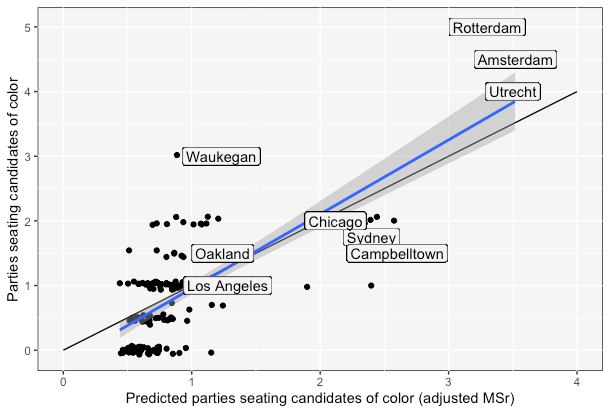
Note: The black line reflects the logical predictive model, the blue line reflects the empirical best fit.
Regardless of electoral system type, as the percentage of residents of color increases, parties generally win a larger percentage of seats with candidates of color. But we find that cities with larger assemblies also have more capacity for parties to elect candidates in terms of absolute numbers. For example, Chicago’s city council seats more than twice as many candidates of color compared to Los Angeles, even though Los Angeles has over a million more residents.
In addition, we find the number of parties represented by candidates of color varies greatly across the racial composition of cities. In U.S. cities, the Democratic Party dominates racial representation relative to other parties. Indeed, the Democratic Party is the only party representing voters of color in most U.S. cities, even in cities where voters of color are in the majority. We do see a handful of Republican, Democratic Socialist (DSA), and independent candidates of color winning seats. Again, a (relatively) larger assembly like Chicago has room to seat more Democratic Socialists than a smaller assembly like that of Los Angeles. The DSA now seats 10 percent of the Chicago council, which is no small feat. Nevertheless, in line with our expectations, we find the partisan diversity of racial representation in U.S. cities to be relatively truncated compared to other racially diverse cities around the globe.
Conclusion
Voting rights advocates and reformers have given significant time and energy to securing representation for historically marginalized groups. The primary means of doing so has been to create single-seat districts—sometimes with a larger assembly, but often not. The results of our research suggest more attention should be paid not just to assembly size but to district magnitude. Additionally, there should be more emphasis on overall population proportionality as well as the number of parties. Our report shows that basic electoral system features are jointly associated with the number of parties that run and elect candidates of color across a variety of national contexts.
So far, we have not been able to say much about specific allocation rules (e.g., single- and multi-winner ranked-choice voting, list proportional representation, and so on). But we show that the Seat Product (MS) matters, and this gets us part of the way. Future research should develop more precise estimates of how variations in electoral rules shape the expression of racial diversity. With more cases of low-magnitude (3–10 seat) elections, we will be better able to test the extent to which allocation formulas reduce or enhance the proportionality of racial and partisan representation.7 Further analysis of these dynamics may eventually lead to new insights about the logical connections between electoral system design and proportionality in the voting strength of racial and multi-racial coalitions, which has direct bearing on the political equality of all voters.
Acknowledgments
We are grateful for the suggestions and input from participants of the Electoral Reform Research Group (ERRG) workshop in February 2020. This project was funded by New America through their ERRG initiative, with support from Arnold Ventures. We thank our research assistants Neila Patino, Jamie Ormiston, and Medina Talebi, the research team at the Center for Science and Democracy at the Union of Concerned Scientists.
Downloads
Citations
- John Aldrich, Why Parties? The Origin and Transformation of Political Parties in America (Chicago: University of Chicago Press, 1995).
- Gary W. Cox, Making Votes Count: Strategic Coordination in the World’s Electoral Systems. (Cambridge: Cambridge University Press, 1996).
- Octavio Amorim Neto and Gary W. Cox, “Electoral Institutions, Cleavage Structures, and the Number of Parties.” American Journal of Political Science 41 (1): 149-174.
- This differs from standard practice in comparative study of national-level samples, which is to discard independents. In the United States, and especially in American local government, independents are too important to be omitted in the usual way.
- The Seat Product Model is developed in Taagepera, Predicting Party Sizes; further elaborated in Matthew S. Shugart and Rein Taagepera, Votes from Seats: Logical Models of Electoral Systems (Cambridge, United Kingdom ; New York, NY, USA: Cambridge University Press, 2017), and summarized in Rein Taagepera and Matthew Shugart, “Predicting Party Systems from Electoral Systems,” Oxford Research Encyclopedia of Politics, August 27, 2020, source.
- The practical relevance of this sort of model fitting is that it reduces the influence of city racial composition on the prediction, that is, the institutions matter more. This is somewhat complementary to the findings in chapter 15 of Shugart and Taagepera, 2017.
- Andrew C. Eggers and Alexander B. Fouirnaies, “Representation and District Magnitude in Plurality Systems,” Electoral Studies 33 (March 2014): 267–77, source.
More About the Authors

Jack Santucci
Matthew S. Shugart