
Moving Up: Lessons from TAACCCT on Career Pathway Progression
Table of Contents
- Introduction
- Growth of Career Pathways
- The TAACCCT Grant Program
- Scaling Up Career Pathways Through TAACCCT
- Data and Methods
- Analyzing TAACCCT Grants Using the Career Pathways Framework
- TAACCCT Grants Integrating Career Progression
- More TAACCCT Grants Which Include Career Progression
- Recommendations
Abstract
Through the Trade Adjustment Assistance Community College and Career Training (TAACCCT) grant program, the federal government charged community colleges across the country with two things: training adults who had lost their jobs so they could regain employment and providing the education needed for those still working to be able to move up career ladders. Now, as health and economic concerns rise in this time of COVID-19, disproportionately impacting racially minoritized populations, low-income groups, and women, we need to understand how the TAACCCT investment worked and how it could inform future policy and practice.
Acknowledgments
I want to thank Lumina Foundation for the generous support that made this work possible. I am grateful for the insights and encouragement I received from members of the Center for Education & Labor at New America (CELNA) team, including Mary Alice McCarthy, Iris Palmer, Ivy Love, and Sophie Nguyen, as well as Sabrina Detlef. I am also grateful to Elizabeth Apple Meza and Grant Blume who collaborated on the first phase of this project and to Barbara Endel who partnered to synthesize career pathways research outside of TAACCCT that created the analytical framework for this brief. Finally, I want to express my gratitude to the many TAACCCT grantees and third-party evaluators who participated in interviews and guided my thinking on career pathways progression and upward mobility.
Downloads
Introduction
Joe Parker1 grew up in Salt Lake City and spoke fondly of his family’s love and support. His face lit up thinking about childhood but took on a pained expression when reflecting on high school. Except for “hands-on” classes, Joe found school irrelevant to what he wanted to do with his life, though life after high school wasn’t all that clear either. Several years after graduating, Joe still wasn’t making enough to move out of the house. Sharing his frustrations, a friend suggested talking to someone at Salt Lake Community College (SLCC).
Joe was nervous the first day he stepped on SLCC’s main campus. No one in his family had gone to or even talked much about college. He had doubts about whether college would be a good fit, given his experience with high school. He worried that he would not know what to say or how to explain his situation. Could anyone at SLCC really help him? Would they even care?
What Joe found at SLCC changed his path forward. Unbeknownst to him, adult learners are a top priority for SLCC, just like most community colleges across the country. In its comprehensive mission to serve over 1 million residents of Salt Lake Valley, SLCC seeks to meet the needs of a diversity of learners. To help address high unemployment during the Great Recession, SLCC secured funds from the federal Trade Adjustment Assistance Community College and Career Training (TAACCCT) program.
Using TAACCCT to enhance and expand SLCC’s programs and services for adults, Joe got the support he needed to move forward. Advisors encouraged him to participate in a “career pathway” program that offered coordinated and interconnected services – academic and employment advising, financial assistance, and more – designed to help him progress toward a career. For Joe and many others who come to community college for help, career pathways offer the clarity of purpose and support needed to move on with life.
Citations
- This story was developed from an interview conducted by the author on February 2, 2017 as part of a third-party evaluation of a round 4 TAACCCT grant secured by Salt Lake Community College. A pseudonym is used to protect the interviewee’s privacy.
Growth of Career Pathways
Focused on strengthening the workforce and economy in recent years, the seeds for career pathways were planted decades ago. Since the United States increased its investment in higher education in the mid-1960s, college enrollment has accelerated, from about 8.5 million in 1970 to nearly 20 million in 2017.1 Community colleges do the lion’s share of educating historically underserved students by offering a wide array of programs and services. Fulfilling this comprehensive mission, community colleges prepare students for sustaining-wage employment, as well as transfer and baccalaureate attainment.
Public policies supporting the creation of logically structured pathways through community colleges are endorsed by at least 12 federal agencies whose leadership signed off on a common definition that emphasizes skills development and career advancement in high-demand industry sectors. Career pathways are authorized in both the Workforce Innovation and Opportunity Act (WIOA) of 2014, administered by the U.S. Department of Labor (DoL), and the Strengthening Career and Technical Education for 21st Century Act, overseen by the U.S. Department of Education.2 These federal policies support state and local efforts to build career pathways that facilitate employment and progress in careers.
President Obama called for higher education to address the economic hardship that Americans faced during the Great Recession. His administration’s goal to increase college completion emphasized the importance of integrating postsecondary education with workforce development to get America back to work. Community colleges were tapped as the higher education institutions to carry out this charge, and career pathways were the preferred means of accomplishing it.
Citations
- Table 303.30 in the National Center for Education Statistics Digest of Educational Statistics presents higher education enrollment in the United States from 1970 to present and includes enrollment projections through 2027, source
- For additional information on federal policies supporting career pathways, see Lauren Eyster, “Pathways to Success through Career and Technical Education: Developing and Evaluating Community College Career Pathway Initiatives,” in Career Pathways: From School to Retirement, ed. Jerry W. Hedge and Gary W. Carter (New York: Oxford University Press, 2020), 36–61; and Judy Mortrude, Better Together: Career and Guided Pathways (Washington, DC: Center for Law and Social Policy, 2018), source
The TAACCCT Grant Program
Through the TAACCCT grant program, the federal government charged community colleges across the country with two things: training adults who had lost their jobs so they could regain employment and providing the education needed for those still working to be able to move up career ladders.
Credential attainment linked to good jobs was the centerpiece of TAACCCT, and this policy trained impressive numbers. Over 2,500 occupational-focused programs of study were created or improved in this large-scale nationwide effort to implement career pathways. In preliminary data reported on all four rounds of TAACCCT, a team of researchers at the Urban Institute reported in 2017 over 300,000 enrollments by mostly adult learners representing a diversity of racial and ethnic backgrounds, primarily white, Black, and Latinx.1 Persons with disabilities, veterans, Pell-eligible, and Trade Adjustment Act (TAA)-eligible recipients enrolled in TAACCCT, though their numbers were more modest than hoped.
Results of the TAACCCT grant program continue to emerge since federal funding ended two years ago, in fall 2018. Now, as health and economic concerns rise in this time of COVID-19, disproportionately impacting racially minoritized populations, low-income groups, and women,2 we need to understand how the TAACCCT investment worked and how it could inform future policy and practice. Gathering information on career pathways is important to addressing persistent inequities in education and employment. Researchers at Georgetown University note the potential of career pathways contribute to educational attainment and upward mobility.3 Claiming college degrees go hand in hand with good jobs, they argue populations detrimentally impacted by crises such as the Great Recession and now COVID-19 have much to gain from a robust career pathways approach.
Citations
- For additional information about initial results of the TAACCCT grant program, see Christin Durham, Lauren Eyster, Kelly S. Mikelson, and Elissa Cohen, Early Results of the TAACCCT Grants (Washington, DC: Urban Institute, 2017), source
- Research conducted by the Economic Policy Institute informing this discussion included the blog by Heidi Shierholz, “Almost Four Months In, Joblessness Remains at Historic Levels,” Working Economics Blog, Economic Policy Institute, July 9, 2020, https:// www.epi.org/blog/almost-four-months-in-joblessnessremains-at-historic-levels-congress-must-extend-theextra-600-in-ui-benefits-which-expires-in-a-littlemore-than-two-weeks/
- For additional evidence of the relationship between college-going and sustaining-wage employment, see Anthony P. Carnevale, Tamara Jayasundera, and Artem Gulish, Good Jobs Are Back: College Graduates Are First in Line (Washington, DC: Georgetown University Center on Education and the Workforce, 2015), 3, source. edu/cew-reports/goodjobsareback/
Scaling Up Career Pathways Through TAACCCT
Between 2011 and 2018, the federal government made an unprecedented investment in community colleges to help get Americans back to work. In a nutshell, the TAACCCT grant program funded new and improved integrated workforce training and postsecondary programs in industry sectors recognized as integral to stimulating state and local economies. In total, 256 grants equaling nearly $2 billion were awarded to single postsecondary institutions and multi-institutional consortia. Eighty-six percent (630) of 729 institutions funded by TAACCCT were community colleges.1
The significance of TAACCCT on building the capacity of community colleges cannot be overstated. More than any other federal grant program in U.S. history, TAACCCT targeted community colleges as the primary provider of education and training for unemployed and underemployed adult workers. TAACCCT had another important impact unknown at the time of its passage and that is the blueprint it provided community colleges for recovery from crises such as the one we face now. As COVID-19 spreads, disproportionately impacting Black, brown, and low-income populations, TAACCCT offers lessons on how community colleges can help the nation recover from the pandemic.2
Through TAACCCT, career pathways became the mechanism for delivering high-quality credentials, extending from short-term, non-degree certificates to college degrees. From the first solicitation for grant application (SGA) in 2011, the U.S. Department of Labor incentivized implementation of new and improved programs and services in single institutions or consortia of institutions in each of the 50 states and U.S. territories. In the SGA, the DoL emphasized the uniquely important role community colleges play to “create tailored education and training programs to meet employers’ needs and give students the skills required to obtain good jobs, earn family-sustaining wages, and advance along a career pathway.”3 TAACCCT envisioned partnerships involving community colleges, workforce development, and employers in service to their communities as the driver of economic recovery.
Evaluation conducted by researchers at the Urban Institute confirms the importance of career pathways in the TAACCCT grants. Urban Institute researchers confirmed community colleges used TAACCCT to create a wide range of programs and services aligned with the career pathway approach. They observed TAACCCT was instrumental in “support[ing] the creation of career pathways by developing stackable credentials, most typically in the form of certificates,”4 noting these credentials support employment in health care, manufacturing, information technology (IT), energy, and other industries important to revitalizing local and state economies.
Other results published in the federal evaluation of TAACCCT show promising employment outcomes, and additional analysis of TAACCCT evaluation studies further support these findings. For example, a team of researchers affiliated with DVP-Praxis, LTD worked with third-party evaluators to re-analyze data from seven TAACCCT consortia involving 49 colleges in eight states. This study concluded TAACCCT participants who completed non-degree credentials were more likely to be employed than comparison groups who did not finish these credentials.5 Moreover, the findings showed credentials of six months to two years produced stronger employment outcomes than shorter term, non-degree credentials of less than six months, lending credence to career pathways that emphasize career progression and upward mobility.
Citations
- Elissa Cohen, Kelly S. Mikelson, Christin Durham, and Lauren Eyster, TAACCCT Grantee Characteristics (Washington, DC: Urban Institute, 2017) source
- Additional discussion of the potential for community colleges to contribute to recovery in the early days of COVID-19 appears in Debra Bragg, “How Community Colleges Can Help America Recover from COVID-19,” EdCentral (blog), New America, April 22, 2020, source
- On page 3 of the SGA, the DoL emphasized the important role community colleges play to “create tailored education and training programs to meet employers’ needs and give students the skills required to obtain good jobs, earn family-sustaining wages, and advance along a career pathway,” source
- For more information on occupationally focused strategies employed in TAACCCT see Lauren Eyster, Elissa Cohen, Kelly S. Mikelson, and Christin Durham, TAACCCT Approaches, Targeted Industries, and Partnerships (Washington, DC: Urban Institute, February 2017), source
- For a full discussion of the secondary analysis of TAACCCT evaluation studies, see Jessa Lewis Valentine and Janelle Clay, Non-Degree Credentials Provide Value for Adults in the Labor Market (Indianapolis, IN: DVP-PRAXIS, July 2019), source
Data and Methods
Our team’s study of TAACCCT began almost three years ago when we analyzed approximately 220 third-party evaluation reports.1 This research confirmed that career pathways implementation was widespread in TAACCCT grants, with evaluators reporting the career pathways included stacked and latticed credentials, comprehensive student supports, credit for prior learning, and partnerships with employers and workforce agencies emphasizing employment and economic recovery.
Using meta-analysis methodology, we dug deeper into 36 evaluation reports that our team determined had used some of the most rigorous methods to estimate the average effects of TAACCCT grant programs on student outcomes. Our research team found positive effects on both education and employment outcomes for TAACCCT participants, with the magnitude of effects being greater for program and credential completion than post-program employment and pre- to post-program wage change.2
These promising results and emerging findings from the federal evaluation of TAACCCT, as well as other secondary analysis3 encouraged us to dig even deeper with our research, to determine what more TAACCCT could contribute to guiding future policy and practice.
Citations
- Phase one of this research on TAACCCT is discussed by Ivy Love and Debra Bragg, “What Can TAACCCT Teach Us? Leveraging Past Lessons for the Future of Work,” EdCentral (blog), New America, October 9, 2018, source
- Results of this meta-analysis are discussed in Grant Blume, Elizabeth Meza, Debra Bragg, and Ivy Love, Estimating the Impact of the Nation’s Largest Single Investment in Community Colleges (Washington, DC: New America, 2019), source
- Results of additional secondary analysis of TAACCCT third-party evaluations are summarized in Impacts of Key Community College Strategies on Non-Degree Credential Completion by Adult Learners (Indianapolis, IN: DVP-PRAXIS, November 2019), source
Analyzing TAACCCT Grants Using the Career Pathways Framework
To better understand career pathways and career progression, we analyzed the same 36 third-party TAACCCT grant evaluations that were included in the meta-analysis using a career pathways framework developed by Bragg, Endel, and colleagues at Jobs for the Future as part of What Works for Adult Learners.1 In this framework, three dimensions of career pathways are identified as (1) pathway entry, (2) integrated training and education, and (3) career progression.
By pathway entry, we mean workforce development and training strategies, often non-credit in nature, that are designed to prepare students for education at the postsecondary level, including credit-bearing courses, and placement in entry-level employment. Pathway entry strategies include bridges, bootcamps, fast-track training, and other approaches found in the Integrated Basic Education and Skills Training (I-BEST), Accelerating Opportunity and similar models.2 By integrated training and education, we mean blending of workforce development and training (non-credit or credit) with postsecondary occupationally focused credit education that leads to employment, beyond entry level. By career progression, we mean postsecondary education and training that enables career advancement so individuals can move up career ladders, including advancing through middle-skill occupations to professional-level employment. Career progression emphasizes the sequencing of programs of study with aligned high-quality credentials leading to associate as well as bachelor’s (or higher) degrees. This vision of career pathways recognizes career progression that enables workers to move up not as an “add-on” strategy, but as necessary for upward educational and economic mobility.
Using this framework, we studied the extent to which pathway entry, integrated training and education, and career progression were planned and executed in the TAACCCT grants. We re-analyzed the 36 third-party evaluation reports included in our earlier meta-analysis,3 and we supplemented these data with qualitative interviews with evaluators and grant personnel. We also compared these results to earlier results of the What Works for Adult Learners study, to provide further evidence of how career pathways were structured and implemented in the TAACCCT grants.
First, looking at findings from the What Works for Adult Learners study, we found only one-third of 16 evaluation studies funded by the federal government, mostly DoL or the Department of Health & Human Services, or private foundations, integrated career progression into career pathways. Instead, most career pathways focused on short-term credentials and did not include college degrees, with some also not including college credit. These pathways tended to prioritize student access to training for entry-level employment over advancement to postsecondary education and employment.
Next, applying the career pathways framework to the 36 evaluation studies included in our meta-analysis, we found 31 evaluations explicitly referenced career pathways as an overarching approach to TAACCCT and of these 31, two-thirds integrated career progression. This is a major difference from career pathways evaluations reported in What Works for Adult Learners that is worth exploring. One reason for this difference may be that the TAACCCT grant program emphasized transfer and articulation as a core element, encouraging higher education institutions to accept academic credit associated with career pathways. The prominent role of postsecondary career and technical education (CTE) programs that culminate in associates degrees, such as nursing and engineering technology programs, may have contributed to career progression too. Other strategies emphasized by TAACCCT may have also reinforced career progression, including the use of stacking and latticing credentials and articulation agreements linking applied associate degrees to bachelor’s of applied science degrees.
Having noted the promising development of career progression under TAACCCT, we also want to acknowledge the challenges faced. Numerous evaluations commented on grants falling short of goals to create transfer and articulation agreements. Some grantees limited plans to create credit-bearing course sequences and abandoned attempts to enhance transfer options. Given the importance of career progression to upward mobility, we need to know more about how career pathways integrate career progression in the context of TAACCCT.
Citations
- For background and further discussion of the career pathways framework, see Debra Bragg, Barbara Endel, Nate Anderson, Lisa Soricone, and Erica Acevedo, What Works for Adult Learners: Lessons from Career Pathway Evaluations (Boston, MA: JFF, July 2019), source
- Additional information can be found on Integrated Basic Education and Skills Training (I-BEST) at source and Accelerating Opportunity at source
- A full discussion of the initial meta-analysis methods and results pertaining to TAACCCT appears in Blume, Meza, Bragg, and Love, Estimating the Impact.
TAACCCT Grants Integrating Career Progression
In this next section, we describe three round four TAACCCT grants in the healthcare, biosciences, and manufacturing sectors. Table 1 provides a snapshot of each of the three grants, and additional information about these grants and third-party evaluation results can be downloaded from the SkillsCommons website.1
Table 1. Industry Sectors and Cases on Career Progression
| Grant | Sector | Type | State |
|---|---|---|---|
| Advancing Careers and Training (ACT) for Healthcare in Wisconsin | Healthcare | State Consortium | WI |
| Building Illinois’ Bioeconomy | Healthcare | State Consortium | IL |
| Advanced Manufacturing to Compete in a Global Economy (AMCGE) Training Program | Manufacturing | Single Institution | OH |
Wisconsin’s Advancing Careers and Training for Health Care Consortium
Possibly no state was as prepared for TAACCCT as Wisconsin. Along with Illinois and Minnesota, Wisconsin had already made good progress in implementing career pathways through the Joyce Foundation’s Shifting Gears initiative.2 Beginning in 2007, the Wisconsin Technical College System (WTCS) partnered with the Department of Workforce Development to develop Regional Industry Skills Education (RISE), a statewide model for integrating workforce training and postsecondary education to prepare for high-demand jobs.3
The Advancing Careers and Training for Healthcare (ACT for Healthcare) grant was the state’s third successful TAACCCT award. Earlier grants focusing on advanced manufacturing and information technology laid the foundation for the $15 million healthcare consortium grant that sought TAA-eligible workers, veterans, and others seeking employment.4
All 16 technical colleges that are part of WTCS signed on to the ACT for Healthcare grant, in partnership with employers across the state. Job projections at the time this grant was funded in September 2014 were larger than any other industry sector and expected to increase by 43 percent by the grant’s end in 2018. Although healthcare programs were already considered some of the most robust career-technical programs offered by WTCS, they could not meet the state’s demand for workers.
In this time of COVID-19, these programs are more essential than ever. Leaders of the Wisconsin Hospital Association describe the state as “under siege from an influx of COVID-19,” and urge the governor and state legislature to take immediate action to address the state’s healthcare workforce shortage or face more dire consequences.5
Drawing lessons from RISE and previous TAACCCT investments, Wisconsin’s technical colleges combined curricular and instructional innovations, comprehensive student services, and industry partnerships to prepare healthcare workers statewide. And results of a rigorous evaluation show these efforts paid off.6 The ACT for Healthcare consortium grant produced 14 new credentials in the form of certificates, diplomas, and degrees aligned with high-demand occupations, including emergency medical technicians, respiratory therapists, surgical technicians, and registered nurses.
Central to the consortium’s plan were innovations to the nursing pathway, including advancements in online and hybrid instruction, accelerated programming, enhanced simulations, and program-to-program bridges that integrate credit for prior learning to accelerate credential attainment. These strategies bolstered college capacity to address the state’s healthcare workforce shortage following the Great Recession, and today, may offer insights into how to address workforce needs caused by COVID-19.
The program-to-program bridges created for nursing are a good example of how career progression works in career pathways. Bridges created in the ACT for Healthcare grant help students who already have experience as VA medics or paramedics enroll in and complete nursing degree programs. These bridges offer a common four-course curriculum, with two courses in theory, one in a skills lab, and one in the clinical setting that enable students to enter the second year of the nursing program and continue alongside those enrolled in the traditional curriculum.7 By integrating credit for prior learning into the bridge, experienced learners avoid repeating courses that increase time and cost in pursuit of their nursing degree.
The third-party evaluation team with DVP-Praxis reported the nursing pathway had the largest enrollment of all TAACCCT-funded programs in the ACT for Healthcare grant, with 66 percent of nearly 4,000 participants.8 Several nursing-related programs of study (e.g., nursing assistant and professional nurse) align and stack to make the RN degree more accessible than curricula that treats these programs as separate and distinct from one another. A benefit of this nursing pathway approach is that it increases access for older students (TAACCCT participants averaged 28.5 years of age) and students of color (nearly 20 percent were identified with racial and ethnic groups), enhancing the diversity of the state’s workforce.
Results of the ACT for Healthcare grant are impressive. Based on a quasi-experimental design using propensity score matching (PSM), participants in the grant were significantly more likely to secure a postsecondary credential than a matched comparison group (74 percent vs. 51 percent, respectively), and positive outcomes extend to participants’ employment and earnings. Participants who received comprehensive support services demonstrated even higher outcomes than the comparison group of non-participants, due to increased retention.9 These results corroborate findings from related research showing comprehensive student services are positively associated with career progression and employment.10
Leaders of the ACT for Healthcare grant could have no idea that another crisis was awaiting, as no one could have anticipated the catastrophic impact of COVID-19. However, there is much to learn from the ways the ACT for Healthcare grant strengthened Wisconsin’s workforce after the Great Recession that could help to address the nation’s urgent healthcare needs today.
Illinois’s Bioeconomy Pathways
Most TAACCCT grants were led mostly by community colleges, but Southern Illinois University Edwardsville (SIUE) was successful in securing a round four consortium award in partnership with Lewis and Clark Community College, Lincoln Land Community College, Carl Sandburg College, and Southeastern Illinois College. Arguing that SIUE had already begun forging strong connections to these colleges, the proposal promised to leverage these relationships with industry to grow Illinois’s bioeconomy workforce. Recognizing the merits of this strategy, DoL made the multi-million investment in the “Building Illinois’ Bioeconomy” (BIB) TAACCCT consortium from 2014 to 2018.
The third-party evaluation conducted by the New Growth Group details the consortium’s focus on career pathways in bioprocessing, biofuels technology, water management, restorative ecology, and agricultural watershed management. It reports that the grant enrolled 1,231 participants, representing 94 percent of the enrollment target. Of these, 815 (85 percent) participants completed a short-term certificate, and another 292 (24 percent) completed a degree. Though most participants completed non-degree certificates, the degree completion rate of BIB grant participants is impressive. Understanding strategies that contribute to this outcome suggest the consortium is implementing “new models” for “sequencing and stacking education and training credentials, including improving transferability of credentials.”11
To create career pathways, the BIB consortium worked closely with industry partners to innovate a number of strategies supporting upward mobility in career paths. Three strategies implemented by SIUE and its partners are transfer and articulation, digital badges, and apprenticeship.
Associate of applied science (AAS) degrees are notoriously tricky to transfer, but institutions involved the BIB consortium worked together to overcome obstacles. Using 2+2 agreements to enable AAS graduates to transfer into integrative studies, pathways were created in horticulture, bioprocess chemistry and environmental science, and biofuels. Though these transfer pathways have not yet enrolled many students, they are seen as a breakthrough in helping AAS-degree students attain baccalaureate degrees.
In another strategy to enhance career progression, the BIB consortium created digital badges customized to the needs of Illinois’s bioeconomy industry. With major pharmaceutical companies near SIUE—such as Pfizer, which is leading COVID-19 vaccine development—the university and its partner colleges felt that these “evidence-based, portable credentials that demonstrate proficiency in specific competency areas,” according to Courtney Breckenridge, a specialist of alternative credentials and grant development at SIUE. Breckenridge argues badges enable employees to “thrive and adapt in a changing workplace,” 12 and she points out badges are drawing more attention from the state. Recently SIUE was awarded a $1.5 million dislocated worker emergency re-employment grant from the Illinois Department of Commerce & Economic Opportunity. Among its many goals, this grant will help advance a plan for SIUE to apply credit for prior learning from badges toward college degrees.13
The BIB consortium has also had success linking career progression strategies to apprenticeships with the National Corn-to-Ethanol Research Center (NCERC). The refinery operator apprenticeship is an “earn-and-learn” accelerated program to prepare apprentices for a process operations career in biofuels, refining, brewing, or chemical production. It entails 18 months of on-the-job training, with wages increasing from $12 to $14 per hour, that culminates in a refinery operator journeyman credential, a Bioprocess Operations Certificate of Completion from Lewis and Clark College, Siemens SIMIT training, and safety trainings from NCERC. This apprenticeship program has the potential to help non-traditional learners establish career paths that also help grow Illinois’s bioeconomy.
Noting the importance of helping students achieve fulfilling careers, Breckenridge thinks that the TAACCCT grant benefited students in many ways. She said, “we are blurring the line between non-credit and credit toward a bachelor’s degree without loading students up with debt. We are finding ways to blend and braid funding to put ‘earn and learn’ models into place, and we are encouraging employer reimbursement to help students get the education and training they need to progress in their career paths.”14 Breckenridge’s perspective reinforces the idea that students benefit when career pathways facilitate progression all the way to the bachelor’s degree.
Ohio’s Advanced Manufacturing Pathway to the Baccalaureate
Manufacturing was a small part of instruction at Clark State Community College in fall 2014, but that changed with TAACCCT. Noting the work college personnel and employers put into the round four proposal, Clark State President Jo Blondin said she believes the federal investment is making a big difference to the region.15 Called the Advanced Manufacturing to Compete in a Global Economy (AMCGE) Training Program, this single-institution grant created new and improved programs to enhance advanced manufacturing career pathways. A third-party evaluation found positive outcomes, attributing student success to systemic organizational changes that other community colleges could implement.16
To understand this TAACCCT grant, it is helpful to know that Clark State Community College is located in Springfield, Ohio, a town that has faced economic challenges for many years. Exacerbated by the Great Recession, Springfield has a higher than average household poverty level compared to the rest of the state. In the 45 years between 1970 and 2015, Springfield has seen its population reduced by 27 percent, while the not-too-distant state capital, Columbus, has recorded population growth of nearly 60 percent.17
Clark State Community College’s round four TAACCCT grant sought to reverse the trends that are wreaking havoc on the community. Working with regional large and small manufacturing firms associated with the automotive, food, and aerospace sectors, the grant sought to enroll TAA-eligible workers impacted by the economic downturn caused by the Great Recession. Over 80 percent of residents of the region have a high school degree or some college, but only 15 percent hold a bachelor’s or higher degree. To address this credentials gap, the grant sought to create career pathways in advanced manufacturing that would provide workers with credentials to move up all the way to a bachelor’s degree.
To this end, Clark State established transfer and articulation agreements extending from sub-baccalaureate level credentials (certificates and degrees) to the bachelor’s degree. The grant built on existing programs in the manufacturing engineering technology (MET) department to add three new programs in welding, additive manufacturing, and supervisory control and data acquisition. New manufacturing and simulation equipment was added to lab spaces and technology-enabled learning was integrated into the curriculum. Employers played (and continue to play) a major role in program design, resource development, and job placement for Clark State graduates.
An innovation in this TAACCCT grant is the creation of a baccalaureate degree in manufacturing engineering technology (MET). Implementing a career pathway in advanced manufacturing that offers students career progression, the Baccalaureate of Applied Science (BAS) degree is endorsed by regional employers, who helped Clark State become one of the first community colleges in the state to confer bachelor’s degrees.18 Coordinating the Higher Learning Commission (HLC) accreditation process with the Ohio Department of Higher Education BAS approval process, this specialized degree will exist long past the TAACCCT grant’s end. So far two student cohorts have been admitted to the program, with seven students in fall 2019 and 24 students in fall 2020. Though not part of TAACCCT, success with the MET BAS degree has prompted a second BAS program in web development and design in engineering.
Modularized programming leading to stackable credentials is the foundation of Clark State’s advanced manufacturing curriculum, to enable students to progress at their own pace. For example, a short-term stackable manufacturing foundations certificate offers baseline skills for other specialized certificates and associate degrees embedded in the MET BAS degree. Students complete two certificates in their associate degree program and proceed to a third certificate, plus general education, to attain their bachelor’s degree. These certificates focus on specialized areas such as computer numerical control, computer aided design, industrial maintenance, and robotics.
Nearly 400 participants enrolled in TAACCCT-grant funded programs. Most of were male and about three-quarters identified as white, with 11 percent identified as Black. Slightly over half the participants were 25 and older, and 40 percent received financial aid. Retention and completion results were positive. About two-thirds of participants received a credential or were still enrolled two years later, though retention and credit attainment were higher in the first year than the second year. However, data challenges and low sample size may contribute to this finding. Comparing MET to a blossoming tree, the evaluators observe the manufacturing pathways are producing “shoots that may ultimately bloom into the long-term outcomes and impacts that the Clark State team is hoping to achieve.”19
Looking back on the TAACCCT grant, President Blondin expressed gratitude for the opportunity to garner federal funding. She attributed the grant with “allowing us to accelerate our workforce alignment efforts and build trust among our employers and regional manufacturing association so that we could make further investment to increase our workforce capacity.” She sees the advanced manufacturing pathways created by TAACCCT as a springboard to even more growth and success, positioning the region favorably to survive new challenges brought on by COVID-19.
Citations
- See source
- For more information about Shifting Gears see Shifting Gears: Building New Pathways for Low-Skilled Workers to Succeed in the 21st Century Economy (Chicago, IL: Joyce Foundation, 2013), source
- Results of a third-party evaluation of Shifting Gears can be found at Brandon Roberts and Derek Price, Building Career Pathways for Adult Learners: An Evaluation of Progress in Illinois, Minnesota, and Wisconsin after Eight Years of Shifting Gears (Chicago, IL: The Joyce Foundation, 2015), source
- The third-party evaluation report of the ACT for Healthcare consortium appears at Derek Price, Jessa Valentine, Wendy Sedlak, and Brandon Roberts, Advancing Careers and Training for Healthcare in Wisconsin (Indianapolis, IN: DVP-PRAXIS, 2018), source
- A discussion of the status of COVID-19 through early November 2020 appears in Rich Kirchen, “Wisconsin Hospital Association Seeks Swift Action from Evers, GOP Legislators on COVID-19 ‘Catastrophe,’” Milwaukee Business Journal, November 20, 2020, source
- See again results of the third-party evaluation conducted by Price, Valentine, Sedlak, and Roberts, Healthcare in Wisconsin.
- This discussion is informed by e-mail communication with Susan Suchomel on November 18, 2020.
- A detailed discussion of results of the ACT for Healthcare consortium grant that informed this brief appear in Price, Valentine, Sedlak, and Roberts, Healthcare in Wisconsin.
- A discussion of research on student supports in the ACT for Healthcare grant appear in Jessa Lewis Valentine and Derek Price, “Enhancing Student Supports to Improve Completion of Non-Degree Credentials for Adult Learners” in Impacts of Key Community College Strategies onNon-Degree Credential Completion by Adult Learners (Indianapolis, IN: DVP-PRAXIS November 2019), source
- See again the discussion of student services and educational outcomes in Valentine and Price, “Enhancing Student Supports.”
- The full third-party evaluation report informing this discuss appears in Building Illinois' Bioeconomy (BIB) Consortium: Final Evaluation Report (Cleveland, OH: New Growth Group, 2018), 11, source
- This information is drawn from a telephone interview with Courtney Breckenridge, Specialist of Alternative Credentials and Grant Development, Office of Online and Education Outreach, SIUE on November 20, 2020.
- This discussion reflects information drawn from a presentation given by Courtney Breckenridge on “Digital badges and industry-aligned credentials: a case study in skills-based hiring partnerships” at the Council for Adult and Experiential Learning annual conference (2020).
- This statement was taken verbatim in a telephone conversation with Courtney Breckenridge on November 20, 2020.
- This information was gathered in a telephone conversation with Jo Blondin, President of Clark State Community College on November 19, 2020.
- For full discussion of the third-party evaluation of the Clark State Community College Round 4 TAACCCT grant, see Sara B. Haviland, Michelle Van Noy, Li Kuang, Justin Vinton, and Nikolas Pardalis, Evaluation of Clark State Community College’s Advanced Manufacturing to Compete in a Global Economy (AMCGE) Training Program Final Report (Piscataway, NJ: Rutgers Education and Employment Research Center, September 2018).
- This discussion is informed by a forthcoming chapter by Justin Vinton, Michelle Van Noy, Sara B. Haviland, and Jo Blondin, TAACCCT as a Facilitator of Organizational Change: Clark State’s Advanced Manufacturing Program Reforms, New Directions for Community Colleges, pp. 117-127 (San Francisco, CA: Jossey-Bass, 2021).
- For more perspective on the bachelor of applied science approved at Clark State Community College, see Vinton, Van Noy, Haviland, and Blondin, TAACCCT as a Facilitator of Organizational Change.
- The third-party evaluation report reflects findings and interpretations of those results in Haviland, Van Noy, Kuang, Vinton, and Pardalis, Evaluation of Clark State, 47.
More TAACCCT Grants Which Include Career Progression
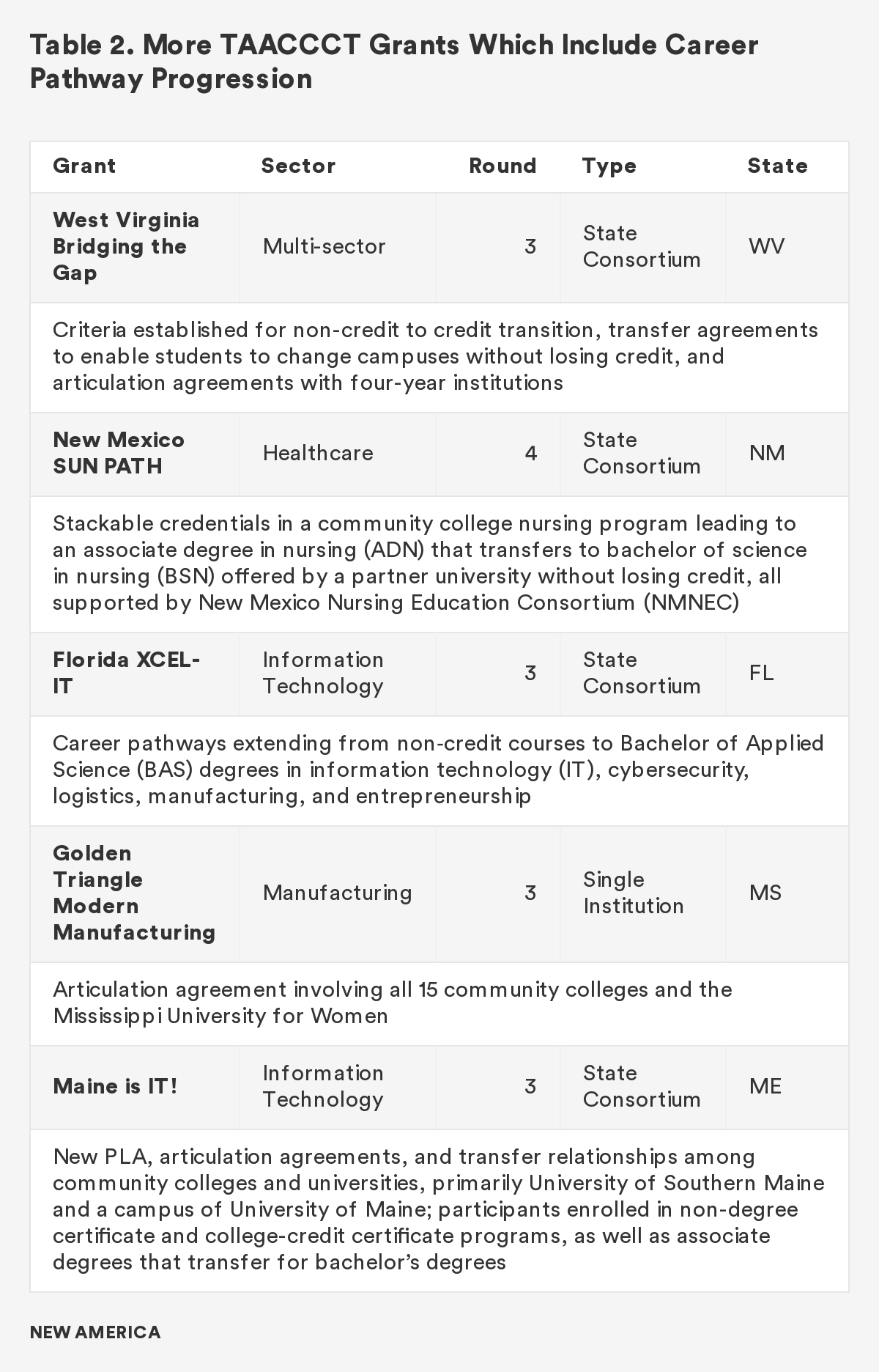
To supplement these three examples of career pathway progression, we list five additional TAACCCT grants from the 36 evaluations we reviewed for this report, shown in Table 2. Additional resources pertaining to all TAACCCT grants described in this report can be downloaded from the Skills Commons website.1
Citations
- See source
Recommendations
TAACCCT evaluation reports analyzed for this brief show that the grant incentivized career pathways designed to increase access to workforce training, and sometimes also college-level instruction, that provides entry to the labor force. These on-ramps are an important dimension of career pathways that extend to postsecondary education to confer college credit and credit-bearing credentials. For many adults in the U.S., these pathways are essential to finding employment that provides a sustaining wage. However, career pathways are incomplete if they do not provide options for students to continue on to additional college education credentials, including work experience that is recognized for college credit, that culminates with an associate or bachelor’s (or higher) degree.
The deep-seated inequities revealed by COVID-19 are troubling for America. Much remains uncertain, but what is increasingly clear is that workers with college credentials, especially bachelor’s degrees, are more likely to retain jobs and be called back to work. Only 15 percent of bachelor’s degree holders are unemployed compared to 25 percent of individuals with a high school diploma, and 21 percent with some college. Bachelor’s holders are twice as likely as those with less education to be called back to work.1 The detrimental impact of COVID-19 is skewed toward less-educated, lower-income minority groups and females who work in service-sector jobs. These groups have an uncertain future until recovery begins in 2021. Career pathways that provide progression to college credit and credential attainment are more important than ever.
For Federal Policymakers
Enhance career pathway progression.
Career pathways need to enable students to progress beyond entry-level employment. Facilitating pathway entry is important but insufficient for upward mobility in college, employment, and earnings. Strategies like creating accessible course schedules and credit for prior learning policies are needed to help students continue to move along the pathway toward associate and baccalaureate degree attainment.
Invest in capacity building.
Many community colleges operate with modest budgets that make new investments in programs and services challenging, which sometimes results in widening inequities among lower-income and racially minoritized groups and more privileged student populations. Following the lead of TAACCCT, public investments need to build capacity in community colleges, as well as the systems that support them, in order for meaningful change to be made and sustained over time.
Disseminate strategies that demonstrate equitable outcomes.
Evaluation of TAACCCT went farther in assessing the impact of community college reforms than any other in history. Lessons from TAACCCT have informed policy and practice in important ways, and the program has provided a blueprint for future evaluations. Assessing the overall impact of public policy is vitally important, as is determining whether target participants obtain outcomes for which those investments were made.
For Practitioners
Focus on organizational and cultural change.
Efforts directed at growing career pathways require advocating for the recruitment, enrollment, and credentialing of students underserved by postsecondary education. Organizational and cultural change must occur to meet student needs. Community colleges must commit to widening student access to education that leads to employment and careers.
Network and form partnerships.
Community colleges that embrace networking, the formation of partnerships, and the teamwork that makes partnerships work, are best positioned to engage in the creation and support of career pathways for students. Community colleges and other higher education institutions, workforce agencies, employers, and other community-based organizations working together is essential to making progression a viable dimension of career pathways.
Invest in leadership and learning.
The more community college educators recognize that real change requires leadership and ongoing learning to make a difference, the more innovation and change will happen. Community colleges that value, promote, and reward career pathways are well positioned to model for other postsecondary education and workforce entities how to succeed.
Citations
- These statistics appear in a discussion of the economic impact of COVID-19 in a blog by Shierholz, “Almost Four Months In.”
More About the Authors

Debra Bragg
Fellow, Community Colleges