
Table of Contents
Oyler School and Roberts Academy (Cincinnati, Ohio)
Two schools in Cincinnati, Oyler School and Roberts Academy, have recently begun working to improve the transition to kindergarten for students and families. Like all Cincinnati Public Schools, Oyler and Roberts Academy are Community Learning Centers, commonly referred to as community schools.1 Oyler and Roberts offer a variety of services that can be used by students and community members, including health, dental, and vision centers as well as housing and employment assistance. These partnerships are managed by an on-site resource coordinator at each school, employed by the Community Learning Center Institute (CLCI), a local nonprofit that leads the development of community learning centers in the Greater Cincinnati area. Several years ago, with support from the W. K. Kellogg Foundation, CLCI began exploring how best to support young children and their families and ensure they had access to community learning center services. CLCI partnered with Cincinnati Early Learning Centers (CELC), a local center-based early childhood provider, to add an early childhood resource coordinator (ECRC) to both Oyler and Roberts Academy.2
The ECRC at each school is tasked with conducting outreach in the community and connecting with families of children ages zero to five to make them aware of the broad array of resources available to families at the school. Valerie Jerome, the ECRC at Oyler School, is steadfast in her efforts to connect with families prior to formal school entry, saying, “I go to all the community activities I can find. When the water park is up and running I’ll go there and talk to the families. It’s all about building a relationship early and figuring out what they need.”3
At Roberts Academy, Maria Rivera, the bilingual ECRC, helps facilitate a class several times a week for parents and their children ages zero to five. The classes, called Learning Together, take place in a mobile classroom that parks at the school and at an apartment complex where many Roberts Academy families reside.4 The classes allow the school to make early connections with families and make them aware of all the services offered by the school. There is no packaged curriculum for the program. Instead, classes focus on helping parents understand child development and learning activities to enhance kindergarten readiness. On a recent Thursday afternoon, the Learning Together van was stationed in the Roberts Academy parking lot. Inside, four mothers were watching as their children, ranging in age from 18 months to three years, were enthusiastically exploring the recently updated play area. Earlier, Rivera had read The Very Hungry Caterpillar to the group and helped the mothers and children create their own caterpillars out of paper towel rolls and tissue paper. As the children played, the mothers conversed in Spanish. “It’s an opportunity for the parents and kids to learn, but it also allows the families to build relationships with each other,” said Rivera.
The ECRCs at both Oyler and Roberts take part in another recent development that has helped the schools break down traditional barriers between early learning and elementary school: the establishment of an early childhood committee that meets monthly at each school. Currently led by CLCI’s director of early childhood, the meetings also include pre-K and kindergarten teachers, a representative from the schools’ mental health partner, and representatives from the early childhood programs that feed the school. The committee meetings help drive the work of supporting kindergarten transitions by planning a variety of activities prior to kindergarten entry and strengthening communication and instructional alignment between early childhood providers and kindergarten teachers.5 “It’s a way to communicate with early learning providers and plan events like early literacy nights,” said Jeff Campbell, a pre-K teacher at Roberts. “The biggest change I’ve seen is our ability now to communicate with the kindergarten teachers and talk about all of our students.”6
As the lead agency at Oyler and Roberts, CLCI has taken a leadership role in breaking down the silos that historically exist between the worlds of early learning and elementary school by serving as a convener for cross-grade and cross-school meetings, educating teaching staff about best practices when it comes to early learning, and working to build buy-in from early learning and elementary school staff. Despite the fact that only one grade separates them, it is relatively rare to have pre-K and kindergarten teachers regularly meet to plan joint activities and ensure instructional alignment between the two grades. This sort of cross-grade, cross-school meeting is key for breaking down the traditional barriers that exist between the formal K–12 school system and early learning providers.
At Roberts, pre-K teachers and the two primary early childhood feeder programs to Roberts now make time to meet either in person or via phone with the kindergarten teachers to discuss how to support children transitioning into kindergarten. Additionally, in the summer of 2018 all elementary school staff, including the early childhood team, attended a four-day Responsive Classroom course that was provided through CLCI’s support to ensure that there is a similar approach to classroom management across all grade levels.7 Professional development that includes both pre-K and kindergarten teachers can be difficult to arrange due to the logistical challenges that arise from each grade having its own schedule for professional development and planning time.
The early childhood teams at both schools have begun to implement other new approaches to ensure a smooth transition to kindergarten. For example, the Oyler team has made it a priority to encourage timely kindergarten registration for families, since historically almost half of the incoming kindergarten class enrolled after the first day of school. The ECRC has employed various strategies to encourage families to enroll in kindergarten, including a “kindergarten enrollment week.” Oyler held its first kindergarten enrollment week in April 2018. Families were invited to attend an enrollment kickoff cookout and the ECRC held a kindergarten round-up where she assisted families with enrollment paperwork. Last year, these efforts led to a 16 percent increase in the number of kindergarten children enrolled prior to the first day of school.8 This year, the results are even more promising, with a 25 percent increase in the number of kindergartners enrolled prior to the end of the previous school year.9
Oyler also holds a kindergarten open house in the spring to allow families of incoming kindergarten students to visit classrooms, ask questions, and meet the teaching team. Building on a pilot offered last summer, CELC has partnered with Oyler to offer a six-week kindergarten bridge program in the summer of 2019 to allow incoming students to become familiar with classroom routines, their teacher, and their new school. Priority for this program was given to students without pre-K experience. The result of the spring and summer activities at Oyler is that “families come in on the first day and they’re not meeting strangers, but instead they feel comfortable and safe,” said April Mueller, director of Family Outreach at Cincinnati Early Learning Centers.10
Many similar programs are currently being implemented by the team at Roberts Academy. The ECRC collaborates with early childhood feeder programs to arrange for incoming students to visit kindergarten classrooms and other key parts of the school as well as meet teachers and staff. CELC has also partnered with Roberts to offer a six-week kindergarten bridge program this summer.11
Roberts Academy Principal Alpacino Beauchamp has taken the initiative to visit early childhood programs in the area to help parents learn more about his school and answer questions about what to expect in kindergarten. When asked why he took time out of his busy schedule of overseeing a school of approximately 800 students to visit early childhood providers, Beauchamp replied, “I say yes to their invitations because it matters. If you want students who are ready to learn then you need to go to the environment where they were previously and align your work with theirs.”12
Acquiring this level of principal buy-in is key for schools and districts focused on smoothing the transition to kindergarten.13 Since principals typically have a high degree of autonomy when it comes to the schools they oversee, it is difficult to make systemic changes to the kindergarten transition process without their support and their understanding of its importance. Principals who have a solid grasp of the importance of early education are more likely to understand the role the transition process plays in helping to ensure a successful kindergarten year for students and families. Currently, however, Illinois is the only state that has a principal licensure law that requires that early education is incorporated throughout coursework and field placements for prospective principals.14
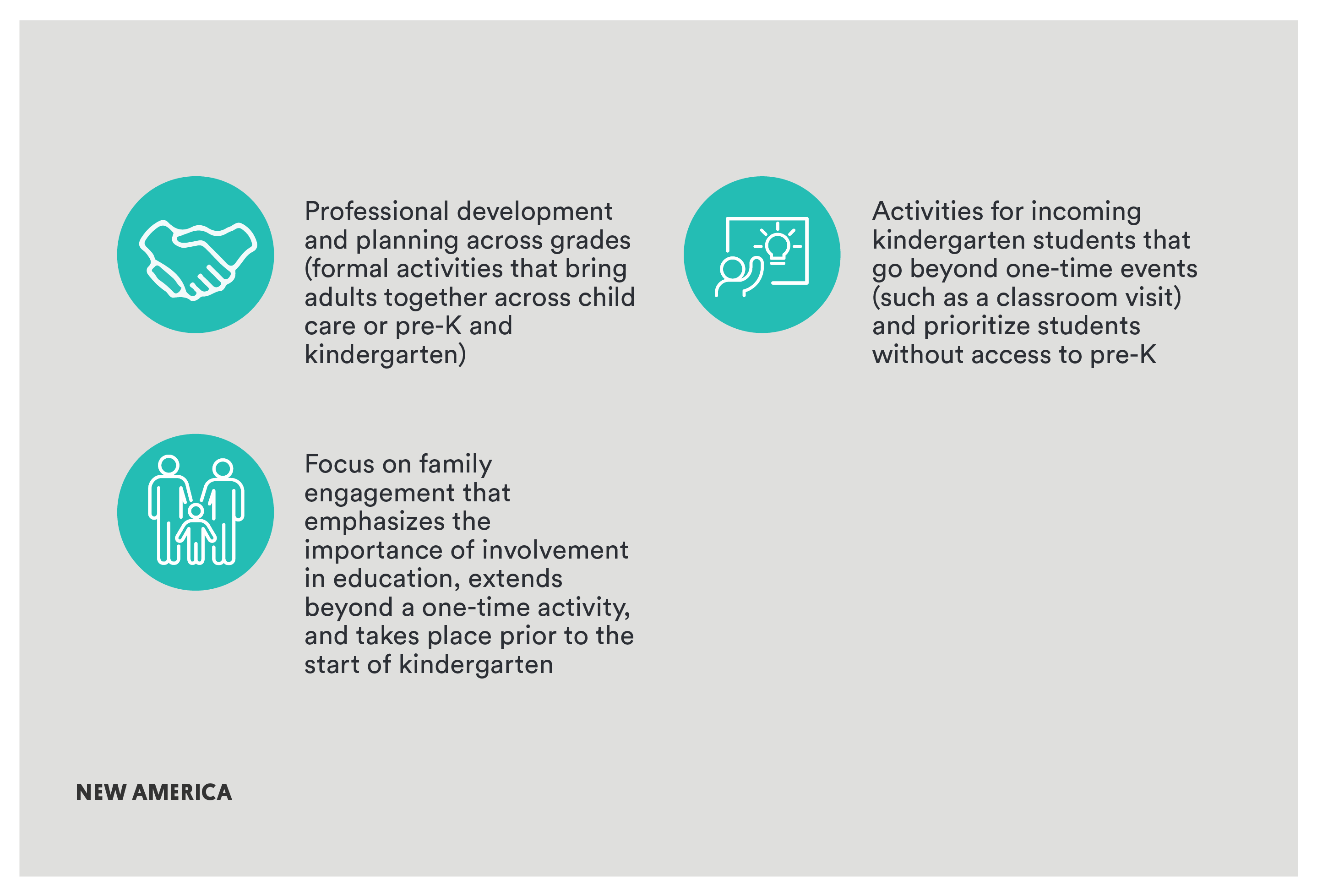
Priorities Addressed by Oyler School and Roberts Academy: Professional Development, Family Engagement, Student Activities
Emphasizing Attendance During Transition Activities
An important element of the transition to kindergarten is an emphasis on consistent attendance. “The message we send during our Early Kindergarten Transition Program is that kindergarten attendance is important and a few days of absence can really hurt a child’s academic progress,” says Brooke Chilton Timmons, the early learning coordinator for the SUN Service System in Multnomah County.15 At least 10 percent of kindergarteners nationwide are chronically absent from school, missing at least 18 days per year. Kindergarteners from low-income families are four times more likely to be chronically absent than their more affluent peers.16 In California, kindergarten students are the most likely of any elementary school students to be chronically absent.17 Chronic absenteeism in the early grades is correlated with poor academic outcomes and continued attendance problems in later grades. A California study found that only 17 percent of students chronically absent in kindergarten and first grade were reading proficiently by third grade compared with 64 percent of students with consistent attendance.18
Attendance Works, a national and state initiative focusing on advancing student success and closing equity gaps by reducing chronic absence, recently released a toolkit titled Early Matters: Integrating Attendance into Kindergarten Transition. The toolkit offers ideas, resources, and examples of how to emphasize the importance of consistent attendance to students and families as part of the kindergarten transition process.19 The toolkit recommends a number of strategies during the transition to kindergarten, such as distributing information about the importance of attendance during school registration activities, making attendance messaging visible in classrooms and hallways, showing a video about the importance of consistent attendance during family workshops at the start of the school year, and offering supports to reduce health-related absences.
Citations
- Community schools bring together a group of partners to offer a range of supports for children and families, often including health and social services.
- Angela Farwig, “Supporting Kindergarten Transitions in Cincinnati’s Community Learning Centers,” August 17, 2018.
- Valerie Jerome (early childhood resource coordinator, Oyler School), interview with author, May 2, 2019.
- Angela Farwig (director of early childhood, Community Learning Center Institute), interview with author, April 1, 2019.
- Angela Farwig, “Supporting Kindergarten Transitions in Cincinnati’s Community Learning Centers,” August 17, 2018.
- Jeff Campbell (pre-K teacher, Roberts Academy), interview with author, May 2, 2019.
- Angela Farwig, “Supporting Kindergarten Transitions in Cincinnati’s Community Learning Centers,” August 17, 2018.
- Angela Farwig, “Supporting Kindergarten Transitions in Cincinnati’s Community Learning Centers: Oyler Community Learning Center,” August 31, 2018.
- Angela Farwig (director of early childhood, Community Learning Center Institute), interview with author, June 26, 2019.
- April Mueller (director of Family Outreach, Cincinnati Early Learning Centers), interview with author, May 2, 2019.
- Ibid.
- Alpacino Beauchamp (principal, Roberts Academy), interview with author, May 2, 2019.
- For information about programs that are building principals’ knowledge of early learning, see Abbie Lieberman and Laura Bornfreund, Building Early Education Leaders: A Closer Look at How States and Districts are Equipping Principals to Support Young Learners (Washington, DC: New America, June 2019), source
- Abbie Lieberman, A Tale of Two Pre-K Leaders: How State Policies for Center Directors and Principals Leading Pre-K Programs Differ, and Why They Shouldn’t (Washington, DC: New America, May 2017), source
- Brooke Chilton Timmons (early learning coordinator, SUN Service System, Multnomah County,) interview with author, March 12, 2019.
- “Mapping the Early Attendance Gap: Charting A Course for School Success,” Attendance Works and Healthy Schools Campaign, September 2015, source
- Erin Brownfield, “Kindergartners: The most ‘truant’ students?” EdSource, October 5, 2015, source
- Attendance Works and The Campaign for Grade-Level Reading, “Attendance in the Early Grades: Why it Matters for Reading,” research brief, February 2014, source
- Attendance Works (website), “Early Matters: Integrating Attendance Into Kindergarten Transition,” February 2019, source