
Table of Contents
Multnomah County (Portland, Ore.)
Multnomah County, home to the city of Portland, has taken several steps to ease the transition to kindergarten by making early connections to children and their families. Early Learning Multnomah, the early learning hub for the area, has used a portion of funds received through the state’s Early Learning Kindergarten Readiness Partnership and Innovation grant program to fund P–3 coordinators at eight high-need schools across the county. Since 2016, the coordinators have offered Play and Learn groups at neighborhood elementary schools to serve parents and families of children from birth to age five prior to formal kindergarten entry. The groups were created as a way to link young children and families to the school and allow an opportunity for parents to connect with each other, with a focus on families who may feel less welcome and comfortable in the school. Each of the schools offers two Play and Learn groups per week and one of the groups must be culturally specific or held in a language other than English. Outreach efforts include developing relationships with community leaders, posting flyers in the community, connecting with faith communities, and working with partner agencies to spread information about the groups. The coordinators plan interactive group activities for parents and children focused on early learning, social-emotional development, getting comfortable with a school setting, and how to support child development.1
An evaluation of the Play and Learn groups performed by Portland State University found that parents and staff experienced multiple benefits from the creation of the groups, with the primary benefit revolving around kindergarten readiness. “This is a good place for them to interact with other kids in a fun and informal setting. They gain valuable kinder readiness skills and can establish social/emotional [skills] in a learning environment,” said one coordinator. Involvement with the groups also helps kids and families gain familiarity with a formal school setting and start to build a trusting relationship with the school. “It makes them familiar to the space. It’s an opportunity to build trust,” said another coordinator.2
Staff members who participate in the groups draw a direct link to involvement in Play and Learn and a smooth transition to kindergarten. “Kids are all about pattern and structure. If they’ve already been coming to the school for two years, kinder is an easy transition,” said a P–3 coordinator. The Play and Learn groups are seen as an important component of the work of aligning the early learning and K–12 systems. “Just having a coordinator in the building has and will probably continue to create more communication between K-1-2-3 grade teachers around following kids through different grades and making connections between younger preschool age children and their older siblings,” said one staff member.3
In addition to leading Play and Learn groups, the P–3 coordinators help organize and staff the Early Kindergarten Transition (EKT) Program, a two- or three-week program during late summer in which incoming kindergarteners become familiar with their new school and parents learn about ways to support learning at home. First piloted in two schools in 2010, EKT now reaches about 700 incoming kindergarten students each summer and takes place in 45 elementary schools.4 The program is based around two components: class time for students in classrooms that are led by a kindergarten teacher and family engagement activities designed to promote positive family-school relationships. There are three broad goals for EKT: (1) increase parental involvement in learning, (2) reduce chronic absenteeism in kindergarten, and (3) promote children’s success in school.5
Over the two- or three-week program, students attend school every morning for a total of 36 hours of classroom time; parents are offered at least 10 hours of group sessions. The parent sessions cover a range of topics, including gaining familiarity with the school facilities and staff, the importance of consistent attendance, how to read interactively with children, and the importance of establishing routines for bedtime and completing homework. Parents have the opportunity to visit their child’s classroom to observe and learn more about what happens in kindergarten.6 The students spend time practicing classroom routines and participating in activities to improve early math and literacy skills. Access to EKT is prioritized for children who did not have access to pre-K, children of color, children from low-income families, children who speak a language other than English, and children with special needs.7
An evaluation of EKT in 14 elementary schools within the Portland Public School District found promising results as a result of involvement in the program. Students who participated in EKT had higher attendance rates in kindergarten compared to students who did not participate. This pattern continued to hold through the second grade for these students before leveling out in third grade. Additionally, students participating in EKT were more likely than non-EKT students to meet early literacy benchmarks and less likely to require intensive support to improve early literacy skills.8
EKT and other similar summer programs are not a substitute for a full year of high-quality pre-K instruction, but they do accomplish several important goals. Most importantly, they facilitate relationship-building between the elementary school and children and families. Parents and children whose first interaction with elementary school staff is through a fun, helpful summer program are more likely to view the school in positive terms in the year that follows. The summer programs are also essential for helping both parents and children develop familiarity with the expectations of the kindergarten year to come.
In order to capture as much data as possible about incoming kindergarten students prior to the first day of school, Portland Public Schools has created a form for families to complete with the assistance of their child’s pre-K teacher or by themselves if their child did not attend pre-K. The Child Centered Plan explains student interests, strengths, and challenges. Once completed the form is shared by parents with the kindergarten teacher before the first day of school, providing valuable information about the needs of each student.9 While it would be even more beneficial to establish an electronic data sharing system that does not rely on parents hand-delivering a paper form, this is a good alternative, given issues of student privacy and software compatibility inherent in establishing a formal data sharing agreement.
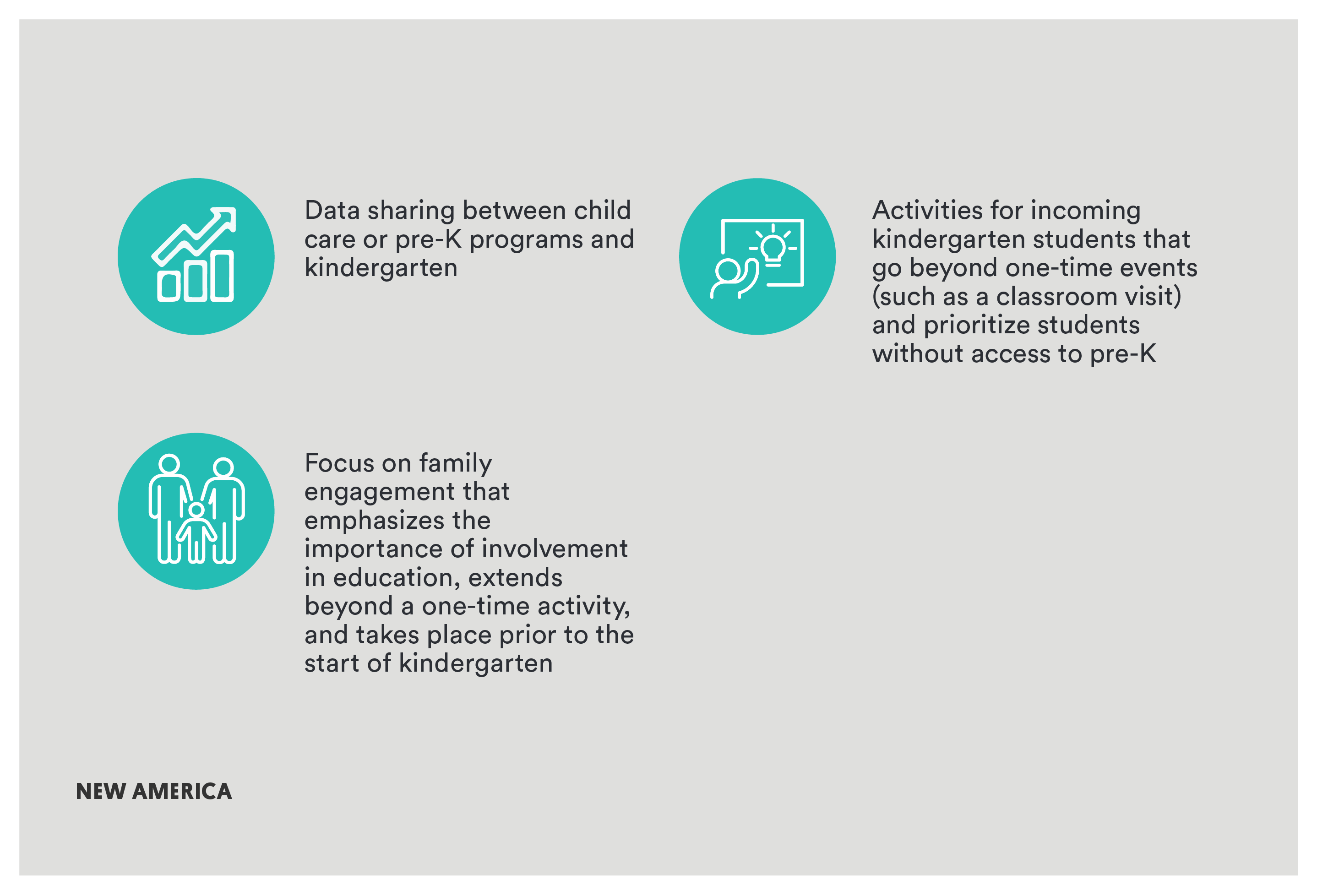
Priorities Addressed by Multnomah County: Data Sharing, Family Engagement, Student Activities
Citations
- Center for Improvement of Child & Family Services, Portland State University, “Play and Learn Groups: A Bridge Between Schools & Families,” October 25, 2017, source
- Ibid.
- Ibid.
- Brooke Chilton Timmons (early learning coordinator, SUN Service System, Multnomah County), interview with author, March 12, 2019.
- Portland Public Schools, “Program at a Glance: Early Kindergarten Transition,” December 2015, source
- Brooke Chilton Timmons (early learning coordinator, SUN Service System, Multnomah County), interview with author, March 12, 2019.
- Ibid.
- Beth Tarasawa, Nicole C. Ralson, and Jacqueline Waggoner, “Leveraging University-School District Research Partnerships: Exploring the Longitudinal Effects of an Early Kindergarten Transition Program,” Journal of Applied Research on Children: Informing Policy for Children at Risk 7, no. 1, Article 6, source
- Portland Public Schools (website), “Child Centered Plan,” source.