Table of Contents
Altgeld-Riverdale Neighborhood (Chicago, Ill.)
The Altgeld-Riverdale community, located on Chicago’s South Side, is taking a community-wide approach to addressing the transition to kindergarten for students and families. Over 60 percent of the approximately 7,000 people residing in the neighborhood live below the poverty line. Over 95 percent of the residents are African American. There are historical divisions within the community that made it seem like the ideal locale to launch a community-wide effort to promote a greater degree of overall cohesion. The community is home to four elementary schools and two early childhood centers.1
The Pre-Kindergarten to Kindergarten Transitions Project (PKTP) was launched in Altgeld-Riverdale in 2015 by BPI, a Chicago-based public interest and law and policy center, after a community needs assessment and work group identified the transition from pre-K to kindergarten as a top priority. PKTP was piloted during the 2015–16 school year with the first full year of implementation taking place during the 2016–17 school year. There are three main components to PKTP: a cross-grade, cross-school professional learning community for educators; common classroom practices across pre-K and kindergarten; and family learning activities.2
The professional learning community consists of monthly 90-minute meetings between pre-K and kindergarten teachers from the various elementary schools and early childhood centers in the neighborhood. The goal of the meetings is to reduce differences in teaching methods and philosophies between grades and schools. The meetings, facilitated by BPI staff, consist of discussions of common classroom practices, planning for upcoming family activities, and professional development sessions on topics such as trauma-informed teaching practices. An evaluation of PKTP found that a majority of participants found the monthly meetings to be valuable and helped them to learn about new strategies for improving student outcomes in their classrooms.3 “If not for PKTP I don’t think these teachers from different schools would be talking to each other. It’s been an incredibly helpful opportunity for teachers to interact with their peers from across the neighborhood,” said Emily Powers, project director of the PreK–K Transitions Program at BPI.4
An important part of the monthly, cross-school meetings is discussion of three common classroom practices that teachers selected as the most important: self-regulation practices, trauma-sensitive practices, and dramatic play. Teachers decided to implement self-regulation and trauma-sensitive practices by having their students identify their feelings three times a day. All pre-K and kindergarten classrooms in the neighborhood schools now use “Tucker the Turtle,” a storybook and puppet to help children learn how to stay calm when they are upset and how to think of a solution to the problem upsetting them. Since all pre-K students in the neighborhood are familiar with the Tucker puppet, when they transition into kindergarten they have a sense of continuity in managing their emotions when they see him. The teachers’ focus on dramatic play resulted in common, cross-school objectives: changing the focus of the dramatic play centers at least twice a month and making sure the focus is related to the current curricular unit.5
In order to increase interactions between teachers and families and to model learning activities that parents can implement at home, PKTP organizes several “Family Fun Hours” each school year. These events, hosted at elementary schools, are open to pre-K and kindergarten students and families from all elementary schools and learning centers in the neighborhood. For example, a science-themed Family Fun Hour consisted of several experiments for students to take part in that could be easily replicated at home. About two-thirds of parents who completed a survey in spring 2017 reported participating in one or more of the Family Fun Hours.6 To encourage student, family, and teacher interaction across grades and schools, PKTP also supports fields trips across the city that bring together pre-K and kindergarten students. The cross-grade, cross-school field trips allow kindergarten teachers to gain familiarity with pre-K students and families who might be entering their classroom during the next school year.
“Now all the teachers and families feel more like a part of the community and are working on a common project together,” said Powers, summing up the achievements of PKTP after three school years of implementation. An evaluation of PKTP provides support for this belief. Pre-K and kindergarten teachers reported feeling a greater sense of connection to each other across grades and schools. Parents also felt more connected to each other as a result of participation in PKTP. Chicago Public Schools has expressed interest in scaling up PKTP’s community-wide approach to supporting the transition to kindergarten, but there is currently no set timeline for doing so.7 That being said, the work of PKTP in the Altgeld-Riverdale neighborhood is still in its early stages and the team is working to strengthen the program based on lessons learned from the first years of implementation.
Currently, there is no formal data sharing arrangement in place between pre-K and kindergarten teachers in the neighborhood. The sharing of data is made difficult by the fact that the pre-K and kindergarten classrooms use two different assessment systems, so there is no simple way to electronically share student records. The development of a formal plan for sharing student assessment data has been identified by BPI as a major need to be addressed in the future.8 Additionally, BPI staff members are aware of challenges that have emerged in implementing common classroom practices between pre-K and kindergarten due to differences in expectations for each grade. Kindergarten generally allots less time for the kind of dramatic play activities encouraged by PKTP, making it more difficult to implement common practices for dramatic play in a way that clearly aligns with each grade’s curricula. BPI plans to continue working with teachers and leaders of the neighborhood schools to provide the tools and skills necessary to help implement classroom practices in a way that is compatible with each grade’s curricula.
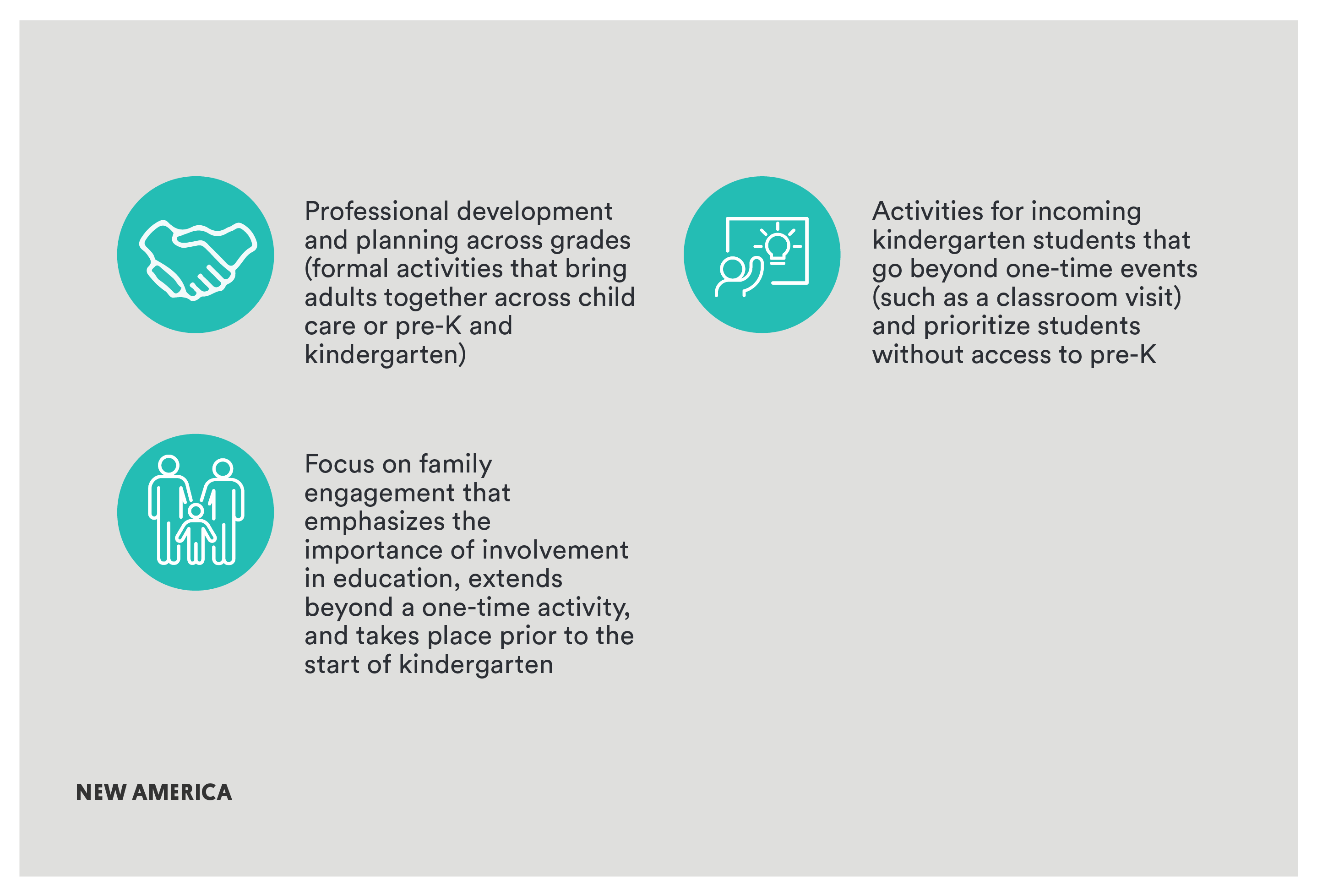
Priorities Addressed by Altgeld-Riverdale Neighborhood: Professional Development, Family Engagement, Student Activities
Citations
- Angeline K. Spain, Stacy B. Ehrlich, Jennifer R. Cowhy, Denali K. Dasgupta, and Tracey Lockaby, A Community Effort to Support the Transition from Pre-K to Kindergarten (Chicago, IL: University of Chicago Consortium on School Research and Chapin Hall at the University of Chicago, 2018), .source
- Emily Powers (project director, PreK–K Transitions Program, BPI) and Susannah Levine (director of Education and Early Learning, BPI), interview with author, March 20, 2019.
- Spain et al., A Community Effort.
- Emily Powers (project director, PreK–K Transitions Program, BPI) and Susannah Levine (director of Education and Early Learning, BPI), interview with author, March 20, 2019.
- Spain et al., A Community Effort.
- Ibid.
- Ibid.
- Emily Powers (project director, PreK-K Transitions Program, BPI) and Susannah Levine (director of Education and Early Learning, BPI), interview with author, March 20, 2019.