Table of Contents
- Executive Summary
- Introduction: The Case for More and Better Parties
- 1. Defining the Problem(s)
- 2. The Case for Political Parties: Why Modern Mass Democracy Needs Political Parties and Can’t Operate without Them
- 3. Learning from History: The Flawed American Tradition of “Tearing Open” without “Building Up”
- 4. The Contemporary Choice: Will We Repeat the Mistakes of the Past or Build Something Better for the Future?
- 5. Pro-Parties Reform: Building More and Better Parties
- 6. Conclusion: Imagining a Better Future, with More and Better Parties
5. Pro-Parties Reform: Building More and Better Parties
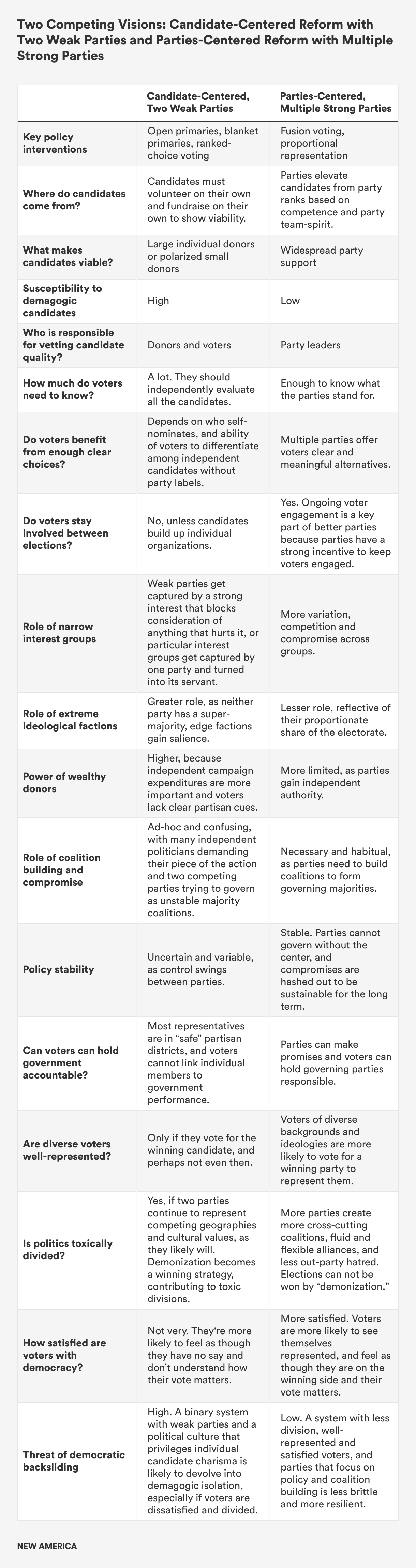
This paper’s core argument is that political parties are vital to modern mass democracy, and more than two are necessary for effective self-governance. Under current conditions (specifically: a diverse, nationalized polity with urban-rural geographic polarization) two parties alone cannot perform the crucial roles that only parties can play in a modern, representative democracy.
Because political parties are the central organizations of modern mass democracy, and we are facing a system problem, reform must begin with the core organizing institutions of the system: the political parties.
Pro-parties reform addresses the problems of polarization, extremism, and democratic representation on the theory that the key point of leverage is realigning partisan competition through more parties, which will require electoral changes.
Specifically, this paper recommends fusion voting and proportional representation. Fusion voting is more likely to be an immediate-term solution. Proportional representation is a longer-term solution. Fusion voting is an immediate-term solution because it can be achieved in a short time, and it can address political extremism right now by creating an opportunity for new center-oriented parties to be at once impactful. Proportional representation is a longer-term and more sustainable solution because it reshapes competition sustainably to maximize vibrant and fluid partisan competition necessary for effective parties and healthy, resilient modern democracy.
Fusion Voting
As described above, fusion voting refers to a system in which a candidate wins the support of more than one party – usually one major party and one “minor” party. Each party nominates the same candidate, and the candidate appears twice on the ballot under two distinct party labels. The votes for each candidate are tallied separately by party, and then added together to produce the ultimate outcome.
Fusion encourages parties to organize because it gives qualified parties a place on the ballot. This place on the ballot gives parties potential leverage, which they can use to bargain with major-party candidates. It is this feature that makes fusion powerfully pro-party. A ballot line is power, and organizations and money are drawn to power like graduate students to a free lunch.
A ballot line signifies a party’s presence across multiple elections, enabling it to hold candidates accountable. This is crucial in building a potential Moderate Party. Consistent parties across elections let voters support major candidates on minor lines, conveying their values effectively.
For moderates, a new party helps in several ways. First, its existence gives them a fresh way to signal their values. The current system allows only crude signaling: “D” or “R.” The new party gives currently homeless voters a new political identity. This matters, because identity is enormously important in modern politics. Much of the vitriol in American political discourse stems from the hardening of voters’ self-conception into bifurcated partisan identities. By strengthening the “moderate” identity, a new and much-needed centripetal force could emerge in American politics.
A party with 10 percent of the vote could significantly increase electoral competitiveness across the country. This would give it a strong claim on encouraging crosspartisan compromise governing. Importantly, a moderate party (or other party) will give voters a reason to show up in an election that otherwise might be less competitive, since the share of votes their preferred ballot party contributes to the winning total contributes to their party’s relative bargaining power.
This potential makes fusion a powerful weapon against extremism in contemporary U.S. politics.
In competitive districts, moderate parties could have a kingmaker status that would pull candidates closer to the political center. Although competitive districts do have a slight moderating pull on political candidates, this moderating pull is somewhat weak. Many political science studies have shown that the centripetal pull of competitive districts is much smaller than the centrifugal pull of partisanship.
Most districts, however, are not two-party competitive. In such districts, fusion would create a different opportunity for a moderate party. Rather than playing kingmaker, a moderate party could effectively run its own candidate and then ask for the endorsement of the minority party. For example, in a district that is 60-40 Republican, a Democratic candidate will never win. But a Moderate Party candidate could. If Democrats could signal on the ballot that they endorsed Moderate Party candidates who could win, this would allow more moderate candidates to compete and sometimes win, thus making more districts competitive and increasing the number of moderates in Congress.
From the perspective of elected officials, the moderate party label becomes meaningful to communicate moderation. In an era of nationalized politics, Republican and Democrat candidates are tied to their national parties, and typically to the most extreme elements of their parties. Candidates can say that they are a different type of Republican or a different kind of Democrat, but it is almost impossible to communicate this to voters, given that they have very few opportunities to break from their national parties, and most voters pay very limited attention to politics and largely rely on party labels.
This is the reality of our highly nationalized political environment. Parties matter to voters more than candidates, because parties determine the direction of government. Voters may like individual candidates of an opposite party, but in competitive districts they are told repeatedly that they are not voting for a candidate; they are voting for which party gets control of the majority in Congress. Crucially, most voters today cast ballots for or against the president, an influence beyond individual congressional members’ control. A new party, capable of organizing a meaningful constituency into a collective identity, can help elected officials break free of these polarizing national forces.
This is not merely theoretical. Fusion has a long and rich history in the United States.1 The Free Soil Party and the Liberty Party, which advanced the abolitionist cause, were fusion parties. Fusion was most widely used in the final third of the nineteenth h century. In the 1880s, fusion allowed minor parties to hold the balance of power in a majority of states. Between 1874 and 1892, fusion allowed minor parties to gain at least 20 percent of the vote at least once in half of the non-Southern states.2
However, starting in 1888, states shifted from the old system of ticket-voting (in which parties printed their own voting tickets, at their own expense, with freedom to cross-nominate) to a new system in which states printed ballots. The reform spread throughout the country during the 1890s and 1900s. With states printing the ballots, state administrators needed a process for listing candidates and parties. Since major parties controlled states, and major parties disliked minor parties, antifusion laws and ballot-access laws spread until they all but eliminated fusion.3
New York, where fusion voting has remained legal since 1911, consistently features minor parties, often positioned at the ideological flanks. Examples include the Conservative and Working Families parties, which lean right and left, respectively, of Republicans and Democrats. Both play a credible, durable role in the political and policy landscape of the Empire State. Fusion voting yields a modest turnout increase in New York, with Democrats and Republicans gaining approximately 3 and 5 percentage points, respectively, when appearing on a second party line.4
What about a New York Moderate Party? In 2022, Matt Castelli, a moderate Democrat challenging Elise Stefanik in the twenty-first district in New York, helped to establish a new Moderate Party of New York and ran as its candidate. Castelli lost, but the Moderate Party helped to make it a closer race. As Castelli explained in a 2023 post, “Our Moderate Democrat brand resonated. Despite zero political experience and name recognition, I outperformed most statewide Democrats on the ballot in NY-21—including Governor Kathy Hochul. In a cycle that saw an 11+ point average shift to the right from 2020 Presidential results in Congressional districts across New York, the shift in NY-21 was the smallest. It’s easy to imagine a closer race if not for the terrible environment for Democrats in NY that mobilized Republican voters at Presidential election levels.”5
Though skeptics might worry that fusion would cause ballots to grow thick with tiny front parties, cluttering ballots with what are basically advertisements, the positive experience of New York suggests otherwise. Minor parties only thrive if candidates want their nomination. Thus, a QAnon Party is unlikely to catch on beyond a few fringe candidates, because most sensible candidates would reject such an endorsement. If a candidate accepts such an endorsement, it effectively signals to voters their extremist stance.
As a practical matter, fusion voting is appealing because litigation can revitalize it. Litigation is both cheaper and more widely possible than ballot initiatives. Many state constitutions provide fulsome protections for the freedom of association. This should apply to political parties and their right to associate with candidates of their choice. This legal theory is currently being tested in the state of New Jersey.
In 2022, the Moderate Party in New Jersey formed because center-right political activists were fed up with the Trumpification of the GOP. Upon founding their party, they chose, as their inaugural candidate for national office, Rep. Tom Malinowski, a moderate incumbent Democrat in the Seventh Congressional District. Malinowski had also been nominated by the Democrats. The cross-nomination, however, was disallowed by the New Jersey secretary of state, since New Jersey law bans fusion. Malinowski was defeated in the November 2022 election.
New Jersey’s Moderate Party sued in state court to repeal the ban and relegalize fusion voting in New Jersey. Lawyers for the party believe they have a strong case under the New Jersey State Constitution’s freedom of association clause, which has remarkably robust language on the “freedom of association” and the right to vote, as do many state constitutions. A decision is expected in early 2024. If this litigation succeeds, similar litigation strategies are likely to succeed elsewhere.
As a pro-parties reform approach, fusion makes sense because it encourages groups and factions who currently feel unrepresented to channel their energies into party-building. New parties gain significance by actively influencing major-party candidates. New parties build new identities for currently politically homeless voters that last beyond an election.
Fusion voting that enables a Moderate Party is thus a powerful and achievable reform that accomplishes two crucial things with one blow. By establishing a new political center, it immediately counteracts extremism. It accomplishes this by offering a feasible alternative for partisans discontented with their party but unwilling to endorse the opposition. And in creating space for new parties, expanding fusion voting marks a powerful first step towards a multiparty democracy that can break the destructive two-party doom loop that is at the core of spiraling extremism and dysfunction.
Ultimately, proportional representation will be necessary to fully support a vibrant multiparty democracy. We turn to that now. However, because some elected offices (senator, governor, president) are single-winner elections, proportional representation is not an option for such offices. An ideal system would use fusion for inherently single-winner offices and proportional representation for offices that can be chosen through multiwinner elections. Or for the U.S. Congress: fusion for Senate elections, proportional representation for House elections.
We now turn to proportional representation.
Proportional Representation
Proportional representation describes a family of voting systems that aims to ensure a party’s share of seats in the legislature is closely proportional to its share of votes in the electorate. Because representation is proportional to party vote share, proportional representation systems are more party-focused. However, there are several types of proportional representation. Systems vary in the number of representatives per district, the threshold for legislative representation, and the extent to which voters are voting for candidates, parties, or both. No two countries use the same system.
Mechanically, proportional representation facilitates a multiparty system, just as winner-take-all elections facilitate a two-party system. When the threshold for winning is a simple plurality, political energy concentrates into two camps. When the threshold for winning is lower, more parties can form. For example, in a five-seat district elected proportionally, it is possible for five different parties to gain representation. This encourages more parties to compete. In a one-seat district, only one seat is available. With only one seat available, third parties become spoilers or wasted votes.
Thus, proportional representation and multiparty democracy go together. A legislature elected through a system of proportional representation is likely to have multiple parties. The number of parties is largely a function of district size, though the size of the legislature and diversity of a country also affect the number of parties. Larger districts correlate with a reduced viability threshold, resulting in a greater number of parties. The larger the legislature, and the more societal diversity, the more viable parties. Allocation formulas also matter. (For example: Does the voting system give a bonus to larger parties or smaller parties?)
Israel, for example, is at the extreme end of the permissive proportional spectrum. The entire Knesset is selected through one nationwide electoral district of 120 seats. Over time, Israel has upped the threshold for representation to 3.25 percent nationwide. A permissive proportional representation system in a diverse and contentious society often features many parties on the ballot, regularly including over a dozen parties in the Knesset simultaneously.
Most proportional multiparty systems have fewer parties. Research on optimal district magnitude suggests that district magnitude of four to eight maximizes benefits (e.g., representation) before venturing too far into risks (e.g., fractionalization).6 Such a system would likely generate four to six national parties—enough to give voters real and meaningful choices and allow different opportunities for governing coalitions, but not too much fragmentation to make governing difficult or voting confusing.
Crucially, a “sweet spot” of four to six parties enables new coalitions to emerge and ascend while allowing older parties to fade away. This dynamic competition is essential to resilient democracy. Consider the current dynamism of party systems in proportional democracies in Western Europe. New Green parties (center-left) and Liberal parties (center-right) are engaging a new generation of citizens who feel disconnected from the more traditional parties, leading to new models of organization and new coalitions. Rather than trying to retrofit the traditional parties, a new generation of political leaders is remaking new parties for contemporary times.
To be sure, dynamism can lead to volatility, and not all new parties are “better.” However, this is not the first instance of European party systems encountering volatility. The standard pattern has been a kind of dialectical process. New parties emerge to fit their times. For example, in the 1950s, European parties consistently represented particular collective identities and bargained on their behalf toward universal solutions. These new “catch-all” parties acted as brokers between citizens and the government. They replaced the earlier model of “mass parties,” which were highly participatory and treated politics as a conflict of interests, incapable of mutual compromise, reflecting the overt class conflicts of a newly mobilized working class in the early twentieth century.7
The point is simply this: Like many organizations, new political parties form in particular moments, with particular structures, oriented around particular types of politics. Like many organizations, they can struggle to adapt to changing times and circumstances. Sometimes, new organizations must replace old ones. Or, in order to adapt, older organizations must reorganize, often merging or splitting in the process. The same is true for political parties.
A more fluid multiparty system allows for old parties to fade away, new parties to rise, and various recombinations and adjustments in between. “Creative destruction” may not generate healthy parties. However, the fluidity and constant recalibration required is more manageable than in a two-party system, where both major parties are ensured continuation because of their monopoly on opposition.
In proportional multiparty systems, as more established parties lose touch with voters or become internally sclerotic, new parties can arise. Indeed, this appears to be the semi-cyclical pattern as political parties attempt to balance the responsibilities of governance with responsiveness to public constituencies, two important roles that can sometimes come into tension. Over time, parties and party systems adapt.8
Since extremism is a central concern in our current moment, let us return to extremism briefly here in the context of proportional, multiparty democracy. In our discussion of fusion, we explored how it could create a moderate party that would offer a meaningful off-ramp for center-right voters who do not want to fully endorse the Democratic Party, but are dissatisfied with the Republican Party’s extremism.
Proportional representation takes this a step further by making it possible for a new center-right party, distinct from the MAGA-right, to run candidates and gain seats in the Congress (or state legislature), thus increasing its power and strengthening the identity of such a party. A center-left party could also form, separate from the progressive left. In many multiparty democracies, center-left and center-right parties have governed together in centrist coalitions in order to form a “cordon sanitaire” to keep extremist parties out of a governing coalition.9 In other multiparty democracies, mainstream parties have tamed populist parties by inviting them into coalitions as junior partners, and effectively sapping them of their antisystem support base through compromise and association with “the system.”10 Mainstream parties have been able to do this because the flexibility of a multiparty system gives them leverage. If the extreme junior party demands too much, the mainstream party can find another coalition partner.
For years, many mainstream American political scientists contended that two-party systems were more effective in confining and minimizing extremism. The argument was as follows: In a two-party system, both parties have to be a broad coalition if they hope to win a national majority. Thus, party leaders have a powerful motivation to marginalize and police extremism. By contrast, in a proportional multiparty system, a 10 percent antisystem party can gain 10 percent of seats in a legislature, with the validation and visibility that come with this representation. They can then harness this to build more support and eventually become a dominant party.
However, as the experience of multiparty systems shows, antisystem parties rise and fall.11 Either the major parties form pacts to keep antisystem parties out of government, or the major parties take them on as junior partners, which often saps them of the support by associating them with the corrupt “system” and forcing them to make compromises.12
By contrast, in a two-party system, once an extreme faction takes over one of the two major parties, the contagion spreads quickly, and politics rapidly polarizes. Moderates have no ability to form a new party and must pick sides. Significantly, an extremist faction only requires a plurality within a major party to seize control. The far-right MAGA movement probably represents at most 20 percent of Americans. But because it is well-placed within the Republican Party, it can achieve total power. In a two-party system with single-winner elections, the Republican Party’s opposition monopoly to Democrats ensures its enduring presence.
A two-party system is moderating until it isn’t. A multiparty system is flexible. It can allow some antisystem representation, but it can also more effectively manage that antisystem representation because parties have more flexibility to change their strategies and coalitions from election to election.
At this moment, America requires a viable center-right party that isn’t antisystem and illiberal. Fusion voting enables the formation of such a party and its electoral impact. Proportional representation fosters an environment where this party can flourish and significantly influence governance through its own representatives.
Proportional representation also softens the distinction between winning and losing, which can increase support for the system and reduce extremism. A winner-take-all system, as the name suggests, gives the winner everything and the loser nothing. But in a proportional system, the distinction between winning and losing is less clear. Coalitions are more fluid, and election-losing parties are not completely shut out of power. The softened binary between winning and losing changes the nature of opposition. In proportional systems, political losers have more trust in the political system and report higher levels of satisfaction with democracy and trust in government. In majoritarian, winner-take-all systems, especially polarized majoritarian systems, the losing side has much lower trust after an election loss. Over time, repeated losing can foster extremism and strong antisystem attitudes.
Another important benefit of proportional representation is that it counts every vote equally, regardless of geography. It also eliminates the potential for disruptive gerrymandering. In the current U.S. system of single-winner districts, roughly 10 percent of districts are competitive, which means only 10 percent of voters live in places where their votes are potentially consequential. In a system of proportional representation, every vote is consequential, since party-seat shares are allocated proportionally to vote shares. Gerrymandering is only consequential when the geographical distribution of voters predictably determines which seats a party can win, as in single-member districts. The larger the district size, the less consequential the partisan geography.
Doing away with gerrymandering, and making every vote consequential, can blunt anti-system feelings as well because it contributes to the perceived fairness of the system. In a proportional system, almost all voters will see their votes go toward a candidate who they feel represents them, and get to support a winner. In a single-winner district, the share of the electorate voting for a losing party has no representative who shares their values.
Because every vote matters equally in proportional representation, parties have a powerful incentive to reach out to all voters everywhere. This makes parties more representative, but it also encourages parties to invest more in on-the-ground organizing and mobilization in all communities.
By contrast, in the current U.S. system of single-winner elections, where most districts are lopsided, parties only have an incentive to invest in the limited number of competitive districts and states. Where elections are a foregone conclusion, money spent on a community presence is electorally wasted money. As a result, party-building has predictably atrophied in one-party states and districts across the country, further contributing to American distrust in and disconnection from political parties.
If we want better parties that can more effectively aggregate citizen concerns and engage and mobilize citizens, we need a system of elections that gives parties a reason to invest in communities everywhere.
Diversity of representation is also much greater under proportional representation. In particular, systems of proportional representation are considered superior for ethnically and racially diverse polities. There are two main reasons for this. First, and most significantly, is that specific identity groups are better able to choose their candidate of choice, regardless of where they live. Second is that majoritarian, winner-take-all systems can exacerbate the us-versus-them thinking that leads to sharpened racial divides as ethnic and racial groups sort into competing parties.
Multiparty proportional systems soften these binaries and allow for more crosscutting coalitions, which are essential for political peace in diverse democracies. They allow for flexible choice. In the U.S. system of single-member districts, by contrast, minority communities who are not sufficiently geographically concentrated are unlikely to elect a candidate who represents them descriptively. Though majority-minority districts have improved descriptive racial representation in the United States, they have come at a cost of isolating racial groups into safe districts where their representatives do not have to compete for their voters. In such districts, competing political parties have little reason to organize a permanent presence where they might better play the crucial linkage and integration role that comes from being a presence in a diverse community. Majority-minority districts are rarely consequential swing districts.
Another advantage of a proportional system is that by ensuring voters have an adequate choice in the general election, it could make the taxpayer-funded direct primary obsolete. Instead, parties could do what they do in all other advanced democracies—choose their candidates privately.
Parties around the world use a variety of methods to select their candidates. Some open the vote to all party members. Others use a delegate system. Others use a more top-down committee system. In doing so, parties must balance coherence and legitimacy. Party-based proportional systems excel at promoting a diverse candidate pool across race and gender when party leaders exert greater control over nominations. This is attributed to leaders’ ability to balance diverse constituencies without relying solely on popular votes and the propensity of men and dominant racial or ethnic groups to self-nominate in popularity-driven contests.13
Implementing proportional representation at a national or state level will involve various design choices, since proportional representation describes a family of voting systems. What all the systems share, however, is that “proportional” refers to the translation of party votes into party seats. Proportional representation makes more parties possible in the longer-term.
A Proposal for Single-Winner Offices: A Two-Round System, with Fusion in the Second Round
Proportionality is not an option for single-winner offices. However, there are ways to achieve some proportionality even within a single-winner office.
Such a system could work as follows:
Any party aiming to compete in such an election will nominate a candidate through its preferred method. Independents who wish to run without a party can also enter if they can meet a signature requirement.
The initial round of voting occurs during a week in September, two months prior to the November election. This is a top-two election, to elevate the top two candidates to a general election. It is held open for a week to increase participation.
Between the two rounds, parties that participated in the first round but whose candidate did not advance have the option to cross-endorse one of the two remaining candidates, effectively fusing with one of the top two candidates. If they choose to do so, their ballot line will appear in the general election. They would have a month to decide. As with any fusion system, candidates must consent to such an endorsement.
This system would work easily with Senate and gubernatorial elections.
However, the Electoral College makes this slightly difficult to implement for presidential elections. Without reforming the Electoral College, however, the bargaining that would take place among parties between the first round of voting for Senate and gubernatorial offices and the November round would certainly spill over into the presidential race, with parties forming pre-electoral coalitions. Presidential candidates could promise Cabinet positions to representatives from different parties, which is how presidents often govern in democracies that use proportional representation for their legislatures, a combination that is common in Latin America, and widely considered to function well—as long as presidents are not too powerful and legislatures not excessively fragmented (which is only likely to happen under overly permissive system of proportional representation.)14
If such a system were adopted, America would have a dynamic two-month election season, full of negotiations and shifting coalitions and innovative compromises, to build winning majorities. Rather than the staid us-versus-them grind of current politics, parties could fuse and coalesce in response to changing problems.
Additional Factors: Campaign Finance and Internal Party Organization
We might also envision changes to campaign finance law, particularly public funding for qualified political parties (not candidates). If campaign finance law could channel organizing and fundraising activities to operate within the political party, these would be a powerful pro-party change. However, rules that channel organizing and fundraising activities to outside organizations or individual candidates undermine party operations.
Not all party activities are equal. A party that mainly focuses on advertising and messaging is typically linked weakly to nonelites and controlled by a small group of donors, consultants, and politicians. Such parties are warning signs of crumbling democracy.15 Instead, as Didi Kuo and Tabatha Abu-El Haj argue, political parties “should foster deep ties to local communities. They should prioritize social interactions with communities and voters, and they should do so in ways that ‘listen’ to the community. This requires investing in state and local parties as organizations with year-round offices, staff, and events.”16
Campaign finance laws and other party regulations can prioritize these more personal and direct modes of political engagement. Currently, campaign finance law and the broader legal conception of political parties favor a very limited view of speech as the most important thing to be protected. The speech under protection, however, is the ability of party leaders to broadcast their message, and the speech of wealthy political donors to broadcast their message, too. Such a cramped view sees politics as a kind of marketplace, in which those who already have power should get to control the conversation. The rest are simply passive listeners.
The Supreme Court’s view has long been that top-down, two-party competition serves democratic accountability well, and so party leadership in the two major parties deserves special protection. Despite the mounting evidence to the contrary (indeed, the two-party system has been a clear driver of democratic dysfunction for at least two decades), the Court has not yet budged from this theory.17
The Supreme Court has maintained that hierarchical two-party competition effectively promotes democratic accountability, warranting protection. Despite increasing evidence to the contrary—with the two-party system driving democratic dysfunction for at least two decades—the Court has yet to update its views. As Tabatha Abu-El Haj explains, “the Court consistently rules in favor of the party leadership’s control of the brand in conflicts between leaders and members.”
The Court also rules in favor of national party leadership over state party leadership, and state party leadership over state party members, and the two parties against the smaller parties.
On money, the court has sided repeatedly with a view that unlimited money is just fine—especially if it flows into “outside” groups that are technically independent from the parties, even if they are not.
A better way to handle campaign finance is to put money into parties, especially for on-the-ground party-building activities that involve face-to-face interactions rather than just one-way advertising. To the extent campaign finance and party regulation can privilege more “associational-party building” approaches, our parties will be better and healthier, and better able to perform their crucial intermediary roles in representative democracy.
However, even with favorable campaign finance regulations and other rules that encourage party leaders to spend more time with diverse constituents and less time with narrow and limited donors, parties are only likely to make such investments where winning more votes actually pays off.
Here’s the problem: Democrats and Republicans have little motivation to invest in on-the-ground party-building in most places, either because they are certain of winning seats or because the possibility of victory is negligible. This issue is most acute in locations where one party dominates, with party leaders displaying a minimal interest in anything that could disrupt the status quo. This lack of competition follows from the difficult combination of geographically sorted parties and single-member districts.
Under a multiparty system, particularly a proportional multiparty system, multiple parties can connect with different communities and develop a more honest representation of these communities. If votes become valuable equally in all locations (as opposed to just in swing districts), investing in party-building organizations everywhere will make sense for party leaders.
In multiparty systems, new parties can more easily innovate with new models of organization. With lower barriers to entry, new challenger parties in proportional democracies are exploring new approaches to internal organization,18 particularly through new technology. There is certainly no perfect model—the balance between inclusivity and leadership is always changing, and parties are constantly attempting to balance short-term responsiveness with long-term responsibility. But as a general rule, a more fluid party system creates more opportunities for rebalancing, because parties that cannot manage the balance also typically cannot gain adherents while other parties replace them.19
The bottom line is this: The key to making parties better is allowing new parties to enter politics. New parties bring new ideas, new approaches to organization, and new forms of representation. Competition spurs innovation.
Citations
- Argersinger, “A Place on the Ballot”; Disch, The Tyranny of the Two-Party System; Scarrow, “Duverger’s Law, Fusion, and the Decline of American ‘Third’ Parties.”
- Argersinger, “A Place on the Ballot,” 289.
- On the rise of the state-printed “Australian ballot,” see Jerrold G. Rusk, “The Effect of the Australian Ballot Reform on Split Ticket Voting: 1876–1908,” American Political Science Review 64 (December 1970): 1220–38, source; Lee Demetrius Walker, “The Ballot as a Party-System Switch: The Role of the Australian Ballot in Party-System Change and Development in the USA,” Party Politics 11 (March 1, 2005): 217–41; Ware, “Anti-Partism and Party Control of Political Reform in the United States: The Case of the Australian Ballot.”
- Oscar Pocasangre, “Fusion Voting in New York and Connecticut: An Analysis of Congressional Races From 1976-2022,” (memo presented at the More Parties Better Parties conference, Palo Alto, CA, April 13-14, 2023).
- Matt Castelli, “Beyond the Ballot: Reflections on My Race Against Elise Stefanik,” Substack, April 4, 2023, source.
- See John M. Carey and Simon Hix, “The Electoral Sweet Spot: Low-Magnitude Proportional Electoral Systems,” American Journal of Political Science 55, no. 2 (April 2011): 383–397.
- Richard S. Katz and Peter Mair, “Changing Models of Party Organization and Party Democracy: The Emergence of the Cartel Party,” Party Politics 1 (January 1995): 5–28, source; Richard S. Katz and Peter Mair, “The Evolution of Party Organizations in Europe: The Three Faces of Party Organization,” American Review of Politics 14 (January 1994): 593–617, source.
- Johannes Karremans and Zoe Lefkofridi, “Responsive versus Responsible? Party Democracy in Times of Crisis,” Party Politics 26 (May 2020): 271–79, source; Zsolt Enyedi, “The Discreet Charm of Political Parties.” Party Politics 20 (March 2014): 194–204, source: “Party systems also have several ways of adapting to the changing demands of society. On one extreme, completely new parties embracing the new demands of the environment appear. On the other, continuity in actors persists, even if they incorporate the new demands into their platforms and partially or completely abandon their previous agenda. A third alternative is the creation of abstract principles, cognitive frames and styles that are capable of accommodating the new demands while preserving ideological continuity.”
- Benny Geys, Bruno Heyndels, and Jan Vermeir,“Explaining the Formation of Minimal Coalitions: Anti-System Parties and Anti-Pact Rules,” European Journal of Political Research 45, no. 6 (2006): 957–84, source.
- Pedro Riera and Marco Pastor, “Cordons Sanitaires or Tainted Coalitions? The Electoral Consequences of Populist Participation in Government.” Party Politics 28 (September 2022): 889–902, source.
- Cas Mudde, “Three Decades of Populist Radical Right Parties in Western Europe: So What?” European Journal of Political Research 52, no. 1 (2013): 1–19, source.
- Reinhard Heinisch, “Success in Opposition—Failure in Government: Explaining the Performance of Right-Wing Populist Parties in Public Office,” West European Politics 26 (July 2003): 91–130, source.
- Hazan, “Candidate Selection: Implications and Challenges for Legislative Behaviour”: “If we focus on the question of representation, smaller electorates are able to balance the composition of the candidate list, or candidacies in single-member districts, better than larger selectorates. In the latter, candidates from a dominant group can win most of the safe positions on the list, or candidacies for the party’s safe seats. The more inclusive the selectorate the less representative the selected candidates—and vice-versa. For example, women, minorities, and candidates from territorial and other social peripheries will find it more difficult to be selected when the selectorate is more inclusive.”
- For overviews of how presidentialism works well with PR, see Cheibub, Jose Antonio, Presidentialism, Parliamentarism, and Democracy (New York: Cambridge University Press, 2006); Carlos Pereira and Marcus André Melo, “The Surprising Success of Multiparty Presidentialism,” Journal of Democracy 23 (July 2012): 156–70, source; Christian Arnold, David Doyle, and Nina Wiesehomeier, “Presidents, Policy Compromise, and Legislative Success,” The Journal of Politics 79 (April 2017): 380–95, source. Though earlier studies had suggested that presidentialism and multipartyism went together poorly, more recent studies have demonstrated that proportional representation and presidentialism can work well together, because the presidency tends to be moderating, and presidents have many tools to build coalitions in the legislature. Brazil, however, is the example of what can go wrong if presidents are too powerful and proportional representation is too permissive, leading to an overly fragmented party system with weak parties.
- Scheppele, “The Party’s Over,” 2. Scheppele calls for more attention to the internal functioning of political parties, suggesting regulations that ensure parties are internally democratic. She notes that antidemocratic parties are also antidemocratic in their internal operations. “Unless constitutional regulation can reach into parties to check their constitutional and democratic health before those parties enter the general public sphere, intra-party civil wars and intra-party dictatorships can grow and spread beyond their boundaries, to the detriment of those who then get to vote on what the parties put forward as choices.”
- El-Haj and Kuo, “Associational Party-Building: A Path to Rebuilding Democracy.”
- El-Haj, “Networking the Party: First Amendment Rights and the Pursuit of Responsive Party Government”: “Strikingly, the Supreme Court’s resolutions in cases involving the First Amendment rights of political parties virtually map onto the 1950 call for responsible party government through a two-party system. The Court’s commitment to responsible party government’s account of the path to democratic accountability explains both why the Court has consistently sided with the leaders of the two major parties when internal party conflicts arise and why it has taken positions in favor of entrenching the two-party system.”
- Piero Ignazi, “The Failure of Mainstream Parties.” New parties “contest mainstream parties for their outmoded and sclerotic organization and their consequent inability to interact appropriately with citizens and respond to their demands.”
- Luciano Bardi, Stefano Bartolini, and Alexander H. Trechsel, “Responsive and Responsible? The Role of Parties in Twenty-First Century Politics,” West European Politics 37 (March 2014): 235–52, source.