Table of Contents
- Executive Summary
- Introduction: The Case for More and Better Parties
- 1. Defining the Problem(s)
- 2. The Case for Political Parties: Why Modern Mass Democracy Needs Political Parties and Can’t Operate without Them
- 3. Learning from History: The Flawed American Tradition of “Tearing Open” without “Building Up”
- 4. The Contemporary Choice: Will We Repeat the Mistakes of the Past or Build Something Better for the Future?
- 5. Pro-Parties Reform: Building More and Better Parties
- 6. Conclusion: Imagining a Better Future, with More and Better Parties
3. Learning from History: The Flawed American Tradition of “Tearing Open” without “Building Up”
An antipartisan reform tradition lies deep in the American subconscious. This long-running narrative is readily available and poised for dusting off and repurposing: Something has gone wrong with our democracy. Too few have too much power. Party bosses, moneyed interests, and other selfish and corrupt actors have conspired to undermine true democracy. To restore “true” democracy, we must expand political participation. Informed and nonpartisan voters, drawing on their innate wisdom, will consistently make the “right” decisions.
Conceptually, this antipartisan vision is an antiorganization vision, and it shares much with the neoliberal fantasy of efficiently self-regulating markets guided by an invisible hand, or the opposing communist fantasy of a government that melts away because all are equal. In such a fantasy, individual leaders miraculously merge the diversity of society into a coherent whole, or, even better, are unnecessary because society becomes conflict-free.
Every history of even modestly sized civilizations suggests otherwise. And every modern representative democracy has contained organized divisions. Indeed, some organized division is necessary for democracy to function. Democracy requires elections. Elections require meaning. Elections must be about something. Parties must present clear alternatives. For representation to work, competing representatives must organize competing visions for governing. Conflict engages. Democracy is not about avoiding conflict, but rather about managing and channeling conflicts to ensure peace.
Though coalitions must form to compete in elections in order to give voters meaningful opportunities to choose among alternatives, coalitions must not become so permanent and binary that citizens feel locked in a permanent struggle with their fellow citizens. Citizens must also feel that they indeed have meaningful options, and that elections do indeed matter. Conflict can be healthy and manageable. Or conflict can be destructive and uncontrollable.
Periods of democracy reform followed eras when partisan polarization was too low (and citizens lacked meaningful choices, and a political establishment formed an exclusive consensus), or when partisan polarization was too high (and corruption flourished because many voters were unwilling to switch parties in response). Low polarization describes both the 1950s (when a bipartisan centrist consensus dominated) and the 1820s (the “Era of Good Feelings,” when the United States had a one-party system). High polarization describes the 1890s, when few voters switched parties. We’ve now returned to excessive polarization. In both scenarios, many voters feel devoid of a meaningful choice, either because the parties are too similar, or because partisan loyalty is too high.
In such periods, the political parties become problematic. The parties either exclude the concerns of many voters (too much partisan consensus leaves many voters unrepresented), or the parties fight so intensely that little gets accomplished and corruption can flourish (when voters will support their parties no matter what, leaders can get away with many things).
“Democracy is not about avoiding conflict, but rather about managing and channeling conflicts to ensure peace.”
Under such realities, it is easy for reformers to see political parties as obstacles to representative government. It’s tempting to think that replacing leaders and granting citizens greater influence in elections could unveil a newfound “public interest.” Well-intentioned reformers, unable to step outside the immediacy of elections and appreciate the broader patterns of the complex political system, turn to morality instead.
The perpetual challenge is that deciding what is “right” is far more subjective than we’d prefer to acknowledge. In moments when politics feels corrupt or unrepresentative, it is natural to want to remove the corruption. But corruption suggests distortion from some baseline. But what is that baseline of unbiased politics, in the “public interest”? Who can define it to universal agreement? Perhaps the “public interest” is like a rainbow. It appears in the distance, but the closer we approach it, the more it dissolves into many little droplets.
The natural response is to wrest power away from those who abuse it. But power is also a confusing concept. In a democracy, we equate power with choice. Voters have power, we tell ourselves, because voters ultimately make the choices. But who chooses the choices?
Opening up the process is one thing. Power to shape the alternatives is always more consequential. Individual voters can decide among alternatives, but only organized groups can shape alternatives. Political parties perform this crucial function, but they require leadership. Somebody has to have power. This is something antipartisan reforms have missed.
In each of the three major reform periods, reforms that appeared to put voters “first” only made it harder for individual voters to coordinate collectively to solve public problems through public policy. Ultimately, small but well-organized interests triumphed because politics always rewards coordination and collective action. Decentralizing power does not equalize power. It just moves it elsewhere, where only the most engaged and well-connected can access it.
American reform has constantly tried to disrupt power. Anti-party reform has forced power into the shadows, where it is hardest to observe, easiest to escape scrutiny and accountability, and most likely to fuel conspiracy theories. If Americans hold uniquely conspiratorial, distrustful views of government, perhaps it is because previous reformers have promised to make organized power vanish, but only made it less visible. Our storytelling brains see things happening, but without clear causation or explanation. We fill in the blanks with our own invented stories.
A pro-parties vision means that much interest aggregation will take place in private. And understandably, many Americans, educated within an antipower tradition, will recoil. But ultimately, anti-partyism becomes a self-fulfilling prophecy. It is easy enough for outsiders to blast existing parties and authorities. Everyone wants “change” when they are on the outside. But aspiring political leaders have a responsibility to offer an affirmative vision of responsible leadership. Our sense of what is possible depends on our collective courage to learn from our past mistakes and do better. Hopefully, by appreciating the distinct limits of anti-party reform in the past, we can do better in the future.
We thus now turn to the history. Those who follow current reform conversations will see obvious reverberations from the past. The familiar ideals of more “open” participation are re-emerging as the path to achieving the “public interest” and “unity.”
The Age of Jackson: The Search for Populist Equality and Limited Government Discovers Patronage and Spoils Instead
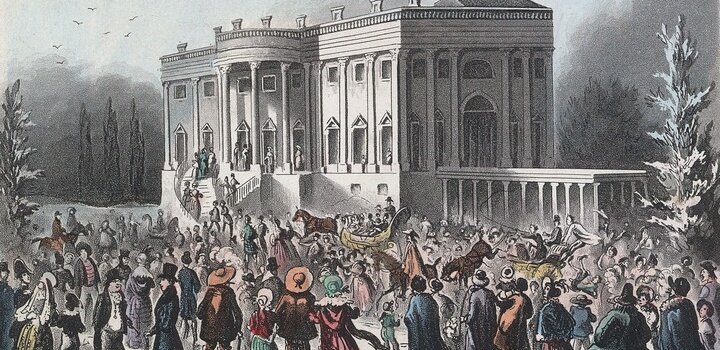
The first era of reform begins with the 1824 presidential election—a four-candidate election that fell to Congress (the House must decide when no candidate wins the Electoral College outright). Andrew Jackson won a plurality of the popular vote and Electoral College vote, though not a majority. But John Quincy Adams became president after making a deal with fellow candidate Henry Clay to make Clay secretary of state.
Jackson and his supporters declared it a “corrupt bargain” and organized disparateanti-Adams groups into the new Democratic Party, with Jackson (a popular general, but a political cipher at the time) as the standard-bearer. Jackson, a populist, won in 1828 in a revolt against the elites. But the revolt had begun in 1824, not just with Jackson’s outsider candidacy, but also with the breakdown of one-party rule.
Let’s back up. After the collapse of the Federalist Party in the early 1800s, the Jeffersonian Democratic-Republican Party (by then called “the Republicans”) achieved dominance, and American democracy experienced its only period of one-party rule, the so-called “Era of Good Feelings.” The American government also operated as a quasi-parliamentary system, with the congressional caucus nominating presidential candidates.
But one-party rule is never really one-party rule. It is the rule of submerged factions. In 1824, after James Monroe—the last of the Virginia dynasty—announced he would not seek a third term, he left no obvious successor. Factions swiftly re-emerged.
William Crawford, Secretary of the Treasury and longtime Virginia dynasty loyalist, was preferred by the insiders in Congress. But outside of Washington, resentment at “King Caucus” (the congressional nominating caucus) was growing, and state activists pressured their representatives not to participate. They found common cause with anti-Crawford factions in Congress. In 1824, only 66 out of 216 Republican Congress members voted for a Republican presidential nominee. This abstinence responded to constituents who disapproved of centralized decision-making in Washington, seeking increased local influence.
Andrew Jackson played the avatar of the new populist movement against big government (or what passed for big government at the time) and big banks. “Old Hickory” won the presidency in the 1828 election on a wave of frontier resentment against the corrupt ruling elites. He condemned “the moral depravity” of the aristocracy and their “false, rotten, insubstantial world.” He spoke for the “common men,” the “farmers and planters” and “mechanics and [laborers]” who were full of “independent spirit” and “intelligence.” “Never for a moment believe,” he argued, “that the great body of citizens … can deliberately intend to do wrong.”1
This populism reflected a growing divide and unresponsiveness from Washington. The era of one-party rule and “consensus” left many Americans feeling like the system no longer represented them. This was especially true for those who had moved inland to the expanding frontier. “Good feelings” were not everywhere. Jackson was the most visible figure in a larger populist movement that demanded more local autonomy and more participatory power—and he got it, by expanding the franchise and arresting the growth of government in Washington.
The devolution of political participatory activity out of Washington led to a new type of party: the first real mass party, the Democratic Party, which strung together a diverse and heterogeneous network of local chapters. However, in the American anti-party tradition, the Democrats of the 1830s were an odd kind of party, organized primarily around what it was against (government authority, especially from the federal government) and tied together by a particular vision of procedural equality, in which all who participated within the party participated on equal grounds, and anybody should be able to hold public office.2 It was a kind of radical libertarian equality. Everyone was free to pursue their self-interest until it ran into somebody else’s self-interest.
In practice, though, winning elections required organizing and mobilizing. But how do you mobilize people on the principle of having no principles? Under the leadership of some clever operatives (with Martin Van Buren being the most renowned as the first genuine pro-parties leader), Democrats figured out a winning strategy: the seemingly high-minded populist principle of “rotation in office.” In rhetoric, it meant everybody should be able to serve in government, regardless of background. In practice, it meant patronage—the so-called “spoils system.”
Administratively, this necessitated standardizing government roles. Government clerks thus became interchangeable parts. But what were they doing? Somebody had to set the rules and routines for them to follow. That gave a few people—or perhaps one person—tremendous power. The promise of equality was that all party members were equal in their submission to authority. Under the pretense of freedom and equality, a new oligarchy emerged.
The opposition to the Democrats, initially forming as the “National Republicans” (1832) and later the “Whigs” (beginning in 1836), observed Andrew Jackson’s White House leadership and saw tyranny. The Whig Party thus organized around opposition to “executive usurpation” and ran against “King Andrew.”
The big divide was over the so-called Bank War. The Charter of the Second Bank of the United States was set to expire in 1836. In 1832, Congress passed a bill to recharter it. Jackson vetoed the bill, which was a popular position among the public. His opponents were dismayed by both Jackson’s direct appeal to voters and to his antielitist populism. (The bank was, naturally, directed by the “best men.”)3
The Whigs had their core in Yankee New England, where an evangelical anti-partyism had deep roots in the ideal of communal solidarity, without division, under the guidance of sagacious leaders. With their high ideals and strong principles, they struggled in the finer arts of compromise necessary for effective party-building and lost many elections as a result.4 Being an anti-party party was not a particularly winning strategy. In a conflict between two parties centered on primarily negative principles—Democrats opposing government in general, and Whigs resisting executive power—election outcomes oscillated predictably. Throughout the 1840s and early 1850s, nearly every election was a “change election.” Though both Democrats and Whigs built modern mass political parties during the 1840s, these new parties were loose networks with no real national organization. The national party was “only the transparent filaments of the ghost of a party.”5
Eventually, of course, the slavery question, which both parties had suppressed in the service of building national coalitions, became unavoidable. Building a national party meant neither party could take a strong position on the one issue that would divide the country in half. But by the 1850s, the “slavery question” needed to be answered. In the tumultuous decade, it realigned the political system from two broad, overlapping national coalitions organized around patronage into two decidedly nonoverlapping coalitions that viewed each other with increasingly conspiratorial contempt.6
Could the Civil War have been avoided under a different party system? Possibly. We do know, however, that once politics devolved into a binary struggle by the late 1850s, peace became unlikely.7 As the Civil War historian David Blight wrote in a recent New York Times essay, “in a two-party system, the capture of one party by extremists is enough to cause great political havoc and violence, a lesson we should have learned from the destruction of our Union in 1861.”8
The lessons of this early period of democracy reform are complicated. The Democrats stood for popular participation and limited government and constant rotation of people, and so they loved elections for everything. Judicial elections, for example, are a Jacksonian-era electoral innovation. Jacksonian democracy, in its fullest aspiration, meant that nobody should be above anybody else, a noble spirit indeed, but a challenging way to run government efficiently and effectively. In practice, it set back American state-building capacity tremendously and built up a corrupt system of office-seeking patronage politics that grew even worse following the Civil War, until it was eventually tamed (somewhat).
While the Whigs promoted a more positive governing agenda focused on internal infrastructure investments—unlike the predominantly antigovernment Democrats—they lacked confidence in positive party organization. Consequently, the Whigs disintegrated faster in the 1850s when the escalating tensions over slavery tested party loyalty.
In practice, the two parties accomplished something quite remarkable, something only political parties can accomplish: They organized a diverse and sprawling nation into coalitions capable of holding together for the sake of winning office. In so doing, they made democracy accessible and interpretable and engaging for a growing share of Americans, expanding the franchise (though it was still quite limited by contemporary standards).
But the legacy is mixed. The decentralized nature of the parties made nominating presidential candidates especially difficult, hence a string of mediocre presidents who were fine compromise candidates but hapless leaders as the nation careened into civil war. The anti-party and antipower ethos prevented either the Whigs or the Democrats from assembling a genuine governing program, which slowed American state-building. Both parties were largely organized in opposition to each other and held together by patronage that bred corruption, inefficiency, and mistrust in governing. These failures of state capacity and rampant corruption, of course, would create the reformist foil for the next age of reform, the Progressive Era.
The irony, of course, is that the decentralizing, antipower ethos that guided both parties made politics more corrupt and less stable. Lacking meaningful authority over policy, or meaningful organization around shared values, party leaders had only patronage and favors to trade. Without any real ideology guiding either party, politics relied on complicated patronage to maintain the coalitions—until, of course, patronage was not enough. And then, with only two competing and antithetical ideologies, it was civil war.
In short, the Age of Jackson marked the beginning of political reform in the United States. Following the collapse of the Federalist Party, the one-party rule of the Jeffersonian Democratic-Republicans emerged, leading to the “Era of Good Feelings.” However, factions eventually resurfaced, culminating in the 1824 presidential election and the formation of the Democratic Party. Andrew Jackson’s populist movement promoted increased local autonomy, participatory power, and the expansion of the franchise. The opposition, initially the National Republicans and later the Whigs, focused on resisting executive power. Both parties struggled with organization and shared values, relying on patronage and favors to maintain their coalitions. This period of reform expanded democracy and political engagement, but also bred corruption, inefficiency, and mistrust in governing. Ultimately, the decentralizing, antipower ethos of the time made politics more corrupt and less stable. The two-party system contributed to the inability to resolve slavery through normal politics.
The Progressive Era: An Attempt to Build a Pure Democracy, Organized Power Fights Back
The Progressive Era stands as the giant among American reform eras, with many relevant contemporary echoes: deep distrust in political institutions, high levels of inequality, changing demographics, rising questions of American identity, and highly “polarized” politics.9
After the Civil War, American politics entered its most openly corrupt era. As Civil War tensions cooled, particularly following the compromise of 1876 that ended Reconstruction, politics once again became a patronage, pay-for-play machine, but with high levels of party loyalty and military-like mobilization, given the patronage at stake. Substantively, the parties mainly disagreed on tariff schemes, reflecting different industrial backers. As one observer remarked, the two parties were as “two bottles, each having a label, denoting the kind of liquor it contains, but each being empty… The American parties now continue to exist, because they have existed. The mill has been constructed, and its machinery goes on turning, even when there is no grist to grind.”10
But society was transforming. New giant railroad and banking conglomerates were dominating the economy, and corporate consolidation everywhere was driving inequality. Immigrants were flooding into cities, where political machines dominated. In rural areas, farmers were at the mercy of railroads, banks, and weather patterns. Everything felt unsettled.
By the 1890s, a loose movement of populists, rising-class professionals, and old-money moralists had congealed around a critique. As historian Samuel Hays distills the theory guiding reformers: “Selfish and evil men arose to take advantage of a political arrangement whereby unsystematic government offered many opportunities for personal gain at public expense. The system thrived until the 'better elements' 'men of intelligence and civic responsibility' or 'right-thinking people' ousted the culprits and fashioned a political force which produced decisions in the 'public interest.’”11
The Progressive Era, like reform eras before and after, was marked by antipower, anti-party reform theories aiming to “restore” direct, unmediated power to the people, despite them never having possessed such power. Reforms that were on their surface equalizing and democratizing were merely power-shifting. By opening up and tearing down existing structures of power, reformers hoped something organic and equal would emerge. But by tearing open all authority, they left nothing on which to build.
As one reticent reformer later reflected on the era, “The real trouble with us reformers is that we made a crusade against standards. Well, we smashed them all, and now neither we nor the people have anything left.”12
The Progressive narrative posed politics as a clash between the “people” and the “interests.”13 The problem was “the system.” Amid a “deep and widespread sense of exploitation and disorder,” many sought to wipe away the encrustations of partisanship and corruption. In a commonly held view, “selfishness had corrupted the original purposes of a higher nation.”14 If only Americans could reconnect with those original purposes, paradise could be restored. If only the people knew the truth (independent of parties), they would no longer be “misinformed and manipulated.”
Jacksonian Era reformers shifted power from Washington to the states; now, people sought to take it directly, bypassing any and all intermediaries between them and their government. “Democratization” served as a cudgel, an attack on the existing system.15
The movement was infused with an abstract ideal of the “public interest.” However, they only defined the ideal negatively, as the antithesis of current politics. The public interest was envisioned as a pristine canvas. It could only be revealed once reformers chiseled away the grimy layers of corruption and selfishness concealing it.
In their loftiest rhetoric, reformers contemplated the possibility of more direct citizen rule—a well-informed and wise electorate, capable of making rationally collective decisions through independent judgment, without corrupting intermediaries like parties or (ordinary) politicians. It was, as the political scientist James Morone called it, a vision of “participatory organization around neoclassical ideals.” Through informed and rational individuals acting independently, an invisible hand would magically unite an atomized public into an efficient polity.
During this period, reformers implemented “democratizing” reforms that seemingly transferred power from “corrupt” politicians and interests to “independent” people and experts. The key reforms were:
- civil service reform (moving from a patronage-based system of government employment to a merit-based system);
- the secret, government-printed ballot (replacing the party “ticket”);
- the direct primary (replacing the party convention);
- the direct election of U.S. senators (replacing appointment by state legislatures);
- the initiative and referendum; and
- recall elections.
The 1890s marked the introduction of the “Australian” ballot, in which states printed universal ballots that listed all candidates rather than parties and candidates handing out individual ballots or “tickets.” Reformers championed this new approach to voting because it gave voters the opportunity to cast their ballots in secret, free from intimidation, and in a space where individual citizens could quietly contemplate their options. Party leaders, meanwhile, championed reforms because it meant that state governments would be in charge of printing and regulating ballots, and since parties controlled state governments, party leaders could shape rules of ballot access in ways that helped their party.16
For dominant parties, a significant advantage of the new secret ballot was that they could now limit fusion voting. In the era of ticket-voting, this cross-endorsement sustained an active third-party movement, which could put pressure on the major parties by elevating issues the parties were ignoring. But by limiting cross-endorsement through ballot control, major parties effectively killed fusion voting around the turn of the century. The banning of fusion and the wide gating-off of ballot access undermined third-party activity.
Direct primary elections also undermined third-party activity, by making the major parties more permeable to outsiders. The direct primary emerged as a response to a corrupted system of nominations, in which party insiders and their moneyed backers conspired to select corrupt candidates. Reformers wanted the people to decide instead.
Already in the 1890s, political parties in some places had turned over their role in administering candidate selection to the states when internal divides prevented them from doing so, marking the first versions of the direct primary. Meanwhile, ambitious politicians grew increasingly frustrated with the power that the convention system gave “political bosses” and “wire pullers.”
Many ambitious candidates preferred to run on their own, confident that a direct connection with the voters would give them the autonomy and power that they rightfully deserved, rather than having to suck up to some political machine. In short, the old convention system had fewer and fewer defenders, as its problems became harder and harder to manage. The only consistent defenders of the existing primary system were rural delegates and representatives, who feared that a more popular-vote driven system would undermine their power relative to urban voters, who were underrepresented. By around 1900, the long-standing convention approach to nominating candidates became increasingly fraught.17
Wisconsin, then a hotbed of progressive reform, enacted the first official direct-primary statute in 1903. Within a decade, most states followed Wisconsin’s lead. The widespread introduction of the direct primary assumed that a hidden fifth column of responsible citizens would emerge, if only given the opportunity.
Nebraska Senator George Norris, a leading progressive, explained his high hopes for the direct primary in a 1923 essay entitled “Why I Believe in the Direct Primary”: The direct primary, Norris noted, places “a great deal of responsibility … upon the individual voter. The intelligent American citizen assumes this responsibility with a firm determination of performing his full duty by informing himself upon all the questions pertaining to government. It therefore results in a more intelligent electorate, and as this intelligence increases, it results in better government.”
Norris predicted that once everyone could participate equally, “the enlightened judgment of reason … will pervade the firesides and homes of a thinking patriotic people.”18 As was typical of Mugwump progressive reformers, Norris shared an abiding faith in the untutored wisdom of ordinary citizens to exercise reasoned and independent judgment and a deep-seated conviction that partisan bosses and organized interests were corrupting forces.
As one chronicler of the reformer history explained the hope: “Civic-minded citizens knew that the system was rigged, reformers averred, hence their decision not to take part was entirely understandable. The same citizens would flock to the polls if they knew their votes would be honestly counted by election officials who were not beholden to a corrupt political boss.”19 The story left one question unanswered: Who would mobilize these citizens?
The direct primary did not transform voter engagement or reason. Voter participation did not increase. Competition increased briefly before declining; the main beneficiaries of the reform were political incumbents.20 By the 1920s, the old forces of organized power regained power. Inequality rose until the stock market crash of 1929. Wealthy individuals and powerful companies continued to influence candidate selection behind the scenes. In some cases, direct primaries even strengthened party machines and “bosses.” The illusion of voter choice took the spotlight off candidate recruitment.
Certainly, progressive reformers talked about the wisdom of the citizens acting on their own. However, glowingly praising “the people” and their wisdom in the abstract is one thing. It is another thing to give them actual power. Professional-class progressive reformers, after rallying working-class populists, belied their rhetoric by empowering independent nonpartisan commissions to stand outside of politics, guided only by disinterested science and “caught up in dreams of social efficiency, systematization, and scientifically adjusted harmony.”21
During the Progressive Era, turnout declined, likely because of reforms that made political participation more demanding, less rewarding, and more confusing for many voters. In 1900, 80 percent of the voter-eligible population had cast ballots, a turnout rate that had been consistent since the 1840s, when the mass patronage party became dominant. Between 1900 and 1920, turnout steadily declined to 50 percent. In particular, the shift to the “Australian ballot” appears to have been a key cause of the decline in turnout.22
In the 1880s and 1890s, partisan machines had mobilized voters with almost military-level get-out-the-vote efforts. Ticket voting was easy. But the new politics weakened the tools of party leadership. Politics now placed political engagement atop the shoulders of individuals, who now shrugged it off as too much effort for too little payoff. The decline of patronage politics almost certainly contributed as well.
Thus, Progressive Era reformers also expanded and centralized government authority by establishing a wide range of administrative commissions, with new powers to regulate industry and land in “the public interest.”
The theory, of course, was that only new, nonpartisan government power could confront the corrupt parties and the special interests. Nonpartisan and independent “experts” would use the most advanced methods of scientific administration. The proper methods would generate the “right” answers, in “the public interest.” And “the people” would, of course, see the progress and boot out any partisan politician who opposed the public interest.
But in practice, the new agencies and commissions disagreed over what, exactly, “the public interest” entailed. Instead, they defaulted to refereeing between competing “special interests” who showed up. New lobbying groups formed to influence new agencies on behalf of narrow interests that could more easily organize collectively in ways diffuse citizens could not match. New lobbying organizations and political professionals could navigate the new institutions because they had the time and resources. Disorganized citizens could not. As Grant McConnell observed, “In sheer self-defense, if nothing else, the commissioners were forced into a search for accommodation, and accommodation slipped imperceptibly into corruption.”23 Without a clear definition of the public interest on which to stand, many “independent” commissioners followed the path of least resistance: capitulating to industry pressure.24 This capitulation would lead the next generation of reformers to try—and fail—to even further decentralize power.
Still, Progressive Era reformers did important work in professionalizing government. The civil service expanded considerably, with an increasing percentage of government positions now selected by merit, not political connections. Under the leadership of energetic reforms, many of the new agencies initially reigned in excesses of corporate power, making the economy fairer. The direct election of U.S. senators, another Progressive Era reform, was also a success.
But reformers of the early twentieth century made one key mistake. They tried to do democracy without organized power. Drawn to the ideal of true democratic equality via complete participatory openness without structure or authority, they believed they could find a way around political parties. So they tore open existing institutions, especially political parties, and hoped for the triumph of process over power-building.
Yet democratic equality meant participatory individualism, and organized power always triumphs over participatory individualism. Reformers hoped that when politics was direct and disintermediated, a “public interest” would miraculously emerge. But the “public interest” they envisioned was only a negative vision—an unstated alternative to the status quo and a common carrier for vague hopes and dreams. It lacked a positive vision or a structure around which to organize. It lacked a positive vision of power and a role for political parties to organize that power. It lacked a realistic understanding of modern representative democracy, which requires intermediary organizations, political parties above all, to mobilize and engage masses of voters and forge governing compromises on their behalf.
In summary, the Progressive Era marked a time of significant reform in American politics, driven by a loose movement of populists, rising-class professionals, and old-money moralists. They believed in restoring power to the people and making the government more democratic. But their reforms were mainly power-shifting and left no authority on which to build. Despite their lofty ideals of direct citizen rule, the reforms enacted during this era, such as civil service reform, the secret ballot, the direct primary, the direct election of senators, the initiative and referendum, and recall elections, did not bring the hoped-for transformation. Voter turnout declined, and new lobbying groups formed to influence the new agencies on behalf of narrow interests. The reformers’ failure to recognize the importance of organized power and political parties in representative democracy would be repeated in future reform eras. Nonetheless, their work in professionalizing the government, expanding the civil service, and reining in excesses of corporate power made the economy fairer.
The 1960s Participatory Party Reform: The Path to Polarization and Populist Backlash
In the 1960s, democracy reform fervor resurfaced with a familiar critique—leadership of the major parties was corrupt and self-serving. A new generation of reformers, with righteous moral fervor, thus turned to a familiar prescription—more openness and more participation.
Following the Second World War, a business-government-labor detente emerged in the 1950s, representing an unusual politics of bipartisan consensus. Both parties converged on a political middle: a vigorous role for America in the world, and peace with the welfare state at home. In the glow of postwar affluence, growth and bigness seemed in harmony. Anticommunism was a cudgel against dissent.
But dissent was growing. C. Wright Mills in 1956 wrote about the “power elite,” a cabal of business, government, and military leaders who run the society for their own personal power and enrichment. Students for a Democratic Society (SDS) launched with a 1962 manifesto against established power: “We would replace power rooted in possession, privilege, or circumstance by power and uniqueness rooted in love, reflectiveness, reason, and creativity. As a social system we seek the establishment of a democracy of individual participation.”25
“The crisis of the 1960s,” wrote Theodore Lowi, “is at bottom a political crisis, a crisis of public authority…. Today government itself has become the problem … protests and militancy, black and white, are the outward signs of decaying respect for public symbols and destroyed trust in public objects.”26
The conventional political institutions, particularly political parties, appeared remote to many citizens. In the “bipartisan lovefest” of the 1950s, many outside of Washington saw what the Texas born Mills saw—a power elite, running government for and by itself.
Though Progressive Era reformers had re-made the American political system, tearing it open to expanded participation, the criticisms of the early 1960s echoed the criticisms of the Progressives: too much power, in too few hands, for too much private gain.
The familiar solutions followed. More decentralization. More grassroots involvement. Revived anti-party sentiment weaved its way into party reform once more, working to sideline existing leadership.
During the 1960s, a new generation of volunteer “amateurs” set their sights on displacing the party “regulars” and demanded seats at the table to support their principles.27 On the left, activists rallied around civil rights and then against the Vietnam War. Meanwhile, on the right, new conservative activists saw the progress of big-government “liberalism” as threatening individual liberty. Though at opposite ends of the political spectrum, both groups saw the political establishment as their enemy and rejected the “go along, get along” culture of political bargaining that dominated the 1950s consensus-style politics, seemingly without clear principle.28
Within the parties, these were factional fights. Because the newer issue-oriented factions began as political outsiders with grassroots energy, they naturally gravitated towards participatory reforms. As with Progressive Era reformers, the reformers of the 1960s saw the political parties as corrupt institutions, held together by backroom parochialism, and thus incapable of decisive principled action. They were anti-party in that they had no taste for the pragmatic machine-style politics that still dominated in the 1950s. Instead, they hoped to seize control of the parties through more open participation. Then, powered by more engagement from new voters, they could re-fashion the parties into principled organizations, capable of advancing righteous moral causes.
Once again, the theory of change posited a simple plan. One, break down existing power sources. Two, give more authority to “the people.” And, voila!: Honesty and integrity in politics would return. And why was this time different? Was it that the Progressives hadn’t done enough to fully democratize politics? That they hadn’t stuck with it long enough? Or was it just that few thought critically about the history?
The most memorable and visible clash came at the 1968 Democratic National Convention, when antiwar protestors fought Chicago police in the streets, while Democrats nominated Hubert Humphrey, Johnson’s vice president. Most of the antiwar protestors had supported Eugene McCarthy, Humphrey’s longtime fellow Minnesota senator. In 1968, the current system of binding primaries was not in place. Instead, each state had its own delegates, who used their own judgment. States voted as units, which gave party “bosses” more control. The protestors howled when Humphrey won the nomination.
Following the chaos of the 1968 Democratic convention, Democrats established the Commission on Party Structure and Delegate Selection, better known as the McGovern-Fraser Commission. Adopting the committee’s recommendations meant that starting in 1972, Democrats handed over the choice of presidential selection to the voters through binding, direct primaries. George McGovern, the very liberal history professor turned U.S. senator from South Dakota, won under the new rules, but lost handily to Nixon in the general election.
Under the new rules, state delegates were now bound by what primary voters in their state had decided. Because these reforms required state legislation, Republicans followed along. This ended the long-standing practice of delegates selecting the nominees at the convention, as parties had done since the 1830s. The shift to direct primaries for president further weakened already-struggling local party organizations. Without their crucial role in appointing delegates, local parties atrophied further.29
The mainstream political science view is that turning presidential selection over so completely to voters weakened the parties as spaces for negotiation and compromise. Instead, parties became increasingly “hollow” organizations where advocates and interest groups mobilized donors and activists to support their chosen candidates, then went directly to the voters for support. Many contemporary scholars see this primary reform as a significant wrong turn, and a key reason why American politics has deteriorated.30
These analyses perhaps overstate the significance of a single change. After all, Goldwater
acolytes had taken over the Republican Party in 1964, before the McGovern-Fraser reforms. Conservatives were already taking over the Republican Party, and liberals were already taking over the Democratic Party—the main reason why the reforms succeeded in the first place.31 Partisan sorting and nationalized polarization would almost certainly have proceeded apace. Nonetheless, the change was consequential for organizational developments in the major parties.
The immediate impact in the 1970s was that candidates developed their own organizations, independent of parties, and used television to speak to their constituents. But unlike the old model of parties as on-the-ground and in-the-community organizations, television advertising was one-way. It was all talking and no listening. Candidates promised a more direct, unmediated relationship with constituents (as compared to parties). What constituents got instead was a one-directional stream of unmediated advertising and promotional mail.
As spending on television and direct mail replaced local organizing and community presence as the currency of politics in the 1970s, both parties coordinated and centralized into national networks of campaign consultants, organized around national committee offices headquartered in Washington, DC, starting in the 1980s. Politics went from the local union and American Legion halls to the airwaves and, eventually, social media. As conflict over race and religion displaced conflict over business regulation and labor regulation, politics became more moral, emotional, and irresolvable. With weakened local parties, politics became more nationalized. As politics became more nationalized, it became more polarized, with parties standardizing their brands everywhere. Local variation in parties, which had contributed to multidimensional fluid coalition, gave way to two nationalized parties, fully sorted, distinct, and at war with each other for total dominance.
As in previous eras, reformers diagnosed genuine institutional failures. The political “establishment” had been an obstacle to progress on civil rights. The political “establishment” had blundered into a disastrous war in Vietnam. Reformers sought to change the rules both within the parties and within Congress. They wanted to throw out the old establishment and give their people power. Reformers believed the public stood firmly with their principles. If so, a democratic, open, and transparent process would naturally yield the “right” policies in the “public interest.”
Party reformers of the 1960s did not ultimately build responsible parties. Instead, they went to war with the existing party establishment. And in the fight over control, power splintered into competing factions within the party, which formed more informal, networked groups.32 Well-funded issue groups came to dominate over professionals in both parties, elevating national culture-war conflict. In this round, nationalized media became the most powerful tool of power.
Reformers also set their sights on the workings of Congress and the federal government writ large, demanding more openness and transparency across decision-making procedures.33 New campaign finance regulations demanded publicity for political donations. Like Progressive Era reformers, the 1960s and 1970s reformers held that a well-informed citizenry, with greater visibility into government operations, would demand and receive more from their leaders.
The concept of the “public interest” returned in full force, alongside deep skepticism of any organized power, outside or inside the government.34 But now the problems were even bigger—nuclear war and environmental degradation loomed as existential problems, alongside new, ambitious expectations of poverty elimination and, for some, self-actualization.35
More broadly, reformers valorized a politics of individual liberation and self-expression, individualized citizen participation, and consumer sovereignty. Ralph Nader, a self-styled “consumer advocate,” became a hero of the left. Atomistic, market-based “neoliberal” principles came to define politics on both left and right.36 If neither big government nor big business deserved trust, then governance must rely on engaged and independent public citizens. If small was beautiful, then any bigness inherent in organized, collective activity was, by definition, ugly.37
The irony was that reformers of the 1960s ultimately made power even harder to wield through their fixations with “participation” and “openness.” And once again, the cycle repeated itself. As the idealist reform energy of the moralizing 1960s and early 1970s dissipated into the narcissistic, materialistic culture of the 1980s and 1990s, the institutions that reformers had established in hopes of a more participatory democracy wound up eventually controlled by the organized few with narrow preferences and the resources to demand them.
A new professional class of lobbyists, working mostly for corporations and business associations, benefited from the expanding range of open-government access points, and with the resources to crowd out smaller groups representing more diffuse constituencies. A new professional class of campaign consultants and fundraisers fused seamlessly with the new class of lobbyists. Campaign-finance reforms put in place after Watergate initially privileged individual candidates over parties, but then, as campaign costs skyrocketed, party committees regained power over individual members by providing access to money.
Meanwhile, many of the new government agencies that emerged in the late 1960s and early 1970s overlearned from the failures of the progressive commission structure. Instead of insulating commissions, new agencies were to be more open to public comment and public pressure, on the theory that mass citizen participation would drive action—hence the model of the “public citizen.” By the late 1970s, businesses began investing significant resources in Washington in response.38 The small-is-beautiful Brandeisian turn toward decentralized power was repurposed into the 1980s neoliberal turn towards full-on market competition.39
Concurrently, the increased transparency and openness only heightened voters’ awareness of their limited control. The political parties, now transformed into networks of donors and organized activists, figured out once again how to control the parties behind the scenes through an “invisible primary,” leaving voters once again feeling powerless and frustrated.
As political parties weakened as institutions in the 1970s and 1980s, political scientists and analysts wrote about the death of collective responsibility and the constant blame-shifting. If nobody was in charge, nobody deserved blame. Everyone could just run against the system, then blame the system when voters complained.40 Single-issue particularistic politics led to legislative chaos. In the mid-1970s, the twin crises of energy and inflation proved too much for the American system of government, which struggled to respond.
Political parties inevitably regained power, primarily through national fundraising committees. These committees became increasingly crucial in campaign management and shaping party messaging. Party leaders asserted more power in Congress because individual members handed over that power. The decentralized Congress of the 1970s and early 1980s left individual members frustrated. They wanted leaders who could organize their caucuses and pass legislation.
And so, as politics nationalized, and the parties centralized, the party system polarized and flattened. Money became more important, and citizens became more distrustful and angrier. The financial crisis of 2008-2009 and its aftermath (bailouts for the banks) broadcasted a confirmation that the government was only for the rich and powerful. The election of Barack Obama, the first Black president, accelerated a racial backlash.
Meanwhile, the unchecked influx of big money, especially “dark money” post-Citizens United, fueled perceptions of political corruption and elite disconnect. In such an environment, “drain the swamp” had an obvious appeal. But when Donald Trump latched onto it in 2016, it was not new. Nancy Pelosi had used it when Democrats were climbing back to a House majority in the 2006 midterms. Before that, Ronald Reagan had used it. “Drain the swamp” is as fitting an ur-slogan of American political reform as any: Something is rotten in Washington. We must smash the corrupt power and give it back to the people. Same old, same old.
Significantly, Trump’s nomination resulted from the presidential primary reforms implemented by earlier generations of reformers. But Trump was no champion of open participation. He was an aspiring autocrat “populist” who scammed and abused everyone around him, especially his supporters. He stripped “rigged” of its meaning by throwing “rigged” at any outcome he didn’t like. And the Republican Party, helpless to stop his rise, handed him the power of the presidency.
Once again, a generation of reforms had failed because they didn’t take political parties seriously enough. Instead, the 1960s reformers simply assumed that a more open, participatory approach to politics would lead to “better” outcomes because an enlightened public would emerge organically, without structure, without organization. Once again, those with resources and concentrated power reasserted that power, taking over the institutions of governing and elections. And once again, the mass public responded with anger.
An important historical irony is that a key democratizing reform of earlier generations—the direct primary—played an important role in creating the current hyperpartisan polarization. Clearly, bypassing parties to give citizens more control does not yield more responsive politics. Yet, it’s unclear if we’ve learned this, given some current proposals.
In short: In the 1960s, reformers sought to address perceived corruption and self-serving behavior among party leaders by promoting openness and participation. Amid a growing atmosphere of dissent, activists on both the left and the right challenged the political establishment. The resulting reforms, particularly the direct primary for presidential nominations, aimed to democratize politics and give more power to the people. However, these measures ultimately weakened political parties and opened the door for big money and special-interest groups to gain influence. The disillusionment that followed has worsened the hyperpartisan polarization. It now seems that the push for more direct control by citizens did not lead to more responsive politics. Political parties and organized interests continue to structure politics, but are now even less connected to nonelite citizens.
A Note on Minor Parties in American History
The history of American democracy reform can often leave out third parties. Yet, despite a system of winner-take-all elections that are unfavorable for vibrant third-party activity, third parties have played key roles in U.S. politics. Throughout the nineteenth and early twentieth centuries, third parties were innovators in many policy areas, including notably women’s suffrage, the progressive income tax, and the direct election of senators. Third parties were frequently the “forerunners” of political change, “representing new groups, and offering new ideas for public policy.”41
The most consequential example was the emergence of the Republican Party in the 1850s—then a third party, but also the offshoot of previous third-party efforts to elevate the abolitionist cause, such as the Free Soil party. The Free Soil party itself was a merging of the Liberty Party and the Barnburners of the 1840s, which first elevated the antislavery cause when the two major parties, the Democrats and the Whigs, tried to suppress the slavery issue, which would split their national coalitions. Major parties are reluctant to respond in ways that might upset their long-standing coalitions. New parties pick up the slack and bring in new voters.
Third parties could thrive in the nineteenth century primarily because of the widespread use of fusion voting. Also called “multiple-party nomination” or “cross-endorsement,” fusion describes a system in which a single candidate can run on multiple party lines—typically a major party and a minor party. The votes are then tallied, first separately by party (to assess where the votes came from), then aggregated, or “fused,” together to determine a candidate’s total votes.
This practice gave minor parties an opportunity to wield modest power within the winner-take-all system of single-member districts. Minor parties could show exactly how much of a candidate’s support came from the minor party. This gave minor parties some bargaining leverage. By demonstrating how many votes a minor party contributed to a winning candidate’s vote share, that minor party could reveal how much a candidate might lose should the minor party abandon its support.
Practically, this encouraged dissenting voices to organize themselves into political parties, where they could have meaningful power. Fusion significantly advanced the abolition cause in the 1840s and 1850s and later propelled populist and progressive reform parties from the 1890s to 1910s.42
However, around the turn of the twentieth century, major parties outlawed fusion voting. They could, because around this time, states took control of ballot access. Early Progressive reformers advanced the “Australian” ballot—a secret ballot—as a response to the grift and intimidation that surrounded “ticket” voting. Today, voters go into a private ballot booth, where they can consider all the options in a secluded setting. In the nineteenth century, voters picked up printed “tickets” of party candidates (hence the phrase “split ticket” voting, because a voter who wanted to vote for two different parties would need to physically split their tickets).
The shift to state-printed ballots meant that somebody had to be in charge of standardizing ballot access. Naturally, partisans in control of state governments wanted to eliminate minor parties that might threaten them. Thus, they eliminated the possibility of fusion. They also enacted many other barriers to third parties.43 Meanwhile, the rise of the direct primary meant dissenters could now simply compete as Democrats or Republicans. Dissenters could now freely contest a major party primary.
While the United States aimed for more nonpartisan and disinterested politics, reformers in other global democracies—mired in more open class conflicts—harbored no such illusions. Around the turn of the twentieth century, politics was disputatious everywhere. Across Europe, new socialist parties were gaining, particularly in the cities. The franchise was expanding beyond the traditional landed classes as governments everywhere tried to gain legitimacy through electoral democracy. Between 1899 and 1919, most European democracies adopted proportional representation, essentially guaranteeing representative multiparty democracy.44 Americans instead doubled down on aspirations of nonpartisanship.
Lessons of History: Doing Democracy Without Organized Parties Is Like Building a House Without Bricks
The American political tradition is an anti-parties tradition. Yet political parties have structured American democracy from the very beginning. This is a peculiar contradiction. Reformers have attempted to fight against the hard reality that political parties are inevitable given the scale and scope of modern mass democracy. Reality, however, remains undefeated.
The basic story of reform is that in each of the major reform eras, popular reform movements attempted to disrupt existing concentrations of power by bringing authority closer, ever closer to “the people.” Reformers hoped that “the people” would be wiser than their leaders could ever be. Or, more specifically, that “the people” completely agreed with the reformers.
But the problem was that “the people” are not a unified bloc but a diverse group in need of structure. Democracy is a system to resolve and manage disagreements. To manage and resolve disagreements, however, requires some order and structure. This is the central role that political parties play in modern mass democracy. Parties organize and mobilize alternatives. But doing so requires both power and limits on participation. If everything is open to debate, then nothing can ever be resolved. Effective government becomes impossible.
In the Age of Jackson, early populists sought to smash centralized power and centralized banking on an ideal of decentralization and equality, against authority. But to hold together for the sake of winning elections, party leaders turned to patronage. Both the early Democrats and the Whigs were parties organized around opposition: Democrats around opposition to federal authority, Whigs around executive overreach they saw in Jackson’s dictatorial opposition to federal authority. Both parties had a negative conception of liberty. Without an affirmative vision of power, graft was the glue that held two competing party coalitions together in opposition to each other.
In the Progressive Era, reformers saw the two parties as irredeemably corrupt. They were certainly corrupt. But a more direct, unmediated connection between the people and their government proved unworkable. Bringing politics closer to the people didn’t solve the question of organization and agenda-setting. And insulating government agencies from partisan pressures by making them independent did not insulate them from private interests. The Progressives envisioned a “public interest” in the abstract, but not in the specifics. They agreed only on the empty vessel of “change.” The “public interest” would somehow emerge when the “private interests” were stripped of their power via direct primaries. Today, direct primaries enable narrowly organized groups to hold excessive power under the guise of democratic participation.
In the 1960s, reformers targeted a corrupt political establishment and sought to revolutionize the existing authority with the aspiration that a more participatory politics would yield a superior outcome. However, the envisioned improvement lacked crucial specificity beyond encouraging openness and fostering a “democratic wish” that the people would exhibit greater wisdom than their leaders. In an era of distrust, reformers improved transparency and expanded participatory opportunities. But disorganized citizens could not mobilize effectively to use these new participatory spaces. Narrowly organized groups could.
In each era, reformers worked to undermine party leadership. But rather than establishing new parties or new collective organizations, they simply attempted to make existing sources of power harder to manage and control. Often reformers try to counter problems of legitimacy by expanding participation, hoping more open participation would restore the legitimacy of institutions. But more open participation without clear structure just makes organizations and institutions more difficult to lead and less effective—and thus less legitimate, creating a recurring set of crises. Bruce Cain calls this the “delegation paradox.” Reformers are constantly trying to close the “representation gap” by giving citizens more nominal control, but this just shifts authority to those who shape the alternatives over which citizens are deciding. Target those who shape the new alternatives by giving citizens more control over them, and authority moves one step beyond. There is no solving the problem that somebody has to set the agenda.45
Yet despite reform efforts to push them to the margins, political parties are resilient, inevitable institutions.46 Well-organized political groups and actors, especially those with big bank accounts, are most adaptive to new obstacles. In each era, the reforms designed to enable more public participation failed to accomplish their goals. Instead, they made public participation harder, by making it more time-demanding.
In each era, empowering citizens with fewer yet more significant opportunities for participation would have yielded greater impact. Fewer elections with more parties would make those choices clearer and more meaningful. Instead, reformers gave voters more choices and opportunities for participation, but less structure, clarity, and meaningful choice.
In every era, reformers made it harder to lead and govern by increasing the participatory opportunities, thus making politics more about campaigning and advertising, and less about doing the hard work of forging governing compromise.
Americans have countless opportunities to vote in endless elections at all levels of government. But most elections, especially at the state and local level, have only one viable candidate. There are thousands of opportunities to participate in all levels of government decision-making, but few organizations exist to represent those who are not already powerful.47 For those, participation falls on the individual actor. Yet, organization is power. Political parties are the central institutions of organized power in modern mass democracy.
The question for our current era is whether we can recognize this truth, or whether we will make the same mistake again.
Citations
- James A. Morone, The Democratic Wish: Popular Participation and the Limits of American Government (New Haven, CT: Yale University Press, 1998); 79-82.
- Douglas W. Jaenicke, “The Jacksonian Integration of Parties into the Constitutional System,” Political Science Quarterly 101, no. 1 (1986): 91-92, source: “The Jacksonians’ ideal was a party and society without any recognized values except the procedural equality and negative liberty of strict constitutional construction”; “the Democratic principles of equal opportunity, limited government, and strict construction necessarily engendered a politics of competitive self-interest.”
- Lynn L. Marshall, “The Strange Stillbirth of the Whig Party,” The American Historical Review 72, no. 2 (January 1967): 464. “The Bank of the United States embodied just this leadership ideal championed by Tocqueville and the proto-Whigs. Without denying the obvious economic utility of central control on banking, consider the socially impacted structure of this particular institution. Originally constructed in accordance with a segment of Hamilton’s brilliant theory, it represented a grand scheme with which men of honor might reach out imaginatively to secure possibly great benefits for the whole of society. It represented, pre-eminently, government buttressing of private socioeconomic position.”
- Ronald P. Formisano, “Political Character, Antipartyism and the Second Party System,” American Quarterly 21, no. 4 (1969): 683, source.
- Elmer Eric Schattschneider, Party Government (New York: Farrar & Rinehart, Inc., 1942), 129. Also cited in Rainey 1975, 174), who cites wide agreement.
- Eric Foner, Politics and Ideology in the Age of the Civil War (New York: Oxford University Press, 1981), 66. As historian Foner has explained, “These competing conspiratorial outlooks were reflections, not merely of sectional “paranoia,” but of the fact that the nation was every day growing apart and into two societies whose ultimate interests were diametrically opposed. The South’s fear of black Republicans, despite its exaggerated rhetoric, was based on the realistic assessment that at the heart of Republican aspirations for the nation’s future was the restriction and eventual eradication of slavery. And the Slave Power expressed northerners’ conviction, not only that slavery was incompatible with basic democratic values, but that to protect slavery, southerners were determined to control the federal government and use it to foster the expansion of slavery. In summary, the Slave Power idea was the ideological glue of the Republican party—it enabled them to elect in 1860 a man conservative enough to sweep to victory in every northern state, yet radical enough to trigger the secession crisis.”
- Foner, Politics and Ideology in the Age of the Civil War.
- David Blight, “Was the Civil War Inevitable?” New York Times Magazine, December 21, 2022, source.
- Frances E. Lee, “Patronage, Logrolls, and ‘Polarization’: Congressional Parties of the Gilded Age, 1876–1896,” Studies in American Political Development 30 (October 2016): 116–27. Americans were polarized in their voting during the Progressive Era, but on substance there was little difference.
- James Bryce, The American Commonwealth (New York: Macmillan Publishers, 1889).
- Samuel P. Hays, “The Politics of Reform in Municipal Government in the Progressive Era,” The Pacific Northwest Quarterly 55, no. 4 (1964): 157–69.
- J. Allen Smith, as quoted in Grant McConnell, Private Power & American Democracy (New York: Knopf, 1966), 48.
- David M. Kennedy, “Overview: The Progressive Era,” The Historian 37 (May 1975): 453–68, source. “It embodies moral passion, has its own built-in dramatic elements in the clash between the ‘people'’and the ‘interests,’” but the problem with this theory is that the reformers were often the elites, and the reforms were not necessarily successful.
- McConnell, Private Power & American Democracy, 31-32, 34. McConnell describes a “deep and widespread sense of exploitation and disorder” and a public preoccupied with corruption; “Any power was usurpation” and conspiracy”; there was “an ingrained distrust of power in the abstract”; the perception was that corruption was rampant—“selfishness had corrupted the original purposes of a higher nation”; the problem was “the system.”
- Hays, “The Politics of Reform in Municipal Government in the Progressive Era”: “The ideology of democratization of decision-making was negative rather than positive; it served as an instrument of attack against the existing political system rather than as a guide to alternative action."
- Lee Demetrius Walker, “The Ballot as a Party-System Switch: The Role of the Australian Ballot in Party-System Change and Development in the USA,” Party Politics 11 (March 2005): 217–41; Alan Ware, “Anti-Partism and Party Control of Political Reform in the United States: The Case of the Australian Ballot,” British Journal of Political Science 30 (January 2000): 1–29.
- For overviews of how the primary system changed during this period, see John F. Reynolds, The Demise of the American Convention System, 1880-1911 (Cambridge: Cambridge University Press, 2006); Alan Ware, The American Direct Primary: Party Institutionalization and Transformation in the North (Cambridge: Cambridge University Press, 2002); Shigeo Hirano, Primary Elections in the United States (Cambridge: Cambridge University Press, 2019).
- George W. Norris, “Why I Believe in the Direct Primary,” The ANNALS of the American Academy of Political and Social Science 106 (March 1923): 22–30.
- John F. Reynolds, “The Origins of the Direct Primary,” In Routledge Handbook of Primary Elections, ed. Robert G. Boatright, (New York Routledge, 2018), 39–56.
- Stephen Ansolabehere, John Mark Hansen, Shigeo Hirano, and James M. Snyder, “More Democracy: The Direct Primary and Competition in U.S. Elections,” Studies in American Political Development 24 (October 2010): 190–205.
- Daniel T. Rodgers, “In Search of Progressivism,” Reviews in American History 10 (1982): 118, source.
- Erik J. Engstrom, “The Rise and Decline of Turnout in Congressional Elections: Electoral Institutions, Competition, and Strategic Mobilization,” American Journal of Political Science 56, no. 2 (2012): 373–86; Erik J. Engstrom and Samuel Kernell, Party Ballots, Reform, and the Transformation of America’s Electoral System (Cambridge: Cambridge University Press, 2014).
- McConnell, Private Power & American Democracy, 50.
- Marver H. Bernstein, Regulating Business by Independent Commission (Princeton, N.J.: Princeton University Press, 1955). Marver Bernstein’s 1955 classic, Regulating Industry by Independent Commission, described the evolution of industry capture, whereby industries over time capture the independent commissions that were intended to regulate them. McConnell made a similar argument in 1966.
- Students for a Democratic Society (U.S.), “The Port Huron Statement,” (1962).
- Theodore J. Lowi, The End of Liberalism: The Second Republic of the United States (New York: W.W. Norton & Company, 1969).
- James Q. Wilson, The Amateur Democrat: Club Politics in Three Cities (Chicago: University of Chicago Press, 1962).
- For a good history of this era, see Eugene J. Dionne, Why Americans Hate Politics (New York: Simon and Schuster, 2004).
- El-Haj and Kuo, “Associational Party-Building,” 17, citing Jaime Sánchez, Jr., “Revisiting McGovern-Fraser: Party Nationalization and the Rhetoric of Reform,” Journal of Policy History 32, no. 1 (2020): 1–24; and Commission on Party Structure and Delegate Selection, 92nd Cong., Mandate for Reform (1971), reprinted in 117 Cong. Rec. 32,908 (1971): “In the 1970s, political parties lost ground at the local level as they began a process of nationalization. With advances in communication technologies, national parties became more prominent in the mid- twentieth century. The McGovern–Fraser reforms accelerated this trend by stripping state parties of their candidate-nomination roles and mandating a primary election system whereby voters themselves would determine the party’s presidential candidate.”
- See Jonathan Rauch, Political Realism: How Hacks, Machines, Big Money, and Back-Room Deals Can Strengthen American Democracy (Washington, DC: Brookings Institution Press, 2015); Frances Rosenbluth and Ian Shapiro, Responsible Parties: Saving Democracy from Itself (New Haven, CT: Yale University Press, 2018); Lawrence R. Jacobs, Democracy under Fire: The Rise of Extremists and the Hostile Takeover of the Republican Party (Oxford: Oxford University Press, 2022).
- Sam Rosenfeld, The Polarizers.
- Byron E. Shafer and Regina L. Wagner, The Long War over Party Structure: Democratic Representation and Policy Responsiveness in American Politics (Cambridge: Cambridge University Press, 2019), source; Seth Masket, No Middle Ground: How Informal Party Organizations Control Nominations and Polarize Legislatures (Ann Arbor: University of Michigan Press, 2011).
- Julian Zelizer, On Capitol Hill: The Struggle to Reform Congress and Its Consequences, 1948-2000 (Cambridge: Cambridge University Press, 2006).
- Paul Sabin, Public Citizens: The Attack on Big Government and the Remaking of American Liberalism (New York: WW Norton & Company, 2021).
- Michel Crozier, Samuel P. Huntington, and Joji Watanuki, The Crisis of Democracy: Report on the Governability of Democracies to the Trilateral Commission (New York: New York University Press, 1975).
- Gary Gerstle, The Rise and Fall of the Neoliberal Order: America and the World in the Free Market Era (Oxford: Oxford University Press, 2022).
- Ernst Friedrich Schumacher, Small Is Beautiful: A Study of Economics as if People Mattered (New York: Random House, 2011). The influential book Small is Beautiful urged everyone to live off the land, a kind of neo-Jeffersonianism vision amid capitalist progress.
- Lee Drutman, The Business of America Is Lobbying: How Corporations Became Politicized and Politics Became More Corporate (New York: Oxford University Press, 2015).
- Thomas Frank, The Conquest of Cool: Business Culture, Counterculture, and the Rise of Hip Consumerism (Chicago: University of Chicago Press, 1997).
- Morris P. Fiorina, “The Decline of Collective Responsibility in American Politics,” Daedalus 109, no. 3, (1980), 25–45. For example, Fiorina writes, “As the electoral interdependence of the party in government declines, its ability to act also declines. If responsibility can be shifted to another level or to another officeholder, there is less incentive to stick one’s own neck out in an attempt to solve a given problem. Leadership becomes more difficult, the ever-present bias toward the short-term solution becomes more pronounced, and the possibility of solving any given problem lessens.”
- Steven J. Rosenstone, Roy L. Behr, and Edward H. Lazarus, Third Parties in America (Princeton, NJ: Princeton University Press, 1996).
- Peter H. Argersinger, “A Place on the Ballot’: Fusion Politics and Antifusion Laws,” American Historical Review 85, no. 2 (1980): 287–306; Howard A. Scarrow, “Duverger’s Law, Fusion, and the Decline of American ‘Third’ Parties,” Western Political Quarterly 39, no. 4 (December 1, 1986): 634–47, source.
- Lisa Disch, The Tyranny of the Two-Party System (New York: Columbia University Press, 2002).
- Andrew McLaren Carstairs, A Short History of Electoral Systems in Western Europe (Crows Nest, Australia: Allen & Unwin, 1980).
- Bruce E. Cain, Democracy More or Less: America’s Political Reform Quandary (Cambridge: Cambridge University Press, 2014), 8-9. Cain explains: “The delegation paradox is this: The effort to gain more citizen control can never close the representation gap. It merely shifts the delegation. Elect more representatives to check the ones that have disappointed or failed, and you have created more delegations. Resort to direct democracy to check or bypass representative government, and a new class of election entrepreneurs gets the delegated task of formulating policy, organizing the effort to get something on the ballot, and providing voters with the information and cues they need to make a decision. Create new citizen forums, and they become the new agents. Average citizens will sporadically give input to government when something really matters to them. Organized interests are a constant presence.”
- Seth Masket, The Inevitable Party: Why Attempts to Kill the Party System Fail and How They Weaken Democracy (New York: Oxford University Press, 2016).
- Kay Lehman Schlozman, Sidney Verba, and Henry E. Brady, The Unheavenly Chorus: Unequal Political Voice and the Broken Promise of American Democracy (Princeton: NJ, Princeton University Press, 2012).