
Jeremy Bauer-Wolf
Investigations Manager
New America breaks down the political attacks against a crucial part of the U.S. higher education accountability system in this audio interview.

This analysis is part of Mythbusting Accreditation, a written and multimedia series from New America’s Education Policy program. It features insights from experts across multiple fields to cut through false narratives about a crucial higher education accountability system.
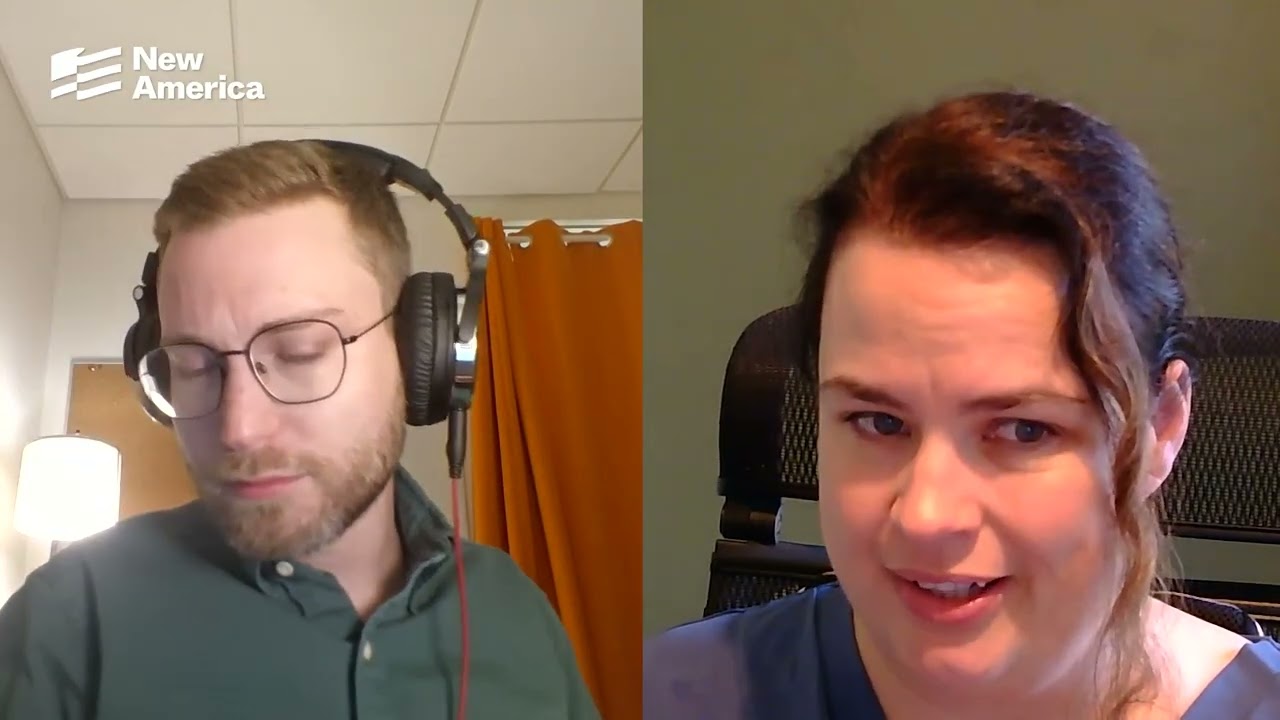
New America’s Jeremy Bauer-Wolf talked with disinformation expert Melissa Ryan about how the right can inflame certain topics in the media.
Jeremy Bauer-Wolf: College accreditation has entered the mediasphere in a way not seen in memory. Headlines about accreditors have become common. Politicians all the way up to the likes of Governor Ron DeSantis of Florida and President Donald Trump have attacked the system publicly, labeling it as woke and in step with the liberal agenda.
But what are accreditors? In essence, they are the gatekeepers of federal financial aid.
Accreditors assess colleges by their standards and determine whether those institutions should qualify for aid, which is an $120 billion annual funding stream. But they’re not always portrayed accurately, either by policymakers, the press, and particularly right-of-line media. Welcome to Mythbusting Accreditation, a New America multimedia series where we’ll be discussing the truth of how accreditors and the system actually works.
My name is Jeremy Bauer-Wolf, I’m the investigations manager for New America’s higher ed policy program. Today I’m joined by Melissa Ryan, who’s the CEO and founder of Inviolable and author of the weekly newsletter Control Alt-Right Delete, which focuses on right-wing extremism and misinformation. Her work has been featured in news outlets, including BuzzFeed News, Refinery29, and NowThis.
Bauer-Wolf: Melissa, welcome.
Melissa Ryan: Thank you for having me.
Bauer-Wolf: So, accreditation is a very technical and niche topic. Why would we see something typically so obscure attract a political narrative?
Ryan: Obscure is a good word, because I think obscurity is a key to understanding why these folks have seized on accreditation and gone all in. It actually reminds me a lot of the critical race theory debates, which were similar, same circles.
And the fact is, most people just don’t know what accreditation is or why it matters because it just doesn’t impact their daily lives. And because of that, there’s also really no one set out to defend it. There’s no war room to protect the reputation of accreditation.
So there’s a data void. What these folks on the right can do is create the narrative and the story around what accreditation is and why it’s a bad, very scary thing. The folks who are involved in accreditation, the systems and institutions, they don’t really have the infrastructure or capacity to respond in a meaningful or speedy way.
Bauer-Wolf: How did we see this process play out when it came to critical race theory? I feel like that fell off a bit.
Ryan: Yeah, it did. I mean, they move on to the next thing, but I will say that it still falls into the general “woke” narrative.
The interesting thing about critical race theory is Christopher Rufo, the operative who was pushing it, he’s very open about what his strategy is. He was saying publicly, “It doesn’t matter to me if you don’t know what critical race theory is, you are going to think it’s the scariest thing.”
He was also not just getting right-wing media outlets on this, he moved onto mainstream outlets to get them freaked about it too. I think there’s also a problem with both-sides-ism that we see in traditional media, where they feel the need in the interest of supposed objectivity to cover both sides of an issue.
If one side has gone completely crazy town, there are a lot of mainstream news outlets that
will still feel compelled to cover it as like, well, this is what one side of the accreditation debate. And this is what the other side is, even if one argument makes absolutely no sense when you think about it.
Bauer-Wolf: Tell us about how some of these topics become inflamed, where they work their way from the hyperpartisan blogs to mainstream media.
Ryan: Generally a topic will percolate on the right. They start talking about it nonstop. And then it becomes, well, why is the mainstream media ignoring the real issue that obviously everyone cares about?
Social media helps with this a lot. Because particularly when you’re thinking about cable news, they will still use social media as the assignment editor.
If these right-wing communities are talking about something online and it becomes a trending topic—which is usually strategic, by the way, they’re usually gaming it intentionally—then what news outlets will often say is “Oh, well, this is what people are talking about. So we need to cover it, too.” Again, because there’s a data void, the right already is able to control the narrative.
Bauer-Wolf: This gaming you mentioned, we’ve often seen the same type of terminology used among media and policymakers. Does that imply coordination?
Ryan: I don’t think it’s coordination in terms of like everybody gets on an 8 a.m. conference call and says this is what we’re mad about. But I do think it’s important to understand that with the attention economy, the way that MAGA media and influencers make money is constantly keeping the attention and constantly keeping their audience outraged, scared, and upset constantly. It helps them drive their political ideology but it also helps them make money because it keeps eyeballs on their content.
So they are always outraged about something and they move quickly to the next thing that people are supposed to be outraged about.
Bauer-Wolf: Where does this outrage originate? Are policymakers making noise, or is it the media themselves?
Ryan: I think it’s a little both. There is definitely an intellectual right. It’s interesting that we’re talking about universities and accreditation because you have one of the early neoreactionary thinkers that sort of brings in the far-right is Curtis Yarvin. And he talked about, and still talks about, “destroying the cathedrals,” meaning all of the civil society institutions, including academia.
It’s always interesting to me that a lot of these folks who have all these intellectual, high-minded ideas about eliteness and education, they went to elite institutions and their kids went to elite institutions.
You also have this right-wing base that for years was part of the Republican Party. But I feel like the elites in the party made sure they never gained any real political power, whether it’s straight up white supremacist, whether you’re thinking about conspiracy mongers, the different, more extreme strains. And under Trump, they’ve amassed a lot of political power. And I don’t think they want to give that up.
Bauer-Wolf: Why in your opinion has higher education, and accreditation by extension, been a target of the right?
Ryan: We disinformation researchers for years would say “well, part of the problem is that trust in institutions is at an all-time low,” which is true.
But there’s a reason trust in institutions is at an all-time low, because there has been so much failure of institutions. There has been so much corruption. I certainly wouldn’t say that every university or every college has been corrupt. But as we’ve seen with the Epstein scandal, a lot of these institutions were willing to tolerate a lot of shady stuff in the interest of getting money and getting help.
And I do think the public has seen that institutions by and large are not serving us in the way that they’re supposed to and failed. Again, that creates something that the right can exploit. I’m not saying that every institution is bad or they’re all corrupt, but I am saying there’s been a lot of failure. And that’s something that the right can build upon because we all feel it.
I think it’s important to understand that the MAGA right, they want institutions to fail.
So they’re exploiting it. The distrust we naturally have because of what’s gone on in the world in the past 20 years. But they are very open about the fact that they want to destroy and dismantle the civil society institutions that have made up America, American politics and culture for quite some time.
Bauer-Wolf: How can a layperson try to navigate this era of disinformation?
Ryan: There are no quick solutions.
One thing I don’t love about this genre of question in particular is we present these huge systemic problems and then we’re like “how can you as an individual fix it?” Or how can you as an individual protect yourself? And I’m not sure that’s realistic.
I want to say to your listeners, first of all, it’s not on you to fix this information in the world. It’s not even on you to fix it for your circle of friends.
But there are some things you can do. An easy thing to do is to just consider what that information is, what the person who came up with the headline and the content is trying to make you feel, and if there might be a motivation behind it.
Investigations Manager