
Providing Meaningful Transparency and Accountability
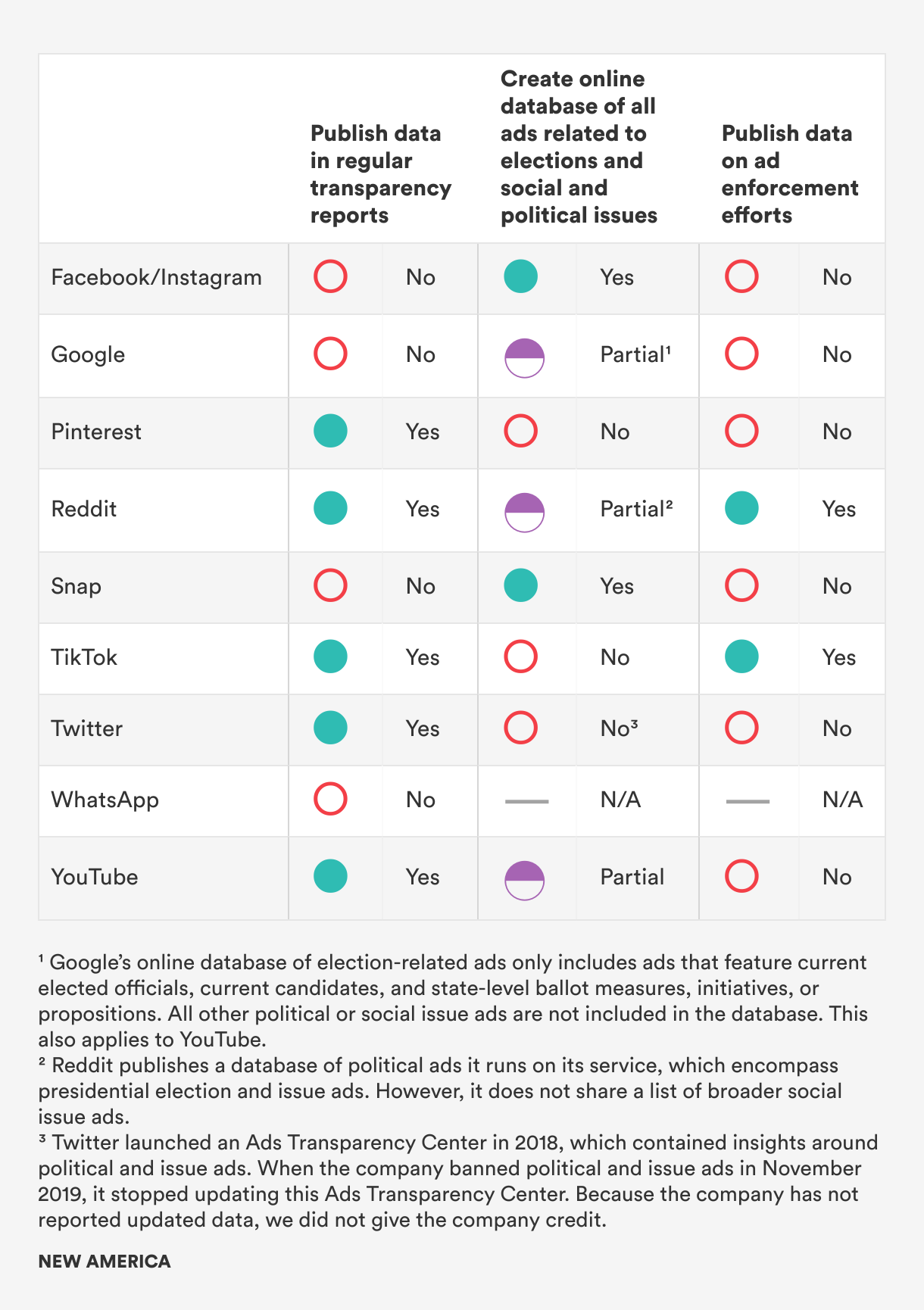
Disappointingly, while most platforms we evaluated have comprehensive content policies that cover election misinformation and disinformation, platforms have made little progress in providing adequate transparency around how they apply these policies and how this has impacted content and user accounts online.
In addition, companies that do report data often fail to disaggregate data between categories of content. For example, YouTube reports on spam and misleading information together, making it difficult to understand how much misleading content the company took action against.1 Additionally, none of the companies provide a comprehensive overview of how all of their enforcement actions have impacted content. For example, Twitter primarily reports on the number of accounts actioned, suspended, and the amount of content it removed under its Civic Integrity Policy. It does not discuss its use of labels and other enforcement mechanisms.2 Similarly, TikTok reports on how much election misinformation, disinformation, or manipulated media content they removed and how many times banners were added to election-related videos in the “For You” feed, but not the broader set of enforcement actions it takes on its platform against misleading information.3 Without this data, it is difficult to understand the effectiveness of platforms’ efforts to combat misleading information, and to hold them accountable for falling short. We encourage platforms to expand their reporting. Additionally, while we encourage some degree of standardization in reporting, we believe that platforms should report on metrics that allow researchers to understand the unique nature of their services and their unique efforts to combat misleading information (e.g., as TikTok has done with the “For You” label metric).4
Similarly, only two platforms publish comprehensive ad databases or libraries of all ads in categories related to elections and social and political issues, while three offer limited libraries. For example, Google’s U.S. political advertising library is limited to four categories of ads, which include ads related to a “federal or state level political party” and “a current office holder or candidate for an elected federal office.”5 Once again, it is challenging to draw clear lines around political and non-political content. As a result, we expect and urge companies that have instituted political ad bans to still establish comprehensive ad libraries for ads that are tangentially related but that do not fall within their political advertising definition. Some of the existing libraries, such as Snap’s Political Ads Library, are also difficult to access and navigate, decreasing the utility of the feature.6
This information is critical for understanding what kinds of advertisements run on these services, which advertisers benefit from certain policies, and where platform advertisement moderation efforts are falling short. Publishing data around ad enforcement is particularly critical, as this facilitates evaluation of platform advertising policies and practices and allows independent assessment of where and how advertisements—including advertisements with misleading information—can slip through the cracks. As of now, only two platforms—Reddit and TikTok—publish any such data, although this data is not directly related to election misinformation or election and issue advertising. Given that there is a dearth of data available in this area right now, we awarded these two companies credit.
Citations
- “YouTube Community Guidelines enforcement,” Google Transparency Report, source.
- “Rules Enforcement,” Twitter Transparency, source.
- Michael Beckerman, “TikTok's H2 2020 Transparency Report,” TikTok Newsroom, February 24, 2021, source.
- Spandana Singh and Leila Doty, The Transparency Report Tracking Tool: How Internet Platforms Are Reporting on the Enforcement of Their Content Rules (Washington, DC: New America, 2021), source.
- “Political Advertising on Google,” Google, source.
- “Snap Political Ads Library,” Snap Inc., source.