
Table of Contents
- Introduction
- The Case for Crafting a Millennial Public Policy Agenda
- Part I: Millennial Public Policy Symposium
- Part II: Policy Research Papers
- Independent, Not Alone: Breaking the Poverty Cycle through Transition-Age Foster Care Reform
- Data Sharing as Social Justice: How an Improved Reentry Process Can Smooth the Transition for Formerly Justice-Involved People
- Making the Case for Culturally Responsive Teaching and Supportive Teaching Standards
- The Context of Tradition: Evolving Challenges in Federal Indian Policy
- Public Policy and the Poor People’s Campaign: Reducing Inequality through Political Action
- A Public Interest Test in Merger Review
- Beyond Access: The Future of Voting Rights in the United States
- Solutions for the Health Care Cybersecurity Workforce of the Digital Age
- Taking Down Terrorism: Strategies for Evaluating the Moderation and Removal of Extremist Content and Accounts
- Gridlock: Enhancing Disaster Response Efforts Through Data Transparency in the Electric Utility Sector
- Part III: The Millennial Public Policy Fellows
- Selected Pieces from the Direct Message Blog
Data Sharing as Social Justice: How an Improved Reentry Process Can Smooth the Transition for Formerly Justice-Involved People
by Emma Coleman
Bipartisan support for criminal justice reform is evident. Apart from those who benefit from rising incarceration rates, like stakeholders and owners of private prisons, we can unite under the shared goals of reducing the prison and jail populations, diverting justice-involved people away from incarceration when possible, and focusing resources on rehabilitation upon release. The reentry experience is a critical link in reducing the societal and personal effects of mass incarceration and, with closer attention, it can provide a solid path for a safer and more just society.
The initial reentry period is a crucial time in the lives of formerly justice-involved people. Often, there are strict limitations on the jobs that are available, the geographic locations that they are allowed to live in, and the people with whom they are allowed to associate. Hundreds of thousands of people released from prisons and jails each year face these challenges in isolation, leading to a high recidivism rate. Within three years of release, over 65 percent of formerly justice-involved people are rearrested, and, within five years, that figure climbs to 75 percent.1 In some places, and for some particularly vulnerable groups, the results are even more extreme. Washington, D.C., for example, sends almost 40 percent of its formerly justice-involved population back to prison, a more severe measure than a rearrest, within just 36 months.2
The initial reentry period is a crucial time in the lives of formerly justice-involved people.
While many conversations about reentry focus on the tension between individual responsibility and community assistance, this paper will not seek to find a curative solution. Instead, given the magnitude of people affected by this system on a daily basis, we must ask how we can improve current procedures to reduce the number of people who recidivate and legitimize their ability to pursue full lives that build on their past rather than shaming it. One way to do this is through a comprehensive empowerment of reentry service providers, so that they might better serve their clients’ individualized needs and encourage them to leverage their strongest abilities.
Reentry service providers play a critical role in combating the serious logistical concerns of reentry—such as job and housing insecurity, inaccessibility of childcare, drug and alcohol rehabilitation, and adjustment to new technology, among others. Effective nonprofits provide the requisite support for a smooth path to successful reentry, but they often lack the data to appropriately serve their clients’ needs immediately after release. In current practice, there are no formalized and universally applied standards for data sharing between correctional facilities and nonprofit reentry organizations. Because of this, nonprofits are largely responsible for collecting all the data they might need about their clients, including vital information like time spent incarcerated, employment history, courses taken while incarcerated, child care responsibilities, and locations in which they are allowed to live. There is no guarantee that nonprofits will receive this information prior to a client arriving at their organization seeking services unless that nonprofit maintains an active and regular presence in a correctional facility and are allowed to do client intakes prior to clients’ release.
The process of relaying personal history information manually to a caseworker from a nonprofit can be traumatic and often provides an incomplete picture. Perhaps most concerning, however, when considering the number of people who access services from these nonprofits each day, is the inefficiency of this process; if the data already exists within the criminal justice system and can be transferred to nonprofit case workers so that they have a general understanding of their clients’ needs before they arise, the relevant information should be transferred. A process that aims to efficiently and effectively provide client information to case managers could be hugely impactful. Such an improved process could save caseworkers’ valuable time, allow for more personal client interactions, and most importantly, ensure clients get the critical services they need immediately upon release.
There is no guarantee that nonprofits will receive this information prior to a client arriving at their organization seeking services unless that nonprofit maintains an active and regular presence in a correctional facility and are allowed to do client intakes prior to clients’ release.
In order for such a process to be successful, however, there are several structural changes needed from both correctional facilities and nonprofits. Establishing a comprehensive data-sharing system will require process reengineering for the release procedure of justice-involved people, signing data agreements between specific nonprofits and the correctional facilities around them, the implementation of sophisticated data-management systems within these nonprofits, and the creation of privacy terms and conditions to ensure client security. By completing these steps, reentry coordinators and case managers can better assess client needs, provide faster and stronger targeted support, and set an actionable, individualized path forward for each person.
Notes on Terminology
Since the objective of reentry is to encourage rehabilitation and forward progress from past wrongs, there is value in abstaining from passing judgment on crimes committed by those reentering society, unless it is directly relevant to their rehabilitation. Therefore, in order to avoid the intense stigmatization of crime and incarceration, this paper avoids use of the term “felon” and “ex-felon” to refer to those currently serving time in a correctional facility and those who have left them, respectively. Instead, the terms justice-involved and formerly justice-involved take the place of felon and ex-felon.
It is also necessary to understand the difference between the various types of correctional facilities. A jail is a small, community-operated holding place usually meant for those with short sentences (less than a year) or those being held as they await trial. These are run by sheriffs or county governments, which is why they are often referred to as “county jails.” Jails are occasionally called detention centers.
A prison is a facility run by either the state or federal government, which usually holds those serving longer sentences. Within prisons, there exist two types: federal and state. Federal prisons are institutions run by the Federal Bureau of Prisons (BOP), leaving them under the jurisdiction of the federal government. People in these prisons are “awaiting trial for violating federal laws or those who have already been convicted of committing a federal crime.”3 Federal prisons tend to house those who have committed “white collar crimes,” because the most commonly prosecuted federal crimes are conspiracy and fraud. State prisons function similarly to federal prisons, but are run at the state level for state crimes, which vary in severity and sentencing across the country. Prisons are referred to by varying names, such as correctional treatment facilities, correctional centers, and penitentiaries.
Both federal and state prisons can be either government-run or private. Private prisons are facilities run by a for-profit company that has been contracted by the federal or state government to oversee all day-to-day operations. Technically, these prisons are bound by the same regulations that the state and federal government enforce in all their other facilities. As of 2015, private prisons are responsible for 7 percent of state prisoners and 18 percent of federal prisoners, along with a handful of local jails.4
As people transition from being justice-involved (held in a correctional facility) to formerly justice-involved, they go through a process called reentry. Reentry processes vary from state to state and from facility to facility. Some states employ parole, during which a person can serve the remainder of their sentence in the community. Recidivism is the process of rearrest, reconviction, and potentially a return to prison after a person has been released.
Reentry service providers are organizations that help with formerly justice-involved people’s adjustment upon their release. These are most often nonprofits, religious organizations, or government-sponsored programs. Residential reentry centers, commonly referred to as RRCs and previously referred to as “halfway houses,” are BOP-contracted reentry service providers that specifically provide housing. They may also offer other services like job training and child care programming, or they may focus solely on providing beds.
Challenges of Reentry and Promises of Rehabilitation
Every year, more than 600,000 people return to society after time spent in prison—averaging out to more than 1,600 people per day across the country.5 The challenges faced upon reentry are staggering. As of March 2018, the National Inventory of the Collateral Consequences of Conviction had amassed over 48,000 restrictions placed on formerly justice-involved people by federal and state laws.6 These restrictions vary in severity and by state or district, but all represent major logistical challenges to the process of reentry and rehabilitation. For example, someone returning to D.C. is ineligible to serve as a live-in aide, gain or reinstate a real estate license, qualify for medical marijuana, and reside in an adoptive family home, amongst hundreds of other extremely specific regulations.7
The greatest challenges that are applied nearly universally to justice-involved people include ineligibility for public benefits like housing and food stamps, curtailed civil liberties for things like voting, restrictions on where and with whom they can live, and an inability to apply for student loans, certain grants, and lines of credit.8 Above all this, there also hangs an intense cultural stigma that leads to discrimination against formerly justice-involved people by landlords, employers, and the general public.
The challenges faced upon reentry are staggering.
While the odds against a successful reentry may seem difficult to overcome, strong rehabilitation efforts have produced promising results, especially amongst those coming from federal prisons. In a study conducted over four years with 262,000 recently released people, it was found that 93 percent of those who found employment during the period of their supervised release did not recidivate; by contrast, 50 percent of those who struggled to find housing returned to prison shortly after release.9 The importance of support services that help formerly justice-involved find housing and employment specifically cannot be overstated. The benefits of coordinated rehabilitation and supportive reentry are clear: they prevent recidivism and promote healthier lives for formerly incarcerated people.
Mapping the reentry landscape
Figure: Immediate reentry needs provided by caseworkers
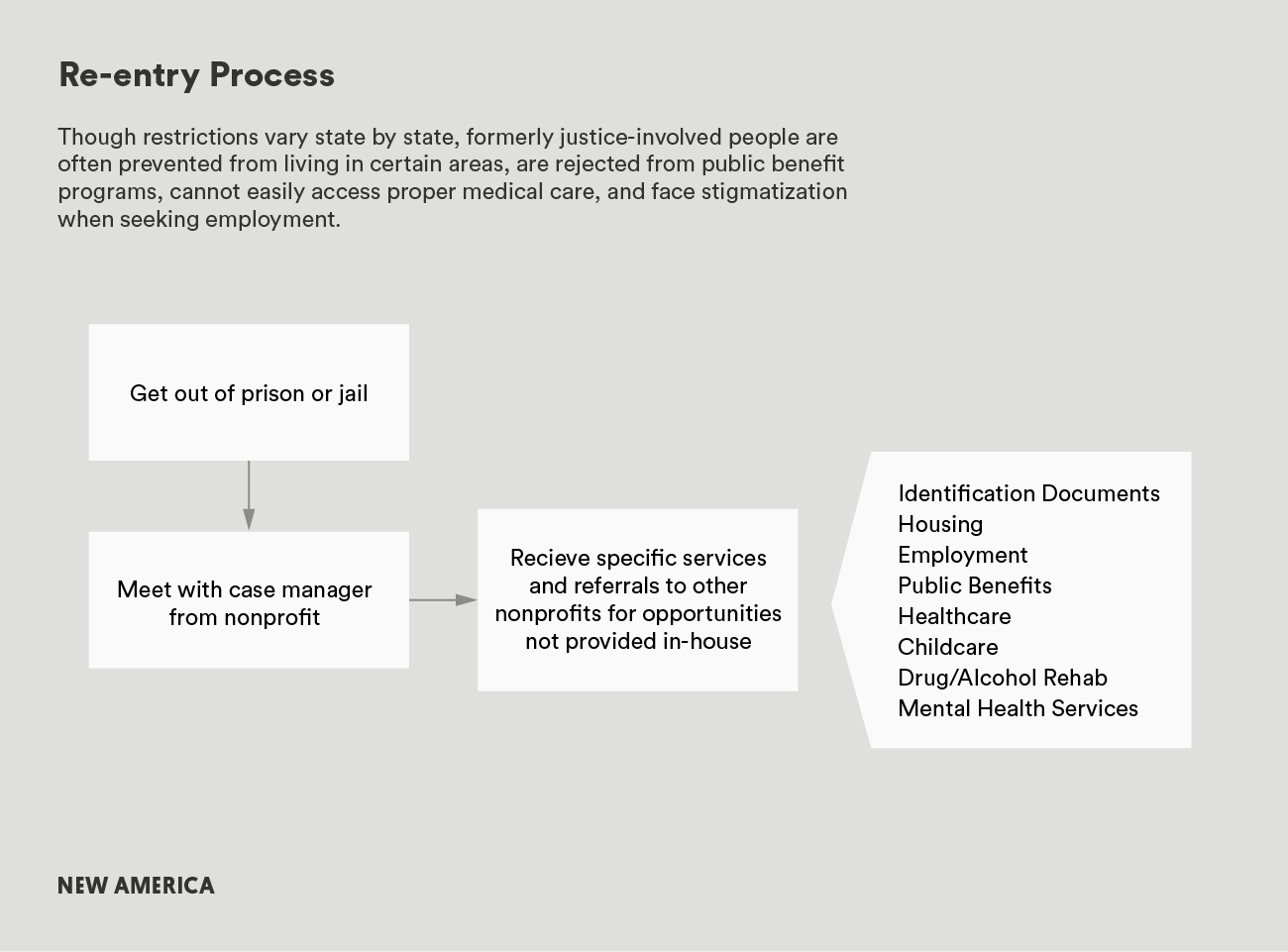
In order to understand why reforms to the reentry system are necessary, it is important to understand the current landscape of the reentry process and its inherent inefficiencies. As a person prepares to exit a correctional facility, they will often consult with a case manager from a visiting nonprofit. Depending on the type of facility, individuals may already be familiar with these case managers. In jails that are located in centralized areas, nonprofit case managers may visit several times a month in order to present on the services they offer and meet with potential future clients to screen them for eligibility or complete intake forms before they are formally released. In more isolated facilities like federal and state prisons, which are often located far from the city centers or towns that most of their residents will return to, case managers may only visit once every few months and will mainly interact with those slotted for imminent release.
Upon release, people have the opportunity to reconnect with these nonprofits for a variety of immediate needs, like housing and health care, as well as long-term services, like job training and child care. Most often, one nonprofit will not offer every service that a client needs, so they refer out to other nonprofits that may provide that type of support. Many nonprofits maintain strong working relationships with one another; in fact, in Washington, D.C., there is a coalition of nonprofits in the reentry space who share clients regularly and use a common data-sharing platform, called Efforts to Outcomes, for client- and grant-tracking purposes.
In more isolated facilities like federal and state prisons, case managers may only visit once every few months and will mainly interact with those slotted for imminent release.
Residential Reentry Centers (RRCs) are distinct from direct service nonprofits in the BOP space. Specifically, RRCs are locations where those returning from prison can serve the remainder of their sentence in a setting that helps them transition back into society. There are currently 161 RRCs nationwide that are contracted with the BOP.10 While most states have between three and five houses, states with a larger population of those in federal prisons may have up to ten. In Washington, D.C., where between 1,400-2,000 people return from a federal prison every year,11 there are two contracted RRCS—Fairview and Hope Village—with a combined total of 420 beds.1213 Not all of these beds are available to those returning from federal prison, however, as many RRCs contract with both the BOP and their local state jails. BOP contracts with these RRCs are massive. Hope Village, for example, has two contracts with the BOP that total about $5.5 million annually, or roughly $100 per bed, per day.14
It is not uncommon for data sharing between the BOP and RRCs to be much more advanced than data sharing with other nonprofit services, even those that provide housing. Since RRCs have federal contracts, some also have established memorandums of understanding (MOUs) with the BOP facilities from which most of their clients return. This distinctly disadvantages nonprofits that provide housing but are not RRCs because there is no guarantee they will receive the information they need. One affordable housing nonprofit in Washington, D.C., for example, is not an RRC, but owns and operates two apartment buildings for formerly justice-involved people to live in immediately upon their release. Their case managers often struggle to get the information they need from BOP facilities, such as up-to-date psychological evaluations, medication records, and similarly vital data.
The poor coordination between reentry service providers and the BOP is born of many factors, but one of the most obvious challenges is the lack of information sharing as justice-involved people approach release. Without a strong precedent for and agreements to data share, the reentry process will continue to be a frustrating experience of tracking down needed information for both case managers and justice-involved people alike.
Create a Data-sharing Protocol for the Federal Bureau of Prisons and Beyond
For a pilot of standardized data sharing agreements, the Federal Bureau of Prisons (BOP) is the most obvious first choice. Though it is geographically sparse, the BOP has a centralized system that is more closely monitored than most states, and has been taking significant steps to reevaluate their reentry protocol since 2016. During this time of improvement, it would be prudent to incorporate all possible technological advancements, with data-sharing lying at the center of them.
As of December 2017, the BOP holds about 184,000 justice-involved people in 122 prisons across the country.15 The BOP has a responsibility to ensure that these people successfully transition back into society and avoid repeat behavior that could lead to recidivism. Starting with a pilot in one city and then scaling to the rest of the BOP’s locations, data-sharing agreements should be the norm for correctional facilities and nonprofit service agencies. Agreements should expand beyond the typical laissez-faire approach that currently exists between certain BOP facilities and RRCs. Those involved in the process of creating new protocols should be the leaders of local nonprofits, the reentry affairs coordinators that sit at individual BOP locations, the National Reentry Service Division of the BOP located in D.C., and a technical team made up of either U.S. Digital Service employees or consultants familiar with the reentry space.
The BOP has a centralized system that is more closely monitored than most states, and has been taking significant steps to reevaluate their reentry protocol since 2016.
The BOP should work collaboratively with a nonprofit reentry network in one city to complete a research sprint that would identify the full scope of services that these organizations provide. After classifying these organizations into buckets based on what information they need to provide services effectively and efficiently, the BOP should map where this information is stored, how long it takes to access, and the federal guidelines around information privacy for each piece of information. For example, nonprofits that provide housing need information about their clients’ medications but those who provide job training do not. It is important to only share the minimum amount of information necessary to protect the privacy of formerly justice-involved people, so bucketing services will make data agreements safer and more manageable. With this knowledge in hand, the BOP can create a set of standardized MOUs for distribution to its correctional facilities, each one correlating to a type of service provided. Standardization will make partnering with local nonprofits infinitely easier for federal prisons; but, beyond this, it should also become a requirement for every nonprofit with which the prison currently has an informal partnership and the standard of practice going forward for new partnerships.
Washington, D.C., would be an excellent pilot location because the BOP’s headquarters are located there, and the reentry service nonprofits in the city already have the capacity to share data between agencies and meet frequently to discuss policy issues. The BOP also has a current data-management tool called R3M, which streamlines the referral process to RRCs, and integrating this tool with the Washington, D.C., reentry network system could create a better case-management protocol.16 Washington, D.C., is also an ideal location because many national nonprofits that provide reentry services are headquartered here as well. The BOP should establish national MOUs as much as possible and then create individual task orders for the local offices.
It is incredibly important to pilot these protocols before spreading them across the BOP. Learnings generated from a pilot program can help the BOP identify best practices, understand where the work needs to pivot, and have their progress reviewed by the Federal Interagency Reentry Council (FIRC). Once the initial pilot is completed, the standardized MOUs and requirements for data sharing can be rolled out throughout the BOP. The progress represented by this policy change fits well into the BOP’s plans for future success. The BOP went through an intense period of scrutiny in 2016 in order to reduce the recidivism rates amongst formerly justice-involved people who were once in BOP custody. From this, one of the recommendations was to make the BOP’s model for reentry more effective by creating new partnerships, testing new operating models, and providing the resources necessary to sustain successful models in the future.17 Given that the BOP has already taken steps to do this with RRCs by creating better pathways for data interoperability, expanding the initiatives to other service agencies should be an easier process. Establishing data-sharing protocols and agreements would align well with the BOP’s organizational goals and current projects.
Learnings generated from a pilot program can help the BOP identify best practices, understand where the work needs to pivot, and have their progress reviewed by the Federal Interagency Reentry Council.
The BOP’s progress should be continuously monitored and the outcomes of individual formerly justice-involved people tracked. If the program is showing success, it would be beneficial to create an explanatory review so that states and localities can begin to implement similar programs in their individual corrections departments. It may not be as difficult a task as it seems to spread this practice from the BOP, should the pilot prove successful. There are a plethora of resources for organizations trying to partner with correctional facilities, and many outline how to approach the topic of information sharing. As noted in The Urban Institute’s guide for community organizations attempting to establish partnerships with local jails, “Information sharing with correctional staff, though often neglected, is a key point of the partnership-building process.”18 They suggest developing clear protocols and using them to provide discharge planning services, allowing organizations to better serve their target population “by engaging them sooner and knowing who most warrants scarce resources.”19
There also exist examples of successful programs at the county and city level, which can serve as informative foundations for other localities implementing similar methods. In Montgomery County, Maryland, there are biweekly meetings of the Re-Entry Collaborative Case Management group, which develops comprehensive plans for people from the Montgomery County Correctional Facility who are considered “high risk” for recidivating. The group represents a wide variety of stakeholders, including correctional staff (case managers, social workers, and treatment staff), local law enforcement, parole and probation offers, human service agency officials, and community service providers. By coordinating services and openly sharing information, the group is able to much more effectively provide a continuum of services during reentry.20
An additional element that may be helpful for the dissemination of these policies from the BOP to states and counties is the recent renewal of the Federal Interagency Reentry Council (FIRC). It has been moved from where it previously stood in the Department of Justice (DOJ) to the White House and staffed with the heads of eleven government departments and agencies.21 While it is currently co-chaired by the senior advisor in charge of the White House Office of American Innovation, the committee lacks a strong technical perspective. In order to remedy this, it would be advisable to add a representative from the Office of Science and Technology Policy (OSTP) and potentially create a U.S. Digital Service team dedicated to helping the Council layout implementation plans for their technological projects. It is within the mandate of the council to engage with key stakeholders in order to “improve collaboration between federal, state, local, and tribal governments through dissemination of evidence-based best practices to reduce the rate of recidivism” by considering “available partnerships with…community organizations.”22 From this mandate, it would be appropriate for the Council to more fully investigate the role of technology in partnerships with community organizations, with standardized data transfer agreements playing a pivotal role.
There are a plethora of resources for organizations trying to partner with correctional facilities, and many outline how to approach the topic of information sharing.
It is important to remember that the benefits of lowered recidivism cannot be undervalued. As noted by FIRC, “The high cost of incarceration directly impacts states’ abilities to fund other needed services and programs in the community, creating a cycle of community disinvestment.”23 If a pilot of data-sharing and cooperation agreements works well at the BOP level, it could be implemented at the state level. These changes may, in fact, end up paying for themselves; although the initial funding to change the system would represent an increase in budget, the overall savings of lowered recidivism could fund the continuation and updates needed to maintain a well-functioning data transfer system.
Precedence for Data Sharing
Data sharing within other government agencies has seen positive results. The Department of Health and Human Services (HHS) recently piloted an increased data-sharing protocol with state and local human services agencies that provide access to various federal programs. The program had great success improving administrative efficiency and client services and, most relevant to any potential partnership between the BOP and local nonprofits, increased data sharing made the work of individual case managers much easier. Case managers from New York City and Allegheny County, Pennsylvania, noted that data sharing made obtaining client information much quicker and helped them make decisions that were better informed by their clients’ needs.24
The main concern over data sharing, understandably, was privacy, which they mitigated through an extensive process for determining who would be granted access to information that they needed to perform their jobs. New York City’s data-sharing initiative worked with program officials, department attorneys, and other relevant stakeholders to define 34 different user groups and then segmented data access under these categories to ensure only those who needed the information had the legal authority to do so. They also employed security measures individualized to their organizations, including user training, password protection, and audit trails. Additionally, all the sites in the HHS study created multiple data-sharing agreements to define exactly what information was shared, with whom, how, and for what purpose. These data-sharing agreements were between service agencies and also were in place with external government entities.
Data sharing made obtaining client information much quicker and helped them make decisions that were better informed by their clients’ needs.
The pilot additionally provided an interesting funding model. Allegheny County, instead of relying on support from HHS, worked with 12 local funders to form a coalition that provided the funding required to start a data warehouse and long-term support for improvements and requisite updates. The success of this pilot experience proves not only that data sharing can be done but also that service provision clearly benefited from its establishment while taking the necessary measures to consider long-term success.
Implementation Challenges
The challenges to a comprehensive data-sharing plan are substantial, but not insurmountable. Primarily, such an adjustment requires an unprecedented synchronization between correctional facilities and nonprofits, most of which use different data-management tools. In order for this to happen most rapidly, the data may have to at first come via the system that the correctional facility has in place, which would most likely be paper records that they have on hand. For more sensitive data, like psychological evaluations and medical information, which are required by most residential reentry nonprofits, it is possible that this information is stored at a central office but not at the correctional facility itself, presenting another challenge to implementation. In order to adjust for this, creating protocols that require all records for returning people be automatically delivered to and accumulated in their facility three months prior to their release could give ample time for transfer of that information to the relevant service nonprofits.
In an ideal world, records that the correctional facility collects would be entirely electronic, and the information relevant to nonprofit case managers, including specific medical information, history of courses taken or degrees earned during incarceration, and whether or not the individual is being released on parole, would be sent to them with the individual’s consent before their release. This would allow nonprofits to take additional time to prepare for each client’s arrival. This would require correctional facilities and nonprofits to use similar data-management systems, so as to ease the transfer of data in accessible formats on both sides. Many reentry nonprofits in D.C. use different case management systems, such as Penelope and Apricot, for their in-house needs, and use Efforts to Outcomes when communicating with other nonprofits about shared clients. Transferring data to nonprofits through Efforts to Outcomes in D.C., and in similar coalition-based data-management systems throughout the country, could be a proactive step for uniting correctional facilities and nonprofits.
Perhaps the greatest concern of all, however, is the issue of data privacy and dignity. Data breaches are relatively common, and both government agencies and nonprofit organizations often lack the capacity to upgrade to the most up-to-date security features. Formerly justice-involved people are particularly vulnerable, and therefore their data requires an additional element of security that will be difficult to manage at scale. It is therefore necessary for both correctional facilities and nonprofits to take relatively simple steps to minimize data abuse and potential harm for returning individuals. First, each nonprofit should compile a list of the data they require from their potential clients for their given services. They should receive only this information and nothing more. For example, if an individual is working with one nonprofit for housing and one nonprofit for job training, the psychological evaluation required for housing should only be given to the former nonprofit, and the history of courses taken during incarceration should only be given to the latter. By employing this approach, the spread of sensitive information is minimized to only those on a need-to-know basis. This also protects client dignity, allowing them to disclose information only to those they trust with sensitive services. In addition to limiting what information is shared, nonprofits can integrate tools like two-factor authentication into their data-management systems, increasing digital security at little to no cost for the organization.
It is necessary for both correctional facilities and nonprofits to take relatively simple steps to minimize data abuse and potential harm for returning individuals.
Furthermore, when correctional facilities and nonprofits enter into data-sharing agreements with one another, it must be a stipulation that nonprofits cannot share any information outside their organization without the written consent of the individual. When an organization refers a client to another nonprofit for particular services, basic intake information should be shared freely to quickly get the client what they need, but anything given by the correctional facility should be approved by the client themselves. Here is where examples from New York City and Allegheny County become particularly relevant, as the nonprofits who established data-sharing agreements with HHS were all able to upgrade their data security with minimal cost and were able to identify funders who helped them establish a data warehouse. By sharing knowledge across fields, nonprofits and coalitions in the reentry space could employ the same strategies seen in other places around the country to safeguard their data.
Benefits of this Approach
The benefits of data-sharing agreements between correctional facilities and nonprofits can be summarized into three major categories. First, this process can smooth the path from incarceration to services to independent living. When case managers can spend less time gathering information from clients, they are instead able to devote themselves to more intensive case management and other tasks that they may not currently have the capacity to undertake. It also means that case managers can be more prepared to help their clients upon arrival, instead of having to do time-consuming intakes and information gathering from various sources to verify that a client is eligible for and accepted into a given benefits program.
By standardizing the data that they receive from correctional facilities, case managers will be able to more effectively target their programming. When orally retelling personal histories, it is common for people to forget things or accidentally omit information that could be helpful for their reentry. For example, if a case manager is able to know in advance a client’s history of courses, degrees, and job training programs that they may have engaged with during incarceration, they can adequately prepare programming that will benefit the maximum number of clients.
This process can smooth the path from incarceration to services to independent living.
Finally, by transferring this data in advance of a client’s arrival, their experience with the nonprofit can feel more like a benefits program and less like a transition out of incarceration. Having to retell personal history details of time spent incarcerated can be a traumatic experience, one which is easily prevented by a data transfer system. Empowering clients to move forward can be a powerful tool in the reentry process.
It is important to acknowledge that this solution represents a palliative, not curative, approach. Implementing such a system does not solve the problem of mass incarceration, and supporting the current system by making it more streamlined can be seen as a detriment to progress. With that said, there are thousands of people who return home each month who need support now. There are thousands of case managers trying their best to help them but struggling with an inefficient system that requires a great deal of time and energy to navigate. We have potential opportunities to support them, and data sharing can play a small, but significant, role in that.
Emma Coleman is a 2017-18 Millennial Fellow with the Public Interest Technology initiative at New America. She would like to thank the numerous nonprofits in D.C. who spoke to her about their work within the criminal justice system for her report, as well as the Public Interest Technology team and the Millennial Public Policy program for their support.
Citations
- Recidivism. (2014, June 17). Retrieved May 23, 2018, from the National Institute of Justice.
- Nakamura, K. (2012, Feb 12). Measuring Recidivism in the District of Columbia (Doc 38348). University of Maryland Department of Criminology and Criminal Justice.
- Federal Inmates. (n.d.). Retrieved May 23, 2018, from the Federal Bureau of Prisons.
- Bureau of Justice Statistics. (2016). Prisoners in 2015. (Bulletin NCJ 250229). U.S. Department of Justice.
- U.S. Department of Justice (2016, Apr). Roadmap to Reentry.
- National Inventory of the Collateral Consequences of Conviction. (2018). Retrieved May 23, 2018, from the Council of State Governments Justice Center.
- District of Columbia. (2018). Retrieved May 23, 2018, from the Justice Center.
- Fact Sheet: Barriers to Successful Re-Entry of Formerly Incarcerated People. (2017, Mar 27). Retrieved May 23, 2018, from The Leadership Conference.
- Fact Sheet: Barriers to Successful Re-Entry of Formerly Incarcerated People. (2017, Mar 27). Retrieved May 23, 2018, from The Leadership Conference.
- Completing the transition. (n.d.). Retrieved May 23, 2018, from the Federal Bureau of Prisons.
- Fact Sheet: Reentry in Washington D.C. (2017). Retrieved May 23, 2018, from the Court Services and Offender Supervision Agency.
- The Fairview RRC. (2014, Feb 28). Retrieved May 23, 2018, from the Corrections Information Council.
- Hope Village Report. (2013, May 24). Retrieved May 23, 2018, from the Corrections Information Council.
- Ibid.
- Maurer, D. (2017, Dec 13). Continued Action Needed to Address Incarceration Challenges and Offenders’ Reentry. (GAO-18-275T). U.S. Government Accountability Office.
- Bureau of Prisons Residential Reentry Centers Assessment. (2016, Aug 22). Retrieved May 23, 2018, from the U.S. Department of Justice.
- Bureau of Prisons Residential Reentry Centers Assessment. (2016, Aug 22). Retrieved May 23, 2018, from the U.S. Department of Justice.
- Crayton, A. et al. (2010, Aug). Partnering with Jails to Improve Reentry: a Guidebook for Community-Based Organizations. The Urban Institute.
- Crayton, A. et al. (2010, Aug). Partnering with Jails to Improve Reentry: a Guidebook for Community-Based Organizations. The Urban Institute.
- Yoon, J. and NIckel, J. (2008). Reentry Partnerships: a Guide for States and Faith-Based and Community Organizations. The Council of State Governments Justice Center.
- Executive Order No. 13826. Volume 83, no. 48. (2018).
- Executive Order No. 13826. Volume 83, no. 48. (2018).
- A Record of Progress and a Roadmap for the Future. (2016, Aug). Retrieved May 23, 2018, from the Federal Interagency Reentry Council.
- Brown, K.E. (2013, Feb 8). Human Services: Sustained and Coordinated Efforts Could Facilitate Data Sharing While Protecting Privacy. (GAO-13-106). U.S. Government Accountability Office.