
II. Landscape Scan
In summer 2025, we conducted a comprehensive search for degree apprenticeships in the United States.1 We found nearly 350 institutions of higher education (346) in 49 states and the District of Columbia that offered close to 600 (579) degree apprenticeship opportunities in which a Registered Apprenticeship was integrated with an associate, bachelor’s, or master’s degree, providing career preparation for 91 different occupations.
We learned 11 key things about the state of degree apprenticeships, organized into three categories below: occupational findings, higher education findings, and geographic findings.
Occupation Findings
Degree Apprenticeships Are Concentrated in a Small Number of Occupational Groups
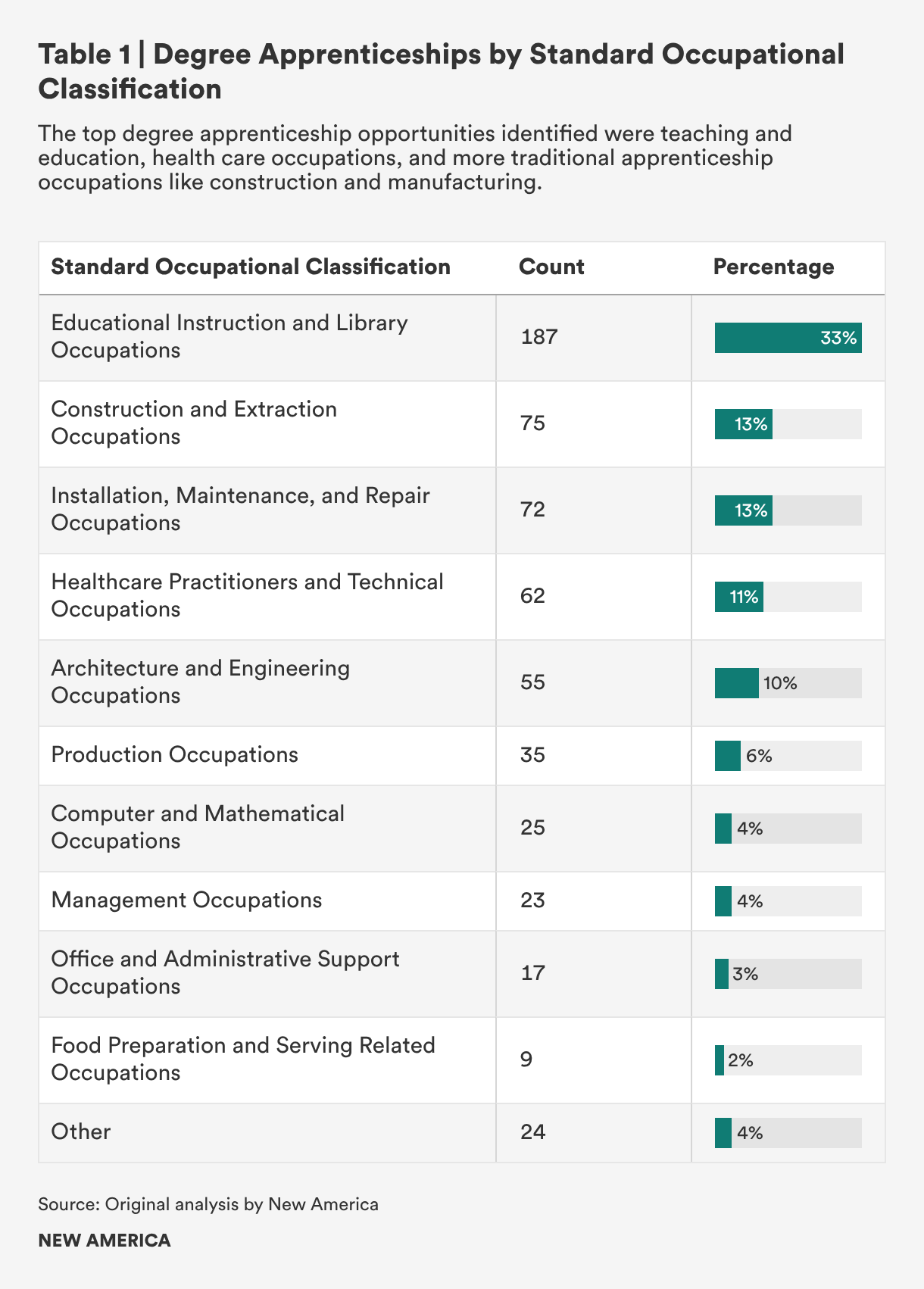
The degree apprenticeship opportunities we identified were heavily concentrated in only a handful of occupational categories. Using the U.S. Department of Labor’s (DOL’s) 23 Standard Occupational Classification (SOC) major categories, we found degree apprenticeship opportunities in 18 of the 23 categories. But more than three-quarters of the degree apprenticeship opportunities were in just five occupational groups (see Table 1), and nearly one-third of them were in just one category: Educational Instruction and Library Occupations. This category includes occupations like K–12 teacher and preschool teacher. Rounding out the top five were health care occupations and more traditional apprenticeship occupations like construction and manufacturing.
This finding matches anecdotal trends and evidence. During the Biden administration, both the secretary of education and the secretary of labor strongly promoted the development of teacher apprenticeships as a strategy to address nationwide teacher shortages and to diversify the educator workforce.2 DOL also widely publicized the availability of competitive grant funding for these programs and awarded numerous grants to support teacher apprenticeship programs in 2023 and 2024.3 Similarly, the federal government invested significant resources in health care apprenticeship via funding opportunities like “Apprenticeships: Closing the Skills Gaps in 2019.”4 There are shortages of professionals in many allied health occupations5 and this may have prompted employers and institutions of higher education to seek out more innovative strategies for attracting and preparing students for these jobs. The prominence of more traditional apprenticeship occupations like the skilled trades among degree apprenticeship opportunities may reflect the recent growth of community colleges as related instruction providers and sponsors for Registered Apprenticeships.6
K–12 Teacher and Registered Nurse Are the Top Two Occupations for Which Degree Apprenticeships Offer Career Preparation
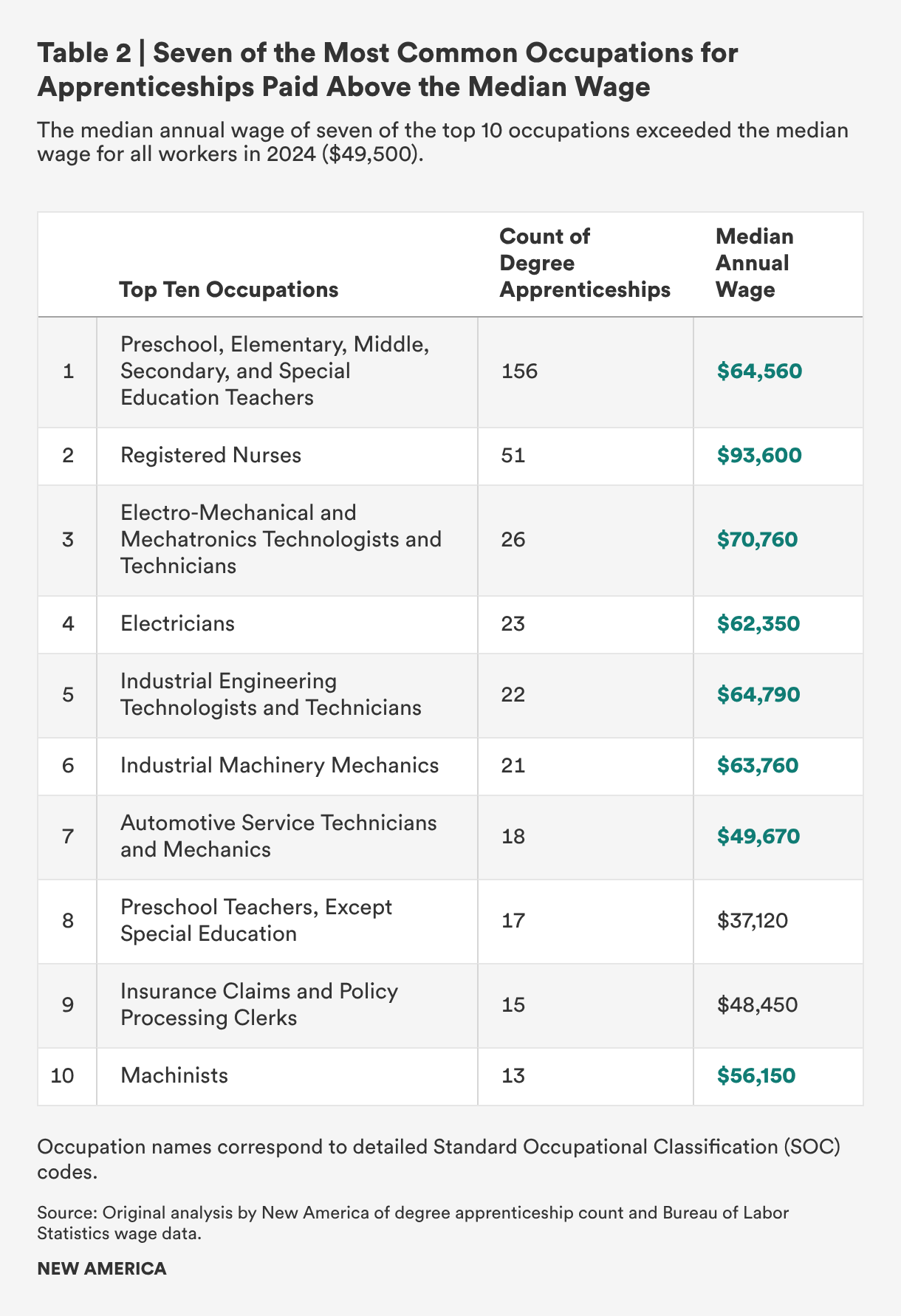
The degree apprenticeship opportunities we identified provided career preparation for 91 different occupations, from computer user support specialist to petroleum pump system operator. The 10 occupations with the largest number of degree apprenticeship opportunities are shown in Table 2. Programs for teachers and registered nurses top the list. Apprenticeships for both occupations also originated in the last four years,7 indicating how quickly institutions of higher education can start up programs when there is a strong demand.
Most of the Occupations Targeted by Degree Apprenticeship Pay Above the Median Wage and Are Projected to Grow
For the most part, degree apprenticeships are opening doors to well-paying jobs. As indicated in Table 2, the median annual wage of seven of the top 10 occupations exceeded the median wage for all workers in 2024 ($49,500). Of the occupations for which we identified degree apprenticeship opportunities, 86 percent paid more than the 2024 median annual wage. Software developer was the highest paying occupation ($133,080), while K–12 teaching assistant paid the least ($35,240).8
The employment outlook for the occupations for which we identified degree apprenticeship opportunities is mixed. The average projected rate of growth of job openings between 2024 and 2034 for the 91 occupations is .44 percent, significantly below the 3.1 percent average projected rate of growth for all occupations. However, 50 of the 91 occupations, or 55 percent, have above-average projected rates of growth. The number of jobs for 16 of the 91 occupations, or 18 percent, is projected to decline between 2024 and 2034.9
Many of these occupations in fields like health care and education pay close to, or even slightly below, the median annual wage, but are critical roles for our society. Degree apprenticeship programs lower the cost to enter professions and allow job advancement for those already employed in lower-paying or lower-skilled positions. Lowered barriers to entry may make degree apprenticeships more attractive to learners, even if they do not lead to the highest-paying jobs.
About Half of the Occupations for Which Degree Apprenticeships Offer Career Preparation Do Not Typically Require a Degree for Entry
According to the Bureau of Labor Statistics (BLS), earning a degree is not a typical requirement for entry for about half (48 percent) of the occupations for which we identified degree apprenticeship opportunities. So if a postsecondary degree is not a typical requirement for an occupation, why are apprenticeship sponsors combining them with Registered Apprenticeship programs to create degree apprenticeships? And why are students enrolling in them?
We heard several different explanations in our interviews. Students in an industrial maintenance mechanic degree apprenticeship in Alabama told us the associate degree was important to them because they believed it would give them more job security and provide greater opportunities for advancement. Other managers sponsoring degree apprenticeships for occupations that do not typically require a degree described the programs as long-term talent development strategies intended to create a bench of well-prepared employees who could later step into other, higher-ranking roles in the organization or even into leadership positions. A North Carolina employer whose apprentices were recent high school graduates said the degree was important to young people and their families. The degree also made the apprenticeship more appealing and competitive with what other area employers were offering.
The insurance industry provides a good example of why an employer may consider offering a degree apprenticeship for a position that does not typically require a degree. Insurance claims and policy processing clerk, one of the entry-level occupations for which we identified degree apprenticeship opportunities, typically does not require a degree.10 However, the academic and technical foundation provided by a degree may be helpful in advancing to higher-paying occupations in insurance for which the completion of licensure and certification courses and exams are desirable or required or, in the case of insurance underwriter, for which earning a degree is typically required. Ensuring claims and policy processing clerks earn a degree through their apprenticeship opens paths to upward mobility in the industry that might otherwise be closed off to them, allowing the apprentice—and the employers—to potentially reap longer-term career development rewards. The opportunity for upward mobility may be especially important in fields where entry-level jobs may be at risk due to the growth of artificial intelligence.
Occupations in the skilled trades do not typically require a degree, but they are the focus of about 13 percent of the degree apprenticeship opportunities we identified. For example, since 1994, Ivy Tech Community College has awarded AAS degrees to more than 25,000 apprentices in the construction trades through its partnership with the Indiana Building Trades Joint Apprenticeship Training Committees (JATCs).11 Individuals in JATC apprenticeships are co-enrolled in an Ivy Tech AAS degree program and take general education courses and some electives, usually online. The JATCs provide the technical-related instruction, for which Ivy Tech awards academic credit.12 Indiana pays the college tuition, using fines and interest on delinquent payments collected from employers by the state unemployment insurance system.13 In 2023–2024, Ivy Tech awarded 972 associate degrees in the construction trades.14
It is important to note that our research identified degree apprenticeship opportunities offered by institutions of higher education, but quantifying the extent to which employers are pursuing these options was beyond the scope of the project. For those occupations for which a degree is not a legal requirement for entry, some college officials noted that they also offered, and employers sometimes chose, a postsecondary certificate rather than a degree connected to the apprenticeship. How employers choose the postsecondary credentials they pair with a Registered Apprenticeship is a complex issue about which more research is needed.
There Are Promising Opportunities for Growth in Some Occupational Categories for Which We Identified Few or No Degree Apprenticeships
Several occupations requiring a degree for entry with strong projected growth and above-median pay still have few to no degree apprenticeships, despite being designated as apprenticeable occupations.15 Occupational therapy assistant and physical therapy assistant both require an associate degree16 and extensive supervised clinical experience17 that could be delivered through a Registered Apprenticeship, yet we located no degree apprenticeships for either occupation. We identified only two degree apprenticeship opportunities for biological technician and none for chemical technician and forensic science technician, but all three typically require a degree18 and have been identified by the U.S. Department of Labor’s Office of Apprenticeship (OA) as an apprenticeable occupation.19 Although we identified only one degree apprenticeship for police officer, there is great interest in using the apprenticeship model in law enforcement.20 While not all police training culminates in a degree, in 2024, 73 percent of detectives and criminal investigators and 58 percent of police and sheriff’s patrol officers had a degree.21 Embalmer is another apprenticeable occupation that typically requires a degree22 and practical work experience23 for which we found only one degree apprenticeship. Expanding degree apprenticeship programs in these occupations could expand affordable pathways into well-paying jobs in new fields.
Higher Education Findings
Most Degree Apprenticeship Opportunities Are Associate Degrees, Chiefly Associate of Applied Science Degrees
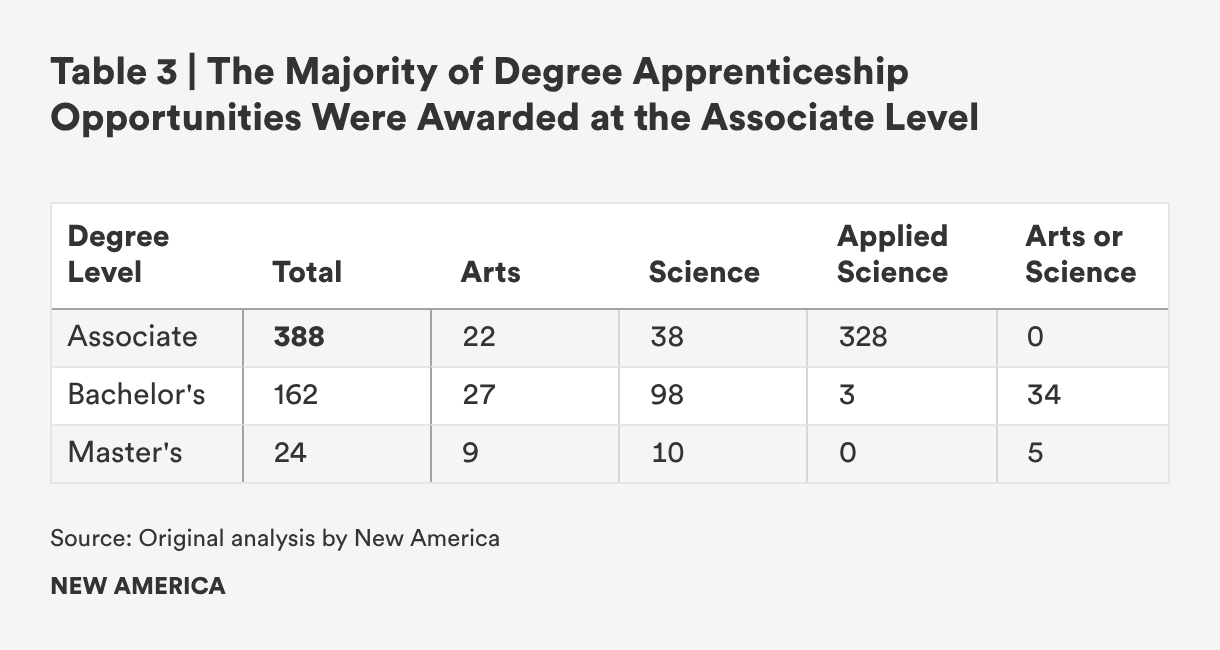
With the exception of teaching degree apprenticeship programs, most degree apprenticeship opportunities are concentrated at the associate degree level. As Table 3 shows, two-thirds of the degree apprenticeship opportunities we identified awarded degrees at the associate degree level, 29 percent awarded bachelor’s degrees, and 4 percent awarded master’s degrees. The associate degree opportunities were predominantly associate of applied science degrees (AAS).
Although results vary by field, AAS degrees can have strong value in the labor market, offering, on average, higher earnings than a high school credential.24 However, AAS degrees have historically been designed as terminal degrees intended to prepare students for immediate entry into the workforce and not as a foundation for transfer to a bachelor’s degree program.25 This limits the upward mobility of individuals with AAS degrees by making it more difficult and costly to attain a bachelor’s degree, except for applied bachelor’s degrees that are aligned with AAS degrees.26 Research in North Carolina has found that students with AAS degrees who transfer into University of North Carolina institutions lose, on average, over two semesters’ worth of course credits in making the transfer. They are less likely to earn a bachelor’s degree than students who transfer with AA or AS degrees, in part because of those lost credits.27
Unsurprisingly, the programs that offered bachelor’s degrees are overwhelmingly in occupations where a bachelor’s degree is required for entry. The bachelor’s degree apprenticeship opportunities are predominantly (92 percent) in education or a related field. Of the remainder, 4 percent are in nursing, and 4 percent are in other fields, such as construction management and cybersecurity. All but two of the master’s degree apprenticeship opportunities are in education.
Degree Apprenticeship Programs Are Rare and Primarily Offered at Large and Urban Schools
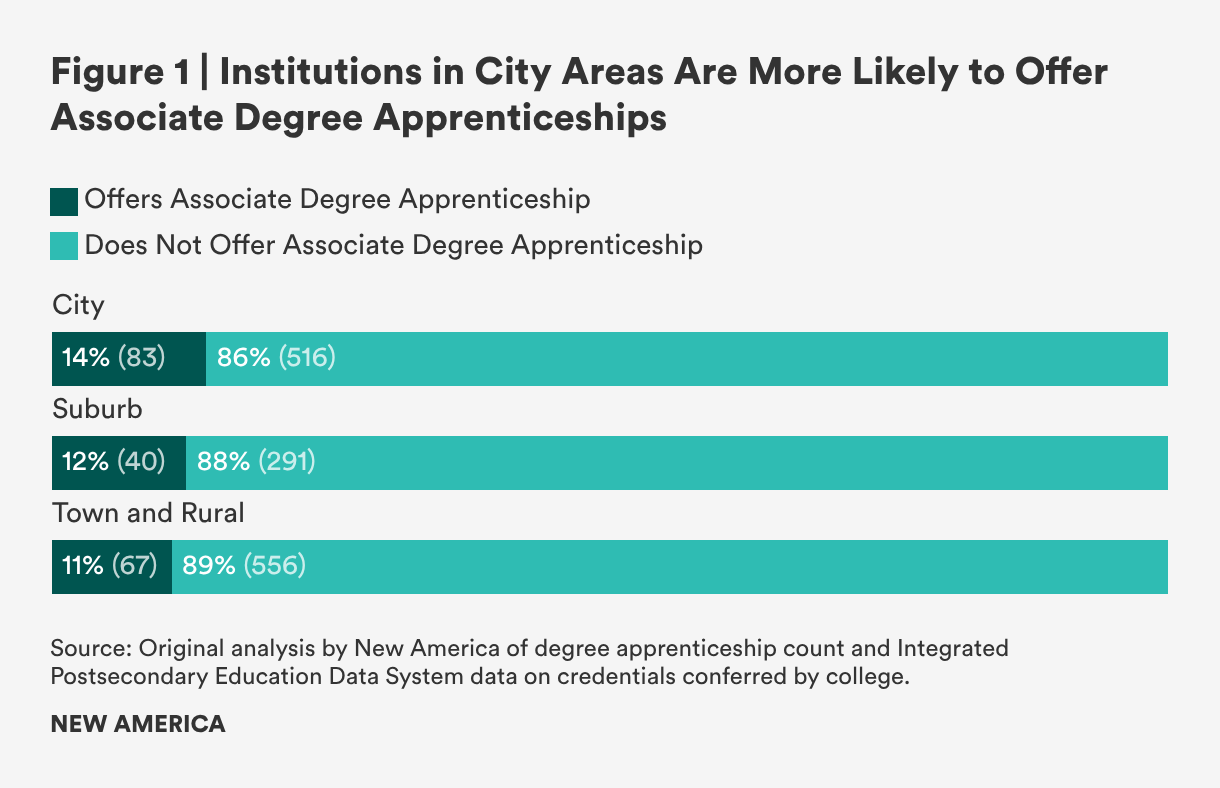
While degree apprenticeship programs have seen growth in recent years, these opportunities remain relatively rare at institutions of higher education. Among the public and private nonprofit institutions of higher education that awarded associate degrees in occupational areas28 in 2022–2023, about 12 percent offered at least one associate degree apprenticeship opportunity. Larger institutions of higher education are overrepresented in this group.29 Figure 1 also highlights that a higher percentage of colleges in urban areas that award occupational associate degrees offer degree apprenticeships than in suburban or rural locales. These institutions may have more resources and staff capacity for the employer outreach and curriculum and program development required to launch degree apprenticeships than schools with fewer students.
Though it is not yet clear why, degree apprenticeship remains a tool used almost exclusively by public colleges and universities. While about one-quarter of the institutions of higher education that awarded occupational associate degrees in 2022–2023 were private nonprofit entities, nearly all of the institutions of higher education that offer associate degree apprenticeship opportunities are public entities (99 percent). Among the colleges and universities that offered bachelor’s degree apprenticeships in teaching, however, 29 percent were private nonprofit institutions of higher education.
Few Public Undergraduate Colleges Offer Both Associate Degree Apprenticeships and Bachelor’s Degree Programs
We explored the intersection of degree apprenticeship opportunities with another emerging but more mature program innovation at public undergraduate colleges: the community college bachelor’s degree. These bachelor’s degrees are almost without exception technical, workforce-oriented degrees, often designed to provide a pathway to a bachelor’s degree after applied associate degree programs previously considered terminal degrees.30 Like degree apprenticeship, states and colleges have been using community college bachelor’s degrees to provide a more affordable, accessible way to upward economic mobility.
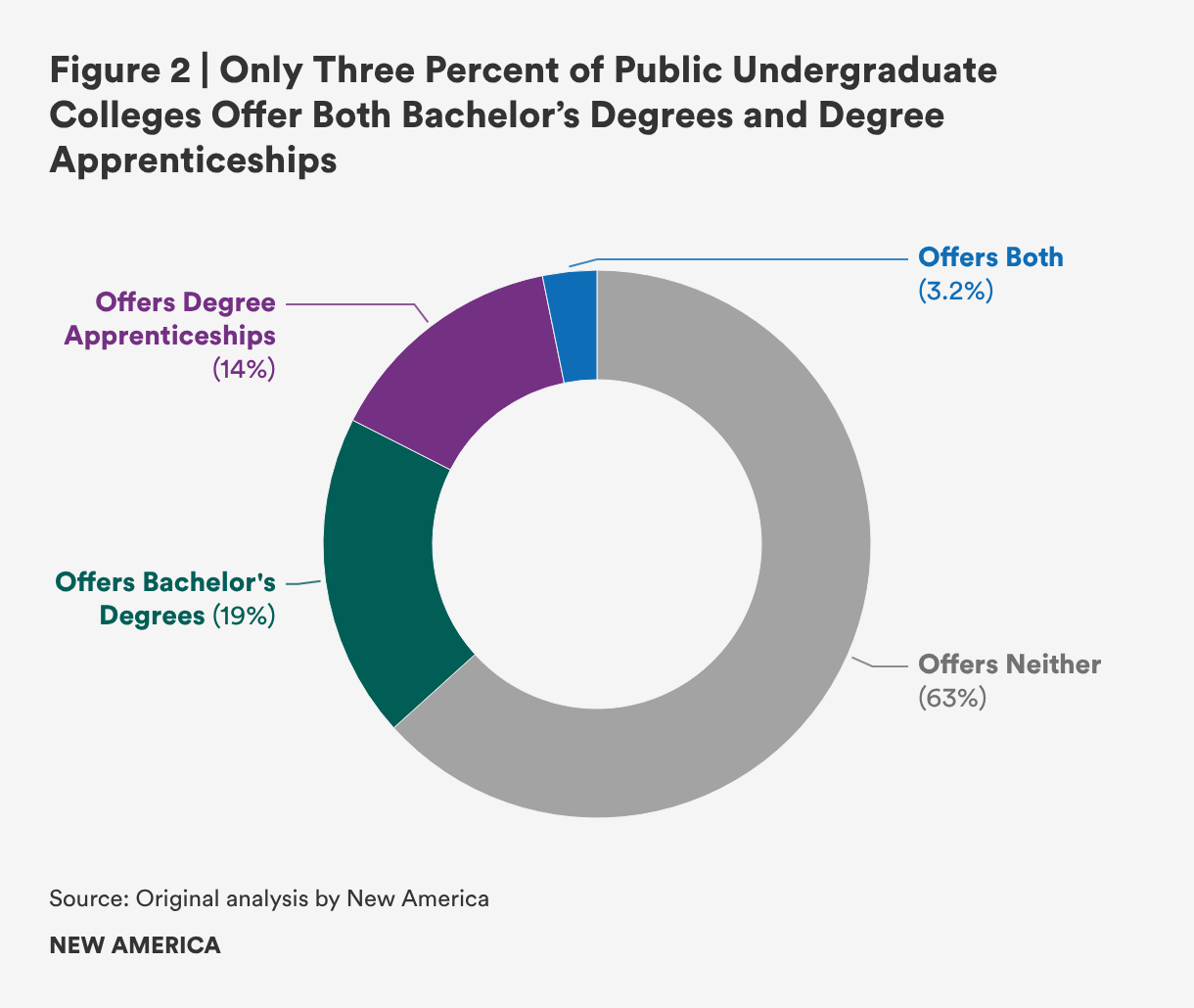
However, as shown in Figure 2, we observed that there is little overlap between public undergraduate colleges (i.e., those with no graduate programs) offering both a bachelor’s degree and an associate degree apprenticeship program.31 Only 3 percent of these colleges offer both bachelor’s degrees and degree apprenticeships. Another 33 percent offer either a bachelor’s program or an associate degree apprenticeship, but not both. More analysis is needed to understand why these two emerging postsecondary workforce development strategies so seldom overlap.
The implications of keeping these separate are important for policymakers and institutional leaders to consider. At colleges with bachelor’s programs but no associate degree apprenticeships, institutions could be missing out on students who first need an accessible, affordable path to an associate degree—like an apprenticeship—before they can begin to think about a bachelor’s degree. For colleges with an associate degree apprenticeship but no bachelor’s degree, the institution may be missing an opportunity to provide learners with applied associate degrees the opportunity to earn a bachelor’s degree at some point down the road without the credit loss they typically experience when transferring.32
Geographic Location Findings
Town and Rural Institutions Are Overrepresented Among Schools Offering Teacher Apprenticeships
We also examined the extent to which colleges and universities with educator preparation programs offered an apprenticeship degree opportunity for aspiring teachers. Among the institutions of higher education that awarded bachelor’s degrees in education in 2022–2023, 10 percent have a bachelor’s degree apprenticeship program in teaching. In contrast to our finding that institutions in town and rural areas were underrepresented among colleges that offer associate degree apprenticeship opportunities, we found that institutions in town and rural areas were overrepresented among the colleges and universities that offer bachelor’s degree apprenticeship programs in education. The great difficulties that rural schools experience filling teacher vacancies33 and their commitment to Grow Your Own programs may be factors in the disproportionate representation of teacher degree apprenticeship opportunities at institutions of higher education in towns and rural areas.
Nursing Degree Apprenticeships Are Uncommon Outside Alabama
In addition, we looked at the extent to which the apprenticeship degree model is being used by colleges and universities with nursing programs. Among the public and private nonprofit institutions of higher education that awarded associate degrees in nursing in 2022–2023, just 4 percent offer associate degree apprenticeships in nursing. Less than 1 percent of the public and private nonprofit institutions of higher education that awarded bachelor’s degrees in nursing in 2022–2023 offer bachelor’s degree apprenticeships in nursing. In Alabama, however, nursing degree apprenticeships are offered by 78 percent of the colleges that awarded associate degrees in nursing in 2022–2023 and 25 percent of the schools with bachelor’s degree programs in nursing. This comparatively high rate is the result of deliberate policy decisions, which we detail in the next section.
Many Degree Apprenticeship Opportunities Are Concentrated in Just Three States
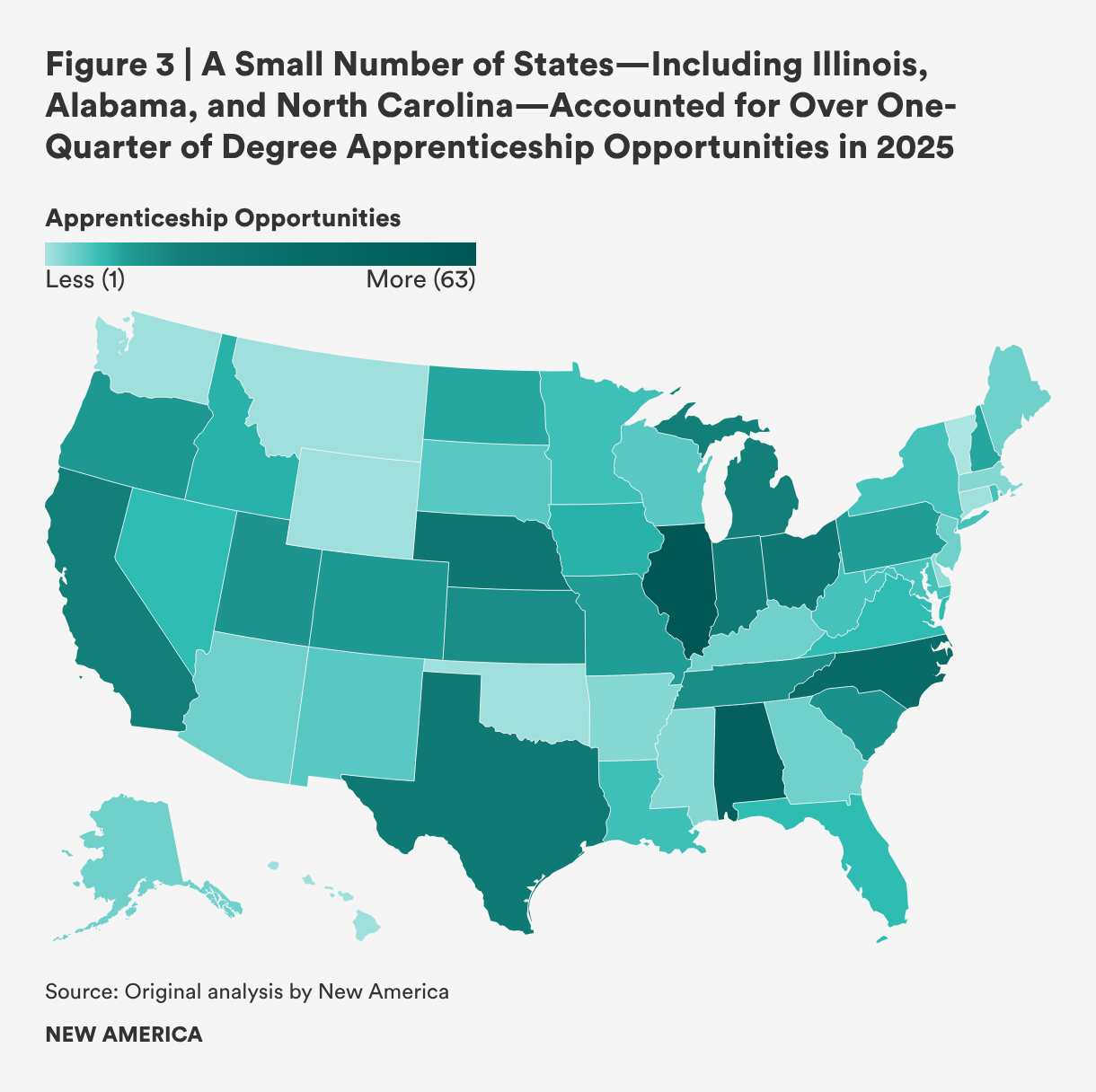
The extensive use of the apprenticeship degree model in Alabama is not limited to its nursing programs. We identified at least one degree apprenticeship opportunity in each of 49 states and the District of Columbia, but three states—Illinois, Alabama, and North Carolina—accounted for more than one-quarter of the opportunities. Several factors appear to have contributed to the growth of degree apprenticeship opportunities in these states, but chief among them is a supportive policy environment, the availability of public funding, and the influence of Europe-based companies that view apprenticeship as an important talent development strategy. Figure 3 shows the number of degree apprenticeship opportunities we located in each state.
In Alabama, increasing degree apprenticeship opportunities has been a state priority since the Alabama Office of Apprenticeship (AOA) was established as the state’s apprenticeship agency in 2019. Josh Laney, the first AOA director, said the state made expanding apprenticeship into occupations that require a degree a priority, “because we saw that many of the opportunities to expand apprenticeship outside the traditional skilled trades were occupations that required postsecondary education, such as nursing. Our focus was those occupations that just hadn’t been touched.” The registration of the first master’s degree apprenticeship at Alabama A&M University was an important early milestone, but the critical breakthrough was AOA’s collaboration with Alabama’s state nursing board, which led to the creation of associate degree nursing apprenticeships throughout the state.
In Illinois, Harper College first launched degree apprenticeship programs following conversations with manufacturers in its region. After receiving a Trade Adjustment Assistance Community College and Career Training grant in 2012 from the U.S. Department of Labor, Harper expanded its capacity to offer more advanced manufacturing programs and later received funds from two federal grants in 2015 to create additional apprenticeship opportunities across the state. Harper directly received a $2.5 million American Apprenticeship Initiative (AAI) grant from the U.S. Department of Labor, which it used to partner with Zurich North America to offer an associate degree apprenticeship in general insurance, as well as to support other apprenticeships in information technology and manufacturing.34 These efforts were further supported by the award of another $3.9 million AAI grant from the U.S. Department of Labor to a consortium led by the Illinois Manufacturers Association Education Foundation that included Harper and the German-American Chamber of Commerce of the Midwest.35 The work of this consortium also led to the establishment of the Industry Consortium for Advanced Technical Training, which promotes associate degree apprenticeship programs in manufacturing throughout the Midwest. Other Illinois colleges worked with former Harper administrators to launch their own programs outside of the Chicagoland region. For example, Heartland Community College in Normal contracted with Harper’s former dean of workforce and economic development for technical assistance in launching their own degree apprenticeships. Another Harper alumnus, Sheila Quirk-Bailey, created a robust apprenticeship program at Illinois Central College in Peoria after she became its president in 2016. In Chicago, the Aon Corporation launched its associate degree apprenticeship program with Harold Washington College in 2017.36
The presence of European-based corporations in North Carolina also seems to have been a factor in the development of degree apprenticeships in that state. In 1995, a group of American, Austrian, German, and Swiss advanced manufacturing companies based outside Charlotte established the Apprenticeship 2000 employer consortium to offer associate degree apprenticeships in mechatronics and other fields related to advanced manufacturing at Central Piedmont Community College. They marketed the opportunity to high school juniors and seniors as one of the country’s first registered youth apprenticeship programs. Apprenticeship 2000’s success prompted employers in other counties to form similar consortia, working with area community and technical colleges.37 The growth and diversification of degree apprenticeships in North Carolina was further fueled by the 2015 enactment of a tuition waiver for recent high school graduates who become apprentices. The state waives tuition costs for high school students in a pre-apprenticeship or Registered Apprenticeship who enroll in a Registered Apprenticeship within four months (120 days) of high school graduation and reimburses community and technical colleges for these costs.38 Chris Harrington, state director of ApprenticeshipNC, reported that 28 of the state’s 58 community and technical colleges took advantage of the waiver in 2024, costing the state about $1 million. Many of the degree apprenticeships we encountered in North Carolina in our research were predominantly composed of recent high school graduates.
Citations
- For details on our search methods, see the appendix.
- On August 31, 2022, Education Secretary Miguel Cardona and Labor Secretary Martin Walsh published a letter to state leaders encouraging them to support Registered Apprenticeships for teachers. See U.S. Department of Education, “Joint Letter with Secretary Martin Walsh of DOL regarding a Sustainable Teacher Workforce,” August 31, 2022, source.
- The Department of Labor summarized its investments in teacher apprenticeships during the Biden administration in a 2024 blog post. See Manny Lamarr, “Building the Next Generation of Teachers Through Apprenticeship” U.S. Department of Labor Blog, May 7, 2024, source.
- The U.S. Department of Labor awarded $99,281,216 in grants to 28 grantees for the H-1B Apprenticeships: Closing the Skills Gap grant program in February 2020. For more information, see the U.S. Department of Labor awarded U.S. Department of Labor, Employment and Training Administration, Overview of the H-1B Apprenticeship: Closing the Skills Gap Grant Program, February 11, 2020, source.
- For example, a 2022 survey by AMN Healthcare found that 85 percent of hospitals, medical groups, home health providers and other health care facilities are experiencing a shortage of allied health care professionals. See Survey of Allied Healthcare Professional New Graduate Hiring Patterns (AMN Healthcare Center for Research, 2022), 3, source.
- Robert Lerman, Tamar Jacoby, Deniz Nemli, and John Colborn, How Community Colleges Can Help Scale US Apprenticeships: Evidence from the Field (Apprenticeships for America, November 6, 2024), source.
- OA approved K–12 Teacher as an apprenticeable occupation on November 30, 2021. See OA Bulletin 2022–18, source. Registered Nurse was approved as apprenticeable on July 19, 2023; see OA Bulletin 2023-111, source.
- U.S. Bureau of Labor Statistics, “Table 1.2 Occupational Projections, 2024–2034, and Worker Characteristics, 2024 (Employment in Thousands),” source.
- Bureau of Labor Statistics, “Table 1.2 Occupational Projections, 2024–2034,” source projections and worker characteristics. Bureau of Labor Statistics, “Table 1.2 Occupational Projections, 2024–2034,” source.
- However, a significant share of the workers in this occupation (42 percent) did have a degree in 2022. See U.S. Bureau of Labor Statistics, “Table 5.3 Educational attainment for workers 25 years and older by detailed occupation, 2022–23 (Percent),” source.
- Built to Succeed (website), source.
- Ivy Tech Community College, “Apprenticeships,” source.
- Indiana Code 22-4-25, Chapter 25, Special Employment and Training Services Fund, source.
- Teresa Hess, Assistant Vice President for Apprenticeships and Work-Based Learning, Ivy Tech Community College, email message to authors, January 5, 2025.
- ApprenticeshipUSA (USDOL Office of Apprenticeship), “Explore Approved Occupations for Registered Apprenticeship,” source.
- Bureau of Labor Statistics, Occupational Outlook Handbook, “Occupational Therapy Assistants and Aides,” source and “Physical Therapist Assistants and Aides,” source.
- The accreditation standards for associate degree programs require occupational therapy assistant students to complete 16 weeks of full-time, supervised fieldwork and physical therapy students to complete 12 weeks of full-time, supervised clinical experience. Accreditation Council for Occupational Therapy Education, 2023 Standards and Interpretive Guide (ACOTE, August 2025 Version), Standard C.1.12, 39, source; and Commission on Accreditation in Physical Therapy Education, Accreditation Handbook, Standards and Required Elements for Accreditation of Physical Therapist Assistant Education Programs (CAPTE, 2024), Standard 6A, 34, source.
- Bureau of Labor Statistics, “Occupational Projections and Worker Characteristics, Table 1.2 Occupational Projections, 2024–2034, and Worker Characteristics, 2024,” source.
- ApprenticeshipUSA (website), “Explore Approved Occupations for Registered Apprenticeships,” source.
- See, for example, Benjamin Klosky and Robert Lerman, Police Apprenticeships for Youth Can Enhance Recruitment and the Quality of Officers While Lowering Costs (Urban Institute, March 2024), source.
- Bureau of Labor Statistics, “Educational Attainment for Workers 25 Years and Older by Detailed Occupation,” Table 5.3, source.
- Bureau of Labor Statistics, “Occupational Projections and Worker Characteristics,” Table 1.2, source.
- The Conference, Regulations in Funeral Service Licensing (The International Conference of Funeral Service Examining Boards, 2025), source.
- Research on the economic returns of postsecondary credentials consistently finds that, on average, individuals with an associate degree earn more than those with only a high school credential. See, for example, Véronique Irwin, Ke Wang, Julie Jung, et al., “Annual Earnings by Educational Attainment,” The Condition of Education 2024 (Institute of Education Sciences, May 2024), Figure 2, source. While this research does not typically disaggregate results for AAS degrees specifically, other studies comparing the returns to different types of associate degrees have found that, on average, individuals with AAS degrees earn as much or more than individuals with AS or AA degrees. See, for example, Mark Schneider, Education Pays in Colorado: Earnings 1, 5, and 10 Years after College (College Measures, 2015), 2, source.
- Mark Fincher, Chris Kelly, Miranda Harrison, Zachary Harrison, Danielle Hopson, and Selah Weems, “Articulation and Transfer for Career and Technical Students: Best Practices for Dealing with Real and Perceived Barriers to Baccalaureate Degree Attainment for Applied Science Students,” Community College Journal of Research and Practice 41 (8): 531–35, source.
- Washington State Board for Community and Technical Colleges, Applied Baccalaureate Degrees:Policy and Outcomes Evaluation, Research Report 15-2 (SBCTC, August 2015), source.
- Holley Nichols and Sarah Deal, Applied Associate of Science Degrees: Pathways for Workforce and Transfer (Belk Center for Community College Leadership and Research, June 2025), source.
- These are associate degrees awarded in the following Classification of Instructional Programs (CIP) two-digit code groups: (01) Agriculture, Agriculture Operations, and Related Sciences; (03) Natural Resources and Conservation; (04) Architecture and Related Services; (10) Communications Technologies/Technicians and Support Services; (11) Computer and Information Sciences and Support Services; (12) Personal and Culinary Services; (13) Education; (15) Engineering Technologies and Engineering-Related Fields; (19) Family and Consumer Sciences/Human Sciences; (22) Legal Professions and Studies; (31) Parks, Recreation, Leisure, and Fitness Studies; (41) Science Technologies/Technicians; (43) Homeland Security, Law Enforcement, Firefighting, and Related Protective Service; (44) Public Administration and Social Service Professions; (46) Construction Trades; (47) Mechanic and Repair Technologies/Technicians; (48) Precision Production; (49) Transportation and Materials Moving; (51) Health Professions and Related Programs; and (52) Business, Management, Marketing, and Related Support Services.
- Only 16 percent of the public and private nonprofit higher education institutions that awarded occupational associate degrees in 2022–23 had total enrollments of 10,000, but these larger institutions comprised 29 percent of the schools offering associate degree apprenticeship opportunities.
- Elizabeth Meza and Ivy Love, When Community Colleges Offer a Bachelor’s Degree: A Literature Review on Student Access and Outcomes (New America, March 2023), source.
- Not all institutions in this count and in Figure 5 are community colleges. We include all public colleges where the highest credential awarded is a bachelor’s degree. Therefore this count includes some institutions for which the bachelor’s degree is the predominantly awarded credential; these institutions fall outside counts of community college bachelor’s degrees in other publications. We include them here for the broadest look at colleges entirely committed to undergraduate education and offering technical associate degrees, as we consider these the most likely to consider both policy innovations discussed in this section.
- Elizabeth Meza and Ivy Love, When Community Colleges Offer a Bachelor’s Degree: A Literature Review on Student Access and Outcomes (New America, March 2023), source.
- Richard M. Ingersoll and Henry Tran, “The Rural Teacher Shortage,” Kappan, October 23, 2023, source.
- Darice Trout, Senior Director of Workforce Solutions and Job Placement, Harper College, email message to authors, January 13, 2025.
- “American Apprenticeship Grant Award Summaries,” Obama White House Archives, National Archives and Records Administration, September 10, 2015, page 5, source.
- Nichola Lowe, Haley Glover, and Ranita Jain, Case Study: Next Generation Apprenticeships at Aon (UpSkill America, February 2023), source.
- Bhavani Arabandi, Zach Boren, and Andrew Campbell, Building Sustainable Apprenticeships: The Case of Apprenticeship 2000 (Urban Institute, February 2021), source.
- Michael Prebil, Solid Foundations: Four State Policy Approaches for Supporting College-Connected Apprenticeships (New America, September 2019), source.